REVIEW 5 major objections 6 minor 31 references
MurreNet: Modeling Holistic Multimodal Interactions Between Histopathology and Genomic Profiles for Survival Prediction
T0 review · 5 major / 6 minor · reviewed 2026-08-06 · deepseek-v4-flash
Pith's one-line read Disentangling images and genomics lifts cancer survival prediction
desk verdict MurreNet is a plausible incremental architecture, but the SOTA claim is under-supported and the 'difference' regularizer is backwards relative to its own equation. read the letter →
The pith
A machine-rendered reading of the paper's core claim, the machinery that carries it, and where it could break.
The reading
What carries the argument
The Multimodal Representation Decoupling (MRD) module produces pathology-specific, genomics-specific, and modality-common embeddings, with the common branch built from a co-attention matrix between the two modalities. The Deep Holistic Orthogonal Fusion (DHOF) then computes, for each specific feature, the residual left after projecting it onto the common representation; that orthogonal residual is concatenated and pooled with the common features to form the final multimodal embedding. The training objective is the weighted sum of an L1 similarity loss, a Kullback-Leibler divergence term (written as a difference loss), an MSE reconstruction loss, and a Cox-style negative log-likelihood survival loss.
What would settle it
Train MurreNet on one TCGA cohort and record the KL divergence between the modality-common and modality-specific representations at the end of training; if the divergence has dropped toward zero, the difference loss is not separating the representations. A direct ablation that removes only the difference term and shows no change in C-index would further confirm that the stated disentanglement benefit is attributable to other components.
Extended reading notes
Core claim
The central claim is that survival prediction improves when histopathology and genomic features are explicitly disentangled into modality-common and modality-specific representations and then fused through a step that removes the common projection from the specific ones. MurreNet uses three parallel encoders, a co-attention module for the common branch, a cross-attention transformer to refine the split features, and an orthogonal fusion that keeps only the component of the specific features orthogonal to the common representation. Trained with a loss that combines similarity, a stated difference term, reconstruction, and negative log-likelihood survival loss, the model achieves higher C-index values than all fifteen baselines on six TCGA datasets. The paper takes that as evidence that holistic modeling of both inter- and intra-modality interactions is what multimodal survival analysis needs.
Load-bearing premise
The paper assumes the divergence term in Eq. 8 forces modality-specific and modality-common features to become distinct, but as written, minimizing that term with a positive weight actually reduces the divergence between the two feature sets, so the claimed disentanglement mechanism may not be doing the work.
Editorial extensions
If this is right
- If MurreNet's reported results hold, multimodal survival models should adopt explicit decoupling of common and private features rather than simple concatenation or attention-only fusion.
- The per-cancer gains over MCAT (2.37% to 14.29% C-index) suggest the benefit of disentanglement varies with tumor type, with the largest gains on COADREAD, UCEC, and STAD.
- Ablation results indicate that the similarity, difference, and reconstruction losses each add predictive value on top of the architectural modules, so the training regularization is a real contributor.
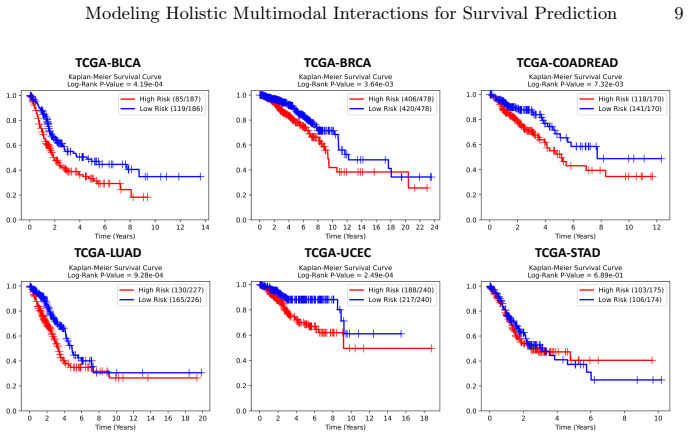
- Risk stratification with the model yields statistically significant separation of high- and low-risk groups across all six cohorts, supporting potential clinical use in prognosis.
- The framework extends naturally to other paired biomedical modalities, such as radiology images with lab values or methylation arrays with expression data.
Reading between the lines
- As written, the KL 'difference' loss in Eq. 8 minimizes the divergence between modality-common and modality-specific features when added to the total loss with a positive weight, so the paper's stated mechanism for enforcing distinctiveness may be acting in the opposite direction; the observed gains could come from the reconstruction or similarity losses instead.
- A sharper test of the disentanglement claim would be to measure the actual KL divergence after training; if it has decreased, the model is not separating the representations the way the prose describes.
- The comparison against MCAT may be confounded by the stronger pathology encoder (CHIEF) used in MurreNet; a fairer attribution would require re-running MCAT with the same feature extractor.
- The orthogonal-fusion step is a testable design: on synthetic paired data with known shared and private signal, one can verify whether the orthogonal residual indeed carries the survival-relevant private information.
Editorial analysis
A structured set of objections, weighed in public.
Referee Report
Summary. The manuscript proposes MurreNet, a multimodal survival analysis model that combines histopathology whole-slide images and genomic profiles. The model contains a Multimodal Representation Decomposition (MRD) module that splits each modality into specific and common representations, a Deep Holistic Orthogonal Fusion (DHOF) module that recombines them, and a composite training objective with similarity, difference, reconstruction, and survival losses. Experiments on six TCGA cohorts against 15 baseline methods report mean C-indices, with the authors claiming state-of-the-art performance on all cohorts. An ablation study and Kaplan-Meier risk-stratification analysis are also presented. The main contribution is the specific decoupling/fusion architecture and its reported empirical performance.
Significance. If the reported C-index gains are statistically robust, MurreNet would be a useful advance in multimodal survival prediction and would provide evidence that explicit decoupling of shared and specific representations helps integrative pathology-genomics modeling. The paper compares with a broad set of 15 baselines on six public TCGA benchmarks, which is a strength. However, the headline claim is not yet supported: no significance test is applied to model-vs-model C-index differences, and the difference-loss mechanism in the training objective is defined in a way that contradicts its stated purpose. The manuscript would need corrected loss definitions and additional statistical evidence before the central claim can be accepted.
major comments (5)
- [Sec. 3.3, Table 1] The statement that MurreNet 'achieves superior performance on all cancer types' is not backed by any statistical comparison of C-index values. The table reports only mean±std over five Monte-Carlo CV folds, and several improvements over the strongest baselines are within one standard deviation (e.g., LUAD: 0.691±0.040 vs. SurvPath 0.676±0.036; UCEC: 0.752±0.075 vs. CMTA 0.740±0.066 and PORPOISE 0.737±0.097). The 'T-test' and log-rank analyses in Sections 3.2 and 3.5 test high- vs. low-risk group separation, not model-vs-model differences. The authors should report paired significance tests (e.g., paired permutation or bootstrap over folds, or DeLong tests on pooled risk scores) and confidence intervals for the C-index differences, and should restrict the SOTA claim accordingly.
- [Sec. 2.4, Eqs. (6)-(8)] The difference loss is internally inverted. Eq. (6) minimizes L_total with positive beta, and Eq. (8) defines L_diff as D_KL(h_c || h_s). Minimizing a positive-weighted KL divergence drives the modality-common and modality-specific representations to become more similar, which is the opposite of the stated goal in Sec. 2.4 ('ensure that the modality-common and -specific representations capture distinct aspects') and of the 'repel' annotation in Fig. 1. The ablation gain from model D to model E in Table 2 therefore cannot be attributed to the mechanism described. In addition, KL divergence is only defined for probability distributions; applying it to raw feature vectors that may contain negative values and are not normalized is mathematically invalid. The authors need to either reverse the objective (e.g., maximize the divergence or use a negative weight), use a proper distance measure, and re-run the affected experiments, or clearly explain why the current formulation is intended.
- [Sec. 2.4, Eq. (7)] The similarity loss formula does not match its description. The text states that L_sim reduces the discrepancy between 'the two modality-common representations' (presumably h_c_p and h_c_g), but Eq. (7) computes L1(h_o_p, h_c_p), which aligns the raw pathology embedding to the pathology-common representation. As written, the loss cannot perform the claimed cross-modal common-space alignment, and it may also be invalid if h_o_p (768-d) and h_c_p (d-d) have different dimensions. The formula should be corrected or the description revised.
- [Sec. 2.2, Eqs. (1)-(2)] The co-attention matrix A is not well-defined. Eq. (2) computes A as the scalar dot product Linear(h_o_p)^T · Linear(h_o_g), but Eq. (1) then uses A^T * h_o_p and MLP(A) * h_o_g as if A were a matrix. If A is intended to be a co-attention map, it should be constructed as a matrix (e.g., an outer product or a softmax of QK^T), and the dimensions should be stated. As written, the MRD module cannot be reproduced from the equations.
- [Sec. 3.2, Sec. 3.5] The paper states in Sec. 3.2 that 'T-test analyses' are used to assess significance, but Sec. 3.5 reports a Log-rank test for risk-group differences. These are different procedures, and the p-values from the log-rank test only show that the model can separate high- and low-risk groups within each cohort; they do not establish that MurreNet outperforms any baseline. The text should be corrected and the distinction made explicit.
minor comments (6)
- [Sec. 3.3] The text says '14.29% on UCED' but the dataset is UCEC; this typo should be fixed.
- [Sec. 1] The word 'preform' in the Introduction should be 'perform'.
- [Sec. 2.3, Eq. (3)] The text states the key-value pair is (f_o_c, f_o_c), but the formula uses (f_o_s, f_o_s); these should be aligned.
- [Sec. 2.3, Eq. (4)] The text mentions enhanced representations f'_s and f'_c, but only the definition for f'_s is given; the analogous definition for f'_c should be provided.
- [Sec. 3.2] The hidden dimension d, number of attention heads, decoder architecture, and other architectural hyperparameters are not reported; these details are needed for reproducibility.
- [Sec. 2.4, Eq. (8)] The notation in Eq. (8) sums over modalities while the logarithm is applied to vectors; the element-wise summation over feature dimensions should be written explicitly to avoid ambiguity.
Circularity Check
No significant circularity: MurreNet's performance claims are empirical benchmark results, not fitted inputs renamed as predictions, and the author self-citations are contextual rather than load-bearing.
full rationale
The paper's central claim—state-of-the-art C-index on six TCGA cohorts—is an experimental result obtained by training on training folds and evaluating on held-out folds under 5-fold Monte-Carlo cross-validation. The survival loss is the standard NLL Cox loss, and the auxiliary losses L_sim, L_diff, and L_recon are regularizers computed from intermediate features, not parameters fitted to the evaluation target. There is no step in which a fitted constant or a subset of the test data is reused to produce a 'prediction' by construction. The self-citations (refs 3, 15, 16, 17) are used for contextual background about previous multimodal methods and WSI feature extraction; none of them is invoked as the justification for MurreNet's architecture or as a uniqueness theorem forcing the design choice. The KL-based 'difference loss' in Eq. 8 is internally inconsistent with its stated purpose—minimizing D_KL(h_c || h_s) with a positive beta in Eq. 6 reduces, rather than increases, divergence between modality-common and modality-specific features—but this is a correctness or mechanism-mismatch concern, not circularity, because the loss is not equivalent to the benchmark outcome. Similarly, the absence of model-vs-model significance testing weakens the superiority claim but does not make the claim circular. Since no prediction reduces to an input by definition and no load-bearing argument rests on self-citation, the appropriate finding is no significant circularity.
Assumptions & free parameters
free parameters (3)
- alpha (loss weight for L_sim) =
1e-4
- beta (loss weight for L_diff) =
1e-4
- gamma (loss weight for L_recon) =
1
assumptions (3)
- domain assumption CHIEF provides sufficiently informative pathology features for survival prediction.
- domain assumption Grouping genomic profiles into six pre-defined functional categories preserves relevant survival information.
- ad hoc to paper KL divergence applied to raw feature vectors is a valid measure of difference between representations.
Cite this review
Pith. "Pith review of MurreNet: Modeling Holistic Multimodal Interactions Between Histopathology and Genomic Profiles for Survival Prediction." pith.science (2026). https://pith.science/paper/JNAIYR3C
@misc{pith2026250704891,
  author       = {Pith},
  title        = {Pith review of: MurreNet: Modeling Holistic Multimodal Interactions Between Histopathology and Genomic Profiles for Survival Prediction},
  year         = {2026},
  howpublished = {\url{https://pith.science/paper/JNAIYR3C}},
  note         = {Machine review of arXiv:2507.04891}
}
read the original abstract
Cancer survival prediction requires integrating pathological Whole Slide Images (WSIs) and genomic profiles, a challenging task due to the inherent heterogeneity and the complexity of modeling both inter- and intra-modality interactions. Current methods often employ straightforward fusion strategies for multimodal feature integration, failing to comprehensively capture modality-specific and modality-common interactions, resulting in a limited understanding of multimodal correlations and suboptimal predictive performance. To mitigate these limitations, this paper presents a Multimodal Representation Decoupling Network (MurreNet) to advance cancer survival analysis. Specifically, we first propose a Multimodal Representation Decomposition (MRD) module to explicitly decompose paired input data into modality-specific and modality-shared representations, thereby reducing redundancy between modalities. Furthermore, the disentangled representations are further refined then updated through a novel training regularization strategy that imposes constraints on distributional similarity, difference, and representativeness of modality features. Finally, the augmented multimodal features are integrated into a joint representation via proposed Deep Holistic Orthogonal Fusion (DHOF) strategy. Extensive experiments conducted on six TCGA cancer cohorts demonstrate that our MurreNet achieves state-of-the-art (SOTA) performance in survival prediction.
Figures

Reference graph
Works this paper leans on
-
[1]
Bmj 317(7172), 1572–1580 (1998)
Bland, J.M., Altman, D.G.: Survival probabilities (the kaplan-meier method). Bmj 317(7172), 1572–1580 (1998)
work page 1998
-
[2]
Bland, J.M., Altman, D.G.: The logrank test. Bmj328(7447), 1073 (2004)
work page 2004
-
[3]
In: 2024 IEEE International Conference on Bioinformatics and Biomedicine (BIBM)
Cai, C., Li, J., Liu, M., Jiao, Y., Xu, J.: Seqfrt: Towards effective adaption of foun- dation model via sequence feature reconstruction in computational pathology. In: 2024 IEEE International Conference on Bioinformatics and Biomedicine (BIBM). pp. 1808–1815. IEEE (2024)
work page 2024
-
[4]
International Journal of Medical Informatics 192, 105648 (2024)
Cai, C., Shi, Q., Li, J., Jiao, Y., Xu, A., Zhou, Y., Wang, X., Peng, C., Zhang, X., Cui, X., et al.: Pathologist-level diagnosis of ulcerative colitis inflammatory activity level using an automated histological grading method. International Journal of Medical Informatics 192, 105648 (2024)
work page 2024
-
[5]
In: Proceedings of the IEEE/CVF interna- tional conference on computer vision
Chen, R.J., Lu, M.Y., Weng, W.H., Chen, T.Y., Williamson, D.F., Manz, T., Shady, M., Mahmood, F.: Multimodal co-attention transformer for survival pre- diction in gigapixel whole slide images. In: Proceedings of the IEEE/CVF interna- tional conference on computer vision. pp. 4015–4025 (2021)
work page 2021
-
[6]
Cancer Cell40(8), 865–878 (2022)
Chen, R.J., Lu, M.Y., Williamson, D.F., Chen, T.Y., Lipkova, J., Noor, Z., Shaban, M., Shady, M., Williams, M., Joo, B., et al.: Pan-cancer integrative histology- genomic analysis via multimodal deep learning. Cancer Cell40(8), 865–878 (2022)
2022
-
[7]
PLoS computational biol- ogy 14(4), e1006076 (2018)
Ching, T., Zhu, X., Garmire, L.X.: Cox-nnet: an artificial neural network method for prognosis prediction of high-throughput omics data. PLoS computational biol- ogy 14(4), e1006076 (2018)
work page 2018
-
[8]
In: International conference on machine learning
Ilse,M.,Tomczak,J.,Welling,M.:Attention-baseddeepmultipleinstancelearning. In: International conference on machine learning. pp. 2127–2136. PMLR (2018) 10 M. Liu et al
work page 2018
Show all 31 references
-
[9]
In: Proceedings of the IEEE/CVF Conference on Computer Vision and Pattern Recognition
Jaume, G., Vaidya, A., Chen, R.J., Williamson, D.F., Liang, P.P., Mahmood, F.: Modeling dense multimodal interactions between biological pathways and histology for survival prediction. In: Proceedings of the IEEE/CVF Conference on Computer Vision and Pattern Recognition. pp. 1...
2024
-
[10]
arXiv preprint arXiv:1412.6980 (2014)
Kingma, D.P.: Adam: A method for stochastic optimization. arXiv preprint arXiv:1412.6980 (2014)
2014 arXiv
-
[11]
Advances in neural information processing systems30 (2017)
Klambauer, G., Unterthiner, T., Mayr, A., Hochreiter, S.: Self-normalizing neural networks. Advances in neural information processing systems30 (2017)
2017
-
[12]
The annals of mathe- matical statistics 22(1), 79–86 (1951)
Kullback, S., Leibler, R.A.: On information and sufficiency. The annals of mathe- matical statistics 22(1), 79–86 (1951)
1951
-
[13]
In: Pro- ceedings of the IEEE/CVF conference on computer vision and pattern recognition
Li, B., Li, Y., Eliceiri, K.W.: Dual-stream multiple instance learning network for whole slide image classification with self-supervised contrastive learning. In: Pro- ceedings of the IEEE/CVF conference on computer vision and pattern recognition. pp. 14318–14328 (2021)
2021
-
[14]
Li, H., Yang, F., Xing, X., Zhao, Y., Zhang, J., Liu, Y., Han, M., Huang, J., Wang, L., Yao, J.: Multi-modal multi-instance learning using weakly correlated histopathological images and tabular clinical information. In: Medical Image Com- puting and Computer Assisted Intervent...
2021
-
[15]
In: 2023 IEEE International Conference on Bioinformatics and Biomedicine (BIBM)
Liu, M., Liu, Y., Cui, H., Li, C., Ma, J.: Mgct: Mutual-guided cross-modality transformer for survival outcome prediction using integrative histopathology- genomic features. In: 2023 IEEE International Conference on Bioinformatics and Biomedicine (BIBM). pp. 1306–1312. IEEE (2023)
2023
-
[16]
IEEE Transactions on Medical Imaging (2024)
Liu, M., Liu, Y., Xu, P., Cui, H., Ke, J., Ma, J.: Exploiting geometric features via hierarchicalgraphpyramidtransformerforcancerdiagnosisusinghistopathological images. IEEE Transactions on Medical Imaging (2024)
2024
-
[17]
In: 2024 IEEE International Symposium on Biomedical Imaging (ISBI)
Liu, M., Liu, Y., Xu, P., Ma, J.: Unleashing the infinity power of geometry: A novel geometry-aware transformer (goat) for whole slide histopathology image analysis. In: 2024 IEEE International Symposium on Biomedical Imaging (ISBI). pp. 1–5. IEEE (2024)
2024
-
[18]
In: International Conference on Medical Image Computing and Computer-Assisted Intervention
Long, L., Cui, J., Zeng, P., Li, Y., Liu, Y., Wang, Y.: Mugi: Multi-granularity inter- actions of heterogeneous biomedical data for survival prediction. In: International Conference on Medical Image Computing and Computer-Assisted Intervention. pp. 490–500. Springer (2024)
2024
-
[19]
Nature biomedical engineering5(6), 555–570 (2021)
Lu, M.Y., Williamson, D.F., Chen, T.Y., Chen, R.J., Barbieri, M., Mahmood, F.: Data-efficient and weakly supervised computational pathology on whole-slide images. Nature biomedical engineering5(6), 555–570 (2021)
2021
-
[20]
Advances in neural information processing systems34, 2136–2147 (2021)
Shao, Z., Bian, H., Chen, Y., Wang, Y., Zhang, J., Ji, X., et al.: Transmil: Trans- former based correlated multiple instance learning for whole slide image classifica- tion. Advances in neural information processing systems34, 2136–2147 (2021)
2021
-
[21]
In: Proceedings of the 41st International Conference on Machine Learning
Song, A.H., Chen, R.J., Jaume, G., Vaidya, A.J., Baras, A., Mahmood, F.: Mul- timodal prototyping for cancer survival prediction. In: Proceedings of the 41st International Conference on Machine Learning. vol. 235, pp. 46050–46073. PMLR (2024)
2024
-
[22]
Nature Reviews Bioengineering 1(12), 930–949 (2023)
Song, A.H., Jaume, G., Williamson, D.F., Lu, M.Y., Vaidya, A., Miller, T.R., Mah- mood, F.: Artificial intelligence for digital and computational pathology. Nature Reviews Bioengineering 1(12), 930–949 (2023)
2023
-
[23]
Nature634(8035), 970–978 (2024) Modeling Holistic Multimodal Interactions for Survival Prediction 11
Wang, X., Zhao, J., Marostica, E., Yuan, W., Jin, J., Zhang, J., Li, R., Tang, H., Wang, K., Li, Y., et al.: A pathology foundation model for cancer diagnosis and prognosis prediction. Nature634(8035), 970–978 (2024) Modeling Holistic Multimodal Interactions for Survival Prediction 11
2024
-
[24]
IEEE Transactions on Medical Imaging (2025)
Wang, Z., Zhang, Y., Xu, Y., Imoto, S., Chen, H., Song, J.: Histo-genomic knowl- edge association for cancer prognosis from histopathology whole slide images. IEEE Transactions on Medical Imaging (2025)
2025
-
[25]
In: International Conference on Medical Image Computing and Computer-Assisted Intervention
Xiong, C., Chen, H., Zheng, H., Wei, D., Zheng, Y., Sung, J.J., King, I.: Mome: Mixture of multimodal experts for cancer survival prediction. In: International Conference on Medical Image Computing and Computer-Assisted Intervention. pp. 318–328. Springer (2024)
2024
-
[26]
In: Proceedings of the IEEE/CVF International Conference on Computer Vision
Xu, Y., Chen, H.: Multimodal optimal transport-based co-attention transformer with global structure consistency for survival prediction. In: Proceedings of the IEEE/CVF International Conference on Computer Vision. pp. 21241–21251 (2023)
2023
-
[27]
IEEE transactions on pattern analysis and machine intelligence43(9), 3126–3137 (2020)
Zadeh, S.G., Schmid, M.: Bias in cross-entropy-based training of deep survival networks. IEEE transactions on pattern analysis and machine intelligence43(9), 3126–3137 (2020)
2020
-
[28]
In: Proceedings of the IEEE/CVF conference on computer vision and pattern recognition
Zhang, H., Meng, Y., Zhao, Y., Qiao, Y., Yang, X., Coupland, S.E., Zheng, Y.: Dtfd-mil: Double-tier feature distillation multiple instance learning for histopathol- ogy whole slide image classification. In: Proceedings of the IEEE/CVF conference on computer vision and pattern ...
2022
-
[29]
Zhang, Y., Xu, Y., Chen, J., Xie, F., Chen, H.: Prototypical information bottle- neckinganddisentanglingformultimodalcancersurvivalprediction.arXivpreprint arXiv:2401.01646 (2024)
2024 arXiv
-
[30]
In: Proceedings of the IEEE/CVF International Conference on Computer Vision
Zhou, F., Chen, H.: Cross-modal translation and alignment for survival analysis. In: Proceedings of the IEEE/CVF International Conference on Computer Vision. pp. 21485–21494 (2023)
2023
-
[31]
IEEE Transactions on Medical Imaging (2024)
Zhou, H., Zhou, F., Chen, H.: Cohort-individual cooperative learning for multi- modal cancer survival analysis. IEEE Transactions on Medical Imaging (2024)
2024
Reviewed August 6, 2026 · model on record in the stance chip above.
Discussion (0). Continue with ORCID to comment.