REVIEW 3 major objections 6 minor 2 cited by
Quantum Spin Glass in the Two-Dimensional Disordered Heisenberg Model via Foundation Neural-Network Quantum States
T0 review · 3 major / 6 minor · reviewed 2026-08-06 · deepseek-v4-flash
Pith's one-line read The two-dimensional disordered Heisenberg model hosts a quantum spin-glass phase for intermediate bond disorder.
desk verdict Plausible first large-scale evidence for a 2D quantum spin glass, but the central overlap value is small and lacks an independent check in the regime where it matters. read the letter →
The pith
A machine-rendered reading of the paper's core claim, the machinery that carries it, and where it could break.
The reading
What carries the argument
The engine of the argument is the Edwards-Anderson self-overlap $Q^{2}$ = E_J[(1/$L^{4}$) ∑_{r,r'} ⟨S_r · S_{r'}⟩^2], which is finite in a glass, zero for a spin liquid, and equals the square of the magnetization for ordered magnets. To obtain reliable disorder-averaged values, the authors use a Foundation Neural-Network Quantum State, a transformer-based variational ansatz whose inputs include the bond couplings J on equal footing with the spin configurations, so a single optimization minimizes the disorder-averaged energy over roughly 600 realizations at once. The supporting semiclassical machinery is a Holstein-Primakoff expansion around the classical ground state: at leading order in 1/S the spin-wave Hamiltonian is quadratic and must be diagonalized by a Bogoliubov transformation, and from it the quantum correction to the overlap is computed and evaluated at S = 1/2.
What would settle it
Perform an exact or non-variational ground-state computation on comparable disorder ensembles at p = 0.5 for L = 8 and L = 10, then check whether the 1/L-extrapolated Edwards-Anderson overlap lands at approximately 0.049(3) or goes to zero; an extrapolation consistent with zero would falsify the quantum spin-glass claim.
Extended reading notes
Core claim
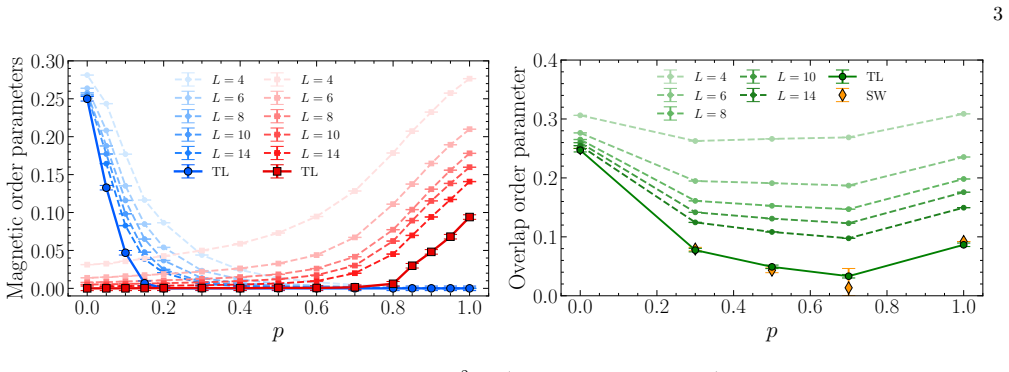
The central claim is a phase diagram with three ground states as the probability p of antiferromagnetic bonds is tuned: ferromagnetic order for p ≲ 0.2, Néel order for p ≳ 0.8, and, in between, a quantum spin glass characterized by zero spontaneous magnetization but a finite Edwards-Anderson overlap Q. The overlap is measured through the squared spin-spin correlations averaged over disorder, $Q^{2}$ = E_J[(1/$L^{4}$) ∑_{r,r'} ⟨S_r · S_{r'}⟩^2_J]. At p = 0.5, finite-size extrapolations over L = 4 to 14 and 600 disorder realizations give Q = 0.049(3), and the same analysis across 0.2 ≲ p ≲ 0.8 leaves Q finite. The numerical result is consistent with the leading 1/S spin-wave correction to the classical spin-glass overlap, establishing agreement between the fully quantum variational calculation and the semiclassical expansion. The finite Q in this region rules out quantum spin liquids and valence-bond solids, both of which would have vanishing overlap.
Load-bearing premise
The whole spin-glass conclusion rests on the assumption that a single variational wave function, optimized to minimize the disorder-averaged energy, yields unbiased estimates of the small overlap Q in the region 0.2 < p < 0.8, where the method is not checked against any non-variational calculation.
Editorial extensions
If this is right
- The ground state of the two-dimensional disordered Heisenberg model is not paramagnetic, spin-liquid, or valence-bond ordered in the intermediate region; it is a distinct quantum spin-glass phase with no spontaneous magnetic moment.
- Spin-glass order survives quantum fluctuations down to S = 1/2, in contrast to the classical two-dimensional Heisenberg spin glass, where order exists only at T = 0.
- The transition from ferromagnetic to spin-glass order occurs near p ≈ 0.2 and from spin-glass to Néel order near p ≈ 0.8, with the paper leaving open the possibility of a narrow spin-liquid window near the Néel boundary.
- Disorder-averaged ground-state observables can be computed with a single variational optimization across many disorder realizations, with only modest loss in accuracy compared to training on each realization separately.
- The overlap order parameter provides a clean numerical diagnostic for distinguishing glassy from liquid-like nonmagnetic phases in frustrated disordered magnets.
Reading between the lines
- Editorial extension: if the finite-Q region is a true glass, the model should exhibit slow, non-thermalizing dynamics and aging in real-time evolution; the authors do not test this, but it is a direct consequence of glass order.
- Editorial extension: the semiclassical agreement suggests the 1/S spin-wave treatment can predict other properties, such as dynamical structure factors, for the same S = 1/2 disordered ensemble, not just the static overlap.
- Editorial extension: because the Foundation Neural-Network Quantum State takes the bond couplings as input, the same trained architecture could be evaluated at disorder strengths p that were not used in training, providing a fast transferability test and a way to refine the phase boundaries.
- Editorial extension: in doped cuprate models where oxygen vacancies create effective ferromagnetic bonds, a finite-Q region would predict spin-glass-like freezing of copper moments at low temperature, a signature that could be searched for in experiment.
Editorial analysis
A structured set of objections, weighed in public.
Referee Report
Summary. The paper studies the S=1/2 square-lattice Heisenberg model with random nearest-neighbor ±1 bonds, Eq. (1)-(2). Using a Foundation Neural-Network Quantum States (FNQS) ansatz optimized simultaneously over many disorder realizations, the authors compute disorder-averaged ferromagnetic, Néel, and Edwards-Anderson overlap order parameters for system sizes L=4 through L=14. They report a phase diagram in which both ferromagnetic and Néel order vanish in the thermodynamic limit for 0.2≲p≲0.8, while the overlap Q remains finite, with the central value Q=0.049(3) at p=0.5, and they interpret this as a quantum spin-glass phase. Independent support is provided by a semiclassical large-spin expansion around classical ground states, which yields a compatible value of the overlap at S=1/2. The numerical method is benchmarked against exact diagonalization for one 6×6 realization at p=0.7 and against quantum Monte Carlo in the clean antiferromagnetic limit p=1.0. The supplementary material additionally shows that a spin-liquid state would give a vanishing overlap in the thermodynamic limit.
Significance. If the central claim holds, this would be the first large-scale numerical evidence for a stable quantum spin-glass phase in the two-dimensional disordered Heisenberg model, settling a question that previous exact-diagonalization studies could only address on 4×4 clusters. The paper also demonstrates a potentially powerful methodological advance: a single FNQS optimization that averages over hundreds of disorder realizations. Credit is due for the clean-limit QMC benchmark, the ED comparison at 6×6, the explicit self-averaging analysis, the spin-liquid control calculation in the SI, and the fact that the semiclassical computation derives its coefficients from the Hamiltonian rather than fitting to the FNQS result. The main weakness is that the central order parameter Q is extrapolated from a variational method in a regime where Q is small, and the only unbiased validation in the disordered regime does not actually test Q.
major comments (3)
- [Methods V A and Numerical Results III A] The central claim—a finite Q in 0.2≲p≲0.8—rests entirely on FNQS estimates. Equation (3) minimizes the disorder-averaged energy, so the variational principle bounds E, not Q, and Q is a squared-correlation observable with no variational bound. The only unbiased check inside the disordered region is a single 6×6 realization at p=0.7 (Fig. 5), and it compares spin-spin correlations and the structure factor, not Q. Since the extrapolated value at p=0.5 is Q=0.049(3), a variational bias of 0.01–0.02 in Q—smaller than the energy-resolution benchmarks quoted in §V A—would change the conclusion. I request a direct benchmark of Q and its disorder distribution against exact diagonalization over many realizations at L=6 for, e.g., p=0.5 and p=0.7, and, if feasible, an independent non-variational check (e.g., DMRG/PEPS on cylinders) in the claimed spin-glass window.
- [Numerical Results III A, Eq. (4), Fig. 3] The finite-size data for Q are not corrected for the known diagonal self-correlation: for r=r′, ⟨S_r·S_r⟩²=9/16, which contributes 3/(4L) to Q. At L=14 this contribution is 0.054, comparable to the extrapolated value 0.049(3), and it is larger at smaller L. The fits in Fig. 3 are performed directly on Q without subtracting or explicitly modeling this term. Please repeat the extrapolation with the diagonal term removed from Q² or with a fixed 9/(16L²) term in the fit function, and show that the positive intercept survives; otherwise the finite-Q conclusion may be controlled by the fitting form absorbing the self-correlation term.
- [Semiclassical analysis, §III B and SI §§III-V] The semiclassical corroboration is less quantitative than the main text suggests. Equation (28) evaluates a 1/S expansion at S=1/2, a regime where the expansion parameter is not small, and the SI explicitly states that a magnon-scattering contribution of the same order as the retained (c⁽¹⁾)² term is omitted. The agreement in Fig. 4 is therefore suggestive but not an independent validation of the FNQS value of Q. The manuscript should state this limitation in the main text and soften the 'great agreement' wording in the Fig. 2 caption.
minor comments (6)
- [Methods V B] The text cites Quantum Monte Carlo data as [52], while Fig. 6 and the main text cite [51]; please make the reference consistent.
- [SI Fig. 1] The caption uses J1/J2=0.5 while the text and Eq. (1) define the frustrated point as J2/J1=0.5; please make the notation consistent.
- [SI Eq. (23)] In the expression for c⁽¹⁾_{ij}, the second correlator should involve site j rather than site i, in agreement with Eq. (21a); as written the expression is inconsistent with the definition of a two-point correction.
- [Fig. 4] The axis label 'Spin Wave OverlapFNQS Q=0.049(3)' is missing a space, and the definition of the plotted quantity Q_SW/(4S²) should be given in the caption rather than only in the text.
- [Data Availability] The statement 'Hugging Face NQS models' would be more useful with a direct URL or repository identifier.
- [Discussion and Fig. 1] The Discussion raises the possibility of a spin-liquid sliver between the antiferromagnetic and spin-glass phases near p≈0.8, but Fig. 1 draws a single boundary at p_AFM≈0.8; the phase diagram should indicate the uncertainty in this boundary.
Circularity Check
No significant circularity: the FNQS estimate of Q is an energy-optimized variational observable, the spin-wave prediction is derived from the Hamiltonian without tuning to Q, and the cited FNQS framework is independently benchmarked against ED and QMC.
full rationale
No load-bearing circular step could be exhibited. The central claim is that Q remains finite in 0.2≲p≲0.8; Q is computed as an expectation value on the variational state optimized for the disorder-averaged energy (Eq. 3), not fitted to the target observable. The finite-size extrapolations in Fig. 3 and Methods VB are standard scaling analyses of an independently computed observable. The FNQS method is cited to the authors' Ref. [47], but the present paper contains external checks: exact Lanczos data on a 6x6 realization at p=0.7 and QMC benchmarks at p=1.0 (Methods VA and VB), so the method does not rest solely on the self-citation. The semiclassical calculation is also not circular: c1 and c2 entering Eq. (25) are computed from the spin-wave Hamiltonian (SI Eqs. 8-10, 26) directly from the disordered Heisenberg couplings, and the FNQS value Q=0.049(3) is compared with, not imposed on, the spin-wave result. A legitimate concern is that the variational wave function has no variational bound on Q and that no unbiased check of Q is performed inside the claimed spin-glass region, where Q is small; however, that is a validation or correctness risk, not a reduction of the prediction to its input by construction. Under the hard rules, circularity requires quoting a specific equation or fitted parameter that makes the output equal to the input, and no such reduction exists here.
Assumptions & free parameters
assumptions (4)
- domain assumption The classical ground state of the binary-bond Heisenberg model in 2D has spin-glass order at T=0
- domain assumption A Holstein-Primakoff expansion truncated at quadratic order, with the 1/S^2 term taken as the square of the leading correlation, is sufficient to estimate Q at S=1/2
- domain assumption The FNQS variational ansatz accurately represents the true ground state for all disorder realizations and system sizes up to L=14
- domain assumption One of the finite-size scaling forms used (quadratic, power-law, or linear on the last three points) correctly describes the L-dependence of Q
Cite this review
Pith. "Pith review of Quantum Spin Glass in the Two-Dimensional Disordered Heisenberg Model via Foundation Neural-Network Quantum States." pith.science (2026). https://pith.science/paper/DLYOR4VQ
@misc{pith2026250705073,
  author       = {Pith},
  title        = {Pith review of: Quantum Spin Glass in the Two-Dimensional Disordered Heisenberg Model via Foundation Neural-Network Quantum States},
  year         = {2026},
  howpublished = {\url{https://pith.science/paper/DLYOR4VQ}},
  note         = {Machine review of arXiv:2507.05073}
}
read the original abstract
We investigate the two-dimensional frustrated quantum Heisenberg model with bond disorder on nearest-neighbor couplings using the recently introduced Foundation Neural-Network Quantum States framework, which enables accurate and efficient computation of disorder-averaged observables with a single variational optimization. Simulations on large lattices reveal an extended region of the phase diagram where conventional magnetic long-range order vanishes in the thermodynamic limit, while the Edwards-Anderson order parameter remains finite, signaling the emergence of a quantum spin-glass phase. These findings, supported by a semiclassical analysis based on a large-spin expansion, provide compelling evidence that the spin glass-order is stable against quantum fluctuations, unlike the classical case where it disappears at any finite temperature.
Figures


Figures from the paper (5 more)


Forward citations
Cited by 2 Pith papers
-
Vanishing spin stiffness in weakly disordered two-dimensional Heisenberg ferromagnets
Weak bond frustration in 2D Heisenberg ferromagnets produces logarithmically correlated spin-stiffness fluctuations whose RG flow drives stiffness to zero, giving soft magnons with scale-dependent z>2.
-
Quantum spin-glass criticality in disordered frustrated dimer magnets
In a disordered triangular bilayer Heisenberg magnet, theory predicts a quantum spin glass whose near-critical order is sparse and nearly collinear — 'doubly weak' — with strongly suppressed amplitude (Higgs) mode weight.
Reference graph
Works this paper leans on
-
[1]
M´ ezard, G
M. M´ ezard, G. Parisi, and M. A. Virasoro,Spin glass the- ory and beyond: An Introduction to the Replica Method and Its Applications, Vol. 9 (World Scientific Publishing Company, 1987)
1987
-
[2]
J. A. Mydosh,Spin Glasses: an Experimental Introduc- tion(CRC Press, 1993)
1993
-
[3]
S. F. Edwards and P. W. Anderson, Theory of spin glasses, Journal of Physics F: Metal Physics5, 965 (1975)
1975
-
[4]
Parisi, Toward a mean field theory for spin glasses, Phys
G. Parisi, Toward a mean field theory for spin glasses, Phys. Lett. A73, 203 (1979)
1979
-
[5]
Parisi, A sequence of approximated solutions to the S-K model for spin glasses, J
G. Parisi, A sequence of approximated solutions to the S-K model for spin glasses, J. Phys. A: Math. Gen.13, L115 (1980)
1980
-
[6]
Parisi, The order parameter for spin glasses: a func- tion on the interval 0-1, J
G. Parisi, The order parameter for spin glasses: a func- tion on the interval 0-1, J. Phys. A: Math. Gen.13, 1101 (1980)
1980
-
[7]
M´ ezard, G
M. M´ ezard, G. Parisi, N. Sourlas, G. Toulouse, and M. Virasoro, Nature of the spin-glass phase, Phys. Rev. Lett.52, 1156 (1984)
1984
-
[8]
Parisi, Nobel lecture: Multiple equilibria, Reviews of Modern Physics95, 030501 (2023)
G. Parisi, Nobel lecture: Multiple equilibria, Reviews of Modern Physics95, 030501 (2023)
2023
Show all 90 references
-
[9]
Efetov,Supersymmetry in Disorder and Chaos(Cam- bridge University Press, 1996)
K. Efetov,Supersymmetry in Disorder and Chaos(Cam- bridge University Press, 1996)
1996
-
[10]
M. A. Moore, The stability of the replica-symmetric state in finite-dimensional spin glasses, Journal of Physics A: Mathematical and General38, L783 (2005)
2005
-
[11]
C. D. Dominicis and I. Giardina,Random Fields and Spin Glasses: a Field Theory Approach(Cambridge Univer- sity Press, Hardback, 2006)
2006
-
[12]
M. A. Moore and A. J. Bray, Disappearance of the de almeida-thouless line in six dimensions, Phys. Rev. B83, 224408 (2011)
2011
-
[13]
J. J. Ruiz-Lorenzo, Nature of the Spin Glass Phase in Fi- nite Dimensional (Ising) Spin Glasses, inOrder, Disorder and Criticality. Advanced Problems of Phase Transition Theory. Volume 6, edited by Y. Holovatch (World Scien- tific Connect, 2020) Chap. 1
2020
-
[14]
M. C. Angelini, C. Lucibello, G. Parisi, G. Perrupato, F. Ricci-Tersenghi, and T. Rizzo, Unexpected upper crit- ical dimension for spin glass models in a field predicted by the loop expansion around the Bethe solution at zero temperature, Phys. Rev. Lett.128, 075702 (2022)
2022
-
[15]
Cugliandolo and M
L. Cugliandolo and M. Mueller, Quantum glasses, inSpin Glass Theory and Far Beyond. Replica Symmetry Break- ing After 40 Years, edited by P. Charbonneau, E. Mari- nari, M. M´ ezard, G. Parisi, F. Ricci-Tersenghi, G. Si- curo, and F. Zamponi (World Scientific Connect, 2023) Chap. 18
2023
-
[16]
W. Wu, B. Ellman, T. F. Rosenbaum, G. Aeppli, and D. H. Reich, From classical to quantum glass, Phys. Rev. Lett.67, 2076 (1991)
1991
-
[17]
W. Wu, D. Bitko, T. F. Rosenbaum, and G. Aeppli, Quenching of the nonlinear susceptibility at a t=0 spin glass transition, Phys. Rev. Lett.71, 1919 (1993)
1993
-
[18]
Baity-Jesi, E
M. Baity-Jesi, E. Calore, A. Cruz, L. A. Fernan- dez, J. M. Gil-Narvion, I. Gonzalez-Adalid Pemartin, A. Gordillo-Guerrero, D. I˜ niguez, A. Maiorano, E. Mari- nari, V. Martin-Mayor, J. Moreno-Gordo, A. Mu˜ noz- Sudupe, D. Navarro, I. Paga, G. Parisi, S. Perez-Gaviro, F. Ricci...
2021
-
[19]
Srednicki, Chaos and quantum thermalization, Phys- ical review e50, 888 (1994)
M. Srednicki, Chaos and quantum thermalization, Phys- ical review e50, 888 (1994)
1994
-
[20]
J. M. Deutsch, Eigenstate thermalization hypothesis, Re- ports on Progress in Physics81, 082001 (2018)
2018
-
[21]
G. E. Santoro, R. Martoˇ n´ ak, E. Tosatti, and R. Car, Theory of quantum annealing of an Ising spin glass, Science295, 2427 (2002), https://www.science.org/doi/pdf/10.1126/science.1068774
2002 doi
-
[22]
Laumann, R
C. Laumann, R. Moessner, and A. Scardicchio, Quan- tum adiabatic algorithm and scaling of gaps at first-order quantum phase transitions, Physical review letters109, 030502 (2012)
2012
-
[23]
Quantum annealing: The fastest route to quantum com- putation?, The European Physical Journal Special Topics 224, 75 (2015)
2015
-
[24]
Martin-Mayor and I
V. Martin-Mayor and I. Hen, Unraveling quantum an- nealers using classical hardness, Scientific Reports5, 15324 (2015)
2015
-
[25]
H. G. Katzgraber, F. Hamze, Z. Zhu, A. J. Ochoa, and H. Munoz-Bauza, Seeking quantum speedup through spin glasses: The good, the bad, and the ugly, Phys. Rev. X5, 031026 (2015)
2015
-
[26]
Maldacena and D
J. Maldacena and D. Stanford, Remarks on the Sachdev- Ye-Kitaev model, Physical Review D94, 106002 (2016)
2016
-
[27]
Sachdev and J
S. Sachdev and J. Ye, Gapless spin-fluid ground state in a random quantum Heisenberg magnet, Physical review letters70, 3339 (1993)
1993
-
[28]
L. F. Cugliandolo and G. Lozano, Real-time nonequilib- rium dynamics of quantum glassy systems, Phys. Rev. B 59, 915 (1999)
1999
-
[29]
M. P. Kennett, C. Chamon, and J. Ye, Aging dynamics of quantum spin glasses of rotors, Phys. Rev. B64, 224408 (2001). 9
2001
-
[30]
M. P. Kennett and C. Chamon, Time reparametrization group and the long time behavior in quantum glassy sys- tems, Phys. Rev. Lett.86, 1622 (2001)
2001
-
[31]
Sierant, M
P. Sierant, M. Lewenstein, A. Scardicchio, L. Vidmar, and J. Zakrzewski, Many-body localization in the age of classical computing, Reports on Progress in Physics88, 026502 (2025)
2025
-
[32]
Choi and S
J. Choi and S. K. Baek, Finite-size scaling analysis of the two-dimensional random transverse-field Ising ferromag- net, Phys. Rev. B108, 144204 (2023)
2023
-
[33]
Kr¨ amer, J
C. Kr¨ amer, J. A. Koziol, A. Langheld, M. H¨ ormann, and K. P. Schmidt, Quantum-critical properties of the one- and two-dimensional random transverse-field Ising model from large-scale quantum monte carlo simulations, Sci- Post Physics17, 10.21468/scipostphys.17.2.061 (2024)
2024 doi
-
[34]
A. W. Sandvik, Classical percolation transition in the diluted two-dimensionals= 1 2 Heisenberg antiferromag- net, Phys. Rev. B66, 024418 (2002)
2002
-
[35]
S. Li, H. Shao, and A. W. Sandvik, Ground state of the s= 1/2 Heisenberg spin chain with random ferromag- netic and antiferromagnetic couplings, Phys. Rev. Lett. 134, 086501 (2025)
2025
-
[36]
M. Fava, J. L. Jacobsen, and A. Nahum, Heisenberg spin chain with random-sign couplings, Proceedings of the National Academy of Sciences121, e2401292121 (2024), https://www.pnas.org/doi/pdf/10.1073/pnas.2401292121
2024 doi
-
[37]
Oitmaa and O
J. Oitmaa and O. P. Sushkov, Two-dimensional randomly frustrated spin-1/2 Heisenberg model., Physical review letters87 16, 167206 (2001)
2001
-
[38]
Arrachea and M
L. Arrachea and M. J. Rozenberg, Dynamical response of quantum spin-glass models atT= 0, Phys. Rev. Lett. 86, 5172 (2001)
2001
-
[39]
J. P. Rodriguez, J. Bonˇ ca, and J. Ferrer, Random frus- tration in a two-dimensional spin-1/2 Heisenberg antifer- romagnet, Phys. Rev. B51, 3616 (1995)
1995
-
[40]
Uematsu and H
K. Uematsu and H. Kawamura, Randomness-induced quantum spin liquid behavior in thes= 1 2 randomJ 1−J2 Heisenberg antiferromagnet on the square lattice, Phys. Rev. B98, 134427 (2018)
2018
-
[41]
D. Wu, F. Yang, and G. Carleo, Unveiling non- magnetic phase and many-body entanglement in two- dimensional random quantum magnets sr 2cute1−xwxo6 (2024), arXiv:2407.05917 [cond-mat.str-el]
2024 arXiv
-
[42]
Ren, T.-Y
H.-D. Ren, T.-Y. Xiong, H.-Q. Wu, D. N. Sheng, and S.-S. Gong, Characterizing random-singlet state in two- dimensional frustrated quantum magnets and implica- tions for the double perovskite sr 2cute1−xwxo6, Phys. Rev. B107, L020407 (2023)
2023
-
[43]
Stoudenmire and S
E. Stoudenmire and S. R. White, Studying two- dimensional systems with the density matrix renormal- ization group, Annual Review of Condensed Matter Physics3, 111–128 (2012)
2012
-
[44]
Aharony, R
A. Aharony, R. J. Birgeneau, A. Coniglio, M. A. Kastner, and H. E. Stanley, Magnetic phase diagram and mag- netic pairing in doped la2cuo4, Phys. Rev. Lett.60, 1330 (1988)
1988
-
[45]
Aharony, R
A. Aharony, R. Birgeneau, A. Coniglio, M. Kastner, and H. Stanley, Magnetic phases and possible magnetic pair- ing in doped lanthanum cuprate, Physica C: Supercon- ductivity153-155, 1211 (1988), proceedings of the Inter- national Conference on High Temperature Superconduc- tor...
1988
-
[46]
Frachet, I
M. Frachet, I. Vinograd, R. Zhou, S. Benhabib, S. Wu, H. Mayaffre, S. Kr¨ amer, S. K. Ramakrishna, A. P. Reyes, J. Debray, T. Kurosawa, N. Momono, M. Oda, S. Komiya, S. Ono, M. Horio, J. Chang, C. Proust, D. LeBoeuf, and M.-H. Julien, Hidden magnetism at the pseudogap critical...
2020
-
[48]
J. F. Fernandez, Isotropic Heisenberg spin-glass order in two dimensions, Journal of Physics C: Solid State Physics 10, L441 (1977)
1977
-
[49]
Kawamura and H
H. Kawamura and H. Yonehara, Ordering of the Heisen- berg spin glass in two dimensions, Journal of Physics A: Mathematical and General36, 10867 (2003)
2003
-
[50]
Calandra Buonaura and S
M. Calandra Buonaura and S. Sorella, Numerical study of the two-dimensional Heisenberg model using a green function monte carlo technique with a fixed number of walkers, Phys. Rev. B57, 11446 (1998)
1998
-
[51]
A. W. Sandvik, Finite-size scaling of the ground-state pa- rameters of the two-dimensional Heisenberg model, Phys. Rev. B56, 11678 (1997)
1997
-
[52]
A. W. Sandvik, Numerical study of a two-dimensional quantum antiferromagnet with random ferromagnetic bonds, Phys. Rev. B50, 15803 (1994)
1994
-
[53]
Kavokine, M
N. Kavokine, M. M¨ uller, A. Georges, and O. Parcollet, Exact numerical solution of the fully connected classi- cal and quantum Heisenberg spin glass, Physical Review Letters133, 016501 (2024)
2024
-
[54]
Becca and S
F. Becca and S. Sorella,Quantum Monte Carlo Ap- proaches for Correlated Systems(Cambridge University Press, 2017)
2017
-
[55]
L. L. Viteritti, R. Rende, and F. Becca, Transformer vari- ational wave functions for frustrated quantum spin sys- tems, Phys. Rev. Lett.130, 236401 (2023)
2023
-
[56]
L. L. Viteritti, R. Rende, A. Parola, S. Goldt, and F. Becca, Transformer wave function for two dimensional frustrated magnets: Emergence of a spin-liquid phase in the shastry-sutherland model, Phys. Rev. B111, 134411 (2025)
2025
-
[57]
Rende, S
R. Rende, S. Goldt, F. Becca, and L. L. Viteritti, Fine- tuning neural network quantum states, Phys. Rev. Res. 6, 043280 (2024)
2024
-
[58]
Sprague and S
K. Sprague and S. Czischek, Variational monte carlo with large patched transformers, Communications Physics7, 90 (2024)
2024
-
[60]
For a fully polarized state ⟨ˆS2⟩=S(S+ 1) = L2 2 ( L2 2 + 1), from which the order pa- rameter follows
By definition,C(0,0) =⟨ ˆS2⟩, where ˆSis the total spin operator. For a fully polarized state ⟨ˆS2⟩=S(S+ 1) = L2 2 ( L2 2 + 1), from which the order pa- rameter follows
-
[61]
Baity-Jesi and G
M. Baity-Jesi and G. Parisi, Inherent structures in m- component spin glasses, Physical Review B91, 134203 (2015)
2015
-
[62]
In fact, 1 L4 X i,j X α,β Sα i Sα j Sβ i Sβ j =S 4 X α,β 1 3 δαβ 1 3 δαβ = S4 3 (8) . 10
-
[63]
Auerbach,Interacting Electrons and Quantum Mag- netism(Springer, New York, NY, 1994)
A. Auerbach,Interacting Electrons and Quantum Mag- netism(Springer, New York, NY, 1994)
1994
-
[65]
Klich, S.-H
I. Klich, S.-H. Lee, and K. Iida, Glassiness and exotic entropy scaling induced by quantum fluctuations in a disorder-free frustrated magnet, Nature Communications 5, 3497 (2014)
2014
-
[66]
T. Cea, D. Bucheli, G. Seibold, L. Benfatto, J. Loren- zana, and C. Castellani, Optical excitation of phase modes in strongly disordered superconductors, Phys. Rev. B89, 174506 (2014)
2014
-
[67]
Menu and T
R. Menu and T. Roscilde, Anomalous diffusion and local- ization in a positionally disordered quantum spin array, Phys. Rev. Lett.124, 130604 (2020)
2020
-
[68]
Nomura and M
Y. Nomura and M. Imada, Dirac-type nodal spin liq- uid revealed by refined quantum many-body solver using neural-network wave function, correlation ratio, and level spectroscopy, Phys. Rev. X11, 031034 (2021)
2021
-
[69]
W.-J. Hu, F. Becca, A. Parola, and S. Sorella, Direct evidence for a gaplessZ 2 spin liquid by frustrating n´ eel antiferromagnetism, Phys. Rev. B88, 060402 (2013)
2013
-
[70]
A. W. Sandvik, Computational studies of quantum spin systems, AIP Conference Proceedings1297, 135 (2010)
2010
-
[71]
Carleo and M
G. Carleo and M. Troyer, Solving the quantum many- body problem with artificial neural networks, Science 355, 602 (2017)
2017
-
[72]
Lange, A
H. Lange, A. Van de Walle, A. Abedinnia, and A. Bohrdt, From architectures to applications: a review of neural quantum states, Quantum Science and Technology9, 040501 (2024). Supplementary Information ofQuantum Spin Glass in the Two-Dimensional Disordered Heisenberg Model via ...
2024
-
[73]
L. L. Viteritti, R. Rende, and F. Becca, Phys. Rev. Lett.130, 236401 (2023)
2023
-
[74]
L. L. Viteritti, R. Rende, A. Parola, S. Goldt, and F. Becca, Phys. Rev. B111, 134411 (2025)
2025
-
[75]
Rende, S
R. Rende, S. Goldt, F. Becca, and L. L. Viteritti, Phys. Rev. Res.6, 043280 (2024)
2024
-
[76]
Sprague and S
K. Sprague and S. Czischek, Communications Physics7, 90 (2024)
2024
-
[77]
Rende, L
R. Rende, L. L. Viteritti, L. Bardone, F. Becca, and S. Goldt, Communications Physics7, 10.1038/s42005-024-01732-4 (2024)
2024 doi
-
[78]
Rende, L
R. Rende, L. L. Viteritti, F. Becca, A. Scardicchio, A. Laio, and G. Carleo, Foundation neural-network quantum states (2025), arXiv:2502.09488 [quant-ph]
2025 arXiv
-
[79]
Sorella, Phys
S. Sorella, Phys. Rev. Lett.80, 4558 (1998)
1998
-
[80]
Sorella, Phys
S. Sorella, Phys. Rev. B71, 241103 (2005)
2005
-
[81]
Chen and M
A. Chen and M. Heyl, Nature Physics20, 1476 (2024)
2024
-
[82]
Nomura and M
Y. Nomura and M. Imada, Phys. Rev. X11, 031034 (2021)
2021
-
[83]
W.-J. Hu, F. Becca, A. Parola, and S. Sorella, Phys. Rev. B88, 060402 (2013)
2013
-
[84]
Dupuis,Field Theory of Condensed Matter and Ultracold Gases(World Scientific, 2023)
N. Dupuis,Field Theory of Condensed Matter and Ultracold Gases(World Scientific, 2023)
2023
-
[85]
Baity-Jesi, V
M. Baity-Jesi, V. Mart ´ ın-Mayor, G. Parisi, and S. Perez-Gaviro, Phys. Rev. Lett.115, 267205 (2015)
2015
-
[86]
Kawamura and H
H. Kawamura and H. Yonehara, Journal of Physics A: Mathematical and General36, 10867 (2003)
2003
-
[87]
J. F. Fernandez, Journal of Physics C: Solid State Physics10, L441 (1977)
1977
-
[88]
Baity-Jesi and G
M. Baity-Jesi and G. Parisi, Physical Review B91, 134203 (2015)
2015
-
[89]
N. N. Bogoljubov, Journal of Physics (USSR)11, 23 (1947)
1947
-
[90]
A. L. Fetter and J. D. Walecka,Quantum Theory of Many-Particle Systems(Dover Publications, 2003)
2003
-
[91]
Blaizot and G
J.-P. Blaizot and G. Ripka,Quantum Theory of Finite Systems(MIT Press, Cambridge, Massachusetts, 1986)
1986
-
[92]
Colpa, Physica A: Statistical Mechanics and its Applications93, 327 (1978)
J. Colpa, Physica A: Statistical Mechanics and its Applications93, 327 (1978)
1978
-
[93]
Xiao, Theory of transformation for the diagonalization of quadratic hamiltonians (2009), arXiv:0908.0787 [math-ph]
M.-W. Xiao, Theory of transformation for the diagonalization of quadratic hamiltonians (2009), arXiv:0908.0787 [math-ph]
2009 arXiv
Reviewed August 6, 2026 · model on record in the stance chip above.
Discussion (0). Continue with ORCID to comment.