REVIEW 4 major objections 6 minor 1 cited by
PAPRLE (Plug-And-Play Robotic Limb Environment): A Modular Ecosystem for Robotic Limbs
T0 review · 4 major / 6 minor · reviewed 2026-08-06 · deepseek-v4-flash
Pith's one-line read This paper introduces PAPRLE, a modular teleoperation ecosystem in which any leader device can drive any follower robot limb, with force feedback even across mismatched kinematics.
desk verdict A genuinely useful modular teleoperation ecosystem with solid hardware demos, but the 'force feedback' headline is a tracking-error spring, not a verified contact wrench. read the letter →
The pith
A machine-rendered reading of the paper's core claim, the machinery that carries it, and where it could break.
The reading
What carries the argument
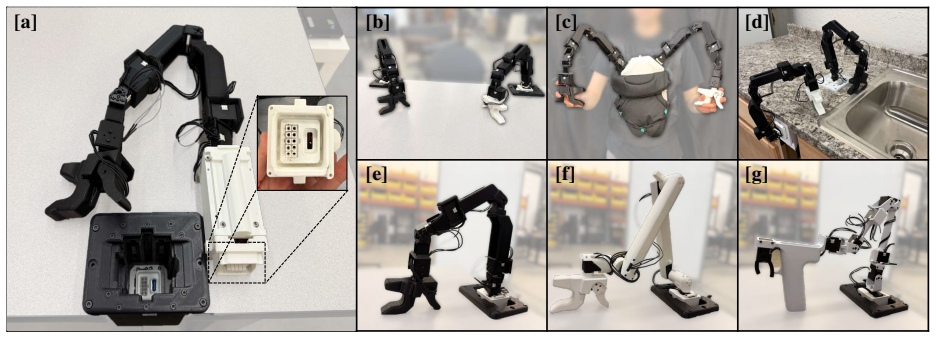
The load-bearing mechanism is the delta-based end-effector command: $T^{\text{leader}}_{0\to t} = (T^{\text{leader}}_0)^{-1} T^{\text{leader}}_t$, scaled by $s$ and applied as $T^{\text{follower}}_{t,\text{cmd}} = T^{\text{follower}}_0 \cdot \tilde{T}^{\text{leader}}_t$ (Eqs. 2–4). This turns any leader into a pose-delta source and any follower into a pose-delta sink. Around this sit two supporting pieces: a weighted damped pseudo-inverse IK solver $\Delta q = - (PJ(q))^\dagger P e$ (Eq. 6), where $P$ is a diagonal user-priority matrix that prevents base joints from dominating, and a feedback path that maps follower tracking error through the logarithmic map to $se(3)$ and back through the leader's Jacobian (Eqs. 9–11). The pluggable puppeteer mount, shared with the modular arm system the paper builds on, is the physical counterpart that makes leader devices quickly swappable.
What would settle it
Mount a load cell on the follower's gripper and compare its measured contact force with the torque applied by the leader puppeteer while the follower squeezes a rigid object; if the two diverge systematically, the claim that tracking error alone provides haptic feedback fails.
Extended reading notes
Core claim
The discovery is that a thin abstraction over end-effector poses makes teleoperation morphology-agnostic. Instead of mapping joints one-to-one, PAPRLE treats every leader as producing either joint positions or a delta end-effector pose relative to its own starting pose, scales the translation by a constant, and applies that delta to the follower's starting pose; a Jacobian-based inverse-kinematics solver with a user-weighted pseudo-inverse then converts the target pose into follower joint commands. The same abstraction supports force feedback: when follower and leader morphologies differ, the feedback module maps the follower's tracking error into the Lie algebra $se(3)$, projects it through the leader's Jacobian, and applies a proportional torque to the puppeteer. The paper reports that this preserves sub-centimeter tracking accuracy and a 50 Hz control loop with up to four limbs, and that the resulting feedback lets an operator feel contact resistance in the gripper even though no force sensor is used.
Load-bearing premise
The system assumes that a scaled delta-pose command passed through a weighted Jacobian IK solver stays intuitive and stable for any leader-follower pair, and that the follower's tracking error reliably stands in for real contact forces.
Editorial extensions
If this is right
- The same pair of puppeteer devices can be remounted to drive the same follower arms in tabletop, wall-mounted, or mobile configurations, with no code changes.
- A leader with a different kinematic structure than the follower still produces accurate tracking, with average end-effector error below 1 cm across the measured episodes.
- Cross-morphology force feedback is generated from tracking error, so operators can feel when the follower lags due to velocity limits or makes contact with an object.
- With four limbs active, the control loop still runs at 50 Hz, suitable for real-time teleoperation and data collection.
- New follower robots can be added by supplying a URDF and a configuration file; new leaders by implementing a small class that publishes joint or pose commands.
Reading between the lines
- Beyond the paper's claims, the delta-pose plus weighted-Jacobian recipe is a simple, largely parameter-light mapping that could become a baseline for cross-embodiment teleoperation research, independent of this specific hardware stack.
- If tracking-error feedback holds up under sensor-verified contact, PAPRLE would offer a low-cost route to haptic data collection without force-torque sensors — a benefit the paper suggests but does not itself demonstrate.
- The same end-effector-pose abstraction could extend beyond arms to mobile bases or dexterous hands, since it only requires a pose source and a Jacobian for the follower.
Editorial analysis
A structured set of objections, weighed in public.
Referee Report
Summary. The paper introduces PAPRLE, a modular teleoperation ecosystem that pairs diverse leader devices (puppeteers, game controllers, VR, offline trajectories) with a wide range of follower robots (PAPRAS variants, Unitree G1, Open Manipulator-Y) through joint-space and end-effector-pose command modes. The system architecture consists of leader, teleoperation, follower, and feedback modules, with a pluggable puppeteer hardware design. The authors report runtime measurements, end-effector tracking accuracy for cross-morphology control, and qualitative demonstrations of force feedback. The central claimed contribution is device- and robot-agnostic teleoperation with bilateral force feedback even when leader and follower morphologies differ.
Significance. If fully supported, PAPRLE would be a useful open-source contribution to teleoperation and embodied-AI data collection: it demonstrates a broad set of leader-follower pairings, a low-cost pluggable puppeteer, multi-limb reconfigurability, and quantitative tracking accuracy for cross-morphology control. The planned open-source release of hardware and software is a concrete reproducibility strength. However, the most distinctive advertised feature, force feedback under heterogeneous morphology, is currently supported only by a tracking-error proxy without sensor validation, and several analysis claims are asserted on thin evidence. The modular architecture itself is credible, but the paper overstates the strength of its force-feedback and generalizability claims.
major comments (4)
- [Section IV-E; Section VII-C; Fig. 10] The central force-feedback claim is unsupported as stated. Equations (9)-(11) define τ_tracking as a proportional joint-space torque derived from the follower's pose tracking error, mapped through J_leader^†. This is a virtual spring on position error, not a display of measured or estimated contact wrench; it conflates contact resistance with velocity-limit lag, safety-filter clamping, and the operator's own motion. No force sensor or calibrated wrench estimate is used in Section VII, and Fig. 10b is explicitly generated by velocity limits rather than contact, while Fig. 10c concerns only the gripper joint. The abstract and Section II claim that PAPRLE 'provides real-time force feedback' and extends beyond prior work 'by providing force feedback even in heterogeneous scenarios'; these claims require either sensor-based validation of the rendered torque against actual contact forces or a revised wording that describes a position-error-based haptic cue rather than force feedback.
- [Section VII-A; Table II] The runtime analysis is incomplete for the stated capability claims. Table II reports only single mean values with no standard deviations, number of trials, or hardware specification, and the four-limb EEF-pose cell is empty even though Section VI claims full-limb humanoid teleoperation. The 50 Hz claim for four limbs therefore cannot be verified for the EEF-pose command mode, which is the mode most relevant to heterogeneous leader-follower pairs. Please report variance, trial counts, hardware details, and either fill the four-limb EEF row or explicitly state that this condition was not measured.
- [Section VII-B; Table III] The accuracy analysis measures the error between the commanded follower end-effector pose and the actual follower end-effector pose, which confirms internal tracking consistency but not whether the mapped commands are intuitive or successful at the task. Since the cross-morphology control claim is about usable teleoperation, the paper should report task-success rates or some external performance metric for the cup-sorting task, or at least compare against a direct joint-mapping baseline. Without this, the statement that tracking errors 'indicate accurate tracking performance despite differences in robot configuration' is only a statement about servo tracking, not about the quality of the teleoperation interface.
- [Section IV-B, IV-C; abstract; Section II] The paper claims device- and robot-agnostic and 'arbitrary' limb configurations, but the system relies on the user-tuned scalar scale factor s, weighting matrix P, and feedback gain Kp, and the evidence covers a limited set of pairs (UR5→PAPRAS, OMY→PAPRAS, plus the demonstrated configurations). No sensitivity analysis or tuning guidance is provided for these parameters, so the generalizability claim is broader than the evidence. Please either temper the 'agnostic'/'arbitrary' wording or add an analysis of how the results depend on s, P, and Kp across the tested pairs.
minor comments (6)
- [Section I] There is a typo: 'PAPARS' should be 'PAPRAS' in the paragraph introducing the plug-and-play robotic arm system.
- [Section I] The sentence 'PAPRLE does not limited to direct joint mapping teleoperation' should read 'PAPRLE is not limited to direct joint mapping teleoperation.'
- [Section IV-E] The text says 'base pos' in the intrinsic feedback description; this should be 'base pose' for consistency with the rest of the paper.
- [Section VII-C, Fig. 10] The subplot labels in Fig. 10b are very small and the mapping between colors/line styles and joints is hard to read; please enlarge the labels and add a legend. Also, the time axis label 't (sec)' appears only on some subplots; make it consistent.
- [Table II] The abbreviation 'EEF' is used in the table header but the full term 'end-effector' is not introduced with the abbreviation; please define EEF before its first use in Section VII or in the table caption.
- [References] Reference [11] is listed as 'A. Authors' with '(Under Review)'; please update it with the actual author list or remove the placeholder if it is not yet public.
Circularity Check
Accuracy numbers are the IK residual being minimized, and the headline force-feedback claim is a tracking-error spring renamed as force feedback.
-
fitted input called prediction
[Section VII-B, Table III; Section IV-C, Eq. (5)]
"the IK solver aims to find the joint positions q∗ such that the resulting end-effector pose f (q) closely matches the desired pose xd. ... We also analyze the accuracy with which the follower robot tracks the leader’s commands ... Table III shows the error between the target end-effector pose command from the leader and the resulting end-effector pose of the follower robot."
The reported 'accuracy' metric is precisely the pose error e that the IK solver in Eq. (5) is constructed to minimize via the damped pseudo-inverse update. The sub-centimeter errors in Table III therefore measure convergence of the optimizer to its own objective, not an independently defined tracking or task performance. No external ground truth or task-level success metric is used; the validation is self-referential and the low-error result is forced by the algorithm's design rather than by an independent property of the cross-morphology control method.
-
renaming known result
[Section IV-E, Eqs. (9)-(11); Section VII-C, Fig. 10b]
"τtracking = −Kp ∆qleader. (11) ... This feedback naturally conveys interaction forces in the gripper, as contact with an object usually results in a deviation between the intended and actual pose of the gripper of the follower."
The paper's central 'real-time force feedback' claim is implemented entirely as a proportional spring on the pose error between commanded and actual follower pose, mapped through the leader Jacobian pseudo-inverse. No force sensor or wrench estimate is used, and the paper's own analysis (Fig. 10b) shows the signal arising from velocity limits rather than contact. Calling this tracking-error correction 'force feedback' and 'improving physical interaction awareness' makes the feedback claim true only by definition: the system outputs torques whenever tracking error exists, but no relationship to actual contact forces is established. This is a renaming of a position-error correction as force feedback.
full rationale
The modular hardware and software ecosystem, alongside the runtime table and qualitative demonstrations, are self-contained and not circular. However, two load-bearing validation steps reduce to the system's own signals. First, the accuracy analysis in Section VII-B reports the same end-effector pose error that the IK solver in Eq. (5) is designed to drive to zero, so the excellent numbers reflect optimizer convergence rather than independent cross-morphology tracking ability. Second, the headline force-feedback extension is a tracking-error virtual spring (Eqs. 9-11) labeled as force feedback; no force sensor or contact-wrench calibration appears, and the paper's own Figure 10b illustrates the signal from velocity limits. The mechanical self-citations to PAPRAS [1] and CHILD [11] concern mounting details and are not load-bearing for these control claims. These issues make the paper partially circular: the modularity claims stand on real demonstrations, but the quantitative accuracy claim and the force-feedback extension reduce by construction to internally defined error signals.
Assumptions & free parameters
free parameters (3)
- Scale factor s =
unspecified; chosen per leader-follower pair
- Jacobian weighting matrix P =
example 0.5 for base joint
- Feedback gain Kp =
unspecified
assumptions (4)
- domain assumption URDF kinematics are accurate for both leader and follower.
- domain assumption Damped pseudo-inverse IK with warm start converges quickly enough at 50 Hz for arbitrary configurations.
- ad hoc to paper End-effector delta pose with scalar scaling is a sufficient interface for cross-morphology control.
- domain assumption Follower tracking error is a valid proxy for contact force feedback.
Cite this review
Pith. "Pith review of PAPRLE (Plug-And-Play Robotic Limb Environment): A Modular Ecosystem for Robotic Limbs." pith.science (2026). https://pith.science/paper/55PLN3PG
@misc{pith2026250705555,
  author       = {Pith},
  title        = {Pith review of: PAPRLE (Plug-And-Play Robotic Limb Environment): A Modular Ecosystem for Robotic Limbs},
  year         = {2026},
  howpublished = {\url{https://pith.science/paper/55PLN3PG}},
  note         = {Machine review of arXiv:2507.05555}
}
read the original abstract
We introduce PAPRLE (Plug-And-Play Robotic Limb Environment), a modular ecosystem that enables flexible placement and control of robotic limbs. With PAPRLE, a user can change the arrangement of the robotic limbs, and control them using a variety of input devices, including puppeteers, gaming controllers, and VR-based interfaces. This versatility supports a wide range of teleoperation scenarios and promotes adaptability to different task requirements. To further enhance configurability, we introduce a pluggable puppeteer device that can be easily mounted and adapted to match the target robot configurations. PAPRLE supports bilateral teleoperation through these puppeteer devices, agnostic to the type or configuration of the follower robot. By supporting both joint-space and task-space control, the system provides real-time force feedback, improving user fidelity and physical interaction awareness. The modular design of PAPRLE facilitates novel spatial arrangements of the limbs and enables scalable data collection, thereby advancing research in embodied AI and learning-based control. We validate PAPRLE in various real-world settings, demonstrating its versatility across diverse combinations of leader devices and follower robots. The system will be released as open source, including both hardware and software components, to support broader adoption and community-driven extension. Additional resources and demonstrations are available at the project website: https://uiuckimlab.github.io/paprle-pages
Figures


Figures from the paper (6 more)


Forward citations
Cited by 1 Pith paper
-
ModPack: An Extensible Teleoperation Interface for Bimanual Mobile Manipulation
A modular backpack-based teleoperation interface enables bimanual mobile manipulation with haptic feedback and active perception across multiple robot platforms.
Reference graph
Works this paper leans on
-
[11]
CHILD: A Controller for Humanoid Imitation and Live Demonstration,
A. Authors, “CHILD: A Controller for Humanoid Imitation and Live Demonstration,” 2025, (Under Review). 3
work page 2025
-
[1]
Papras: Plug-and-play robotic arm system,
J. Kim, D. C. Mathur, K. Shin, and S. Taylor, “Papras: Plug-and-play robotic arm system,” arXiv preprint arXiv:2302.09655 , 2023. 1, 3
arXiv 2023
-
[2]
GELLO: A General, Low-Cost, and Intuitive Teleoperation Framework for Robot Manipula- tors,
P. Wu, Y . Shentu, Z. Yi, X. Lin, and P. Abbeel, “GELLO: A General, Low-Cost, and Intuitive Teleoperation Framework for Robot Manipula- tors,” in IEEE/RSJ International Conference on Intelligent Robots and Systems (IROS), 2024. 2, 3, 7
work page 2024
-
[3]
Learning Fine-Grained Bimanual Manipulation with Low-Cost Hardware,
T. Zhao, V . Kumar, S. Levine, and C. Finn, “Learning Fine-Grained Bimanual Manipulation with Low-Cost Hardware,” in Robotics: Science and Systems (RSS) , 2023. 2
work page 2023
-
[4]
FACTR: Force-Attending Curriculum Training for Contact-Rich Policy Learning,
J. J. Liu, Y . Li, K. Shaw, T. Tao, R. Salakhutdinov, and D. Pathak, “FACTR: Force-Attending Curriculum Training for Contact-Rich Policy Learning,” arXiv preprint arXiv:2502.17432 , 2025. 2
arXiv 2025
-
[5]
A. Bazhenov, S. Satsevich, S. Egorov, F. Khabibullin, and D. Tset- serukou, “Echo: An Open-Source, Low-Cost Teleoperation System with Force Feedback for Dataset Collection in Robot Learning,” arXiv preprint arXiv:2504.07939, 2025. 2
arXiv 2025
-
[6]
Bunny-visionpro: Real-time bimanual dexterous teleoperation for imitation learning,
R. Ding, Y . Qin, J. Zhu, C. Jia, S. Yang, R. Yang, X. Qi, and X. Wang, “Bunny-visionpro: Real-time bimanual dexterous teleoperation for imitation learning,” arXiv preprint arXiv:2407.03162 , 2024. 2
arXiv 2024
-
[7]
Open-television: Teleoperation with immersive active visual feedback,
X. Cheng, J. Li, S. Yang, G. Yang, and X. Wang, “Open-television: Teleoperation with immersive active visual feedback,” in 8th Annual Conference on Robot Learning , 2024. 2
work page 2024
Show all 17 references
-
[8]
ACE: A Cross-platform and visual-Exoskeletons System for Low-Cost Dexterous Teleoperation,
S. Yang, M. Liu, Y . Qin, R. Ding, J. Li, X. Cheng, R. Yang, S. Yi, and X. Wang, “ACE: A Cross-platform and visual-Exoskeletons System for Low-Cost Dexterous Teleoperation,” in 8th Annual Conference on Robot Learning, 2024. 2
2024
-
[9]
TeleMoMa: A Modular and Versatile Teleoperation System for Mobile Manipulation,
S. Dass, W. Ai, Y . Jiang, S. Singh, J. Hu, R. Zhang, P. Stone, B. Abbatematteo, and R. Mart ´ın-Mart´ın, “TeleMoMa: A Modular and Versatile Teleoperation System for Mobile Manipulation,” in Robotics: Science and Systems, Workshop on Data Generation for Robotics , 2024. 2
2024
-
[10]
Whole-Body Teleoperation for Mobile Manipulation at Zero Added Cost,
D. Honerkamp, H. Mahesheka, J. O. von Hartz, T. Welschehold, and A. Valada, “Whole-Body Teleoperation for Mobile Manipulation at Zero Added Cost,” IEEE Robotics and Automation Letters , 2025. 2
2025
-
[12]
Universal Manipulation Interface: In-The-Wild Robot Teaching Without In-The-Wild Robots,
C. Chi, Z. Xu, C. Pan, E. Cousineau, B. Burchfiel, S. Feng, R. Tedrake, and S. Song, “Universal Manipulation Interface: In-The-Wild Robot Teaching Without In-The-Wild Robots,” in Robotics: Science and Sys- tems (RSS), 2024. 7, 8
2024
-
[13]
ROS: an open-source Robot Operating System,
M. Quigley, K. Conley, B. Gerkey, J. Faust, T. Foote, J. Leibs, R. Wheeler, A. Y . Ng, et al. , “ROS: an open-source Robot Operating System,” in IEEE International Conference on Robotics and Automation (ICRA), Workshop on Open Source Software , 2009. 7
2009
-
[14]
Robot Operating System 2: Design, architecture, and uses in the wild,
S. Macenski, T. Foote, B. Gerkey, C. Lalancette, and W. Woodall, “Robot Operating System 2: Design, architecture, and uses in the wild,” Science Robotics, vol. 7, no. 66, p. eabm6074, 2022. 7
2022
-
[15]
MuJoCo: A physics engine for model-based control,
E. Todorov, T. Erez, and Y . Tassa, “MuJoCo: A physics engine for model-based control,” in IEEE/RSJ International Conference on Intelli- gent Robots and Systems (IROS) , 2012. 7
2012
-
[16]
Isaac Gym: High Performance GPU-Based Physics Simulation For Robot Learning,
V . Makoviychuk, L. Wawrzyniak, Y . Guo, M. Lu, K. Storey, M. Macklin, D. Hoeller, N. Rudin, A. Allshire, A. Handa, and G. State, “Isaac Gym: High Performance GPU-Based Physics Simulation For Robot Learning,” arXiv preprint arXiv:2108.10470 , 2021. 7
2021 arXiv
-
[17]
Design and use paradigms for Gazebo, an open-source multi-robot simulator,
N. Koenig and A. Howard, “Design and use paradigms for Gazebo, an open-source multi-robot simulator,” in IEEE/RSJ International Confer- ence on Intelligent Robots and Systems (IROS) , 2004. 7 10
2004
Reviewed August 6, 2026 · model on record in the stance chip above.
Discussion (0). Sign in to comment.