REVIEW 4 major objections 5 minor 12 references
PINNs Study for the Bekki-Nozaki Chaos in the Non-linear Schr\"{o}dinger equation
T0 review · 4 major / 5 minor · reviewed 2026-08-06 · deepseek-v4-flash
Pith's one-line read The Bekki-Nozaki equation's chaotic behavior is intrinsic to the system, not an artifact of numerical discretization; a mesh-free physics-informed neural network reproduces the attractor and recovers the equation's parameters from chaotic…
desk verdict A modest new PINN application where the central 'inherent chaos' claim is unsupported; the inverse coefficient study is the more credible part. read the letter →
The pith
A machine-rendered reading of the paper's core claim, the machinery that carries it, and where it could break.
The reading
What carries the argument
The central object is the Bekki-Nozaki equation, the forced dissipative nonlinear Schrödinger equation $iq_t+q_{xx}+2|q|^2q=i\varepsilon_1 e^{i\omega t}+i\varepsilon_2 e^{2i\omega t}+i\gamma q_{xx}$, whose small perturbative terms turn the integrable bright-soliton solution into a chaotic attractor. The machinery carrying the argument is a physics-informed neural network: the network outputs the real and imaginary parts $u$ and $v$ of $q(x,t)=u(x,t)+iv(x,t)$; automatic differentiation produces the derivatives; and the loss function is the sum of mean-squared errors for the initial condition, the boundary condition, and the residuals of the two real PDEs $F_{\mathrm{real}}=0$ and $F_{\mathrm{imag}}=0$. To reach long times, the authors divide the interval into sequential blocks such as $[0,2]$, $[2,4]$, $[4,6]$ and solve each block separately. In the inverse mode, the same networks treat the perturbation parameters, or the coefficients $\lambda_0$ and $\lambda_1$ in the underlying NLS equation, as trainable and fit them from the forward solution.
What would settle it
Take the forward PINN solution on $t\in[0,30]$ with the reported settings and compare the final state of each two-second block with the initial condition of the next block: a nonzero jump at $t=2,4,\dots,28$ would mean the reported attractor is a stitching of disconnected pieces rather than a single solution. Separately, compute a Lyapunov exponent, or a high-resolution spectral reference solution, for Eq. (1) with the same parameters: a reference with no positive exponent while the PINN trajectory keeps bouncing would indicate that the bouncing is a training artifact rather than inherent chaos.
Extended reading notes
Core claim
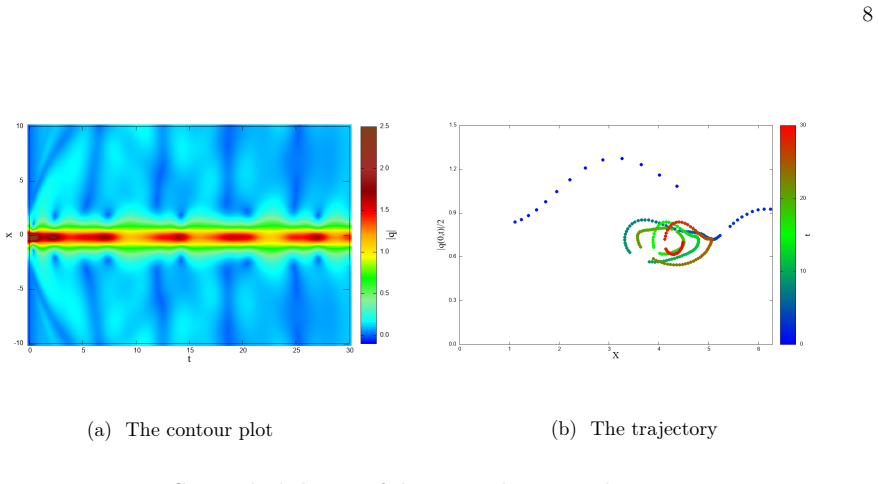
In Section IV the paper states its central conclusion: the mesh-free PINN solution also has the property of chaos, so the chaos in the Bekki-Nozaki equation is not a numerical artifact but an inherent property of the system. Concretely, starting from the static one-soliton initial condition $q(x,0)=2A\eta_0\,\mathrm{sech}(2\eta_0 x)$ with $A=1.2$, $\eta_0=0.871$, and with $\varepsilon_1=\varepsilon_2=0.0405$, $\gamma=0.05$, $\omega=1.0$, a four-hidden-layer, 128-node PINN trained in two-second time blocks reproduces the contour plot of $|q(x,t)|$ and the attractor trajectory over $t\in[0,30]$. The inverse PINN then identifies the perturbation coefficients from the chaotic trajectory, with identified values such as $\varepsilon_1=0.04046$, $\varepsilon_2=0.04032$, $\gamma=0.05039$, and the paper takes this agreement as evidence that the forward solution is correct. The paper further reports that the identification of the NLS coefficients $\lambda_0$ and $\lambda_1$ remains accurate while the solution keeps bouncing and becomes unreliable once the attractor collapses, attributing the failure to time segments shorter than the forcing period $2\pi$.
Load-bearing premise
The result depends on the assumption that the two-second neural-network blocks join into one continuous trajectory of the true equation, not merely into a sequence of low-loss local fits, and that a small training loss means the network actually solves the PDE.
Editorial extensions
If this is right
- The chaotic behavior of the Bekki-Nozaki equation is intrinsic, so any faithful solver, discretized or mesh-free, should see it; the dependence of Runge-Kutta runs on time step is a consequence of sensitive dependence on initial conditions rather than evidence that the chaos is numerical.
- Physics-informed neural networks can follow the chaotic solution over at least a 30-second window when trained in sequential two-second blocks.
- Inverse PINN analysis can recover the perturbation parameters from chaotic training data to within roughly $10^{-4}$ in the reported runs.
- The reliability of coefficient identification tracks chaoticity: coefficients stay accurate while the soliton attractor bounces and degrade once the solution decays to a non-chaotic state.
- Time segments shorter than the forcing period $2\pi$ fail to capture the system's dynamics, which sets a resolution requirement for inverse analysis of these forced-dissipative equations.
Reading between the lines
- The paper leaves open a direct diagnostic: if the central claim is right, the long-time attractor should be independent of the chosen block length, so rerunning the same forward analysis with blocks of $1$, $2$, and $4$ seconds and comparing the phase-space trajectories would test whether the sequential training preserves the dynamics or simply stitches near-solutions.
- A practical rule implied but not stated is that the training window for inverse PINNs should cover at least one full period of the slowest external drive; this could be checked by varying $\omega$ while rescaling segment length and observing where coefficient recovery starts to fail.
- Computing a Lyapunov exponent from the PINN trajectory would strengthen the inherent-chaos conclusion beyond visual agreement of the attractor; the paper reports no such independent measure.
Editorial analysis
A structured set of objections, weighed in public.
Referee Report
Summary. The paper studies the Bekki-Nozaki equation, a forced dissipative nonlinear Schrödinger equation. Using fourth-order Runge-Kutta integration, the authors show that two different timesteps (dt=10^-4 and dt=10^-5) produce different long-time attractorlike trajectories and interpret this as a motivation for a discretization-free method. They then apply forward PINNs with sequential time-block training over t in [0,30], observe bouncing norms and an attractor, and claim that the PINN result implies the chaos is an inherent property of the equation rather than a numerical artifact. Inverse PINNs are used first to recover the perturbation parameters from the forward-PINN solution and then to estimate the dispersion and nonlinear coefficients of the underlying NLS equation over long time intervals; the results are reported as accurate while the solution bounces and degrading after the soliton decays. The paper concludes that inverse PINNs work with chaotic data and that the degradation of coefficient identification correlates with the transition away from chaos.
Significance. If the central claim were established, the paper would be significant for two reasons: it would support the view that Bekki-Nozaki chaos is intrinsic to the PDE, and it would demonstrate that PINNs can integrate a chaotic PDE over long times while enabling inverse parameter estimation. The paper's positive evidence is primarily internal consistency: the recovered perturbation parameters in Table I are close to their prescribed values, and the long-segment inverse results in Figs. 7-9 show plausible coefficient estimates with a segment-length dependence that is physically interpretable. However, the paper does not provide machine-checked proofs, reproducible code, or an independent validation of the forward PINN trajectory; the load-bearing external comparison is absent. The significance is therefore conditional on the additional numerical validation requested in the major comments.
major comments (4)
- [Section IV, Eq. (8), Fig. 5] The central claim that the PINN solution establishes inherent chaos is not supported by the evidence shown. The forward loss in Eq. (8) penalizes initial conditions, boundary conditions, and PDE residuals at collocation points, but it contains no term comparing the network output with an independent reference trajectory over [0,30]. For a chaotic equation, a low value of such a loss is not sufficient to establish that the recovered trajectory is the true physical one, because small trajectory errors are amplified exponentially. The paper neither reports per-block residuals nor compares the PINN solution with a converged Runge-Kutta or pseudo-spectral solution. Please add this validation, for example a trajectory comparison over short intervals, a comparison of attractor statistics, or Lyapunov exponent estimates, before claiming that the chaos is an inherent property of the system.
- [Section IV, sequential time-block training] The sequential-block procedure is not described completely. The manuscript states that the time interval is divided into blocks [0,2], [2,4], ... and solved sequentially, but it does not specify how the solution is passed from one block to the next, whether continuity at the seams is enforced, or how large the mismatch is at t=2,4,.... In a chaotic system, an uncontrolled seam mismatch acts as a perturbation of the initial condition and can create apparent irregular bouncing in the attractor plot. The paper should report the seam errors and demonstrate that they do not change attractor-level diagnostics; without this, the attractor in Fig. 5 cannot be attributed to Eq. (1).
- [Section IV, Table I, Eq. (12)] The inverse-PINNs validation in Table I is circular. The forward-PINNs solution for t in [0,30] is used as training data, and the recovered parameters are then used to conclude that "the forward analysis performs correctly." Minimizing Eq. (12) with data produced by the forward network can only establish that the forward output is consistent, in a least-squares sense, with Eq. (1) under the network's parametrization; it cannot establish that the forward output approximates the true solution of the initial-value problem. The forward solution should be compared with an independent solver, and the inverse test should be repeated on that reference data.
- [Section II, Fig. 3] The observation that dt=10^-4 and dt=10^-5 produce different attractors is not evidence for inherent chaos. For a chaotic system, any two numerically accurate trajectories with slightly different truncation errors will diverge exponentially. To make this experiment informative, the authors should include a convergence study, for example a third timestep or a short-time trajectory comparison at several timesteps, and ideally compare statistical invariants such as Lyapunov exponents or attractor dimension. As it stands, the figure motivates the concern that solver artifacts may matter, but it does not resolve that concern.
minor comments (5)
- [Section IV, figure numbering] The text refers to the forward-PINNs solution as "Fig. 6(a)", but the corresponding caption says "Fig. 5"; later Runge-Kutta results are also labeled "Fig. 6". The figures should be renumbered consistently.
- [Section IV, typo] The word "Finaly" should be "Finally".
- [Section II, Fig. 2] Figure 2 labels the trajectory at epsilon=0.04 as the attractor, while the rest of the paper uses epsilon=0.0405. Please clarify whether these are intentionally different values.
- [Section III.D, numerical setup] For reproducibility, the paper should report how the initial condition of each sequential block is generated, the learning rate schedule, the number of Adam and L-BFGS iterations, and the stopping criterion used in training.
- [Section I and Section III] The term "mesh-free" is used loosely: Eq. (8) and Eq. (12) rely on collocation points in (x,t), which constitute a sampling grid. The authors should replace "mesh-free" with a more careful statement such as "without a fixed spatial mesh".
Circularity Check
Forward-PINN validation is self-referential: the inverse-PINN's training data are the forward-PINN's own output, so the parameter recovery in Table I confirms self-consistency, not independent correctness.
-
fitted input called prediction
[Section IV, inverse-PINNs paragraph following Table I; forward loss Eq. (8), inverse loss Eq. (12).]
"The forward-PINNs solution for t ∈ [0, 30] is used as training data for the estimation of the perturbation parameters through the inverse-PINNs. ... The results are summarized in Table I, which indicate that PINNs accurately identify the perturbative parameters. Since the solution obtained by forward-PINNs is successfully identified as the solution to the Bekki-Nozaki equation, we can conclude that the forward analysis performs correctly."
The inverse problem's 'correct' data u_correct, v_correct in Eq. (12) are the output of a forward PINN whose own loss Eq. (8) was minimized by making that output satisfy Eq. (1) with exactly the parameters ε1=ε2=0.0405, γ=0.05. The inverse network then fits a surrogate of the same parameterized PDE to data generated by that surrogate. Recovering the parameters is therefore a self-consistency check of the PINN's own loss, not an independent demonstration that the forward trajectory matches the physical solution. The conclusion 'the forward analysis performs correctly' is forced by construction: the training data for the validation were manufactured by the very network being validated. No independent reference solution (e.g., the Runge-Kutta data used later) enters this validation.
full rationale
One circular step exists. In Section IV the paper uses the forward-PINNs solution as the ground-truth training data for the inverse-PINNs parameter estimation and then treats the recovered parameters as proof that 'the forward analysis performs correctly.' Because the forward network was trained with Eq. (8) to satisfy Eq. (1) with those exact parameters, the inverse recovery of Table I is a self-fit: the inverse network recognizes the forward network's own output as satisfying the equation the forward network was built to satisfy. This is fitted input called prediction, and it is load-bearing because it is the stated evidence for the forward solution's correctness, which in turn supports the claim that the observed chaos is inherent. The paper's later inverse study using Runge-Kutta-generated data (Section IV, Eqs. (13)-(14), Figs. 7-9) is an independent test and does not inherit this circularity. The sequential-block structure and lack of reported block-boundary residuals are correctness concerns, not circularity, and the overlapping-author citations [8,9] are background rather than load-bearing. The central 'inherent chaos' claim therefore retains some independent content from the RK solutions, but its forward-PINN validation step reduces by construction, warranting score 6.
Assumptions & free parameters
free parameters (2)
- Time-segment length for sequential PINN training =
2 s for forward; 10 s and 5 s for inverse
- PINN architecture and training point counts =
4x128 hidden (forward); 6x40 (inverse); Nu=1,000, Nb=2,000, NF=50,000 forward; Nu=NF=300,000 or 100,000/50,000 inverse
assumptions (5)
- domain assumption The Bekki-Nozaki equation with the given forcing and damping parameters is the correct model for the intended chaotic dynamics.
- domain assumption The discrepancy between Runge-Kutta solutions with dt=1e-4 and dt=1e-5 is due to chaos rather than numerical instability or implementation error.
- ad hoc to paper Sequential time-block PINN training preserves the true solution across block boundaries.
- domain assumption A low PINN residual implies an accurate PDE solution for chaotic dynamics.
- ad hoc to paper Recovering parameters from inverse PINN training on forward-PINN data validates the forward solver.
Cite this review
Pith. "Pith review of PINNs Study for the Bekki-Nozaki Chaos in the Non-linear Schr\"{o}dinger equation." pith.science (2026). https://pith.science/paper/3AAGEJCW
@misc{pith2026250705664,
  author       = {Pith},
  title        = {Pith review of: PINNs Study for the Bekki-Nozaki Chaos in the Non-linear Schr\"odinger equation},
  year         = {2026},
  howpublished = {\url{https://pith.science/paper/3AAGEJCW}},
  note         = {Machine review of arXiv:2507.05664}
}
read the original abstract
In this paper we study chaotic behavior in the forced dissipative non-linear Schr\"{o}dinger equation, so called the Bekki-Nozaki equation. Chaotic systems are often seen in a strong sensitivity to initial conditions,leading to error accumulation over time when traditional numerical methods are applied. To address this difficulty, we employ Physics-Informed Neural Networks(PINNs), a mesh-free deep learning framework. PINNs mitigate error accumulation in chaotic systems by solving partial differential equations without discretizing the computational domain. We demonstrate that PINNs successfully reproduce chaotic behavior of the Bekki-Nozaki equation. The results of the inverse analysis indicate a correlation between the governing equation's predictability and its chaotic nature of the solution.
Figures


Figures from the paper (6 more)



Reference graph
Works this paper leans on
- [1]
- [2]
-
[3]
M. Raissi, P. Perdikaris, and G. Karniadakis, (2017), 10.48550/arXiv.1711.10561
-
[4]
M. Raissi, P. Perdikaris, and G. Karniadakis, (2017), 10.48550/arXiv.1711.10566
-
[5]
A. D. Jagtap, E. Kharazmi, and G. E. Karniadakis, Computer Methods in Applied Mechanics and Engineering 365, 113028 (2020)
work page 2020
-
[6]
Z. Zhou, L. Wang, and Z. Yan, Computers and Mathematics with Applications151, 164 (2023)
work page 2023
- [7]
-
[8]
A. Nakamula, K. Obuse, N. Sawado, K. Shimasaki, Y. Shimazaki, Y. Suzuki, and K. Toda, Phys. Scripta 100, 056012 (2025), arXiv:2410.19014 [physics.flu-dyn]
work page Pith review arXiv 2025
Show all 12 references
-
[9]
Nakamula, K
A. Nakamula, K. Obuse, N. Sawado, K. Shimasaki, Y. Shimazaki, Y. Suzuki, and K. Toda, (2024), arXiv:2412.20027 [nlin.SI]
2024 arXiv
-
[10]
A. G. Baydin, B. A. Pearlmutter, A. A. Radul, and J. M. Siskind, (2018), arXiv:1502.05767 [cs.SC]
2018 arXiv
-
[11]
D. P. Kingma and J. Ba, (2017), arXiv:1412.6980 [cs.LG]
2017 arXiv
-
[12]
D. C. Liu and J. Nocedal, Math. Programming45, 503 (1989)
1989
Reviewed August 6, 2026 · model on record in the stance chip above.
Discussion (0). Continue with ORCID to comment.