REVIEW 4 major objections 4 minor 97 references
Magnetic White Dwarfs in the SDSS 100 pc Sample: Further Evidence of Two Formation Channels
T0 review · 4 major / 4 minor · reviewed 2026-08-06 · deepseek-v4-flash
Pith's one-line read Using the largest volume-limited sample of magnetic white dwarfs, this paper argues that they split into two formation channels: young, massive, strong-field objects from mergers, and old, average-mass, weak-field objects from single…
desk verdict The paper's real contribution is the sample; the 'strong evidence' for two populations overstates what the statistics justify. read the letter →
The pith
A machine-rendered reading of the paper's core claim, the machinery that carries it, and where it could break.
The reading
What carries the argument
The analysis rests on three pieces of machinery. First, a volume-limited sample: all white dwarfs within 100 pc in the SDSS footprint with optical spectroscopy, 86-91% complete for targets hotter than 5000-6000 K, from which 163 magnetic white dwarfs are identified, mostly by Zeeman splitting of Balmer lines. Second, offset-dipole model atmospheres (a magnetic geometry with a dipole displaced from the star's center) used to fit effective temperature, mass, cooling age, and field strength for the newly discovered objects. Third, the statistical separation itself: two-sample Kolmogorov-Smirnov tests compare field-strength and mass distributions for white dwarfs younger and older than 2 Gyr, and a two-component Gaussian mixture model clusters the sample in the three-dimensional space of mass, cooling age, and field strength. The dynamo interpretation is carried by comparing the observed mass-age distribution with theoretical breakout times for a crystallization dynamo and emergence times for a main-sequence core-convective dynamo.
What would settle it
Conduct a spectropolarimetric survey of the same SDSS 100 pc volume sensitive to fields down to about 0.1 MG and to white dwarfs cooler than 6000 K. If it finds numerous young, average-mass white dwarfs with weak fields, or old, cool white dwarfs with fields above roughly 100 MG, the K-S and GMM separation should dissolve; if such objects remain rare or absent, the two-population claim survives. A quantitative version: add the missing populations at the rates implied by the 20 pc spectropolarimetric sample and recompute the two-sample K-S p-values; if they rise above 0.05, the claim is refuted.
Extended reading notes
Core claim
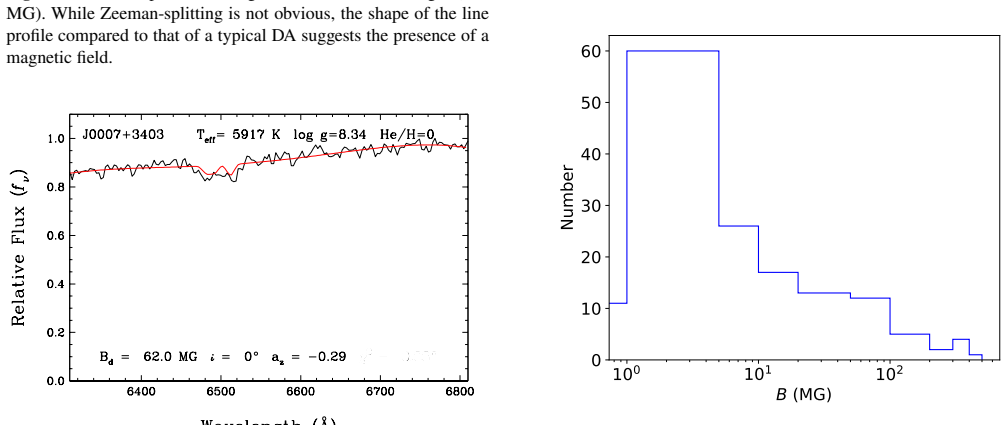
The central claim is that magnetic white dwarfs are not one population with a single field origin. Using model-atmosphere fits and a Gaussian mixture model on mass, cooling age, and field strength, the paper identifies two clusters: a young, massive, strong-field group centered at 1.8 Gyr, 0.96 $M_\odot$, 84 MG, and an old, average-mass, weak-field group centered at 2.9 Gyr, 0.71 $M_\odot$, 3.7 MG. Splitting the sample at a 2 Gyr cooling age, two-sample Kolmogorov-Smirnov tests reject the null hypothesis that the two age groups share the same mass and field-strength distributions, with p-values of $2.3 \times 10^{-8}$ for mass and 0.01 for field strength. The paper interprets the first group as dominated by merger remnants and the second as products of single-star evolution, with magnetic fields generated earlier in the star's life (a core-convective dynamo on the main sequence) rather than by crystallization alone. It also reports that the magnetic fraction rises with mass and with cooling age out to 2-3 Gyr, and that known rotation periods are shorter for the young, massive objects, consistent with a merger origin.
Load-bearing premise
The split into two groups is real and not an artifact of what the survey can detect: the sample misses fields below about 1 MG and misses magnetic white dwarfs whose hydrogen or helium lines have disappeared, and if those missing objects fill the gap between the two clusters, the statistical evidence for two populations would weaken.
Editorial extensions
If this is right
- If the two-population split holds, most white dwarfs with masses above roughly 0.9 $M_\odot$, young cooling ages, and fields stronger than about 10 MG are merger remnants, so binary evolution becomes the dominant route to the strongest magnetic fields.
- The old, average-mass magnetic white dwarfs require a field generated before or during the star's earlier evolution; a crystallization dynamo alone cannot explain their cooling ages because the field would not have reached the surface yet.
- The magnetic fraction of white dwarfs should increase with mass for young objects but stay roughly flat with mass for old objects, which is exactly the trend the paper finds when splitting the sample at 2 Gyr.
- Future surveys with better sensitivity to weak fields and to featureless cool white dwarfs should find more magnetic objects in the old, average-mass group, raising the overall magnetic fraction above the 5.2% measured here.
- Rotation periods of magnetic white dwarfs should be shorter on average than those of non-magnetic ones, with the fastest rotators concentrated among the young, massive, likely merged objects.
Reading between the lines
- If the two-population picture is correct, it predicts that a spectropolarimetric survey of the same 100 pc volume, sensitive to fields below 1 MG, should find young, average-mass magnetic white dwarfs only at very low space density, and that filling them in would not erase the two clusters.
- The merger-dominated interpretation implies a testable link between kinematics and binarity: the young, massive magnetic group should show signs of past binary interaction (fast rotation, white dwarf companions, or the low tangential velocities typical of a thin-disk origin), while the old group should look kinematically like ordinary single white dwarfs.
- A quantitative falsifier of the dynamo interpretation would come from asteroseismic measurements of core rotation in average-mass magnetic white dwarfs: if their fields are fossilized core-convective dynamo products, core rotation and field strength should correlate more tightly than the current sample can show.
- The GMM centers themselves are a prediction for larger samples: adding the DESI, SDSS-V, and 4MOST white dwarf discoveries should either sharpen the same two centroids or reveal a third population at very old ages and very strong fields that the current survey's detection biases hide.
Signed reviews
Editorial analysis
A structured set of objections, weighed in public.
Referee Report
Summary. The paper presents a model atmosphere analysis of 163 magnetic white dwarfs in the SDSS 100 pc sample, 87 of which are new discoveries, and reports field strengths, masses, and cooling ages for most of them. The authors use two-sample Kolmogorov-Smirnov tests with a 2 Gyr age split and a two-component Gaussian mixture model to argue for two distinct populations: young, massive, strongly magnetic objects attributed to mergers, and old, average-mass, weakly magnetic objects attributed to single-star evolution with fields from a core-convective dynamo. They also present rotation periods and tangential velocities and discuss selection biases against weak fields and featureless spectra.
Significance. If the two-population claim is established, this work would provide the strongest volume-limited evidence to date for the dual formation channel scenario, considerably extending earlier work by Bagnulo & Landstreet using a much larger sample. The paper ships a substantial new catalog, public model fits on Zenodo, and a careful qualitative discussion of detectability limits, including synthetic spectra in Figure 21. However, the statistical evidence as presented is incomplete, and the interpretive step favoring a core-convective dynamo relies heavily on a theory paper co-authored by a member of this team. The underlying data and sample are valuable, but the central claim currently outruns the analysis.
major comments (4)
- [§5.2] The GMM analysis is presented as evidence of two populations, but the paper never compares the two-component model against a one-component null model. A two-component Gaussian mixture fit will generally return two centroids for any skewed or heavy-tailed distribution, so the reported centers at 2.9 Gyr/0.71 Msun/3.7 MG and 1.8 Gyr/0.96 Msun/84 MG do not, by themselves, demonstrate bimodality. Please add a formal model comparison (BIC/AIC or a likelihood-ratio test with a sensible null) and state whether the field strength was log-transformed before fitting.
- [§5.1] The Kolmogorov-Smirnov tests show that the mass and field-strength distributions differ between the young and old age groups, but they do not establish the existence of two distinct populations. A continuous monotonic trend in mass and field strength with age would produce the same significant p-values, and the authors' own cutoff scan (significant for B only between 1.0 and 3.5 Gyr) is more naturally read as a gradual shift than as a sharp separation. The K-S results should be framed as evidence of a location difference, not as evidence of bimodality.
- [§5.1 and §6.1] Selection biases are acknowledged qualitatively but are not propagated into the statistical tests. The sample is incomplete for fields below roughly 1 MG and for cool, featureless WDs that could host strong fields; both omissions plausibly accentuate the difference between the young and old groups. The synthetic spectra in Figure 21 define detectability thresholds, and the arguments from Bagnulo & Landstreet (2022) suggest the missed populations are small, but no quantitative correction or sensitivity analysis is performed. Please estimate the expected number of missed objects and state how the K-S p-values and GMM centroids would be affected under conservative completeness assumptions.
- [§6.3] The interpretation that the old, low-mass population is explained by a main-sequence core-convective dynamo relies on the emergence timescales of Camisassa et al. (2024), and Maria Camisassa is a co-author of the present paper. This is not a statistical error, but the dependence should be acknowledged explicitly, and the paper should clarify whether the two-population conclusion would survive if the Camisassa et al. timescales were substantially revised. Ideally the statistical claim should be stated independently of the dynamo interpretation.
minor comments (4)
- [Title/author list] The title contains a typo ('T wo Formation Channels') and the author list has 'W arren'; these should be corrected.
- [Figure 19] The caption does not state whether the ellipses are 1/2/3-sigma contours in the full three-dimensional space or after marginalization onto each pair of axes; please clarify.
- [§5.2] The text says 'the algorithm detects two groups,' but the number of components is fixed by the user; a more precise phrasing would be 'a two-component model was fit, yielding two groups.'
- [Table 3 and §5.1] The exact number of objects entering each K-S test should be given (152 of 163 have field measurements, and some have NA masses or ages); sample sizes strongly affect the p-values and should be reported alongside the test statistics.
Circularity Check
No significant circularity: the two-population claim is built on new observational data, and the self-citations used for interpretation are independent, non-circular inputs.
full rationale
The paper's central claim is observational rather than a first-principles derivation. Magnetic field strengths, masses, and cooling ages come from model-atmosphere fits and literature values; the K-S tests compare pre-defined young/old subsamples, and the GMM is run with a fixed two-component model. The number of components is an assumed hyperparameter, not a fitted quantity, so reporting two cluster centers does not reduce to the input by construction; the absence of a one-component comparison weakens the statistical support but is not circularity. The interpretive reliance on Camisassa et al. (2024) and Moss et al. (2024) involves co-authors, but those citations supply independent theoretical emergence-time and model-atmosphere calculations that do not assume the present sample's target conclusion. No step fits a parameter to the claimed output and then re-presents it as a prediction, and no cited uniqueness theorem is used to forbid alternatives. The two-population conclusion could be strengthened by explicit model selection, but the derivation chain does not reduce to its own inputs.
Assumptions & free parameters
free parameters (2)
- Cooling age split threshold =
2 Gyr
- GMM component means =
(2.9 Gyr, 0.71 Msun, 3.7 MG) and (1.8 Gyr, 0.96 Msun, 84 MG)
assumptions (4)
- domain assumption Core composition assumed equal C and O (X_O = 0.5) for cooling models.
- domain assumption Offset dipole model geometry for magnetic field fits (viewing angle and dipole offset).
- domain assumption Evolutionary models for mass and cooling age (Bédard et al. 2020, with C/O cores).
- ad hoc to paper Emergence timescale for core-convective dynamo from Camisassa et al. 2024.
Cite this review
Pith. "Pith review of Magnetic White Dwarfs in the SDSS 100 pc Sample: Further Evidence of Two Formation Channels." pith.science (2026). https://pith.science/paper/SDZWRQT2
@misc{pith2026250706102,
  author       = {Pith},
  title        = {Pith review of: Magnetic White Dwarfs in the SDSS 100 pc Sample: Further Evidence of Two Formation Channels},
  year         = {2026},
  howpublished = {\url{https://pith.science/paper/SDZWRQT2}},
  note         = {Machine review of arXiv:2507.06102}
}
abstract
We conduct a model atmosphere analysis on all magnetic white dwarfs in the SDSS 100 pc sample. We have 163 magnetic targets in this sample, 87 of which are new discoveries, making this the largest volume-limited survey of magnetic white dwarfs to date. We discuss the distribution of multiple parameters, including mass, cooling age, and field strength. We find strong evidence of two populations of magnetic white dwarfs that form through separate mechanisms based on a cluster analysis of these parameters. The young, high mass objects typically have high field strengths which indicate a merger origin, while old, average mass objects have weaker fields that likely originated through a crystallization-induced dynamo or previous evolution stages. When comparing young and old objects, two-sample Kolmogorov-Smirnov tests yield statistically significant differences between the field strengths and masses of the magnetic targets. We use a Gaussian mixture model to identify where these populations lie in parameter space, and we find two groups centered at distinct cooling ages, masses, and field strengths: 2.9 Gyr, 0.71 $M_{\odot}$, 3.7 MG and 1.8 Gyr, 0.96 $M_{\odot}$, 84 MG respectively. Our results further support the dual formation channel previously reported in the literature. The occurrence of magnetism strongly correlates with the onset of crystallization. However, given the breakout times required for a crystallization dynamo, we find that many of our older, average mass objects can be better explained with a core-convective dynamo that forms on the main-sequence.
Figures


Figures from the paper (15 more)



Reference graph
Works this paper leans on
-
[1]
, " * write output.state after.block = add.period write newline
ENTRY address archivePrefix author booktitle chapter doi edition editor eprint howpublished institution journal key month number organization pages publisher school series title misctitle type volume year version url label extra.label sort.label short.list INTEGERS output.state before.all mid.sentence after.sentence after.block FUNCTION init.state.consts ...
-
[2]
write newline
" write newline "" before.all 'output.state := FUNCTION format.url url empty "" new.block "" url * "" * if FUNCTION format.eprint eprint empty "" archivePrefix empty "" archivePrefix "arXiv" = new.block " " eprint * " " * new.block " " eprint * " " * if if if FUNCTION format.doi doi empty "" " " doi * " " * if FUNCTION format.pid doi empty eprint empty ur...
-
[3]
˓ /3r7p l[C/ܜ oK ixƽ 5 R#9 0͉י y w x ?] Lr M0 ? >A:+xG Ā6 9 @T o Aw8opl* \]]& ?:/< E>A xD+ F aDz׆2Zg v R̖AIlg t!L
thebibliography [1] 20pt to REFERENCES 6pt =0pt -12pt 10pt plus 3pt =0pt =0pt =1pt plus 1pt =0pt =0pt -12pt =13pt plus 1pt =20pt =13pt plus 1pt \@M =10000 =-1.0em =0pt =0pt 0pt =0pt =1.0em @enumiv\@empty 10000 10000 `\.\@m \@noitemerr \@latex@warning Empty `thebibliography' environment \@ifnextchar \@reference \@latexerr Missing key on reference command E...
2021
-
[4]
Achilleos , N., & Wickramasinghe , D. T. 1989, , 346, 444, 10.1086/168024
-
[5]
F., Argudo-Fern \'a ndez , M., et al
Almeida , A., Anderson , S. F., Argudo-Fern \'a ndez , M., et al. 2023, , 267, 44, 10.3847/1538-4365/acda98
-
[6]
Amorim , L. L., Kepler , S. O., K \"u lebi , B., Jordan , S., & Romero , A. D. 2023, , 944, 56, 10.3847/1538-4357/acaf6e
-
[7]
Andrews , J. J., Ag \"u eros , M. A., Gianninas , A., et al. 2015, , 815, 63, 10.1088/0004-637X/815/1/63
-
[8]
Angel , J. R. P., & Landstreet , J. D. 1971, , 164, L15, 10.1086/180682
doi:10.1086/180682 1971
Show all 97 references
-
[9]
Angel , J. R. P., & Landstreet , J. D. 1972, , 178, L21, 10.1086/181076
1972 doi
-
[10]
C., Brun , A
Augustson , K. C., Brun , A. S., & Toomre , J. 2016, , 829, 92, 10.3847/0004-637X/829/2/92
2016 doi
-
[11]
Bagnulo , S., & Landstreet , J. D. 2021, , 507, 5902, 10.1093/mnras/stab2046
2021 doi
-
[12]
Bagnulo , S., & Landstreet , J. D. 2022, , 935, L12, 10.3847/2041-8213/ac84d3
2022 doi
-
[13]
Bagnulo , S., & Landstreet , J. D. 2024, , 692, A174, 10.1051/0004-6361/202451386
2024 doi
-
[14]
D., Mason , E., et al
Bagnulo , S., Landstreet , J. D., Mason , E., et al. 2006, , 450, 777, 10.1051/0004-6361:20054223
2006 doi
-
[15]
2020, , 901, 93, 10.3847/1538-4357/abafbe
B \'e dard , A., Bergeron , P., Brassard , P., & Fontaine , G. 2020, , 901, 93, 10.3847/1538-4357/abafbe
2020 doi
-
[16]
D., Bagnulo , S., Piirola , V., & Berdyugina , S
Berdyugin , A., Landstreet , J. D., Bagnulo , S., Piirola , V., & Berdyugina , S. V. 2024, , 690, A10, 10.1051/0004-6361/202450527
2024 doi
-
[17]
2019, , 876, 67, 10.3847/1538-4357/ab153a
Bergeron , P., Dufour , P., Fontaine , G., et al. 2019, , 876, 67, 10.3847/1538-4357/ab153a
2019 doi
-
[18]
Bergeron , P., Ruiz , M.-T., & Leggett , S. K. 1992, , 400, 315, 10.1086/171997
1992 doi
-
[19]
Bergeron , P., Ruiz , M.-T., & Leggett , S. K. 1993, , 407, 733, 10.1086/172554
1993 doi
-
[20]
2024, , 528, 3153, 10.1093/mnras/stae222
Blatman , D., & Ginzburg , S. 2024, , 528, 3153, 10.1093/mnras/stae222
2024 doi
-
[21]
Blouin , S., Dufour , P., Thibeault , C., & Allard , N. F. 2019, , 878, 63, 10.3847/1538-4357/ab1f82
2019 doi
-
[22]
E., Phillip , C., Fleming , S
Brasseur , C. E., Phillip , C., Fleming , S. W., Mullally , S. E., & White , R. L. 2019, Astrocut: Tools for creating cutouts of TESS images , Astrophysics Source Code Library, record ascl:1905.007
2019
-
[23]
P., Ferrario , L., Tout , C
Briggs , G. P., Ferrario , L., Tout , C. A., & Wickramasinghe , D. T. 2018, , 478, 899, 10.1093/mnras/sty1150
2018 doi
-
[24]
S., Burleigh , M
Brinkworth , C. S., Burleigh , M. R., Lawrie , K., Marsh , T. R., & Knigge , C. 2013, , 773, 47, 10.1088/0004-637X/773/1/47
2013 doi
-
[25]
S., Browning , M
Brun , A. S., Browning , M. K., & Toomre , J. 2005, , 629, 461, 10.1086/430430
2005 doi
-
[26]
J., Kirkpatrick , J
Burgasser , A. J., Kirkpatrick , J. D., Reid , I. N., et al. 2003, , 586, 512, 10.1086/346263
2003 doi
-
[27]
2020, , 901, 154, 10.3847/1538-4357/abafa2
Burrow , A., Baron , E., Ashall , C., et al. 2020, , 901, 154, 10.3847/1538-4357/abafa2
2020 doi
-
[28]
2020, , 901, L14, 10.3847/2041-8213/abb5f7
Caiazzo , I., Heyl , J., Richer , H., et al. 2020, , 901, L14, 10.3847/2041-8213/abb5f7
2020 doi
-
[29]
R., Schreiber , M
Camisassa , M., Fuentes , J. R., Schreiber , M. R., et al. 2024, , 691, L21, 10.1051/0004-6361/202452539
2024 doi
-
[30]
2016, , 824, 14, 10.3847/0004-637X/824/1/14
Cantiello , M., Fuller , J., & Bildsten , L. 2016, , 824, 14, 10.3847/0004-637X/824/1/14
2016 doi
-
[31]
2024, , 975, 63, 10.3847/1538-4357/ad7a6a
Castro-Tapia , M., Zhang , S., & Cumming , A. 2024, , 975, 63, 10.3847/1538-4357/ad7a6a
2024 doi
-
[32]
D., M \'e nard , B., & Toonen , S
Cheng , S., Cummings , J. D., M \'e nard , B., & Toonen , S. 2020, , 891, 160, 10.3847/1538-4357/ab733c
2020 doi
-
[33]
P., Koposov , S
Cooper , A. P., Koposov , S. E., Allende Prieto , C., et al. 2023, , 947, 37, 10.3847/1538-4357/acb3c0
2023 doi
-
[34]
Day, N. E. 1969, Biometrika, 56, 463, 10.1093/biomet/56.3.463
1969 doi
-
[35]
S., Agertz , O., Berbel , A
de Jong , R. S., Agertz , O., Berbel , A. A., et al. 2019, The Messenger, 175, 3, 10.18727/0722-6691/5117
2019 doi
-
[36]
2024, , 529, L164, 10.1093/mnrasl/slae014
Farihi , J., Robert , A., & Walters , N. 2024, , 529, L164, 10.1093/mnrasl/slae014
2024 doi
-
[37]
Ferrario , L., de Martino , D., & G \"a nsicke , B. T. 2015, , 191, 111, 10.1007/s11214-015-0152-0
2015 doi
-
[38]
2020, Advances in Space Research, 66, 1025, 10.1016/j.asr.2019.11.012
Ferrario , L., Wickramasinghe , D., & Kawka , A. 2020, Advances in Space Research, 66, 1025, 10.1016/j.asr.2019.11.012
2020 doi
-
[39]
2015, , 582, A45, 10.1051/0004-6361/201526725
Fossati , L., Castro , N., Sch \"o ller , M., et al. 2015, , 582, A45, 10.1051/0004-6361/201526725
2015 doi
-
[40]
R., Castro-Tapia , M., & Cumming , A
Fuentes , J. R., Castro-Tapia , M., & Cumming , A. 2024, , 964, L15, 10.3847/2041-8213/ad3100
2024 doi
-
[41]
R., Cumming , A., Castro-Tapia , M., & Anders , E
Fuentes , J. R., Cumming , A., Castro-Tapia , M., & Anders , E. H. 2023, , 950, 73, 10.3847/1538-4357/accb56
2023 doi
-
[42]
2012, , 749, 25, 10.1088/0004-637X/749/1/25
Garc \' a-Berro , E., Lor \'e n-Aguilar , P., Aznar-Sigu \'a n , G., et al. 2012, , 749, 25, 10.1088/0004-637X/749/1/25
2012 doi
-
[43]
P., Tremblay , P.-E., G \"a nsicke , B
Gentile Fusillo , N. P., Tremblay , P.-E., G \"a nsicke , B. T., et al. 2019, , 482, 4570, 10.1093/mnras/sty3016
2019 doi
-
[44]
2022, Frontiers in Astronomy and Space Sciences, 9, 879045, 10.3389/fspas.2022.879045
Giammichele , N., Charpinet , S., & Brassard , P. 2022, Frontiers in Astronomy and Space Sciences, 9, 879045, 10.3389/fspas.2022.879045
2022
-
[45]
2018, , 554, 73, 10.1038/nature25136
Giammichele , N., Charpinet , S., Fontaine , G., et al. 2018, , 554, 73, 10.1038/nature25136
2018 doi
-
[46]
2022, , 514, 4111, 10.1093/mnras/stac1363
Ginzburg , S., Fuller , J., Kawka , A., & Caiazzo , I. 2022, , 514, 4111, 10.1093/mnras/stac1363
2022 doi
-
[47]
2023, , 520, 6111, 10.1093/mnras/stad196
Hardy , F., Dufour , P., & Jordan , S. 2023, , 520, 6111, 10.1093/mnras/stad196
2023 doi
-
[48]
J., G \"a nsicke , B
Hermes , J. J., G \"a nsicke , B. T., Kawaler , S. D., et al. 2017, , 232, 23, 10.3847/1538-4365/aa8bb5
2017 doi
-
[49]
S., Schreiber , M
Hernandez , M. S., Schreiber , M. R., Landstreet , J. D., et al. 2024, , 528, 6056, 10.1093/mnras/stae307
2024 doi
-
[50]
P., K \"a pyl \"a , P
Hidalgo , J. P., K \"a pyl \"a , P. J., Schleicher , D. R. G., Ortiz-Rodr \' guez , C. A., & Navarrete , F. H. 2024, , 691, A326, 10.1051/0004-6361/202449977
2024 doi
-
[51]
A., Koester , D., Alekseev , V., Herbert , E
Hollands , M. A., Koester , D., Alekseev , V., Herbert , E. L., & G \"a nsicke , B. T. 2017, , 467, 4970, 10.1093/mnras/stx250
2017 doi
-
[52]
2017, , 836, L28, 10.3847/2041-8213/aa5eae
Isern , J., Garc \' a-Berro , E., K \"u lebi , B., & Lor \'e n-Aguilar , P. 2017, , 836, L28, 10.3847/2041-8213/aa5eae
2017 doi
-
[53]
2024, , 974, 12, 10.3847/1538-4357/ad6905
Jewett , G., Kilic , M., Bergeron , P., et al. 2024, , 974, 12, 10.3847/1538-4357/ad6905
2024 doi
- [54]
-
[55]
2020, in IAU Symposium, Vol
Kawka , A. 2020, in IAU Symposium, Vol. 357, White Dwarfs as Probes of Fundamental Physics: Tracers of Planetary, Stellar and Galactic Evolution, ed. M. A. Barstow , S. J. Kleinman , J. L. Provencal , & L. Ferrario , 60--74, 10.1017/S1743921320000745
2020 doi
-
[56]
C., Swedlund , J
Kemp , J. C., Swedlund , J. B., Landstreet , J. D., & Angel , J. R. P. 1970, , 161, L77, 10.1086/180574
1970 doi
-
[57]
O., Pelisoli , I., Jordan , S., et al
Kepler , S. O., Pelisoli , I., Jordan , S., et al. 2013, , 429, 2934, 10.1093/mnras/sts522
2013 doi
-
[58]
2025, , 979, 157, 10.3847/1538-4357/ad9bb3
Kilic , M., Bergeron , P., Blouin , S., et al. 2025, , 979, 157, 10.3847/1538-4357/ad9bb3
2025 doi
-
[59]
2020, , 898, 84, 10.3847/1538-4357/ab9b8d
Kilic , M., Bergeron , P., Kosakowski , A., et al. 2020, , 898, 84, 10.3847/1538-4357/ab9b8d
2020 doi
-
[60]
G., Bergeron , P., & Conly , A
Kilic , M., Kosakowski , A., Moss , A. G., Bergeron , P., & Conly , A. A. 2021, , 923, L6, 10.3847/2041-8213/ac3b60
2021 doi
-
[61]
Kolmogorov , A. N. 1933, Annals of Mathematical Statistics, 4, 251
1933
-
[62]
u lebi , B., Jordan , S., Euchner , F., G \
K \"u lebi , B., Jordan , S., Euchner , F., G \"a nsicke , B. T., & Hirsch , H. 2009, , 506, 1341, 10.1051/0004-6361/200912570
2009 doi
-
[63]
Landstreet , J. D. 2015, in IAU Symposium, Vol. 307, New Windows on Massive Stars, ed. G. Meynet , C. Georgy , J. Groh , & P. Stee , 311--320, 10.1017/S1743921314007017
2015 doi
- [64]
-
[65]
Liebert , J., Bergeron , P., & Holberg , J. B. 2003, , 125, 348, 10.1086/345573
2003 doi
-
[66]
T., & Smith , P
Liebert , J., Ferrario , L., Wickramasinghe , D. T., & Smith , P. S. 2015, , 804, 93, 10.1088/0004-637X/804/2/93
2015 doi
-
[67]
T., Schmidt , G
Liebert , J., Wickramasinghe , D. T., Schmidt , G. D., et al. 2005, , 129, 2376, 10.1086/429639
2005 doi
-
[68]
M., Bergeron , P., & L \'e pine , S
Limoges , M. M., Bergeron , P., & L \'e pine , S. 2015, , 219, 19, 10.1088/0067-0049/219/2/19
2015 doi
-
[69]
J., G \"a nsicke , B
Manser , C. J., G \"a nsicke , B. T., Inight , K., et al. 2023, , 521, 4976, 10.1093/mnras/stad727
2023 doi
-
[70]
Maxted , P. F. L., Ferrario , L., Marsh , T. R., & Wickramasinghe , D. T. 2000, , 315, L41, 10.1046/j.1365-8711.2000.03636.x
2000
-
[71]
P., et al
McCleery , J., Tremblay , P.-E., Gentile Fusillo , N. P., et al. 2020, , 499, 1890, 10.1093/mnras/staa2030
2020 doi
-
[72]
J., & Peel , D
McLachlan , G. J., & Peel , D. 2000, Finite Mixture Models, Wiley Series in Probability and Statistics (John Wiley and Sons)
2000
-
[73]
H., & Dunlap , B
Montgomery , M. H., & Dunlap , B. H. 2024, , 961, 197, 10.3847/1538-4357/ad16dc
2024 doi
-
[74]
2024, , 527, 10111, 10.1093/mnras/stad3825
Moss , A., Bergeron , P., Kilic , M., et al. 2024, , 527, 10111, 10.1093/mnras/stad3825
2024 doi
-
[75]
2023, , 523, 5598, 10.1093/mnras/stad1835
Moss , A., Kilic , M., Bergeron , P., Firgard , M., & Brown , W. 2023, , 523, 5598, 10.1093/mnras/stad1835
2023 doi
-
[76]
2004, , 418, 989, 10.1051/0004-6361:20035959
Nordstr \"o m , B., Mayor , M., Andersen , J., et al. 2004, , 418, 989, 10.1051/0004-6361:20035959
2004 doi
-
[77]
W., Tremblay , P
O'Brien , M. W., Tremblay , P. E., Klein , B. L., et al. 2024, , 527, 8687, 10.1093/mnras/stad3773
2024 doi
-
[78]
O., Soethe , L
Oliveira da Rosa , G., Kepler , S. O., Soethe , L. T. T., Romero , A. D., & Bell , K. J. 2024, , 974, 314, 10.3847/1538-4357/ad6987
2024 doi
-
[79]
2011, Journal of Machine Learning Research, 12, 2825
Pedregosa, F., Varoquaux, G., Gramfort, A., et al. 2011, Journal of Machine Learning Research, 12, 2825
2011
-
[80]
1995, , 449, 863, 10.1086/176103
Putney , A., & Jordan , S. 1995, , 449, 863, 10.1086/176103
1995 doi
-
[81]
B., Kerr , R., Heyl , J., et al
Richer , H. B., Kerr , R., Heyl , J., et al. 2019, , 880, 75, 10.3847/1538-4357/ab2874
2019 doi
-
[82]
D., & Norsworthy , J
Schmidt , G. D., & Norsworthy , J. E. 1991, , 366, 270, 10.1086/169559
1991 doi
-
[83]
D., Harris , H
Schmidt , G. D., Harris , H. C., Liebert , J., et al. 2003, , 595, 1101, 10.1086/377476
2003 doi
-
[84]
R., Belloni , D., G \"a nsicke , B
Schreiber , M. R., Belloni , D., G \"a nsicke , B. T., Parsons , S. G., & Zorotovic , M. 2021, Nature Astronomy, 5, 648, 10.1038/s41550-021-01346-8
2021 doi
-
[85]
2021, , 906, 53, 10.3847/1538-4357/abc87e
Schwab , J. 2021, , 906, 53, 10.3847/1538-4357/abc87e
2021 doi
-
[86]
2021, , 923, 177, 10.3847/1538-4357/ac300a
Serna , J., Hernandez , J., Kounkel , M., et al. 2021, , 923, 177, 10.3847/1538-4357/ac300a
2021 doi
-
[87]
Shorlin , S. L. S., Wade , G. A., Donati , J. F., et al. 2002, , 392, 637, 10.1051/0004-6361:20021192
2002 doi
-
[88]
Smirnov , N. V. 1939, Annals of Mathematical Statistics, 10, 361
1939
-
[89]
J., Guidry , J
Steen , M., Hermes , J. J., Guidry , J. A., et al. 2024, , 967, 166, 10.3847/1538-4357/ad3e60
2024 doi
-
[90]
D., Toonen , S., Zapartas , E., Justham , S., & G \"a nsicke , B
Temmink , K. D., Toonen , S., Zapartas , E., Justham , S., & G \"a nsicke , B. T. 2020, , 636, A31, 10.1051/0004-6361/201936889
2020 doi
-
[92]
A., Wickramasinghe , D
Tout , C. A., Wickramasinghe , D. T., Liebert , J., Ferrario , L., & Pringle , J. E. 2008, , 387, 897, 10.1111/j.1365-2966.2008.13291.x
2008
-
[93]
E., Ludwig , H
Tremblay , P. E., Ludwig , H. G., Steffen , M., Bergeron , P., & Freytag , B. 2011, , 531, L19, 10.1051/0004-6361/201117310
2011 doi
-
[94]
1999, in Astronomical Society of the Pacific Conference Series, Vol
Valyavin , G., & Fabrika , S. 1999, in Astronomical Society of the Pacific Conference Series, Vol. 169, 11th European Workshop on White Dwarfs, ed. S. E. Solheim & E. G. Meistas , 206
1999
-
[95]
2011, , 734, 17, 10.1088/0004-637X/734/1/17
Valyavin , G., Antonyuk , K., Plachinda , S., et al. 2011, , 734, 17, 10.1088/0004-637X/734/1/17
2011 doi
-
[96]
Wegg , C., & Phinney , E. S. 2012, , 426, 427, 10.1111/j.1365-2966.2012.21394.x
2012
-
[97]
T., & Ferrario , L
Wickramasinghe , D. T., & Ferrario , L. 2005, , 356, 1576, 10.1111/j.1365-2966.2004.08603.x
2005
-
[98]
A., Hermes , J
Williams , K. A., Hermes , J. J., & Vanderbosch , Z. P. 2022, , 164, 131, 10.3847/1538-3881/ac8543
2022 doi
Reviewed August 6, 2026 · model on record in the stance chip above.
Discussion (0). Continue with ORCID to comment.