Centralized Copy-Paste: Enhanced Data Augmentation Strategy for Wildland Fire Semantic Segmentation
Pith reviewed 2026-05-19 05:35 UTC · model grok-4.3
The pith
Centralized copy-paste of refined fire clusters improves segmentation accuracy for wildland fires on small labeled datasets.
A machine-rendered reading of the paper's core claim, the machinery that carries it, and where it could break.
Core claim
The paper establishes that the three-step CCPDA process of identifying fire clusters, applying centralization to isolate the core area, and pasting the refined clusters onto target images produces more effective training data for multiclass segmentation models. This increases dataset diversity without disrupting the visual characteristics of real fires. Evaluations demonstrate higher performance on fire-class segmentation compared to alternative augmentations, as measured through weighted sum-based multi-objective optimization on the available wildland fire datasets.
What carries the argument
Centralized Copy-Paste Data Augmentation (CCPDA), the three-step process of fire cluster identification in source images, centralization to the core fire area, and pasting onto target images to expand limited training sets for semantic segmentation.
If this is right
- Segmentation models reach higher accuracy on the fire class, which carries the greatest operational importance among fuel, ash, and background.
- Training of deep learning models becomes viable with smaller manually labeled datasets in wildland fire applications.
- Dataset diversity increases while essential fire visual traits remain intact for better generalization.
- The approach outperforms standard augmentation methods in the tested wildland fire segmentation scenario.
Where Pith is reading between the lines
- The centralization step before pasting could be adapted for augmenting segmentation of other variable or rare visual features in remote sensing tasks.
- Combining CCPDA with generative techniques might create additional synthetic variations of fire appearances to further reduce data needs.
- Testing the method on wildland images from varied ecosystems would check whether the preserved characteristics transfer across different fire environments.
Load-bearing premise
That pasting centrally refined fire clusters onto target images preserves the essential visual characteristics of real fires without introducing distribution shift or artifacts that harm generalization on unseen wildland scenes.
What would settle it
A direct comparison experiment where models trained using CCPDA produce lower fire-class segmentation accuracy than models trained with other augmentation strategies when tested on a separate collection of real wildland fire images from new locations or conditions.
Figures


read the original abstract
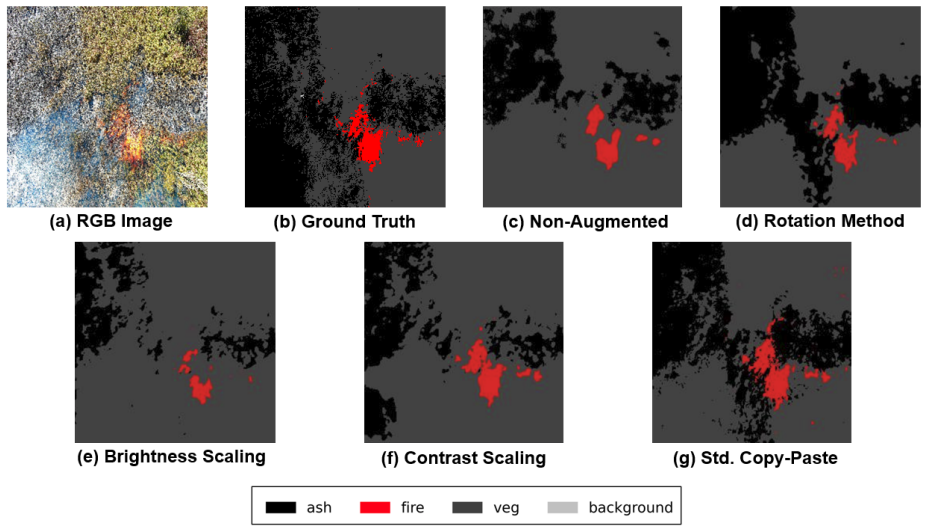
Collecting and annotating images for the purpose of training segmentation models is often cost prohibitive. In the domain of wildland fire science, this challenge is further compounded by the scarcity of reliable public datasets with labeled ground truth. This paper presents the Centralized Copy-Paste Data Augmentation (CCPDA) method, for the purpose of assisting with the training of deep-learning multiclass segmentation models, with special focus on improving segmentation outcomes for the fire-class. CCPDA has three main steps: (i) identify fire clusters in the source image, (ii) apply a centralization technique to focus on the core of the fire area, and (iii) paste the refined fire clusters onto a target image. This method increases dataset diversity while preserving the essential characteristics of the fire class. The effectiveness of this augmentation technique is demonstrated via numerical analysis and comparison against various other augmentation methods using a weighted sum-based multi-objective optimization approach. This approach helps elevate segmentation performance metrics specific to the fire class, which carries significantly more operational significance than other classes (fuel, ash, or background). Numerical performance assessment validates the efficacy of the presented CCPDA method in alleviating the difficulties associated with small, manually labeled training datasets. It also illustrates that CCPDA outperforms other augmentation strategies in the application scenario considered, particularly in improving fire-class segmentation performance.
Editorial analysis
A structured set of objections, weighed in public.
Referee Report
Summary. The paper presents the Centralized Copy-Paste Data Augmentation (CCPDA) method for enhancing semantic segmentation models in wildland fire analysis. CCPDA involves three steps: identifying fire clusters in source images, centralizing to focus on core fire areas, and pasting these clusters onto target images. The authors claim this increases dataset diversity while preserving fire characteristics, leading to better fire-class segmentation performance compared to other augmentations, particularly beneficial for small labeled datasets. Validation is done via weighted multi-objective optimization comparisons.
Significance. If the results hold, this work could significantly aid in developing robust segmentation models for wildland fires by mitigating the impact of limited training data. The emphasis on the fire class aligns with its practical importance in fire science applications. The approach builds on copy-paste augmentation but tailors it with centralization for this domain.
major comments (2)
- [Abstract] The pasting procedure is described without any reference to blending, illumination matching, scale adjustment, or perspective correction. Given that the central claim depends on the pasted fire clusters behaving like genuine instances without artifacts or distribution shift, this omission is load-bearing and requires clarification or additional experiments to support the preservation of essential characteristics.
- [Abstract] The numerical performance assessment and comparisons are reported without details on the dataset size, baseline method implementations, statistical tests, or evaluation across multiple random seeds. This makes it challenging to determine the robustness of the claimed outperformance in fire-class IoU and other metrics.
minor comments (1)
- [Abstract] The abstract mentions 'various other augmentation methods' but does not name them; specifying at least a few examples would improve clarity.
Simulated Author's Rebuttal
We thank the referee for their constructive feedback on our manuscript. We address each major comment point by point below, providing clarifications and committing to revisions that strengthen the presentation without altering the core contributions.
read point-by-point responses
-
Referee: [Abstract] The pasting procedure is described without any reference to blending, illumination matching, scale adjustment, or perspective correction. Given that the central claim depends on the pasted fire clusters behaving like genuine instances without artifacts or distribution shift, this omission is load-bearing and requires clarification or additional experiments to support the preservation of essential characteristics.
Authors: We agree that the abstract's brevity leaves the pasting mechanics underspecified. The full method section details the centralization and pasting steps, including basic alpha blending to reduce edge artifacts and context-aware scaling to match the target image's fire region proportions. To directly address the concern, we will revise the abstract to explicitly note these integration steps and add a short clarification on how they help preserve fire characteristics and limit distribution shift. We will also include one additional qualitative figure in the revision showing before/after pasting examples to visually support the claim. revision: yes
-
Referee: [Abstract] The numerical performance assessment and comparisons are reported without details on the dataset size, baseline method implementations, statistical tests, or evaluation across multiple random seeds. This makes it challenging to determine the robustness of the claimed outperformance in fire-class IoU and other metrics.
Authors: We acknowledge that the abstract omits these implementation specifics for conciseness. The manuscript body (Sections 4 and 5) specifies the dataset composition and size, describes how baseline augmentations were implemented, and reports results aggregated over multiple random seeds using the weighted multi-objective optimization. To improve transparency, we will expand the abstract with a concise mention of the dataset scale, the use of multiple seeds, and the statistical comparison framework. No new experiments are required, but we will ensure the revised abstract better highlights these robustness elements. revision: yes
Circularity Check
No circularity: empirical augmentation validated against external benchmarks
full rationale
The paper introduces CCPDA as a three-step empirical data augmentation procedure (cluster identification, centralization, paste) for improving fire-class segmentation in small wildland fire datasets. Effectiveness is shown via direct numerical comparison to other augmentation strategies using a weighted-sum multi-objective optimization on segmentation metrics. No equations, fitted parameters, or first-principles derivations are present that reduce any claimed result to the method's own inputs by construction. No self-citations are invoked as load-bearing uniqueness theorems or ansatzes. The central performance claim rests on external benchmark comparisons rather than self-referential loops, making the derivation chain self-contained.
Axiom & Free-Parameter Ledger
free parameters (2)
- centralization focus parameters
- weights in multi-objective optimization
axioms (1)
- domain assumption Pasting centrally refined fire clusters preserves the essential visual statistics of real fires
Lean theorems connected to this paper
-
IndisputableMonolith/Cost/FunctionalEquation.leanwashburn_uniqueness_aczel unclear?
unclearRelation between the paper passage and the cited Recognition theorem.
CCPDA has three main steps: (i) identify fire clusters in the source image, (ii) apply a centralization technique to focus on the core of the fire area, and (iii) paste the refined fire clusters onto a target image.
-
IndisputableMonolith/Foundation/RealityFromDistinction.leanreality_from_one_distinction unclear?
unclearRelation between the paper passage and the cited Recognition theorem.
We employ a weighted sum-based multi-objective optimization (MOO) strategy that minimizes false negatives in the fire class
What do these tags mean?
- matches
- The paper's claim is directly supported by a theorem in the formal canon.
- supports
- The theorem supports part of the paper's argument, but the paper may add assumptions or extra steps.
- extends
- The paper goes beyond the formal theorem; the theorem is a base layer rather than the whole result.
- uses
- The paper appears to rely on the theorem as machinery.
- contradicts
- The paper's claim conflicts with a theorem or certificate in the canon.
- unclear
- Pith found a possible connection, but the passage is too broad, indirect, or ambiguous to say the theorem truly supports the claim.
Reference graph
Works this paper leans on
-
[1]
J. C. Sparks, R. E. Masters, D. M. Engle, M. W. Palmer, and G. A. Bukenhofer, “Effects of late growing-season and late dormant-season prescribed fire on herbaceous vegetation in restored pine-grassland communities,” Journal of Vegetation Science , vol. 9, no. 1, pp. 133–142, 1998
work page 1998
-
[2]
Rising wildfire risk to houses in the united states, especially in grasslands and shrublands,
V. C. Radeloff, M. H. Mockrin, D. Helmers, A. Carlson, T. J. Hawbaker, S. Martinuzzi, F. Schug, P. M. Alexandre, H. A. Kramer, and A. M. Pidgeon, “Rising wildfire risk to houses in the united states, especially in grasslands and shrublands,” Science, vol. 382, no. 6671, pp. 702–707, 2023
work page 2023
-
[3]
Economic footprint of california wildfires in 2018,
D. Wang, D. Guan, S. Zhu, M. M. Kinnon, G. Geng, Q. Zhang, H. Zheng, T. Lei, S. Shao, P. Gong, et al. , “Economic footprint of california wildfires in 2018,” Nature Sustainability , vol. 4, no. 3, pp. 252–260, 2021
work page 2018
-
[4]
Climate warming increases extreme daily wildfire growth risk in california,
P. T. Brown, H. Hanley, A. Mahesh, C. Reed, S. J. Strenfel, S. J. Davis, A. K. Kochanski, and C. B. Clements, “Climate warming increases extreme daily wildfire growth risk in california,” Nature, vol. 621, no. 7980, pp. 760–766, 2023
work page 2023
-
[5]
Fire images classification based on a handcraft approach,
H. Harkat, J. M. Nascimento, A. Bernardino, and H. F. T. Ahmed, “Fire images classification based on a handcraft approach,” Expert Systems with Applications , vol. 212, p. 118594, 2023
work page 2023
-
[6]
N. J. Abram, B. J. Henley, A. Sen Gupta, T. J. Lippmann, H. Clarke, A. J. Dowdy, J. J. Sharples, R. H. Nolan, T. Zhang, M. J. Wooster, et al. , “Connections of climate change and variability to large and extreme forest fires in southeast australia,” Communications Earth & Environment, vol. 2, no. 1, pp. 1–17, 2021
work page 2021
-
[7]
Evidence for increasing red maple abundance in the eastern united states,
S. Fei and K. C. Steiner, “Evidence for increasing red maple abundance in the eastern united states,” Forest Science, vol. 53, no. 4, pp. 473–477, 2007
work page 2007
-
[8]
Assessing changes in global fire regimes,
E. Montoya, J. A. L´ opez-S´ aez, J. Madrigal, B. W. Abbott, B. Vanni` ere, B. Leys, D. Colom- baroli, G. Gil-Romera, M. S lowi´ nski, J. C. Aleman, et al. , “Assessing changes in global fire regimes,” 2024
work page 2024
-
[9]
Us fires became larger, more frequent, and more widespread in the 2000s,
V. Iglesias, J. K. Balch, and W. R. Travis, “Us fires became larger, more frequent, and more widespread in the 2000s,” Science advances, vol. 8, no. 11, p. eabc0020, 2022
work page 2022
-
[10]
Human-related ignitions increase the number of large wildfires across us ecoregions,
R. C. Nagy, E. Fusco, B. Bradley, J. T. Abatzoglou, and J. Balch, “Human-related ignitions increase the number of large wildfires across us ecoregions,” Fire, vol. 1, no. 1, p. 4, 2018
work page 2018
-
[11]
The demise of fire and “mesophication
G. J. Nowacki and M. D. Abrams, “The demise of fire and “mesophication” of forests in the eastern united states,” BioScience, vol. 58, no. 2, pp. 123–138, 2008. 17
work page 2008
-
[12]
A. Bouguettaya, H. Zarzour, A. M. Taberkit, and A. Kechida, “A review on early wildfire de- tection from unmanned aerial vehicles using deep learning-based computer vision algorithms,” Signal Processing, vol. 190, p. 108309, 2022
work page 2022
-
[13]
S. Duangsuwan and K. Klubsuwan, “Accuracy assessment of drone real-time open burning imagery detection for early wildfire surveillance,” Forests, vol. 14, no. 9, p. 1852, 2023
work page 2023
-
[14]
J.-H. Kim and B. Y. Lattimer, “Real-time probabilistic classification of fire and smoke using thermal imagery for intelligent firefighting robot,” Fire Safety Journal , vol. 72, pp. 40–49, 2015
work page 2015
-
[15]
K. Penglase, T. Lewis, and S. K. Srivastava, “A new approach to estimate fuel budget and wildfire hazard assessment in commercial plantations using drone-based photogrammetry and image analysis,” Remote Sensing, vol. 15, no. 10, p. 2621, 2023
work page 2023
-
[16]
Wildland fire rate of spread estimation using an autonomous unmanned aerial system: A case study,
B. T. Ford, J. T. Kim, Z. Dong, R. Williams, and M. Kumar, “Wildland fire rate of spread estimation using an autonomous unmanned aerial system: A case study,” in AIAA SCITECH 2024 Forum, p. 0093, 2024
work page 2024
-
[17]
M. Momeni, S. M. J. M. Al-e, et al. , “Collaboration of thermal sensors and drones in fighting wildfires; mathematical model and heuristic approach,” Internet of Things , vol. 26, p. 101168, 2024
work page 2024
-
[18]
Aerial forest fire surveillance-evaluation of forest fire de- tection model using aerial videos,
H. Dang-Ngoc and H. Nguyen-Trung, “Aerial forest fire surveillance-evaluation of forest fire de- tection model using aerial videos,” in 2019 International Conference on Advanced Technologies for Communications (ATC) , pp. 142–148, IEEE, 2019
work page 2019
-
[19]
F. A. Hossain, Y. M. Zhang, and M. A. Tonima, “Forest fire flame and smoke detection from uav-captured images using fire-specific color features and multi-color space local binary pattern,” Journal of Unmanned Vehicle Systems , vol. 8, no. 4, pp. 285–309, 2020
work page 2020
-
[20]
Forest fire detection with color features and wavelet analysis based on aerial imagery,
Z. Jiao, Y. Zhang, J. Xin, Y. Yi, D. Liu, and H. Liu, “Forest fire detection with color features and wavelet analysis based on aerial imagery,” in 2018 Chinese automation congress (CAC) , pp. 2206–2211, IEEE, 2018
work page 2018
-
[21]
C. Yuan, Z. Liu, and Y. Zhang, “Aerial images-based forest fire detection for firefighting using optical remote sensing techniques and unmanned aerial vehicles,” Journal of Intelligent & Robotic Systems, vol. 88, pp. 635–654, 2017
work page 2017
-
[22]
Wildland fire detection and monitoring using a drone-collected rgb/ir image dataset,
X. Chen, B. Hopkins, H. Wang, L. O’Neill, F. Afghah, A. Razi, P. Ful´ e, J. Coen, E. Rowell, and A. Watts, “Wildland fire detection and monitoring using a drone-collected rgb/ir image dataset,” IEEE Access, vol. 10, pp. 121301–121317, 2022
work page 2022
-
[23]
Image fire detection algorithms based on convolutional neural networks,
P. Li and W. Zhao, “Image fire detection algorithms based on convolutional neural networks,” Case Studies in Thermal Engineering , vol. 19, p. 100625, 2020
work page 2020
-
[24]
Beyond boundaries: Unifying classification and segmentation in wildfire detection systems,
S. Singh, V. Vazirani, S. Singhania, V. S. Suroth, V. Soni, A. Biwalkar, and D. Krishnan, “Beyond boundaries: Unifying classification and segmentation in wildfire detection systems,” Multimedia Tools and Applications , pp. 1–33, 2024
work page 2024
-
[25]
U-net: Convolutional networks for biomedical im- age segmentation,
O. Ronneberger, P. Fischer, and T. Brox, “U-net: Convolutional networks for biomedical im- age segmentation,” in Medical image computing and computer-assisted intervention–MICCAI 18 2015: 18th international conference, Munich, Germany, October 5-9, 2015, proceedings, part III 18 , pp. 234–241, Springer, 2015
work page 2015
-
[26]
Object insertion based data augmentation for seman- tic segmentation,
Y. Ren, S. Zhao, and L. Bingbing, “Object insertion based data augmentation for seman- tic segmentation,” in 2022 International Conference on Robotics and Automation (ICRA) , pp. 359–365, IEEE, 2022
work page 2022
-
[27]
Automating data preparation: Can we? should we? must we?,
N. Paton, “Automating data preparation: Can we? should we? must we?,” in 21st Interna- tional Workshop on Design, Optimization, Languages and Analytical Processing of Big Data , 2019
work page 2019
-
[28]
The flame dataset: Aerial imagery pile burn detection using drones (uavs),
A. Shamsoshoara, F. Afghah, A. Razi, L. Zheng, P. Ful´ e, and E. Blasch, “The flame dataset: Aerial imagery pile burn detection using drones (uavs),” 2020
work page 2020
-
[29]
Flame 2: Fire detection and modeling: Aerial multi-spectral image dataset,
B. Hopkins, L. O’Neill, F. Afghah, A. Razi, E. Rowell, A. Watts, P. Fule, and J. Coen, “Flame 2: Fire detection and modeling: Aerial multi-spectral image dataset,” 2022
work page 2022
-
[30]
Prescribed fire science: the case for a refined research agenda,
J. K. Hiers, J. J. O’Brien, J. M. Varner, B. W. Butler, M. Dickinson, J. Furman, M. Gallagher, D. Godwin, S. L. Goodrick, S. M. Hood, et al. , “Prescribed fire science: the case for a refined research agenda,” Fire Ecology, vol. 16, pp. 1–15, 2020
work page 2020
-
[31]
Gradient-based learning applied to document recognition,
Y. LeCun, L. Bottou, Y. Bengio, and P. Haffner, “Gradient-based learning applied to document recognition,” Proceedings of the IEEE , vol. 86, no. 11, pp. 2278–2324, 1998
work page 1998
-
[32]
Imagenet classification with deep convolutional neural networks,
A. Krizhevsky, I. Sutskever, and G. E. Hinton, “Imagenet classification with deep convolutional neural networks,” Advances in neural information processing systems , vol. 25, 2012
work page 2012
-
[33]
Going deeper with convolutions,
C. Szegedy, W. Liu, Y. Jia, P. Sermanet, S. Reed, D. Anguelov, D. Erhan, V. Vanhoucke, and A. Rabinovich, “Going deeper with convolutions,” in Proceedings of the IEEE conference on computer vision and pattern recognition , pp. 1–9, 2015
work page 2015
-
[34]
Autoaugment: Learning augmentation strategies from data,
E. D. Cubuk, B. Zoph, D. Mane, V. Vasudevan, and Q. V. Le, “Autoaugment: Learning augmentation strategies from data,” in Proceedings of the IEEE/CVF conference on computer vision and pattern recognition , pp. 113–123, 2019
work page 2019
-
[35]
Randaugment: Practical automated data augmentation with a reduced search space,
E. D. Cubuk, B. Zoph, J. Shlens, and Q. V. Le, “Randaugment: Practical automated data augmentation with a reduced search space,” in Proceedings of the IEEE/CVF conference on computer vision and pattern recognition workshops , pp. 702–703, 2020
work page 2020
-
[36]
Bag of Freebies for Training Object Detection Neural Networks
Z. Zhang, T. He, H. Zhang, Z. Zhang, J. Xie, and M. Li, “Bag of freebies for training object detection neural networks,” arXiv preprint arXiv:1902.04103 , 2019
work page internal anchor Pith review Pith/arXiv arXiv 1902
-
[37]
Cut, paste and learn: Surprisingly easy synthesis for instance detection,
D. Dwibedi, I. Misra, and M. Hebert, “Cut, paste and learn: Surprisingly easy synthesis for instance detection,” in Proceedings of the IEEE international conference on computer vision , pp. 1301–1310, 2017
work page 2017
-
[38]
Instaboost: Boosting instance segmentation via probability map guided copy-pasting,
H.-S. Fang, J. Sun, R. Wang, M. Gou, Y.-L. Li, and C. Lu, “Instaboost: Boosting instance segmentation via probability map guided copy-pasting,” in Proceedings of the IEEE/CVF international conference on computer vision , pp. 682–691, 2019
work page 2019
-
[39]
Simple copy-paste is a strong data augmentation method for instance segmentation,
G. Ghiasi, Y. Cui, A. Srinivas, R. Qian, T.-Y. Lin, E. D. Cubuk, Q. V. Le, and B. Zoph, “Simple copy-paste is a strong data augmentation method for instance segmentation,” in Proceedings of the IEEE/CVF conference on computer vision and pattern recognition , pp. 2918–2928, 2021. 19
work page 2021
-
[40]
Wildfire segmentation on satellite images using deep learn- ing,
V. Khryashchev and R. Larionov, “Wildfire segmentation on satellite images using deep learn- ing,” in 2020 Moscow Workshop on Electronic and Networking Technologies (MWENT) , pp. 1– 5, 2020
work page 2020
-
[41]
Single image haze removal using dark channel prior,
K. He, J. Sun, and X. Tang, “Single image haze removal using dark channel prior,” IEEE Transactions on Pattern Analysis and Machine Intelligence , vol. 33, no. 12, pp. 2341–2353, 2011
work page 2011
-
[42]
K. He, J. Sun, and X. Tang, “Guided image filtering,” IEEE Transactions on Pattern Analysis and Machine Intelligence , vol. 35, no. 6, pp. 1397–1409, 2013
work page 2013
-
[43]
Improved single image dehazing using guided filter,
J. Pang, O. C. Au, and Z. Guo, “Improved single image dehazing using guided filter,” Proc. APSIPA ASC, pp. 1–4, 2011
work page 2011
-
[44]
Labkit: labeling and segmentation toolkit for big image data,
M. Arzt, J. Deschamps, C. Schmied, T. Pietzsch, D. Schmidt, P. Tomancak, R. Haase, and F. Jug, “Labkit: labeling and segmentation toolkit for big image data,” Frontiers in computer science, vol. 4, p. 777728, 2022
work page 2022
-
[45]
Simple copy-paste is a strong data augmentation method for instance segmentation,
G. Ghiasi, Y. Cui, A. Srinivas, R. Qian, T.-Y. Lin, E. D. Cubuk, Q. V. Le, and B. Zoph, “Simple copy-paste is a strong data augmentation method for instance segmentation,” in Proceedings of the IEEE/CVF conference on computer vision and pattern recognition , pp. 2918–2928, 2021
work page 2021
-
[46]
Wildfire spread prediction using attention mechanisms in u-net,
K. Shah and M. Pantoja, “Wildfire spread prediction using attention mechanisms in u-net,” in 2023 3rd International Conference on Electrical, Computer, Communications and Mecha- tronics Engineering (ICECCME) , pp. 1–6, IEEE, 2023
work page 2023
-
[47]
Burned area semantic segmentation: A novel dataset and evaluation using convolutional networks,
T. F. Ribeiro, F. Silva, J. Moreira, and R. L. d. C. Costa, “Burned area semantic segmentation: A novel dataset and evaluation using convolutional networks,” ISPRS Journal of Photogram- metry and Remote Sensing , vol. 202, pp. 565–580, 2023
work page 2023
-
[48]
A survey on multi-objective based parameter optimization for deep learning,
M. Chakraborty, W. Pal, S. Bandyopadhyay, and U. Maulik, “A survey on multi-objective based parameter optimization for deep learning,” ArXiv, vol. abs/2305.10014, 2023
-
[49]
The weighted sum method for multi-objective optimization: new insights,
R. T. Marler and J. S. Arora, “The weighted sum method for multi-objective optimization: new insights,” Structural and multidisciplinary optimization , vol. 41, pp. 853–862, 2010
work page 2010
-
[50]
B. S. Ahn, “Compatible weighting method with rank order centroid: Maximum entropy or- dered weighted averaging approach,”European Journal of Operational Research, vol. 212, no. 3, pp. 552–559, 2011
work page 2011
-
[51]
A systematic study of the class imbalance problem in convolutional neural networks
M. Buda, A. Maki, and M. A. Mazurowski, “A systematic study of the class imbalance problem in convolutional neural networks,” Neural Networks , vol. 106, pp. 249–259, 2018. arXiv:1710.05381
work page internal anchor Pith review Pith/arXiv arXiv 2018
-
[52]
Segnet: A deep convolutional encoder- decoder architecture for image segmentation,
V. Badrinarayanan, A. Kendall, and R. Cipolla, “Segnet: A deep convolutional encoder- decoder architecture for image segmentation,” IEEE Transactions on Pattern Analysis and Machine Intelligence , vol. 39, no. 12, pp. 2481–2495, 2017
work page 2017
-
[53]
L.-C. Chen, G. Papandreou, I. Kokkinos, K. Murphy, and A. L. Yuille, “Deeplab: Semantic image segmentation with deep convolutional nets, atrous convolution, and fully connected crfs,” IEEE Transactions on Pattern Analysis and Machine Intelligence , vol. 40, no. 4, pp. 834– 848, 2018. 20
work page 2018
-
[54]
Color thresholding method for image segmentation algorithm of ziehl-neelsen sputum slide images,
R. Raof, Z. Salleh, S. Sahidan, M. Mashor, S. M. Noor, F. M. Idris, and H. Hasan, “Color thresholding method for image segmentation algorithm of ziehl-neelsen sputum slide images,” in 2008 5th International Conference on Electrical Engineering, Computing Science and Au- tomatic Control, pp. 212–217, 2008. 21
work page 2008
discussion (0)
Sign in with ORCID, Apple, or X to comment. Anyone can read and Pith papers without signing in.