REVIEW 3 major objections 6 minor 19 references
Discrete Diffusion Models for Language Generation
T0 review · 3 major / 6 minor · reviewed 2026-08-06 · deepseek-v4-flash
Pith's one-line read This thesis establishes that discrete diffusion models can generate language in parallel, but on WikiText-103 they trail autoregressive models in compression and stability while showing a modest speed advantage.
desk verdict The thesis's only pro-diffusion result—speed—turns out to be a transcription of NLL, so it confirms the known quality gap but provides no evidence for the parallel-decoding advantage. read the letter →
The pith
A machine-rendered reading of the paper's core claim, the machinery that carries it, and where it could break.
The reading
What carries the argument
The central object is the absorbing-state D3PM. A forward process pushes each token toward a special mask state through transition matrices $Q_i = (1-\beta_i)I + \beta_i \mathbf{1}\mathbf{e}_m^{\top}$, and a learned denoiser $x_\theta(x_t, t)$ estimates the clean token, which is inserted into the reverse posterior $q(x_s | x_t, x_0)$ to unmask tokens in parallel over $T$ diffusion steps. That parallel unmasking is what gives D3PM its speed profile, while the noise schedule and initialization determine quality and stability. The comparison machinery is the set of metrics, Bits Per Token, Negative Log-Likelihood, Perplexity, and batch processing speed, applied to 100,000 generated tokens per model.
What would settle it
Re-run one D3PM seed and the autoregressive model on WikiText-103 with the same loader batch size, for example 4, and the same 100,000 generated tokens, reporting both BPT and batches per second; if the D3PM speed advantage disappears or its best-run BPT moves outside the 5.0 to 6.5 range while the autoregressive model stays near 4.6, the claimed trade-off is configuration-dependent.
Extended reading notes
Core claim
Taken on its own terms, the paper establishes that a Discrete Denoising Diffusion Probabilistic Model (D3PM) can be trained to generate text on WikiText-103, but only one of three seeded runs converges to competitive behavior; that run gives BPT 5.72, NLL 3.97, and perplexity 52.78, while the other two runs diverge to BPT above 9. The same evaluation shows the custom autoregressive model averaging BPT 4.60 and GPT-2 averaging 4.25, with GPT-2 reaching perplexity near 19. The author reads this as a trade-off: autoregressive models remain better at fluent, context-aware generation and compression, while D3PM offers genuinely parallel decoding and a modest speed advantage over the custom autoregressive pipeline, making it a candidate for masked completion and structured reconstruction tasks rather than open-ended generation.
Load-bearing premise
The central claim rests on the assumption that the comparison is fair, meaning identical training configurations, batch size, and 100,000-token evaluation across models, so that any observed difference reflects architecture rather than protocol.
Editorial extensions
If this is right
- If the result holds, autoregressive models remain the safer default for fluent open-ended generation, because both BPT and perplexity are lower.
- Diffusion-based generation becomes a practical option in settings where parallel throughput matters more than peak quality, provided a converged seed or stabilized training is used.
- D3PM's seed sensitivity implies that a single run is not a reliable performance estimate; multiple seeds are needed before comparing paradigms.
- For masked-token completion, sequence reordering, and denoising tasks, the parallel reverse process may be a better fit than sequential autoregressive decoding.
- The speed advantage over a from-scratch autoregressive model, but not over GPT-2, delimits where non-autoregressive generation currently competes.
Reading between the lines
- An unstated consequence of the parallel architecture is that its speed advantage should grow with sequence length, so a follow-up measuring batches per second at several lengths would test the trade-off more directly.
- The paper positions D3PM for masked completion and reconstruction; a direct benchmark on text infilling or sentence reordering would be a natural test of that positioning.
- If additional seeds cluster near the best run, the mean BPT of 8.05 would fall and the quality gap to autoregressive models would narrow; if they spread, seed instability is the more durable finding.
- The same metrics and 100,000-token protocol could be reused to benchmark other non-autoregressive generators, making the comparison reproducible beyond the two model families tested.
Editorial analysis
A structured set of objections, weighed in public.
Referee Report
Summary. This licentiate thesis compares a Discrete Denoising Diffusion Probabilistic Model (D3PM), implemented with the MDLM codebase, against a small autoregressive (AR) model and a fine-tuned GPT-2 on WikiText-103. It reports Bits Per Token (BPT), Negative Log-Likelihood (NLL), perplexity, and batch processing speed across a small number of seeds. The central claims are that AR achieves lower BPT (mean 4.59) than D3PM (mean 8.05, best 5.72), while D3PM offers higher processing speed (up to 3.97 batches/s), indicating potential for parallel generation. The thesis also contains an introduction to discrete diffusion theory and a discussion of limitations.
Significance. If the reported results held, the paper would provide a modest but useful empirical datapoint on the quality/speed trade-off between autoregressive and discrete diffusion language models. The negative quality result (AR better BPT than D3PM) is plausible and consistent with the broader literature, and the public code repository is a strength. However, the only result favoring D3PM—the speed advantage—is not supported by the reported data: the 'Speed' column for AR and D3PM exactly reproduces the NLL values in the same tables. Since the abstract and conclusions hinge on D3PM's speed potential, the manuscript's main positive claim is currently unverified.
major comments (3)
- [Tables 4.1 and 4.2; Abstract] In Tables 4.1 and 4.2, the reported 'Speed (Batch/s)' values for the AR and D3PM models coincide numerically with the NLL values in the same rows (for example, D3PM seed 2000: speed 3.9661 vs NLL 3.9661; seed 1000: speed 6.2690 vs NLL 6.2693; seed 3000: speed 6.5199 vs NLL 6.5199; AR seed 1: speed 3.1832 vs NLL 3.1833). An independent throughput measurement would not be expected to track a log-likelihood loss to several decimal places. This strongly suggests that the speed was not measured independently or that the wrong quantity was copied into the Speed column. Because the abstract's favorable claim for D3PM is precisely its 'higher processing speed, reaching up to 3.97 batches per sec.', the speed advantage is unsupported and must be re-measured under controlled conditions before any comparison can be made.
- [Section 4 and Appendix 7.5] The evaluation protocol is not consistent between models. Section 4 states that all models were trained and evaluated with batch size 4, but the D3PM training command in Appendix 7.5 sets loader.batch_size=8 and only loader.eval_batch_size=4. Because throughput in batches per second depends directly on batch size, this discrepancy invalidates the claimed 'consistent conditions' premise and could by itself explain speed differences. The comparison must be repeated with identical batch sizes in both training and evaluation.
- [Abstract, Section 4.2, and Section 5.1] The speed claim is internally inconsistent. Even taking Table 4.2 at face value, the maximum reported D3PM speed is 6.5199 batches/s (seed 3000), and seed 1000 reports 6.2690 batches/s, both larger than the 'up to 3.97 batches per sec.' stated in the abstract; the 3.97 value is simply the speed of the best-BPT seed, not a maximum. Moreover, Section 5.1 states that 'in terms of inference speed, both AR and D3PM models demonstrated comparable performance,' which contradicts the abstract's assertion of a D3PM speed advantage. The narrative needs to be aligned with the actual, re-measured numbers.
minor comments (6)
- [Section 3.3.3 and Section 4] Section 3.3.3 describes 'generation speed (measured in tokens per second),' while Section 4 and the tables report 'Speed (Batch/s)'; the units must be defined consistently throughout the thesis.
- [Table 4.1] Table 4.1 is malformed: the AR row contains values ('4.5976512 4.6028 3.1904 24.2989 3.1904') that do not align with the column headers and appear to merge results from two seeds into one row; the table must be reformatted so each column contains a single metric.
- [Section 5.1] Section 5.1 contains unresolved '??' placeholders (for example, 'Figures ?? and 7.6'); these need to be replaced with actual cross-references.
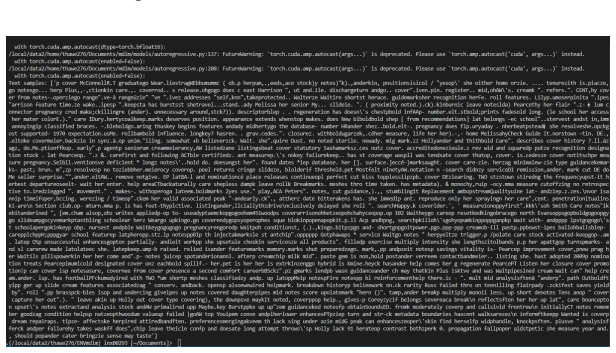
- [Appendix 7.4] Appendix 7.4 includes raw terminal output and TensorFlow warning messages; this material should be replaced with clean, formatted results and sample generations.
- [Section 2.1.1] The BPC and BPT formulas use a leading negative sign and a fraction in a manner that is difficult to parse; using display math with clear notation would improve readability.
- [Section 3.3.2 and Bibliography] The MDLM package is credited to Ho et al. [10] in Section 3.3.2, but the correct reference for MDLM is Sahoo et al. [16]; please verify and correct the citation.
Circularity Check
The thesis is an empirical benchmark with no derivation-chain circularity, but the reported D3PM speed advantage is compromised because the 'Speed' values equal the NLL values in the same rows, so the central speed claim is not independently supported.
-
other
[Abstract; Tables 4.1, 4.2, and 5.2]
"Results show ... D3PM achieves higher processing speed, reaching up to 3.97 batches per sec., indicating potential for parallel generation. Table 4.2, seed 2000 row: '5.7219 3.9661 52.7819 3.9661'."
The abstract's central claim of a D3PM speed advantage of 3.97 batches/s is taken from the seed-2000 row of Table 4.2, where the 'Speed (Batch/s)' value is 3.9661, exactly equal to the NLL value 3.9661 in the same row. The same coincidence appears for D3PM seeds 1000 and 3000 (Speed 6.2690 vs NLL 6.2693; Speed 6.5199 vs NLL 6.5199) and for the AR model in Table 4.1 (Speed 3.1832 vs NLL 3.1833). Thus the speed numbers are not independent throughput measurements; the reported speed result reduces to the reported NLL value by transcription, and the paper's main positive claim for D3PM rests on that equivalence.
full rationale
The thesis is an empirical comparison rather than a derivation: the theory sections reproduce standard D3PM/MDLM equations from Austin et al. and Sahoo et al., and no new first-principles result is claimed, so there is no circular derivation chain to walk. The MDLM framework attributions in Appendix 7.3 are ordinary tool citations, not load-bearing self-citations. The notable circularity-adjacent issue is the speed metric: in Tables 4.1, 4.2, and 5.2, the 'Speed (Batch/s)' values for AR and D3PM equal the NLL values in the same rows, while GPT-2's speed values differ from its NLL, indicating that throughput was not measured independently for the former models. Because the abstract's headline claim that D3PM reaches 3.97 batches/s is exactly the seed-2000 NLL value, the speed advantage is an unsupported, reported-metric equivalence rather than a real measurement. That is primarily a data-integrity and correctness problem, but because the claimed speed result is equivalent to the NLL result by construction in the table, it warrants a partial circularity flag and a score of 4 rather than 0. Additional protocol inconsistencies, such as Section 4 stating batch size 4 while the Appendix 7.5 command sets loader.batch_size=8 and loader.eval_batch_size=4, further weaken the empirical comparison but are not themselves circular reasoning.
Assumptions & free parameters
free parameters (3)
- Diffusion horizon T and sampling steps =
1000
- Noise/learning-rate parameter beta =
0.0003
- Model size small =
small / about 124M parameters
assumptions (4)
- domain assumption The forward corruption process is Markov, so q(xs|xt) equals q(xs|xt, x0).
- domain assumption Masking with an absorbing MASK state and transition matrix Qi = (1 - beta_i)I + beta_i times 1 e_m^T is a valid discrete corruption process.
- domain assumption The same evaluation harness yields comparable BPT, NLL, and PPL across AR and D3PM.
- ad hoc to paper All models were trained and evaluated under identical conditions, including batch size 4 and 100,000 generated tokens.
Cite this review
Pith. "Pith review of Discrete Diffusion Models for Language Generation." pith.science (2026). https://pith.science/paper/VA4OZ52D
@misc{pith2026250707050,
  author       = {Pith},
  title        = {Pith review of: Discrete Diffusion Models for Language Generation},
  year         = {2026},
  howpublished = {\url{https://pith.science/paper/VA4OZ52D}},
  note         = {Machine review of arXiv:2507.07050}
}
read the original abstract
Diffusion models have emerged as a powerful class of generative models, achieving state-of-the-art results in continuous data domains such as image and video generation. Their core mechanism involves a forward diffusion process that gradually transforms structured data into a Gaussian-like distribution, followed by a learned reverse process to reconstruct the data. While successful in continuous modalities, applying this framework to discrete data-particularly natural language-remains challenging due to token dependency complexities and the lack of a defined generation order.This thesis investigates the feasibility and performance of discrete diffusion models for natural language generation. Specifically, we evaluate the Discrete Denoising Diffusion Probabilistic Model (D3PM) and compare it with traditional autoregressive (AR) language models. To assess generative performance, we use Bits Per Token (BPT), Negative Log-Likelihood (NLL), Perplexity (PPL), and Batch Processing Speed. Results show the best-performing D3PM model achieves a BPT of 5.72, with a mean of 8.05. The AR model outperforms in compression with a lower mean BPT of 4.59, but D3PM achieves higher processing speed, reaching up to 3.97 batches per sec., indicating potential for parallel generation.All evaluations were conducted under consistent conditions-generating 100,000 tokens per model with a fixed batch size of four-for fair comparison. This research presents a detailed analysis of diffusion-based vs. autoregressive models, highlighting trade-offs in generative quality and efficiency. Findings emphasize both the promise and limitations of diffusion models for discrete data, supporting future work in non-autoregressive language generation.
Figures


Figures from the paper (19 more)




Reference graph
Works this paper leans on
-
[1]
Structured denoising diffusion models in discrete state-spaces
Jacob Austin, Daniel D Johnson, Jonathan Ho, Daniel Tarlow, and Rianne Van Den Berg. Structured denoising diffusion models in discrete state-spaces. Advances in Neural Information Processing Systems , 34:17981--17993, 2021
work page 2021
-
[2]
A survey on prompting techniques in llms
Prabin Bhandari. A survey on prompting techniques in llms. arXiv preprint arXiv:2312.03740 , 2023
arXiv 2023
-
[3]
Better Character Language Modeling Through Morphology
Terra Blevins and Luke Zettlemoyer. Better character language modeling through morphology. arXiv preprint arXiv:1906.01037 , 2019
work page Pith review arXiv 1906
-
[4]
Pixelsnail: An improved autoregressive generative model
Xi Chen, Nikhil Mishra, Mostafa Rohaninejad, and Pieter Abbeel. Pixelsnail: An improved autoregressive generative model. In International Conference on Machine Learning , pages 864--872. PMLR, 2018
work page 2018
-
[5]
Lizhe Fang, Yifei Wang, Zhaoyang Liu, Chenheng Zhang, Stefanie Jegelka, Jinyang Gao, Bolin Ding, and Yisen Wang. What is wrong with perplexity for long-context language modeling? arXiv preprint arXiv:2410.23771 , 2024
arXiv 2024
-
[6]
Gregory Grefenstette. Tokenization. In Syntactic Wordclass Tagging , pages 117--133. Springer, 1999
work page 1999
-
[7]
Towards tokenization evaluation
Benoît Habert, Gilles Adda, Martine Adda-Decker, Philippe Boula de Mareüil, Silvana Ferrari, Olivier Ferret, Gabriel Illouz, and P Paraubeck. Towards tokenization evaluation. In LREC , pages 427--432, 1998
work page 1998
-
[8]
Symbolic word clustering for medium-size corpora
Benoît Habert, Elie Naulleau, and Adeline Nazarenko. Symbolic word clustering for medium-size corpora. In COLING 1996 Volume 1: The 16th International Conference on Computational Linguistics , 1996
work page 1996
Show all 19 references
-
[9]
Learning multi-modal generative models with permutation-invariant encoders and tighter variational objectives
Marcel Hirt, Domenico Campolo, Victoria Leong, and Juan-Pablo Ortega. Learning multi-modal generative models with permutation-invariant encoders and tighter variational objectives. arXiv preprint arXiv:2309.00380 , 2023
2023 arXiv
-
[10]
Denoising diffusion probabilistic models
Jonathan Ho, Ajay Jain, and Pieter Abbeel. Denoising diffusion probabilistic models. Advances in Neural Information Processing Systems , 33:6840--6851, 2020
2020
-
[11]
Perplexity—a measure of the difficulty of speech recognition tasks
Fred Jelinek, Robert L Mercer, Lalit R Bahl, and James K Baker. Perplexity—a measure of the difficulty of speech recognition tasks. The Journal of the Acoustical Society of America , 62(S1):S63--S63, 1977
1977
-
[12]
Discrete diffusion modeling by estimating the ratios of the data distribution
Aaron Lou, Chenlin Meng, and Stefano Ermon. Discrete diffusion modeling by estimating the ratios of the data distribution. arXiv preprint arXiv:2310.16834 , 2023
2023 arXiv
-
[13]
Pointer sentinel mixture models, 2016
Stephen Merity, Caiming Xiong, James Bradbury, and Richard Socher. Pointer sentinel mixture models, 2016
2016
-
[14]
Medt: Using multimodal encoding-decoding network as in transformer for multimodal sentiment analysis
Qingfu Qi, Liyuan Lin, Rui Zhang, and Chengrong Xue. Medt: Using multimodal encoding-decoding network as in transformer for multimodal sentiment analysis. IEEE Access , 10:28750--28759, 2022
2022
-
[15]
Fast generation for convolutional autoregressive models
Prajit Ramachandran, Tom Le Paine, Pooya Khorrami, Mohammad Babaeizadeh, Shiyu Chang, Yang Zhang, Mark A Hasegawa-Johnson, Roy H Campbell, and Thomas S Huang. Fast generation for convolutional autoregressive models. arXiv preprint arXiv:1704.06001 , 2017
2017 arXiv
-
[16]
Simple and effective masked diffusion language models
Subham Sahoo, Marianne Arriola, Yair Schiff, Aaron Gokaslan, Edgar Marroquin, Justin Chiu, Alexander Rush, and Volodymyr Kuleshov. Simple and effective masked diffusion language models. Advances in Neural Information Processing Systems , 37:130136--130184, 2024
2024
-
[17]
Simplified and generalized masked diffusion for discrete data
Jiaxin Shi, Kehang Han, Zhe Wang, Arnaud Doucet, and Michalis Titsias. Simplified and generalized masked diffusion for discrete data. Advances in Neural Information Processing Systems , 37:103131--103167, 2024
2024
-
[18]
Attention is all you need
Ashish Vaswani, Noam Shazeer, Niki Parmar, Jakob Uszkoreit, Llion Jones, Aidan N Gomez, Łukasz Kaiser, and Illia Polosukhin. Attention is all you need. Advances in Neural Information Processing Systems , 30, 2017
2017
-
[19]
Mmoe: Enhancing multimodal models with mixtures of multimodal interaction experts
Haofei Yu, Zhengyang Qi, Lawrence Jang, Ruslan Salakhutdinov, Louis-Philippe Morency, and Paul Pu Liang. Mmoe: Enhancing multimodal models with mixtures of multimodal interaction experts. arXiv preprint arXiv:2311.09580 , 2023
2023 arXiv
Reviewed August 6, 2026 · model on record in the stance chip above.
Discussion (0). Sign in to comment.