Amplifying muon-to-positron conversion in nuclei with ultralight dark matter
Pith reviewed 2026-05-19 05:23 UTC · model grok-4.3
The pith
Ultralight scalar dark matter amplifies muon-to-positron conversion rates in nuclei by inducing an off-diagonal Majorana mass.
A machine-rendered reading of the paper's core claim, the machinery that carries it, and where it could break.
Core claim
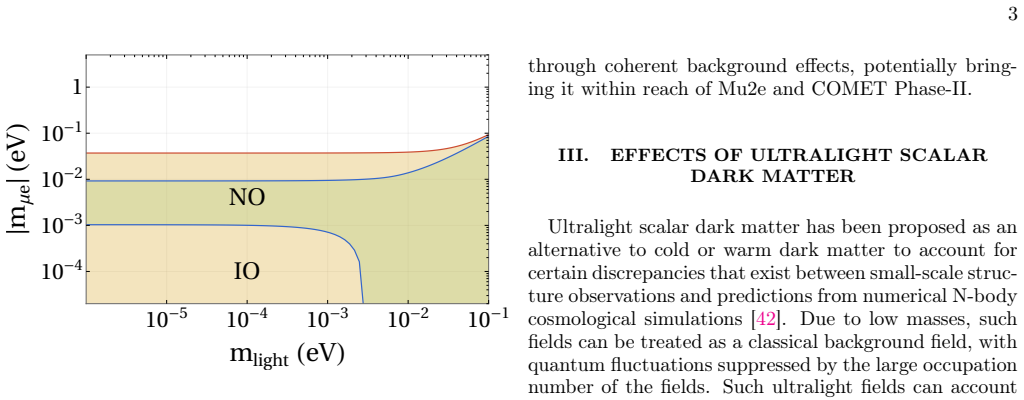
We present an analysis of the lepton-number and lepton-flavour-violating process of muon-to-positron conversion μ− + N → e+ + N′, in the presence of an ultralight scalar dark matter (ULSDM) field which couples to neutrinos. The ULSDM contributes to the effective off-diagonal Majorana mass m_μe, therefore amplifying the rate of muon-to-positron conversion to experimentally observable levels. Using existing bounds from SINDRUM II, COMET, and Mu2e experiments, we derive novel constraints on the flavour-off-diagonal couplings of neutrinos to ULSDM. Our work reveals that upcoming experiments can provide stronger sensitivity to these new couplings than bounds arising from cosmological surveys and
What carries the argument
The effective off-diagonal Majorana mass m_μe generated by the coupling of the ultralight scalar dark matter field to neutrinos.
Load-bearing premise
The ultralight scalar dark matter field couples to neutrinos in a flavor-off-diagonal manner that produces a coherent effective Majorana mass term m_μe capable of enhancing the conversion rate inside nuclei.
What would settle it
Non-observation of muon-to-positron conversion at the sensitivity levels projected for upcoming runs of Mu2e or COMET, in the range of couplings still allowed by cosmology, would rule out the proposed amplification from ultralight dark matter.
Figures


read the original abstract
We present an analysis of the lepton-number and lepton-flavour-violating process of muon-to-positron conversion $\mu^- + N \rightarrow e^+ + N'$, in the presence of an ultralight scalar dark matter (ULSDM) field which couples to neutrinos. The ULSDM contributes to the effective off-diagonal Majorana mass $ m_{\mu e}$, therefore amplifying the rate of muon-to-positron conversion to experimentally observable levels. Using existing bounds from SINDRUM II, COMET, and Mu2e experiments, we derive novel constraints on the flavour-off-diagonal couplings of neutrinos to ULSDM. Our work reveals that upcoming experiments can provide stronger sensitivity to these new couplings than bounds arising from cosmological surveys and terrestrial experiments.
Editorial analysis
A structured set of objections, weighed in public.
Referee Report
Summary. The manuscript analyzes the lepton-number and lepton-flavor violating process μ− + N → e+ + N' in the presence of an ultralight scalar dark matter (ULSDM) field coupling to neutrinos. It claims that the ULSDM induces an effective off-diagonal Majorana mass m_μe that amplifies the conversion rate to experimentally observable levels. Existing bounds from SINDRUM II, COMET, and Mu2e are used to derive novel constraints on the flavor-off-diagonal neutrino-ULSDM couplings, with the argument that upcoming experiments can exceed the sensitivity of cosmological surveys and terrestrial experiments.
Significance. If the central mechanism holds after proper accounting for time dependence, the work provides a new avenue to constrain ultralight scalar dark matter via lepton-flavor violation in nuclei, leveraging high-precision muon conversion experiments. This could complement or surpass existing bounds if the effective mass derivation is robust and the parameter space is correctly mapped.
major comments (1)
- [rate derivation and effective mass section] The central claim that the ULSDM amplifies the conversion rate to observable levels (abstract and rate derivation) assumes a static effective mass m_μe. However, the oscillating ULSDM field φ(t) = φ0 cos(m_φ t + δ) with m_φ ≪ 10^{-20} eV makes m_μe(t) = g φ(t) time-dependent. The instantaneous rate ∝ |m_μe(t)|^2 requires the time average ⟨|m_μe|^2⟩ = (g φ0)^2 / 2 (or random-phase ensemble average) when comparing to experimental limits; using the peak amplitude without this factor overestimates the enhancement by √2 and affects whether SINDRUM II/COMET bounds already exclude the claimed parameter space.
minor comments (1)
- [introduction] Clarify the precise definition of the coupling g and its relation to the Majorana mass term in the Lagrangian to avoid ambiguity with standard neutrino mass parameters.
Simulated Author's Rebuttal
We thank the referee for their careful reading of the manuscript and for highlighting the important issue of time dependence in the effective mass. We address this comment directly below and have revised the manuscript to incorporate the appropriate averaging.
read point-by-point responses
-
Referee: [rate derivation and effective mass section] The central claim that the ULSDM amplifies the conversion rate to observable levels (abstract and rate derivation) assumes a static effective mass m_μe. However, the oscillating ULSDM field φ(t) = φ0 cos(m_φ t + δ) with m_φ ≪ 10^{-20} eV makes m_μe(t) = g φ(t) time-dependent. The instantaneous rate ∝ |m_μe(t)|^2 requires the time average ⟨|m_μe|^2⟩ = (g φ0)^2 / 2 (or random-phase ensemble average) when comparing to experimental limits; using the peak amplitude without this factor overestimates the enhancement by √2 and affects whether SINDRUM II/COMET bounds already exclude the claimed parameter space.
Authors: We agree that the oscillating nature of the ULSDM field requires careful treatment. The field takes the form φ(t) = φ0 cos(m_φ t + δ), so that m_μe(t) = g φ(t) is explicitly time dependent. Because the muon conversion experiments integrate over timescales much longer than the oscillation period (given m_φ ≪ 10^{-20} eV), the observable rate is proportional to the time average ⟨|m_μe(t)|^2⟩ = (g φ0)^2 / 2. Our original derivation inadvertently used the peak amplitude without this averaging, thereby overestimating the rate by a factor of two. We have revised the rate derivation section to employ the proper time-averaged quantity and have updated the resulting constraints on the flavor-off-diagonal couplings by the corresponding factor of √2. The abstract has also been adjusted to reflect this correction. After these changes the central conclusion—that upcoming experiments can still probe regions of parameter space beyond existing cosmological and terrestrial bounds—remains valid. revision: yes
Circularity Check
Derivation self-contained against external experimental benchmarks
full rationale
The paper derives constraints on neutrino-ULSDM couplings by inserting the effective off-diagonal Majorana mass m_μe (generated by the scalar coupling) into the standard μ−→e+ conversion rate formula and then applying published upper limits from SINDRUM II, COMET, and Mu2e. No step reduces a prediction to a fitted parameter by construction, no load-bearing uniqueness theorem is imported from the authors’ prior work, and the central amplification claim rests on external experimental bounds rather than internal normalization or self-citation chains. The time-dependent oscillation of the ULSDM field raises a separate correctness question about averaging but does not create circularity in the derivation itself.
Axiom & Free-Parameter Ledger
axioms (2)
- domain assumption Neutrinos are Majorana particles allowing off-diagonal mass terms
- domain assumption Ultralight scalar dark matter field is coherent over nuclear scales
Reference graph
Works this paper leans on
-
[1]
Amplifying muon-to-positron conversion in nuclei with ultralight dark matter
and SINDRUM [41] respectively. Experimentally, the SINDRUM II experiment places the strongest bound onµ− →e +, with a limit of Br(µ−+ Ti→e ++Ca)<1.7×10 −12 at 90% confidence level [41]. Next-generation experiments such as COMET [20] and Mu2e [17] will improve this sensitivity by several orders of magnitude, thereby probing branching ratios as low as10 −17...
work page internal anchor Pith review Pith/arXiv arXiv 2025
-
[2]
B. T. Cleveland, T. Daily, R. Davis, Jr., J. R. Distel, K. Lande, C. K. Lee, P. S. Wildenhain, and J. Ullman, Astrophys. J.496, 505 (1998)
work page 1998
-
[3]
K. S. Hirataet al.(Kamiokande-II), Phys. Rev. Lett.63, 16 (1989)
work page 1989
-
[4]
J. N. Abdurashitovet al.(SAGE), Phys. Rev. C60, 055801 (1999), arXiv:astro-ph/9907113
work page internal anchor Pith review Pith/arXiv arXiv 1999
- [5]
-
[6]
Measurements of the Solar Neutrino Flux from Super-Kamiokande's First 300 Days
Y. Fukudaet al.(Super-Kamiokande), Phys. Rev. Lett. 81, 1158 (1998), [Erratum: Phys.Rev.Lett. 81, 4279 (1998)], arXiv:hep-ex/9805021
work page internal anchor Pith review Pith/arXiv arXiv 1998
-
[7]
Q. R. Ahmadet al.(SNO), Phys. Rev. Lett.87, 071301 (2001), arXiv:nucl-ex/0106015
work page internal anchor Pith review Pith/arXiv arXiv 2001
- [8]
-
[9]
K. S. Hirataet al.(Kamiokande-II), Phys. Lett. B280, 146 (1992)
work page 1992
-
[10]
Fukudaet al.(Kamiokande), Phys
Y. Fukudaet al.(Kamiokande), Phys. Lett. B335, 237 (1994)
work page 1994
-
[11]
Evidence for oscillation of atmospheric neutrinos
Y. Fukudaet al.(Super-Kamiokande), Phys. Rev. Lett. 81, 1562 (1998), arXiv:hep-ex/9807003
work page internal anchor Pith review Pith/arXiv arXiv 1998
- [12]
-
[13]
J. F. Nieves, Phys. Lett. B147, 375 (1984)
work page 1984
-
[14]
S. M. Bilenky, S. Pascoli, and S. T. Petcov, Phys. Rev. D64, 053010 (2001), arXiv:hep-ph/0102265
work page internal anchor Pith review Pith/arXiv arXiv 2001
- [15]
-
[16]
The muon-positron conversion in nuclei mediated by light Majorana neutrinos
F. Simkovic, P. Domin, S. V. Kovalenko, and A. Faessler, Part. Nucl. Lett.104, 40 (2001), arXiv:hep-ph/0103029
work page internal anchor Pith review Pith/arXiv arXiv 2001
- [17]
-
[18]
L. Bartoszeket al.(Mu2e) 10.2172/1172555 (2014), arXiv:1501.05241 [physics.ins-det]
work page internal anchor Pith review Pith/arXiv arXiv doi:10.2172/1172555 2014
- [19]
-
[20]
T. Geib, A. Merle, and K. Zuber, Phys. Lett. B764, 157 (2017), arXiv:1609.09088 [hep-ph]
work page internal anchor Pith review Pith/arXiv arXiv 2017
-
[21]
Abramishviliet al.(COMET), PTEP2020, 033C01 (2020), arXiv:1812.09018 [physics.ins-det]
R. Abramishviliet al.(COMET), PTEP2020, 033C01 (2020), arXiv:1812.09018 [physics.ins-det]
- [22]
-
[23]
Search for Majorana Neutrinos near the Inverted Mass Hierarchy Region with KamLAND-Zen
A. Gandoet al.(KamLAND-Zen), Phys. Rev. Lett.117, 082503 (2016), [Addendum: Phys.Rev.Lett. 117, 109903 (2016)], arXiv:1605.02889 [hep-ex]
work page internal anchor Pith review Pith/arXiv arXiv 2016
-
[24]
Abeet al.(KamLAND-Zen), (2022), arXiv:2203.02139 [hep-ex]
S. Abeet al.(KamLAND-Zen), (2022), arXiv:2203.02139 [hep-ex]
-
[25]
M. Agostiniet al.(GERDA), Phys. Rev. Lett.125, 252502 (2020), arXiv:2009.06079 [nucl-ex]
-
[26]
G. Antonet al.(EXO-200), Phys. Rev. Lett.123, 161802 (2019), arXiv:1906.02723 [hep-ex]
- [27]
-
[28]
O. Azzolini, J. W. Beeman, F. Bellini, M. Beretta, M. Bi- assoni, C. Brofferio, C. Bucci, S. Capelli, L. Cardani, P. Carniti, N. Casali, D. Chiesa, M. Clemenza, O. Cre- monesi, A.Cruciani, I.Dafinei, S.DiDomizio, F.Ferroni, L. Gironi, A. Giuliani, P. Gorla, C. Gotti, G. Keppel, M. Martinez, S. Nagorny, M. Nastasi, S. Nisi, C. Nones, D. Orlandi, L. Pagnani...
work page 2019
- [29]
- [30]
-
[31]
Nuclear muon-positron conversion mediated by Majorana neutrinos
P. Domin, S. Kovalenko, A. Faessler, and F. Simkovic, Phys. Rev. C70, 065501 (2004), arXiv:nucl-th/0409033
work page internal anchor Pith review Pith/arXiv arXiv 2004
-
[32]
The (muon^-,muon^+) conversion in nuclei as a probe of new physics
F. Simkovic, A. Faessler, S. Kovalenko, and I. Schmidt, Phys. Rev. D66, 033005 (2002), arXiv:hep-ph/0112271
work page internal anchor Pith review Pith/arXiv arXiv 2002
-
[33]
J. M. Berryman, A. de Gouvêa, K. J. Kelly, and A. Kobach, Phys. Rev. D95, 115010 (2017), arXiv:1611.00032 [hep-ph]
work page internal anchor Pith review Pith/arXiv arXiv 2017
-
[34]
$\boldsymbol{\mu^-}$- $\boldsymbol{e^+}$ Conversion from Short-Range Operators
T. Geib and A. Merle, Phys. Rev. D95, 055009 (2017), arXiv:1612.00452 [hep-ph]
work page internal anchor Pith review Pith/arXiv arXiv 2017
- [35]
-
[36]
K. S. Babu and C. N. Leung, Nucl. Phys. B619, 667 (2001), arXiv:hep-ph/0106054
work page internal anchor Pith review Pith/arXiv arXiv 2001
-
[37]
A Survey of Lepton Number Violation Via Effective Operators
A. de Gouvêa and J. Jenkins, Phys. Rev. D77, 013008 (2008), arXiv:0708.1344
work page internal anchor Pith review Pith/arXiv arXiv 2008
-
[38]
P. W. Angel, N. L. Rodd, and R. R. Volkas, Phys. Rev. D87, 073007 (2013), arXiv:1212.6111
work page internal anchor Pith review Pith/arXiv arXiv 2013
-
[39]
A. de Gouvêa, W.-C. Huang, J. König, and M. Sen, Phys. Rev. D100, 075033 (2019), arXiv:1907.02541
- [40]
-
[41]
A. M. Baldiniet al.(MEG), Eur. Phys. J. C76, 434 (2016), arXiv:1605.05081 [hep-ex]
work page internal anchor Pith review Pith/arXiv arXiv 2016
-
[42]
Kaulardet al.(SINDRUM II Collaboration), Phys
J. Kaulardet al.(SINDRUM II Collaboration), Phys. Lett. B422, 334 (1998)
work page 1998
-
[43]
W. Hu, R. Barkana, and A. Gruzinov, Phys. Rev. Lett. 85, 1158 (2000), arXiv:astro-ph/0003365
work page internal anchor Pith review Pith/arXiv arXiv 2000
- [44]
- [45]
- [46]
-
[47]
Kaulardet al.(SINDRUM II), Phys
J. Kaulardet al.(SINDRUM II), Phys. Lett. B422, 334 (1998)
work page 1998
-
[48]
P. F. de Salas, D. V. Forero, S. Gariazzo, P. Martínez- Miravé, O. Mena, C. A. Ternes, M. Tórtola, and J. W. F. Valle, JHEP02, 071, arXiv:2006.11237 [hep-ph]
work page internal anchor Pith review arXiv 2006
-
[49]
N. Dalal and A. Kravtsov, Phys. Rev. D106, 063517 (2022), arXiv:2203.05750 [astro-ph.CO]
-
[50]
R. V. Wagoner, W. A. Fowler, and F. Hoyle, Astrophys. J.148, 3 (1967)
work page 1967
-
[51]
A. M. Boesgaard and G. Steigman, Annu. Rev. Astron. Astrophys.23, 319 (1985)
work page 1985
-
[52]
D. N. Schramm and M. S. Turner, Rev. Mod. Phys.70, 303 (1998)
work page 1998
-
[53]
K. A. Olive, G. Steigman, and T. P. Walker, Phys. Rep. 333, 389 (2000)
work page 2000
- [54]
-
[55]
R. H. Cyburt, B. D. Fields, K. A. Olive, and T. H. Yeh, Rev. Mod. Phys.88, 015004 (2016)
work page 2016
- [56]
-
[57]
Observational Constraints on Secret Neutrino Interactions from Big Bang Nucleosynthesis
G.-y. Huang, T. Ohlsson, and S. Zhou, Phys. Rev. D97, 075009 (2018), arXiv:1712.04792 [hep-ph]
work page internal anchor Pith review Pith/arXiv arXiv 2018
-
[58]
Limits on Neutrino-Neutrino Scattering in the Early Universe
F.-Y. Cyr-Racine and K. Sigurdson, Phys. Rev. D90, 123533 (2014), arXiv:1306.1536
work page internal anchor Pith review Pith/arXiv arXiv 2014
-
[59]
I. M. Oldengott, T. Tram, C. Rampf, and Y. Y. Y. Wong, JCAP11, 027, arXiv:1706.02123
work page internal anchor Pith review Pith/arXiv arXiv
- [60]
- [61]
-
[62]
Fuzzy Dark Matter and Non-Standard Neutrino Interactions
V. Brdar, J. Kopp, J. Liu, P. Prass, and X.-P. Wang, Phys. Rev. D97, 043001 (2018), arXiv:1705.09455 [hep- ph]
work page internal anchor Pith review Pith/arXiv arXiv 2018
- [63]
- [64]
-
[65]
Supernova Bounds on Majoron-emitting decays of light neutrinos
M. Kachelriess, R. Tomas, and J. W. F. Valle, Phys. Rev. D62, 023004 (2000), arXiv:hep-ph/0001039
work page internal anchor Pith review Pith/arXiv arXiv 2000
-
[66]
Majoron Dark Matter and Constraints on the Majoron-Neutrino Coupling
T. Brune and P. Pasquini, Phys. Rev. D99, 096005 (2019), arXiv:1808.08158
work page internal anchor Pith review Pith/arXiv arXiv 2019
-
[67]
G. G. Raffelt,Stars as Laboratories for Fundamen- tal Physics: The Astrophysics of Neutrinos, Axions, and Other Weakly Interacting Particles(University of Chicago Press, 1996)
work page 1996
-
[68]
A. de Gouvêa, I. Martinez-Soler, Y. F. Perez-Gonzalez, and M. Sen, Phys. Rev. D106, 103026 (2022), arXiv:2205.01102 [hep-ph]
- [69]
-
[70]
Neutrino Oscillations as a Probe of Light Scalar Dark Matter
A. Berlin, Phys. Rev. Lett.117, 231801 (2016), arXiv:1608.01307 [hep-ph]
work page internal anchor Pith review Pith/arXiv arXiv 2016
- [71]
- [72]
- [73]
-
[74]
H. Davoudiasl and P. B. Denton, Phys. Rev. D108, 035013 (2023), arXiv:2301.09651 [hep-ph]
-
[75]
P. Escribano and A. Vicente, JHEP03, 240, arXiv:2008.01099 [hep-ph]
-
[76]
I. Bigaran, P. J. Fox, Y. Gouttenoire, R. Harnik, G. Krn- jaic, T. Menzo, and J. Zupan, (2025), arXiv:2503.07722 [hep-ph]
discussion (0)
Sign in with ORCID, Apple, or X to comment. Anyone can read and Pith papers without signing in.