REVIEW 3 major objections 5 minor 129 references
Tidal Disruption Event Demographics in Supermassive Black Hole Binaries Over Cosmic Times
T0 review · 3 major / 5 minor · reviewed 2026-08-06 · deepseek-v4-flash
Pith's one-line read This paper argues that tidal disruption event demographics can reveal hidden supermassive black hole binaries, because in binary systems the disruption rate rises with black hole mass while single black holes show the opposite trend.
desk verdict A useful demographic wrapper around an inherited binary-TDE rate curve whose mass dependence is only demonstrated for one extreme configuration; deserves review, but needs sensitivity analysis and an evolving mass function. read the letter →
The pith
A machine-rendered reading of the paper's core claim, the machinery that carries it, and where it could break.
The reading
What carries the argument
The central mechanism is the combined eccentric Kozai-Lidov plus two-body relaxation channel in an SMBH binary with a fixed extreme mass ratio ($q=100$), moderate eccentricity $e_{\rm bin}=0.5$, separation set to half the primary's sphere of influence, and a core-like stellar density slope $\alpha=1$. The companion's torque drives stellar orbits to high eccentricity, refilling the loss cone and producing TDEs from the primary; the rate curve from 1000 simulated systems per mass configuration is then used as $\gamma(M)$ in the convolution $\Gamma(z)=\int (d^2N/dV\,d\ln M)\,\gamma(M)\,d\ln M$ with the Merloni & Heinz (2008) SMBH mass function. This convolution, together with the $(1+z)^{-1}$ time-dilation factor and comoving volume, converts the simulated per-mass rates into the redshift-dependent volumetric rates and cumulative TDE counts shown for $z\le2$.
What would settle it
Measure the TDE rate as a function of host-derived SMBH mass in an LSST sample where binary companions have been independently identified: the paper predicts a plateau or rise from $10^6$ to $10^7\,M_\odot$ for binary hosts while single-SMBH models fall, so a monotonically declining rate in that range would falsify the central claim.
Extended reading notes
Core claim
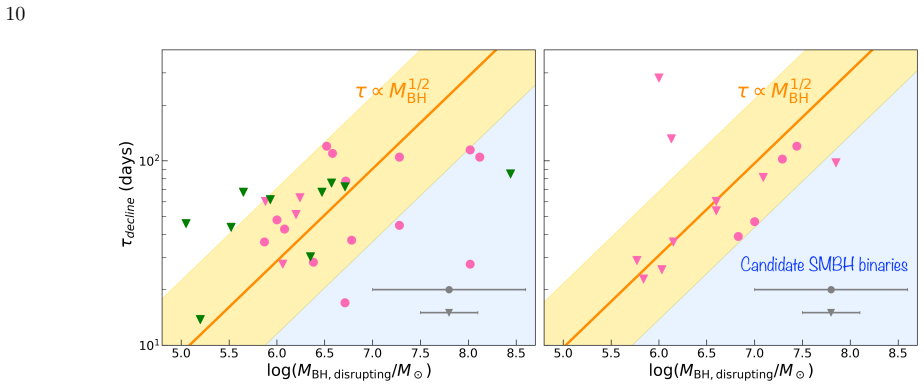
The paper's central claim is a mass-dependent dichotomy: in a supermassive black hole binary, with the primary (less massive) black hole acting as the disruptor, the per-black-hole TDE rate increases with disrupting black hole mass from $10^5$ to $10^7\,M_\odot$, whereas single-SMBH rates decline over the same range. This reversed trend is attributed to the companion's eccentric Kozai-Lidov perturbations keeping loss-cone refilling efficient where two-body relaxation alone is not. The authors convolve the simulated rate curve with the Merloni & Heinz (2008) SMBH mass function to predict the volumetric TDE rate and cumulative counts for $z\le 2$, presenting them as upper limits. They further report that binary-driven rates approach the observed TDE rate in post-starburst galaxies for $M_{\rm BH}\gtrsim$ a few $\times 10^6\,M_\odot$, and interpret the asymmetric scatter of TDE light-curve durations around the $t_{1/2}\propto M_{\rm BH}^{1/2}$ relation as evidence that some high-host-mass TDEs are disruptions by the less massive member of a binary.
Load-bearing premise
The predictions assume that the simulated binary configuration, with a companion 100 times more massive than the disruptor at half the sphere of influence, eccentricity 0.5, and a core-like density slope, represents the real post-merger SMBH binary population, and that the simulated rate curve can be extrapolated and convolved with the mass function at all redshifts.
Editorial extensions
If this is right
- If binary-driven TDE rates rise with disrupting black hole mass, then a measured TDE rate that flattens or climbs toward $10^7$-$10^8\,M_\odot$, where single-SMBH models fall, would indicate a population of unresolved binaries.
- The match between binary-model rates and the observed post-starburst galaxy TDE rate suggests that a subset of PSB TDE hosts may contain SMBH binaries with a disrupting black hole in the few $\times 10^6$-$10^8\,M_\odot$ range.
- The computed volumetric rates imply substantially more TDEs per unit redshift from the binary channel than from two-body relaxation alone, giving LSST and Roman upper-limit rate predictions to test.
- Short-duration TDEs whose inferred black hole mass is systematically lower than host-galaxy scaling relations predict can be targeted as candidate binary disruptions.
- The redshift-dependent TDE counts, scaled by a tuning parameter $\eta$ representing the binary fraction, provide a route to constrain the SMBH binary fraction from future photometric surveys.
Reading between the lines
- Inference beyond the paper: if the mass-dependent dichotomy survives, the ratio of TDE rates at high versus low host mass could itself serve as a binary-fraction estimator, independent of the overall volumetric normalization that the paper keeps as an upper limit.
- Inference beyond the paper: the model's omission of direct stellar capture above roughly $10^8\,M_\odot$ means the predicted high-mass rates are optimistic; a survey that resolves the location of the high-mass cutoff in the rate curve could separate the binary and single channels cleanly.
- Inference beyond the paper: the fixed $q=100$, fixed-separation configuration may not represent the real binary population; running the same mass-function convolution on simulated rate curves for smaller mass ratios or different separations would be a natural sensitivity test of the PSB-rate match.
Editorial analysis
A structured set of objections, weighed in public.
Referee Report
Summary. This paper argues that TDE rates from SMBH binaries increase with the mass of the disrupting black hole, in contrast to the declining trend for single SMBHs, and that this can explain the elevated TDE rate observed in post-starburst galaxies. The authors use secular three-body simulations (OSPE) of the combined EKL and two-body relaxation mechanisms for a binary configuration with mass ratio q=100, eccentricity e_bin=0.5, separation 0.5 R_sph, and primary masses 1e5, 1e6, and 1e7 M_sun, then extrapolate the resulting rate-mass curve to 1e8 M_sun. They convolve this curve with the Merloni & Heinz (2008) SMBH mass function to predict the redshift-dependent volumetric TDE rate and event counts relevant for LSST and Roman. They also interpret the scatter in TDE light-curve durations as evidence that some TDEs are produced by the less massive member of an unresolved binary.
Significance. If the claimed mass-dependent dichotomy holds, it would provide a new demographic observable for identifying SMBH binaries and would offer a plausible explanation for the PSB TDE excess. The paper makes explicit, falsifiable predictions for upcoming surveys and usefully brings together light-curve timescale data and rate comparisons. However, the central result currently rests on a single simulated configuration and an extrapolation past both the simulated mass range and the direct-capture limit, so the significance is conditional on additional validation. The strong point of the manuscript is that it frames the result as a testable prediction rather than a post-hoc fit.
major comments (3)
- [Section 3, Appendix A, Figure 2] The pink curve in Figure 2, which carries the central claim, is not derived or tabulated in this paper; the simulations described in Appendix A cover only m1 = 1e5, 1e6, 1e7 M_sun with q=100, e_bin=0.5, separation=0.5 R_sph, alpha=1, and the curve is drawn to 1e8 M_sun. No sensitivity study over q, e_bin, separation, or alpha is presented, and the text states that the model does not include direct stellar capture. Because the EKL-driven rate depends on the balance between companion perturbations and general relativistic precession, the increasing-with-mass trend at q=100 need not hold for less extreme mass ratios or at high m1 where GR precession suppresses high-eccentricity excitations. The claim in Section 3 that the binary rate 'approaches that observed in PSB galaxies' for massive SMBHs is therefore an extrapolation past both the simulated mass range and a known physical cutoff. At minimum, the paper should tabulate the rate curve, justify the power-law extrapolation to 1e8 M_sun, and test the mass trend against variations in q and the other fixed parameters.
- [Section 3, Equation (3)] The convolution in Equation (3), Gamma(z) = integral of (d2N/dV dlnM) gamma(M) dlnM, does not contain a binary fraction or a factor specifying what fraction of SMBHs are in binaries of the simulated configuration. As written, it appears to assume that every SMBH of mass M produces TDEs at the binary rate gamma(M), which is the eta=1 upper limit introduced only later in Section 4. The 'upper limit' interpretation of Figures 3 and 4 depends on this normalization; without a clear definition of gamma(M) (per binary? per unit SMBH? per galaxy?) and its relation to eta, the volumetric rates and cumulative event numbers are not uniquely defined. Please revise Equation (3) to include the binary fraction explicitly or state that the plotted curves are the eta=1 limit.
- [Section 4, Figure 4] The parameter eta is introduced as an envelope that folds in unknown binary fractions and binary properties, but it does not test the rate-mass curve: the pink curve at eta=1 is simply the extrapolated curve from Figure 2, and the light blue line is a linear interpolation anchored at that point. The alignment with observed PSB fractions is therefore not independent evidence for the mass-dependent dichotomy. To make the PSB match convincing, the paper would need a scan over the simulation parameters (q, e_bin, separation, alpha) or a physical argument for why the chosen configuration is representative of the post-merger binary population.
minor comments (5)
- [Section 3] The sentence stating that the binary-driven rates show 'only a modest difference between 10^7 M⊙ and 10^7 M⊙' appears to contain a typo; it should presumably read 'between 10^7 M⊙ and 10^8 M⊙.'
- [Appendix B] The text refers to 'Equation B, in Appendix A' when presenting the single-SMBH rate; the reference should be to Equation (B1).
- [Figure 2 caption] The pink curve is described as a 'predicted upper-limit TDE rate,' but the text does not define whether this is an upper limit per binary, per SMBH, or per galaxy; please clarify the normalization in the caption or in Section 3.
- [Section 2, Figures 1 and 5] The discussion of the asymmetric scatter in light-curve timescales would benefit from a quantitative statement of the fraction of TDEs falling in the blue-shaded region and a simple statistical test of whether that asymmetry is expected under the binary hypothesis.
- [Tables 1 and 2] The tables have several formatting inconsistencies, including repeated reference entries and incomplete journal information for some references, which should be cleaned up before publication.
Circularity Check
No significant circularity: the binary TDE rate curve is a simulation output from the authors' prior work, and the demographic predictions are convolutions with external functions, not fitted to the targets they claim to match.
full rationale
The paper's central mass-dependent binary TDE rate is not derived from the observed PSB rate or from the redshift-dependent predictions; it is taken from the authors' own previous numerical simulations (Naoz et al. 2022; Melchor et al. 2024), which are code-based, externally checkable results with stated assumptions rather than fitted parameters. The single-SMBH comparison rates are computed from the standard two-body relaxation formalism in Appendix B, and the redshift evolution is obtained by convolving the simulated rate with the independent Merloni & Heinz (2008) mass function, so the redshift curves are not forced to match observed counts. The short-duration TDE discussion is offered as a consistency argument, not as a derivation, and the 'approach' to the PSB rate band is a comparison of a simulated upper limit to an observed band, not a fit. Self-citations are frequent, but they support the framework with prior simulation work; the load-bearing claim of an increasing binary TDE rate with mass is a simulation result that could fail in other parts of parameter space, which is a robustness concern rather than circularity. The paper therefore does not reduce its predictions to its inputs by construction.
Assumptions & free parameters
free parameters (6)
- binary mass ratio q =
100
- binary eccentricity e_bin =
0.5
- binary separation a_bin =
0.5 R_sph
- stellar density slope alpha =
1 (core-like)
- stellar mass m_star =
0.8 M_sun
- tuning parameter eta =
not fixed
assumptions (6)
- standard math The loss-cone two-body relaxation formalism (Eq. B1) gives the single-SMBH TDE rate within the sphere of influence.
- domain assumption The OSPE secular three-body code correctly models EKL-driven orbital evolution in SMBH binaries.
- ad hoc to paper The binary configuration (q=100, e_bin=0.5, separation 0.5 R_sph, alpha=1, m_star=0.8 M_sun) represents typical post-merger SMBH binaries.
- domain assumption The stellar density profile follows the M-sigma relation normalization (M0=1e8 M_sun, sigma0=200 km/s) with a power-law slope alpha.
- domain assumption The SMBH mass function from Merloni & Heinz (2008), with an implicit redshift dependence, can be integrated against TDE rates.
- domain assumption A steady-state stellar cusp surrounds each SMBH in the binary.
Cite this review
Pith. "Pith review of Tidal Disruption Event Demographics in Supermassive Black Hole Binaries Over Cosmic Times." pith.science (2026). https://pith.science/paper/4NWT7ZAS
@misc{pith2026250708082,
  author       = {Pith},
  title        = {Pith review of: Tidal Disruption Event Demographics in Supermassive Black Hole Binaries Over Cosmic Times},
  year         = {2026},
  howpublished = {\url{https://pith.science/paper/4NWT7ZAS}},
  note         = {Machine review of arXiv:2507.08082}
}
read the original abstract
Tidal disruption events (TDEs) offer a unique probe of supermassive black hole (SMBH) demographics, but their observed rates remain difficult to reconcile with standard single-SMBH models. In this work, we use simulations of SMBH binaries, including the combined effects of eccentric Kozai-Lidov oscillations and two-body relaxation, to explore how TDE rates scale with SMBH mass and redshift. We find that binary systems exhibit increasing TDE rates with mass, in contrast to the declining trend expected for single SMBHs. These binary-driven rates match those observed in post-starburst galaxies, suggesting that a subset of TDE hosts may contain SMBH binaries. TDE light curves in some massive galaxies exhibit unexpectedly short durations, suggesting that the disrupting SMBH may be less massive than implied by host galaxy scaling relations, consistent with disruptions by the less massive black hole in a binary. By convolving our mass-dependent rates with the SMBH mass function, we predict redshift-dependent TDE rates, which we show can be used to constrain the supermassive black hole binary fraction. Our results provide a testable framework for interpreting TDE demographics in upcoming wide-field surveys such as LSST and Roman.
Figures


Figures from the paper (2 more)

Reference graph
Works this paper leans on
-
[1]
, " * write output.state after.block = add.period write newline
ENTRY address archivePrefix author booktitle chapter doi edition editor eprint howpublished institution journal key month number organization pages publisher school series title misctitle type volume year version url label extra.label sort.label short.list INTEGERS output.state before.all mid.sentence after.sentence after.block FUNCTION init.state.consts ...
-
[2]
write newline
" write newline "" before.all 'output.state := FUNCTION format.url url empty "" new.block "" url * "" * if FUNCTION format.eprint eprint empty "" archivePrefix empty "" archivePrefix "arXiv" = new.block " " eprint * " " * new.block " " eprint * " " * if if if FUNCTION format.doi doi empty "" " " doi * " " * if FUNCTION format.pid doi empty eprint empty ur...
-
[3]
thebibliography [1] 20pt to REFERENCES 6pt =0pt -12pt 10pt plus 3pt =0pt =0pt =1pt plus 1pt =0pt =0pt -12pt =13pt plus 1pt =20pt =13pt plus 1pt \@M =10000 =-1.0em =0pt =0pt 0pt =0pt =1.0em @enumiv\@empty 10000 10000 `\.\@m \@noitemerr \@latex@warning Empty `thebibliography' environment \@ifnextchar \@reference \@latexerr Missing key on reference command E...
arXiv 2018
-
[4]
2023, The Astrophysical Journal Letters, 951, L11, 10.3847/2041-8213/acdc91
Afzal, A., Agazie, G., Anumarlapudi, A., et al. 2023, The Astrophysical Journal Letters, 951, L11, 10.3847/2041-8213/acdc91
-
[5]
Agazie, G., Anumarlapudi, A., Archibald, A. M., et al. 2023, The Astrophysical Journal Letters, 951, L8, 10.3847/2041-8213/acdac6
-
[6]
2017, The Astrophysical Journal, 843, 9, 10.3847/1538-4357/aa72eb
Alatalo, K., Bitsakis, T., Lanz, L., et al. 2017, The Astrophysical Journal, 843, 9, 10.3847/1538-4357/aa72eb
-
[7]
2017, Laser Interferometer Space Antenna , arXiv, 10.48550/arXiv.1702.00786
Amaro-Seoane, P., Audley, H., Babak, S., et al. 2017, Laser Interferometer Space Antenna , arXiv, 10.48550/arXiv.1702.00786
-
[8]
Angus, C. R., Baldassare, V. F., Mockler, B., et al. 2022, Nature Astronomy, 6, 1452, 10.1038/s41550-022-01811-y
Show all 129 references
-
[9]
2014, The Astrophysical Journal, 793, 38, 10.1088/0004-637X/793/1/38
Arcavi, I., Gal-Yam, A., Sullivan, M., et al. 2014, The Astrophysical Journal, 793, 38, 10.1088/0004-637X/793/1/38
2014 doi
-
[10]
2020, Transient Name Server Classification Report, 2020-1080, 1
Arcavi, I., Hiramatsu, D., Trakhtenbrot, B., et al. 2020, Transient Name Server Classification Report, 2020-1080, 1. https://ui.adsabs.harvard.edu/abs/2020TNSCR1080....1A
2020
-
[11]
2017, The Astrophysical Journal, 838, 149, 10.3847/1538-4357/aa633b
Auchettl, K., Guillochon, J., & Ramirez-Ruiz, E. 2017, The Astrophysical Journal, 838, 149, 10.3847/1538-4357/aa633b
2017 doi
- [12]
-
[13]
C., Blandford, R
Begelman, M. C., Blandford, R. D., & Rees, M. J. 1980, Nature, 287, 307, 10.1038/287307a0
1980 doi
-
[15]
2017, The Astrophysical Journal, 844, 46, 10.3847/1538-4357/aa7579
Blagorodnova, N., Gezari, S., Hung, T., et al. 2017, The Astrophysical Journal, 844, 46, 10.3847/1538-4357/aa7579
2017 doi
-
[16]
B., Kulkarni, S
Blagorodnova, N., Cenko, S. B., Kulkarni, S. R., et al. 2019, The Astrophysical Journal, 873, 92, 10.3847/1538-4357/ab04b0
2019 doi
-
[17]
2004, The Astrophysical Journal, 610, 707, 10.1086/421758
Bogdanović, T., Eracleous, M., Mahadevan, S., Sigurdsson, S., & Laguna, P. 2004, The Astrophysical Journal, 610, 707, 10.1086/421758
2004 doi
-
[18]
2022, Monthly Notices of the Royal Astronomical Society, 511, 2885, 10.1093/mnras/stac262
Bortolas, E. 2022, Monthly Notices of the Royal Astronomical Society, 511, 2885, 10.1093/mnras/stac262
2022 doi
-
[19]
G., Benson, A
Bower, R. G., Benson, A. J., Malbon, R., et al. 2006, Monthly Notices of the Royal Astronomical Society, 370, 645, 10.1111/j.1365-2966.2006.10519.x
2006
-
[21]
2009, The Astrophysical Journal, 696, L89, 10.1088/0004-637X/696/1/L89
Callegari, S., Mayer, L., Kazantzidis, S., et al. 2009, The Astrophysical Journal, 696, L89, 10.1088/0004-637X/696/1/L89
2009 doi
- [22]
-
[23]
Chen, X., Madau, P., Sesana, A., & Liu, F. K. 2009, The Astrophysical Journal, 697, L149, 10.1088/0004-637X/697/2/L149
2009 doi
-
[24]
2021, Transient Name Server Classification Report, 2021-4107, 1
Chu, M., Dahiwale, A., & Fremling, C. 2021, Transient Name Server Classification Report, 2021-4107, 1. https://ui.adsabs.harvard.edu/abs/2021TNSCR4107....1C
2021
-
[25]
2022, Transient Name Server Classification Report, 2022-36, 1
---. 2022, Transient Name Server Classification Report, 2022-36, 1. https://ui.adsabs.harvard.edu/abs/2022TNSCR..36....1C
2022
-
[26]
M., Griffith, R
Comerford, J. M., Griffith, R. L., Gerke, B. F., et al. 2009, The Astrophysical Journal, 702, L82, 10.1088/0004-637X/702/1/L82
2009 doi
-
[27]
M., Nevin, R., Stemo, A., et al
Comerford, J. M., Nevin, R., Stemo, A., et al. 2018, The Astrophysical Journal, 867, 66, 10.3847/1538-4357/aae2b4
2018 doi
-
[28]
2005, Nature, 433, 604, 10.1038/nature03335
Di Matteo, T., Springel, V., & Hernquist, L. 2005, Nature, 433, 604, 10.1038/nature03335
2005 doi
-
[29]
2007, Monthly Notices of the Royal Astronomical Society, 379, 956, 10.1111/j.1365-2966.2007.12010.x
Dotti, M., Colpi, M., Haardt, F., & Mayer, L. 2007, Monthly Notices of the Royal Astronomical Society, 379, 956, 10.1111/j.1365-2966.2007.12010.x
2007
-
[30]
R., & Kochanek, C
Evans, C. R., & Kochanek, C. S. 1989, The Astrophysical Journal, 346, L13, 10.1086/185567
1989 doi
-
[31]
Fabian, A. C. 2012, Annual Review of Astronomy and Astrophysics, 50, 455, 10.1146/annurev-astro-081811-125521
2012 doi
-
[32]
2020, The Astrophysical Journal, 892, 29, 10.3847/1538-4357/ab72fa
Foord, A., Gültekin, K., Nevin, R., et al. 2020, The Astrophysical Journal, 892, 29, 10.3847/1538-4357/ab72fa
2020 doi
-
[33]
Frank, J., & Rees, M. J. 1976, Monthly Notices of the Royal Astronomical Society, 176, 633, 10.1093/mnras/176.3.633
1976 doi
-
[34]
D., Arcavi, I., & Zabludoff, A
French, K. D., Arcavi, I., & Zabludoff, A. 2016, The Astrophysical Journal, 818, L21, 10.3847/2041-8205/818/1/L21
2016 doi
-
[35]
D., Arcavi, I., Zabludoff, A
French, K. D., Arcavi, I., Zabludoff, A. I., et al. 2020 a , The Astrophysical Journal, 891, 93, 10.3847/1538-4357/ab7450
2020 doi
-
[36]
D., Wevers, T., Law-Smith, J., Graur, O., & Zabludoff, A
French, K. D., Wevers, T., Law-Smith, J., Graur, O., & Zabludoff, A. I. 2020 b , Space Science Reviews, 216, 32, 10.1007/s11214-020-00657-y
2020 doi
-
[37]
2021, Annual Review of Astronomy and Astrophysics, 59, 21, 10.1146/annurev-astro-111720-030029
Gezari, S. 2021, Annual Review of Astronomy and Astrophysics, 59, 21, 10.1146/annurev-astro-111720-030029
2021 doi
-
[38]
2012, Nature, 485, 217, 10.1038/nature10990
Gezari, S., Chornock, R., Rest, A., et al. 2012, Nature, 485, 217, 10.1038/nature10990
2012 doi
- [39]
-
[40]
M., Klein, B
Ghez, A. M., Klein, B. L., Morris, M., & Becklin, E. E. 1998, The Astrophysical Journal, 509, 678, 10.1086/306528
1998 doi
-
[41]
A., Berger, E., et al
Gomez, S., Villar, V. A., Berger, E., et al. 2023, The Astrophysical Journal, 949, 113, 10.3847/1538-4357/acc535
2023 doi
-
[42]
2020, Monthly Notices of the Royal Astronomical Society, 497, 1925, 10.1093/mnras/staa2099
Gomez, S., Nicholl, M., Short, P., et al. 2020, Monthly Notices of the Royal Astronomical Society, 497, 1925, 10.1093/mnras/staa2099
2020 doi
-
[43]
J., Myers, A
Green, P. J., Myers, A. D., Barkhouse, W. A., et al. 2010, The Astrophysical Journal, 710, 1578, 10.1088/0004-637X/710/2/1578
2010 doi
-
[44]
2014, The Astrophysical Journal, 783, 23, 10.1088/0004-637X/783/1/23
Guillochon, J., Manukian, H., & Ramirez-Ruiz, E. 2014, The Astrophysical Journal, 783, 23, 10.1088/0004-637X/783/1/23
2014 doi
-
[45]
2013, The Astrophysical Journal, 767, 25, 10.1088/0004-637X/767/1/25
Guillochon, J., & Ramirez-Ruiz, E. 2013, The Astrophysical Journal, 767, 25, 10.1088/0004-637X/767/1/25
2013 doi
-
[46]
G., & Kauffmann, G
Haehnelt, M. G., & Kauffmann, G. 2000, Monthly Notices of the Royal Astronomical Society, 318, L35, 10.1046/j.1365-8711.2000.03989.x
2000
-
[47]
2009, The Astrophysical Journal, 700, 1952, 10.1088/0004-637X/700/2/1952
Haiman, Z., Kocsis, B., & Menou, K. 2009, The Astrophysical Journal, 700, 1952, 10.1088/0004-637X/700/2/1952
2009 doi
-
[48]
v., et al
Hammerstein, E., Gezari, S., Velzen, S. v., et al. 2021 a , The Astrophysical Journal Letters, 908, L20, 10.3847/2041-8213/abdcb4
2021 doi
-
[49]
V., et al
Hammerstein, E., Gezari, S., Velzen, S. V., et al. 2021 b , Transient Name Server Classification Report, 2021-955, 1. https://ui.adsabs.harvard.edu/abs/2021TNSCR.955....1H
2021
-
[51]
2023 a , The Astrophysical Journal, 942, 9, 10.3847/1538-4357/aca283
---. 2023 a , The Astrophysical Journal, 942, 9, 10.3847/1538-4357/aca283
2023 doi
-
[52]
B., Gezari, S., et al
Hammerstein, E., Cenko, S. B., Gezari, S., et al. 2023 b , The Astrophysical Journal, 957, 86, 10.3847/1538-4357/acfb84
2023 doi
-
[53]
M., & Best, P
Heckman, T. M., & Best, P. N. 2014, Annual Review of Astronomy and Astrophysics, 52, 589, 10.1146/annurev-astro-081913-035722
2014 doi
-
[54]
Hills, J. G. 1975, Nature, 254, 295, 10.1038/254295a0
1975 doi
-
[55]
T., Holoien, T
Hinkle, J. T., Holoien, T. W. S., Auchettl, K., et al. 2021, Monthly Notices of the Royal Astronomical Society, 500, 1673, 10.1093/mnras/staa3170
2021 doi
-
[56]
W.-S., Prieto, J
Holoien, T. W.-S., Prieto, J. L., Bersier, D., et al. 2014, Monthly Notices of the Royal Astronomical Society, 445, 3263, 10.1093/mnras/stu1922
2014 doi
-
[57]
W.-S., Huber, M
Holoien, T. W.-S., Huber, M. E., Shappee, B. J., et al. 2019 a , The Astrophysical Journal, 880, 120, 10.3847/1538-4357/ab2ae1
2019 doi
-
[58]
W.-S., Vallely, P
Holoien, T. W.-S., Vallely, P. J., Auchettl, K., et al. 2019 b , The Astrophysical Journal, 883, 111, 10.3847/1538-4357/ab3c66
2019 doi
-
[59]
F., Hernquist, L., Cox, T
Hopkins, P. F., Hernquist, L., Cox, T. J., et al. 2006, The Astrophysical Journal Supplement Series, 163, 1, 10.1086/499298
2006 doi
-
[60]
F., Hernquist, L., Cox, T
Hopkins, P. F., Hernquist, L., Cox, T. J., & Kereš, D. 2008, The Astrophysical Journal Supplement Series, 175, 356, 10.1086/524362
2008 doi
-
[61]
2017, The Astrophysical Journal, 842, 29, 10.3847/1538-4357/aa7337
Hung, T., Gezari, S., Blagorodnova, N., et al. 2017, The Astrophysical Journal, 842, 29, 10.3847/1538-4357/aa7337
2017 doi
-
[62]
M., Tyson, J
Ivezic, Z., Kahn, S. M., Tyson, J. A., et al. 2019, The Astrophysical Journal, 873, 111, 10.3847/1538-4357/ab042c
2019 doi
-
[63]
Z., Blecha, L., & Hernquist, L
Kelley, L. Z., Blecha, L., & Hernquist, L. 2017, Monthly Notices of the Royal Astronomical Society, 464, 3131, 10.1093/mnras/stw2452
2017 doi
-
[64]
F., Meiron, Y., Shukirgaliyev, B., et al
Kennedy, G. F., Meiron, Y., Shukirgaliyev, B., et al. 2016, Monthly Notices of the Royal Astronomical Society, 460, 240, 10.1093/mnras/stw908
2016 doi
-
[65]
2012, Physical Review D, 85, 024037, 10.1103/PhysRevD.85.024037
Kesden, M. 2012, Physical Review D, 85, 024037, 10.1103/PhysRevD.85.024037
2012 doi
- [66]
-
[67]
2008, The Astrophysical Journal, 678, L81, 10.1086/588656
Komossa, S., Zhou, H., & Lu, H. 2008, The Astrophysical Journal, 678, L81, 10.1086/588656
2008 doi
-
[68]
Kormendy, J., & Ho, L. C. 2013, Annual Review of Astronomy and Astrophysics, 51, 511, 10.1146/annurev-astro-082708-101811
2013 doi
-
[69]
1962, The Astronomical Journal, 67, 591, 10.1086/108790
Kozai, Y. 1962, The Astronomical Journal, 67, 591, 10.1086/108790
1962 doi
-
[70]
2019, The Astrophysical Journal, 887, 218, 10.3847/1538-4357/ab5792
Leloudas, G., Dai, L., Arcavi, I., et al. 2019, The Astrophysical Journal, 887, 218, 10.3847/1538-4357/ab5792
2019 doi
-
[71]
Li, K., Bogdanović, T., & Ballantyne, D. R. 2020, The Astrophysical Journal, 896, 113, 10.3847/1538-4357/ab93c6
2020 doi
-
[72]
1962, The evolution of orbits of artificial satellites of planets under the action of gravitational perturbations of external bodies - ScienceDirect
Lidov, M. 1962, The evolution of orbits of artificial satellites of planets under the action of gravitational perturbations of external bodies - ScienceDirect . https://www.sciencedirect.com/science/article/pii/0032063362901290?via
1962
-
[73]
2022, The Astrophysical Journal, 940, 101, 10.3847/1538-4357/ac9bfd
Linial, I., & Sari, R. 2022, The Astrophysical Journal, 940, 101, 10.3847/1538-4357/ac9bfd
2022 doi
-
[74]
E., Shen, Y., & Strauss, M
Liu, X., Greene, J. E., Shen, Y., & Strauss, M. A. 2010, The Astrophysical Journal Letters, 715, L30, 10.1088/2041-8205/715/1/L30
2010 doi
-
[75]
2022, The Astrophysical Journal, 925, 67, 10.3847/1538-4357/ac33a9
Liu, X.-L., Dou, L.-M., Chen, J.-H., & Shen, R.-F. 2022, The Astrophysical Journal, 925, 67, 10.3847/1538-4357/ac33a9
2022 doi
-
[76]
2014, Annual Review of Astronomy and Astrophysics, 52, 415, 10.1146/annurev-astro-081811-125615
Madau, P., & Dickinson, M. 2014, Annual Review of Astronomy and Astrophysics, 52, 415, 10.1146/annurev-astro-081811-125615
2014 doi
-
[77]
2018, The Astrophysical Journal, 853, 141, 10.3847/1538-4357/aaa714
Madigan, A.-M., Halle, A., Moody, M., et al. 2018, The Astrophysical Journal, 853, 141, 10.3847/1538-4357/aaa714
2018 doi
-
[78]
C., & Ramirez-Ruiz, E
Melchor, D., Mockler, B., Naoz, S., Rose, S. C., & Ramirez-Ruiz, E. 2024, The Astrophysical Journal, 960, 39, 10.3847/1538-4357/acfee0
2024 doi
-
[79]
Menou, K., Haiman, Z., & Narayanan, V. K. 2001, The Astrophysical Journal, 558, 535, 10.1086/322310
2001 doi
-
[80]
2008, Monthly Notices of the Royal Astronomical Society, 388, 1011, 10.1111/j.1365-2966.2008.13472.x
Merloni, A., & Heinz, S. 2008, Monthly Notices of the Royal Astronomical Society, 388, 1011, 10.1111/j.1365-2966.2008.13472.x
2008
-
[81]
2013, Classical and Quantum Gravity, 30, 244005, 10.1088/0264-9381/30/24/244005
Merritt, D. 2013, Classical and Quantum Gravity, 30, 244005, 10.1088/0264-9381/30/24/244005
2013 doi
-
[82]
2005, Living Reviews in Relativity, 8, 10.12942/lrr-2005-8
Merritt, D., & Milosavljevic, M. 2005, Living Reviews in Relativity, 8, 10.12942/lrr-2005-8
2005 doi
-
[83]
2019, The Astrophysical Journal, 872, 151, 10.3847/1538-4357/ab010f
Mockler, B., Guillochon, J., & Ramirez-Ruiz, E. 2019, The Astrophysical Journal, 872, 151, 10.3847/1538-4357/ab010f
2019 doi
-
[84]
2023, The Astrophysical Journal, 959, 18, 10.3847/1538-4357/ad0234
Mockler, B., Melchor, D., Naoz, S., & Ramirez-Ruiz, E. 2023, The Astrophysical Journal, 959, 18, 10.3847/1538-4357/ad0234
2023 doi
-
[85]
2024, Monthly Notices of the Royal Astronomical Society, 527, 2452, 10.1093/mnras/stad3001
Mummery, A., van Velzen, S., Nathan, E., et al. 2024, Monthly Notices of the Royal Astronomical Society, 527, 2452, 10.1093/mnras/stad3001
2024 doi
-
[86]
2016, Annual Review of Astronomy and Astrophysics, 54, 441, 10.1146/annurev-astro-081915-023315
Naoz, S. 2016, Annual Review of Astronomy and Astrophysics, 54, 441, 10.1146/annurev-astro-081915-023315
2016 doi
-
[87]
M., Lithwick, Y., Rasio, F
Naoz, S., Farr, W. M., Lithwick, Y., Rasio, F. A., & Teyssandier, J. 2011, Nature, 473, 187, 10.1038/nature10076
2011 doi
-
[88]
2013 a , Monthly Notices of the Royal Astronomical Society, 431, 2155, 10.1093/mnras/stt302
---. 2013 a , Monthly Notices of the Royal Astronomical Society, 431, 2155, 10.1093/mnras/stt302
2013 doi
-
[89]
2023, The Astrophysical Journal, 955, L27, 10.3847/2041-8213/acf8c9
Naoz, S., & Haiman, Z. 2023, The Astrophysical Journal, 955, L27, 10.3847/2041-8213/acf8c9
2023 doi
-
[90]
2013 b , The Astrophysical Journal, 773, 187, 10.1088/0004-637X/773/2/187
Naoz, S., Kocsis, B., Loeb, A., & Yunes, N. 2013 b , The Astrophysical Journal, 773, 187, 10.1088/0004-637X/773/2/187
2013 doi
-
[91]
C., Michaely, E., et al
Naoz, S., Rose, S. C., Michaely, E., et al. 2022, The Astrophysical Journal Letters, 927, L18, 10.3847/2041-8213/ac574b
2022 doi
-
[92]
R., et al
Nicholl, M., Wevers, T., Oates, S. R., et al. 2020, Monthly Notices of the Royal Astronomical Society, 499, 482, 10.1093/mnras/staa2824
2020 doi
-
[93]
B., & Alexander, T
Perets, H. B., & Alexander, T. 2008, The Astrophysical Journal, 677, 146, 10.1086/527525
2008 doi
-
[94]
B., Hopman, C., & Alexander, T
Perets, H. B., Hopman, C., & Alexander, T. 2007, The Astrophysical Journal, 656, 709, 10.1086/510377
2007 doi
-
[95]
2024, Astronomy & Astrophysics, 689, A204, 10.1051/0004-6361/202449470
Polkas, M., Bonoli, S., Bortolas, E., et al. 2024, Astronomy & Astrophysics, 689, A204, 10.1051/0004-6361/202449470
2024 doi
-
[96]
P., & Tremaine, S
Rauch, K. P., & Tremaine, S. 1996, New Astronomy, 1, 149, https://doi.org/10.1016/S1384-1076(96)00012-7
1996 doi
-
[97]
Rees, M. J. 1988, Nature, 333, 523, 10.1038/333523a0
1988 doi
-
[98]
S., Cox, T
Robertson, B., Bullock, J. S., Cox, T. J., et al. 2006, The Astrophysical Journal, 645, 986, 10.1086/504412
2006 doi
-
[99]
B., Zavala, R
Rodriguez, C., Taylor, G. B., Zavala, R. T., et al. 2006, The Astrophysical Journal, 646, 49, 10.1086/504825
2006 doi
-
[100]
2024, The Astrophysical Journal, 977, 7, 10.3847/1538-4357/ad8b1d
Rom, B., Linial, I., Kaur, K., & Sari, R. 2024, The Astrophysical Journal, 977, 7, 10.3847/1538-4357/ad8b1d
2024 doi
-
[101]
2025, Segregation in Nuclear Stellar Clusters : Rates and Mass Distributions of TDEs , QPEs , Plunges , and EMRIs , arXiv, 10.48550/arXiv.2502.13209
Rom, B., & Sari, R. 2025, Segregation in Nuclear Stellar Clusters : Rates and Mass Distributions of TDEs , QPEs , Plunges , and EMRIs , arXiv, 10.48550/arXiv.2502.13209
-
[102]
C., Naoz, S., Sari, R., & Linial, I
Rose, S. C., Naoz, S., Sari, R., & Linial, I. 2023, The Astrophysical Journal, 955, 30, 10.3847/1538-4357/acee75
2023 doi
-
[103]
2011, Monthly Notices of the Royal Astronomical Society, 415, L35, 10.1111/j.1745-3933.2011.01073.x
Sesana, A., Gualandris, A., & Dotti, M. 2011, Monthly Notices of the Royal Astronomical Society, 415, L35, 10.1111/j.1745-3933.2011.01073.x
2011
-
[104]
2006, The Astrophysical Journal, 651, 392, 10.1086/507596
Sesana, A., Haardt, F., & Madau, P. 2006, The Astrophysical Journal, 651, 392, 10.1086/507596
2006 doi
-
[105]
2020, Monthly Notices of the Royal Astronomical Society, 498, 4119, 10.1093/mnras/staa2065
Short, P., Nicholl, M., Lawrence, A., et al. 2020, Monthly Notices of the Royal Astronomical Society, 498, 4119, 10.1093/mnras/staa2065
2020 doi
- [106]
-
[107]
J., Sundelius, B., & Byrd, G
Sillanpaa, A., Haarala, S., Valtonen, M. J., Sundelius, B., & Byrd, G. G. 1988, The Astrophysical Journal, 325, 628, 10.1086/166033
1988 doi
-
[108]
L., Shields, G
Smith, K. L., Shields, G. A., Bonning, E. W., et al. 2010, The Astrophysical Journal, 716, 866, 10.1088/0004-637X/716/1/866
2010 doi
-
[109]
2015, Wide- Field InfrarRed Survey Telescope - Astrophysics Focused Telescope Assets WFIRST - AFTA 2015 Report , 10.48550/arXiv.1503.03757
Spergel, D., Gehrels, N., Baltay, C., et al. 2015, Wide- Field InfrarRed Survey Telescope - Astrophysics Focused Telescope Assets WFIRST - AFTA 2015 Report , 10.48550/arXiv.1503.03757
-
[110]
2005, Monthly Notices of the Royal Astronomical Society, 361, 776, 10.1111/j.1365-2966.2005.09238.x
Springel, V., Di Matteo, T., & Hernquist, L. 2005, Monthly Notices of the Royal Astronomical Society, 361, 776, 10.1111/j.1365-2966.2005.09238.x
2005
-
[111]
2021, Nature Astronomy, 5, 510, 10.1038/s41550-020-01295-8
Stein, R., van Velzen, S., Kowalski, M., et al. 2021, Nature Astronomy, 5, 510, 10.1038/s41550-020-01295-8
2021 doi
-
[112]
M., Barrows, R
Stemo, A., Comerford, J. M., Barrows, R. S., et al. 2021, The Astrophysical Journal, 923, 36, 10.3847/1538-4357/ac0bbf
2021 doi
-
[113]
C., Generozov, A., Vasiliev, E., & Metzger, B
Stone, N. C., Generozov, A., Vasiliev, E., & Metzger, B. D. 2018, Monthly Notices of the Royal Astronomical Society, 480, 5060, 10.1093/mnras/sty2045
2018 doi
-
[114]
C., & Metzger, B
Stone, N. C., & Metzger, B. D. 2016, Monthly Notices of the Royal Astronomical Society, 455, 859, 10.1093/mnras/stv2281
2016 doi
-
[115]
Teboul, O., & Perets, H. B. 2025, The Astrophysical Journal, 984, 12, 10.3847/1538-4357/adc09f
2025 doi
-
[116]
1999, The Astrophysical Journal, 514, 180, 10.1086/306909
Ulmer, A. 1999, The Astrophysical Journal, 514, 180, 10.1086/306909
1999 doi
-
[117]
W.-S., Onori, F., Hung, T., & Arcavi, I
van Velzen, S., Holoien, T. W.-S., Onori, F., Hung, T., & Arcavi, I. 2020, Space Science Reviews, 216, 124, 10.1007/s11214-020-00753-z
2020 doi
-
[118]
C., Metzger, B
van Velzen, S., Stone, N. C., Metzger, B. D., et al. 2019 a , The Astrophysical Journal, 878, 82, 10.3847/1538-4357/ab1844
2019 doi
-
[119]
R., Gezari, S., et al
van Velzen, S., Farrar, G. R., Gezari, S., et al. 2011, The Astrophysical Journal, 741, 73, 10.1088/0004-637X/741/2/73
2011 doi
-
[120]
B., et al
van Velzen, S., Gezari, S., Cenko, S. B., et al. 2019 b , The Astrophysical Journal, 872, 198, 10.3847/1538-4357/aafe0c
2019 doi
-
[121]
2021, The Astrophysical Journal, 908, 4, 10.3847/1538-4357/abc258
van Velzen, S., Gezari, S., Hammerstein, E., et al. 2021, The Astrophysical Journal, 908, 4, 10.3847/1538-4357/abc258
2021 doi
-
[122]
Rubin, O
Vera C. Rubin, O. 2025, Ever-changing Universe Revealed in First Imagery From NSF – DOE Vera C . Rubin Observatory Rubin Observatory . https://rubinobservatory.org/news/first-imagery-rubin
2025
-
[123]
2003, The Astrophysical Journal, 582, 559, 10.1086/344675
Volonteri, M., Haardt, F., & Madau, P. 2003, The Astrophysical Journal, 582, 559, 10.1086/344675
2003 doi
-
[124]
2024, The Astrophysical Journal, 960, 69, 10.3847/1538-4357/ad0bfb
Wang, M., Ma, Y., Wu, Q., & Jiang, N. 2024, The Astrophysical Journal, 960, 69, 10.3847/1538-4357/ad0bfb
2024 doi
-
[125]
C., van Velzen, S., et al
Wevers, T., Stone, N. C., van Velzen, S., et al. 2019 a , Monthly Notices of the Royal Astronomical Society, 487, 4136, 10.1093/mnras/stz1602
2019 doi
-
[126]
R., van Velzen, S., et al
Wevers, T., Pasham, D. R., van Velzen, S., et al. 2019 b , Monthly Notices of the Royal Astronomical Society, 488, 4816, 10.1093/mnras/stz1976
2019 doi
-
[127]
2022, Astronomy & Astrophysics, 666, A6, 10.1051/0004-6361/202142616
Wevers, T., Nicholl, M., Guolo, M., et al. 2022, Astronomy & Astrophysics, 666, A6, 10.1051/0004-6361/202142616
2022 doi
-
[128]
I., Schawinski, K., Kaviraj, S., et al
Wong, O. I., Schawinski, K., Kaviraj, S., et al. 2012, Monthly Notices of the Royal Astronomical Society, 420, 1684, 10.1111/j.1365-2966.2011.20159.x
2012
-
[129]
2016, Monthly Notices of the Royal Astronomical Society: Letters, slw213, 10.1093/mnrasl/slw213
Wyrzykowski, L., Zielinski, M., Kostrzewa-Rutkowska, Z., et al. 2016, Monthly Notices of the Royal Astronomical Society: Letters, slw213, 10.1093/mnrasl/slw213
2016 doi
-
[130]
V., Hammerstein, E., & Somalwar, J
Yao, Y., Gezari, S., Velzen, S. V., Hammerstein, E., & Somalwar, J. 2021, Transient Name Server Classification Report, 2021-2155, 1. https://ui.adsabs.harvard.edu/abs/2021TNSCR2155....1Y
2021
-
[131]
2022, The Astrophysical Journal, 937, 8, 10.3847/1538-4357/ac898a
Yao, Y., Lu, W., Guolo, M., et al. 2022, The Astrophysical Journal, 937, 8, 10.3847/1538-4357/ac898a
2022 doi
-
[132]
2023, The Astrophysical Journal Letters, 955, L6, 10.3847/2041-8213/acf216
Yao, Y., Ravi, V., Gezari, S., et al. 2023, The Astrophysical Journal Letters, 955, L6, 10.3847/2041-8213/acf216
2023 doi
Reviewed August 6, 2026 · model on record in the stance chip above.
Discussion (0). Continue with ORCID to comment.