REVIEW 4 major objections 5 minor 69 references
Single Domain Generalization for Multimodal Cross-Cancer Prognosis via Dirac Rebalancer and Distribution Entanglement
T0 review · 4 major / 5 minor · reviewed 2026-08-06 · deepseek-v4-flash
Pith's one-line read This paper claims that multimodal cancer-prognosis models, which combine whole-slide pathology images with gene expression, generalize worse than unimodal models when tested on unseen cancer types, and that a rebalancing-plus-entanglement…
desk verdict New task framing and a useful negative result, but the headline number is a target-selected artifact; needs a cleaner evaluation before I'd trust the claimed gain. read the letter →
The pith
A machine-rendered reading of the paper's core claim, the machinery that carries it, and where it could break.
The reading
What carries the argument
The argument is carried by two plug-and-play modules inside a multimodal survival network. SDIR is the rebalancing mechanism: a Bernoulli mask with sparsity $\alpha$ suppresses the strong WSI stream, and a Dirac-inspired response $D(\hat z)=\varphi(\hat z)+\psi(\|\hat z\|_2)e$ with $\psi(r)=\exp(-r)$ maps heavily degraded features toward a fixed anchor vector $e$ while leaving strong features nearly unchanged, so weak gene signals get amplified during fusion. CADE is the generalization mechanism: it computes empirical statistics $\theta_I=(\mu_I,\Sigma_I)$ and $\theta_G=(\mu_G,\Sigma_G)$ for the two modalities, defines a linear interpolation path $\mu(t)=(1-t)\mu_G+t\mu_I$ and $\Sigma(t)=(1-t)\Sigma_G+t\Sigma_I$, integrates these against a symmetric Beta kernel $\kappa_\gamma(t)$ centered at $\gamma$, whitens the concatenated features, and transforms them by $z' = \mu_{\text{CADE}} + \Sigma_{\text{CADE}}^{1/2}\tilde z$, defining a synthetic distribution $P_{\text{ent}}$ that the training loss pulls the model toward via $\mathrm{KL}(P_{\text{model}}\|P_{\text{ent}})$. The paper invokes the Cramér–Wold theorem to argue the path integration yields a valid multivariate Gaussian and an entropy inequality to argue the entangled distribution expands latent-space entropy, reducing overfitting.
What would settle it
A decisive test would be to train the full method on BLCA and evaluate it on a cancer type not among the four TCGA benchmarks, under matched compute and seeds; if the average C-index fails to stay above the best unimodal baseline, the claimed cross-cancer generalization advantage is falsified.
Extended reading notes
Core claim
On the paper's own terms, the central discovery is that the usual in-domain advantage of multimodal survival models reverses under cross-cancer domain shift, and that the reversal can be addressed by two mechanisms operating in latent space. The first, Sparse Dirac Information Rebalancer (SDIR), applies a Bernoulli-based sparsification mask to dominant WSI features and then a Dirac-inspired nonlinearity that pushes degraded features toward a stable anchor vector so weaker gene-expression features are not marginalized. The second, Cancer-aware Distribution Entanglement (CADE), models the WSI and gene modalities by their empirical means and covariances, blends these statistics with a Beta-kernel-weighted path, and uses the resulting synthetic Gaussian as a soft surrogate target domain, with a KL term pulling the model's learned distribution toward it. The paper reports an average C-index of 0.5625 across four source-to-target directions, ranking in the top two for all four target domains, and shows the modules also improve existing multimodal frameworks when plugged in. The authors frame the result as the first task formulation and method for cross-cancer single-domain generalization in multimodal prognosis.
Load-bearing premise
The load-bearing premise is that each cancer's latent slide and gene features can be summarized by a Gaussian cloud and that blending these clouds along a path produces a realistic stand-in for cancers the model has never seen; if that premise fails, the gains may come from generic regularization rather than the proposed mechanism.
Editorial extensions
If this is right
- A prognostic model trained on one cancer type could be evaluated and deployed on other cancer types without collecting labeled multimodal data for every subtype, which is the practical setting the paper targets.
- Existing multimodal survival models gain cross-cancer C-index when SDIR and CADE are added, with average improvements from 0.0297 to 0.0490, so the modules act as a general upgrade rather than a bespoke architecture.
- The finding that multimodal fusion underperforms unimodal under domain shift implies that cross-cancer generalization, not just in-domain accuracy, should become a standard evaluation axis for prognosis models.
- At the reported operating point ($\alpha=0.5$, $\gamma=0.3$), the method ranks in the top two for all four source-to-target directions, suggesting the improvement is not concentrated in one cancer type.
Reading between the lines
- Outside the paper: the same imbalance pattern, a strong pretrained visual encoder paired with a weak tabular encoder, appears in many medical multimodal tasks, so SDIR's degrade-and-anchor strategy may transfer beyond survival analysis to any fusion where one modality dominates.
- The paper does not compare CADE's synthetic distribution against empirically measured target distributions; a direct diagnostic would show whether the Gaussian path actually resembles unseen cancers or merely acts as a stronger regularizer.
- All four benchmark cancers are TCGA cohorts with shared processing; external cohorts with different staining, platforms, and population mixes would provide a stronger test of the clinical claim than the reported four-way leave-one-out setup.
Editorial analysis
A structured set of objections, weighed in public.
Referee Report
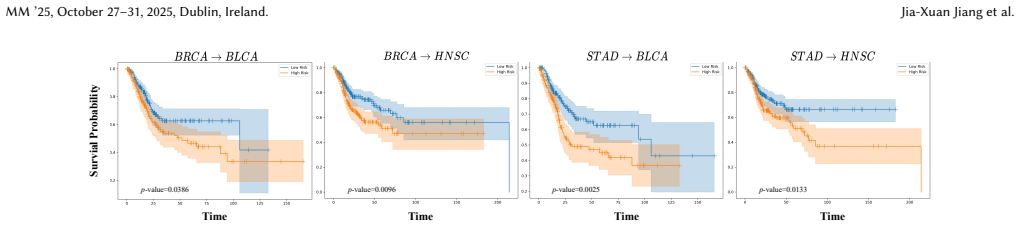
Summary. The manuscript proposes a new task, Cross-Cancer Single Domain Generalization for Multimodal Prognosis, in which a multimodal survival model is trained on one cancer type (source domain) and evaluated on other cancer types (target domains). It argues that existing multimodal prognostic models generalize worse than unimodal models under this shift, and introduces two plug-and-play modules: SDIR, which sparsifies dominant modality features and applies an exponential-decay ('Dirac-inspired') correction to amplify weaker features, and CADE, which constructs a synthetic latent target-domain distribution by kernel-weighted interpolation of modality-specific means and covariances. Experiments on four TCGA cancer types report an average C-index of 0.5625, outperforming the best unimodal baseline (MLP, 0.5489) and all multimodal baselines. The paper also reports ablations, synergy analysis of the two hyperparameters, compatibility with existing multimodal methods, and Kaplan-Meier stratification.
Significance. If the claims hold, the paper would make a useful contribution: the task formulation is practically motivated, the observation that multimodal models can underperform unimodal models under cross-cancer shift is interesting, and the proposed modules are simple enough to be adapted to existing frameworks. The use of external TCGA data, four-cancer leave-one-source-out evaluation, and plug-and-play compatibility experiments are strengths, as is the fact that the method itself is built from source statistics only. The empirical evidence, however, is currently weakened by target-informed hyperparameter selection and by effect sizes that fall within reported standard deviations; the theoretical justification for CADE also needs correction. These issues are addressable but they are load-bearing for the paper's central 'superior generalization' claim.
major comments (4)
- [§4.3.2, Table 3] The hyperparameter selection procedure leaks target-domain information. The grid search over α and γ is evaluated on the target cancer domains, and α=0.5, γ=0.3 are selected because they give the highest average target C-index (0.5625). In single-source domain generalization the target domain is supposed to be unseen; using target performance for model selection invalidates the setting and can inflate the reported number. The paper does not describe any source-only validation set or a fixed default configuration chosen before seeing the targets. Please re-run the comparison with hyperparameters selected without access to target data (e.g., a held-out split of the source domain or fixed defaults) and report whether the advantage over the MLP baseline survives.
- [§3.3, Theorem 3.1 and Eq. (12)] The theoretical justification of CADE is not valid as stated. The Cramér–Wold theorem characterizes convergence in distribution of a sequence of random vectors via the convergence of their one-dimensional projections; it does not imply that averaging the means and covariances in Eq. (8) yields a valid multivariate Gaussian distribution, and there is no sequence of random vectors here. The entropy inequality in Eq. (12) also does not follow from 'concavity of differential entropy' in the way described; it requires a separate argument about log-det concavity under the specific Gaussian family, and even if the inequality holds it does not by itself establish that enlarging latent entropy improves generalization to unseen cancer types. Please either provide a correct derivation of the validity of P_CADE and of the claimed entropy expansion, or reframe CADE as a heuristic distributional regularization and remove the unproven theoretical claims.
- [Table 1] The headline improvement over the best unimodal baseline is within overlapping error bars and is not supported by significance testing. For example, the proposed method achieves an average C-index of 0.5625 versus 0.5489 for the omics MLP, but the per-domain standard deviations are large (e.g., 0.5648±0.0477 on BLCA for the proposed method and 0.6145±0.0562 for MLP), and no standard deviation is reported for the average. Please report paired significance tests across seeds (or bootstrap/DeLong-style confidence intervals for C-index) and state how many random seeds were used. Without this, the claim of 'superior generalization' is not established by the experiments.
- [§3.3, Eq. (10), and Limitations in §5] The central mechanism of CADE depends on the assumption that the latent distributions of WSI and gene features are Gaussian and that the composed P_CADE is a useful surrogate for unseen target domains. The manuscript itself concedes that this Gaussian assumption may not hold for complex multimodal biomedical data. Since the theoretical rationale in Theorem 3.1 is also flawed (see the comment above), the current text does not establish how CADE synthesizes a useful target distribution. If the benefit is actually due to implicit regularization or feature mixing, that should be stated and supported with appropriate analyses rather than presented as a distribution-entanglement guarantee.
minor comments (5)
- [§3.2, Eq. (4)] The 'Dirac-inspired' nonlinear function does not use a Dirac delta; it is an exponential decay toward a template vector e. The template vector e is not described as learned or fixed, and its initialization and role in the reported experiments should be stated.
- [§2.3] Reference [33] is duplicated in the citation list for multiple instance learning methods: '[14, 33, 33, 39]' should be '[14, 33, 39]'.
- [§3.4, Eq. (13)] The sentence after Eq. (13) is incomplete: 'The Kullback-Leibler divergence KL(P_model∥P_CADE) serves as a regularization to encourage the learned distribution.' Please complete the sentence and specify what property of the learned distribution is being encouraged.
- [§4.3.2, Table 3] The layout of Table 3 is confusing: the grid over α and γ is not presented as a full two-dimensional matrix, and the text 'when fixing γ=0.5' and 'when fixing α=0.5' does not clearly correspond to the rows of the table. Please restructure the table for readability.
- [Figure 4] The Kaplan-Meier analysis should specify the number of patients in each risk group, the test used to compute the p-values (e.g., log-rank test), and whether the median risk cutoff is computed on the combined target cohorts.
Circularity Check
Reported 0.5625 average C-index is not an independent estimate: it is the target-domain C-index of the grid-search configuration selected by maximizing that same target-domain C-index, so the claimed superiority over unimodal baselines is partly an evaluation-selection artifact.
-
fitted input called prediction
[Section 4.3.2 (Table 3)]
"The model is trained on each single source domain and evaluated on the other target domains using the C-index as the performance metric. ... The best performance was obtained when 𝛾 = 0.3, yielding an average C-index of 0.5625."
The headline number 0.5625 is the target-domain C-index of the configuration (α=0.5, γ=0.3) that scored highest on exactly that target-domain C-index in the grid search over 25 combinations. In single-source domain generalization, target data may not be used for model selection, and the paper describes no source-only validation split. Thus the claimed 'superior generalization' is not a prediction from a fixed model; it is the selected maximum of the evaluation metric, making the comparison against the 0.5489 unimodal baseline inflated by construction relative to any configuration chosen without access to targets.
full rationale
The method's internal equations are not circular in a derivation sense: SDIR and CADE are heuristic modules, and CADE's Gaussian assumption is explicitly acknowledged in the limitations rather than derived from the target data. The benchmark uses external TCGA data, and self-citations are extensive but not load-bearing for the central mechanism. The only concrete circularity-like defect is the evaluation protocol: hyperparameters α and γ are selected by maximizing the average C-index on the unseen target domains, and the same selected value is then reported as evidence of generalization. This is a fitted-input-called-prediction pattern that partially undermines the headline empirical claim, but it does not make the method's architecture or underlying formulation equivalent to its inputs. Hence a moderate score of 4 is appropriate rather than a higher score reserved for derivation-level circularity.
Assumptions & free parameters
free parameters (3)
- alpha (SDIR sparsity) =
0.5 (selected by grid search, Table 3)
- gamma (CADE semantic guidance) =
0.3 (selected by grid search, Table 3)
- template vector e (SDIR) =
not specified
assumptions (5)
- standard math Cramér-Wold theorem applies to the kernel-weighted statistical path and guarantees P_ent is a valid multivariate Gaussian
- standard math Differential entropy is concave as a function of the density, so S(P_ent) >= integral kappa S(P_t) dt, implying entropy expansion
- domain assumption Gene expression provides a global semantic prior that can guide reorganization of local WSI features in latent space
- ad hoc to paper The synthetic latent distribution P_CADE is a soft surrogate for unseen target cancer domains
- domain assumption Multimodal feature imbalance (strong WSI, weak gene features) is the main cause of poor cross-domain fusion
invented entities (1)
-
P_CADE (synthetic target-domain latent distribution)
Cite this review
Pith. "Pith review of Single Domain Generalization for Multimodal Cross-Cancer Prognosis via Dirac Rebalancer and Distribution Entanglement." pith.science (2026). https://pith.science/paper/DUIWKWWO
@misc{pith2026250708340,
  author       = {Pith},
  title        = {Pith review of: Single Domain Generalization for Multimodal Cross-Cancer Prognosis via Dirac Rebalancer and Distribution Entanglement},
  year         = {2026},
  howpublished = {\url{https://pith.science/paper/DUIWKWWO}},
  note         = {Machine review of arXiv:2507.08340}
}
read the original abstract
Deep learning has shown remarkable performance in integrating multimodal data for survival prediction. However, existing multimodal methods mainly focus on single cancer types and overlook the challenge of generalization across cancers. In this work, we are the first to reveal that multimodal prognosis models often generalize worse than unimodal ones in cross-cancer scenarios, despite the critical need for such robustness in clinical practice. To address this, we propose a new task: Cross-Cancer Single Domain Generalization for Multimodal Prognosis, which evaluates whether models trained on a single cancer type can generalize to unseen cancers. We identify two key challenges: degraded features from weaker modalities and ineffective multimodal integration. To tackle these, we introduce two plug-and-play modules: Sparse Dirac Information Rebalancer (SDIR) and Cancer-aware Distribution Entanglement (CADE). SDIR mitigates the dominance of strong features by applying Bernoulli-based sparsification and Dirac-inspired stabilization to enhance weaker modality signals. CADE, designed to synthesize the target domain distribution, fuses local morphological cues and global gene expression in latent space. Experiments on a four-cancer-type benchmark demonstrate superior generalization, laying the foundation for practical, robust cross-cancer multimodal prognosis. Code is available at https://github.com/HopkinsKwong/MCCSDG
Figures


Figures from the paper (1 more)
Reference graph
Works this paper leans on
-
[1]
12 Kucherlapati Raju 13, Genome data analysis: Baylor College of Medicine Creighton Chad J
Brigham & Women’s Hospital & Harvard Medical School Chin Lynda 9 11 Park Peter J. 12 Kucherlapati Raju 13, Genome data analysis: Baylor College of Medicine Creighton Chad J. 22 23 Donehower Lawrence A. 22 23 24 25, Institute for Systems Biology Reynolds Sheila 31 Kreisberg Richard B. 31 Bernard Brady 31 Bressler Ryan 31 Erkkila Timo 32 Lin Jake 31 Thorsso...
work page 2012
-
[2]
Qi Bi, Jingjun Yi, Huimin Huang, Hao Zheng, Haolan Zhan, Yawen Huang, Yuex- iang Li, Xian Wu, and Yefeng Zheng. 2025. NightAdapter: Learning a Frequency Adapter for Generalizable Night-time Scene Segmentation. In Proceedings of the Computer Vision and Pattern Recognition Conference . 23838–23849
work page 2025
-
[3]
Qi Bi, Jingjun Yi, Haolan Zhan, Wei Ji, and Gui-Song Xia. 2025. Learning fine- grained domain generalization via hyperbolic state space hallucination. In Pro- ceedings of the AAAI Conference on Artificial Intelligence , Vol. 39. 1853–1861
work page 2025
-
[4]
Qi Bi, Jingjun Yi, Hao Zheng, Wei Ji, Yawen Huang, Yuexiang Li, and Yefeng Zheng. 2024. Learning generalized medical image segmentation from decoupled feature queries. In Proceedings of the AAAI Conference on Artificial Intelligence , Vol. 38. 810–818
work page 2024
-
[5]
Qi Bi, Jingjun Yi, Hao Zheng, Wei Ji, Haolan Zhan, Yawen Huang, Yuexiang Li, and Yefeng Zheng. 2024. Samba: Severity-aware recurrent modeling for cross-domain medical image grading. Advances in Neural Information Processing Systems 37 (2024), 75829–75852
work page 2024
-
[6]
Qi Bi, Jingjun Yi, Hao Zheng, Haolan Zhan, Yawen Huang, Wei Ji, Yuexiang Li, and Yefeng Zheng. 2024. Learning frequency-adapted vision foundation model for domain generalized semantic segmentation. Advances in Neural Information Processing Systems 37 (2024), 94047–94072
work page 2024
-
[7]
Richard J Chen, Tong Ding, Ming Y Lu, Drew FK Williamson, Guillaume Jaume, Andrew H Song, Bowen Chen, Andrew Zhang, Daniel Shao, Muhammad Shaban, et al. 2024. Towards a general-purpose foundation model for computational pathology. Nature Medicine 30, 3 (2024), 850–862
work page 2024
-
[8]
Richard J Chen, Ming Y Lu, Wei-Hung Weng, Tiffany Y Chen, Drew FK Williamson, Trevor Manz, Maha Shady, and Faisal Mahmood. 2021. Multimodal co-attention transformer for survival prediction in gigapixel whole slide im- ages. In Proceedings of the IEEE/CVF International Conference on Computer Vision . 4015–4025
work page 2021
Show all 69 references
-
[9]
Richard J Chen, Ming Y Lu, Drew FK Williamson, Tiffany Y Chen, Jana Lipkova, Zahra Noor, Muhammad Shaban, Maha Shady, Mane Williams, Bumjin Joo, et al
-
[10]
Ziyang Chen, Yongsheng Pan, Yiwen Ye, Hengfei Cui, and Yong Xia. 2023. Trea- sure in distribution: a domain randomization based multi-source domain gen- eralization for 2d medical image segmentation. In International Conference on Medical Image Computing and Computer Assisted ...
2023
-
[11]
Vitor Manuel Leitão De Sousa and Lina Carvalho. 2018. Heterogeneity in lung cancer. Pathobiology 85, 1-2 (2018), 96–107
2018
-
[12]
Tong Ding, Sophia J Wagner, Andrew H Song, Richard J Chen, Ming Y Lu, Andrew Zhang, Anurag J Vaidya, Guillaume Jaume, Muhammad Shaban, Ahrong Kim, et al. 2024. Multimodal whole slide foundation model for pathology. arXiv preprint arXiv:2411.19666 (2024)
2024 arXiv
-
[13]
Antonio Fabregat, Steven Jupe, Lisa Matthews, Konstantinos Sidiropoulos, Marc Gillespie, Phani Garapati, Robin Haw, Bijay Jassal, Florian Korninger, Bruce May, et al. 2018. The reactome pathway knowledgebase. Nucleic Acids Research 46, D1 (2018), D649–D655
2018
-
[14]
Zeyu Gao, Anyu Mao, Yuxing Dong, Jialun Wu, Jiashuai Liu, Chunbao Wang, Kai He, Tieliang Gong, Chen Li, and Mireia Crispin-Ortuzar. 2024. Accurate spatial quantification in computational pathology with multiple instance learning. MedRxiv (2024), 2024–04
2024
-
[15]
Jie Hao, Youngsoon Kim, Tae-Kyung Kim, and Mingon Kang. 2018. PASNet: Pathway-associated sparse deep neural network for prognosis prediction from high-throughput data. BMC Bioinformatics 19 (2018), 1–13
2018
-
[16]
Frank E Harrell Jr, Kerry L Lee, Robert M Califf, David B Pryor, and Robert A Rosati. 1984. Regression modelling strategies for improved prognostic prediction. Statistics in Medicine 3, 2 (1984), 143–152
1984
-
[17]
Shishuai Hu, Zehui Liao, and Yong Xia. 2023. Devil is in channels: Contrastive single domain generalization for medical image segmentation. In International Conference on Medical Image Computing and Computer Assisted Intervention . Springer, 14–23
2023
-
[18]
Shishuai Hu, Zehui Liao, Jianpeng Zhang, and Yong Xia. 2022. Domain and con- tent adaptive convolution based multi-source domain generalization for medical image segmentation. IEEE Transactions on Medical Imaging 42, 1 (2022), 233–244
2022
-
[19]
Maximilian Ilse, Jakub Tomczak, and Max Welling. 2018. Attention-based deep multiple instance learning. In International Conference on Machine Learning . PMLR, 2127–2136
2018
-
[20]
Guillaume Jaume, Anurag Vaidya, Richard J Chen, Drew FK Williamson, Paul Pu Liang, and Faisal Mahmood. 2024. Modeling dense multimodal interactions between biological pathways and histology for survival prediction. InProceedings of the IEEE/CVF Conference on Computer Vision an...
2024
-
[21]
Jia-Xuan Jiang, Hongsheng Jing, Ling Zhou, Yuee Li, and Zhong Wang. 2025. Multi-attribute balanced dataset generation framework AutoSyn and KinFace Channel-Spatial Feature Extractor for kinship recognition. Neurocomputing 613 (2025), 128750
2025
-
[22]
Jia-Xuan Jiang, Wenhui Lei, Yifeng Wu, Hongtao Wu, Furong Li, Yining Xie, Xiaofan Zhang, and Zhong Wang. 2025. MFM-DA: instance-aware adaptor and hierarchical alignment for efficient domain adaptation in medical foundation models. arXiv preprint arXiv:2503.00802 (2025)
2025 arXiv
-
[23]
Jia-Xuan Jiang, Yuee Li, and Zhong Wang. 2025. Structure-aware single-source generalization with pixel-level disentanglement for joint optic disc and cup segmentation. Biomedical Signal Processing and Control 99 (2025), 106801
2025
-
[24]
Günter Klambauer, Thomas Unterthiner, Andreas Mayr, and Sepp Hochreiter
-
[25]
William Knottenbelt, Zeyu Gao, Rebecca Wray, Woody Zhidong Zhang, Jiashuai Liu, and Mireia Crispin-Ortuzar. 2024. Coxkan: Kolmogorov-arnold networks for interpretable, high-performance survival analysis.arXiv preprint arXiv:2409.04290 (2024)
2024
-
[26]
Konstantina Kourou, Themis P Exarchos, Konstantinos P Exarchos, Michalis V Karamouzis, and Dimitrios I Fotiadis. 2015. Machine learning applications in cancer prognosis and prediction. Computational and Structural Biotechnology Journal 13 (2015), 8–17
2015
-
[27]
Ruiqing Li, Xingqi Wu, Ao Li, and Minghui Wang. 2022. HFBSurv: Hierarchical multimodal fusion with factorized bilinear models for cancer survival prediction. Bioinformatics 38, 9 (2022), 2587–2594
2022
-
[28]
Yijun Li, Chen Fang, Jimei Yang, Zhaowen Wang, Xin Lu, and Ming-Hsuan Yang. 2017. Universal style transfer via feature transforms. Advances in Neural Information Processing Systems 30 (2017)
2017
-
[29]
Zheren Li, Zhiming Cui, Lichi Zhang, Sheng Wang, Chenjin Lei, Xi Ouyang, Dongdong Chen, Xiangyu Zhao, Chunling Liu, Zaiyi Liu, et al. 2025. Domain generalization for mammographic image analysis with contrastive learning. Computers in Biology and Medicine 185 (2025), 109455
2025
-
[30]
Arthur Liberzon, Chet Birger, Helga Thorvaldsdóttir, Mahmoud Ghandi, Jill P Mesirov, and Pablo Tamayo. 2015. The molecular signatures database hallmark gene set collection. Cell Systems 1, 6 (2015), 417–425
2015
-
[31]
Ziqiang Liu, Zhao-Min Chen, Huiling Chen, Shu Teng, and Lei Chen. 2025. Style adaptation for avoiding semantic inconsistency in unsupervised domain adaptation medical image segmentation. Biomedical Signal Processing and Control 105 (2025), 107573
2025
-
[32]
Ming Y Lu, Bowen Chen, Drew FK Williamson, Richard J Chen, Ivy Liang, Tong Ding, Guillaume Jaume, Igor Odintsov, Long Phi Le, Georg Gerber, et al. 2024. A visual-language foundation model for computational pathology. Nature Medicine 30, 3 (2024), 863–874
2024
-
[33]
Ming Y Lu, Drew FK Williamson, Tiffany Y Chen, Richard J Chen, Matteo Barbieri, and Faisal Mahmood. 2021. Data-efficient and weakly supervised computational pathology on whole-slide images. Nature Biomedical Engineering 5, 6 (2021), 555–570
2021
-
[34]
Cancer Genome Atlas Network et al. 2015. Comprehensive genomic character- ization of head and neck squamous cell carcinomas. Nature 517, 7536 (2015), 576
2015
-
[35]
Cancer Genome Atlas Research Network et al. 2014. Comprehensive molecular characterization of gastric adenocarcinoma. Nature 513, 7517 (2014), 202
2014
-
[36]
Hui Qu, Mu Zhou, Zhennan Yan, He Wang, Vinod K Rustgi, Shaoting Zhang, Olivier Gevaert, and Dimitris N Metaxas. 2021. Genetic mutation and biological pathway prediction based on whole slide images in breast carcinoma using deep learning. NPJ Precision Oncology 5, 1 (2021), 87
2021
-
[37]
A Gordon Robertson, Jaegil Kim, Hikmat Al-Ahmadie, Joaquim Bellmunt, Guangwu Guo, Andrew D Cherniack, Toshinori Hinoue, Peter W Laird, Kather- ine A Hoadley, Rehan Akbani, et al. 2017. Comprehensive molecular characteri- zation of muscle-invasive bladder cancer. Cell 171, 3 (2...
2017
-
[38]
Mattia Segu, Alessio Tonioni, and Federico Tombari. 2023. Batch normalization embeddings for deep domain generalization. Pattern Recognition 135 (2023), 109115. MM ’25, October 27–31, 2025, Dublin, Ireland. Jia-Xuan Jiang et al
2023
-
[39]
Zhuchen Shao, Hao Bian, Yang Chen, Yifeng Wang, Jian Zhang, Xiangyang Ji, et al. 2021. Transmil: Transformer based correlated multiple instance learning for whole slide image classification. Advances in Neural Information Processing Systems 34 (2021), 2136–2147
2021
-
[40]
Nitish Srivastava, Geoffrey Hinton, Alex Krizhevsky, Ilya Sutskever, and Ruslan Salakhutdinov. 2014. Dropout: a simple way to prevent neural networks from overfitting. The Journal of Machine Learning Research 15, 1 (2014), 1929–1958
2014
-
[41]
Sören Richard Stahlschmidt, Benjamin Ulfenborg, Göran Falkman, and Jane Synnergren. 2024. Domain generalization of deep Learning models under sub- group shift in breast cancer prognosis. In 2024 IEEE Conference on Computational Intelligence in Bioinformatics and Computational ...
2024
-
[42]
Zixian Su, Kai Yao, Xi Yang, Kaizhu Huang, Qiufeng Wang, and Jie Sun. 2023. Rethinking data augmentation for single-source domain generalization in med- ical image segmentation. In Proceedings of the AAAI Conference on Artificial Intelligence, Vol. 37. 2366–2374
2023
-
[43]
Aravind Subramanian, Pablo Tamayo, Vamsi K Mootha, Sayan Mukherjee, Ben- jamin L Ebert, Michael A Gillette, Amanda Paulovich, Scott L Pomeroy, Todd R Golub, Eric S Lander, et al. 2005. Gene set enrichment analysis: A knowledge- based approach for interpreting genome-wide expre...
2005
-
[44]
Baochen Sun and Kate Saenko. 2016. Deep coral: Correlation alignment for deep domain adaptation. In ECCV 2016 workshops. Springer, 443–450
2016
-
[45]
Dmitry Ulyanov, Andrea Vedaldi, and Victor Lempitsky. 2016. Instance normaliza- tion: The missing ingredient for fast stylization. arXiv preprint arXiv:1607.08022 (2016)
2016 arXiv
-
[46]
Kunz, Matthew C
Eugene Vorontsov, Alican Bozkurt, Adam Casson, George Shaikovski, Michal Zelechowski, Kristen Severson, Eric Zimmermann, James Hall, Neil Tenenholtz, Nicolo Fusi, Ellen Yang, Philippe Mathieu, Alexander van Eck, Donghun Lee, Julian Viret, Eric Robert, Yi Kan Wang, Jeremy D. Ku...
2024
-
[47]
Xiangyu Wang, Weiheng Su, Yuxing Dong, Yang Li, Xianli Zhang, Tieliang Gong, Ines Prata Machado, Mireia Crispin-Ortuzar, Chen Li, and Zeyu Gao. 2024. Shallow-deep synergy: Boosting cross-Domain generalization in histopathologi- cal image segmentation. In 2024 IEEE Internationa...
2024
-
[48]
Xiyue Wang, Sen Yang, Jun Zhang, Minghui Wang, Jing Zhang, Wei Yang, Jun- zhou Huang, and Xiao Han. 2022. Transformer-based unsupervised contrastive learning for histopathological image classification. Medical Image Analysis 81 (2022), 102559
2022
-
[49]
Yunqi Wang, Tianjiao Zeng, Furui Liu, Qi Dou, Peng Cao, Hing-Chiu Chang, Qiao Deng, and Edward S Hui. 2025. Illuminating the unseen: Advancing MRI domain generalization through causality. Medical Image Analysis 101 (2025), 103459
2025
-
[50]
Zhong Wang, Jia-Xuan Jiang, Hao-Ran Wang, Ling Zhou, and Yuee Li. 2025. Localized Adaptive Style Mixing for feature statistics manipulation in medical image translation with limited Data. Expert Systems with Applications 277 (2025), 127217
2025
-
[51]
Ziyu Wang, Jia-xuan Jiang, Shubin Zeng, Ling Zhou, Yuee Li, and Zhong Wang
-
[52]
Zhiqin Wang, Ruiqing Li, Minghui Wang, and Ao Li. 2021. GPDBN: Deep bilinear network integrating both genomic data and pathological images for breast cancer prognosis prediction. Bioinformatics 37, 18 (2021), 2963–2970
2021
-
[53]
Hongtao Wu, Yifeng Wu, Jiaxuan Jiang, Chengyu Wu, Hong Wang, and Yefeng Zheng. 2025. SAMVSR: Leveraging Semantic Priors to Zone-Focused Mamba for Video Snow Removal. In Proceedings of the 33rd ACM International Conference on Multimedia
2025
-
[54]
Hongtao Wu, Yijun Yang, Angelica I Aviles-Rivero, Jingjing Ren, Sixiang Chen, Haoyu Chen, and Lei Zhu. 2024. Semi-supervised Video Desnowing Network via Temporal Decoupling Experts and Distribution-Driven Contrastive Regular- ization. In European Conference on Computer Vision ...
2024
-
[55]
Hongtao Wu, Yijun Yang, Haoyu Chen, Jingjing Ren, and Lei Zhu. 2023. Mask- guided progressive network for joint raindrop and rain streak removal in videos. In Proceedings of the 31st ACM International Conference on Multimedia. 7216–7225
2023
-
[56]
Hongtao Wu, Yijun Yang, Huihui Xu, Weiming Wang, Jinni Zhou, and Lei Zhu
-
[57]
Yunyang Xiong, Zhanpeng Zeng, Rudrasis Chakraborty, Mingxing Tan, Glenn Fung, Yin Li, and Vikas Singh. 2021. Nyströmformer: A nyström-based algo- rithm for approximating self-attention. In Proceedings of the AAAI Conference on Artificial Intelligence, Vol. 35. 14138–14148
2021
-
[58]
Yingxue Xu and Hao Chen. 2023. Multimodal optimal transport-based co- attention transformer with global structure consistency for survival prediction. In Proceedings of the IEEE/CVF International Conference on Computer Vision . 21241– 21251
2023
-
[59]
Yijun Yang, Hongtao Wu, Angelica I Aviles-Rivero, Yulun Zhang, Jing Qin, and Lei Zhu. 2024. Genuine knowledge from practice: Diffusion test-time adaptation for video adverse weather removal. In 2024 IEEE/CVF Conference on Computer Vision and Pattern Recognition (CVPR) . IEEE, ...
2024
-
[60]
Yilan Zhang, Yingxue Xu, Jianqi Chen, Fengying Xie, and Hao Chen. 2024. Pro- totypical information bottlenecking and disentangling for multimodal cancer survival prediction. In International Conference on Learning Representations
2024
-
[61]
Zhixing Zhong, Junchen Hou, Zhixian Yao, Lei Dong, Feng Liu, Junqiu Yue, Tiantian Wu, Junhua Zheng, Gaoliang Ouyang, Chaoyong Yang, et al . 2024. Domain generalization enables general cancer cell annotation in single-cell and spatial transcriptomics. Nature Communications 15, ...
2024
-
[62]
Fengtao Zhou and Hao Chen. 2023. Cross-modal translation and alignment for survival analysis. In Proceedings of the IEEE/CVF International Conference on Computer Vision. 21485–21494
2023
-
[63]
Kaiyang Zhou, Ziwei Liu, Yu Qiao, Tao Xiang, and Chen Change Loy. 2022. Domain generalization: A survey. IEEE Transactions on Pattern Analysis and Machine Intelligence 45, 4 (2022), 4396–4415
2022
-
[64]
Kaiyang Zhou, Yongxin Yang, Yu Qiao, and Tao Xiang. 2021. Domain gener- alization with mixstyle. International Conference on Learning Representations (2021)
2021
-
[65]
Jiayi Zhu, Bart Bolsterlee, Yang Song, and Erik Meijering. 2025. Improving cross- domain generalizability of medical image segmentation using uncertainty and shape-aware continual test-time domain adaptation. Medical Image Analysis 101 (2025), 103422
2025
-
[2017]
In Advances in Neural Information Processing Systems, I
Self-normalizing neural networks. In Advances in Neural Information Processing Systems, I. Guyon, U. Von Luxburg, S. Bengio, H. Wallach, R. Fergus, S. Vishwanathan, and R. Garnett (Eds.), Vol. 30
-
[2022]
Cancer Cell 40, 8 (2022), 865–878
Pan-cancer integrative histology-genomic analysis via multimodal deep learning. Cancer Cell 40, 8 (2022), 865–878
2022
-
[2024]
In Proceedings of the 32nd ACM International Conference on Multimedia
Rainmamba: Enhanced locality learning with state space models for video deraining. In Proceedings of the 32nd ACM International Conference on Multimedia . 7881–7890
-
[2025]
Neurocomputing (2025), 130120
Multi-receptive field feature disentanglement with distance-aware gaussian brightness augmentation for single-source domain generalization in medical image segmentation. Neurocomputing (2025), 130120
2025
Reviewed August 6, 2026 · model on record in the stance chip above.
Discussion (0). Continue with ORCID to comment.