REVIEW 3 major objections 3 minor 65 references
Representation learning with a transformer by contrastive learning for money laundering detection
T0 review · 3 major / 3 minor · reviewed 2026-08-06 · deepseek-v4-flash
Pith's one-line read Contrastive pre-training lets a transformer learn money-laundering patterns from unlabeled transaction time series, and a two-threshold Benjamini-Hochberg rule converts its scores into fraudster detections at a controlled false-discovery…
desk verdict New contrastive-transformer pipeline for AML, but the headline FDR-controlled detection counts rest on an unverified BH calibration protocol. read the letter →
The pith
A machine-rendered reading of the paper's core claim, the machinery that carries it, and where it could break.
The reading
What carries the argument
The load-bearing object is the contrastively pre-trained transformer encoder $f_\theta$ composed with a projection head $h_\gamma$, trained to minimize the InfoNCE loss on raw transaction time series, with the similarity criterion defined on the auxiliary tabular dataset $D'$: positive examples are the $\kappa$ closest accounts in Euclidean distance in $D'$, and negative examples are drawn from the other K-means clusters. A memory bank stores recent projected embeddings to allow diverse positive and negative sampling at low computational cost, and Gaussian noise in the latent space plays the role of data augmentation that respects the temporal dependence structure. On the detection side, the machinery is the two-threshold Benjamini-Hochberg calibration: for each account an empirical p-value ranks its score against the labelled scores of the opposite class, the BH step-up rule yields the high threshold $T_h$ at FDR $\alpha$, and the low threshold $T_l$ applies the same rule at the rescaled level $\alpha' = (N/\sum_i y_i)\alpha$ so that clearing non-fraudsters also controls FDR at $\alpha$.
What would settle it
Compute the empirical p-values for the test-set scores using labels from a held-out calibration set drawn from the same period as the test set, apply the BH procedure at the levels reported in Tables 1 and 2, and record the realized FDR on the test set; if the realized $\mathrm{FDR}_h$ or $\mathrm{FDR}_l$ for the transformer exceeds the nominal level while the reported detection counts hold, the cross-model comparison at 'controlled' FDR is not valid. A cheaper check is seed stability: the reported counts carry standard deviations as large as the counts themselves (e.g., 23.6 ± 12.8 fraudsters at $\mathrm{FDR}_h=0.4$), so rerunning the pre-training with more seeds would show whether the transformer's advantage over fine-tuning is an ordering or seed noise.
Extended reading notes
Core claim
The central discovery is that contrastive pre-training of a transformer, without any label, yields embeddings from which a plain logistic regression produces scores whose conditional distributions for fraudsters and non-fraudsters are far better separated than those obtained from tabular aggregates or from an LSTM autoencoder. The procedure maximizes the InfoNCE contrastive loss, pulling the projection of an account toward the projections of its $\kappa$ nearest neighbours in a tabular descriptor space ($\kappa=50$) and pushing it away from accounts in other K-means clusters, with a memory bank for efficient sampling and Gaussian noise injected in the latent space as augmentation. A logistic regressor then scores each account, and two thresholds are calibrated by the Benjamini-Hochberg multiple-testing procedure: the high threshold $T_h$ declares fraudsters at requested FDR level $\alpha$, and the low threshold $T_l$ declares non-fraudsters with the level rescaled by the estimated fraud proportion. In the experiments the transformer detects about twice as many fraudsters as the LSTM at $\mathrm{FDR}_h=0.4$ (23.6 vs 8.5 of roughly 116 test fraudsters), and at $\mathrm{FDR}_l=0.01$ it clears 54% of non-fraudsters compared with 3.4% for the LSTM, gains the authors attribute to the transformer's capacity to capture long-range dependencies in the transaction stream.
Load-bearing premise
The reported detection counts assume the Benjamini-Hochberg thresholds keep the false-discovery rate at the requested level on the test set, but in Sections 3.3 and 4.4 (Tables 1 and 2) the procedure is applied on the test data, the thresholds are calibrated on training data with 27% fraudsters while the test set has only 5%, and the FDR actually achieved on the test set is never reported.
Editorial extensions
If this is right
- Because the pre-training uses no labels, the representation step can consume large volumes of unlabeled transaction streams, with only a small labelled set needed to fit the final logistic scorer and calibrate the two thresholds.
- At a fixed requested FDR, the transformer-based pipeline detects roughly two to three times more true fraudsters than the LSTM autoencoder baseline, while the tabular baselines detect essentially none at FDR levels at or below 0.3.
- On the low threshold, the transformer clears 54-97% of non-fraudster accounts at FDR levels between 0.01 and 0.03, versus at most 3.4-40% for the LSTM, meaning most routine alerts could be automatically dismissed without an analyst.
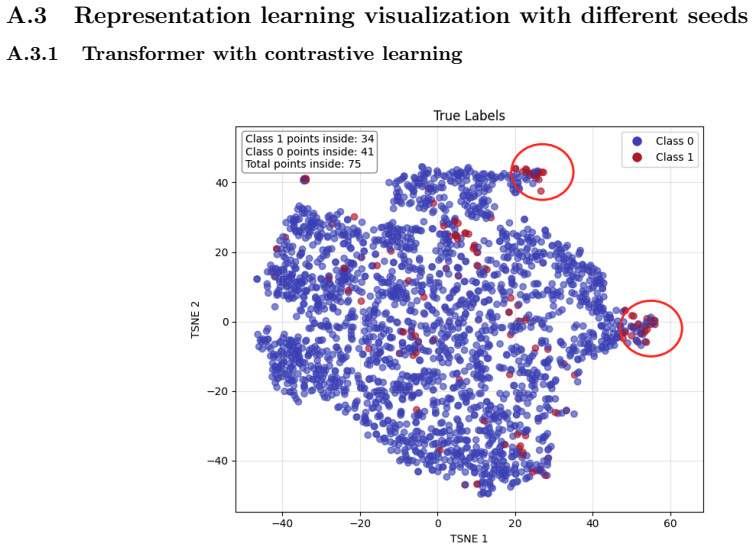
- The t-SNE visualizations show one or two compact fraudster clusters that reappear across random seeds for the transformer but not for the LSTM, which the authors read as evidence that the representations capture laundering patterns rather than memorizing the training set.
- The conclusion projects that, because the experiments used only a small anonymized subset of the full data, performance should improve further on larger datasets.
Reading between the lines
- The realistic operating point of the procedure is the low threshold: clearing roughly 97% of non-fraudsters at 3% FDR is what actually removes alert volume, while the high-threshold counts at FDR levels of 0.2 or below are near zero, so an operational deployment would likely lean on $T_l$ for triage and use $T_h$ only to escalate a handful of accounts.
- The design couples raw-sequence encoding with a tabular similarity signal in a way that is not laundering-specific, so the same recipe of a contrastive transformer over a sequence modality with positives and negatives drawn from a cheap tabular side view could be tested on other rare-event financial tasks such as insider trading or credit-card fraud.
- Because the training and test periods have different fraud prevalences (27% vs 5%), the honest reading of 'FDR control' is a claim about transfer across time; a natural extension is to re-estimate the fraud proportion on the test period, as the paper's own rescaling formula requires, and report the realized test FDR for each model.
- The seed-to-seed variation in detected counts (standard deviations comparable to the counts themselves) suggests ensembling several contrastively pre-trained encoders would be a cheap way to stabilize the two thresholds, an option the paper does not explore.
Signed reviews
Editorial analysis
A structured set of objections, weighed in public.
Referee Report
Summary. The paper proposes a two-step pipeline for anti-money laundering detection: a transformer encoder is pre-trained with an unsupervised contrastive loss on raw transaction time series, using a similarity criterion built from tabular descriptors to sample positives and negatives; a logistic regression on the learned embeddings produces a fraud score; and a two-threshold rule, calibrated with the Benjamini-Hochberg procedure, declares high-score accounts as fraudsters and low-score accounts as non-fraudsters while ostensibly controlling the false discovery rate. The experiments compare the transformer, a fine-tuned transformer, an LSTM autoencoder, and tabular baselines on an anonymized real-life dataset, reporting the number of detected fraudsters and non-fraudsters at several nominal FDR levels.
Significance. If the empirical claims were fully supported, the paper would be a useful demonstration that self-supervised contrastive pretraining can produce transferable representations for a highly imbalanced financial detection task, and the two-threshold BH treatment of the false-discovery rate is a sensible way to frame the operational decision problem. The manuscript also contains positive reproducibility elements: the dataset is released on Kaggle, the preprocessing and anonymization steps are described, and detailed hyperparameter tables are provided in Appendix A.2. The main quantitative claim, however, is currently weakened by an ambiguous evaluation protocol: it is not established that the thresholds are calibrated independently of the test labels, and the realized FDR on the test set is never reported. The significance of the work therefore depends on whether the evaluation can be clarified and repaired.
major comments (3)
- [§4.4, Tables 1 and 2] The paper does not establish that the BH thresholds are calibrated independently of the test set. Section 3.3 defines the p-values through label-dependent empirical distributions, and Algorithm 4 takes the labels as an input, while Section 4.4 only states that the five strategies were applied to the test set data. If the thresholds are recomputed from the test labels, then the reported detection counts are in-sample oracle counts, not out-of-sample detections, and the comparison across models is circular. If the thresholds are fixed using only training labels, the guarantee in Eq. (10) does not automatically transfer to the test population because Appendix Table 3 changes the fraud prevalence from 26.76% in training to 5.03% in test; the BH FDR bound is proportional to the null proportion in the calibration set. The realized test-set FDR is never reported for any model or level. Please clarify the exact protocol and report, for each model and each nominal level, the realized false discovery proportion on the test set.
- [§3.3, Algorithm 4] The pseudocode for the BH procedure appears to apply the low-threshold correction to the high threshold. For Th the null class is non-fraudsters, as defined in Eq. (6), so the relevant null proportion is the non-fraudster proportion; the correction in Eq. (11), α' = N / (Σ yi) α, is derived for Tl, where Σ yi is the number of fraudsters. Algorithm 4 is headed 'for Th' yet computes α' with Nl = Σ yi. If this pseudocode were used as written for Th, it would inflate the target level and invalidate the advertised FDR control. Please correct the pseudocode and state explicitly which correction, if any, was used to produce Tables 1 and 2.
- [§3.3, Eq. (10)] The FDR guarantee is invoked without discussing the conditions under which the BH bound holds. The guarantee in Eq. (10) requires p-values that are valid under the null and satisfy the independence or PRDS condition; here the p-values are estimated from the same scores and labels, with a leave-one-out construction in the denominators, and the resulting dependence is not addressed either theoretically or empirically. Given that the thresholds are later applied to a test population with substantially different class proportions, the paper should either justify the applicability of the BH bound or treat the procedure as heuristic and evaluate the realized FDR directly.
minor comments (3)
- [§2.1] The notation is inconsistent: the dataset is first written as D = {x0, ..., x_{N-1}}, but the text then says 'for each 1 ≤ i ≤ N', and later equations use indices 0 ≤ i ≤ N-1 and 1 ≤ i ≤ N interchangeably. Please normalize the indexing.
- [§3.2] The decision rule for accounts whose scores lie between Tl and Th is not explicitly described. The text says low scores are declared non-fraudsters and high scores are declared fraudsters, but it should state clearly whether the middle region is left for manual review or is assigned to a third category.
- [Appendix A.4, Table 7] In the row for Logistic Regression on tabular data at FDRh = 0.80, the '% total frauds' column reports 0.41, which appears to be a fraction rather than a percentage; other rows in the same column use values such as 37.06 and 42.80. Please make the units consistent.
Circularity Check
FDR-controlled detection counts are in-sample because BH thresholds are calibrated on the same test labels used to count detections; realized test FDR is never reported.
-
fitted input called prediction
[Section 3.3 (Eq. 10) and Section 4.4 (Tables 1-2)]
"Once the p-values have been estimated according to the methodology detailed above, the BH procedure is applied to compute the two required thresholds Th and respectively Tl. ... [BH95] established that ... rejecting all the accounts with a score larger than or equal to Th,α results in FDRh,α = ... ≤ α. ... The results are reported in Table 1 for Th and Table 2 for Tl from applying the above five strategies on the test set data."
Tables 1-2 count detections at nominal FDR levels, but the thresholds that define a detection are the BH thresholds computed from label-estimated p-values; Section 4.4 applies the strategies on the test set and never states that the BH thresholds were fixed from training labels alone. If BH is run on test labels (the natural reading of applying the strategies on the test set data), Eq. (10) is the calibration identity, so the FDR is controlled by construction and the detection counts are in-sample, not independent predictions. If instead the thresholds were fixed on training, the 26.76%-vs-5.03% prevalence shift breaks the transfer of the FDR guarantee, and realized test FDR is never reported.
full rationale
The contrastive pre-training and the logistic-regression score distributions are not themselves circular: the transformer is trained without labels, and the score separation in Section 4.3 is reported as score distributions. The circularity is confined to the FDR-controlled evaluation: the BH thresholds are calibrated with the same labels that are then used to count detections. There is no self-citation chain or uniqueness argument; the BH theory is external and standard. The failure is a label-leakage/in-sample-evaluation loop in the central quantitative claim, so the paper's power comparison at a fixed FDR is not an out-of-sample prediction as presented.
Assumptions & free parameters
free parameters (5)
- temperature T =
0.2
- noise intensity sigma^2 =
0.05
- number of positive neighbors kappa =
50
- number of clusters K =
chosen via silhouette score
- model hyperparameters =
see Appendix A.2 (layers, heads, learning rate, dropout, memory bank size)
assumptions (4)
- standard math BH procedure controls FDR when p-values are independent or positively dependent and uniform under the null
- domain assumption Euclidean distance on tabular descriptors D' defines financial similarity for contrastive sampling
- domain assumption Gaussian noise added in the latent space preserves the semantic structure needed for contrastive learning
- domain assumption Labels are noisy but usable: non-fraudulent accounts are those not yet detected
Cite this review
Pith. "Pith review of Representation learning with a transformer by contrastive learning for money laundering detection." pith.science (2026). https://pith.science/paper/GLQKYDZH
@misc{pith2026250708835,
  author       = {Pith},
  title        = {Pith review of: Representation learning with a transformer by contrastive learning for money laundering detection},
  year         = {2026},
  howpublished = {\url{https://pith.science/paper/GLQKYDZH}},
  note         = {Machine review of arXiv:2507.08835}
}
read the original abstract
The present work tackles the money laundering detection problem. A new procedure is introduced which exploits structured time series of both qualitative and quantitative data by means of a transformer neural network. The first step of this procedure aims at learning representations of time series through contrastive learning (without any labels). The second step leverages these representations to generate a money laundering scoring of all observations. A two-thresholds approach is then introduced, which ensures a controlled false-positive rate by means of the Benjamini-Hochberg (BH) procedure. Experiments confirm that the transformer is able to produce general representations that succeed in exploiting money laundering patterns with minimal supervision from domain experts. It also illustrates the higher ability of the new procedure for detecting nonfraudsters as well as fraudsters, while keeping the false positive rate under control. This greatly contrasts with rule-based procedures or the ones based on LSTM architectures.
Figures


Figures from the paper (21 more)




Reference graph
Works this paper leans on
-
[1]
Sunil Arya, David M. Mount, Nathan S. Netanyahu, Ruth Silverman, and Angela Y. Wu. An optimal algorithm for approximate nearest neighbor searching fixed dimensions. J. ACM , 45(6):891–923, November 1998
work page 1998
-
[2]
Controlling the false discovery rate: A practical and powerful approach to multiple testing
Yoav Benjamini and Yosef Hochberg. Controlling the false discovery rate: A practical and powerful approach to multiple testing. Journal of the Royal Statistical Society: Series B (Methodological) , 57(1):289--300, 1995
work page 1995
-
[3]
Christopher M. Bishop. Training with noise is equivalent to Tikhonov regularization. Neural Computation , 7(1):108--116, 1995
work page 1995
-
[4]
Rule-based anti-money laundering in financial intelligence units: Experience and vision
Luigi Bellomarini, Eleonora Laurenza, and Emanuel Sallinger. Rule-based anti-money laundering in financial intelligence units: Experience and vision. In Sotiris Moschoyiannis, Paul Fodor, Jan Vanthienen, Daniela Inclezan, Nikolay Nikolov, Francisco Mart \' n - Recuerda, and Ioan Toma, editors, Proceedings of the 14th International Rule Challenge, 4th Doct...
work page 2020
-
[5]
Large-scale machine learning with stochastic gradient descent
L \'e on Bottou. Large-scale machine learning with stochastic gradient descent. In Proceedings of COMPSTAT'2010: 19th International Conference on Computational StatisticsParis France, August 22-27, 2010 Keynote, Invited and Contributed Papers , pages 177--186. Springer, 2010
work page 2010
-
[6]
Stephen Boyd and Lieven Vandenberghe. Convex Optimization . Cambridge University Press, Cambridge, 2004
work page 2004
-
[7]
The control of the false discovery rate in multiple testing under dependency
Yoav Benjamini and Daniel Yekutieli. The control of the false discovery rate in multiple testing under dependency . The Annals of Statistics , 29(4):1165 -- 1188, 2001
work page 2001
-
[8]
Xgboost: A scalable tree boosting system
Tianqi Chen and Carlos Guestrin. Xgboost: A scalable tree boosting system. In Proceedings of the 22nd ACM SIGKDD International Conference on Knowledge Discovery and Data Mining , KDD ’16, page 785–794. ACM, August 2016
work page 2016
Show all 65 references
-
[9]
A simple framework for contrastive learning of visual representations, 2020
Ting Chen, Simon Kornblith, Mohammad Norouzi, and Geoffrey Hinton. A simple framework for contrastive learning of visual representations, 2020
2020
-
[10]
A cross-validation based estimation of the proportion of true null hypotheses
Alain Celisse and St \'e phane Robin. A cross-validation based estimation of the proportion of true null hypotheses. Journal of Statistical Planning and Inference , 140(11):3132--3147, 2010
2010
-
[11]
Bert: Pre-training of deep bidirectional transformers for language understanding
Jacob Devlin, Ming-Wei Chang, Kenton Lee, and Kristina Toutanova. Bert: Pre-training of deep bidirectional transformers for language understanding. Conference of the North American Chapter of the Association for Computational Linguistics: Human Language Technologies , 1:4171–4...
2019
-
[12]
Learning deep representations using convolutional auto-encoders with symmetric skip connections, 2017
Jianfeng Dong, Xiao-Jiao Mao, Chunhua Shen, and Yu-Bin Yang. Learning deep representations using convolutional auto-encoders with symmetric skip connections, 2017
2017
-
[13]
Position information in transformers: An overview, 2021
Philipp Dufter, Martin Schmitt, and Hinrich Schütze. Position information in transformers: An overview, 2021
2021
-
[14]
Terrance DeVries and Graham W. Taylor. Dataset augmentation in feature space, 2017
2017
-
[15]
de Almeida, Hassan Sirelkhatim, Guillaume Richard, Marcin Skwark, Karim Beguir, Marie Lopez, and Thomas Pierrot
Hugo Dalla-Torre, Liam Gonzalez, Javier Mendoza-Revilla, Nicolas Lopez Carranza, Adam Henryk Grzywaczewski, Francesco Oteri, Christian Dallago, Evan Trop, Bernardo P. de Almeida, Hassan Sirelkhatim, Guillaume Richard, Marcin Skwark, Karim Beguir, Marie Lopez, and Thomas Pierro...
2024
-
[16]
Anti-money laundering alert optimization using machine learning with graphs, 2022
Ahmad Naser Eddin, Jacopo Bono, David Aparício, David Polido, João Tiago Ascensão, Pedro Bizarro, and Pedro Ribeiro. Anti-money laundering alert optimization using machine learning with graphs, 2022
2022
-
[17]
Jeffrey L. Elman. Finding structure in time. Cognitive Science , 14(2):179--211, 1990
1990
-
[18]
European Parliament . Proposal for a directive on the mechanisms to be put in place by the member states for the prevention of the use of the financial system for the purposes of money laundering or terrorist financing, 2024
2024
-
[19]
Understanding and improving the role of projection head in self-supervised learning
Kartik Gupta, Thalaiyasingam Ajanthan, Anton van den Hengel, and Stephen Gould. Understanding and improving the role of projection head in self-supervised learning. arXiv preprint arXiv:2212.11491 , 2022
2022 arXiv
-
[20]
Understanding and improving the role of projection head in self-supervised learning, 2022
Kartik Gupta, Thalaiyasingam Ajanthan, Anton van den Hengel, and Stephen Gould. Understanding and improving the role of projection head in self-supervised learning, 2022
2022
-
[21]
Rankme: Assessing the downstream performance of pretrained self-supervised representations by their rank, 2023
Quentin Garrido, Randall Balestriero, Laurent Najman, and Yann Lecun. Rankme: Assessing the downstream performance of pretrained self-supervised representations by their rank, 2023
2023
-
[22]
A survey on self-supervised learning: Algorithms, applications, and future trends
Jie Gui, Tuo Chen, Jing Zhang, Qiong Cao, Zhenan Sun, Hao Luo, and Dacheng Tao. A survey on self-supervised learning: Algorithms, applications, and future trends. IEEE Transactions on Pattern Analysis and Machine Intelligence , 2024
2024
-
[23]
Diffprivlib: the IBM differential privacy library
Naoise Holohan, Stefano Braghin, P \'o l Mac Aonghusa, and Killian Levacher. Diffprivlib: the IBM differential privacy library. ArXiv e-prints , 1907.02444 [cs.CR], July 2019
1907 arXiv
-
[24]
Momentum contrast for unsupervised visual representation learning, 2020
Kaiming He, Haoqi Fan, Yuxin Wu, Saining Xie, and Ross Girshick. Momentum contrast for unsupervised visual representation learning, 2020
2020
-
[25]
Walter, Michael Maire, and Maryam Khademi
Tri Huynh, Simon Kornblith, Matthew R. Walter, Michael Maire, and Maryam Khademi. Boosting contrastive self-supervised learning with false negative cancellation, 2022
2022
-
[26]
Universal language model fine-tuning for text classification, 2018
Jeremy Howard and Sebastian Ruder. Universal language model fine-tuning for text classification, 2018
2018
-
[27]
A comprehensive survey on contrastive learning
Haigen Hu, Xiaoyuan Wang, Yan Zhang, Qi Chen, and Qiu Guan. A comprehensive survey on contrastive learning. Neurocomputing , page 128645, 2024
2024
-
[28]
Design of a monitor for detecting money laundering and terrorist financing
Tamer Hossam, Mohamed Zaki, Tarek Sobh, and Khaled Badran. Design of a monitor for detecting money laundering and terrorist financing. Journal of Theoretical and Applied Information Technology , 85:425–436, 03 2016
2016
-
[29]
Ikotun, Absalom E
Abiodun M. Ikotun, Absalom E. Ezugwu, Laith Abualigah, Belal Abuhaija, and Jia Heming. K-means clustering algorithms: A comprehensive review, variants analysis, and advances in the era of big data. Information Sciences , 622:178--210, 2023
2023
-
[30]
Hafiz Hasnain Imtiaz and Anand D. Sarwate. Symmetric matrix perturbation for differentially-private principal component analysis. 2016 IEEE International Conference on Acoustics, Speech and Signal Processing (ICASSP) , pages 2339--2343, 2016
2016
-
[31]
Augmenting imbalanced time-series data via adversarial perturbation in latent space
Beomsoo Kim, Jang-Ho Choi, and Jaegul Choo. Augmenting imbalanced time-series data via adversarial perturbation in latent space. In Vineeth N. Balasubramanian and Ivor Tsang, editors, Proceedings of The 13th Asian Conference on Machine Learning , volume 157 of Proceedings of M...
2021
-
[32]
Kim, Alejandro Cosa-Linan, Nandhini Santhanam, Mahboubeh Jannesari, Mate E
Hee E. Kim, Alejandro Cosa-Linan, Nandhini Santhanam, Mahboubeh Jannesari, Mate E. Maros, and Thomas Ganslandt. Transfer learning for medical image classification: a literature review. BMC Medical Imaging , 22(1):69, 2022
2022
-
[33]
Portfolio transformer for attention-based asset allocation, 2022
Damian Kisiel and Denise Gorse. Portfolio transformer for attention-based asset allocation, 2022
2022
-
[34]
Deep learning and explainable artificial intelligence techniques applied for detecting money laundering–a critical review
Dattatray Vishnu Kute, Biswajeet Pradhan, Nagesh Shukla, and Abdullah Alamri. Deep learning and explainable artificial intelligence techniques applied for detecting money laundering–a critical review. IEEE Access , 9:82300--82317, 2021
2021
-
[35]
Supervised contrastive learning, 2021
Prannay Khosla, Piotr Teterwak, Chen Wang, Aaron Sarna, Yonglong Tian, Phillip Isola, Aaron Maschinot, Ce Liu, and Dilip Krishnan. Supervised contrastive learning, 2021
2021
-
[36]
Temporal ensembling for semi-supervised learning, 2017
Samuli Laine and Timo Aila. Temporal ensembling for semi-supervised learning, 2017
2017
-
[37]
HaoChen, Adrien Gaidon, and Tengyu Ma
Hong Liu, Jeff Z. HaoChen, Adrien Gaidon, and Tengyu Ma. Self-supervised learning is more robust to dataset imbalance, 2022
2022
-
[38]
Le-Khac, Graham Healy, and Alan F
Phuc H. Le-Khac, Graham Healy, and Alan F. Smeaton. Contrastive representation learning: A framework and review. IEEE Access , 8:193907–193934, 2020
2020
-
[39]
Anti-money laundering in the eu: Time to get serious
Karel Lannoo and Richard Parlour. Anti-money laundering in the eu: Time to get serious. ceps task force report 28 jan 2021., January 2021
2021
-
[40]
Financial Fraud and Cybercrime in Wartime: An Overview of the Scientific Landscape and Insights from Countries Engaged in Military Conflict
Serhiy Lyeonov, Tetiana Vasylieva, and Hanna Filatova. Financial Fraud and Cybercrime in Wartime: An Overview of the Scientific Landscape and Insights from Countries Engaged in Military Conflict . Academic Research and Publishing UG (i.\,G.), Hamburg, 2024
2024
-
[41]
A preprocessing scheme for high‐cardinality categorical attributes in classification and prediction problems
Daniele Micci‐Barreca. A preprocessing scheme for high‐cardinality categorical attributes in classification and prediction problems. SIGKDD Explorations Newsletter , 3(1):27--32, jul 2001
2001
-
[42]
Cross-entropy loss functions: Theoretical analysis and applications, 2023
Anqi Mao, Mehryar Mohri, and Yutao Zhong. Cross-entropy loss functions: Theoretical analysis and applications, 2023
2023
-
[43]
Money laundering, proceeds of crime and the financing of terrorism
United Nation. Money laundering, proceeds of crime and the financing of terrorism
-
[44]
Regularizing deep neural networks by noise: Its interpretation and optimization
Hyeonwoo Noh, Tackgeun You, Jonghwan Mun, and Bohyung Han. Regularizing deep neural networks by noise: Its interpretation and optimization. In I. Guyon, U. Von Luxburg, S. Bengio, H. Wallach, R. Fergus, S. Vishwanathan, and R. Garnett, editors, Advances in Neural Information P...
2017
-
[45]
Sentence-bert: Sentence embeddings using siamese bert-networks, 2019
Nils Reimers and Iryna Gurevych. Sentence-bert: Sentence embeddings using siamese bert-networks, 2019
2019
-
[46]
Williams
David Zipser Ronald J. Williams. A learning algorithm for continually running fully recurrent neural networks. Neural Computation , 1:270–280., 1989
1989
-
[47]
Improving language understanding by generative pre-training
Alec Radford, Karthik Narasimhan, Tim Salimans, and Ilya Sutskever. Improving language understanding by generative pre-training. Technical Report TR-2018-001, OpenAI, 2018
2018
-
[48]
Rousseeuw
Peter J. Rousseeuw. Silhouettes: A graphical aid to the interpretation and validation of cluster analysis. Journal of Computational and Applied Mathematics , 20:53--65, 1987
1987
-
[49]
A natural language processing approach for financial fraud detection
Javier Fern \'a ndez Rodr \' guez, Michele Papale, Michele Carminati, Stefano Zanero, et al. A natural language processing approach for financial fraud detection. In CEUR workshop proceedings , volume 3260, pages 135--149. CEUR-WS. org, 2022
2022
-
[50]
Yarrow Baldock, and Kimberly Gleason
Roy Majed Sinno, G. Yarrow Baldock, and Kimberly Gleason. The evolution of trade-based money laundering schemes: a regulatory dialectic perspective. Journal of Financial Crime , 2023
2023
-
[51]
Long short-term memory
Jürgen Schmidhuber Sepp Hochreiter. Long short-term memory. Neural Computation , 9:270–280., 1997
1997
-
[52]
Modern information retrieval: A brief overview
Amit Singhal. Modern information retrieval: A brief overview. IEEE Data Eng. Bull. , 24:35--43, 2001
2001
-
[53]
Unsupervised learning of video representations using lstms, 2016
Nitish Srivastava, Elman Mansimov, and Ruslan Salakhutdinov. Unsupervised learning of video representations using lstms, 2016
2016
-
[54]
Statistical methods for fighting financial crimes
Agus Sudjianto, Sheela Nair, Ming Yuan, Aijun Zhang, Daniel Kern, and Fernando Cela-Díaz. Statistical methods for fighting financial crimes. Technometrics , 52(1):5--19, 2010
2010
-
[55]
A direct approach to false discovery rates
John D Storey. A direct approach to false discovery rates. Journal of the Royal Statistical Society Series B: Statistical Methodology , 64(3):479--498, 2002
2002
-
[56]
Hamlet: A transformer based approach for money laundering detection
Maria Paola Tatulli, Tommaso Paladini, Mario D'Onghia, Michele Carminati, and Stefano Zanero. Hamlet: A transformer based approach for money laundering detection. In Shlomi Dolev, Ehud Gudes, and Pascal Paillier, editors, Cyber Security, Cryptology, and Machine Learning , page...
2023
-
[57]
Scalable and imbalance-resistant machine learning models for anti-money laundering: A two-layered approach
Pavlo Tertychnyi, Ivan Slobozhan, Madis Ollikainen, and Marlon Dumas. Scalable and imbalance-resistant machine learning models for anti-money laundering: A two-layered approach. In Enterprise Applications and Services in the Finance Industry , 2020
2020
-
[58]
Representation learning with contrastive predictive coding, 2019
Aaron van den Oord, Yazhe Li, and Oriol Vinyals. Representation learning with contrastive predictive coding, 2019
2019
-
[59]
van Houwelingen and S
J.C. van Houwelingen and S. le Cessie. Logistic regression, a review. Statistica Neerlandica , 42(4):215--232, 1988
1988
-
[60]
Gomez, Lukasz Kaiser, and Illia Polosukhin
Ashish Vaswani, Noam Shazeer, Niki Parmar, Jakob Uszkoreit, Llion Jones, Aidan N. Gomez, Lukasz Kaiser, and Illia Polosukhin. Attention is all you need. Advances in Neural Information Processing Systems , 30:5998--6008, 2017
2017
-
[61]
What do position embeddings learn? an empirical study of pre-trained language model positional encoding, 2020
Yu-An Wang and Yun-Nung Chen. What do position embeddings learn? an empirical study of pre-trained language model positional encoding, 2020
2020
-
[62]
Transformers in time series: A survey
Qingsong Wen, Tian Zhou, Chaoli Zhang, Weiqi Chen, Ziqing Ma, Junchi Yan, and Liang Sun. Transformers in time series: A survey. In International Joint Conference on Artificial Intelligence(IJCAI) , 2023
2023
-
[63]
Investigating the benefits of projection head for representation learning, 2024
Yihao Xue, Eric Gan, Jiayi Ni, Siddharth Joshi, and Baharan Mirzasoleiman. Investigating the benefits of projection head for representation learning, 2024
2024
-
[64]
Bronstein, and Or Litany
Evgenii Zheltonozhskii, Chaim Baskin, Avi Mendelson, Alex M. Bronstein, and Or Litany. Contrast to divide: Self-supervised pre-training for learning with noisy labels. In 2022 IEEE/CVF Winter Conference on Applications of Computer Vision (WACV) , page 387–397. IEEE, January 2022
2022
-
[65]
Comparative study on the performance of categorical variable encoders in classification and regression tasks, 2024
Wenbin Zhu, Runwen Qiu, and Ying Fu. Comparative study on the performance of categorical variable encoders in classification and regression tasks, 2024
2024
Reviewed August 6, 2026 · model on record in the stance chip above.
Discussion (0). Continue with ORCID to comment.