Swa-bhasha Resource Hub: Romanized Sinhala to Sinhala Transliteration Systems and Data Resources
Pith reviewed 2026-05-19 04:38 UTC · model grok-4.3
The pith
The Swa-bhasha Resource Hub assembles and releases datasets plus algorithms for converting Romanized Sinhala into native script to support Sinhala NLP research.
A machine-rendered reading of the paper's core claim, the machinery that carries it, and where it could break.
Core claim
The authors have gathered and made openly available a set of datasets and corresponding tools for Romanized Sinhala to Sinhala transliteration, resources that have already supported training of transliteration models and development of related applications, together with a comparative analysis of other systems in the domain.
What carries the argument
The Swa-bhasha Resource Hub, a public repository of collected datasets and transliteration algorithms developed over five years.
If this is right
- NLP researchers gain ready training data for models that convert informal Romanized inputs into standard Sinhala script.
- Developers of Sinhala-language applications can incorporate the released tools to handle mixed-script user input without building resources from scratch.
- The comparative analysis of existing applications clarifies which approaches currently work best and where gaps remain.
- Public release of the datasets invites community extensions, corrections, and new experiments using the same base materials.
Where Pith is reading between the lines
- The resources could serve as seed data for building larger parallel corpora that combine Romanized Sinhala with English or other languages.
- Mobile or web applications might integrate the transliteration tools to let users type in Roman letters and receive native-script output in real time.
- Similar hubs for other low-resource languages that use Romanized forms could follow the same pattern of collecting, documenting, and releasing paired data.
Load-bearing premise
The collected datasets and tools are comprehensive enough and of sufficient quality to meaningfully advance Sinhala NLP without requiring external validation or additional large-scale testing.
What would settle it
Train a transliteration model exclusively on the hub's released data and evaluate it on a fresh, independently gathered test set of real-world Romanized Sinhala sentences; if accuracy or downstream application performance remains low, the claim that the resources suffice for meaningful progress would be weakened.
Figures

read the original abstract
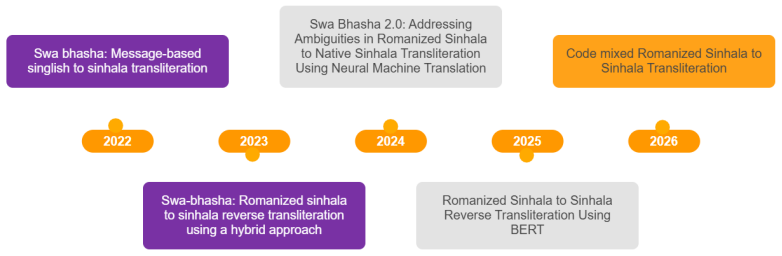
The Swa-bhasha Resource Hub provides a comprehensive collection of data resources and algorithms developed for Romanized Sinhala to Sinhala transliteration between 2020 and 2025. These resources have played a significant role in advancing research in Sinhala Natural Language Processing (NLP), particularly in training transliteration models and developing applications involving Romanized Sinhala. The current openly accessible data sets and corresponding tools are made publicly available through this hub. This paper presents a detailed overview of the resources contributed by the authors and includes a comparative analysis of existing transliteration applications in the domain.
Editorial analysis
A structured set of objections, weighed in public.
Referee Report
Summary. The manuscript presents the Swa-bhasha Resource Hub as a collection of datasets and transliteration algorithms for Romanized Sinhala to Sinhala script conversion, developed between 2020 and 2025. It claims these resources have played a significant role in advancing Sinhala NLP research, especially for training models and applications, and provides an overview of the contributed resources together with a comparative analysis of existing transliteration applications.
Significance. Open release of resources targeting Romanized input for Sinhala, a low-resource language, could help address gaps in handling informal text in social media or user-facing applications. The public availability of the datasets and tools is a concrete strength that supports reproducibility. However, the asserted field-level advancement would be stronger if backed by adoption metrics or downstream performance gains.
major comments (2)
- [Abstract and §1] Abstract and §1: The statement that the resources 'have played a significant role in advancing research in Sinhala Natural Language Processing' is presented without supporting evidence such as citation counts, download statistics, or results from independent downstream evaluations using these datasets. This leaves the impact claim dependent on internal description alone.
- [Comparative analysis section] Comparative analysis section: The discussion of existing transliteration applications would be more informative if it included quantitative metrics (e.g., character error rate, accuracy on held-out test sets) rather than qualitative comparison only; without such numbers it is difficult to judge whether the contributed systems represent measurable progress.
minor comments (2)
- [Resource Hub Description] Ensure every dataset and tool has a direct, persistent URL or DOI listed in the resource hub description so readers can access them without additional searching.
- [Data Resources] Add a short table summarizing dataset sizes, sources, and annotation methods to improve clarity and allow quick assessment of coverage.
Simulated Author's Rebuttal
We thank the referee for the constructive comments and the recommendation of minor revision. We address each major comment below and have revised the manuscript accordingly where appropriate.
read point-by-point responses
-
Referee: [Abstract and §1] Abstract and §1: The statement that the resources 'have played a significant role in advancing research in Sinhala Natural Language Processing' is presented without supporting evidence such as citation counts, download statistics, or results from independent downstream evaluations using these datasets. This leaves the impact claim dependent on internal description alone.
Authors: We acknowledge that the claim of a significant role in advancing Sinhala NLP research is presented without external metrics such as citation counts or independent evaluations. The resources were developed and applied internally over five years for model training, but we do not possess comprehensive adoption statistics at present. To correct this, we will revise the abstract and Section 1 to describe the resources as having been developed to support and advance Sinhala NLP research, removing the stronger assertion of past impact and focusing on their public release and intended utility. revision: yes
-
Referee: [Comparative analysis section] Comparative analysis section: The discussion of existing transliteration applications would be more informative if it included quantitative metrics (e.g., character error rate, accuracy on held-out test sets) rather than qualitative comparison only; without such numbers it is difficult to judge whether the contributed systems represent measurable progress.
Authors: We agree that quantitative metrics would improve the informativeness of the comparative analysis. The current section emphasizes qualitative differences in features, coverage, and accessibility. We will expand the section to include available performance numbers from our internal evaluations, such as character error rates and accuracy on held-out test sets for the contributed systems, allowing readers to assess measurable progress more directly. revision: yes
Circularity Check
No circularity: descriptive resource paper with no derivations or self-referential reductions
full rationale
The paper describes collected datasets, tools, and a public hub for Romanized Sinhala transliteration from 2020-2025. It contains no equations, no fitted parameters, no predictions of quantities, and no derivation chain. The claim that resources 'have played a significant role' is an unsupported assertion about impact rather than a logical reduction to the paper's own inputs. No self-citation is used to justify a uniqueness theorem or to force a result. The work is self-contained as a catalog and release announcement; external validation is absent but that is a correctness/impact issue, not circularity.
Axiom & Free-Parameter Ledger
axioms (1)
- domain assumption Romanized input is a frequent practical entry point for Sinhala text processing due to keyboard limitations.
Lean theorems connected to this paper
-
IndisputableMonolith/Foundation/RealityFromDistinction.leanreality_from_one_distinction unclear?
unclearRelation between the paper passage and the cited Recognition theorem.
The Swa-bhasha Resource Hub provides a comprehensive collection of data resources and algorithms developed for Romanized Sinhala to Sinhala transliteration between 2020 and 2025.
What do these tags mean?
- matches
- The paper's claim is directly supported by a theorem in the formal canon.
- supports
- The theorem supports part of the paper's argument, but the paper may add assumptions or extra steps.
- extends
- The paper goes beyond the formal theorem; the theorem is a base layer rather than the whole result.
- uses
- The paper appears to rely on the theorem as machinery.
- contradicts
- The paper's claim conflicts with a theorem or certificate in the canon.
- unclear
- Pith found a possible connection, but the passage is too broad, indirect, or ambiguous to say the theorem truly supports the claim.
Reference graph
Works this paper leans on
-
[1]
In 2024 4th Interna- tional Conference on Advanced Research in Comput- ing (ICARC), pages 241–246
Swa bhasha 2.0: Addressing ambiguities in romanized sinhala to native sinhala transliteration us- ing neural machine translation . In 2024 4th Interna- tional Conference on Advanced Research in Comput- ing (ICARC), pages 241–246. H. Herath and Deshan Sumanathilaka. 2024. Tamzhi: Shorthand romanized tamil to tamil reverse translit- eration using novel hybr...
work page 2024
-
[2]
IndoNLP 2025 shared task: Romanized Sin- hala to Sinhala reverse transliteration using BERT . In Proceedings of the First Workshop on Natural Language Processing for Indo-Aryan and Dravidian Languages, pages 135–140, Abu Dhabi. Association for Computational Linguistics. Sandun Sameera Perera and Deshan Koshala Sumanathilaka. 2025. Machine translation and ...
discussion (0)
Sign in with ORCID, Apple, or X to comment. Anyone can read and Pith papers without signing in.