REVIEW 5 major objections 6 minor 2 cited by
VerifyBench: A Systematic Benchmark for Evaluating Reasoning Verifiers Across Domains
T0 review · 5 major / 6 minor · reviewed 2026-08-06 · deepseek-v4-flash
Pith's one-line read A 3,989-question benchmark across four STEM domains shows that specialized verifiers lead in accuracy while general LLM judges lead in recall, and that format changes can reverse their rankings.
desk verdict Useful new verifier benchmark, but the short-output comparison is confounded by the shared prompt/token cap and precision is never tabulated. read the letter →
The pith
A machine-rendered reading of the paper's core claim, the machinery that carries it, and where it could break.
The reading
What carries the argument
The load-bearing device is a four-dimensional evaluation grid: two input conditions, the extracted boxed final answer versus the complete chain-of-thought response, crossed with two output constraints, an 8-token verdict and a 4k-token verdict, applied through one shared prompt template to every verifier on the same 3,989 annotated instances. The grid is what converts individual model scores into a statement about tradeoffs, and the fine-grained human labels, with inter-annotator agreement of 0.88 to 0.92, are what make the accuracy and recall numbers trustworthy enough to compare.
What would settle it
Re-run the general LLM judges on the same 3,989 instances with their own structured prompt format and no 8-token cap, then compare precision and recall against the same gold labels; if any general model matches or beats the best specialized verifier on both metrics, the claimed accuracy-recall tradeoff is largely a format artifact. A cheaper check is to report the '-' scored models' outputs verbatim and see whether they contained usable verdicts that the extraction function missed.
Extended reading notes
Core claim
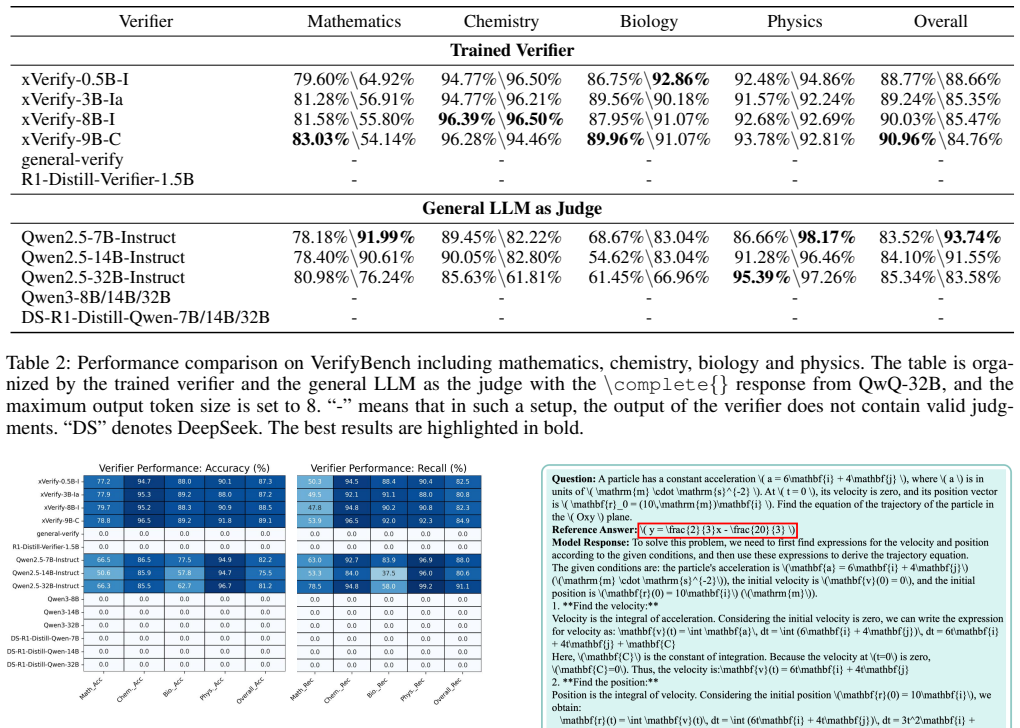
The central discovery is an empirical frontier rather than a new architecture: across all tested configurations, no verifier type dominates both precision and recall. Specialized verifiers lead accuracy in almost every setting, with overall accuracy around 89% to 91%, while general LLM judges post higher recall when given full responses and longer outputs, sometimes above 90%, but their precision is unstable and collapses when outputs are capped at 8 tokens. The paper also reports high sensitivity to input structure: rankings change when the verifier sees only the boxed final answer rather than the complete reasoning trace, and cross-domain generalization is limited, so a strong physics verifier is not automatically strong in biology. This supports the paper's claim that current verifier technology has predictable but format-dependent reliability frontiers.
Load-bearing premise
The load-bearing premise is that giving every verifier the same prompt template and the same 8-token output cap is a fair way to compare them; if general LLM judges are simply mismatched to that format, the reported precision collapse and the '-' entries are an artifact rather than a capability limit.
Editorial extensions
If this is right
- Any RLVR pipeline should treat verifier scores as conditional on interface: the same model can look unusable with an 8-token cap and competitive with a 4k-token output.
- The paper's concrete recommendation is a hybrid pipeline: use a general LLM judge for high-recall coarse filtering, then a specialized verifier for precision filtering.
- Specialized verifiers should be trained on varied answer forms and noisy reasoning chains to improve recall without sacrificing accuracy.
- General LLM judges should be steered toward structured outputs, because unstructured judgments are a major source of their precision instability.
- Verifier benchmark scores are comparable only when input granularity and output length are fixed; varying either can reverse model rankings.
Reading between the lines
- The paper leaves implicit that its unified-prompt, 8-token-cap design may understate general LLM judges: several produced no valid verdict in that setup, yet the same models post substantial recall in the 4k-token condition, so the short-output comparison likely measures format compatibility as much as verification ability.
- A natural extension is to measure whether the same accuracy-recall frontier appears when verifiers are embedded in an actual RLVR training loop, since the paper evaluates verifiers only on static annotations.
- If format sensitivity is as strong as reported, answer extraction becomes part of the verifier problem; improving extraction could raise downstream reward accuracy without retraining the verifier.
- The cross-domain generalization limits suggest that a verifier's domain accuracy may track domain-specific surface conventions such as chemical notation or physics units, letting benchmark designers predict where a verifier will fail before measuring it.
Editorial analysis
A structured set of objections, weighed in public.
Referee Report
Summary. The paper introduces VerifyBench, a benchmark of 3,989 expert-level STEM questions spanning mathematics, physics, chemistry, and biology, each paired with a reference answer and a QwQ-32B-generated chain-of-thought response, with binary correctness labels obtained through a two-stage human annotation process. It then evaluates several verifier families—specialized verifiers (xVerify, general-verify, R1-Distill-Verifier) and general-purpose LLMs (Qwen2.5-Instruct, Qwen3, DeepSeek-R1-Distill-Qwen)—under four conditions that cross input granularity (boxed final answer vs. full chain of thought) with verifier output length (8 vs. 4k tokens). The central claims are that specialized verifiers achieve leading accuracy but lag in recall, general LLM judges are more inclusive but less precise, and verifiers are highly sensitive to input structure and output length, with limitations in cross-domain generalization.
Significance. VerifyBench addresses a real gap: verifier evaluation for RLVR is currently fragmented, and a multi-domain, human-annotated benchmark with standardized conditions would be a useful community resource. The annotation effort (inter-annotator agreement 0.88–0.92) and the breadth of verifier families covered are credible strengths. If the evaluation protocol were made fair across model types, the benchmark could serve as a reference point for verifier selection and for future work on verifier robustness. However, as presented, the headline comparisons overstate what the data support: the short-output condition is confounded with format adherence, no uncertainty is reported despite stochastic decoding, and several stated findings are not backed by the tables.
major comments (5)
- [Verifier Inference / Evaluation Variants; Table 2; Figure 3] The 8-token short-output condition is not a valid comparison across verifier families. The manuscript states in 'Baseline' that Qwen3, DeepSeek-R1-Distill-Qwen, general-verify, and R1-Distill-Verifier-1.5B produce reasoning traces before a judgment, while all models are given the xVerify prompt and the output is truncated at 8 tokens; consequently Table 2 and Figure 3 report '-'/0.0 for these models. The conclusion in 'Performance Across Settings' that 'general LLMs perform poorly when limited to short outputs' therefore conflates prompt-adherence and decoding behavior with verification ability. This confound needs to be removed by using each model's native output format, by constrained decoding that forces the final judgment token, or by allowing enough tokens; at minimum, invalid outputs should be reported separately and excluded from accuracy/recall, and short-output claims should be restricted to models that produce direct labels.
- [Verifier Inference; Tables 2 and 3] No uncertainty is reported despite stochastic decoding at temperature 0.2 with TopP 0.95. Many of the headline comparisons are close—for example, in Table 3 Qwen3-14B attains 91.11% overall accuracy versus xVerify-9B-C's 90.86%, and several xVerify variants differ by less than a point. Without multiple seeds, standard deviations, confidence intervals, or significance tests, the paper's ranking claims (e.g., 'xVerify-9B-C leads' and 'specialized verifiers consistently achieve higher accuracy') are not supported. Please report means over at least three seeds with error bars for all tables.
- [Strictness vs. Inclusiveness; Tables 2 and 3] The precision-related claims are not evidenced by the reported metrics. The paper repeatedly says general LLMs have 'unstable precision' and specialized verifiers have higher precision, but Tables 2 and 3 report only accuracy and recall; precision is never tabulated. Since the central accuracy-recall trade-off narrative depends on distinguishing precision from accuracy, please add precision (or full confusion matrices) per model, domain, and setting.
- [Analysis, 'Performance Across Settings'; Table 3] The statement that 'Across all configurations, specialized verifiers consistently achieve higher accuracy' is contradicted by the paper's own data. In Table 3, the full-CoT long-output setting, Qwen3-14B has higher overall accuracy (91.11%) than xVerify-9B-C (90.86%) and higher physics accuracy (96.99% vs. 93.98%). The consistency claim needs to be qualified to specific settings and domains, or the tables need to be corrected.
- [Abstract; Conclusion] The claim of 'inherent limitations in cross-domain generalization' is unsupported by the experimental design. The study evaluates each verifier separately on four domains; this is multi-domain evaluation, not a cross-domain generalization test. No protocol trains or calibrates on one domain and tests on another, so the abstract/conclusion wording overreaches. Either add a cross-domain transfer experiment (e.g., judge on one domain after prompting or tuning on another) or rephrase the finding as per-domain performance variation.
minor comments (6)
- [Tables 2 and 3] The captions do not define the two numbers in each cell (accuracy and recall) or the backslash separator; please add explicit column headers or a clear legend.
- [Task Overview] The extraction function g for the boxed-only input is defined formally, but its implementation (how the last \boxed{} environment is parsed, how LaTeX syntax errors are handled) is not described; this is essential for reproducing the boxed-only settings.
- [VerifyBench] The manuscript refers to an 'Appendix' for question-selection criteria, annotation protocols, and case studies, but the submitted text contains no appendix. If the appendix exists, please include it; otherwise, move the referenced material into the main text.
- [Baseline] Model names are inconsistent across text and tables ('general verifier' vs. 'general-verify'; 'R1-Distill-Verifier-1.5B' matching the table but not the baseline paragraph). Please standardize names and provide exact model versions and hyperparameters.
- [Figure 3] Encoding invalid judgments as 0.0 visually equates a missing judgment with an incorrect judgment. Use a separate 'invalid' category or exclude such entries from plots, and report their frequencies.
- [General] Please state where the benchmark data and evaluation code will be released; the paper currently gives no access information, which limits reproducibility.
Circularity Check
No significant circularity: VerifyBench evaluates externally human-annotated labels rather than fitting predictions from its own outputs.
full rationale
VerifyBench is a benchmark evaluation rather than a derivation chain. The ground-truth labels are produced by a two-stage human annotation process with inter-annotator agreement 0.88–0.92, and every verifier's accuracy and recall are external measurements against those human labels. No predicted quantity is fitted from the benchmark itself, and no result is assumed in order to construct the benchmark. The use of the xVerify prompt as the unified inference prompt is a controlled-comparison design choice, not a load-bearing citation: the cited xVerify work supplies the prompt format, not the ground truth, and the paper's conclusions about verifier tradeoffs rest on the measured scores. The '-' entries under the 8-token output cap are explicitly acknowledged in the Table 2 footnote as 'the output of the verifier does not contain valid judgments'; this is an experimental-design validity concern, not circular reasoning. No step can be exhibited in which a claimed prediction reduces by construction to a fitted input, a self-citation chain, or a definitional equivalence. The evaluation is self-contained against external human annotation, so the appropriate circularity score is 0.
Assumptions & free parameters
assumptions (3)
- domain assumption Human expert annotations of response-reference consistency are the ground truth for correctness.
- domain assumption QwQ-32B generated responses at temperature 0.6 are representative of the diverse, long-form responses a verifier must judge in RLVR.
- domain assumption A binary consistency label (correct or incorrect) and the accuracy-recall pair are sufficient statistics for verifier utility in RLVR.
Cite this review
Pith. "Pith review of VerifyBench: A Systematic Benchmark for Evaluating Reasoning Verifiers Across Domains." pith.science (2026). https://pith.science/paper/PIFO2Z2S
@misc{pith2026250709884,
  author       = {Pith},
  title        = {Pith review of: VerifyBench: A Systematic Benchmark for Evaluating Reasoning Verifiers Across Domains},
  year         = {2026},
  howpublished = {\url{https://pith.science/paper/PIFO2Z2S}},
  note         = {Machine review of arXiv:2507.09884}
}
read the original abstract
Large language models (LLMs) increasingly rely on reinforcement learning (RL) to enhance their reasoning capabilities through feedback. A critical challenge is verifying the consistency of model-generated responses and reference answers, since these responses are often lengthy, diverse, and nuanced. Rule-based verifiers struggle with complexity, prompting the use of model-based verifiers. However, specialized verifiers lack flexibility, while general LLM judges can be inconsistent. Existing research primarily focuses on building better verifiers, yet a systematic evaluation of different types of verifiers' performance across domains remains lacking, severely constraining the reliable development of Reinforcement Learning with Verifiable Reward (RLVR). To address this, we propose VerifyBench--a cross-domain comprehensive benchmark for systematically evaluating verifiers. We construct 4,000 expert-level questions covering mathematics, physics, chemistry, and biology. Each question is equipped with reference answers and diverse responses. The reliability of the evaluation is ensured through a rigorous annotation process conducted by a multidisciplinary expert team. We design a four-dimensional experimental framework to comprehensively compare the performance boundaries of specialized verifiers and general LLMs under combined conditions of extracted answers vs. complete responses, and short vs. long outputs. Our evaluation uncovers fundamental trade-offs in verifiers: while specialized verifiers achieve leading accuracy, they exhibit deficiencies in recall; general models show stronger inclusivity but unstable precision. More importantly, we discover verifiers' high sensitivity to input structure and inherent limitations in cross-domain generalization, providing critical insights into the bottlenecks of current verifier technology.
Figures


Figures from the paper (1 more)

Forward citations
Cited by 2 Pith papers
-
AdvancedMathBench: A Benchmark Suite for Advanced Mathematical Proof Generation and Verification
A 245-problem advanced proof benchmark plus 888 expert-labeled trajectories shows frontier LLMs remain far from reliable advanced proof generation and verification.
-
CausalStep: A Benchmark for Explicit Stepwise Causal Reasoning in Videos
CausalStep introduces a stepwise video QA protocol and reports that top multimodal models (chain success rate 51%) remain far below human performance (79%) on explicit causal chains.
Reference graph
Works this paper leans on
-
[4]
Guo, D.; Yang, D.; Zhang, H.; Song, J.; Zhang, R.; Xu, R.; Zhu, Q.; Ma, S.; Wang, P.; Bi, X.; et al
xverify: Efficient an- swer verifier for reasoning model evaluations.arXiv preprint arXiv:2504.10481. Guo, D.; Yang, D.; Zhang, H.; Song, J.; Zhang, R.; Xu, R.; Zhu, Q.; Ma, S.; Wang, P.; Bi, X.; et al
-
[5]
arXiv preprint arXiv:2501.12948
Deepseek-r1: Incentivizing reasoning capability in llms via reinforcement learning. arXiv preprint arXiv:2501.12948. He, J.; Liu, J.; Liu, C. Y .; Yan, R.; Wang, C.; Cheng, P.; Zhang, X.; Zhang, F.; Xu, J.; Shen, W.; Li, S.; Zeng, L.; Wei, T.; Cheng, C.; An, B.; Liu, Y .; and Zhou, Y
-
[7]
arXiv preprint arXiv:2503.24290
Open-Reasoner-Zero: An Open Source Ap- proach to Scaling Up Reinforcement Learning on the Base Model. arXiv preprint arXiv:2503.24290. Huang, Y .; Zeng, W.; Zeng, X.; Zhu, Q.; and He, J
-
[8]
arXiv preprint arXiv:2505.22203
Pitfalls of Rule-and Model-based Verifiers–A Case Study on Mathematical Reasoning. arXiv preprint arXiv:2505.22203. Hynek Kydl´ıˇcek, G. G
-
[9]
arXiv preprint arXiv:2403.07974
Livecodebench: Holistic and contamination free eval- uation of large language models for code. arXiv preprint arXiv:2403.07974. Jiang, P.; Lin, J.; Cao, L.; Tian, R.; Kang, S.; Wang, Z.; Sun, J.; and Han, J
-
[10]
arXiv preprint arXiv:2503.00223
Deepretrieval: Hacking real search engines and retrievers with large language models via re- inforcement learning. arXiv preprint arXiv:2503.00223. Jin, B.; Zeng, H.; Yue, Z.; Yoon, J.; Arik, S.; Wang, D.; Za- mani, H.; and Han, J
-
[11]
arXiv preprint arXiv:2503.09516
Search-r1: Training llms to rea- son and leverage search engines with reinforcement learn- ing. arXiv preprint arXiv:2503.09516. Li, X.; Zou, H.; and Liu, P. 2025a. Limr: Less is more for rl scaling. arXiv preprint arXiv:2502.11886. Li, X.; Zou, H.; and Liu, P. 2025b. Torl: Scaling tool- integrated rl. arXiv preprint arXiv:2503.23383. Luo, M.; Tan, S.; Wo...
-
[12]
DeepScaleR: Surpass- ing O1-Preview with a 1.5B Model by Scaling RL. https://pretty-radio-b75.notion.site/DeepScaleR- Surpassing-O1-Preview-with-a-1-5B-Model-by-Scaling- RL-19681902c1468005bed8ca303013a4e2. Notion Blog. Ma, X.; Liu, Q.; Jiang, D.; Zhang, G.; Ma, Z.; and Chen, W. 2025a. General-reasoner: Advancing llm reasoning across all domains. arXiv pr...
Show all 20 references
-
[13]
arXiv:2412.15115
Qwen2.5 Technical Report. arXiv:2412.15115. Team, K.; Du, A.; Gao, B.; Xing, B.; Jiang, C.; Chen, C.; Li, C.; Xiao, C.; Du, C.; Liao, C.; et al
-
[14]
5: Scaling reinforcement learning with llms
Kimi k1. 5: Scaling reinforcement learning with llms. arXiv preprint arXiv:2501.12599. Team, Q
-
[15]
arXiv preprint arXiv:2502.14768
Logic-rl: Unleashing llm reasoning with rule-based reinforcement learning. arXiv preprint arXiv:2502.14768. Yang, A.; Li, A.; Yang, B.; Zhang, B.; Hui, B.; Zheng, B.; Yu, B.; Gao, C.; Huang, C.; Lv, C.; et al
-
[16]
arXiv preprint arXiv:2505.09388
Qwen3 technical report. arXiv preprint arXiv:2505.09388. Yang, A.; Zhang, B.; Hui, B.; Gao, B.; Yu, B.; Li, C.; Liu, D.; Tu, J.; Zhou, J.; Lin, J.; et al
-
[17]
5-math tech- nical report: Toward mathematical expert model via self- improvement
Qwen2. 5-math tech- nical report: Toward mathematical expert model via self- improvement. arXiv preprint arXiv:2409.12122. Yu, Q.; Zhang, Z.; Zhu, R.; Yuan, Y .; Zuo, X.; Yue, Y .; Fan, T.; Liu, G.; Liu, L.; Liu, X.; et al
-
[18]
arXiv preprint arXiv:2503.14476
Dapo: An open- source llm reinforcement learning system at scale. arXiv preprint arXiv:2503.14476. Yue, Y .; Chen, Z.; Lu, R.; Zhao, A.; Wang, Z.; Song, S.; and Huang, G
-
[19]
Zeng, W.; Huang, Y .; Liu, Q.; Liu, W.; He, K.; Ma, Z.; and He, J
Does reinforcement learning really in- centivize reasoning capacity in llms beyond the base model? arXiv preprint arXiv:2504.13837. Zeng, W.; Huang, Y .; Liu, Q.; Liu, W.; He, K.; Ma, Z.; and He, J
-
[20]
Simplerl-zoo: Investigating and taming zero re- inforcement learning for open base models in the wild.arXiv preprint arXiv:2503.18892
-
[2021]
arXiv preprint arXiv:2103.03874
Measuring mathematical problem solving with the math dataset. arXiv preprint arXiv:2103.03874. Hu, J.; Zhang, Y .; Han, Q.; Jiang, D.; Zhang, X.; and Shum, H.-Y
-
[2023]
arXiv preprint arXiv:2303.08774
Gpt-4 technical report. arXiv preprint arXiv:2303.08774. Artstein, R
-
[2024]
arXiv:2403.17297
InternLM2 Technical Report. arXiv:2403.17297. Cao, P.; Men, T.; Liu, W.; Zhang, J.; Li, X.; Lin, X.; Sui, D.; Cao, Y .; Liu, K.; and Zhao, J
-
[2025]
Chen, D.; Yu, Q.; Wang, P.; Zhang, W.; Tang, B.; Xiong, F.; Li, X.; Yang, M.; and Li, Z
Large language models for planning: A comprehensive and systematic survey.arXiv preprint arXiv:2505.19683. Chen, D.; Yu, Q.; Wang, P.; Zhang, W.; Tang, B.; Xiong, F.; Li, X.; Yang, M.; and Li, Z
Reviewed August 6, 2026 · model on record in the stance chip above.
Discussion (0). Sign in to comment.