REVIEW 5 major objections 4 minor 21 references
CausalStep: A Benchmark for Explicit Stepwise Causal Reasoning in Videos
T0 review · 5 major / 4 minor · reviewed 2026-08-06 · deepseek-v4-flash
Pith's one-line read CausalStep forces video models to reason step by step and finds the best one still 28 points behind humans.
desk verdict A genuinely new stepwise gating protocol, undermined by internally inconsistent dataset statistics and an unreported human protocol. read the letter →
The pith
A machine-rendered reading of the paper's core claim, the machinery that carries it, and where it could break.
The reading
What carries the argument
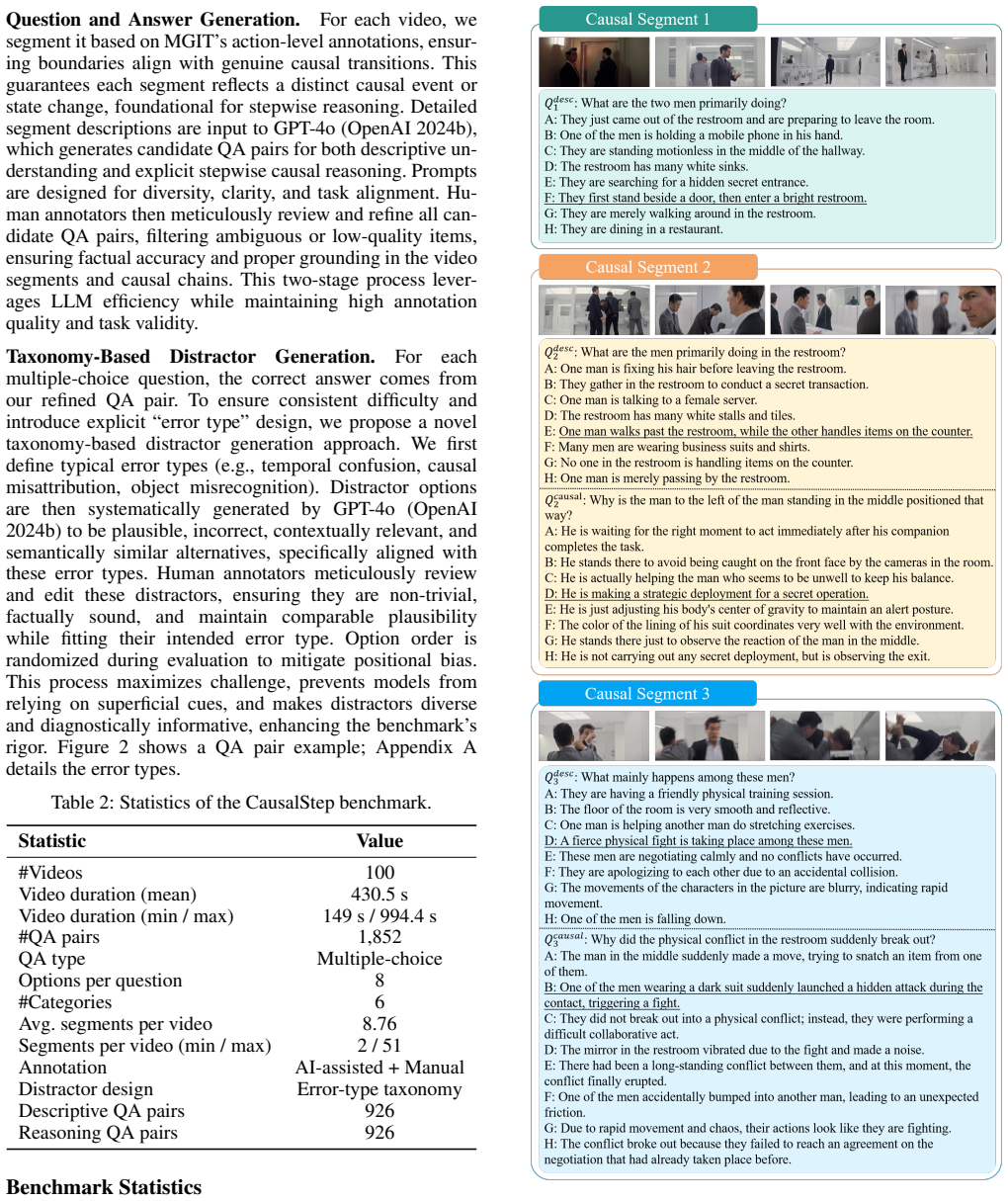
The central object is the stepwise causal chain evaluation protocol. A video is manually segmented into causally linked units; at each step the model receives only the current and immediately preceding segments plus the history of its own correct answers, must answer a descriptive or causal multiple-choice question, and if it errs the chain restarts. The scoring scheme rewards longer chains with increasing weights, and seven metrics—chain success rate, average and global maximum chain length, restart frequency, weighted score, descriptive accuracy, and isolated causal accuracy—separate perceptual understanding from causal integration. Distractors are generated against an error-type taxonomy (temporal confusion, causal misattribution, object misrecognition, and others) so failures are diagnostic.
What would settle it
Run the benchmark's human study with the full protocol published in an accessible appendix, giving participants the same segment-by-segment inputs, the same eight-option multiple-choice questions, and the same restart rule; if human chain success rate falls to near the 51% level of the best model, the claimed human-model gap would collapse. Alternatively, an independent replication of the model evaluation with a different random option order would test whether the 51% chain success rate is robust to positional bias.
Extended reading notes
Core claim
CausalStep establishes that explicit stepwise causal reasoning over video is a distinct capability that current multimodal LLMs largely lack. The central empirical discovery is the size and shape of the human-model gap: the best model reaches 51% chain success and 39.8% isolated causal accuracy, versus 79% and 76.8% for humans; even strong models falter when a causal question must be answered from an isolated pair of segments without a built-up chain. Because the protocol withholds future segments and restarts the chain after errors, the paper attributes the gap not to perception but to the inability to sustain long, error-free causal chains and to resist confusable distractors.
Load-bearing premise
The human baselines were measured under the same information restrictions and scoring rules as the models; the paper defers participant details to an appendix that is absent from this version, so if humans saw more of the video or were graded differently the headline gap would not be established.
Editorial extensions
If this is right
- If a model cannot see future segments, its score reflects genuine sequential integration rather than global-context shortcutting.
- The 28-point gap in chain success rate means current MLLMs are unreliable for tasks that require sustained causal tracking, such as embodied instruction following or long-document video analysis.
- The low isolated causal accuracy (39.8% best model vs. 76.8% human) shows causal inference itself, not just video perception, is the bottleneck.
- Restart frequency and weighted score provide a direct measure of error recovery, enabling researchers to see whether a model recovers after a mistake.
- The benchmark's seven metrics can serve as a diagnostic suite for future video reasoning models, distinguishing perception, causal inference, and chain stability.
Reading between the lines
- Beyond the paper: the stepwise protocol could be turned into a training curriculum, rewarding models for maintaining chains, which may improve real-world video agents more than full-video fine-tuning.
- Beyond the paper: because causal questions are anchored to adjacent pairs, the benchmark may underestimate models that could reason with longer-range dependencies; a variant that asks about non-adjacent causal links would test that.
- Beyond the paper: the error-type taxonomy could be reused for automated distractor generation in other multiple-choice benchmarks, making wrong answers more diagnostically meaningful.
- Beyond the paper: one testable extension is to measure whether the human-model gap shrinks when humans receive the same frame sampling (not full video) and the same forced-restart rules; the paper's current appendix defers this.
Editorial analysis
A structured set of objections, weighed in public.
Referee Report
Summary. CausalStep is a proposed benchmark for explicit stepwise causal reasoning in videos. Each video is manually segmented into causally linked segments; one descriptive QA is attached to every segment and one explicit causal QA to every non-first segment, with seven distractors per question drawn from an error-type taxonomy. The evaluation follows Algorithm 1's sequential protocol, in which a model answers each step before seeing the next segment, with a restart mechanism and position-weighted scoring. The paper reports 1,852 QA pairs from 100 videos, introduces seven diagnostic metrics, and compares open-source and proprietary MLLMs with human participants, concluding that the best model (o4-mini) reaches 51% chain success versus 79% for humans. The claim is that CausalStep is a rigorous, shortcut-resistant instrument for diagnosing stepwise causal reasoning.
Significance. The design idea is valuable: the stepwise protocol is a principled attempt to prevent global-context shortcuts, Algorithm 1 makes the intended evaluation procedure explicit, the error-type taxonomy gives distractors a diagnostic role, and the seven metrics separate chain depth, stability, and isolated accuracy. A publicly released, reproducible version of this benchmark would be a useful community resource, and a fully documented human baseline would provide a valuable reference point. These contributions cannot yet be credited as stated: the QA inventory is internally inconsistent, Algorithm 1 conflicts with the prose on restart and scoring, the ICRA definition is ambiguous, and the human study is unreported.
major comments (5)
- [Table 2; 'CausalStep Task Overview'] Table 2 and the task definition in 'CausalStep Task Overview' are mutually inconsistent. The task definition fixes one descriptive question per segment and one causal question per non-first segment, so across V videos the aggregate counts satisfy #causal = #descriptive - V and total = 2*#descriptive - V. Table 2 reports #descriptive = #causal = 926 and total = 1,852; these cannot all hold. With 926 descriptive questions the causal count would be 826 and the total 1,752; with total 1,852 the split would be 976/876; with the reported mean of 8.76 segments per video (about 876 segments total) the split would be 876/776. The discrepancy is on the order of 100-200 items and is not explained by rounding. Because Table 3 metrics are computed over these QA pairs, the empirical results cannot be verified until the counts and annotation protocol are reconciled.
- [Algorithm 1; 'Restart Mechanism'] Algorithm 1 implements a different restart rule from the one stated in 'Restart Mechanism.' The text says that when a causal answer is wrong at segment S_k the chain restarts from the descriptive QA of the same segment; the algorithm instead executes i = i+1 and current_question_type = 'desc', so the next question is the descriptive QA of S_{k+1} and the failed step at S_k is never revisited. This discrepancy changes chain length, restart frequency, and weighted score for every interrupted chain, so the reported metrics depend on which rule was actually used.
- [Algorithm 1; 'Scoring Scheme'] The scoring in Algorithm 1 does not match the stated 'Scoring Scheme.' The text says the first causal question in a chain is worth 1 point, the second 2 points, and so on; the algorithm increments chain_length (which already includes the descriptive question at S1) before adding it to score, making the first causal question worth 2 points and shifting all later causal contributions by one. The reported weighted scores (WS) therefore implement a different weighting than the one described.
- [Metrics; Table 3 (ICRA)] The definition of ICRA is at odds with the task. A causal question Q_causal_i is defined as asking about the relationship between S_i and S_{i-1}, but ICRA is defined as accuracy 'when only the current segment is provided.' If only S_i is supplied, the model lacks the segment it is asked to reason about; if both segments are supplied, the definition should say that. Under either reading, the ICRA column in Table 3 is not a clean measure of the stated causal task.
- [Experiments; human baseline] The human baseline is not documented. The main text states only that human experiments were conducted to establish an upper bound and defers to Appendix F, but that appendix is absent from this version. There is no participant count, recruitment or screening information, instruction text, statement of whether humans saw full videos or the same stepwise segments as models, or grading procedure. Since the headline conclusion is the human-MLLM gap, this evidence is currently unverifiable.
minor comments (4)
- [Throughout] The model name 'LLaV A' appears with an internal space in several places (e.g., Table 3 and the Related Work section); use 'LLaVA' consistently.
- [Metrics] 'A verage Maximum Chain Length' has a stray space; it should read 'Average Maximum Chain Length.'
- [Table 2] The text says 'Each question averages 8 options' while Table 2 reports 'Options per question 8'; if the number is fixed by construction, say 'each question has exactly 8 options.'
- [Availability] No URL or download link is given for CausalStep, and the appendices referenced as A-F are not included in this arXiv version; a data availability statement and the full appendices should be supplied with the revision.
Circularity Check
No significant circularity: CausalStep is an external benchmark instrument, and its empirical model-versus-human results are measurements, not consequences of the benchmark's construction by definition.
full rationale
CausalStep is a benchmark-construction and evaluation paper rather than a derivation; no reported metric is fitted to data or defined as the quantity it is supposed to predict. The model scores in Table 3 are obtained by running fixed QA pairs through the stepwise protocol, and the human gap is an empirical measurement, not an algebraic consequence of the task definition. The paper does contain an internal inconsistency: its Task Overview defines an N-segment video as having N descriptive questions and N-1 causal questions, while Table 2 and the Benchmark Statistics report 926 descriptive and 926 causal QA pairs for 100 videos with an average of 8.76 segments; this is a serious arithmetic/consistency error that makes the reported totals unverifiable as written, but it is not a circular reduction. The use of MGIT, a prior dataset with overlapping authors, to source and segment videos is a self-citation that is material to benchmark construction, yet MGIT is an external published resource and is not an unverified theorem invoked to force the paper's conclusions; the central claim that current MLLMs underperform humans does not reduce to MGIT's annotations. The involvement of GPT-4o in QA generation while also being an evaluated model is a contamination/bias risk and should be disclosed and analyzed, but it is not a circular-reasoning pattern under the stated rubric. The missing Appendix F for human-experiment details weakens the evidentiary support for the human-baseline gap but again is not definitional circularity. Overall, no step in the paper makes a prediction equivalent to its input by construction, so the circularity score is 0.
Assumptions & free parameters
free parameters (3)
- Weighted score step increment =
1 point for first causal step, +1 point per additional step in an uninterrupted chain
- Number of video frames per segment
- Distractor count per question =
7
assumptions (4)
- domain assumption MGIT action-level segment boundaries correspond to genuine causal transitions in the videos.
- domain assumption Human-reviewed GPT-4o-generated QA pairs and distractors are factually correct and grounded in the video segments.
- domain assumption Human participants were evaluated under the same information-gated stepwise protocol as the models.
- domain assumption Evaluated models have not memorized the MGIT-derived videos or their QA content during pretraining.
Cite this review
Pith. "Pith review of CausalStep: A Benchmark for Explicit Stepwise Causal Reasoning in Videos." pith.science (2026). https://pith.science/paper/HV2BXJHY
@misc{pith2026250716878,
  author       = {Pith},
  title        = {Pith review of: CausalStep: A Benchmark for Explicit Stepwise Causal Reasoning in Videos},
  year         = {2026},
  howpublished = {\url{https://pith.science/paper/HV2BXJHY}},
  note         = {Machine review of arXiv:2507.16878}
}
read the original abstract
Recent advances in large language models (LLMs) have improved reasoning in text and image domains, yet achieving robust video reasoning remains a significant challenge. Existing video benchmarks mainly assess shallow understanding and reasoning and allow models to exploit global context, failing to rigorously evaluate true causal and stepwise reasoning. We present CausalStep, a benchmark designed for explicit stepwise causal reasoning in videos. CausalStep segments videos into causally linked units and enforces a strict stepwise question-answer (QA) protocol, requiring sequential answers and preventing shortcut solutions. Each question includes carefully constructed distractors based on error type taxonomy to ensure diagnostic value. The benchmark features 100 videos across six categories and 1,852 multiple-choice QA pairs. We introduce seven diagnostic metrics for comprehensive evaluation, enabling precise diagnosis of causal reasoning capabilities. Experiments with leading proprietary and open-source models, as well as human baselines, reveal a significant gap between current models and human-level stepwise reasoning. CausalStep provides a rigorous benchmark to drive progress in robust and interpretable video reasoning.
Figures

Reference graph
Works this paper leans on
-
[3]
Chen, Z.; Wu, J.; Wang, W.; Su, W.; Chen, G.; Xing, S.; Zhong, M.; Zhang, Q.; Zhu, X.; Lu, L.; et al
Large language models for planning: A comprehensive and systematic survey.arXiv preprint arXiv:2505.19683. Chen, Z.; Wu, J.; Wang, W.; Su, W.; Chen, G.; Xing, S.; Zhong, M.; Zhang, Q.; Zhu, X.; Lu, L.; et al
-
[4]
Fei, H.; Wu, S.; Ji, W.; Zhang, H.; Zhang, M.; Lee, M.-L.; and Hsu, W
Video-Holmes: Can MLLM Think Like Holmes for Complex Video Reasoning?arXiv preprint arXiv:2505.21374. Fei, H.; Wu, S.; Ji, W.; Zhang, H.; Zhang, M.; Lee, M.-L.; and Hsu, W
-
[5]
Video-of-thought: Step-by-step video reasoning from perception to cognition.arXiv preprint arXiv:2501.03230. Fu, C.; Dai, Y .; Luo, Y .; Li, L.; Ren, S.; Zhang, R.; Wang, Z.; Zhou, C.; Shen, Y .; Zhang, M.; et al
-
[6]
Hu, S.; Li, X.; Li, X.; Zhang, J.; Wang, Y .; Zhao, X.; and Cheong, K
Video-MMMU: Evaluating Knowledge Acquisition from Multi-Discipline Professional Videos.arXiv preprint arXiv:2501.13826. Hu, S.; Li, X.; Li, X.; Zhang, J.; Wang, Y .; Zhao, X.; and Cheong, K. H
-
[7]
Hu, S.; Zhang, D.; Feng, X.; Li, X.; Zhao, X.; Huang, K.; et al
Can LVLMs Describe Videos like Humans? A Five-in-One Video Annotations Benchmark for Better Human-Machine Comparison.arXiv preprint arXiv:2410.15270. Hu, S.; Zhang, D.; Feng, X.; Li, X.; Zhao, X.; Huang, K.; et al
- [8]
-
[10]
Li, Y .; Chen, X.; Hu, B.; Wang, L.; Shi, H.; and Zhang, M
VerifyBench: A Systematic Benchmark for Evaluating Reasoning Verifiers Across Domains.arXiv preprint arXiv:2507.09884. Li, Y .; Chen, X.; Hu, B.; Wang, L.; Shi, H.; and Zhang, M. 2024g. Videovista: A versatile benchmark for video under- standing and reasoning.arXiv preprint arXiv:2406.11303. Lin, B.; Ye, Y .; Zhu, B.; Cui, J.; Ning, M.; Jin, P.; and Yuan, L
-
[12]
Vcr-bench: A comprehensive evaluation framework for video chain-of- thought reasoning.arXiv preprint arXiv:2504.07956. Reid, M.; Savinov, N.; Teplyashin, D.; Lepikhin, D.; Lilli- crap, T.; Alayrac, J.-b.; Soricut, R.; Lazaridou, A.; Firat, O.; Schrittwieser, J.; et al
Show all 21 references
-
[13]
arXiv preprint arXiv:2403.05530
Gemini 1.5: Unlocking mul- timodal understanding across millions of tokens of context. arXiv preprint arXiv:2403.05530. Roy, N.; Posner, I.; Barfoot, T.; Beaudoin, P.; Bengio, Y .; Bohg, J.; Brock, O.; Depatie, I.; Fox, D.; Koditschek, D.; et al
-
[15]
Wang, A.; Wu, B.; Chen, S.; Chen, Z.; Guan, H.; Lee, W.-N.; Li, L
Video understanding with large language models: A survey.IEEE Transactions on Circuits and Systems for Video Technology. Wang, A.; Wu, B.; Chen, S.; Chen, Z.; Guan, H.; Lee, W.-N.; Li, L. E.; and Gan, C. 2024a. Sok-bench: A situated video reasoning benchmark with aligned open-...
-
[16]
Wei, H.; Yuan, Y .; Lan, X.; Ke, W.; and Ma, L
Multimodal chain-of-thought reasoning: A comprehensive survey.arXiv preprint arXiv:2503.12605. Wei, H.; Yuan, Y .; Lan, X.; Ke, W.; and Ma, L
-
[17]
Wu, B.; Yu, S.; Chen, Z.; Tenenbaum, J
Instruc- tionbench: An instructional video understanding bench- mark.arXiv preprint arXiv:2504.05040. Wu, B.; Yu, S.; Chen, Z.; Tenenbaum, J. B.; and Gan, C. 2024a. Star: A benchmark for situated reasoning in real- world videos.arXiv preprint arXiv:2405.09711. Wu, H.; Li, D.; ...
-
[18]
CoRR, abs/2412.15115
Qwen2.5 Technical Report. CoRR, abs/2412.15115. Yang, J.; Yang, S.; Gupta, A. W.; Han, R.; Fei-Fei, L.; and Xie, S
-
[19]
Zhang, Y .; Zhang, R.; Gu, J.; Zhou, Y .; Lipka, N.; Yang, D.; and Sun, T
Video instruction tuning with synthetic data.arXiv preprint arXiv:2410.02713. Zhang, Y .; Zhang, R.; Gu, J.; Zhou, Y .; Lipka, N.; Yang, D.; and Sun, T
-
[20]
Zhao, Y .; Zhang, H.; Xie, L.; Hu, T.; Gan, G.; Long, Y .; Hu, Z.; Chen, W.; Li, C.; Xu, Z.; et al
Llavar: Enhanced visual instruction tuning for text-rich image understanding.arXiv preprint arXiv:2306.17107. Zhao, Y .; Zhang, H.; Xie, L.; Hu, T.; Gan, G.; Long, Y .; Hu, Z.; Chen, W.; Li, C.; Xu, Z.; et al
-
[21]
Zhu, J.; Wang, W.; Chen, Z.; Liu, Z.; Ye, S.; Gu, L.; Duan, Y .; Tian, H.; Su, W.; Shao, J.; et al
Mlvu: A comprehensive benchmark for multi-task long video under- standing.arXiv preprint arXiv:2406.04264. Zhu, J.; Wang, W.; Chen, Z.; Liu, Z.; Ye, S.; Gu, L.; Duan, Y .; Tian, H.; Su, W.; Shao, J.; et al. 2025a. In- ternVL3: Exploring Advanced Training and Test-Time Recipes ...
-
[2021]
Tang, Y .; Bi, J.; Xu, S.; Song, L.; Liang, S.; Wang, T.; Zhang, D.; An, J.; Lin, J.; Zhu, R.; et al
From machine learning to robotics: Challenges and opportunities for embodied intelligence.arXiv preprint arXiv:2110.15245. Tang, Y .; Bi, J.; Xu, S.; Song, L.; Liang, S.; Wang, T.; Zhang, D.; An, J.; Lin, J.; Zhu, R.; et al
-
[2022]
Li, B.; Zhang, Y .; Guo, D.; Zhang, R.; Li, F.; Zhang, H.; Zhang, K.; Zhang, P.; Li, Y .; Liu, Z.; et al
Human action recognition and prediction: A survey.International Journal of Computer Vi- sion, 130(5): 1366–1401. Li, B.; Zhang, Y .; Guo, D.; Zhang, R.; Li, F.; Zhang, H.; Zhang, K.; Zhang, P.; Li, Y .; Liu, Z.; et al. 2024a. Llava-onevision: Easy visual task transfer.arXiv pr...
-
[2023]
Liu, Y .; Li, S.; Liu, Y .; Wang, Y .; Ren, S.; Li, L.; Chen, S.; Sun, X.; and Hou, L
Video-llava: Learning united visual rep- resentation by alignment before projection.arXiv preprint arXiv:2311.10122. Liu, Y .; Li, S.; Liu, Y .; Wang, Y .; Ren, S.; Li, L.; Chen, S.; Sun, X.; and Hou, L. 2024a. Tempcompass: Do video llms really understand videos?arXiv preprint...
-
[2024]
Cao, P.; Men, T.; Liu, W.; Zhang, J.; Li, X.; Lin, X.; Sui, D.; Cao, Y .; Liu, K.; and Zhao, J
Temporalbench: Benchmarking fine-grained temporal un- derstanding for multimodal video models.arXiv preprint arXiv:2410.10818. Cao, P.; Men, T.; Liu, W.; Zhang, J.; Li, X.; Lin, X.; Sui, D.; Cao, Y .; Liu, K.; and Zhao, J
-
[2025]
Anthropic
Phi-4-Mini Tech- nical Report: Compact yet Powerful Multimodal Language Models via Mixture-of-LoRAs.CoRR, abs/2503.01743. Anthropic
Reviewed August 6, 2026 · model on record in the stance chip above.
Discussion (0). Sign in to comment.