REVIEW 4 major objections 5 minor 48 references
PLEX: Perturbation-free Local Explanations for LLM-Based Text Classification
T0 review · 4 major / 5 minor · reviewed 2026-08-06 · deepseek-v4-flash
Pith's one-line read One-pass explainer matches LIME and SHAP at 10,000x lower cost
desk verdict A plausible fast-explanations idea with a real efficiency win, but the central generalization claim is undercut by an undocumented train/test split and inflated agreement numbers. read the letter →
The pith
A machine-rendered reading of the paper's core claim, the machinery that carries it, and where it could break.
The reading
What carries the argument
The central object is a Siamese network made of two identical subnetworks that share weights (fully connected layers 768 to 128 to 64, or 1024 to 128 to 64 for the larger RoBERTa, with ReLU and dropout on the first layer). The network receives the [CLS] token embedding $h_{cls}$ and a word embedding $h_w$ from the fine-tuned LLM and outputs projected embeddings $e_{cls} = W(h_{cls})$ and $e_w = W(h_w)$; the predicted importance is the cosine similarity $\mathrm{sim}(e_{cls}, e_w)$. The training loss is $\alpha |f_w|\, |\mathrm{sim}(e_{cls}, e_w) - f_w|$, a weighted L1 loss where $f_w$ is the LIME or SHAP importance score and the weight $|f_w|$ prioritizes the most and least important words. The mechanism converts attribution into similarity learning in embedding space, so that at inference the cosine value serves directly as the word's importance score without any perturbation.
What would settle it
Evaluate PLEX on a held-out set of sentences whose LIME/SHAP scores were not used in training: compute rank correlation (e.g., Spearman) between PLEX and LIME/SHAP per sentence and run the same top-k removal stress test. If the held-out correlation drops well below the training-set agreement, or if the accuracy-decline curve flattens relative to LIME/SHAP's, the learned mapping is not transferring and the central claim fails.
Extended reading notes
Core claim
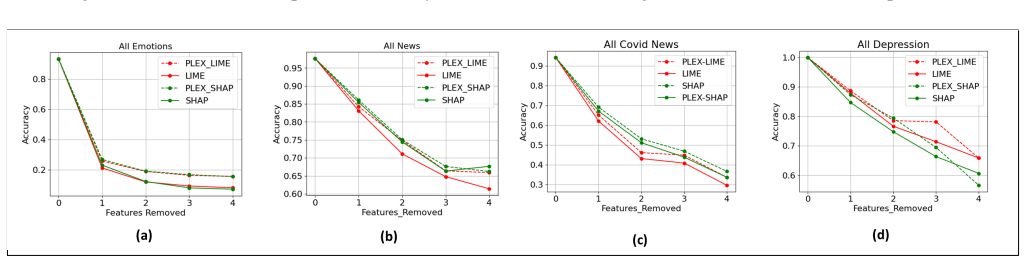
On the paper's own terms, the discovery is that a word's contribution to a BERT or RoBERTa classification decision can be read off from its contextual embedding relative to the sentence's [CLS] token embedding, once a learned projection has been applied. A shared-weight network with two fully connected layers transforms each word embedding and the CLS embedding into a common space, and the cosine similarity between the two projected vectors is trained with a weighted L1 loss to match the word's LIME or SHAP importance score. After this one-off training, explaining a sentence requires only a single pass through the classifier and the small network, and the resulting importance scores track LIME/SHAP closely: the paper shows that removing the top-ranked words causes a similar decline in accuracy as removing LIME/SHAP's top words, and that polarity agreement between PLEX and SHAP exceeds 91% for words with absolute importance above 0.01 and 98% above 0.05. The authors also find the method works across six-class emotion classification, two-class fake news, COVID-19 fake news, and depression classification, on both BERT and RoBERTa backbones.
Load-bearing premise
The method assumes that the information needed to explain a classification decision is already contained in the pair of contextual embeddings (the CLS vector and the word vectors), and that a network trained on a few hundred sentences per class will keep predicting accurate importance scores on sentences it has never seen.
Editorial extensions
If this is right
- Local explanations for LLM classifiers can be generated in real time, because a single forward pass through a small network replaces thousands of perturbed inferences.
- PLEX inherits the faithfulness yardstick of LIME and SHAP: the stress-test methodology ties explanation quality to how quickly classifier accuracy drops when top-ranked words are removed.
- The cost of explanation scales with sentence length and model size, not with the number of perturbations, so long sentences remain cheap to explain where LIME and SHAP grow exponentially.
- The same trained network serves any new sentence for a given classifier and task, without retraining or additional perturbation runs.
Reading between the lines
- Editorial inference: The paper does not report a held-out test split for the Siamese network itself; whether the learned mapping transfers to completely unseen sentences is an open, testable question and is the main extension worth checking.
- Editorial inference: Because PLEX is trained to imitate LIME or SHAP, it will inherit whatever biases those methods have; comparing PLEX-LIME and PLEX-SHAP on a sentence could serve as a lightweight disagreement signal for when attributions are uncertain.
- Editorial inference: The same distillation recipe could be applied to other attribution methods or other base models, potentially turning any costly explainer into a forward-only explainer once enough embedding-importance pairs are collected.
Editorial analysis
A structured set of objections, weighed in public.
Referee Report
Summary. The paper proposes PLEX, a method that trains a Siamese network to map the [CLS] embedding and per-word contextual embeddings from a fine-tuned transformer into word-level importance scores, using LIME or SHAP scores as training targets. At inference, PLEX computes an explanation with a single forward pass plus a small network, avoiding the thousands of perturbed inferences required by LIME/SHAP. The method is evaluated on four text classification tasks (emotion, fake news, COVID-19 fake news, depression) using fine-tuned BERT/RoBERTa models, reporting agreement with LIME/SHAP, a word-removal stress test, and computational speedups.
Significance. If the central claim holds, PLEX is a practically useful contribution: it offers a one-time training procedure that replaces perturbation-based explanation with a cheap forward pass, and the authors support the work with source code, four diverse tasks, and an external behavioral stress test. These are real strengths. However, the generalization claim that PLEX can explain 'any new sentence' rests on the Siamese network transferring to unseen sentences, and the manuscript does not currently document a held-out split for that network. In addition, the headline agreement figure ('more than 92%') is not backed by the displayed overlap numbers, and the speedup factors are stated more strongly than the table supports. These issues are load-bearing for the paper's two central claims (transferability and the quantitative agreement/efficiency figures).
major comments (4)
- [Section V-B, Table III, Section VI-B] The manuscript never defines the 'Test' column in Table III and never states that the Siamese-network agreement evaluation in Section VI-B is performed on a held-out set. Section VI-B says the overlap is 'calculated across all sentences in the dataset,' which could include the same sentences used to create the 50,000 training pairs. The duplicate paragraph in Section V-B even alternates between saying the 'Pairs' column and the 'Train' column reflect the effective training data, without explaining either. For the claim that PLEX can explain any new sentence, the paper must describe a sentence-level (not pair-level) train/test split for the Siamese network and report agreement on the test sentences only.
- [Abstract and Section VI-B/VI-C] The abstract and introduction claim 'more than 92% agreement with LIME and SHAP,' but the reported numbers do not support this as a global agreement rate. Figure 8 shows top-1 overlap of about 80% and top-2/top-3 overlap of 55%/50% for emotion, and Figure 9 reaches 91%/98% only for depression when restricting to words with absolute importance greater than 0.01/0.05. Please state the exact metric used for the 92% claim (e.g., polarity agreement at a threshold, or some other measure), report the same metric for all four tasks, and reconcile the abstract with the displayed numbers.
- [Section VI-F, Table V] The abstract states PLEX 'reduces time and computational overhead by two and four orders of magnitude, respectively.' The numbers in Table V do not clearly show this: the time ratio between SHAP/LIME and PLEX appears to be roughly 10-25x (one order of magnitude), and the FLOPs ratios shown are roughly 10^2.4 to 10^3.6, not consistently 10^4. The table layout is also hard to parse, since the sentence-length blocks and perturbation-count columns are not clearly separated. Please present the speedup ratios explicitly and adjust the claims to match the measured values.
- [Section IV-C and V-C] The training procedure is not fully specified. The loss in Section IV-C includes a scaling factor alpha, but its value is never given. Section V-C reports that batches of 32 are used but does not state the optimizer, learning rate, weight decay, number of training epochs (Table III lists 'Epochs' but the text does not define the epoch count versus the number of pairs), or any early-stopping criterion. These details are needed to reproduce the eight trained models.
minor comments (5)
- [Section II-C] The text refers to a 'Seismic network' instead of 'Siamese network.'
- [Section V-B] The heading contains a typo ('Novel Dastset Creation'), and the same paragraph is repeated twice with conflicting statements about whether the 'Pairs' or 'Train' column reflects the effective training data.
- [Section VI-C] The sentence 'We observed the same distribution for LIME across all use cases' is not supported by any figure or table; the paper only shows the SHAP-polarity distribution in Figure 9.
- [Table V] The table header mixes sentence-length categories with perturbation-count columns; the reader cannot tell which block corresponds to small, medium, or long sentences. Please restructure the table.
- [Section VI-E] The phrase 'the word which not important' is ungrammatical; it should read 'the words which are not important.'
Circularity Check
PLEX's headline agreement with LIME/SHAP is partly a training-fit measure: the Siamese network is trained on LIME/SHAP scores and agreement is computed across the same dataset with no documented held-out split; the 92% figure is further filtered to the high-magnitude words that the loss weights most.
-
fitted input called prediction
[Section IV-C (training loss) and Section VI-B (agreement evaluation); Table III]
"This similarity score, sim (zcls, zw), is compared to the corresponding word’s feature importance obtained from LIME/SHAP ( f Iw) from the constructed dataset ... L = α.|f Iw|.|sim(zcls, zw) − f Iw| ... The bar chart displays the average overlap percentages between the top k important words identified by each method, calculated across all sentences in the dataset."
The Siamese network is trained to minimize L1 distance to LIME/SHAP importance scores f_Iw. The evaluation of 'agreement' with LIME/SHAP then computes top-k overlap between PLEX outputs and those same f_Iw scores 'across all sentences in the dataset.' No Siamese-network held-out split is defined: Section V-B says the 'Train' column reflects the training data and never explains the 'Test' column in Table III in connection with PLEX. If the agreement is computed on sentences whose CLS-word pairs were used in training, the reported 80%/55%/50% top-k overlaps are in-sample training-fit values, not predictions for new sentences. The abstract's 'more than 92% agreement' claim therefore rests on a fitted input being reported as an independent agreement result.
-
fitted input called prediction
[Section IV-C (weighted loss) and Section VI-C (polarity agreement)]
"L = α.|f Iw|.|sim(zcls, zw) − f Iw|, where α is a scaling factor and |f Iw| prioritizes the most and least important words during training. ... When we consider all the words, more than 75% of the words in each sentence have the same polarity. However, when we consider the words with absolute importance score 0.01 and 0.05 or bigger, this agreement increased to 91% and 98%."
The 91%/98% polarity agreement is reported only for words with absolute importance above 0.01/0.05. The training loss explicitly weights each word by |f_Iw|, so exactly these high-magnitude words receive the largest gradient pressure during training. Reporting agreement on the most heavily weighted subset is a restatement of the training objective rather than an independent validation: PLEX is optimized to reproduce the sign and magnitude of high-|f_Iw| LIME/SHAP scores, so high sign-agreement on that subset is expected by construction. The paper presents this as evidence of robustness, but it is a property of the fitted loss.
full rationale
The core circularity is pattern 2 (fitted input called prediction). PLEX's only learned component, the Siamese network in Section IV-C, is trained to minimize L1 distance to LIME/SHAP importance scores. The paper then evaluates 'agreement' by comparing PLEX outputs to those same LIME/SHAP scores, and Section VI-B states this agreement is 'calculated across all sentences in the dataset' without documenting any held-out split for the Siamese network. Section V-B says the 'Train' column reflects the effective training data but never defines how the 'Test' column in Table III was used for PLEX evaluation. Consequently, the reported top-k overlaps and the abstract's 'more than 92% agreement' claim may be in-sample training fits rather than evidence of transfer to new sentences. The polarity-agreement figures in Section VI-C are additionally circular because they are filtered to high-magnitude words, which the loss function weights most heavily via the |f_Iw| factor, making high agreement on that subset a direct consequence of the training objective. The stress test in Section VI-A is an external behavioral check that does not reduce to the training target: it measures actual accuracy decline when PLEX-selected words are removed from the classifier. This gives the central method some independent grounding and prevents a fully circular score. There are no load-bearing self-citations; the cited prior work is not used to justify the method. The paper also overstates its quantitative results (80% top-1 overlap, 55% top-2, and 91%/98% only after filtering), which is a correctness concern rather than a circularity concern. Overall, the central claim that PLEX agrees with LIME and SHAP on unseen sentences is partially unverified because the evaluation may be in-sample, but the stress test provides independent behavioral evidence, so a score of 6 reflects this partial circularity.
Assumptions & free parameters
free parameters (3)
- Scaling factor alpha in the weighted L1 loss =
not reported
- Siamese network hyperparameters =
two layers of 128 and 64 units, ReLU, dropout 0.5, batch size 32, 400-500 epochs
- Learned Siamese network weights W =
trained on LIME/SHAP-labeled CLS-word pairs
assumptions (3)
- domain assumption A word's contribution to the classifier's decision can be represented as cosine similarity between trained projections of its contextual embedding and the CLS embedding.
- domain assumption LIME and SHAP importance scores are valid ground truth for word importance.
- domain assumption A training set of roughly 400 sentences per class is representative of each task's test distribution.
Cite this review
Pith. "Pith review of PLEX: Perturbation-free Local Explanations for LLM-Based Text Classification." pith.science (2026). https://pith.science/paper/T7TN6EDA
@misc{pith2026250710596,
  author       = {Pith},
  title        = {Pith review of: PLEX: Perturbation-free Local Explanations for LLM-Based Text Classification},
  year         = {2026},
  howpublished = {\url{https://pith.science/paper/T7TN6EDA}},
  note         = {Machine review of arXiv:2507.10596}
}
read the original abstract
Large Language Models (LLMs) excel in text classification, but their complexity hinders interpretability, making it difficult to understand the reasoning behind their predictions. Explainable AI (XAI) methods like LIME and SHAP offer local explanations by identifying influential words, but they rely on computationally expensive perturbations. These methods typically generate thousands of perturbed sentences and perform inferences on each, incurring a substantial computational burden, especially with LLMs. To address this, we propose \underline{P}erturbation-free \underline{L}ocal \underline{Ex}planation (PLEX), a novel method that leverages the contextual embeddings extracted from the LLM and a ``Siamese network" style neural network trained to align with feature importance scores. This one-off training eliminates the need for subsequent perturbations, enabling efficient explanations for any new sentence. We demonstrate PLEX's effectiveness on four different classification tasks (sentiment, fake news, fake COVID-19 news and depression), showing more than 92\% agreement with LIME and SHAP. Our evaluation using a ``stress test" reveals that PLEX accurately identifies influential words, leading to a similar decline in classification accuracy as observed with LIME and SHAP when these words are removed. Notably, in some cases, PLEX demonstrates superior performance in capturing the impact of key features. PLEX dramatically accelerates explanation, reducing time and computational overhead by two and four orders of magnitude, respectively. This work offers a promising solution for explainable LLM-based text classification.
Figures


Figures from the paper (8 more)




Reference graph
Works this paper leans on
-
[1]
Zhao et al. 2024. Explainability for large language models: A survey. ACM Trans. Intelligent Systems and Technology, 15(2), pp.1-38
work page 2024
-
[2]
Shahid, Z., Rahulamathavan, Y . and Dogan, S., 2024. Second Glance: A Novel Explainable AI to Understand Feature Interactions in Neural Networks using Higher-Order Partial Derivatives
work page 2024
-
[3]
Attention is all you need
Vaswani, A., 2017. Attention is all you need. Advances in Neural Information Processing Systems
2017
-
[4]
Malhotra, A., Jindal, R. (2024). XAI transformer-based approach for interpreting depressed and suicidal user behaviour on online social networks.Cognitive Systems Research, 84, 101186. 11 (a) All words (b) Words with Absolute score > 0.01 (c) Words with Absolute score > 0.05 Figure 9: Distribution of matching percentages between SHAP and PLEX feature impo...
work page 2024
-
[5]
Ribeiro, M.T., Singh, S. and Guestrin, C., 2016, August. “Why should i trust you?” Explaining the predictions of any classifier. In Proc. the 22nd ACM SIGKDD Int’l Conf. knowledge discovery and data mining (pp. 1135-1144)
work page 2016
-
[6]
Hashmi et al. (2024). Advancing fake news detection: hybrid deep learning with fast-text and explainable AI. IEEE Access
work page 2024
-
[7]
A unified approach to interpreting model predictions
Lundberg, S., 2017. A unified approach to interpreting model predictions. arXiv preprint arXiv:1705.07874
arXiv 2017
-
[8]
Bert: Pre-training of deep bidirectional transformers for language understanding
Devlin, J., 2018. Bert: Pre-training of deep bidirectional transformers for language understanding. arXiv preprint arXiv:1810.04805
arXiv 2018
Show all 48 references
-
[9]
and Shah, R., 1993
Bromley, J., Guyon, I., LeCun, Y ., S ¨ackinger, E. and Shah, R., 1993. Signature verification using a” siamese” time delay neural network. Advances in neural information processing systems, 6
1993
-
[10]
(2024, July)
Farooq, M., De Silva, V ., and Shi, X. (2024, July). An Attention-based Ensemble Model for Emotion Recognition in Conversation. In 2024 14th Int’l Conf. on Pattern Recognition Systems (ICPRS) (pp. 1-7). IEEE
2024
-
[11]
Wu, Z., and Ong, D. C. (2021). On explaining your explanations of BERT: An empirical study with sequence classification. arXiv preprint arXiv:2101.00196
2021 arXiv
-
[12]
Li, J., Chen, X., Hovy, E., and Jurafsky, D. (2015). Visualizing and understanding neural models in NLP. arXiv preprint arXiv:1506.01066
2015 arXiv
-
[13]
Kindermans et al. (2019). The (un) reliability of saliency methods. Explainable AI: Interpreting, explaining and visualizing deep learning, 267-280
2019
-
[14]
Bach et al. (2015). On pixel-wise explanations for non-linear classifier decisions by layer-wise relevance propagation. PloS one, 10(7), e0130140
2015
-
[15]
S., and Ong, D
Wu, Z., Nguyen, T. S., and Ong, D. C. (2020). Structured self- attention weights encode semantics in sentiment analysis. arXiv preprint arXiv:2010.04922
2020 arXiv
-
[16]
Attanasio, G., Nozza, D., Pastor, E., and Hovy, D. (2022). Benchmark- ing post-hoc interpretability approaches for transformer-based misogyny detection. In Proc. NLP Power! The First Workshop on Efficient Bench- marking in NLP. Association for Computational Linguistics
2022
-
[17]
(2017, July)
Sundararajan, M., Taly, A., and Yan, Q. (2017, July). Axiomatic attri- bution for deep networks. In Int’l Conf. on machine learning (pp. 3319- 3328). PMLR
2017
-
[18]
Jin, X., Wei, Z., Du, J., Xue, X., and Ren, X. (2019). Towards hierarchical importance attribution: Explaining compositional semantics for neural sequence models. arXiv preprint arXiv:1911.06194
2019 arXiv
-
[19]
(2024, November)
Barkan et al. (2024, November). LLM Explainability via Attributive Masking Learning. In Findings of the Association for Computational Linguistics: EMNLP 2024 (pp. 9522-9537)
2024
-
[20]
(2024, November)
Horovicz, M., and Goldshmidt, R. (2024, November). TokenSHAP: Interpreting Large Language Models with Monte Carlo Shapley Value Estimation. In Proc. the 1st Workshop on NLP for Science (NLP4Science) (pp. 1-8)
2024
-
[21]
Cantini, R., Orsino, A., and Talia, D. (2024). Xai-driven knowledge distillation of large language models for efficient deployment on low- resource devices. Journal of Big Data, 11(1), 63
2024
-
[22]
(2024, April)
Li, J., Zhang, Y ., Karas, Z., McMillan, C., Leach, K., and Huang, Y . (2024, April). Do Machines and Humans Focus on Similar Code? Explor- ing Explainability of Large Language Models in Code Summarization. In Proc. the 32nd IEEE/ACM Int’l Conf. on Program Comprehension (pp. 47-51)
2024
-
[23]
T., and Szolovits, P
Jin, D., Jin, Z., Zhou, J. T., and Szolovits, P. (2020, April). Is BERT really robust? a strong baseline for natural language attack on text classification and entailment. In Proc. the AAAI conference on artificial intelligence (V ol. 34, No. 05, pp. 8018-8025)
2020
-
[24]
Li, Y ., Xu, M., Miao, X., Zhou, S., and Qian, T. (2023). Prompting large language models for counterfactual generation: An empirical study. arXiv preprint arXiv:2305.14791
2023 arXiv
-
[25]
Liu, G., Zhang, J., Liu, Q., Wu, J., Wu, S., and Wang, L. (2024). Uni- Modal Event-Agnostic Knowledge Distillation for Multimodal Fake News Detection. IEEE Trans. Knowledge and Data Engineering
2024
-
[26]
Lin, G., and Zhao, Q. (2024). Large Language Model Sentinel: Advancing Adversarial Robustness by LLM Agent. arXiv preprint arXiv:2405.20770
2024 arXiv
-
[27]
and Horovicz, M., 2024
Goldshmidt, R. and Horovicz, M., 2024. TokenSHAP: Interpreting Large Language Models with Monte Carlo Shapley Value Estimation. arXiv preprint arXiv:2407.10114
2024 arXiv
-
[28]
Krishna el al. (2024). Post hoc explanations of language models can improve language models. Advances in Neural Information Processing Systems, 36
2024
-
[29]
Slack, D., Krishna, S., Lakkaraju, H., and Singh, S. (2023). Explaining machine learning models with interactive natural language conversations using TalkToModel. Nature Machine Intelligence, 5(8), 873-883
2023
-
[30]
Du, C., and Huang, L. (2018). Text classification research with attention- based recurrent neural networks. International Journal of Computers Communications and Control, 13(1), 50-61
2018
-
[31]
Yeh, C., Chen, Y ., Wu, A., Chen, C., Vi ´egas, F., and Wattenberg, M. (2023). Attentionviz: A global view of transformer attention. IEEE Trans. Visualization and Computer Graphics
2023
-
[32]
Liu, D., Greene, D., and Dong, R. (2022). A novel perspective to look at attention: Bi-level attention-based explainable topic modelling for news classification. arXiv preprint arXiv:2203.07216
2022 arXiv
-
[33]
(2021, December)
Liu, S., Le, F., Chakraborty, S., and Abdelzaher, T. (2021, December). On exploring attention-based explanation for transformer models in text classification. In 2021 IEEE Int’l Conf. on Big Data (Big Data) (pp. 1193-1203). IEEE
2021
-
[34]
(2019, July)
Shu, K., Cui, L., Wang, S., Lee, D., and Liu, H. (2019, July). defend: Explainable fake news detection. In Proc. the 25th ACM SIGKDD Int’l Conf. on knowledge discovery and data mining (pp. 395-405)
2019
-
[35]
Sebbaq, H. (2023). MTBERT-Attention: An Explainable BERT Model based on Multi-Task Learning for Cognitive Text Classification. Scientific African, 21, e01799
2023
-
[36]
Bastings, J., and Filippova, K. (2020). The elephant in the interpretability room: Why use attention as explanation when we have saliency methods?. arXiv preprint arXiv:2010.05607
2020 arXiv
-
[37]
(2021, May)
Arous et al. (2021, May). Marta: Leveraging human rationales for explainable text classification. In Proc. the AAAI conference on artificial intelligence (V ol. 35, No. 7, pp. 5868-5876). 13
2021
-
[38]
(2021, August)
Bai, B., Liang, J., Zhang, G., Li, H., Bai, K., and Wang, F. (2021, August). Why attentions may not be interpretable?. In Proc. the 27th ACM SIGKDD conference on knowledge discovery and data mining (pp. 25-34)
2021
-
[39]
Brunner et al. (2019). On identifiability in transformers. arXiv preprint arXiv:1908.04211
2019 arXiv
-
[40]
Chrysostomou, G., and Aletras, N. (2021). Improving the faithfulness of attention-based explanations with task-specific information for text classification. arXiv preprint arXiv:2105.02657
2021 arXiv
-
[41]
Savani, B. (2024). Emotion Classifier. Available at: https://huggingface. co/bhadresh-savani/bert-base-uncased-emotion
2024
-
[42]
Jy46604790. (2024). Fake News Detect. Available at: https:// huggingface.co/jy46604790/Fake-News-Bert-Detect
2024
-
[43]
Qinghui. (2024). Fake COVID News Classifier. Available at: https:// huggingface.co/Qinghui/autonlp-fake-covid-news-36769078
2024
-
[44]
Poudel, A. (2024). Sentiment Classifier for Depression. Available at: https://huggingface.co/poudel/sentiment-classifier
2024
-
[45]
Elkomy, A. (2024). Twitter Emotion Dataset: Unveiling the Emotional Tapestry of Social Media. Available at: https://www.kaggle.com/datasets/ adhamelkomy/twitter-emotion-dataset/data
2024
-
[46]
Yetim, E. (2024). Fake News Detection Datasets. Available at: https: //www.kaggle.com/datasets/emineyetm/fake-news-detection-datasets
2024
-
[47]
Depression: Reddit Dataset (Cleaned) (2020), https://www.kaggle.com/datasets/infamouscoder/depression-reddit- cleaned, Accessed: October 22, 2024
2020
-
[48]
COVID-19 Fake News Dataset, https://www.kaggle.com/datasets/arashnic/covid19- fake-news, Accessed: October 22, 2024
2024
Reviewed August 6, 2026 · model on record in the stance chip above.
Discussion (0). Sign in to comment.