REVIEW 4 major objections 6 minor 61 references
Internal Value Alignment in Large Language Models through Controlled Value Vector Activation
T0 review · 4 major / 6 minor · reviewed 2026-08-06 · deepseek-v4-flash
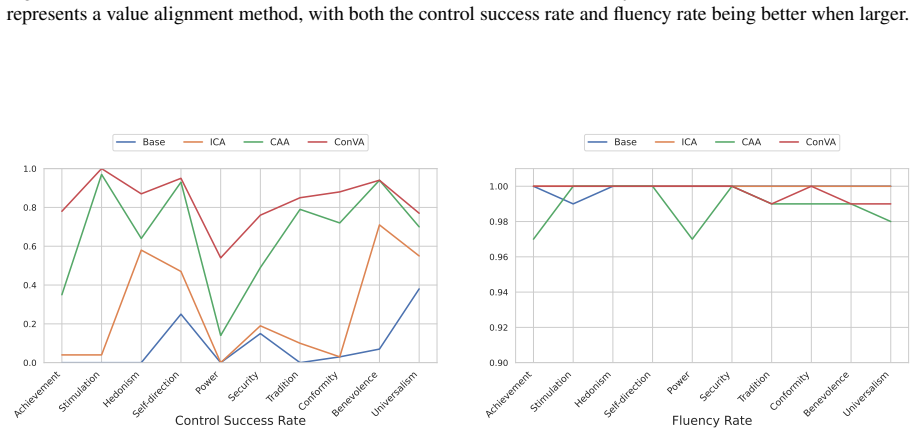
Pith's one-line read ConVA steers an LLM's values by adding a single learned direction to its internal activations, lifting control success by 29.6 percent on average while keeping fluency at or above 97 percent.
desk verdict A serious activation-steering paper with a real methodological increment; the GPT-4o-as-judge circularity is the load-bearing flaw, but the method and breadth of experiments deserve refereeing. read the letter →
The pith
A machine-rendered reading of the paper's core claim, the machinery that carries it, and where it could break.
The reading
What carries the argument
The load-bearing object is the value vector $v$, taken as the unit normal of a linear classifier $P_V(e)=\mathrm{sigmoid}(w^\top e+b)$ trained to separate embeddings of positive and negative examples of the value, so $v=w/\|w\|$. Control modifies each relevant embedding as $\hat{e}=e+\epsilon v$, where $\epsilon$ is the closed-form solution of a constrained optimization problem that pushes $P_V(\hat{e})$ to a threshold $P_0$ with minimal $|\epsilon|$, and a binary gate $g(x)$ decides whether the input is value-related at all. The context-controlled pairwise data generation is what makes $w$ encode the value rather than correlated topics; the gating and minimal-perturbation solution are what make the steering survive without destroying fluency or general capability.
What would settle it
Hold out entire scenario categories during training (for example, train 'security' vectors only on financial and digital contexts, then test on physical-safety and national-security dilemmas) and measure control success rate; if CSR on the held-out scenarios returns to the base model's level, the vector encodes topic correlations rather than the value. A second decisive check is to compare the learned vector with random unit vectors of the same norm on the same evaluation set: if random directions achieve comparable CSR, direction-specificity is not established.
Extended reading notes
Core claim
The central claim is that ConVA reliably controls which of Schwartz's ten basic values an LLM expresses by steering hidden embeddings along a learned value vector, and that it does so more effectively than the compared behavioral and activation-editing baselines while preserving fluency and most general capability. The paper presents this as a statistically significant advantage (p-value 6.29e-07, average relative CSR improvement 29.6% on the main backbone), shows the same pattern across seven model families in the appendix, and demonstrates that the effect survives explicit negative prompt guidance, which the authors interpret as evidence that internal control can override prompt-level attacks. The paper also claims that the identified vectors are interpretable, that gating restores the model's MMLU score from 0.272 to 0.455 against a vanilla 0.476, and that the cosine-similarity structure of the vectors partly mirrors Schwartz's higher-order value groups.
Load-bearing premise
The whole method depends on the direction learned from GPT-4o's paired sentences pointing at the target value and at nothing else about the topic; if the 'opposite' sentences also shift the situation, the steering direction is wrong even when the examples look clean to a human reader.
Editorial extensions
If this is right
- Deployed models could be re-aligned to a different value profile by swapping in a new value vector and gate, with no fine-tuning and with a dataset of roughly 100 text pairs per value.
- Because steering happens during the forward pass, ConVA can override negative value instructions embedded in prompts, offering a defense against simple prompt-level value attacks.
- Gate-equipped activation steering limits the usual activation-engineering damage: MMLU scores stay close to the vanilla model, while ungated steering drops them from 0.476 to 0.272.
- Value vectors give a read on how a model organizes values internally; the observed cosine-similarity clusters partly align with Schwartz's higher-order groups, while some opposite pairs are encoded close together, exposing potential internal conflicts for downstream safety analysis.
Reading between the lines
- One implication the paper does not develop is that the same recipe could be used to measure, rather than just to set, a model's default value profile: the gate scores and the margins of the linear classifier could be reported as a vector of value strengths for any input.
- A testable extension is multi-value control: since the optimization is per-value and only one direction is added at a time, composing several $\epsilon v$ shifts may point one value against another, so multi-dimensional steering needs its own validation before it can be trusted.
- The method's transfer guarantees are tied to the pairing step: if GPT-4o's paired 'opposite' sentences differ in topic or tone rather than only in value orientation, the learned vector will encode that extra difference, and the 29.6% gain would shrink on out-of-distribution scenarios.
Editorial analysis
A structured set of objections, weighed in public.
Referee Report
Summary. The paper proposes Controlled Value Vector Activation (ConVA), an inference-time activation-steering method for aligning LLM outputs with Schwartz's 10 basic values. A linear probe is trained on GPT-4o-generated positive/negative sentence pairs with prompt-matched contexts to obtain a value direction per layer; a gate decides when to apply steering, and a closed-form minimal epsilon shifts activations so that the probe classifies the modified embedding as value-conforming. Experiments on Llama-2, Llama-3, Qwen2.5, Vicuna, and Mistral report consistent control success rate (CSR) improvements (e.g., 29.6% average relative improvement over baselines on Llama-2-7b-chat, p=6.29e-07) with fluency rates at least 97%, while an MMLU evaluation shows the gate mitigates degradation of general capabilities.
Significance. If the reported effects hold under independent evaluation, ConVA would be a valuable lightweight, inference-time method for controlling value-related behavior in LLMs, with interpretable value vectors and a principled minimal-perturbation update. The paper's strengths include the context-bias analysis showing that naive LLM-generated datasets conflate values with domains (Tab. 2), evaluation across nine backbones with consistent CSR gains, a user study with high Fleiss kappa on a subsample, a closed-form solution for the gated steering magnitude (Appx. K), and public release of code and data. The main risk is that the evaluation loop is largely self-referential (GPT-4o generates the training data, the test questions, and the CSR judgments), so the magnitude of the claimed advantage over human-meaningful value control is not yet established. The Limitations section is candid about uneven per-value control and the linear-representation assumption, but it does not address this circularity.
major comments (4)
- [Sec. 4.1 / Appx. D / Appx. G] The headline CSR metric is computed by GPT-4o judging whether Bob's answer prioritizes the target value, while GPT-4o also generated the training pairs (Sec. 3.1) and the evaluation questions (Sec. 4.1). Because the value vectors are trained on GPT-4o's pairwise contrasts, high CSR on GPT-4o-generated questions judged by GPT-4o may reflect alignment with GPT-4o's stylistic and lexical preferences rather than with human values. The human validation in Appx. G covers only 100 outputs (10 per value) and uses the same GPT-4o-generated questions, so it is underpowered to break this circularity. Please add an independent evaluation, e.g., human annotation of the full evaluation set or of a larger held-out set written by humans, and report per-value CSR with confidence intervals.
- [Sec. 3.1, Eq. (1)-(4), Tab. 2] The claim that the value vector is a faithful, context-independent linear encoding rests on the assumption that GPT-4o's pairwise generation isolates the value while keeping all other context matched. The provided evidence is a word-overlap analysis for one value and a 200-text labeler check that only verifies whether each sample expresses the value or its opposite, not whether pairs are context-matched. The decoded logits in Tab. 3 are noisy (e.g., 'Î1Î1?ε', 'JACK') and come from a single layer of one model, so they do not establish semantic correspondence. Please add control experiments (e.g., label shuffling), transfer tests on human-authored or out-of-distribution value dilemmas, and a quantitative pair-similarity measure beyond top-word overlap.
- [Abstract / Sec. 4.3, Tab. 5] The claim that ConVA achieves value control 'without hurting LLM performance' is not supported by Tab. 5: MMLU drops from 0.476 (vanilla) to 0.455 with the gate and to 0.272 without the gate. Please qualify the performance-preservation claim, report variance or significance for the MMLU difference, and state the acceptable trade-off between control success and general capability.
- [Sec. 4.2, Appx. I, Tab. 16] P0 and g0 are tuned per value and per model, and the layer-selection rule (test accuracy >0.9, excluding the last five layers) is a free choice; the t-test's exact form (paired vs. independent, one- vs. two-sided, across values or across models) is not reported. Without sensitivity analyses or fixed-threshold variants, the reported 29.6% average relative improvement is a selected optimum, and comparison with baselines whose hyperparameters are not similarly tuned is not yet fair. Please report the t-test details and threshold sensitivity.
minor comments (6)
- [Eq. (6)] Equation (6) uses I both as the indicator function and as the gating indicator variable; please define the notation before first use.
- [Appx. K, Eqs. (12)-(13)] The expressions 'wT − b' should likely read 'w^T e − b'; as printed, the derivation omits the embedding e.
- [Tab. 16] The table header reads 'lama-2-7b-chat'; it should be 'Llama-2-7b-chat'.
- [Sec. 3.1] Reporting labeler-specific suitability rates (98%, 99%, 95%) and calling this 'high consistency' is imprecise; please report an inter-rater agreement statistic for the training-data study, as is done for the evaluation study.
- [Appx. D/E] The prompt-table captions state that {basic_value} and {value_description} are replaced, but the FR prompt contains neither variable; correct the caption or the prompt.
- [References] The LoRA reference (Hu et al.) lacks a year and venue; please complete the citation.
Circularity Check
No significant circularity: the central value-vector derivation and steering are self-contained, with only minor non-load-bearing self-citations.
full rationale
The paper's derivation chain is self-contained: the value vector v is obtained from a linear probe trained on positive/negative sentence pairs (Eqs. 1-4), the steering magnitude is derived analytically from the constraint that the modified embedding be classified as positive (Eqs. 5-6, Appx. K), and the gate is an external Deberta-based detector. The GPT-4o generator-judge overlap is a validity concern rather than a formal circularity: the probe PV and the CSR judge are different functions, and the paper provides independent human anchoring via a 200-sample training-data user study (Sec. 3.1), a 100-sample evaluation user study with three labelers and high Fleiss Kappa (Appx. G), and an external MMLU benchmark (Tab. 5). The only self-citations (Xu et al. 2024b and Zhang et al. 2025, both sharing author Xiting Wang) are used to contextualize dataset scale and multi-layer steering, but the paper reports its own empirical observations for these design choices; they are not load-bearing for the central claim. No equation-level reduction of the claimed result to its inputs exists, so the circularity score is low.
Assumptions & free parameters
free parameters (3)
- P0 (target classifier probability threshold) =
0.88 to 0.975 per value for Llama-2-7b-chat (Tab. 16)
- g0 (gate threshold) =
0.007 to 0.6 per value for Llama-2-7b-chat (Tab. 16)
- Layer selection cutoff =
layers with CAV test accuracy > 0.9, excluding last five
assumptions (4)
- domain assumption Linear representation hypothesis: each basic value is encoded as a single linear direction in activation space.
- ad hoc to paper GPT-4o-generated context-controlled positive/negative pairs faithfully instantiate the target value and its opposite with matched contexts.
- domain assumption The external Deberta-based value detector used as the gate correctly identifies value-related prompts.
- domain assumption Schwartz's 10 basic values are a valid and complete value taxonomy for alignment.
Cite this review
Pith. "Pith review of Internal Value Alignment in Large Language Models through Controlled Value Vector Activation." pith.science (2026). https://pith.science/paper/WNU5MOG5
@misc{pith2026250711316,
  author       = {Pith},
  title        = {Pith review of: Internal Value Alignment in Large Language Models through Controlled Value Vector Activation},
  year         = {2026},
  howpublished = {\url{https://pith.science/paper/WNU5MOG5}},
  note         = {Machine review of arXiv:2507.11316}
}
read the original abstract
Aligning Large Language Models (LLMs) with human values has attracted increasing attention since it provides clarity, transparency, and the ability to adapt to evolving scenarios. In this paper, we introduce a Controlled Value Vector Activation (ConVA) method that directly aligns the internal values of LLMs by interpreting how a value is encoded in their latent representations and modifies relevant activations to ensure consistent values in LLMs. To ensure an accurate and unbiased interpretation, we propose a context-controlled value vector identification method. To consistently control values without sacrificing model performance, we introduce a gated value vector activation method for effective and minimum degree of value control. Experiments show that our method achieves the highest control success rate across 10 basic values without hurting LLM performance and fluency, and ensures target values even with opposite and potentially malicious input prompts. Source code and data are available at~ https://github.com/hr-jin/ConVA.
Figures


Figures from the paper (11 more)




Reference graph
Works this paper leans on
-
[1]
Marwa Abdulhai, Gregory Serapio-Garc \' a, Clement Crepy, Daria Valter, John Canny, and Natasha Jaques. 2024. https://doi.org/10.18653/v1/2024.emnlp-main.982 Moral foundations of large language models . In Proceedings of the 2024 Conference on Empirical Methods in Natural Language Processing, pages 17737--17752, Miami, Florida, USA. Association for Comput...
-
[2]
Rishabh Bhardwaj and Soujanya Poria. 2023. Red-teaming large language models using chain of utterances for safety-alignment. arXiv preprint arXiv:2308.09662
arXiv 2023
-
[3]
Wolfgang Bilsky, Michael Janik, and Shalom H Schwartz. 2011. The structural organization of human values-evidence from three rounds of the european social survey (ess). Journal of cross-cultural psychology, 42(5):759--776
work page 2011
-
[4]
Collin Burns, Haotian Ye, Dan Klein, and Jacob Steinhardt. 2023. Discovering latent knowledge in language models without supervision. In The Eleventh International Conference on Learning Representations
work page 2023
-
[5]
Samuel Cahyawijaya, Delong Chen, Yejin Bang, Leila Khalatbari, Bryan Wilie, Ziwei Ji, Etsuko Ishii, and Pascale Fung. 2025. https://aclanthology.org/2025.naacl-long.274/ High-dimension human value representation in large language models . In Proceedings of the 2025 Conference of the Nations of the Americas Chapter of the Association for Computational Ling...
work page 2025
-
[6]
Souradip Chakraborty, Jiahao Qiu, Hui Yuan, Alec Koppel, Furong Huang, Dinesh Manocha, Amrit Bedi, and Mengdi Wang. 2024. Maxmin-rlhf: Towards equitable alignment of large language models with diverse human preferences. In ICML 2024 Workshop on Models of Human Feedback for AI Alignment
work page 2024
-
[7]
Yangyi Chen, Hongcheng Gao, Ganqu Cui, Fanchao Qi, Longtao Huang, Zhiyuan Liu, and Maosong Sun. 2022. Why should adversarial perturbations be imperceptible? rethink the research paradigm in adversarial nlp. In Proceedings of the 2022 Conference on Empirical Methods in Natural Language Processing, pages 11222--11237
work page 2022
-
[8]
Jacob Cohen. 1960. https://api.semanticscholar.org/CorpusID:15926286 A coefficient of agreement for nominal scales . Educational and Psychological Measurement, 20:37 -- 46
work page 1960
Show all 61 references
-
[9]
Ameet Deshpande, Vishvak Murahari, Tanmay Rajpurohit, Ashwin Kalyan, and Karthik Narasimhan. 2023. https://doi.org/10.18653/v1/2023.findings-emnlp.88 Toxicity in chatgpt: Analyzing persona-assigned language models . In Findings of the Association for Computational Linguistics:...
2023 doi
-
[10]
Shitong Duan, Xiaoyuan Yi, Peng Zhang, Tun Lu, Xing Xie, and Ning Gu. 2024. https://openreview.net/forum?id=m3RRWWFaVe Denevil: towards deciphering and navigating the ethical values of large language models via instruction learning . In The Twelfth International Conference on ...
2024
-
[11]
Abhimanyu Dubey, Abhinav Jauhri, Abhinav Pandey, Abhishek Kadian, Ahmad Al-Dahle, Aiesha Letman, Akhil Mathur, Alan Schelten, Amy Yang, Angela Fan, et al. 2024. The llama 3 herd of models. arXiv preprint arXiv:2407.21783
2024 arXiv
-
[12]
Joshua Engels, Eric J Michaud, Isaac Liao, Wes Gurnee, and Max Tegmark. 2024. Not all language model features are linear. arXiv preprint arXiv:2405.14860
2024 arXiv
-
[13]
Joseph Fleiss. 1971. https://doi.org/10.1037/h0031619 Measuring nominal scale agreement among many raters . Psychological Bulletin, 76:378--
1971 doi
-
[14]
Deep Ganguli, Amanda Askell, Nicholas Schiefer, Thomas I Liao, Kamil \.e Luko s i \=u t \.e , Anna Chen, Anna Goldie, Azalia Mirhoseini, Catherine Olsson, Danny Hernandez, et al. 2023. The capacity for moral self-correction in large language models. arXiv preprint arXiv:2302.07459
2023 arXiv
-
[15]
Bernard Gert. 2004. Common morality: Deciding what to do. Oxford University Press
2004
-
[16]
Jesse Graham, Jonathan Haidt, Sena Koleva, Matt Motyl, Ravi Iyer, Sean P Wojcik, and Peter H Ditto. 2013. Moral foundations theory: The pragmatic validity of moral pluralism. In Advances in experimental social psychology, volume 47, pages 55--130. Elsevier
2013
-
[17]
Geert Hofstede. 2011. Dimensionalizing cultures: The hofstede model in context. Online readings in psychology and culture, 2(1):8
2011
-
[18]
Lora: Low-rank adaptation of large language models
Edward J Hu, Phillip Wallis, Zeyuan Allen-Zhu, Yuanzhi Li, Shean Wang, Lu Wang, Weizhu Chen, et al. Lora: Low-rank adaptation of large language models. In International Conference on Learning Representations
-
[19]
Jen - tse Huang, Wenxuan Wang, Eric John Li, Man Ho Lam, Shujie Ren, Youliang Yuan, Wenxiang Jiao, Zhaopeng Tu, and Michael R. Lyu. 2024. On the humanity of conversational ai: Evaluating the psychological portrayal of llms. In Proceedings of the Twelfth International Conferenc...
2024
-
[20]
Albert Q. Jiang, Alexandre Sablayrolles, Arthur Mensch, Chris Bamford, Devendra Singh Chaplot, Diego de las Casas, Florian Bressand, Gianna Lengyel, Guillaume Lample, Lucile Saulnier, Lélio Renard Lavaud, Marie-Anne Lachaux, Pierre Stock, Teven Le Scao, Thibaut Lavril, Thomas ...
2023 arXiv
-
[21]
Guangyuan Jiang, Manjie Xu, Song-Chun Zhu, Wenjuan Han, Chi Zhang, and Yixin Zhu. 2024. Evaluating and inducing personality in pre-trained language models. Advances in Neural Information Processing Systems, 36
2024
-
[22]
Chuhao Jin, Kening Ren, Lingzhen Kong, Xiting Wang, Ruihua Song, and Huan Chen. 2024. Persuading across diverse domains: a dataset and persuasion large language model. In Proceedings of the 62nd Annual Meeting of the Association for Computational Linguistics (Volume 1: Long Pa...
2024
-
[23]
Been Kim, Martin Wattenberg, Justin Gilmer, Carrie Cai, James Wexler, Fernanda Viegas, et al. 2018. Interpretability beyond feature attribution: Quantitative testing with concept activation vectors (tcav). In International conference on machine learning, pages 2668--2677. PMLR
2018
-
[24]
Kenneth Li, Oam Patel, Fernanda Vi \'e gas, Hanspeter Pfister, and Martin Wattenberg. 2024. Inference-time intervention: Eliciting truthful answers from a language model. Advances in Neural Information Processing Systems, 36
2024
-
[25]
Andy Liu, Mona Diab, and Daniel Fried. 2024 a . https://doi.org/10.18653/v1/2024.findings-acl.586 Evaluating large language model biases in persona-steered generation . In Findings of the Association for Computational Linguistics: ACL 2024, pages 9832--9850, Bangkok, Thailand....
2024 doi
-
[26]
Hao Liu, Carmelo Sferrazza, and Pieter Abbeel. 2024 b . Chain of hindsight aligns language models with feedback. In The Twelfth International Conference on Learning Representations
2024
-
[27]
Ruibo Liu, Ruixin Yang, Chenyan Jia, Ge Zhang, Diyi Yang, and Soroush Vosoughi. 2024 c . Training socially aligned language models on simulated social interactions. In The Twelfth International Conference on Learning Representations
2024
-
[28]
Jinqi Luo, Tianjiao Ding, Kwan Ho Ryan Chan, Darshan Thaker, Aditya Chattopadhyay, Chris Callison-Burch, and Ren \'e Vidal. 2024. Pace: Parsimonious concept engineering for large language models. In Advances in Neural Information Processing Systems
2024
-
[29]
Samuel Marks and Max Tegmark. 2024. https://openreview.net/forum?id=aajyHYjjsk The geometry of truth: Emergent linear structure in large language model representations of true/false datasets . In First Conference on Language Modeling
2024
-
[30]
Ian R McKenzie, Alexander Lyzhov, Michael Martin Pieler, Alicia Parrish, Aaron Mueller, Ameya Prabhu, Euan McLean, Xudong Shen, Joe Cavanagh, Andrew George Gritsevskiy, et al. 2023. Inverse scaling: When bigger isn't better. Transactions on Machine Learning Research
2023
-
[31]
Tomas Mikolov, Wen-tau Yih, and Geoffrey Zweig. 2013. https://aclanthology.org/N13-1090 Linguistic regularities in continuous space word representations . In Proceedings of the 2013 Conference of the North A merican Chapter of the Association for Computational Linguistics: Hum...
2013
-
[32]
Moin Nadeem, Anna Bethke, and Siva Reddy. 2021. Stereoset: Measuring stereotypical bias in pretrained language models. In Proceedings of the 59th Annual Meeting of the Association for Computational Linguistics and the 11th International Joint Conference on Natural Language Pro...
2021
-
[33]
Neel Nanda, Andrew Lee, and Martin Wattenberg. 2023. https://doi.org/10.18653/v1/2023.blackboxnlp-1.2 Emergent linear representations in world models of self-supervised sequence models . In Proceedings of the 6th BlackboxNLP Workshop: Analyzing and Interpreting Neural Networks...
2023 doi
-
[34]
Long Ouyang, Jeffrey Wu, Xu Jiang, Diogo Almeida, Carroll Wainwright, Pamela Mishkin, Chong Zhang, Sandhini Agarwal, Katarina Slama, Alex Ray, et al. 2022. Training language models to follow instructions with human feedback. Advances in neural information processing systems, 3...
2022
-
[35]
Kiho Park, Yo Joong Choe, and Victor Veitch. 2024. The linear representation hypothesis and the geometry of large language models. In Forty-first International Conference on Machine Learning
2024
-
[36]
Adam Paszke, Sam Gross, Francisco Massa, Adam Lerer, James Bradbury, Gregory Chanan, Trevor Killeen, Zeming Lin, Natalia Gimelshein, Luca Antiga, et al. 2019. Pytorch: An imperative style, high-performance deep learning library. Advances in neural information processing systems, 32
2019
-
[37]
Fabian Pedregosa, Ga \"e l Varoquaux, Alexandre Gramfort, Vincent Michel, Bertrand Thirion, Olivier Grisel, Mathieu Blondel, Peter Prettenhofer, Ron Weiss, Vincent Dubourg, et al. 2011. Scikit-learn: Machine learning in python. the Journal of machine Learning research, 12:2825--2830
2011
-
[38]
Yuanyi Ren, Haoran Ye, Hanjun Fang, Xin Zhang, and Guojie Song. 2024. https://doi.org/10.18653/v1/2024.acl-long.111 V alue B ench: Towards comprehensively evaluating value orientations and understanding of large language models . In Proceedings of the 62nd Annual Meeting of th...
2024 doi
-
[39]
Nina Rimsky, Nick Gabrieli, Julian Schulz, Meg Tong, Evan Hubinger, and Alexander Turner. 2024. https://doi.org/10.18653/v1/2024.acl-long.828 Steering llama 2 via contrastive activation addition . In Proceedings of the 62nd Annual Meeting of the Association for Computational L...
2024 doi
-
[40]
Naama Rozen, Liat Bezalel, Gal Elidan, Amir Globerson, and Ella Daniel. 2024. Do llms have consistent values? arXiv preprint arXiv:2407.12878
2024 arXiv
-
[41]
William Saunders, Catherine Yeh, Jeff Wu, Steven Bills, Long Ouyang, Jonathan Ward, and Jan Leike. 2022. Self-critiquing models for assisting human evaluators. arXiv preprint arXiv:2206.05802
2022 arXiv
-
[42]
Daniel Schroter, Daryna Dementieva, and Georg Groh. 2023. https://doi.org/10.18653/v1/2023.semeval-1.74 A dam-smith at S em E val-2023 task 4: Discovering human values in arguments with ensembles of transformer-based models . In Proceedings of the 17th International Workshop o...
2023 doi
-
[43]
Shalom H Schwartz. 2012. An overview of the schwartz theory of basic values. Online readings in Psychology and Culture, 2(1):11
2012
-
[44]
Daniel Freeman, Theodore R
Adly Templeton, Tom Conerly, Jonathan Marcus, Jack Lindsey, Trenton Bricken, Brian Chen, Adam Pearce, Craig Citro, Emmanuel Ameisen, Andy Jones, Hoagy Cunningham, Nicholas L Turner, Callum McDougall, Monte MacDiarmid, C. Daniel Freeman, Theodore R. Sumers, Edward Rees, Joshua ...
2024
-
[45]
Hugo Touvron, Thibaut Lavril, Gautier Izacard, Xavier Martinet, Marie-Anne Lachaux, Timoth \'e e Lacroix, Baptiste Rozi \`e re, Naman Goyal, Eric Hambro, Faisal Azhar, et al. 2023. Llama: Open and efficient foundation language models. arXiv preprint arXiv:2302.13971
2023 arXiv
-
[46]
Yizhong Wang, Yeganeh Kordi, Swaroop Mishra, Alisa Liu, Noah A Smith, Daniel Khashabi, and Hannaneh Hajishirzi. 2023 a . Self-instruct: Aligning language models with self-generated instructions. In The 61st Annual Meeting Of The Association For Computational Linguistics
2023
-
[47]
Yizhong Wang, Yeganeh Kordi, Swaroop Mishra, Alisa Liu, Noah A Smith, Daniel Khashabi, and Hannaneh Hajishirzi. 2023 b . Self-instruct: Aligning language models with self-generated instructions. In Proceedings of the 61st Annual Meeting of the Association for Computational Lin...
2023
-
[48]
Jerry Wei, Da Huang, Yifeng Lu, Denny Zhou, and Quoc V Le. 2023. Simple synthetic data reduces sycophancy in large language models. arXiv preprint arXiv:2308.03958
2023 arXiv
-
[49]
Laura Weidinger, John Mellor, Maribeth Rauh, Conor Griffin, Jonathan Uesato, Po-Sen Huang, Myra Cheng, Mia Glaese, Borja Balle, Atoosa Kasirzadeh, et al. 2021. Ethical and social risks of harm from language models. arXiv preprint arXiv:2112.04359
2021 arXiv
-
[50]
Shaoyang Xu, Weilong Dong, Zishan Guo, Xinwei Wu, and Deyi Xiong. 2024 a . https://doi.org/10.18653/v1/2024.findings-emnlp.96 Exploring multilingual concepts of human values in large language models: Is value alignment consistent, transferable and controllable across languages...
2024 doi
-
[51]
Zhihao Xu, Ruixuan Huang, Xiting Wang, Fangzhao Wu, Jing Yao, and Xing Xie. 2024 b . Uncovering safety risks in open-source llms through concept activation vector. arXiv preprint arXiv:2404.12038
2024 arXiv
-
[52]
An Yang, Baosong Yang, Beichen Zhang, Binyuan Hui, Bo Zheng, Bowen Yu, Chengyuan Li, Dayiheng Liu, Fei Huang, Haoran Wei, et al. 2024 a . Qwen2. 5 technical report. arXiv preprint arXiv:2412.15115
2024 arXiv
-
[53]
Weikai Yang, Mengchen Liu, Zheng Wang, and Shixia Liu. 2024 b . Foundation models meet visualizations: Challenges and opportunities. Computational Visual Media, 10(3):399--424
2024
-
[54]
Jing Yao, Xiaoyuan Yi, Yifan Gong, Xiting Wang, and Xing Xie. 2024 a . https://doi.org/10.18653/v1/2024.naacl-long.486 Value FULCRA : Mapping large language models to the multidimensional spectrum of basic human value . In Proceedings of the 2024 Conference of the North Americ...
2024 doi
-
[55]
Jing Yao, Xiaoyuan Yi, and Xing Xie. 2024 b . https://www.microsoft.com/en-us/research/publication/clave-an-adaptive-framework-for-evaluating-values-of-llm-generated-responses/ Clave: An adaptive framework for evaluating values of llm generated responses . Advances in Neural I...
2024
-
[56]
Hanyu Zhang, Xiting Wang, Chengao Li, Xiang Ao, and Qing He. 2025. Controlling large language models through concept activation vectors. arXiv preprint arXiv:2501.05764
2025 arXiv
-
[57]
Ying Zhao, Shenglan Lv, Wenwei Long, Yilun Fan, Jian Yuan, Haojin Jiang, and Fangfang Zhou. 2024. Malicious webshell family dataset for webshell multi-classification research. Visual Informatics, 8(1):47--55
2024
-
[58]
Lianmin Zheng, Wei-Lin Chiang, Ying Sheng, Siyuan Zhuang, Zhanghao Wu, Yonghao Zhuang, Zi Lin, Zhuohan Li, Dacheng Li, Eric Xing, et al. 2023. Judging llm-as-a-judge with mt-bench and chatbot arena. Advances in Neural Information Processing Systems, 36:46595--46623
2023
-
[59]
Andy Zou, Long Phan, Sarah Chen, James Campbell, Phillip Guo, Richard Ren, Alexander Pan, Xuwang Yin, Mantas Mazeika, Ann-Kathrin Dombrowski, et al. 2023. Representation engineering: A top-down approach to ai transparency. arXiv preprint arXiv:2310.01405
2023 arXiv
-
[60]
online" 'onlinestring :=
ENTRY address archivePrefix author booktitle chapter edition editor eid eprint eprinttype howpublished institution journal key month note number organization pages publisher school series title type volume year doi pubmed url lastchecked label extra.label sort.label short.list...
-
[61]
write newline
" write newline "" before.all 'output.state := FUNCTION n.dashify 't := "" t empty not t #1 #1 substring "-" = t #1 #2 substring "--" = not "--" * t #2 global.max substring 't := t #1 #1 substring "-" = "-" * t #2 global.max substring 't := while if t #1 #1 substring * t #2 gl...
Reviewed August 6, 2026 · model on record in the stance chip above.
Discussion (0). Sign in to comment.