ν-QSSEP: A toy model for entanglement spreading in stochastic diffusive quantum systems
Pith reviewed 2026-05-19 04:08 UTC · model grok-4.3
The pith
In the ν-QSSEP model with homogeneous noise, entanglement dynamics follows a stochastic quasiparticle picture with random walk trajectories.
A machine-rendered reading of the paper's core claim, the machinery that carries it, and where it could break.
Core claim
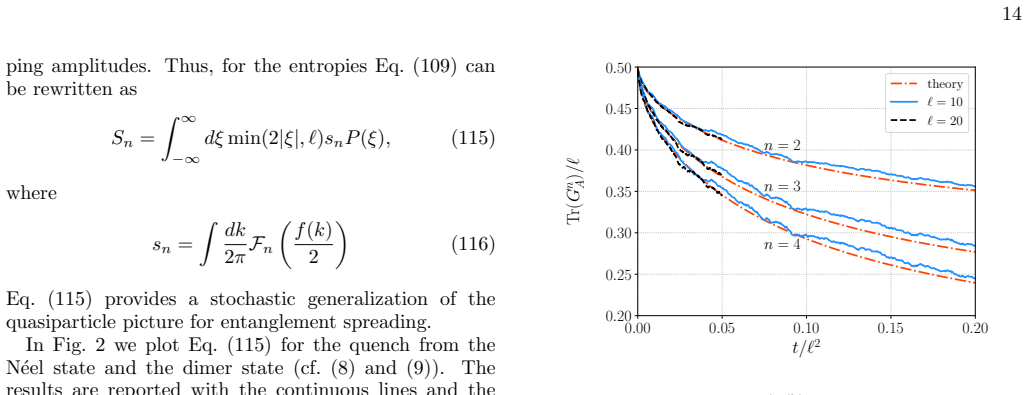
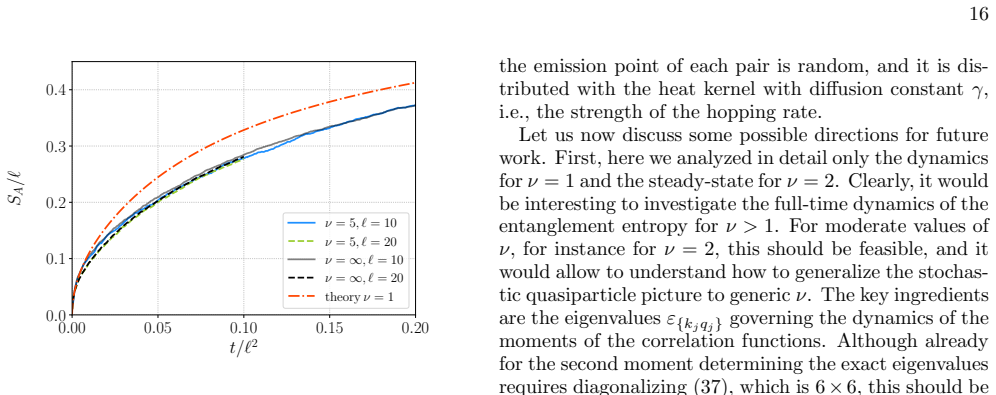
For ν=1 the entanglement dynamics is describable by a stochastic generalization of the quasiparticle picture: entanglement is propagated by pairs of quasiparticles whose trajectories are random walks, giving rise to diffusive entanglement growth.
What carries the argument
Stochastic quasiparticle pairs with random walk trajectories that carry fixed entanglement content while diffusing through the chain.
If this is right
- Entanglement entropy grows diffusively rather than ballistically with time.
- Noise-averaged entanglement quantities follow from the statistics of the random walks.
- Steady-state correlators obey topological relationships reflecting Haar invariance under structured SU(ν) matrices.
- The description extends to ν=2 with more complex structured random matrices.
Where Pith is reading between the lines
- This suggests that in real diffusive quantum systems with noise, entanglement might spread according to random quasiparticle motion rather than ballistic propagation.
- The model could be used to test how different noise correlations affect entanglement scaling in quantum many-body systems.
Load-bearing premise
The stochastic hopping amplitudes maintain ν-site translation invariance but are fully random in time to ensure the required invariance properties for the correlators.
What would settle it
Numerical evidence that the entanglement growth is not diffusive or does not match the predicted quasiparticle pair statistics in simulations of the ν=1 model.
Figures




read the original abstract
We investigate out-of-equilibrium entanglement dynamics in a generalization of the so-called $QSSEP$ model, which is a free-fermion chain with stochastic in space and time hopping amplitudes. In our setup, the noisy amplitudes are spatially-modulated satisfying a $\nu$-site translation invariance but retaining their randomness in time. For each noise realization, the dynamics preserves Gaussianity, which allows to obtain noise-averaged entanglement-related quantities. The statistics of the steady-state correlators satisfy nontrivial relationships that are of topological nature. They reflect the Haar invariance under multiplication with structured momentum-dependent random $SU(\nu)$ matrices. We discuss in detail the case with $\nu=1$ and $\nu=2$. For $\nu=1$, i.e., spatially homogeneous noise we show that the entanglement dynamics is describable by a stochastic generalization of the quasiparticle picture. Precisely, entanglement is propagated by pairs of quasiparticles. The entanglement content of the pairs is the same as for the deterministic chain. However, the trajectories of the quasiparticles are random walks, giving rise to diffusive entanglement growth.
Editorial analysis
A structured set of objections, weighed in public.
Referee Report
Summary. The manuscript introduces the ν-QSSEP model, a free-fermion chain with stochastic hopping amplitudes obeying ν-site translation invariance in space while remaining fully random in time. For each noise realization the dynamics remains Gaussian, permitting exact noise-averaged entanglement quantities. Steady-state correlators obey topological relations traceable to Haar invariance under structured, momentum-dependent SU(ν) matrices. The case ν=1 is treated in detail: entanglement is carried by quasiparticle pairs whose trajectories are random walks, producing diffusive rather than ballistic entanglement growth.
Significance. If the central claims hold, the work supplies a clean, analytically tractable toy model that interpolates between deterministic quasiparticle pictures and diffusive entanglement dynamics in noisy quantum systems. The explicit stochastic generalization for ν=1 and the topological structure of the correlators for general ν are potentially useful benchmarks for more realistic open-system simulations.
major comments (2)
- [§3.1] §3.1 (model definition): the ν-site translation invariance is imposed on the noise while time randomness is retained; it is not shown explicitly how this structured noise still yields the claimed full Haar invariance of the steady-state correlators under the structured SU(ν) matrices, which is load-bearing for the topological relations.
- [§4.2] §4.2, paragraph after Eq. (22): the stochastic quasiparticle picture asserts that pair trajectories are random walks whose diffusion constant controls the entanglement growth; no explicit computation of the diffusion constant from the second moment of the noise or from the two-point correlator is provided, leaving the diffusive scaling claim without a quantitative anchor.
minor comments (3)
- Notation for the structured SU(ν) matrices is introduced only in the text; a compact definition or appendix would improve readability.
- Figure 3 caption does not state the system size or number of noise realizations used for the numerical curves.
- The abstract states 'topological nature' of the relations; the main text should clarify whether these are homotopy invariants or merely algebraic identities preserved by the Haar measure.
Simulated Author's Rebuttal
We thank the referee for the careful reading, the positive assessment of the work, and the recommendation for minor revision. We address the two major comments point by point below.
read point-by-point responses
-
Referee: [§3.1] §3.1 (model definition): the ν-site translation invariance is imposed on the noise while time randomness is retained; it is not shown explicitly how this structured noise still yields the claimed full Haar invariance of the steady-state correlators under the structured SU(ν) matrices, which is load-bearing for the topological relations.
Authors: We agree that the connection between the imposed ν-site translation invariance of the noise and the resulting Haar invariance under momentum-dependent SU(ν) matrices deserves a more explicit derivation. The manuscript states the invariance but does not walk through the steps showing how time randomness combined with the spatial structure produces the full Haar measure on the relevant subgroup. In the revised manuscript we will expand the discussion in §3.1 (and, if needed, add a short appendix) to derive this explicitly, starting from the noise correlator and showing the invariance of the steady-state two-point functions under the structured unitary transformations. revision: yes
-
Referee: [§4.2] §4.2, paragraph after Eq. (22): the stochastic quasiparticle picture asserts that pair trajectories are random walks whose diffusion constant controls the entanglement growth; no explicit computation of the diffusion constant from the second moment of the noise or from the two-point correlator is provided, leaving the diffusive scaling claim without a quantitative anchor.
Authors: The referee correctly notes the absence of an explicit calculation. The diffusive scaling is asserted on the basis of the random-walk trajectories, but the diffusion constant itself is not extracted from the noise second moment or from the two-point correlator. In the revised version we will insert this computation immediately after Eq. (22), relating the diffusion constant D to the variance of the stochastic hopping amplitudes (specifically, D proportional to the second moment of the noise distribution) and confirming that the entanglement growth rate is set by this D. revision: yes
Circularity Check
No significant circularity; derivation remains self-contained
full rationale
The paper introduces the ν-QSSEP model with ν-site translation-invariant noise as an explicit assumption, then uses preservation of Gaussianity to compute noise-averaged quantities. Steady-state correlator statistics are attributed to standard Haar invariance under structured SU(ν) matrices, an external mathematical property rather than a result fitted or defined from the paper's own outputs. For ν=1 the stochastic quasiparticle picture is obtained by replacing deterministic trajectories with random walks while keeping the entanglement content per pair unchanged; this follows directly from the model definition without reducing to a self-citation chain or a parameter fit renamed as prediction. No load-bearing step equates an output to its input by construction, and the central claims retain independent content from the stochastic dynamics.
Axiom & Free-Parameter Ledger
axioms (2)
- domain assumption For each noise realization the dynamics preserves Gaussianity.
- domain assumption The steady-state correlators obey nontrivial topological relationships reflecting Haar invariance under multiplication with structured momentum-dependent random SU(ν) matrices.
Lean theorems connected to this paper
-
IndisputableMonolith/Cost/FunctionalEquation.leanwashburn_uniqueness_aczel unclear?
unclearRelation between the paper passage and the cited Recognition theorem.
For ν=1 … entanglement is propagated by pairs of quasiparticles … trajectories of the quasiparticles are random walks, giving rise to diffusive entanglement growth … P(ξ,t)=1/(2√πγt) e^{-ξ²/(4γt)}
-
IndisputableMonolith/Foundation/AlexanderDuality.leanalexander_duality_circle_linking unclear?
unclearRelation between the paper passage and the cited Recognition theorem.
the statistics of the steady-state correlators satisfy nontrivial relationships that are of topological nature. They reflect the Haar invariance under multiplication with structured momentum-dependent random SU(ν) matrices
What do these tags mean?
- matches
- The paper's claim is directly supported by a theorem in the formal canon.
- supports
- The theorem supports part of the paper's argument, but the paper may add assumptions or extra steps.
- extends
- The paper goes beyond the formal theorem; the theorem is a base layer rather than the whole result.
- uses
- The paper appears to rely on the theorem as machinery.
- contradicts
- The paper's claim conflicts with a theorem or certificate in the canon.
- unclear
- Pith found a possible connection, but the passage is too broad, indirect, or ambiguous to say the theorem truly supports the claim.
Forward citations
Cited by 2 Pith papers
-
Domain-wall melting in all-to-all QSSEP from random-matrix theory
In the thermodynamic limit the quantum and classical full-counting statistics of charge coincide exactly with no finite-time corrections, while the averaged von Neumann entanglement entropy admits a fully explicit exp...
-
Dynamics of entanglement fluctuations and quantum Mpemba effect in the $\nu=1$ QSSEP model
Incorporating noise-induced quasiparticle correlations in the ν=1 QSSEP model yields the full-time distribution of entanglement entropy and shows the quantum Mpemba effect is extremely fine-tuned and hard to observe.
Reference graph
Works this paper leans on
-
[1]
We verified that this rule generalizes to higher-point functions, and it is also valid for generic ν. Moreover, further constraints on the indices ρj, σj exist. To discuss them, it is convenient to introduce a picto- rial notation, denoting with a directed red line the cor- relator Gρσ kq as , the endpoints being ρ and σ. Now, for each diagram of (39) the...
-
[2]
Artificially de- vised many-body quantum dynamics in low dimensions - ManyQLowD
In contrast with the quench from the N´ eel state (see Fig. 3) we observe sizeable finite-size corrections. The qualitative behavior is similar as for the N´ eel quench. At t = 0 one has Mn = 1 /2, and Mn decrease upon increasing t. To understand the corrections we plot data for several subsystem sizes up to ℓ = 80. Upon increasing ℓ the data approach the...
work page 2022
-
[3]
V. Gorini, A. Kossakowski, and E. C. G. Sudarshan, Completely positive dynamical semigroups of n-level sys- tems, Journal of Mathematical Physics 17, 821 (1976), https://aip.scitation.org/doi/pdf/10.1063/1.522979. 17
-
[4]
G. Lindblad, On the generators of quantum dynamical semigroups, Communications in Mathematical Physics 48, 119 (1976)
work page 1976
-
[5]
H. P. Breuer and F. Petruccione, The theory of open quantum systems (Oxford University Press, Great Clarendon Street, 2002)
work page 2002
-
[6]
D. Bernard, Can the macroscopic fluctuation theory be quantized?, Journal of Physics A: Mathematical and The- oretical 54, 433001 (2021)
work page 2021
-
[7]
L. Bertini, A. De Sole, D. Gabrielli, G. Jona-Lasinio, and C. Landim, Macroscopic fluctuation theory, Rev. Mod. Phys. 87, 593 (2015)
work page 2015
-
[8]
P. Calabrese and J. Cardy, Evolution of entanglement entropy in one-dimensional systems, Journal of Statisti- cal Mechanics: Theory and Experiment 2005, P04010 (2005)
work page 2005
-
[9]
M. Fagotti and P. Calabrese, Evolution of entanglement entropy following a quantum quench: Analytic results for the XY chain in a transverse magnetic field, Phys. Rev. A 78, 010306 (2008)
work page 2008
-
[10]
V. Alba and P. Calabrese, Entanglement and thermodynamics after a quantum quench in integrable systems, Proceedings of the Na- tional Academy of Sciences 114, 7947 (2017), https://www.pnas.org/content/114/30/7947.full.pdf
work page 2017
-
[11]
V. Alba and P. Calabrese, Entanglement dynamics after quantum quenches in generic integrable systems, SciPost Phys. 4, 17 (2018)
work page 2018
- [12]
-
[13]
K. Klobas and B. Bertini, Entanglement dynamics in Rule 54: Exact results and quasiparticle picture, SciPost Phys. 11, 107 (2021)
work page 2021
- [14]
- [15]
-
[16]
Coarse-grained dynamics of operator and state entanglement
C. Jonay, D. A. Huse, and A. Nahum, Coarse-grained dynamics of operator and state entanglement (2018), arXiv:1803.00089 [cond-mat.stat-mech]
work page internal anchor Pith review Pith/arXiv arXiv 2018
-
[17]
ˇZnidariˇ c, Entanglement growth in diffusive systems, Communications Physics 3, 100 (2020)
M. ˇZnidariˇ c, Entanglement growth in diffusive systems, Communications Physics 3, 100 (2020)
work page 2020
-
[18]
Disentangling strategies and entanglement transitions in unitary circuit games with matchgates
R. Morral-Yepes, M. Langer, A. Gammon-Smith, B. Kraus, and F. Pollmann, Disentangling strategies and entanglement transitions in unitary circuit games with matchgates, (2025), arXiv:2507.05055 [quant-ph]
work page internal anchor Pith review Pith/arXiv arXiv 2025
-
[19]
T. Prosen, Third quantization: a general method to solve master equations for quadratic open Fermi systems, New Journal of Physics 10, 43026 (2008)
work page 2008
-
[20]
V. Alba and F. Carollo, Spreading of correlations in Markovian open quantum systems, Phys. Rev. B 103, L020302 (2021)
work page 2021
-
[21]
F. Carollo and V. Alba, Dissipative quasiparticle picture for quadratic markovian open quantum systems, Phys. Rev. B 105, 144305 (2022)
work page 2022
-
[22]
V. Alba and F. Carollo, Hydrodynamics of quantum en- tropies in Ising chains with linear dissipation, Journal of Physics A: Mathematical and Theoretical 55, 74002 (2022)
work page 2022
-
[23]
V. Alba and F. Carollo, Logarithmic negativity in out-of- equilibrium open free-fermion chains: An exactly solvable case, SciPost Phys. 15, 124 (2023)
work page 2023
-
[24]
F. Caceffo and V. Alba, Entanglement negativity in a fermionic chain with dissipative defects: exact results, Journal of Statistical Mechanics: Theory and Experi- ment 2023, 023102 (2023)
work page 2023
-
[25]
F. Caceffo and V. Alba, Fate of entanglement in quadratic markovian dissipative systems, (2024), arXiv:2406.15328 [cond-mat.stat-mech]
-
[26]
B. Skinner, J. Ruhman, and A. Nahum, Measurement- induced phase transitions in the dynamics of entangle- ment, Phys. Rev. X 9, 031009 (2019)
work page 2019
-
[27]
C.-M. Jian, Y.-Z. You, R. Vasseur, and A. W. W. Ludwig, Measurement-induced criticality in random quantum cir- cuits, Phys. Rev. B 101, 104302 (2020)
work page 2020
- [28]
- [29]
-
[30]
D. Bernard and T. Jin, Open quantum symmetric simple exclusion process, Phys. Rev. Lett. 123, 080601 (2019)
work page 2019
- [31]
-
[32]
D. Bernard and T. Jin, Solution to the quantum symmet- ric simple exclusion process: The continuous case, Com- munications in Mathematical Physics 384, 1141 (2021)
work page 2021
-
[33]
L. Hruza and D. Bernard, Coherent fluctuations in noisy mesoscopic systems, the open quantum ssep, and free probability, Phys. Rev. X 13, 011045 (2023)
work page 2023
-
[34]
G. Barraquand and D. Bernard, Introduction to quan- tum exclusion processes, (2025), arXiv:2507.01570 [math.PR]
-
[35]
K. Mallick, The exclusion process: A paradigm for non- equilibrium behaviour, Physica A: Statistical Mechan- ics and its Applications 418, 17 (2015), proceedings of the 13th International Summer School on Fundamental Problems in Statistical Physics
work page 2015
-
[36]
T. Jin, A. Krajenbrink, and D. Bernard, From stochas- tic spin chains to quantum kardar-parisi-zhang dynamics, Phys. Rev. Lett. 125, 040603 (2020)
work page 2020
-
[37]
D. Bernard, F. H. L. Essler, L. Hruza, and M. Medenjak, Dynamics of fluctuations in quantum simple exclusion processes, SciPost Phys. 12, 042 (2022)
work page 2022
-
[38]
D. Bernard, T. Jin, S. Scopa, and S. Wei, Large de- viations of density fluctuations in the boundary driven quantum symmetric simple inclusion process (2025), arXiv:2503.18763 [cond-mat.stat-mech]
-
[39]
D. Bernard and L. Piroli, Entanglement distribution in the quantum symmetric simple exclusion process, Phys. Rev. E 104, 014146 (2021)
work page 2021
-
[40]
X. Cao, A. Tilloy, and A. D. Luca, Entanglement in a fermion chain under continuous monitoring, SciPost Phys. 7, 24 (2019)
work page 2019
-
[41]
V. Alba, B. Bertini, M. Fagotti, L. Piroli, and P. Rug- giero, Generalized-hydrodynamic approach to inhomoge- neous quenches: correlations, entanglement and quantum effects, Journal of Statistical Mechanics: Theory and Ex- periment 2021, 114004 (2021)
work page 2021
-
[42]
P. Calabrese, F. H. L. Essler, and G. Mussardo, Intro- duction to ‘Quantum Integrability in Out of Equilibrium Systems’, Journal of Statistical Mechanics: Theory and Experiment 2016, 064001 (2016). 18
work page 2016
-
[43]
L. Vidmar and M. Rigol, Generalized Gibbs ensemble in integrable lattice models, Journal of Statistical Mechan- ics: Theory and Experiment 2016, 064007 (2016)
work page 2016
-
[44]
V. Eisler, Crossover between ballistic and diffusive trans- port: the quantum exclusion process, Journal of Statis- tical Mechanics: Theory and Experiment 2011, P06007 (2011)
work page 2011
-
[45]
M. Creutz, On invariant integration over su(n), Journal of Mathematical Physics 19, 2043 (1978), https://pubs.aip.org/aip/jmp/article- pdf/19/10/2043/19078670/2043 1 online.pdf
work page 2043
-
[46]
D. Weingarten, Non-planar diagrams in the large n limit of u(n) and su(n) lattice gauge theories, Physics Letters B 90, 285 (1980)
work page 1980
-
[47]
P. Calabrese, F. H. L. Essler, and M. Fagotti, Quantum quench in the transverse field Ising chain: I. Time evo- lution of order parameter correlators, Journal of Statis- tical Mechanics: Theory and Experiment 2012, P07016 (2012)
work page 2012
-
[48]
R. Wong, Asymptotic Approximations of Integrals (Soci- ety for Industrial and Applied Mathematics, 2001)
work page 2001
-
[49]
I. Peschel and V. Eisler, Reduced density matrices and entanglement entropy in free lattice models, Journal of Physics A: Mathematical and Theoretical 42, 504003 (2009)
work page 2009
-
[50]
V. Alba and P. Calabrese, Quantum information dynam- ics in multipartite integrable systems, EPL (Europhysics Letters) 126, 60001 (2019)
work page 2019
-
[51]
F. Rottoli, C. Rylands, and P. Calabrese, Entanglement hamiltonians and the quasiparticle picture, Phys. Rev. B 111, L140302 (2025)
work page 2025
-
[52]
S. Paeckel, T. K¨ ohler, A. Swoboda, S. R. Manmana, U. Schollw¨ ock, and C. Hubig, Time-evolution methods for matrix-product states, Annals of Physics 411, 167998 (2019). Appendix A: Detailed derivation of Mn for small n Here provide details on the derivation of the large ℓ, t behavior of the moments Mn of GA (cf. (86)) for n = 2, 3, 4. Let us consider th...
work page 2019
discussion (0)
Sign in with ORCID, Apple, or X to comment. Anyone can read and Pith papers without signing in.