REVIEW 3 major objections 9 minor 126 references
Unraveling the Feedback-Regulated Star Formation Activities around the Expanding Galactic MIR Bubble [HKS2019] E71
T0 review · 3 major / 9 minor · reviewed 2026-08-06 · deepseek-v4-flash
Pith's one-line read The paper concludes that feedback from the B1.5 star m2 sculpted the E71 bubble and is now triggering star formation at its rim, including the accreting massive young stellar object m4.
desk verdict Solid multi-wavelength case study of the E71 bubble; the structural results are probably right, but the expansion velocity and triggered star formation claim rest on an untested kinematic choice. read the letter →
The pith
A machine-rendered reading of the paper's core claim, the machinery that carries it, and where it could break.
The reading
What carries the argument
The load-bearing mechanism is the "collect and collapse" scenario for expanding H II regions, evaluated observationally through three coupled diagnostics: (1) the measured total feedback pressure from m2, dominated by H II gas pressure ($P_{\rm HII} = 2.1 \times 10^{-11}$ dyn cm$^{-2}$) plus radiation pressure and wind ram pressure, compared against typical cloud pressures; (2) the spatial coincidence between the PDR arc, the dust arc, and the distribution of Class I YSOs and molecular condensations; and (3) the CO kinematics, namely moment maps at a uniform $-16$ km s$^{-1}$ with a position-velocity spread of about $2$ km s$^{-1}$ along the bubble rim, plus linewidth maxima toward the arc, interpreted as expansion. A secondary but essential piece is the Gaia DR3 membership analysis that places m2 inside Cl1 and fixes the cluster distance, turning m2 into the only known massive star capable of powering the bubble.
What would settle it
A decisive test is to measure the distance and velocity structure of the red-shifted cloud ($-4$ to $2$ km s$^{-1}$), for example with NH3 or C18O lines and absorption against background continuum sources: if it lies at the same 1.8 kpc distance as the blue cloud and connects kinematically to it, the two clouds form a single shell expanding at about $11$ km s$^{-1}$, and the paper's $\sim 2$ km s$^{-1}$ expansion and the direct m2-to-bubble causal chain fail. If the red-shifted cloud is genuinely foreground or background, the shell interpretation at $\sim 2$ km s$^{-1}$ survives and the pressure argument stands.
Extended reading notes
Core claim
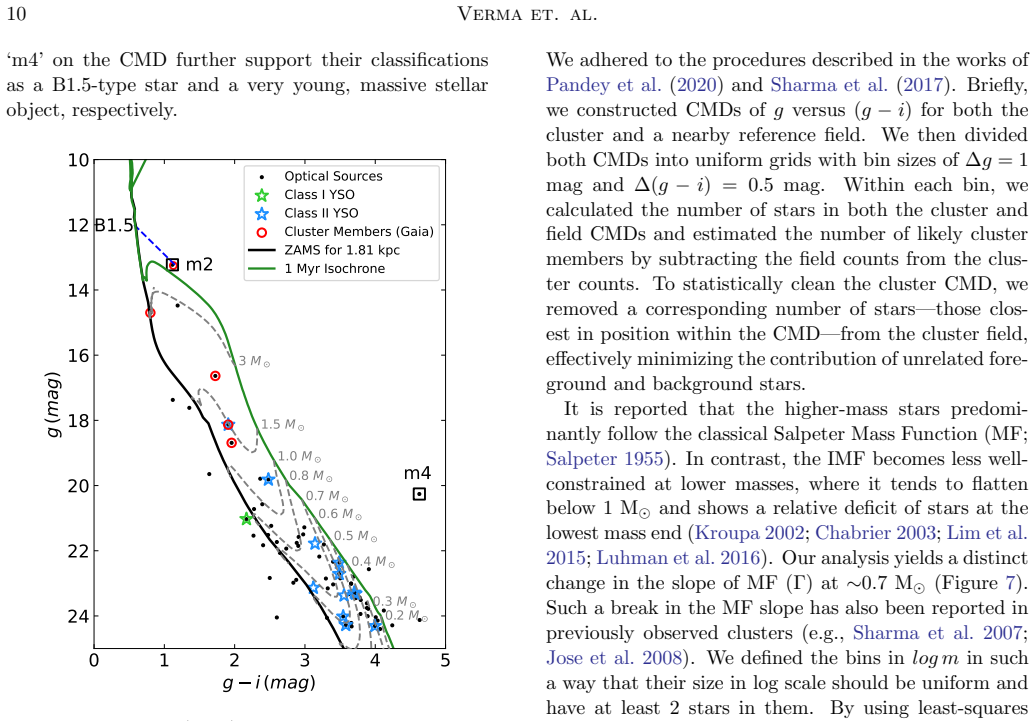
The central claim is that m2, a B1.5 member of cluster Cl1 at $1.81 \pm 0.15$ kpc, is the primary ionizing source of the E71 H II region and has sculpted the bubble's arc-like morphology through feedback. The assembled evidence includes a partial ring of warm dust and PAH emission (a PDR) surrounding m2; H-$\alpha$ and 1.26 GHz radio continuum tracing ionized gas confined by that PDR; Herschel column density and extinction maps showing the arc; and 12CO position-velocity diagrams along the bubble rim showing a velocity spread around $-16$ km s$^{-1}$, interpreted as expansion at about $2$ km s$^{-1}$. The pressure of m2's H II region, radiation, and wind at the position of the rim protostar m4 is $2.9 \times 10^{-11}$ dyn cm$^{-2}$, above the roughly $10^{-11}$ to $10^{-12}$ dyn cm$^{-2}$ internal pressure of a typical molecular cloud. The authors therefore conclude that m2's feedback swept up and compressed the ambient cloud, that the regularly spaced condensations along the arc are the fragmentation products of that compressed shell, and that m4, an accreting massive young stellar object with jet-like non-thermal radio emission, is a newly triggered star.
Load-bearing premise
The load-bearing premise is that the molecular cloud seen at $-20$ to $-14$ km s$^{-1}$ is the gas shell of the E71 bubble, while the cloud at $-4$ to $2$ km s$^{-1}$ is an unrelated foreground or background component; Section 4.3 itself notes the two clouds could instead be the near and far sides of one disrupted shell expanding at about $11$ km s$^{-1}$, and sets that aside because the blue cloud's morphology matches the bubble better.
Editorial extensions
If this is right
- If m2's feedback is the driver, the E71 bubble is an expanding shell that is actively sweeping up the rim gas, and the cluster Cl1 must be older than the rim-triggered population.
- The regularly spaced condensations along the PDR arc are candidate sites of collapse that should contain dense cores, potentially forming a new generation of stars around the bubble.
- m4 and m4' are likely young massive objects powered by B2/B3-type stars, with non-thermal radio emission from jets rather than ultra-compact H II regions; the absence of a P-Cygni profile at higher spectral resolution leaves their outflow geometry open.
- The measured Lyman continuum flux ($4.32 \times 10^{45}$ photons s$^{-1}$) falls short of the expected B1.5 value ($1.00 \times 10^{46}$ photons s$^{-1}$), implying that roughly half the ionizing photons are absorbed by dust within the bubble, consistent with a dust- and density-bounded H II region.
- The deep optical, near-infrared, and radio data together make E71 a clear example of feedback-regulated star formation where one massive star can shape a parsec-scale environment and induce a second generation of stars.
Reading between the lines
- The paper sets aside a more dramatic reading of the CO data: the $[-20, -14]$ km s$^{-1}$ and $[-4, 2]$ km s$^{-1}$ clouds could be the near and far sides of a single expanding shell, implying an expansion velocity near $11$ km s$^{-1}$. If that reading is correct, the bubble's dynamical age would be much shorter, and the feedback would have had to act very quickly; a targeted distance or absorpti
- A natural test of the collect-and-collapse interpretation is the spacing of the rim condensations: resolved millimeter interferometry should show cores whose separations and masses match the Jeans fragmentation of a swept-up shell; if the cores turn out to be pre-existing, triggered formation is not established.
- The pressure argument assumes m2 is the only ionizing source inside Cl1; if deeper radio observations reveal additional embedded massive stars, the pressure budget would need to be shared and the causal story would be weakened.
- The paper's higher-resolution spectrum of m4 does not confirm the previously reported P-Cygni profile, which suggests that the outflow classification of this MYSO may need revision and that follow-up spectroscopy at even higher resolution is worthwhile.
Editorial analysis
A structured set of objections, weighed in public.
Referee Report
Summary. The manuscript presents a multi-wavelength study of the Galactic mid-infrared bubble [HKS2019] E71. Using deep optical photometry (DOT), optical spectroscopy (HFOSC), near-infrared spectroscopy (TANSPEC), uGMRT 1260 MHz radio continuum, Herschel dust maps, and PMO MWISP CO(1-0) data, the authors identify a stellar cluster Cl1 at 1.81±0.15 kpc, classify the central massive star m2 as B1.5, detect an arc-like PDR and associated dust/gas condensations, identify a population of Class I/II YSOs, resolve two radio continuum peaks near the MYSO m4, and infer an expansion velocity of ~2 km/s from a 12CO position-velocity diagram. They conclude that feedback from m2 likely sculpted the bubble and triggered the formation of m4 through the collect-and-collapse mechanism.
Significance. If the kinematic association and expansion inference hold, the paper would provide a well-observed example of feedback-regulated star formation in a modest-size Galactic bubble, with new uGMRT and TANSPEC observations as original contributions. The study makes good use of archival Gaia and Herschel data and presents a coherent morphological case for an embedded cluster, a PDR, and ongoing star formation. However, the causal claim—that m2's feedback drove the expansion and triggered m4—depends on a kinematic interpretation that the authors themselves flag as ambiguous in Section 4.3, and the ~2 km/s expansion velocity is not quantitatively established. The structural results are likely robust; the trigger conclusion needs additional support before it can be accepted.
major comments (3)
- [§4.3 (with §3.10.3)] The central claim—that m2's feedback expanded the E71 bubble and triggered the formation of m4—requires that the [−20, −14] km/s CO cloud is the molecular shell of the bubble and that the [−4, 2] km/s cloud is an unrelated foreground/background component. Section 4.3 explicitly states that the two clouds 'appear to form a disrupted molecular shell' with an implied expansion velocity of ~11 km/s, and this alternative is set aside only because 'the blue-shifted cloud aligns more closely in morphology with the E71 bubble.' That is a morphological preference, not a quantitative test; no distance or absorption measurement is presented for the red cloud. Please provide a discriminating test (e.g., extinction or 3D dust measurements toward the two velocity components, or a search for associated continuum/dust emission) or explicitly frame the expansion and triggering conclusions as conditional on the adopted association.
- [§3.10.3] The inferred expansion velocity of ~2 km/s is read from a PV diagram along arc CD with eye-drawn curves and no quoted uncertainty. The stated velocity spread [−18, −14] km/s is comparable to the measured 13CO FWHM linewidths in Table 4 (0.62–1.99 km/s) and to the linewidth maxima in Figure 12, so it is not established that the apparent expansion exceeds the local velocity dispersion. Please fit the PV structure quantitatively (e.g., a shell or Gaussian model) to obtain an expansion velocity with uncertainty, and compare it with the non-thermal velocity dispersion before using it as evidence of feedback-driven expansion.
- [§3.4 (with §1)] The physical association of the MYSO m4 with the bubble is itself dependent on the same velocity association: m4 is not a Gaia cluster member, and its adopted distance of 2.0±0.6 kpc comes from Kawamura et al. (1998), whereas Cl1 is at 1.81±0.15 kpc. The association currently rests on the NH3 velocity of −16 km/s and on the morphology of the blue-shifted cloud. If the blue-cloud association is not confirmed, the triggering scenario involving m4 loses its observational anchor. Please state this dependence explicitly and, if possible, use the new TANSPEC or uGMRT data to constrain m4's distance or association.
minor comments (9)
- [§3.10.3] The phrase 'The thought behind electing these paths' should be 'selecting these paths.'
- [§4.4] 'Harbig-haro object' should be 'Herbig–Haro object.'
- [§5] The phrase 'encouraging and amusing signatures' is informal for a journal article; consider 'compelling signatures.'
- [§3.5] The sentence 'We defined the bins in log min' should read 'log m' (the logarithm of stellar mass).
- [§3.9] Section 3.8 derives NUV = 4.32×10^45 s−1 from the uGMRT flux, while Section 3.9 uses Nuv = 1.00×10^46 s−1 from Clark & Porter (2004) for the same star; please justify using the literature value or propagate the observed value, since PHII in Eq. (11) depends on Nuv.
- [Figure 13 caption] The blue curves in the PV diagram are not described in the caption; please state what they represent and how they were drawn.
- [§4.3] The text refers to 'm-2 moment maps,' but Figure 12 shows m-0, m-1, and linewidth (m-2) maps; please make the terminology consistent.
- [§3.10.4] The assumption c = (a+b)/2 for the third axis enters the density estimates in Table 5; please state the resulting systematic uncertainty.
- [§2.5] 'To authorize the flux density scale' should read 'To calibrate the flux density scale.'
Circularity Check
No significant circularity: expansion velocity, pressure, and triggered-formation claims are measured or referenced externally, not fitted; Sec. 4.3's two-cloud ambiguity is an interpretive assumption, not a circular reduction.
full rationale
The paper's central inference—that the B1.5 star m2 has sculpted E71 and may have triggered m4—is assembled from independent measurements: the ~2 km/s expansion velocity is read directly from the 12CO(1-0) PV diagram along arc CD (Sec. 3.10.3), the pressure on m4 uses external B1.5 parameters from Clark & Porter (2004) and Pauwels et al. (2023) together with a projected distance, and the ionized-gas morphology comes from new uGMRT/NVSS and WISE data. None of these inputs is adjusted to produce the conclusion; no fitted parameter is renamed as a prediction, and no uniqueness theorem or load-bearing self-citation forces the result. The authors do cite their own previous work (e.g., Sharma et al. 2017, Verma et al. 2023) but only as methodological precedent or morphological analogy, not as the justification for the expansion claim. Sec. 4.3 explicitly flags an alternative reading of the CO kinematics—the blue and red clouds 'appear to form a disrupted molecular shell' with expansion ~11 km/s—and sets it aside because 'the blue-shifted cloud aligns more closely in morphology with the E71 bubble.' That is an observational assumption about which cloud is the bubble shell; it weakens the kinematics-based association but does not make the derivation circular, because the adopted 2 km/s expansion is still read from the data rather than manufactured by the assumption. Similarly, the pressure comparison demonstrates capability to compress typical molecular gas, not a forced causal chain. The paper is therefore self-contained relative to the circularity tests; the two-cloud degeneracy is a correctness risk, not circularity.
Assumptions & free parameters
free parameters (5)
- Cluster distance =
1.81 ± 0.15 kpc
- Visual extinction A_V =
2.63 mag
- Assumed YSO mass =
0.5 M_sun per YSO
- Electron temperature T_e =
10,000 K
- Core third axis c =
mean of semi-major and semi-minor axes
assumptions (6)
- domain assumption Dust temperature equals gas kinetic temperature (T_gas ≈ T_d)
- domain assumption Local thermodynamic equilibrium (LTE) and a fixed 13CO-to-H2 conversion factor
- ad hoc to paper The blue-shifted cloud [-20,-14] km/s is the gas associated with the bubble
- domain assumption m2 is the sole significant ionizing and feedback source of the bubble
- domain assumption Regularly spaced condensations along an arc are diagnostic of collect-and-collapse
- standard math Standard pressure formulas for HII regions, radiation, and winds
Cite this review
Pith. "Pith review of Unraveling the Feedback-Regulated Star Formation Activities around the Expanding Galactic MIR Bubble [HKS2019] E71." pith.science (2026). https://pith.science/paper/XYKSSLLR
@misc{pith2026250713232,
  author       = {Pith},
  title        = {Pith review of: Unraveling the Feedback-Regulated Star Formation Activities around the Expanding Galactic MIR Bubble [HKS2019] E71},
  year         = {2026},
  howpublished = {\url{https://pith.science/paper/XYKSSLLR}},
  note         = {Machine review of arXiv:2507.13232}
}
abstract
We explore the physical environment of the Galactic mid-infrared (MIR) bubble [HKS2019] E71 (hereafter E71) through a multi-wavelength approach. E71 is located at the edge of a filamentary structure, as traced in Herschel images (250-500 $\mu$m), Herschel column density map, and molecular maps in the velocity range [-20,-14] km/s. It hosts a stellar cluster (radius~1.26 pc, distance~1.81+/-0.15 kpc) associated with radio continuum emission, including a centrally positioned B1.5-type massive star (hereafter 'm2'), along with an enhanced population of evolved low-mass stars and young stellar objects. MIR images and molecular line maps reveal a PDR surrounding 'm2', exhibiting an arc-like structure along the edges of E71. Regularly spaced molecular and dust condensations are identified along this structure. The position-velocity map of 12CO emission suggests an expansion of molecular gas concentrated at the periphery of E71. Near-infrared spectroscopic observations with TANSPEC confirm the presence of the accretion process in a massive young stellar object (MYSO) located near the edge of the bubble. High-resolution uGMRT radio continuum maps uncover substructures in the ionized emission, both toward the MYSO and the center of E71. These findings support that 'm2' has shaped an arc-like morphology through its feedback processes. The pressure exerted by 'm2' and the velocity structure of the 12/13CO(1-0) emission suggest that the stellar feedback has likely driven out molecular material, leading to the formation of the expanding E71 bubble. Our overall investigation infers that the "collect and collapse" process might be a possible mechanism that can describe the ongoing star formation activities around the E71 bubble.
Figures


Figures from the paper (12 more)




Reference graph
Works this paper leans on
-
[1]
, " * write output.state after.block = add.period write newline
ENTRY address archivePrefix author booktitle chapter doi edition editor eprint howpublished institution journal key month number organization pages publisher school series title misctitle type volume year version url label extra.label sort.label short.list INTEGERS output.state before.all mid.sentence after.sentence after.block FUNCTION init.state.consts ...
-
[2]
write newline
" write newline "" before.all 'output.state := FUNCTION format.url url empty "" new.block "" url * "" * if FUNCTION format.eprint eprint empty "" archivePrefix empty "" archivePrefix "arXiv" = new.block " " eprint * " " * new.block " " eprint * " " * if if if FUNCTION format.doi doi empty "" " " doi * " " * if FUNCTION format.pid doi empty eprint empty ""...
-
[3]
- [1] #1 = = ^ ^ ^ .\!\!^ d .\!\!^ h .\!\!^ m .\!\!^ s .\!\!^ @mss
thebibliography [1] 20pt to REFERENCES 6pt =0pt -12pt 10pt plus 3pt =0pt =0pt =1pt plus 1pt =0pt =0pt -12pt =13pt plus 1pt =20pt =13pt plus 1pt \@M =10000 =-1.0em =0pt =0pt 0pt =0pt =1.0em @enumiv\@empty 10000 10000 `\.\@m \@noitemerr \@latex@warning Empty `thebibliography' environment \@ifnextchar \@reference \@latexerr Missing key on reference command E...
2021
-
[4]
Alcal \'a , J. M., Natta , A., Manara , C. F., et al. 2014, , 561, A2, 10.1051/0004-6361/201322254
-
[5]
Bailer-Jones , C. A. L., Rybizki , J., Fouesneau , M., Demleitner , M., & Andrae , R. 2021, , 161, 147, 10.3847/1538-3881/abd806
-
[6]
Balaguer-N \'u \ n ez , L., Jordi , C., Galad \' -Enr \' quez , D., & Zhao , J. L. 2004, , 426, 819, 10.1051/0004-6361:20041332
-
[7]
Balaguer-N \'u nez , L., Tian , K. P., & Zhao , J. L. 1998, , 133, 387, 10.1051/aas:1998324
-
[8]
A., Churchwell , E., Babler , B
Benjamin , R. A., Churchwell , E., Babler , B. L., et al. 2005, , 630, L149, 10.1086/491785
doi:10.1086/491785 2005
Show all 126 references
-
[9]
G., W \"u nsch , R., Whitworth , A
Bisbas , T. G., W \"u nsch , R., Whitworth , A. P., & Hubber , D. A. 2009, , 497, 649, 10.1051/0004-6361/200811522
2009 doi
-
[10]
2012, , 758, L28, 10.1088/2041-8205/758/2/L28
Bressert , E., Ginsburg , A., Bally , J., et al. 2012, , 758, L28, 10.1088/2041-8205/758/2/L28
2012 doi
-
[11]
C., Hoare , M
Bunn , J. C., Hoare , M. G., & Drew , J. E. 1995, , 272, 346, 10.1093/mnras/272.2.346
1995 doi
-
[12]
2022, , 134, 114501, 10.1088/1538-3873/ac9642
CASA Team , Bean , B., Bhatnagar , S., et al. 2022, , 134, 114501, 10.1088/1538-3873/ac9642
2022 doi
- [13]
-
[14]
C., Magnier , E
Chambers , K. C., Magnier , E. A., Metcalfe , N., et al. 2016, arXiv e-prints, arXiv:1612.05560. 1612.05560
2016 arXiv
-
[15]
2014, , 439, 3719, 10.1093/mnras/stu224
Chavarr \' a , L., Allen , L., Brunt , C., et al. 2014, , 439, 3719, 10.1093/mnras/stu224
2014 doi
-
[16]
S., Allen , D., et al
Churchwell , E., Povich , M. S., Allen , D., et al. 2006, , 649, 759, 10.1086/507015
2006 doi
-
[17]
S., & Porter , J
Clark , J. S., & Porter , J. M. 2004, , 427, 839, 10.1051/0004-6361:20040523
2004 doi
-
[18]
J., Cotton , W
Condon , J. J., Cotton , W. D., Greisen , E. W., et al. 1998, , 115, 1693, 10.1086/300337
1998 doi
-
[19]
S., & Reipurth , B
Connelley , M. S., & Reipurth , B. 2018, , 861, 145, 10.3847/1538-4357/aaba7b
2018 doi
-
[20]
Cooper , H. D. B., Lumsden , S. L., Oudmaijer , R. D., et al. 2013, , 430, 1125, 10.1093/mnras/sts681
2013 doi
-
[21]
E., Ercolano , B., & Bonnell , I
Dale , J. E., Ercolano , B., & Bonnell , I. A. 2013, , 431, 1062, 10.1093/mnras/stt236
2013 doi
-
[22]
2003, , 408, L25, 10.1051/0004-6361:20031157
Deharveng , L., Lefloch , B., Zavagno , A., et al. 2003, , 408, L25, 10.1051/0004-6361:20031157
2003 doi
-
[23]
2005, , 433, 565, 10.1051/0004-6361:20041946
Deharveng , L., Zavagno , A., & Caplan , J. 2005, , 433, 565, 10.1051/0004-6361:20041946
2005 doi
-
[24]
D., et al
Deharveng , L., Schuller , F., Anderson , L. D., et al. 2010, , 523, A6, 10.1051/0004-6361/201014422
2010 doi
-
[25]
2018, Data of the MWISP Sky Survey (2011 - 2017) , V1, Science Data Bank, 10.11922/sciencedb.570
DengRong, L., Jixian, S., Zherui, Y., Liang, L., & Ji, Y. 2018, Data of the MWISP Sky Survey (2011 - 2017) , V1, Science Data Bank, 10.11922/sciencedb.570
2018 doi
-
[26]
K., Baug , T., Ojha , D
Dewangan , L. K., Baug , T., Ojha , D. K., et al. 2017 a , , 845, 34, 10.3847/1538-4357/aa7da2
2017 doi
-
[27]
K., Baug , T., Pirogov , L
Dewangan , L. K., Baug , T., Pirogov , L. E., & Ojha , D. K. 2020 a , , 898, 41, 10.3847/1538-4357/ab964c
2020 doi
-
[28]
K., Ojha , D
Dewangan , L. K., Ojha , D. K., Zinchenko , I., Janardhan , P., & Luna , A. 2017 b , , 834, 22, 10.3847/1538-4357/834/1/22
2017 doi
-
[29]
K., Sharma , S., Pandey , R., et al
Dewangan , L. K., Sharma , S., Pandey , R., et al. 2020 b , , 898, 172, 10.3847/1538-4357/ab9c27
2020 doi
-
[30]
E., & Williams , D
Dyson , J. E., & Williams , D. A. 1980, Physics of the interstellar medium
1980
-
[31]
Edwards , S., Fischer , W., Kwan , J., Hillenbrand , L., & Dupree , A. K. 2003, , 599, L41, 10.1086/381077
2003 doi
-
[32]
Elmegreen , B. G. 1998, in Astronomical Society of the Pacific Conference Series, Vol. 148, Origins, ed. C. E. Woodward , J. M. Shull , & H. A. Thronson , Jr., 150
1998
- [33]
-
[34]
D., & Pudritz , R
Fiege , J. D., & Pudritz , R. E. 2000, , 311, 85, 10.1046/j.1365-8711.2000.03066.x
2000
- [35]
-
[36]
Gaia Collaboration , Prusti , T., de Bruijne , J. H. J., et al. 2016, , 595, A1, 10.1051/0004-6361/201629272
2016 doi
-
[37]
Gaia Collaboration , Vallenari , A., Brown , A. G. A., et al. 2023, , 674, A1, 10.1051/0004-6361/202243940
2023 doi
-
[38]
P., et al
Ghosh , A., Sharma , S., Ninan , J. P., et al. 2023, Journal of Astrophysics and Astronomy, 44, 50, 10.1007/s12036-023-09939-7
2023 doi
-
[39]
2013, , 778, 71, 10.1088/0004-637X/778/1/71
Giannini , T., Nisini , B., Antoniucci , S., et al. 2013, , 778, 71, 10.1088/0004-637X/778/1/71
2013 doi
-
[40]
2020, GLIMPSE 360 Catalog, IPAC, 10.26131/IRSA214
GLIMPSE Team . 2020, GLIMPSE 360 Catalog, IPAC, 10.26131/IRSA214 . https://catcopy.ipac.caltech.edu/dois/doi.php?id=10.26131/IRSA214
2020 doi
-
[41]
Goldsmith , P. F. 2001, , 557, 736, 10.1086/322255
2001 doi
-
[42]
M., Schlafly , E., Zucker , C., Speagle , J
Green , G. M., Schlafly , E., Zucker , C., Speagle , J. S., & Finkbeiner , D. 2019, , 887, 93, 10.3847/1538-4357/ab5362
2019 doi
-
[43]
S., et al
Gupta , Y., Ajithkumar , B., Kale , H. S., et al. 2017, Current Science, 113, 707, 10.18520/cs/v113/i04/707-714
2017 doi
-
[44]
A., Megeath , S
Gutermuth , R. A., Megeath , S. T., Myers , P. C., et al. 2009, , 184, 18, 10.1088/0067-0049/184/1/18
2009 doi
-
[45]
A., Megeath , S
Gutermuth , R. A., Megeath , S. T., Pipher , J. L., et al. 2005, , 632, 397, 10.1086/432460
2005 doi
-
[46]
2019, , 71, 6, 10.1093/pasj/psy126
Hanaoka , M., Kaneda , H., Suzuki , T., et al. 2019, , 71, 6, 10.1093/pasj/psy126
2019 doi
-
[47]
G., Drew , J
Hoare , M. G., Drew , J. E., Muxlow , T. B., & Davis , R. J. 1994, , 421, L51, 10.1086/187185
1994 doi
-
[48]
Inoue , A. K. 2001, , 122, 1788, 10.1086/323095
2001 doi
-
[49]
H., Hunter , D
Jacoby , G. H., Hunter , D. A., & Christian , C. A. 1984, , 56, 257, 10.1086/190983
1984 doi
-
[50]
C., Reiter , M., Sanchez-Janssen , R., et al
Jones , O. C., Reiter , M., Sanchez-Janssen , R., et al. 2022, , 517, 1518, 10.1093/mnras/stac2491
2022 doi
-
[52]
K., Ogura , K., et al
Jose , J., Pandey , A. K., Ogura , K., et al. 2012, , 424, 2486, 10.1111/j.1365-2966.2012.21175.x
2012
-
[53]
2022, , 663, A133, 10.1051/0004-6361/202141676
Karska , A., Koprowski , M., Solarz , A., et al. 2022, , 663, A133, 10.1051/0004-6361/202141676
2022 doi
-
[54]
C., L \'o pez-S \'a nchez , \'A
Karthick , M. C., L \'o pez-S \'a nchez , \'A . R., Sahu , D. K., Sanwal , B. B., & Bisht , S. 2014, , 439, 157, 10.1093/mnras/stt2301
2014 doi
-
[55]
L., Evans , II, N
Kauffmann , J., Bertoldi , F., Bourke , T. L., Evans , II, N. J., & Lee , C. W. 2008, , 487, 993, 10.1051/0004-6361:200809481
2008 doi
-
[56]
K., et al
Kaur , H., Sharma , S., Dewangan , L. K., et al. 2020, , 896, 29, 10.3847/1538-4357/ab9122
2020 doi
-
[57]
1998, , 117, 387, 10.1086/313119
Kawamura , A., Onishi , T., Yonekura , Y., et al. 1998, , 117, 387, 10.1086/313119
1998 doi
-
[58]
V., Piskunov , A
Kharchenko , N. V., Piskunov , A. E., Roeser , S., Schilbach , E., & Scholz , R. D. 2013, VizieR Online Data Catalog, J/A+A/558/A53
2013
- [59]
-
[60]
P., & Leisawitz , D
Koenig , X. P., & Leisawitz , D. T. 2014, , 791, 131, 10.1088/0004-637X/791/2/131
2014 doi
-
[61]
2002, Science, 295, 82, 10.1126/science.1067524
Kroupa , P. 2002, Science, 295, 82, 10.1126/science.1067524
2002 doi
-
[62]
B., Singh , A., et al
Kumar , A., Pandey , S. B., Singh , A., et al. 2022, Journal of Astrophysics and Astronomy, 43, 27, 10.1007/s12036-022-09798-8
2022 doi
-
[63]
2018, Bulletin de la Societe Royale des Sciences de Liege, 87, 29
Kumar , B., Omar , A., Maheswar , G., et al. 2018, Bulletin de la Societe Royale des Sciences de Liege, 87, 29
2018
-
[64]
Kumar , M. S. N., Palmeirim , P., Arzoumanian , D., & Inutsuka , S. I. 2020, , 642, A87, 10.1051/0004-6361/202038232
2020 doi
- [65]
-
[66]
J., Bergin , E
Lada , C. J., Bergin , E. A., Alves , J. F., & Huard , T. L. 2003, , 586, 286, 10.1086/367610
2003 doi
-
[67]
G., & Ryder , S
Lee , Y.-H., Koo , B.-C., Lee , J.-J., Burton , M. G., & Ryder , S. 2019, , 157, 123, 10.3847/1538-3881/ab0212
2019 doi
-
[68]
2015, arXiv e-prints, arXiv:1511.01118
Lim , B., Sung , H., Hur , H., & Park , B.-G. 2015, arXiv e-prints, arXiv:1511.01118. 1511.01118
2015 arXiv
-
[69]
W., Hoare , M
Lucas , P. W., Hoare , M. G., Longmore , A., et al. 2008, , 391, 136, 10.1111/j.1365-2966.2008.13924.x
2008
-
[70]
L., Esplin , T
Luhman , K. L., Esplin , T. L., & Loutrel , N. P. 2016, , 827, 52, 10.3847/0004-637X/827/1/52
2016 doi
-
[71]
L., Hoare , M
Lumsden , S. L., Hoare , M. G., Urquhart , J. S., et al. 2013, VizieR Online Data Catalog: The Red MSX Source Survey: massive protostars (Lumsden+, 2013) , VizieR On-line Data Catalog: J/ApJS/208/11. Originally published in: 2013ApJS..208...11L, 10.26093/cds/vizier.22080011
2013 doi
-
[72]
Luri , X., Brown , A. G. A., Sarro , L. M., et al. 2018, , 616, A9, 10.1051/0004-6361/201832964
2018 doi
-
[73]
K., Dewangan , L
Mallick , K. K., Dewangan , L. K., Ojha , D. K., Baug , T., & Zinchenko , I. I. 2023, , 944, 228, 10.3847/1538-4357/acb8bc
2023 doi
-
[74]
A., Whitworth , A
Marsh , K. A., Whitworth , A. P., & Lomax , O. 2015, , 454, 4282, 10.1093/mnras/stv2248
2015 doi
-
[75]
A., Whitworth , A
Marsh , K. A., Whitworth , A. P., Lomax , O., et al. 2017, , 471, 2730, 10.1093/mnras/stx1723
2017 doi
-
[76]
N., Evans , II, N
Matsakis , D. N., Evans , II, N. J., Sato , T., & Zuckerman , B. 1976, , 81, 172, 10.1086/111871
1976 doi
-
[77]
2010 a , , 122, 314, 10.1086/651314
Molinari , S., Swinyard , B., Bally , J., et al. 2010 a , , 122, 314, 10.1086/651314
2010 doi
-
[78]
2010 b , , 518, L100, 10.1051/0004-6361/201014659
---. 2010 b , , 518, L100, 10.1051/0004-6361/201014659
2010 doi
-
[79]
C., & Tremonti , C
Moustakas , J., Kennicutt , Jr., R. C., & Tremonti , C. A. 2006, , 642, 775, 10.1086/500964
2006 doi
-
[80]
1998, , 116, 455, 10.1086/300428
Muzerolle , J., Hartmann , L., & Calvet , N. 1998, , 116, 455, 10.1086/300428
1998 doi
-
[81]
O., Lumsden , S
Obonyo , W. O., Lumsden , S. L., Hoare , M. G., et al. 2019, , 486, 3664, 10.1093/mnras/stz1091
2019 doi
-
[82]
K., Tamura , M., Nakajima , Y., et al
Ojha , D. K., Tamura , M., Nakajima , Y., et al. 2004, , 608, 797, 10.1086/420876
2004 doi
-
[83]
Olnon , F. M. 1975, , 39, 217
1975
- [84]
-
[85]
2020, , 891, 81, 10.3847/1538-4357/ab6dc7
Pandey , R., Sharma , S., Panwar , N., et al. 2020, , 891, 81, 10.3847/1538-4357/ab6dc7
2020 doi
-
[86]
K., et al
Panwar , N., Sharma , S., Ojha , D. K., et al. 2020, , 905, 61, 10.3847/1538-4357/abc42e
2020 doi
-
[87]
2019, , 485, 5666, 10.1093/mnras/stz725
Pastorelli , G., Marigo , P., Girardi , L., et al. 2019, , 485, 5666, 10.1093/mnras/stz725
2019 doi
-
[88]
2023, , 678, A172, 10.1051/0004-6361/202245324
Pauwels , T., Reggiani , M., Sana , H., Rainot , A., & Kratter , K. 2023, , 678, A172, 10.1051/0004-6361/202245324
2023 doi
-
[89]
2016, , 128, 073001, 10.1088/1538-3873/128/965/073001
Pecchioli , T., Sanna , N., Massi , F., & Oliva , E. 2016, , 128, 073001, 10.1088/1538-3873/128/965/073001
2016 doi
-
[90]
I., Pera , M
Perren , G. I., Pera , M. S., Navone , H. D., & V \'a zquez , R. A. 2023, , 526, 4107, 10.1093/mnras/stad2826
2023 doi
- [91]
-
[92]
Pirogov , L. E. 2015, Astronomy Reports, 59, 360, 10.1134/S1063772915050078
2015 doi
-
[93]
Purser , S. J. D., Lumsden , S. L., Hoare , M. G., & Kurtz , S. 2021, , 504, 338, 10.1093/mnras/stab747
2021 doi
-
[94]
G., Roman-Lopes , A., Rom \'a n-Z \'u \ n iga , C
Ram \' rez-Preciado , V. G., Roman-Lopes , A., Rom \'a n-Z \'u \ n iga , C. G., et al. 2020, , 894, 5, 10.3847/1538-4357/ab8127
2020 doi
-
[95]
Sagar , R., Kumar , B., Omar , A., & Joshi , Y. C. 2012, in Astronomical Society of India Conference Series, Vol. 4, Astronomical Society of India Conference Series, 173
2012
-
[96]
Salpeter , E. E. 1955, , 121, 161, 10.1086/145971
1955 doi
-
[97]
R., Zavagno , A., Deharveng , L., et al
Samal , M. R., Zavagno , A., Deharveng , L., et al. 2014, , 566, A122, 10.1051/0004-6361/201321794
2014 doi
-
[98]
Schmeja , S., & Klessen , R. S. 2006, , 449, 151, 10.1051/0004-6361:20054464
2006 doi
-
[99]
Schulz , N. S. 2005, From Dust To Stars Studies of the Formation and Early Evolution of Stars , 10.1007/b138917
2005 doi
-
[100]
K., Ogura , K., et al
Sharma , S., Pandey , A. K., Ogura , K., et al. 2008, , 135, 1934, 10.1088/0004-6256/135/5/1934
2008 doi
- [101]
-
[102]
K., Ojha , D
Sharma , S., Pandey , A. K., Ojha , D. K., et al. 2017, , 467, 2943, 10.1093/mnras/stx014
2017 doi
-
[103]
K., Ojha, D
Sharma, S., Pandey, A. K., Ojha, D. K., et al. 2007, Monthly Notices of the Royal Astronomical Society, 380, 1141, 10.1111/j.1365-2966.2007.12156.x
2007
-
[104]
K., Borissova , J., et al
Sharma , S., Pandey , A. K., Borissova , J., et al. 2016, , 151, 126, 10.3847/0004-6256/151/5/126
2016 doi
-
[105]
K., et al
Sharma , S., Ghosh , A., Ojha , D. K., et al. 2020, , 498, 2309, 10.1093/mnras/staa2412
2020 doi
-
[106]
K., Ghosh , A., et al
Sharma , S., Ojha , D. K., Ghosh , A., et al. 2022, , 134, 085002, 10.1088/1538-3873/ac81eb
2022 doi
-
[107]
2024, , 167, 106, 10.3847/1538-3881/ad19cd
Sharma , S., Verma , A., Mallick , K., et al. 2024, , 167, 106, 10.3847/1538-3881/ad19cd
2024 doi
- [108]
-
[109]
F., Cutri , R
Skrutskie , M. F., Cutri , R. M., Stiening , R., et al. 2003, 2MASS All-Sky Point Source Catalog, IPAC, 10.26131/IRSA2 . https://catcopy.ipac.caltech.edu/dois/doi.php?id=10.26131/IRSA2
2003 doi
- [110]
-
[111]
2020, , 497, 1851, 10.1093/mnras/staa2056
Sofue , Y., & Kohno , M. 2020, , 497, 1851, 10.1093/mnras/staa2056
2020 doi
-
[112]
W., & Palla , F
Stahler , S. W., & Palla , F. 2004, The Formation of Stars
2004
-
[113]
2005, The Formation of Stars , 865
---. 2005, The Formation of Stars , 865
2005
-
[114]
2019, , 240, 9, 10.3847/1538-4365/aaf1c8
Su , Y., Yang , J., Zhang , S., et al. 2019, , 240, 9, 10.3847/1538-4365/aaf1c8
2019 doi
-
[115]
K., et al
Swarup , G., Ananthakrishnan , S., Kapahi , V. K., et al. 1991, Current Science, Vol. 60, NO.2/JAN25, P. 95, 1991, 60, 95
1991
-
[116]
S., Morgan , L
Urquhart , J. S., Morgan , L. K., Figura , C. C., et al. 2011, , 418, 1689, 10.1111/j.1365-2966.2011.19594.x
2011
-
[117]
K., et al
Verma , A., Sharma , S., Mallick , K. K., et al. 2023, , 953, 145, 10.3847/1538-4357/acdeef
2023 doi
-
[118]
K., et al
Verma , A., Sharma , S., Dewangan , L. K., et al. 2024, , 168, 98, 10.3847/1538-3881/ad5a8b
2024 doi
-
[119]
C., Van Dyk , S
Wachter , S., Mauerhan , J. C., Van Dyk , S. D., et al. 2010, , 139, 2330, 10.1088/0004-6256/139/6/2330
2010 doi
-
[120]
R., & Fitzpatrick , E
Walborn , N. R., & Fitzpatrick , E. L. 1990, , 102, 379, 10.1086/132646
1990 doi
-
[121]
2019, , 877, 116, 10.3847/1538-4357/ab1c61
Wang , S., & Chen , X. 2019, , 877, 116, 10.3847/1538-4357/ab1c61
2019 doi
-
[122]
L., Eisenhardt , P
Wright , E. L., Eisenhardt , P. R. M., Mainzer , A. K., et al. 2010, , 140, 1868, 10.1088/0004-6256/140/6/1868
2010 doi
-
[123]
L., Eisenhardt , P
Wright , E. L., Eisenhardt , P. R. M., Mainzer , A. K., et al. 2019, AllWISE Source Catalog, IPAC, 10.26131/IRSA1 . https://catcopy.ipac.caltech.edu/dois/doi.php?id=10.26131/IRSA1
2019 doi
-
[124]
K., Pandey , A
Yadav , R. K., Pandey , A. K., Sharma , S., et al. 2016, , 461, 2502, 10.1093/mnras/stw1356
2016 doi
-
[125]
D., Russeil , D., et al
Zavagno , A., Anderson , L. D., Russeil , D., et al. 2010, , 518, L101, 10.1051/0004-6361/201014587
2010 doi
- [126]
-
[127]
2020, , 897, 74, 10.3847/1538-4357/ab94c0
Zhou , J., Zhou , D., Esimbek , J., et al. 2020, , 897, 74, 10.3847/1538-4357/ab94c0
2020 doi
Reviewed August 6, 2026 · model on record in the stance chip above.
Discussion (0). Continue with ORCID to comment.