REVIEW 5 major objections 4 minor 39 references
DyG-RAG: Dynamic Graph Retrieval-Augmented Generation with Event-Centric Reasoning
T0 review · 5 major / 4 minor · reviewed 2026-08-06 · deepseek-v4-flash
Pith's one-line read DyG-RAG rebuilds retrieval-augmented generation around a dynamic event graph of time-stamped units, reporting accuracy gains of 18.30, 14.95, and 10.94 absolute points over the strongest baselines on three temporal QA benchmarks.
desk verdict A well-motivated event-centric RAG pipeline with large reported gains, but the manuscript under-specifies the graph mechanism and the ablation figures are undecodable, so the central claim cannot be verified as written. read the letter →
The pith
A machine-rendered reading of the paper's core claim, the machinery that carries it, and where it could break.
The reading
What carries the argument
The engine of the method is the pair consisting of the Dynamic Event Unit (DEU) and the dynamic event graph built from it. A DEU is a quadruple $\{s_i, t_i, \mathrm{ID}_{\mathrm{event}}, \mathrm{ID}_{\mathrm{source}}\}$; the graph places a node on each DEU and connects two nodes with an undirected edge when their entity sets overlap and $|t_i - t_j| \le \Delta t$, weighting the edge by entity Jaccard similarity times a temporal decay $\exp(-\alpha|t_i - t_j|)$. A Fourier time encoder embeds timestamps, the query is encoded with a tunable temporal weight $\lambda$, and retrieval is a weighted random walk that yields candidate paths later sorted into a chronological timeline. Time Chain-of-Thought then turns that timeline into a step-by-step verification of order, intervals, and state persistence before the LLM answers.
What would settle it
A decisive experiment would take a corpus with two interleaved but causally unrelated event streams around the same entity, run DyG-RAG with a deliberately wide $\Delta t$, and check whether retrieved timelines mix the streams: if they stay separated, temporal proximity in the edge rule is not what carries the performance, and if they mix, the proximity-as-causality assumption fails.
Extended reading notes
Core claim
The central discovery is that time can be made a first-class citizen of RAG by restructuring text as a dynamic event graph. Each node is a Dynamic Event Unit, defined as a self-contained factual statement about a discrete event or stable state, stored as a sentence, a normalized timestamp, an event ID, and a source ID. Edges are added when two units share a named entity and their timestamps are within a window $\Delta t$, with weight $w_{i,j}=\mathrm{sim}(v_i,v_j)\exp(-\alpha|t_i-t_j|)$; each node keeps only its $K$ strongest edges. Retrieval proceeds by embedding the query with a temporally reweighted Fourier time encoding, selecting seed DEUs, and performing weighted random walks that produce candidate event paths, which are sorted into a chronological timeline and handed to the LLM with a Time Chain-of-Thought template. The authors report that this pipeline outperforms all tested RAG and Graph RAG baselines on all three temporal benchmarks, with the largest absolute accuracy gain being 18.30 points on TimeQA.
Load-bearing premise
The load-bearing premise is that two events sharing a named entity and falling within the chosen time window $\Delta t$ are connected enough that walking across them reconstructs a coherent timeline; the window size itself is never reported or varied.
Editorial extensions
If this is right
- Temporal QA becomes a graph-construction problem: once text is stored as time-stamped event units, implicit temporal inference, state grounding, and multi-hop temporal chaining all improve without fine-tuning the language model.
- Retrieved output is a chronological timeline, so answers can cite the specific events and intervals that justify them rather than an unordered bag of chunks.
- Because static facts are separated from timestamped events before sorting, timeless background knowledge can still be supplied without contaminating the temporal order.
- One unified pipeline answers 'what happened at time T', 'what was the state at time T', and 'what chain of events led to Y', which previously required separate mechanisms.
- The reported efficiency figures suggest that dynamic indexing remains competitive with graph-RAG baselines while delivering substantially higher accuracy.
Reading between the lines
- The paper leaves an obvious next experiment unstated: swap the shared-entity-plus-window edge rule for explicitly causal edge labels and measure the accuracy difference, isolating how much of the gain comes from genuine narrative dependence rather than mere temporal adjacency.
- The same event graph could directly serve timeline summarization, temporal fact-checking, and 'what changed between $T_1$ and $T_2$' queries, because intervals and state transitions are already stored as first-class objects.
- A natural follow-up is a sensitivity study of the unreported hyperparameters $\Delta t$, $\alpha$, $K$, and $\lambda$ to reveal whether the result is driven by temporal embeddings, graph traversal, or the Time-CoT prompt.
- A targeted stress test on corpora with interleaved, causally unrelated event streams around one entity (for example, a person's career versus family life) would expose whether same-entity temporal proximity creates false bridges in the timeline.
Editorial analysis
A structured set of objections, weighed in public.
Referee Report
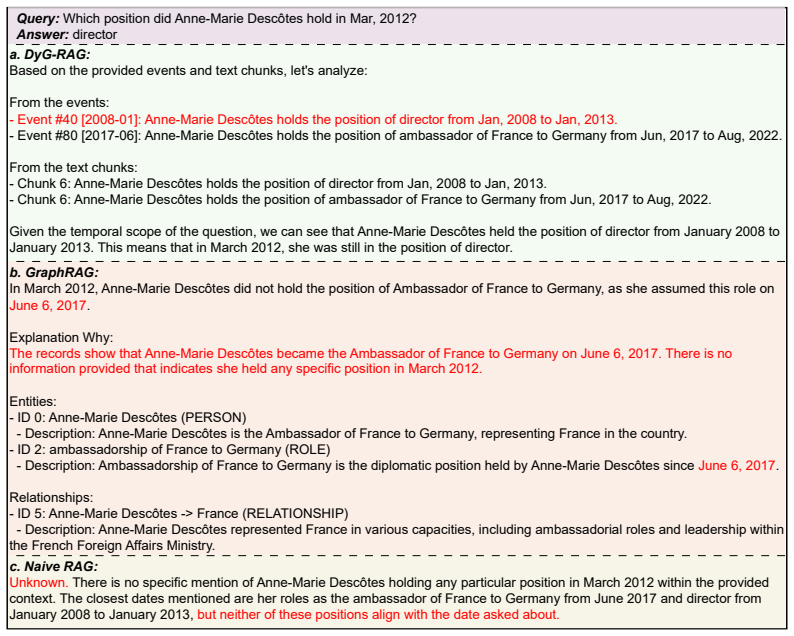
Summary. The manuscript introduces DyG-RAG, a retrieval-augmented generation framework for temporal question answering. It extracts Dynamic Event Units (DEUs), each consisting of a sentence, a normalized timestamp, and provenance identifiers; builds an event graph whose edges connect DEUs that share at least one named entity and occur within a time window; weights edges by entity Jaccard similarity multiplied by an exponential temporal decay; retrieves seed DEUs using concatenated semantic and Fourier time embeddings; performs weighted random walks over the event graph; assembles retrieved events into chronologically sorted timelines; and instructs the LLM with a Time Chain-of-Thought prompt. Experiments on TimeQA, TempReason, and ComplexTR report large absolute accuracy gains over several RAG and GraphRAG baselines, with the largest gains being 18.30, 14.95, and 10.94 percentage points respectively. Ablation and efficiency results are presented in Figures 4 and 5, and case studies are given in Figures 6-8.
Significance. If the reported results withstand scrutiny, DyG-RAG would be a useful empirical contribution to temporal QA and Graph RAG: it addresses a genuine limitation of chunk-based and static knowledge-graph retrieval for time-sensitive queries, and the public release of code and processed datasets supports follow-up work. The combination of event-granularity indexing, time-aware graph traversal, and temporally structured prompting is a reasonable and potentially valuable design. However, the evidence in the manuscript is currently incomplete: the graph-construction hyperparameters are unreported, the ablation and efficiency figures are not decodable in the submitted text, and the controlled comparison that isolates the dynamic graph from the Time-CoT prompting is missing. These issues are load-bearing for the central claim because they determine whether the 10-18 percentage point gains are attributable to the proposed mechanism rather than to prompt engineering or uncontrolled configuration differences.
major comments (5)
- [Section 3.4 (Eqs. 3-6) and Section 3.5] The values of the temporal proximity threshold Delta-t (Eq. 3), the temporal decay alpha (Eq. 5), the per-node degree bound K (Eq. 6), the query-time scaling lambda (Eq. 8), the random-walk length L, the number of walks per seed, and the number of seed nodes are never reported, and no sensitivity analysis is provided. Since the edge set and the transition probabilities are fully determined by these parameters, the reported 10.94-18.30% absolute accuracy gains cannot be independently reproduced or attributed to the dynamic graph mechanism; in particular, if Delta-t is very large the graph degenerates to entity co-occurrence, and if alpha is small temporal proximity has no effect on traversal.
- [Section 4.3-4.4; Figures 4 and 5] The ablation and efficiency figures are not decodable in the submitted text: Figure 4 and Figure 5 render as sequences such as '/uni00000037/uni0000004c/...' rather than as plots, so the claimed ablations (event graph vs. KG-based and chunk-based construction; event timeline and Time-CoT removal) and the efficiency comparison are unsupported in the manuscript. Because these are the only experiments that isolate the contribution of the dynamic graph, the central claim currently rests on unverifiable exhibits.
- [Section 4.3] The KG-based RAG and Chunk-based RAG ablations are described only by a single sentence stating that the LLM is forced to construct a timeline and reason step-by-step; no retrieval details, prompt templates, or numeric results are given, and the corresponding figure is unreadable. This makes it impossible to determine whether the accuracy gain comes from the event-graph retrieval or from the Time-CoT prompt and chronological timeline construction, which could in principle be applied on top of any baseline's retrieved chunks.
- [Section 4.1.2-4.1.3; Table 3] The comparison may not be controlled for prompt and configuration differences. The paper does not state whether every baseline received the same Time-CoT-style temporal prompting and chronological timeline, nor whether each baseline was run with its own recommended settings under the unified Qwen2.5-14B backbone; the very low scores of GraphRAG-G (10.10% and 8.81%) and LightRAG-G (6.66% and 12.46%) suggest that some configurations may be poorly matched, which can inflate the reported relative gains.
- [Section 4.2; Table 3] All accuracy and recall numbers are reported from single runs, without error bars, standard deviations, or statistical significance tests. Given dataset sizes in the thousands, the large point gains may be real, but the absence of variance information leaves the robustness of the 10.94-18.30% improvements unquantified, and the token-level Accuracy and Recall metrics are not formally defined in the text despite being the sole evaluation protocol.
minor comments (4)
- [Table 3] The header contains a typo, 'TempReaon', which should read 'TempReason'; the caption of Figure 8 also spells 'ComplexTR' as 'CompexTR'.
- [Section 3.5] The word 'expilicitly' should be 'explicitly'.
- [Section 3.3] The handling of timeless facts, where 'ti is assigned a static value', is underspecified; the manuscript should state what value is used and how retrieval treats static events relative to timestamped ones.
- [Section 4.2] The evaluation metric is described only by a citation to [35]; please include the exact token-overlap formulas used to compute Accuracy and Recall.
Circularity Check
No significant circularity: the reported gains are measured by independent token-overlap metrics against external benchmarks, and no equation or citation chain reduces the output to the fitted inputs.
full rationale
The paper's derivation chain is empirical rather than formal. DEUs are defined by Eq. (1) as sentence + timestamp + IDs, and the event graph is defined by Eqs. (3)-(6) using entity overlap and a temporal window; the query embedding in Eq. (8) and random walk in Eq. (9) are retrieval mechanisms, not definitions of the answer. None of the reported accuracy/recall numbers is a quantity that appears as an input to these equations, so no self-definitional or fitted-input-called-prediction pattern is present. The paper contains no load-bearing self-citations: references to GraphRAG, LightRAG, HippoRAG, E2GraphRAG, and TimeQA/TempReason/ComplexTR are external prior work, and no uniqueness theorem or ansatz is imported from the present authors' own prior publications. Time-CoT is a prompt template rather than a renamed known result; even if it is only a heuristic, that is a novelty or attribution question, not circularity. The genuine weaknesses are reproducibility and attribution: the values of Delta-t, alpha, K, lambda, walk length, and the temporal reweighting procedure are not reported, and the ablations in Sections 4.3-4.4 do not isolate the graph from the Time-CoT prompt. These are correctness and completeness concerns, and they would matter if the paper overclaimed causal attribution, but they do not make any prediction equivalent to its inputs by construction. The unusual '/uni...' fragments before Figures 4 and 5 contain no load-bearing claim and do not alter this conclusion.
Assumptions & free parameters
free parameters (6)
- alpha (temporal decay) =
not reported
- delta_t (temporal proximity threshold) =
not reported
- K (max neighbors per node) =
not reported
- lambda (temporal scaling in query embedding) =
not reported
- L (random walk length) =
not reported
- number of random walks per seed =
not reported
assumptions (4)
- domain assumption Pretrained encoders (BGE-M3, TinyBERT-L-2-v2) and the NER model (dslim/bert-base-NER) are accurate enough for retrieval and entity extraction.
- domain assumption Persistence assumption: a state (e.g., an office incumbency) persists until an explicit end event.
- domain assumption Temporal parsing resolves relative expressions by reference to the most recent absolute date in the same context.
- ad hoc to paper Entity co-occurrence and temporal proximity (Eq. 3) suffice to encode causal and narrative dependencies.
invented entities (1)
-
Dynamic Event Unit (DEU)
Cite this review
Pith. "Pith review of DyG-RAG: Dynamic Graph Retrieval-Augmented Generation with Event-Centric Reasoning." pith.science (2026). https://pith.science/paper/LCALJJ6G
@misc{pith2026250713396,
  author       = {Pith},
  title        = {Pith review of: DyG-RAG: Dynamic Graph Retrieval-Augmented Generation with Event-Centric Reasoning},
  year         = {2026},
  howpublished = {\url{https://pith.science/paper/LCALJJ6G}},
  note         = {Machine review of arXiv:2507.13396}
}
read the original abstract
Graph Retrieval-Augmented Generation has emerged as a powerful paradigm for grounding large language models with external structured knowledge. However, existing Graph RAG methods struggle with temporal reasoning, due to their inability to model the evolving structure and order of real-world events. In this work, we introduce DyG-RAG, a novel event-centric dynamic graph retrieval-augmented generation framework designed to capture and reason over temporal knowledge embedded in unstructured text. To eliminate temporal ambiguity in traditional retrieval units, DyG-RAG proposes Dynamic Event Units (DEUs) that explicitly encode both semantic content and precise temporal anchors, enabling accurate and interpretable time-aware retrieval. To capture temporal and causal dependencies across events, DyG-RAG constructs an event graph by linking DEUs that share entities and occur close in time, supporting efficient and meaningful multi-hop reasoning. To ensure temporally consistent generation, DyG-RAG introduces an event timeline retrieval pipeline that retrieves event sequences via time-aware traversal, and proposes a Time Chain-of-Thought strategy for temporally grounded answer generation. This unified pipeline enables DyG-RAG to retrieve coherent, temporally ordered event sequences and to answer complex, time-sensitive queries that standard RAG systems cannot resolve. Extensive experiments on temporal QA benchmarks demonstrate that DyG-RAG significantly improves the accuracy and recall of three typical types of temporal reasoning questions, paving the way for more faithful and temporal-aware generation. DyG-RAG is available at https://github.com/RingBDStack/DyG-RAG.
Figures


Figures from the paper (5 more)



Reference graph
Works this paper leans on
-
[1]
A survey on large language model (llm) security and privacy: The good, the bad, and the ugly
Yifan Yao, Jinhao Duan, Kaidi Xu, Yuanfang Cai, Zhibo Sun, and Yue Zhang. A survey on large language model (llm) security and privacy: The good, the bad, and the ugly. High- 15 Query: Which employer did Manuel García Velarde work for 3 years and 11 months after he/she worked for Université libre de Bruxelles? Answer: Autonomous University of Madrid a. DyG...
-
[2]
we interpret this as looking for the relevant period after 1970
Identify the timeline for Université libre de Bruxelles involvement: - Event #22 [1970]: Manuel García Velarde got his second PhD degree at the Université Libre de Bruxelles in 1970. we interpret this as looking for the relevant period after 1970
work page 1970
-
[3]
Calculate the period after Université libre de Bruxelles involvement: - The period of 3 years and 11 months after 1970 would be approximately 1974
work page 1970
-
[4]
Identify Manuel García Velarde’s employment timeline around 1974: - Event #24 [1971]: Manuel García Velarde started to teach and research at the Autonomous University of Madrid in 1971. - Event #29 [1979]: Manuel García Velarde started to work at the National University of Distance Education in 1979. Given these events, there is a gap between 1971 and 197...
work page 1974
-
[5]
Determine the employer around 1974: - From the timeline, the period between 1971 and 1979 is not covered by any specific employer changes except for starting at the Autonomous University of Madrid in 1971 and moving to the National University of Distance Education in 1979. Since there is no specific event mentioning any change in employment between 1971 a...
work page 1974
-
[6]
A survey on rag meeting llms: Towards retrieval-augmented large language models
Wenqi Fan, Yujuan Ding, Liangbo Ning, Shijie Wang, Hengyun Li, Dawei Yin, Tat-Seng Chua, and Qing Li. A survey on rag meeting llms: Towards retrieval-augmented large language models. In Proceedings of the 30th ACM SIGKDD Conference on Knowledge Discovery and Data Mining, pages 6491–6501, 2024
2024
-
[7]
Retrieval-augmented generation for large language models: A survey
Yunfan Gao, Yun Xiong, Xinyu Gao, Kangxiang Jia, Jinliu Pan, Yuxi Bi, Yixin Dai, Jiawei Sun, Haofen Wang, and Haofen Wang. Retrieval-augmented generation for large language models: A survey. arXiv preprint arXiv:2312.10997, 2(1), 2023
arXiv 2023
-
[8]
Graph retrieval-augmented generation: A survey
Boci Peng, Yun Zhu, Yongchao Liu, Xiaohe Bo, Haizhou Shi, Chuntao Hong, Yan Zhang, and Siliang Tang. Graph retrieval-augmented generation: A survey. arXiv preprint arXiv:2408.08921, 2024
arXiv 2024
Show all 39 references
-
[9]
Timeline sum- marization in the era of llms
Daivik Sojitra, Raghav Jain, Sriparna Saha, Adam Jatowt, and Manish Gupta. Timeline sum- marization in the era of llms. In Proceedings of the 47th International ACM SIGIR Conference on Research and Development in Information Retrieval, pages 2657–2661, 2024
2024
-
[10]
Historyquest: Arabic question answering in egyptian history with llm fine-tuning and transformer models
Samaa Maged, Asmaa ElMaghraby, Ali Marzban, Mohamed Essawey, Amira Ahmed, Esraa Negm, and Wael H Gomaa. Historyquest: Arabic question answering in egyptian history with llm fine-tuning and transformer models. In 2024 Intelligent Methods, Systems, and Applica- tions (IMSA), pag...
2024
-
[11]
G-retriever: Retrieval-augmented generation for textual graph un- 16 derstanding and question answering
Xiaoxin He, Yijun Tian, Yifei Sun, Nitesh Chawla, Thomas Laurent, Yann LeCun, Xavier Bresson, and Bryan Hooi. G-retriever: Retrieval-augmented generation for textual graph un- 16 derstanding and question answering. Advances in Neural Information Processing Systems , 37:132876–...
2024
-
[12]
The power of noise: Redefin- ing retrieval for rag systems
Florin Cuconasu, Giovanni Trappolini, Federico Siciliano, Simone Filice, Cesare Campag- nano, Yoelle Maarek, Nicola Tonellotto, and Fabrizio Silvestri. The power of noise: Redefin- ing retrieval for rag systems. In Proceedings of the 47th International ACM SIGIR Conference on ...
2024
-
[13]
The chronicles of rag: The retriever, the chunk and the generator
Paulo Finardi, Leonardo Avila, Rodrigo Castaldoni, Pedro Gengo, Celio Larcher, Marcos Piau, Pablo Costa, and Vinicius Carid ´a. The chronicles of rag: The retriever, the chunk and the generator. arXiv preprint arXiv:2401.07883, 2024
2024 arXiv
-
[14]
Improving the domain adaptation of retrieval augmented generation (rag) models for open domain question answering
Shamane Siriwardhana, Rivindu Weerasekera, Elliott Wen, Tharindu Kaluarachchi, Rajib Rana, and Suranga Nanayakkara. Improving the domain adaptation of retrieval augmented generation (rag) models for open domain question answering. Transactions of the Association for Computatio...
2023
-
[15]
Self-rag: Learn- ing to retrieve, generate, and critique through self-reflection
Akari Asai, Zeqiu Wu, Yizhong Wang, Avirup Sil, and Hannaneh Hajishirzi. Self-rag: Learn- ing to retrieve, generate, and critique through self-reflection. In The Twelfth International Conference on Learning Representations, 2023
2023
-
[16]
Haoyu Han, Harry Shomer, Yu Wang, Yongjia Lei, Kai Guo, Zhigang Hua, Bo Long, Hui Liu, and Jiliang Tang. Rag vs. graphrag: A systematic evaluation and key insights. arXiv preprint arXiv:2502.11371, 2025
2025
-
[17]
From lo- cal to global: A graph rag approach to query-focused summarization
Darren Edge, Ha Trinh, Newman Cheng, Joshua Bradley, Alex Chao, Apurva Mody, Steven Truitt, Dasha Metropolitansky, Robert Osazuwa Ness, and Jonathan Larson. From lo- cal to global: A graph rag approach to query-focused summarization. arXiv preprint arXiv:2404.16130, 2024
2024 arXiv
-
[18]
Lightrag: Simple and fast retrieval-augmented generation
Zirui Guo, Lianghao Xia, Yanhua Yu, Tu Ao, and Chao Huang. Lightrag: Simple and fast retrieval-augmented generation. 2024
2024
-
[19]
Eˆ 2graphrag: Streamlining graph-based rag for high efficiency and effectiveness
Yibo Zhao, Jiapeng Zhu, Ye Guo, Kangkang He, and Xiang Li. Eˆ 2graphrag: Streamlining graph-based rag for high efficiency and effectiveness. arXiv preprint arXiv:2505.24226, 2025
2025 arXiv
-
[20]
Hipporag: Neurobiologically inspired long-term memory for large language models
Bernal Jim ´enez Guti ´errez, Yiheng Shu, Yu Gu, Michihiro Yasunaga, and Yu Su. Hipporag: Neurobiologically inspired long-term memory for large language models. InThe Thirty-eighth Annual Conference on Neural Information Processing Systems, 2024
2024
-
[21]
Hybridrag: Integrating knowledge graphs and vector retrieval augmented generation for efficient information extraction
Bhaskarjit Sarmah, Dhagash Mehta, Benika Hall, Rohan Rao, Sunil Patel, and Stefano Pasquali. Hybridrag: Integrating knowledge graphs and vector retrieval augmented generation for efficient information extraction. In Proceedings of the 5th ACM International Conference on AI in ...
2024
-
[22]
It’s high time: A survey of temporal information retrieval and question answering
Bhawna Piryani, Abdelrahman Abdullah, Jamshid Mozafari, Avishek Anand, and Adam Ja- towt. It’s high time: A survey of temporal information retrieval and question answering. arXiv preprint arXiv:2505.20243, 2025
2025 arXiv
-
[23]
Chain-of-timeline: Enhancing llm zero-shot temporal reasoning with sql-style timeline formalization
Jiaying Wu and Bryan Hooi. Chain-of-timeline: Enhancing llm zero-shot temporal reasoning with sql-style timeline formalization. In Workshop on Reasoning and Planning for Large Language Models
-
[24]
Timer4: Time-aware retrieval-augmented large language models for temporal knowl- edge graph question answering
Xinying Qian, Ying Zhang, Yu Zhao, Baohang Zhou, Xuhui Sui, Li Zhang, and Kehui Song. Timer4: Time-aware retrieval-augmented large language models for temporal knowl- edge graph question answering. In Proceedings of the 2024 Conference on Empirical Methods in Natural Language ...
2024
-
[25]
Back to the future: To- wards explainable temporal reasoning with large language models
Chenhan Yuan, Qianqian Xie, Jimin Huang, and Sophia Ananiadou. Back to the future: To- wards explainable temporal reasoning with large language models. InProceedings of the ACM Web Conference 2024, pages 1963–1974, 2024. 17
2024
-
[26]
Two- stage generative question answering on temporal knowledge graph using large language mod- els
Yifu Gao, Linbo Qiao, Zhigang Kan, Zhihua Wen, Yongquan He, and Dongsheng Li. Two- stage generative question answering on temporal knowledge graph using large language mod- els. arXiv preprint arXiv:2402.16568, 2024
2024 arXiv
-
[27]
Temporal knowledge question answering via abstract reasoning induction
Ziyang Chen, Dongfang Li, Xiang Zhao, Baotian Hu, and Min Zhang. Temporal knowledge question answering via abstract reasoning induction. arXiv preprint arXiv:2311.09149, 2023
2023 arXiv
-
[28]
Retrieval-augmented generation with graphs (graphrag)
Haoyu Han, Yu Wang, Harry Shomer, Kai Guo, Jiayuan Ding, Yongjia Lei, Mahantesh Ha- lappanavar, Ryan A Rossi, Subhabrata Mukherjee, Xianfeng Tang, et al. Retrieval-augmented generation with graphs (graphrag). arXiv preprint arXiv:2501.00309, 2024
2024 arXiv
-
[29]
Chi, Quoc V
Jason Wei, Xuezhi Wang, Dale Schuurmans, Maarten Bosma, Brian Ichter, Fei Xia, Ed H. Chi, Quoc V . Le, and Denny Zhou. Chain-of-thought prompting elicits reasoning in large language models. In Advances in Neural Information Processing Systems , volume 35, pages 24824–24837. Cu...
2022
-
[30]
A dataset for answering time-sensitive questions
Wenhu Chen, Xinyi Wang, and William Yang Wang. A dataset for answering time-sensitive questions. arXiv preprint arXiv:2108.05266, 2021
2021 arXiv
-
[31]
Towards benchmarking and improving the temporal reasoning capability of large language models
Qingyu Tan, Hwee Tou Ng, and Lidong Bing. Towards benchmarking and improving the temporal reasoning capability of large language models. In Proceedings of the 61st Annual Meeting of the Association for Computational Linguistics (Long Papers), pages 14820–14835, 2023
2023
-
[32]
Towards robust temporal reasoning of large language models via a multi-hop qa dataset and pseudo-instruction tuning
Qingyu Tan, Hwee Tou Ng, and Lidong Bing. Towards robust temporal reasoning of large language models via a multi-hop qa dataset and pseudo-instruction tuning. arXiv preprint arXiv:2311.09821, 2023
2023 arXiv
-
[33]
Wikipedia, the Free Encyclopedia
Wikipedia contributors. Wikipedia, the Free Encyclopedia. https://www .wikipedia.org/, 2023. [Online; accessed in 2023]
2023
-
[34]
Retrieval- augmented generation for knowledge-intensive nlp tasks
Patrick Lewis, Ethan Perez, Aleksandra Piktus, Fabio Petroni, Vladimir Karpukhin, Na- man Goyal, Heinrich K ¨uttler, Mike Lewis, Wen-tau Yih, Tim Rockt ¨aschel, et al. Retrieval- augmented generation for knowledge-intensive nlp tasks. Advances in neural information pro- cessin...
2020
-
[35]
Qwen2: The next generation of qwen language models, 2024
An Yang, Baosong Yang, Binyuan Hui, Bo Zheng, Bowen Yu, Chang Zhou, Chengpeng Li, Chengyuan Li, Dayiheng Liu, Fei Huang, Guanting Dong, Haoran Wei, Huan Lin, Jialong Tang, Jialin Wang, Jian Yang, Jianhong Tu, Jianwei Zhang, Jianxin Ma, Jianxin Yang, Jin Xu, Jingren Zhou, Jinze...
2024
-
[36]
Bge-m3: A multilingual, multi-task, multi-vector embedding model, 2024
Jianlv Chen, Shitao Xiao, Peitian Zhang, Kun Luo, Defu Lian, and Zheng Liu. Bge-m3: A multilingual, multi-task, multi-vector embedding model, 2024
2024
-
[37]
Bert: Pre-training of deep bidirectional transformers for language understanding
Jacob Devlin, Ming-Wei Chang, Kenton Lee, and Kristina Toutanova. Bert: Pre-training of deep bidirectional transformers for language understanding. In Proceedings of NAACL, 2019
2019
-
[38]
Tinybert: Distilling bert for natural language understanding
Xiaoqi Jiao, Yichun Yin, Lifeng Shang, Xin Jiang, Xiao Chen, Linlin Li, Fang Wang, and Qun Liu. Tinybert: Distilling bert for natural language understanding. In Findings of the Association for Computational Linguistics: EMNLP 2020 , pages 4163–4174. Association for Computation...
2020
-
[39]
In-depth analysis of graph-based rag in a unified framework, 2025
Yingli Zhou, Yaodong Su, Youran Sun, Shu Wang, Taotao Wang, Runyuan He, Yongwei Zhang, Sicong Liang, Xilin Liu, Yuchi Ma, and Yixiang Fang. In-depth analysis of graph-based rag in a unified framework, 2025. 18
2025
Reviewed August 6, 2026 · model on record in the stance chip above.
Discussion (0). Continue with ORCID to comment.