REVIEW 2 major objections 4 minor 6 cited by
A resource theoretical unification of Mpemba effects: classical and quantum
T0 review · 2 major / 4 minor · reviewed 2026-08-06 · deepseek-v4-flash
Pith's one-line read This paper claims that thermal and symmetry Mpemba effects are two faces of one resource-theoretic mechanism, resting on a relative-entropy splitting identity.
desk verdict A clean unifying decomposition with one honest proof gap in the asymptotic analysis; deserves a serious referee. read the letter →
The pith
A machine-rendered reading of the paper's core claim, the machinery that carries it, and where it could break.
The reading
What carries the argument
The central object is the twirling (symmetrization) map $G[\rho]=\int_G dg\, U_g\,\rho\,U_g^\dagger$, together with the modes of asymmetry, a harmonic-analysis decomposition of the operator algebra into sectors labelled by irreducible representations $\mu$ of the symmetry group. The identity that carries the argument is $S(\rho\|\pi)=S(\rho\|G[\rho])+S(G[\rho]\|\pi)$, valid when $\pi$ is $G$-invariant. It does the work of separating the total resource into a symmetry-breaking contribution and a symmetry-preserving contribution, and the mode decomposition explains why the two contributions relax at different rates: a $G$-covariant map cannot mix modes, so the slowest mode in a nonzero-$\mu$ sector sets the asymmetry decay rate.
What would settle it
Numerically compute $\ln S(\rho(t)\|G[\rho(t)])$ at late times for a model in which the twirled state itself relaxes on a timescale comparable to the slowest symmetry-breaking mode, for instance the Z$_4$ quantum chain of Section III E with the initial state placed entirely on the slowest $\mu\neq 0$ eigenmode. The paper's asymptotic claim predicts slope $2\,\mathrm{Re}(\lambda_{\rm slow})$; if the observed slope differs, the replacement of the fixed steady state $\pi$ by the time-dependent $G[\rho(t)]$ in the Appendix C derivation is invalid.
Extended reading notes
Core claim
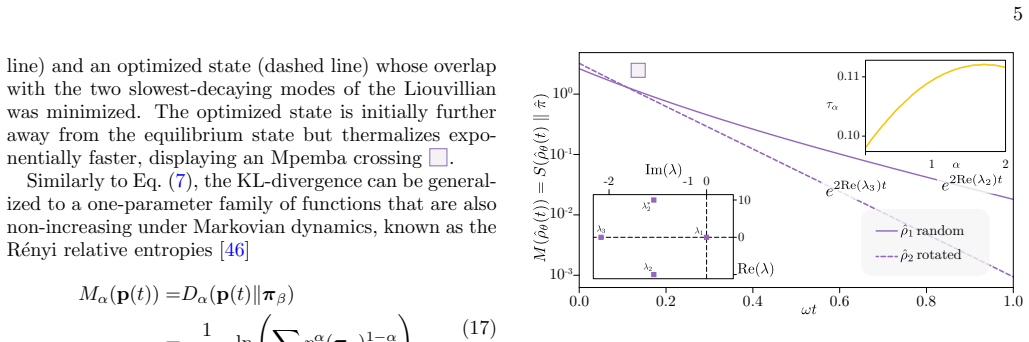
The paper's central claim is that both thermal and symmetry Mpemba effects are governed by the overlap of the initial state with the slowest decaying mode appropriate to the resource being measured. For thermalization this is the slowest Liouvillian eigenmode; for symmetry restoration it is the slowest eigenmode living in a nonzero asymmetry sector, and the modes of asymmetry framework shows that every $G$-covariant map acts independently on those sectors. The load-bearing identity is Eq. (81): $S(\rho\|\pi)=S(\rho\|G[\rho])+S(G[\rho]\|\pi)$ for any $G$-invariant $\pi$. Consequently the relative entropy of athermality equals the relative entropy of asymmetry plus the relative entropy of athermality of the symmetrized state, and the same split applies to non-stationarity when $\pi$ is the nonthermal fixed point. The paper supports the unification with a classical Z$_4$ Markov chain, quantum Z$_4$ Lindblad dynamics, Davies maps, and Markovian and non-Markovian circuits with U(1) and SU(2) symmetries, including the first classical example of a symmetry Mpemba effect.
Load-bearing premise
The whole symmetry-Mpemba prediction rests on an unproved substitution: the asymptotic decay formula derived for a fixed steady state $\pi$ is applied with the time-dependent reference $G[\rho(t)]$, and if that step fails, the slowest-symmetry-mode explanation has no rigorous basis.
Editorial extensions
If this is right
- For a Davies map, the quantum thermal Mpemba effect splits into a classical population part and a quantum coherence part (time-translation asymmetry), and either part can produce a crossing independently.
- A crossing in either component entropy is necessary for a crossing in the total relative entropy; when both components cross, the total is guaranteed to cross.
- Strong symmetry Mpemba effects can be engineered by preparing states with vanishing overlap with the slowest symmetry-restoring mode, as the tilted block-product states do in U(1)-symmetric circuits.
- Because the split holds for any $G$-invariant steady state, the unification also covers non-stationarity with nonthermal fixed points, connecting the framework to entropy production.
- The observed Mpemba phenomenon depends on the chosen resource monotone; the same thermalizing model can show a classical thermal, quantum thermal, or symmetry Mpemba effect under different choices.
Reading between the lines
- The paper proves the additivity identity for the quantum relative entropy; extending the same split to Petz-Rényi $\alpha$-divergences would require a separate argument, so the unification is anchored to the $\alpha=1$ measure.
- Because the mode-sector argument relies only on covariance, the same slowest-sector-mode recipe should predict Mpemba-speedup states for other group symmetries, such as lattice translation symmetry or parity, where the paper notes parity studies have not yet found an unambiguous effect.
- A predictive use the authors leave implicit: given a generator and a symmetry, one could compute sector-resolved spectra and initial mode occupations to screen for fast-equilibrating states before running the full dynamics.
- The classical Z$_4$ example suggests tabletop classical experiments with rotationally symmetric Markov systems could test symmetry Mpemba behavior without quantum hardware.
Editorial analysis
A structured set of objections, weighed in public.
Referee Report
Summary. The paper proposes a resource-theoretic unification of thermal and symmetry Mpemba effects. After reviewing resource theories, it derives the central identity Eq. (81): for any G-invariant state pi, S(rho||pi) = S(rho||G[rho]) + S(G[rho]||pi), splitting the relative entropy of athermality (or non-stationarity) into a symmetry-breaking part, the relative entropy of asymmetry, and a symmetry-respecting part. The paper then uses the modes-of-asymmetry formalism to argue that thermal Mpemba is governed by the slowest overall Liouvillian eigenmode while symmetry Mpemba is governed by the slowest mode in a nonzero symmetry sector. This is supported by several examples: a classical Z4 Markov chain, a Z4 Lindblad model, Davies-map thermalization with time-translation symmetry, Markovian and non-Markovian random circuits with U(1) and SU(2) symmetries, and an ETH-based unitary example. The paper also emphasizes that the presence and crossing time of the effect depend on the chosen monotone. The central identity is cleanly proved, but the theoretical derivation of the asymptotic decay of S(rho(t)||G[rho(t)]) is not fully established, and one spectral assumption in the random-circuit example is empirical rather than proven.
Significance. If the asymptotic step is made rigorous, the paper provides a genuinely unifying principle: Mpemba effects are crossings of resource monotones, and the relative entropy decomposes exactly into an asymmetry part and a symmetry-respecting athermality part. Equation (81) is a valuable parameter-free identity with broad applicability, and the use of modes of asymmetry to identify symmetry Mpemba with overlap with the slowest symmetry-restoring mode is a compelling and testable framework. The examples are consistent with the formalism, including what appears to be the first classical symmetry Mpemba effect, and the paper is careful to illustrate monotone dependence. However, the advertised governing principle currently rests on an unproved replacement of the fixed reference state by a time-dependent one in Appendix C, and on an observed rather than proven decay-rate ordering in random U(1) circuits. Both points are load-bearing for the central claim, so the paper is not yet fully self-contained, though the issues appear repairable.
major comments (2)
- [Appendix C, after Eq. (16) and Eq. (C14); Section IV] The asymptotic analysis of the asymmetry monotone is not proved. Appendix C derives the decay of D(p(t)||pi) and S(rho(t)||pi) for a fixed, full-rank reference state pi, and then states, after Eq. (16), that 'Replacing pi with G[p(t)] allows to extend this to the asymptotic behaviour of the relative entropy of asymmetry.' The quantum part similarly says, after Eq. (C14), that the proof extends 'by replacing pi with G[rho(t)].' This replacement is exactly the load-bearing step for the claim in Section IV that symmetry Mpemba is governed by the slowest symmetry-restoring mode. Since G[rho(t)] is itself relaxing and includes the full mu=0 sector, one must prove that the linear term in delta = rho - G[rho] vanishes (for example by G-invariance of ln G[rho]) and that the time dependence of (G[rho(t)])^{-1} changes only the prefactor and not the exponent 2 Re(lambda_j) for the slowest mu != 0 mode with nonzero overlap. Neither of these points is shown. Please provide a proof or state the required assumptions explicitly; without this, the central theoretical conclusion is an assertion rather than a theorem.
- [Section III G 1 and Fig. 9] The strong symmetry Mpemba effect in random U(1) circuits relies on the spectral ordering Re(lambda_mu) < Re(lambda_mu') for |mu| > |mu'|, which the text introduces as a numerical observation with heuristic mechanisms rather than as a proven statement. Because this ordering is a nontrivial property of the random circuit ensemble and is used to justify the claim that avoiding low-|mu| sectors produces a strong Mpemba effect, the conclusion should be labeled as conditional on the observed ordering, or the ordering should be supported by an analytic argument or by a precise statistical statement with a quantified failure probability over the circuit ensemble. The other examples in the paper do not depend on this assumption.
minor comments (4)
- [Appendix C 2, paragraph after Eq. (C9)] In the paragraph after Eq. (C9), the text refers to the slowest decaying eigenmode as 'j = 1' for athermality, but with the ordering 0 = Re(lambda_1) > Re(lambda_2) the slowest decaying mode is j = 2; lambda_1 is the steady state. Please correct this index.
- [Section V] The conclusion contains a typo: 'thte restoration' should read 'the restoration.'
- [Section III G 1, Eq. (76)] In the definition k(mu) = arg max_{k: ell_k in H_s^(mu)} s Re(lambda_k), the stray 's' before Re appears to be a typographical artifact and should be removed.
- [Fig. 9 caption and surrounding text] The text says the inset shows a 'clear, monotonic decrease' of Re(lambda_mu) with |mu|, but the panel displays the mean and spread over circuit realizations; please state explicitly that the monotonicity holds on average rather than for every realization, or quantify the probability of exceptions.
Circularity Check
No significant circularity: Eq. (81) is derived in-text from twirling properties, and the numerical demonstrations are self-contained; the Appendix C replacement step is an unproven extension, not a circular reduction.
full rationale
The paper's central identity Eq. (81) is derived directly from G-invariance of pi, idempotence and self-adjointness of the twirl G, and cyclicity of the trace; it is not assumed from the Mpemba conclusion. The resource-theoretic language (free states, monotones, and defining Mpemba as a monotone crossing) is definitional framing, but the specific claims about decay rates are supported by spectral expansions of the Liouvillian (Eqs. (15)-(16), (22)-(23)) and by numerical simulations. Citations to Marvian-Spekkens for modes of asymmetry and the relative entropy of asymmetry are to independent, published formalism, not to a result that presupposes the Mpemba effect. The only weak point is Appendix C, where the asymptotic formula for S(rho(t)||pi) is extended to S(rho(t)||G[rho(t)]) by the sentence 'Replacing pi with G[p(t)] allows to extend this...' without proof; since G[rho(t)] is time-dependent, this is a gap in the derivation. However, a proof gap or unjustified approximation is not circularity under the stated criteria: no equation is reduced to its own input and no fitted parameter is renamed as a prediction. Therefore no circular step is identified.
Assumptions & free parameters
assumptions (5)
- standard math Haar twirling G is a self-adjoint, trace-preserving projection onto G-invariant operators for compact groups.
- domain assumption The Lindblad generators in the examples are diagonalizable with a non-degenerate slowest eigenmode.
- domain assumption States have sufficient support (π full rank, compatible supports) for relative entropies and the quadratic late-time expansion to be finite.
- ad hoc to paper In random U(1) circuits, sectors with larger |µ| decay faster, so Re λ_µ < Re λ_µ' for |µ| > |µ'|.
- ad hoc to paper The time-dependent twirled state G[ρ(t)] can be replaced by the fixed point π when evaluating the asymptotic decay of S(ρ(t)||G[ρ(t)]).
invented entities (1)
-
Resource theory of symmetry-respecting athermality
Cite this review
Pith. "Pith review of A resource theoretical unification of Mpemba effects: classical and quantum." pith.science (2026). https://pith.science/paper/ITJ5QHPD
@misc{pith2026250716976,
  author       = {Pith},
  title        = {Pith review of: A resource theoretical unification of Mpemba effects: classical and quantum},
  year         = {2026},
  howpublished = {\url{https://pith.science/paper/ITJ5QHPD}},
  note         = {Machine review of arXiv:2507.16976}
}
read the original abstract
The Mpemba effect originally referred to the observation that, under certain thermalizing dynamics, initially hotter samples can cool faster than colder ones. This effect has since been generalized to other anomalous relaxation behaviors even beyond classical domains, such as symmetry restoration in quantum systems. This work demonstrates that resource theories, widely employed in information theory, provide a unified organizing principle to frame Mpemba physics. We show how the conventional thermal Mpemba effect arises naturally from the resource theory of athermality, while its symmetry-restoring counterpart is fully captured by the resource theories of asymmetry. Leveraging the framework of modes of asymmetry, we demonstrate that the Mpemba effect due to symmetry restoration is governed by the initial overlap with the slowest symmetry-restoring mode -- mirroring the role of the slowest Liouvillian eigenmode in thermal Mpemba dynamics. Through this resource-theoretical formalism, we uncover the connection between these seemingly disparate effects and show that the dynamics of thermalization naturally splits into a symmetry-respecting and a symmetry-breaking term.
Figures


Figures from the paper (8 more)


Forward citations
Cited by 6 Pith papers
-
Strong Quantum Mpemba Effect from Exact Slow-Mode Selection in Constrained Rydberg Chains
Translation-invariant states with Tr(Hρ0)=0 remove the exact H slow mode of the dephased Liouvillian and thus relax asymptotically faster than thermal states, yielding a strong quantum Mpemba effect in constrained Ryd...
-
Exponentially accelerated relaxation and quantum Mpemba effect in open quantum systems
Permuting a state's eigenvalues and rotating to the energy basis suppresses the slowest decay mode of a Davies-map Liouvillian and maximizes its distance from equilibrium, producing a genuine quantum Mpemba effect.
-
Entanglement Asymmetry in Random Quantum Automata
In random quantum automaton ensembles, the subsystem symmetrization scale depends on the initial state's participation entropy, and the onset of U(1) entanglement asymmetry coincides with the onset of subsystem coherence.
-
Accelerating qubit reset through the Mpemba effect
A single entangling gate that turns slow-decaying local qubit coherences into fast-decaying two-qubit coherences shortens passive reset by up to T2/T1 (about 30-50% time reduction) in the T2>T1 regime.
-
Quantum Mpemba Effect in Dissipative Spin Chains at Criticality
Under dephasing, a zero-temperature initial state relaxes faster than all finite-temperature states precisely at the quantum critical point of the XXZ and J1-J2 spin chains, a strong quantum Mpemba effect.
-
Quantum Mpemba Effect Induced by Non-Markovian Exceptional Points
Claims a non-Markovian Liouvillian exceptional point at γ=4α accelerates relaxation and induces a quantum Mpemba effect, but the faster trajectory is assigned a different Liouvillian than the slower one.
Reference graph
Works this paper leans on
-
[1]
conservation of total ˆSz) can give rise to a Mpemba effect in random circuits
Symmetry: U(1) We now explore how U(1) symmetry (i.e. conservation of total ˆSz) can give rise to a Mpemba effect in random circuits. In particular, we show how it is possible to achieve a strong Mpemba effect. Each two-qubit gate [86] ˆun,n+1 = e−iˆhn,n+1 e−ihn ˆsz n e−ih′ n ˆsz n+1 , (70) 13 Input state Evolution operator Environment System (b1) Markovi...
-
[2]
To impose full SU(2) covariance we switch off all local Z- rotations and Peierls phases ( hn = h′ n = ϕn = 0) and sample only the isotropic exchange coupling J = Jz
Symmetry: SU(2) We next turn to a non-abelian example, where the con- served quantity is the total angular momentum ˆS2. To impose full SU(2) covariance we switch off all local Z- rotations and Peierls phases ( hn = h′ n = ϕn = 0) and sample only the isotropic exchange coupling J = Jz. We break the symmetry on the system by preparing the 15 state ˆρθ = |φ...
2004
-
[3]
E B Mpemba and D G Osborne, “Cool?” Phys. Educ. 4, 172 (1969)
1969
-
[4]
Experimental verifications of mpemba-like behav- iors of clathrate hydrates,
Yun-Ho Ahn, Hyery Kang, Dong-Yeun Koh, and Huen Lee, “Experimental verifications of mpemba-like behav- iors of clathrate hydrates,” Korean J. Chem. Eng. 33, 1903–1907 (2016)
2016
-
[5]
Conformation directed mpemba effect on polylac- tide crystallization,
Cunliang Hu, Jingqing Li, Shaoyong Huang, Hongfei Li, Chuanfu Luo, Jizhong Chen, Shichun Jiang, and Lijia An, “Conformation directed mpemba effect on polylac- tide crystallization,” Cryst. Growth Des. 18, 5757–5762 (2018)
2018
-
[6]
Overtaking while approaching equilibrium,
P. Chaddah, S. Dash, Kranti Kumar, and A. Banerjee, “Overtaking while approaching equilibrium,” (2010), arXiv:1011.3598 [cond-mat.stat-mech]
arXiv 2010
-
[7]
Nonequilibrium thermody- namics of the markovian mpemba effect and its inverse,
Zhiyue Lu and Oren Raz, “Nonequilibrium thermody- namics of the markovian mpemba effect and its inverse,” Proc. Natl. Acad. Sci. U. S. A. 114, 5083–5088 (2017)
2017
-
[8]
Mpemba index and anomalous relaxation,
Israel Klich, Oren Raz, Ori Hirschberg, and Marija Vucelja, “Mpemba index and anomalous relaxation,” Phys. Rev. X 9, 021060 (2019)
2019
Show all 114 references
-
[9]
Precooling strategy allows expo- nentially faster heating,
A. Gal and O. Raz, “Precooling strategy allows expo- nentially faster heating,” Phys. Rev. Lett. 124, 060602 (2020)
2020
-
[10]
Relax- ation shortcuts through boundary coupling,
Gianluca Teza, Ran Yaacoby, and Oren Raz, “Relax- ation shortcuts through boundary coupling,” Phys. Rev. Lett. 131, 017101 (2023)
2023
-
[11]
Speedups in nonequi- librium thermal relaxation: Mpemba and related ef- fects,
Gianluca Teza, John Bechhoefer, Antonio Lasanta, Oren Raz, and Marija Vucelja, “Speedups in nonequi- librium thermal relaxation: Mpemba and related ef- fects,” (2025), arXiv:2502.01758
2025
-
[12]
Exponentially faster cooling in a colloidal system,
Avinash Kumar and John Bechhoefer, “Exponentially faster cooling in a colloidal system,” Nature 584, 64–68 (2020)
2020
-
[13]
Anomalous heating in a colloidal system,
Avinash Kumar, Rapha¨ el Ch´ etrite, and John Bechhoe- fer, “Anomalous heating in a colloidal system,” Proc. Natl. Acad. Sci. U. S. A. 119, e2118484119 (2022)
2022
-
[14]
Double mpemba effect in the cooling of trapped colloids,
Isha Malhotra and Hartmut L¨ owen, “Double mpemba effect in the cooling of trapped colloids,” (2024), arXiv:2406.19098 [cond-mat.soft]
2024 arXiv
-
[15]
Lindblad dissipa- tive dynamics in the presence of phase coexistence,
Andrea Nava and Michele Fabrizio, “Lindblad dissipa- tive dynamics in the presence of phase coexistence,” Phys. Rev. B 100, 125102 (2019)
2019
-
[16]
Exponentially accelerated approach to stationarity in markovian open quantum systems through the mpemba effect,
Federico Carollo, Antonio Lasanta, and Igor Lesanovsky, “Exponentially accelerated approach to stationarity in markovian open quantum systems through the mpemba effect,” Phys. Rev. Lett. 127, 060401 (2021)
2021
-
[17]
Accelerating re- laxation in markovian open quantum systems through quantum reset processes,
Ruicheng Bao and Zhonghuai Hou, “Accelerating re- laxation in markovian open quantum systems through quantum reset processes,” (2022), arXiv:2212.11170 [quant-ph]
2022
-
[18]
Accelerating the approach of dissi- pative quantum spin systems towards stationarity through global spin rotations,
Simon Kochsiek, Federico Carollo, and Igor Lesanovsky, “Accelerating the approach of dissi- pative quantum spin systems towards stationarity through global spin rotations,” Phys. Rev. A 106, 012207 (2022)
2022
-
[19]
Hyperacceleration of quantum thermalization dy- namics by bypassing long-lived coherences: An analyti- cal treatment,
Felix Ivander, Nicholas Anto-Sztrikacs, and Dvira Se- gal, “Hyperacceleration of quantum thermalization dy- namics by bypassing long-lived coherences: An analyti- cal treatment,” Phys. Rev. E 108, 014130 (2023)
2023
-
[20]
Mpemba effects in nonequilibrium open quantum systems,
Xuanhua Wang and Jin Wang, “Mpemba effects in nonequilibrium open quantum systems,” Phys. Rev. Res. 6, 033330 (2024)
2024
-
[21]
Inverse mpemba effect demonstrated on a single trapped ion qubit,
Shahaf Aharony Shapira, Yotam Shapira, Jovan Markov, Gianluca Teza, Nitzan Akerman, Oren Raz, and Roee Ozeri, “Inverse mpemba effect demonstrated on a single trapped ion qubit,” Phys. Rev. Lett. 133, 010403 (2024)
2024
-
[22]
Thermodynamics of the quantum mpemba effect,
Mattia Moroder, Ois ´ ın Culhane, Krissia Zawadzki, and John Goold, “Thermodynamics of the quantum mpemba effect,” Phys. Rev. Lett. 133, 140404 (2024)
2024
-
[23]
Non-markovian quantum mpemba effect,
David J. Strachan, Archak Purkayastha, and Stephen R. Clark, “Non-markovian quantum mpemba effect,” Phys. Rev. Lett. 134, 220403 (2025)
2025
-
[24]
Anomalous discharging of quantum batteries: The ergotropic mpemba effect,
Ivan Medina, Ois ´ ın Culhane, Felix C. Binder, Gabriel T. Landi, and John Goold, “Anomalous discharging of quantum batteries: The ergotropic mpemba effect,” Phys. Rev. Lett. 134, 220402 (2025)
2025
-
[25]
Expedited thermalization dynamics in incommensu- rate systems,
Mingdi Xu, Zijun Wei, Xiang-Ping Jiang, and Lei Pan, “Expedited thermalization dynamics in incommensu- rate systems,” (2025), arXiv:2505.03645 [quant-ph]
2025
-
[26]
Fast and direct preparation of a genuine lat- tice bec via the quantum mpemba effect,
Philipp Westhoff, Sebastian Paeckel, and Mattia Mo- roder, “Fast and direct preparation of a genuine lat- tice bec via the quantum mpemba effect,” (2025), arXiv:2504.05549 [cond-mat.quant-gas]
2025
-
[27]
In the open-dynamics case He describes an external bath; in the closed-dynamics case He is the complementary sub- 18 system within an overall isolated H
Throughout this paper we consider dynamics on a com- posite Hilbert space H = Hs ⊗ He, where Hs (system) and He (environment) are always distinguished. In the open-dynamics case He describes an external bath; in the closed-dynamics case He is the complementary sub- 18 system w...
-
[28]
Entanglement asymmetry as a probe of sym- metry breaking,
Filiberto Ares, Sara Murciano, and Pasquale Cal- abrese, “Entanglement asymmetry as a probe of sym- metry breaking,” Nat. Commun. 14, 2036 (2023)
2023
-
[29]
The quantum mpemba effects,
Filiberto Ares, Pasquale Calabrese, and Sara Mur- ciano, “The quantum mpemba effects,” Nat. Rev. Phys. (2025), 10.1038/s42254-025-00838-0
2025 doi
-
[30]
A mathematical theory of resources,
Bob Coecke, Tobias Fritz, and Robert W. Spekkens, “A mathematical theory of resources,” Inf. Comput. 250, 59–86 (2016)
2016
-
[31]
Quantum resource theories,
Eric Chitambar and Gilad Gour, “Quantum resource theories,” Rev. Mod. Phys. 91, 025001 (2019)
2019
-
[32]
Modes of asymmetry: The application of harmonic analysis to symmetric quantum dynamics and quantum reference frames,
Iman Marvian and Robert W. Spekkens, “Modes of asymmetry: The application of harmonic analysis to symmetric quantum dynamics and quantum reference frames,” Phys. Rev. A 90, 062110 (2014)
2014
-
[33]
The role of quantum informa- tion in thermodynamics—a topical review,
John Goold, Marcus Huber, Arnau Riera, L ´ ıdia del Rio, and Paul Skrzypczyk, “The role of quantum informa- tion in thermodynamics—a topical review,” J. Phys. A: Math. Theor. 49, 143001 (2016)
2016
-
[34]
We indicate by S(Hs) the set of density matrices on Hs
-
[35]
Quantum en- tanglement,
Ryszard Horodecki, Pawe l Horodecki, Micha l Horodecki, and Karol Horodecki, “Quantum en- tanglement,” Rev. Mod. Phys. 81, 865–942 (2009)
2009
-
[36]
Theory of fault-tolerant quantum computation,
Daniel Gottesman, “Theory of fault-tolerant quantum computation,” Phys. Rev. A 57, 127–137 (1998)
1998
-
[37]
On the quantum r´ enyi relative entropies and related capacity formulas,
Mil´ an Mosonyi and Fumio Hiai, “On the quantum r´ enyi relative entropies and related capacity formulas,” IEEE Trans. Inf. Theory 57, 2474–2487 (2011)
2011
-
[38]
Free energy and the relative en- tropy,
Matthew J Donald, “Free energy and the relative en- tropy,” J. Stat. Phys. 49, 81–87 (1987)
1987
-
[39]
Resource theory of quantum states out of thermal equilibrium,
Fernando G. S. L. Brand˜ ao, Micha l Horodecki, Jonathan Oppenheim, Joseph M. Renes, and Robert W. Spekkens, “Resource theory of quantum states out of thermal equilibrium,” Phys. Rev. Lett. 111, 250404 (2013)
2013
-
[40]
Description of quantum coherence in thermodynamic processes requires constraints beyond free energy,
Matteo Lostaglio, David Jennings, and Terry Rudolph, “Description of quantum coherence in thermodynamic processes requires constraints beyond free energy,” Nat. Comm. 6, 6383 (2015)
2015
-
[41]
Entropy production as correla- tion between system and reservoir,
Massimiliano Esposito, Katja Lindenberg, and Chris- tian Van den Broeck, “Entropy production as correla- tion between system and reservoir,” New J. Phys. 12, 013013 (2010)
2010
-
[42]
Stochastic thermodynamics, fluctuation theorems and molecular machines,
Udo Seifert, “Stochastic thermodynamics, fluctuation theorems and molecular machines,” Rep. Prog. Phys. 75, 126001 (2012)
2012
-
[43]
An introductory review of the re- source theory approach to thermodynamics,
Matteo Lostaglio, “An introductory review of the re- source theory approach to thermodynamics,” Rep. Prog. Phys. 82, 114001 (2019)
2019
-
[44]
David J. C. MacKay, Information Theory, Inference & Learning Algorithms (Cambridge University Press, USA, 2002)
2002
-
[45]
Re- source theory of quantum thermodynamics: Thermal operations and second laws,
Nelly Huei Ying Ng and Mischa Prebin Woods, “Re- source theory of quantum thermodynamics: Thermal operations and second laws,” in Thermodynamics in the Quantum Regime: Fundamental Aspects and New Directions, edited by Felix Binder, Luis A. Correa, Christian Gogolin, Janet Ande...
2018
-
[46]
Thermomajoriza- tion mpemba effect,
Tan Van Vu and Hisao Hayakawa, “Thermomajoriza- tion mpemba effect,” Phys. Rev. Lett. 134, 107101 (2025)
2025
-
[47]
Mpemba effects in open nonequilibrium quantum systems,
Andrea Nava and Reinhold Egger, “Mpemba effects in open nonequilibrium quantum systems,” Phys. Rev. Lett. 133, 136302 (2024)
2024
-
[48]
Marco Tomamichel, Quantum Information Processing with Finite Resources(Springer International Publish- ing, 2016)
2016
-
[49]
Monotone metrics on matrix spaces,
D´ enes Petz, “Monotone metrics on matrix spaces,” Lin. Alg. Appl. 244, 81–96 (1996)
1996
-
[50]
Symmetries and monotones in Markovian quantum dynamics,
Georgios Styliaris and Paolo Zanardi, “Symmetries and monotones in Markovian quantum dynamics,” Quan- tum 4, 261 (2020)
2020
-
[51]
Quantum fisher information and its dynamical nature,
Matteo Scandi, Paolo Abiuso, Jacopo Surace, and Dario De Santis, “Quantum fisher information and its dynamical nature,” Rep. Prog. Phys. 88, 076001 (2025)
2025
-
[52]
Extending noether’s theorem by quantifying the asymmetry of quantum states,
Iman Marvian and Robert W Spekkens, “Extending noether’s theorem by quantifying the asymmetry of quantum states,” Nat. Comm. 5, 3821 (2014)
2014
-
[53]
Generators of dynamical semigroups,
E.B. Davies, “Generators of dynamical semigroups,” J. Funct. Anal. 34, 421–432 (1979)
1979
-
[54]
Elementary Thermal Operations,
Matteo Lostaglio, ´Alvaro M. Alhambra, and Christo- pher Perry, “Elementary Thermal Operations,” Quan- tum 2, 52 (2018)
2018
-
[55]
On the detailed balance condition for non-hamiltonian systems,
Robert Alicki, “On the detailed balance condition for non-hamiltonian systems,” Reports on Mathematical Physics 10, 249–258 (1976)
1976
-
[56]
Intrin- sic quantum mpemba effect in markovian systems and quantum circuits,
Dongheng Qian, Huan Wang, and Jing Wang, “Intrin- sic quantum mpemba effect in markovian systems and quantum circuits,” (2024)
2024
-
[57]
Mi- croscopic origin of the quantum mpemba effect in inte- grable systems,
Colin Rylands, Katja Klobas, Filiberto Ares, Pasquale Calabrese, Sara Murciano, and Bruno Bertini, “Mi- croscopic origin of the quantum mpemba effect in inte- grable systems,” Phys. Rev. Lett. 133, 010401 (2024)
2024
-
[58]
Entanglement asymmetry and quantum mpemba effect in the xy spin chain,
Sara Murciano, Filiberto Ares, Israel Klich, and Pasquale Calabrese, “Entanglement asymmetry and quantum mpemba effect in the xy spin chain,” J. Stat. Mech. Theor. Exp. 2024, 013103 (2024)
2024
-
[59]
Measurement-induced symmetry restoration and quantum mpemba effect,
Giuseppe Di Giulio, Xhek Turkeshi, and Sara Mur- ciano, “Measurement-induced symmetry restoration and quantum mpemba effect,” Entropy 27, 407 (2025)
2025
-
[60]
Entanglement asymmetry and quantum mpemba effect in two-dimensional free-fermion sys- tems,
Shion Yamashika, Filiberto Ares, and Pasquale Calabrese, “Entanglement asymmetry and quantum mpemba effect in two-dimensional free-fermion sys- tems,” Phys. Rev. B 110, 085126 (2024)
2024
-
[61]
Quantum mpemba effect in random circuits,
Xhek Turkeshi, Pasquale Calabrese, and Andrea De Luca, “Quantum mpemba effect in random circuits,” Phys. Rev. Lett. (2025), 10.1103/5d6p-8d1b
2025 doi
-
[62]
Symmetry restoration and quantum mpemba effect in symmetric random circuits,
Shuo Liu, Hao-Kai Zhang, Shuai Yin, and Shi-Xin Zhang, “Symmetry restoration and quantum mpemba effect in symmetric random circuits,” Phys. Rev. Lett. 133, 140405 (2024)
2024
-
[63]
Entanglement asymmetry dynamics in random quantum circuits,
Filiberto Ares, Sara Murciano, Pasquale Calabrese, and Lorenzo Piroli, “Entanglement asymmetry dynamics in random quantum circuits,” (2025), arXiv:2501.12459 [cond-mat.stat-mech]
2025 arXiv
-
[64]
Observing the quantum mpemba effect in quantum simulations,
Lata Kh. Joshi, Johannes Franke, Aniket Rath, Filib- erto Ares, Sara Murciano, Florian Kranzl, Rainer Blatt, Peter Zoller, Beno ˆ ıt Vermersch, Pasquale Calabrese, Christian F. Roos, and Manoj K. Joshi, “Observing the quantum mpemba effect in quantum simulations,” Phys. Rev. L...
2024
-
[65]
Noether’s first theorem originally applied to continu- ous (Lie) groups of differentiable symmetries, but its principles have since been extended to include discrete symmetries such as parity or time reversal
-
[66]
Schwarzbach, The Noether Theorems: Invariance and Conservation Laws in the Twentieth Century(Springer New York, 2011)
Yvette Kosmann-Schwarzbach and Bertram E. Schwarzbach, The Noether Theorems: Invariance and Conservation Laws in the Twentieth Century(Springer New York, 2011)
2011
-
[67]
Invariante variationsprobleme,
E. Noether, “Invariante variationsprobleme,” Nachrichten von der Gesellschaft der Wissenschaften zu G¨ ottingen, Mathematisch-Physikalische Klasse 1918, 235–257 (1918)
1918
-
[68]
Symmetries and conserved quantities in lindblad master equations,
Victor V. Albert and Liang Jiang, “Symmetries and conserved quantities in lindblad master equations,” Phys. Rev. A 89, 022118 (2014)
2014
-
[69]
Physically, the more relevant property is that the ra- tios of Bohr frequencies Ei − Ej are rational numbers, in which case the corresponding unitary group forms a projective representation of U(1)
-
[70]
Translation symmetry restoration under random uni- tary dynamics,
Katja Klobas, Colin Rylands, and Bruno Bertini, “Translation symmetry restoration under random uni- tary dynamics,” Phys. Rev. B 111, L140304 (2025)
2025
-
[71]
Non-equilibrium entanglement asymmetry for discrete groups: the example of the xy spin chain,
Florent Ferro, Filiberto Ares, and Pasquale Calabrese, “Non-equilibrium entanglement asymmetry for discrete groups: the example of the xy spin chain,” J. Stat. Mech. Theor. Exp. 2024, 023101 (2024)
2024
-
[72]
A note on symmetry reductions of the lindblad equation: transport in con- strained open spin chains,
Berislav Buˇ ca and Tomaˇ z Prosen, “A note on symmetry reductions of the lindblad equation: transport in con- strained open spin chains,” New J. Phys. 14, 073007 (2012)
2012
-
[73]
Optimal cloning of pure states, testing single clones,
M. Keyl and R. F. Werner, “Optimal cloning of pure states, testing single clones,” Jour- nal of Mathematical Physics 40, 3283–3299 (1999), https://pubs.aip.org/aip/jmp/article- pdf/40/7/3283/19017106/3283 1 online.pdf
1999
-
[74]
Marvian, Symmetry, Asymme- try and Quantum Information, PhD the- sis, Ph.D
Iman. Marvian, Symmetry, Asymme- try and Quantum Information, PhD the- sis, Ph.D. thesis, University of Waterloo, https://uwspace.uwaterloo.ca/handle/10012/7088 (2012)
2012
-
[75]
This is sometimes known as covariant Stinespring dila- tion theorem
-
[76]
A broad class of maps that are guaranteed to restore a symmetry consists of quantum Markov processes with a fixed point, as shown in Ref. [93]. However, non- Markovian examples also exist, such as spin star sys- tems [94]
-
[77]
How to quan- tify coherence: Distinguishing speakable and unspeak- able notions,
Iman Marvian and Robert W. Spekkens, “How to quan- tify coherence: Distinguishing speakable and unspeak- able notions,” Phys. Rev. A 94, 052324 (2016)
2016
-
[78]
(24)) must hold for each Kraus element individually
For channels with multiple Kraus operators, the require- ment of G-invariance (Eq. (24)) must hold for each Kraus element individually. Equivalently, one can de- mand that the Lindblad generator be unchanged under independent left- and right-unitary twists, U (L) g L U(L)† g =...
-
[79]
Quantum thermodynamics with missing reference frames: Decompositions of free energy into non-increasing components,
Dominik Janzing, “Quantum thermodynamics with missing reference frames: Decompositions of free energy into non-increasing components,” Journal of Statistical Physics 125, 761–776 (2006)
2006
-
[80]
Reference frames, superselection rules, and quantum information,
Stephen D. Bartlett, Terry Rudolph, and Robert W. Spekkens, “Reference frames, superselection rules, and quantum information,” Rev. Mod. Phys. 79, 555–609 (2007)
2007
-
[81]
The resource the- ory of quantum reference frames: manipulations and monotones,
Gilad Gour and Robert W Spekkens, “The resource the- ory of quantum reference frames: manipulations and monotones,” New Journal of Physics 10, 033023 (2008)
2008
-
[82]
The theory of manipulations of pure state asymmetry: I. basic tools, equivalence classes and single copy transformations,
Iman Marvian and Robert W Spekkens, “The theory of manipulations of pure state asymmetry: I. basic tools, equivalence classes and single copy transformations,” New J. Phys. 15, 033001 (2013)
2013
-
[83]
Measuring the quality of a quantum reference frame: The relative entropy of frameness,
Gilad Gour, Iman Marvian, and Robert W. Spekkens, “Measuring the quality of a quantum reference frame: The relative entropy of frameness,” Phys. Rev. A 80, 012307 (2009)
2009
-
[84]
Tradeoff between extractable mechanical work, accessible entanglement, and ability to act as a ref- erence system, under arbitrary superselection rules,
J. A. Vaccaro, F. Anselmi, H. M. Wiseman, and K. Ja- cobs, “Tradeoff between extractable mechanical work, accessible entanglement, and ability to act as a ref- erence system, under arbitrary superselection rules,” Phys. Rev. A 77, 032114 (2008)
2008
-
[85]
In the case of equal real parts, modes are further ordered by increasing µ, and then by decreasing imaginary part
-
[86]
Restrictions on realizable unitary op- erations imposed by symmetry and locality,
Iman Marvian, “Restrictions on realizable unitary op- erations imposed by symmetry and locality,” Nature Physics 18, 283–289 (2022)
2022
-
[87]
Theory of quantum circuits with abelian symmetries,
Iman Marvian, “Theory of quantum circuits with abelian symmetries,” Phys. Rev. Res. 6, 043292 (2024)
2024
-
[88]
Anomalous transport in u(1)-symmetric quantum circuits,
Alessandro Summer, Alex Nico-Katz, Shane Doo- ley, and John Goold, “Anomalous transport in u(1)-symmetric quantum circuits,” (2024), arXiv:2411.14357
2024 arXiv
-
[89]
Ergodic and mixing quantum channels in finite dimensions,
D Burgarth, G Chiribella, V Giovannetti, P Perinotti, and K Yuasa, “Ergodic and mixing quantum channels in finite dimensions,” New J. Phys. 15, 073045 (2013)
2013
-
[90]
Colloquium: Non-markovian dy- namics in open quantum systems,
Heinz-Peter Breuer, Elsi-Mari Laine, Jyrki Piilo, and Bassano Vacchini, “Colloquium: Non-markovian dy- namics in open quantum systems,” Rev. Mod. Phys. 88, 021002 (2016)
2016
-
[91]
Deep thermalization under charge- conserving quantum dynamics,
Rui-An Chang, Harshank Shrotriya, Wen Wei Ho, and Matteo Ippoliti, “Deep thermalization under charge- conserving quantum dynamics,” PRX Quantum 6, 020343 (2025)
2025
-
[92]
Experimental detection of dissipative quantum chaos,
Kristian Wold, Zitian Zhu, Feitong Jin, Xuhao Zhu, Ze- hang Bao, Jiarun Zhong, Fanhao Shen, Pengfei Zhang, Hekang Li, Zhen Wang, Chao Song, Qiujiang Guo, Sergey Denisov, Lucas S´ a, H. Wang, and Pedro Ribeiro, “Experimental detection of dissipative quantum chaos,” (2025), arXi...
2025 arXiv
-
[93]
The role of quantum coherence in non-equilibrium entropy production,
Jader P Santos, Lucas C C´ eleri, Gabriel T Landi, and Mauro Paternostro, “The role of quantum coherence in non-equilibrium entropy production,” Npj Quantum Inf. 5 (2019)
2019
-
[94]
The resource theory of symmetry-respecting athermal- ity is defined by the free states F = {ˆρ | G[ˆρ] = ˆπ} and the free operations given by G-covariant TOs, such as the Davies map in our example. By construction, any free operation E maps free states to free states: G-covari...
-
[95]
Stationary states of quantum dy- namical semigroups,
Alberto Frigerio, “Stationary states of quantum dy- namical semigroups,” Communications in Mathematical Physics 63, 269–276 (1978)
1978
-
[96]
Non-markovian dynamics in a spin star system: Exact solution and approximation techniques,
Heinz-Peter Breuer, Daniel Burgarth, and Francesco Petruccione, “Non-markovian dynamics in a spin star system: Exact solution and approximation techniques,” Phys. Rev. B 70, 045323 (2004)
2004
-
[97]
Quantum fluctuation theorems for ar- bitrary environments: Adiabatic and nonadiabatic en- tropy production,
Gonzalo Manzano, Jordan M. Horowitz, and Juan M. R. Parrondo, “Quantum fluctuation theorems for ar- bitrary environments: Adiabatic and nonadiabatic en- tropy production,” Phys. Rev. X 8, 031037 (2018)
2018
-
[98]
Entropy production for quantum dy- namical semigroups,
Herbert Spohn, “Entropy production for quantum dy- namical semigroups,” J. Math. Phys. 19, 1227–1230 (1978)
1978
-
[99]
Many-body physics with ultracold gases,
Immanuel Bloch, Jean Dalibard, and Wilhelm Zwerger, “Many-body physics with ultracold gases,” Rev. Mod. Phys. 80, 885–964 (2008)
2008
-
[100]
Collective quantum jumps of rydberg atoms,
Tony E. Lee, H. H¨ affner, and M. C. Cross, “Collective quantum jumps of rydberg atoms,” Phys. Rev. Lett. 108, 023602 (2012)
2012
-
[101]
A simple tensor network algorithm for two-dimensional steady states,
Augustine Kshetrimayum, Hendrik Weimer, and Rom´ an Or´ us, “A simple tensor network algorithm for two-dimensional steady states,” Nat. Commun. 8, 1291 (2017)
2017
-
[102]
Quantum mpemba effect without global symmetries,
Tanmay Bhore, Lei Su, Ivar Martin, Aashish A. Clerk, and Zlatko Papi´ c, “Quantum mpemba effect without global symmetries,” (2025), arXiv:2505.17181 [quant- ph]
2025
-
[103]
Chaos and quantum thermalization,
Mark Srednicki, “Chaos and quantum thermalization,” Phys. Rev. E 50, 888–901 (1994)
1994
-
[104]
Quantum statistical mechanics in a closed system,
J. M. Deutsch, “Quantum statistical mechanics in a closed system,” Phys. Rev. A 43, 2046–2049 (1991)
1991
-
[105]
Quantum master equation from the eigenstate thermalization hypothe- sis,
Peter O’Donovan, Philipp Strasberg, Kavan Modi, John Goold, and Mark T. Mitchison, “Quantum master equation from the eigenstate thermalization hypothe- sis,” (2024), arXiv:2411.07706
2024 arXiv
-
[106]
Markovian evolution of quantum coherence under sym- metric dynamics,
Matteo Lostaglio, Kamil Korzekwa, and Antony Milne, “Markovian evolution of quantum coherence under sym- metric dynamics,” Phys. Rev. A 96, 032109 (2017)
2017
-
[107]
Noncon- vexity of the relative entropy for markov dynamics: A fisher information approach,
Matteo Polettini and Massimiliano Esposito, “Noncon- vexity of the relative entropy for markov dynamics: A fisher information approach,” Phys. Rev. E 88, 012112 (2013)
2013
-
[108]
Gradient flow structure and exponential decay of the sandwiched r´ enyi divergence for primitive lindblad equations with gns- detailed balance,
Yu Cao, Jianfeng Lu, and Yulong Lu, “Gradient flow structure and exponential decay of the sandwiched r´ enyi divergence for primitive lindblad equations with gns- detailed balance,” Journal of Mathematical Physics 60, 052202 (2019), https://pubs.aip.org/aip/jmp/article- pdf/do...
2019 doi
-
[109]
Preservation of the steady state: E[ˆπ] = ˆπ
-
[110]
Phase covariance: Ut ◦ E= E ◦ Ut, where Ut is given by Ut[·] = ˆπit [·] ˆπ−it , (A2) for arbitrary t ∈ R. Interestingly, and generalizing the result on thermal- izing maps that connects the athermality monotone to the non-equilibrium free energy, the monotone of non- stationar...
-
[111]
Inset: The crossing times τα obtained by studying the different α-divergence (see Eq. (3)). The evolution of the system’s state is described by a CPTP map ˆρθ(t) =Et[ˆρθ] = Tre[e−it ˆHse (|φθ⟩ ⟨φθ| ⊗ |Eθ⟩ ⟨Eθ|)eit ˆHse ] . (B5) To quantify the divergence of ˆρθ(t) with respect...
-
[112]
Let us define the weighted inner product ⟨u, v⟩π = X i ui vi πi , (C1) 22 and to order the eigenvalues of ˆLcl as 0 = Re(λ1) > Re(λ2) ≥ Re(λ3) ≥ · · ·
Proof of the Asymptotic Decay of the KL-Divergence Let ˆLcl be a classical Liouvillian with unique stationary distribution π, which we assume has full support (πi > 0 for all i). Let us define the weighted inner product ⟨u, v⟩π = X i ui vi πi , (C1) 22 and to order the eigenva...
-
[113]
At long times, its decay is governed by the slowest eigenmode of the Lindbladian L having nonzero overlap with the initial state, following Eq
Proof of the Asymptotic Decay of the Quantum Relative Entropy In both the thermalization example of Section II C and the symmetry-breaking scenario of Section III, our main monotone M (ˆρ(t)) = S(ˆρ(t)∥ˆπβ) or S(ˆρ(t)∥G[ˆρ(t)]) (C6) is the quantum relative entropy between the ...
-
[114]
operator monotonicity: for any positive semidefinite operators A and B such that A ≤ B, it holds that f (A) ≤ f (B); 2) self-inversiveness: f (x) = xf (1/x) for all x >0; 3) normalization: f (1) = 1. Common examples of such QFI measures include the symmetric logarithmic deriva...
Reviewed August 6, 2026 · model on record in the stance chip above.
Discussion (0). Sign in to comment.