REVIEW 2 major objections 5 minor 4 cited by
Beyond the Dot: an LRD-like nucleus at the Heart of an IR-Bright Galaxy and its implications for high-redshift LRDs
T0 review · 2 major / 5 minor · reviewed 2026-08-06 · deepseek-v4-flash
Pith's one-line read This paper argues that Little Red Dots are not a distinct galaxy class but the compact, red nuclei of hidden host galaxies, made to look isolated by surface-brightness dimming.
desk verdict A careful case study of an LRD-like nucleus in an extended host, with a plausible but unproven population-level claim that depends on a PSF-sensitive stacking measurement. read the letter →
The pith
A machine-rendered reading of the paper's core claim, the machinery that carries it, and where it could break.
The reading
What carries the argument
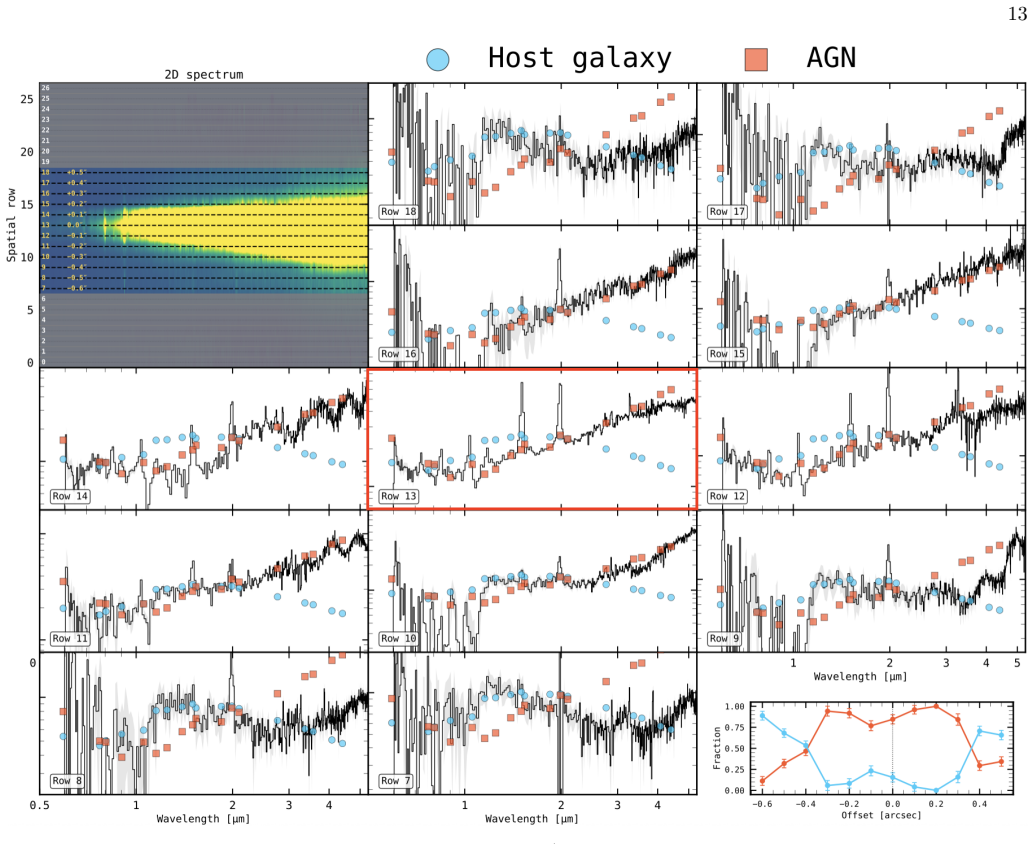
The claim is carried by three pieces. First, the Saguaro provides a concrete laboratory: a galaxy where the 'V-shaped' nuclear SED, broad H$\alpha$, and He I $\lambda10830$ absorption can be separated from a resolved spiral host through multiwavelength AGN–host decomposition and row-by-row NIRSpec/PRISM spectroscopy. Second, a redshifted toy experiment applies the standard $(1+z)^4$ cosmological surface-brightness dimming to each pixel, showing exactly how the extended host fades while the nucleus survives. Third, an exponential-disk visibility model, $I(R)=I_0\exp(-R/R_s)$, with a fixed detection threshold $I_{\rm lim}$, predicts the detectable fraction of host light as a function of redshift; with the adopted parameters more than two-thirds of the host light is lost by $z=7$. A stacking analysis of 99 LRDs, comparing the median rest-frame UV profile against a deliberately broadened simulated stacked PSF, supplies the empirical anchor: faint extended emission persists to $\approx0.2''$, indicating hosts around typical LRDs.
What would settle it
A stack of the same 99 LRDs built with a PSF assembled from isolated point sources in the same field and filters, without the artificial 30 mas broadening, would settle the host claim: if the excess beyond $0.1''$ vanishes, the extended emission is an artifact.
Extended reading notes
Core claim
The central discovery is that the defining LRD features—compactness, redness, and the 'V-shaped' spectral energy distribution with a break near the Balmer limit—can be produced by a normal galaxy's nucleus once surface-brightness dimming removes the host from view. The Saguaro, a Compton-thick, near-Eddington AGN at $z=2.0145$ inside a face-on spiral host, displays a nuclear 'V-shaped' SED in spatially resolved NIRSpec/PRISM spectra; an AGN–host image decomposition shows the V-shape belongs to the point-like nucleus and is diluted within $0.1$–$0.2''$ by the host. When the authors redshift the whole system to $z=7$ with the $(1+z)^4$ dimming law, the host vanishes and the object would be classified as an LRD. Stacking 99 photometrically selected LRDs in rest-frame UV light then shows excess emission beyond the PSF out to $\approx0.2''$, and a simple analytic model quantifies the effect: only about one-third of a typical host's light remains detectable at $z=7$, and almost none at $z=9$. The paper concludes that current observations cannot distinguish isolated LRDs from nuclei of extended galaxies, and that the LRD phase is likely a transient, largely AGN-dominated stage rather than a distinct class.
Load-bearing premise
The stacked detection of faint extended light around LRDs stands on the assumption that the reference PSF is not broader than the true telescope PSF, since a broader true PSF would make the apparent host excess an artifact.
Editorial extensions
If this is right
- The steep drop in LRD number density from $z\approx4$ to $z\approx2$ is at least partly a selection effect: the same nuclei embedded in growing, detectable hosts no longer satisfy compact-source criteria.
- Black-hole-to-stellar-mass ratios for LRDs would be biased high, because host starlight lost to dimming is omitted from the host stellar mass.
- Complex, disturbed UV morphologies seen in roughly 30% of LRDs can be read as genuine host or merger structure rather than intrinsic source structure.
- Deeper JWST observations and lensed LRD samples at $z>6$ should detect host emission at the radii and depths predicted by the exponential-disk model.
- Low-redshift analogs in SDSS, DESI, and Spitzer-selected dusty samples are plausible evolved descendants of the same transient LRD phase.
Reading between the lines
- If unseen host mass is substantial, the overmassive-black-hole tension in LRDs could ease without invoking exotic engines; the paper stops short of quantifying this, but the math implies host stellar masses have been underestimated.
- The same dimming argument predicts that some compact, red sources at $z>7$ may be ordinary star-forming nuclei with no AGN, so a search for broad-line-free, X-ray-quiet LRD analogs would test whether the 'V-shape' uniquely traces accretion.
- Selection functions based on point-source compactness should be supplemented with surface-brightness-based criteria to map the true demographics of the LRD phase.
- A luminosity/colour sequence connecting the Saguaro-like ULIRG at $z\approx2$, HotDOGs at $z\approx0.5$, and SDSS analogues at $z\approx0.1$ is a direct, testable consequence of the evolutionary picture.
Editorial analysis
A structured set of objections, weighed in public.
Referee Report
Summary. The paper presents WISEA J123635.56+621424.2 ("the Saguaro"), a z=2.0145 galaxy in GOODS-North with a compact nuclear source showing a "V-shaped" SED typical of Little Red Dots (LRDs), embedded in a face-on spiral host. Using GALFITM AGN-host image decomposition, spatially resolved NIRSpec/PRISM spectroscopy, Chandra X-ray spectral analysis, and a FERENGI-style redshift simulation, the authors argue that if the same object were observed unchanged at z~7, cosmological surface-brightness dimming would hide the host and leave a compact LRD-like nucleus. They then stack rest-frame UV images of 99 photometrically selected LRDs at z~4-8 and report excess emission beyond the stacked PSF out to ~0.2 arcsec, which they interpret as faint extended host galaxies. An analytic exponential-disk model is used to quantify how much host light is lost to dimming, and the paper concludes that LRDs may not be a distinct population but rather the visible nuclei of short-lived, AGN-dominated phases in extended galaxies.
Significance. If the central claim holds, the paper is a substantial contribution to the current debate on the nature of LRDs: it provides a concrete low-redshift analog with a resolved host, a direct stacking test for extended UV emission, and a quantitative surface-brightness-dimming argument. The Saguaro analysis is careful and multi-instrumental; the spatially resolved NIRSpec/PRISM extraction using a custom background subtraction to avoid self-subtraction is a particularly commendable piece of work. The analytic model is a clean application of Tolman's law and makes falsifiable predictions that can be tested with deeper or higher-resolution JWST data. However, the population-level conclusion rests on the stacked UV excess, whose PSF calibration is not empirically verified, and the analytic model's quantitative results are sensitive to adopted parameters. The paper is therefore best read as a strong hypothesis-forming study rather than a definitive proof, but it is well within the scope of the journal and would be of wide interest if the PSF concern is addressed.
major comments (2)
- [3.1, Fig. 7] The detection of extended host emission around stacked LRDs is the load-bearing measurement for the population-level claim, and it is calibrated only against a synthetic STPSF model broadened by a fixed 30 mas offset. The paper itself states that the comparison is "strongly sensitive to the applied offset," and the chosen offset, while six times the internal JADES astrometric scatter, does not bound absolute astrometric errors, PSF model errors, or per-source centroiding noise for faint LRDs. No empirical stellar PSF comparison is presented. If the true NIRCam PSF wings are broader than STPSF predictions—from scattering, detector persistence, or residual misregistration among F090W/F115W/F150W—the reported 0.2 arcsec excess could be PSF mismatch rather than genuine host emission. I request an empirical PSF test using unresolved stars in the same fields and filters, processed through the same stacking pipeline, or an explicit treatment of PSF uncertainty in the significance estimate.
- [3.2, Eqs. (2)-(3), Table 2] The analytic model's headline numbers (f_lost = 0.69 at z=7 and 0.98 at z=9 in Table 2) are highly sensitive to the adopted central surface brightness I0 and scale radius Rs. With the same Rs and I_lim, raising I0 from 100 to 1000 L_sun/pc^2 reduces f_lost at z=7 to about 0.14; the model therefore does not "confirm" that surface-brightness dimming alone explains the compact appearance unless the parameter choices are representative of actual LRD hosts. The paper cites one z=2 study for I0, but the host properties of z~4-8 LRDs are precisely what is under debate. Please add a parameter exploration or a distribution-motivated range, and soften the conclusion in Section 5 ("hosts are virtually undetectable by z=9") accordingly.
minor comments (5)
- [2.3.8 and Section 5] The word "prove" in Section 5 overstates a toy experiment whose evolutionary brightening term is explicitly described in Section 2.3.8 as "purely for visual purposes." Please replace "prove" with "illustrate" or "demonstrate" and carry the caveat into the abstract and conclusions.
- [3.1, Fig. 8] The mild radial growth between redshift bins is presented without a significance estimate or uncertainty on the profile difference. Please quantify the significance, or present the trend as suggestive rather than measured.
- [2.3.2] The AGN-host decomposition assumes a point source plus a single Sersic profile, and the authors note that unresolved circumnuclear star formation could contaminate the AGN SED, but they do not quantify the surface-brightness limit at which such contamination could affect the V-shaped SED. A short quantitative statement would strengthen the inference that the V-shape is purely AGN-related.
- [2.3.3] The row-by-row spectral extraction convincingly shows that the V-shaped continuum is centrally concentrated, but the effective spatial resolution is set by the NIRSpec PSF. Please state explicitly in the text that the reported 0.1-0.2 arcsec spatial scale is PSF-smoothed, as this is easy to misread.
- [Throughout] There are several typographical and formatting errors: "V asily" in the author list, "T able 1" in the text, "here dubbedthe Saguaro" missing a space, "face on spiral" should be "face-on spiral," and "common seen" in Section 2.3.2 should be "commonly seen." A careful proofread is needed.
Circularity Check
No significant circularity: the stacked UV measurement is direct, the analytic dimming model uses literature values rather than fitted outputs, and the authors' self-citations are reused data products, not load-bearing premises.
full rationale
I find no circular step that reduces a claimed prediction to its own inputs. The paper rests on two independent evidentiary legs: the resolved Saguaro case study (imaging, NIRSpec/PRISM spectra, AGN-host decomposition) and the stacking analysis of 99 LRDs, which is a direct observational measurement. The analytic model in Section 3.2 (Eqs. 1-3) is explicitly conditional: it adopts I0 = 100 L_sun/pc2, Rs = 1.2 kpc, and I_lim = 0.0079 L_sun/pc2 from literature values and JWST detection thresholds, then computes the lost-light fraction; these parameters are not fitted to the stacked profile, so this is not a fitted input being renamed a prediction. The use of the authors' own LRD sample (Rinaldi et al. 2025a) and census (Rinaldi et al. 2026) is reuse of published data products, not a self-citation chain carrying the logical load; the PSF comparison uses external STPSF models, and independent literature is cited for galaxy size evolution and independent host detections (e.g., Zhang et al. 2025; Genin et al. 2025). The paper itself flags its principal measurement caveat - 'the results are strongly sensitive to the applied offset' - and cautions that the redshift-bin results may be biased; these are empirical robustness concerns, not circularity. The score of 1 reflects the presence of several non-load-bearing self-citations and the otherwise self-contained derivation; the central claim is appropriately hedged as supporting a scenario rather than a proof.
Assumptions & free parameters
free parameters (4)
- Host central surface brightness I0 =
100 L_sun/pc^2
- Host scale radius Rs =
1.2 kpc
- Detection limit I_lim =
0.0079 L_sun/pc^2 (mu ~ 28.5 mag/arcsec^2)
- Evolutionary brightening slope x =
-1
assumptions (5)
- standard math Tolman (1+z)^4 surface-brightness dimming applies universally
- domain assumption The LRD host light profile is an exponential disk with a single scale radius
- domain assumption The Saguaro nuclear SED is well described by an LRD template plus a star-forming host template
- ad hoc to paper The Saguaro, observed unchanged in its intrinsic properties, is representative of high-z LRD hosts
- domain assumption The 99 photometrically selected LRDs from Rinaldi et al. 2025a form a representative sample of the LRD population
Cite this review
Pith. "Pith review of Beyond the Dot: an LRD-like nucleus at the Heart of an IR-Bright Galaxy and its implications for high-redshift LRDs." pith.science (2026). https://pith.science/paper/WRSKXVIA
@misc{pith2026250717738,
  author       = {Pith},
  title        = {Pith review of: Beyond the Dot: an LRD-like nucleus at the Heart of an IR-Bright Galaxy and its implications for high-redshift LRDs},
  year         = {2026},
  howpublished = {\url{https://pith.science/paper/WRSKXVIA}},
  note         = {Machine review of arXiv:2507.17738}
}
abstract
Little Red Dots (LRDs) are compact, red sources discovered by JWST at high redshift ($z \gtrsim 4$), marked by distinctive 'V-shaped' spectral energy distributions (SEDs) and often interpreted as rapidly accreting Active Galactic Nuclei (AGNs). Their true nature remains unclear, however, and their evolutionary connection to their lower-redshift counterparts is still poorly constrained. Thus, we present WISEA J123635.56+621424.2, here dubbed {\it the Saguaro}, a $z=2.0145$ galaxy in GOODS-North, as a possible analog of high-redshift LRDs and a potential missing link in their evolutionary path toward lower-redshift systems. It features a compact LRD-like nucleus surrounded by a face-on spiral host. Its connection to LRDs includes that: (1) its nuclear spectrum shows a clear `V-shaped'' SED; and (2) when redshifted to $z=7$, surface-brightness dimming makes the host undetectable, thus mimicking an LRD. This suggests that high-redshift LRDs may be embedded in extended hosts. To test this, we stack rest-frame UV images of 99 photometrically selected LRDs, revealing faint, diffuse emission. Stacking in redshift bins reveals mild radial growth, consistent with the expected galaxy size evolution. A simple analytic model confirms that surface-brightness dimming alone can explain their compact appearance. Lastly, we show that {\it the Saguaro} is not unique by describing similar objects from the literature at $z\lesssim3.5$. Taken together, our results support a scenario in which LRDs may not be a distinct population, but could instead be the visible nuclei of galaxies undergoing a short-lived, perhaps AGN-dominated, evolutionary phase, with their compact, red appearance driven largely by observational biases.
Figures


Figures from the paper (10 more)


Forward citations
Cited by 4 Pith papers
-
The metallicities of little red dot host galaxies: LRDs are metal poor, but not pristine
LRD host galaxies show average metallicity 0.08 Z_sun with narrow stable range, challenging pristine-gas formation models while ruling out typical local AGN.
-
OCEANS of Absorption: High-resolution NIRSpec Spectroscopy Reveals Diverse Balmer-line Absorption in Little Red Dots
High-resolution spectra show Balmer absorption in 4/10 LRDs with blue-shifted velocities and exponential wings, supporting a model of co-located partial-covering gas with inflow/outflow gradients.
-
Little Red and Blue Dots: AGN-excited narrow lines, Lyman-$\alpha$ emission, and resemblance to standard quasars
JWST data on LRDs and LBDs show AGN-like excitation, strong Lyα with broad components, and X-ray weakness, implying clumpy or equatorial geometries around growing black holes rather than complete gas envelopes.
-
Undermassive Hosts of $z = 4-6 $ AGN from JWST/NIRCam Image Decomposition with CONGRESS, FRESCO, and JADES
Faint AGN hosts at z≈4–6 look 1–2 dex less massive after image decomposition, pushing their black-hole-to-stellar-mass ratios to ~0.01–1.48, above the local relation.
Reference graph
Works this paper leans on
-
[1]
Akins, H. B., Casey, C. M., Lambrides, E., et al. 2024, doi: 10.48550/arXiv.2406.10341 Akins, H. B., Casey, C. M., Lambrides, E., et al. 2025, The Astrophysical Journal, 991, 37, doi: 10.3847/1538-4357/ade984 Alexander, D. M., Bauer, F. E., Chapman, S. C., et al. 2005, The Astrophysical Journal, 632, 736, doi: 10.1086/444342 Ananna, T. T., Bogd´ an,´A., K...
-
[3]
https://ui.adsabs.harvard.edu/abs/2022ASPC..532....3T team, T. p. d. 2024, Zenodo, doi: 10.5281/zenodo.13819579 Teplitz, H. I., Chary, R., Elbaz, D., et al. 2011, The Astronomical Journal, Volume 141, Issue 1, article id. 1, <NUMPAGES>16</NUMPAGES>pp. (2011)., 141, 1, doi: 10.1088/0004-6256/141/1/1 Toba, Y., Ueda, J., Lim, C.-F., et al. 2018, The Astrophy...
-
[834]
adsabs.harvard.edu/abs/2000A&A...353..834K/abstract Kriek, M., & Conroy, C
https://ui. adsabs.harvard.edu/abs/2000A&A...353..834K/abstract Kriek, M., & Conroy, C. 2013, The Astrophysical Journal, 775, L16, doi: 10.1088/2041-8205/775/1/L16 Kroupa, P. 2001, Monthly Notices of the Royal Astronomical Society, 322, 231, doi: 10.1046/j.1365-8711.2001.04022.x Labb´ e, I., van Dokkum, P., Nelson, E., et al. 2023, Nature, 616, 266, doi: ...
arXiv 2018
-
[3038]
https://ui.adsabs.harvard.edu/abs/ 2023jwst.prop.3038Z/abstract Zhuang, M.-Y., & Ho, L. C. 2023, Nature Astronomy, 7, 1376, doi: 10.1038/s41550-023-02051-4
Reviewed August 6, 2026 · model on record in the stance chip above.
Discussion (0). Sign in to comment.