Little Red and Blue Dots: AGN-excited narrow lines, Lyman-α emission, and resemblance to standard quasars
Pith reviewed 2026-06-26 13:34 UTC · model grok-4.3
The pith
Little Red Dots and Little Blue Dots are both AGN powered by growing black holes whose ionizing radiation escapes to the ISM
A machine-rendered reading of the paper's core claim, the machinery that carries it, and where it could break.
Core claim
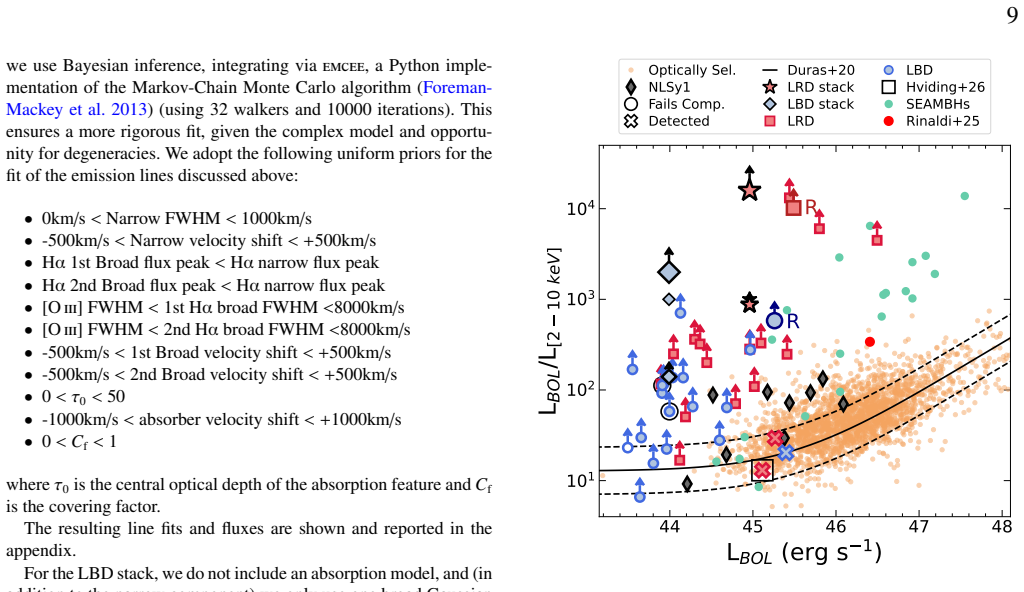
LRDs and LBDs are both powered by growing black holes and their ionizing radiation escapes to ionize the surrounding interstellar medium. The broad Balmer lines of LRDs show higher equivalent widths and Hα/Hβ ratios than LBDs, though still within the quasar distribution, while LBDs match normal AGN values. This rules out simple complete encasing envelopes for LRDs and indicates that LBDs are not merely LRDs with added galaxy light. Bolometric luminosities assuming full isotropic covering are inadequate, and the few X-ray detections align with standard corrections once absorption is included.
What carries the argument
Locations on standard AGN diagnostic diagrams combined with broad Balmer line equivalent widths, Hα/Hβ ratios, and Lyα properties compared to quasars and star-forming galaxies.
If this is right
- Ionizing photons escape the nuclear region, requiring clumpiness or equatorial geometry instead of full spherical covering.
- LRD bolometric luminosities calculated under isotropic complete-covering assumptions are too high.
- Dust-obscured LBD scenarios remain viable for explaining LRDs while complete-encasing models do not.
- The few X-ray-detected LRDs follow standard AGN bolometric corrections after accounting for absorption.
Where Pith is reading between the lines
- These objects may represent an early phase of black-hole growth where partial obscuration allows radiation to escape.
- The findings connect to broader questions of how AGN feedback operates at cosmic dawn when many high-z galaxies show similar line properties.
- Future spectroscopy could test whether the softer spectra reflect lower black-hole masses or different accretion states compared to local quasars.
Load-bearing premise
That standard diagnostic diagrams confirm AGN excitation rather than star formation even with weak HeII and at the metallicities and redshifts of these objects.
What would settle it
A larger sample showing strong HeII lines or X-ray luminosities that place the objects firmly in the star-formation region of the diagrams without AGN signatures.
Figures





read the original abstract
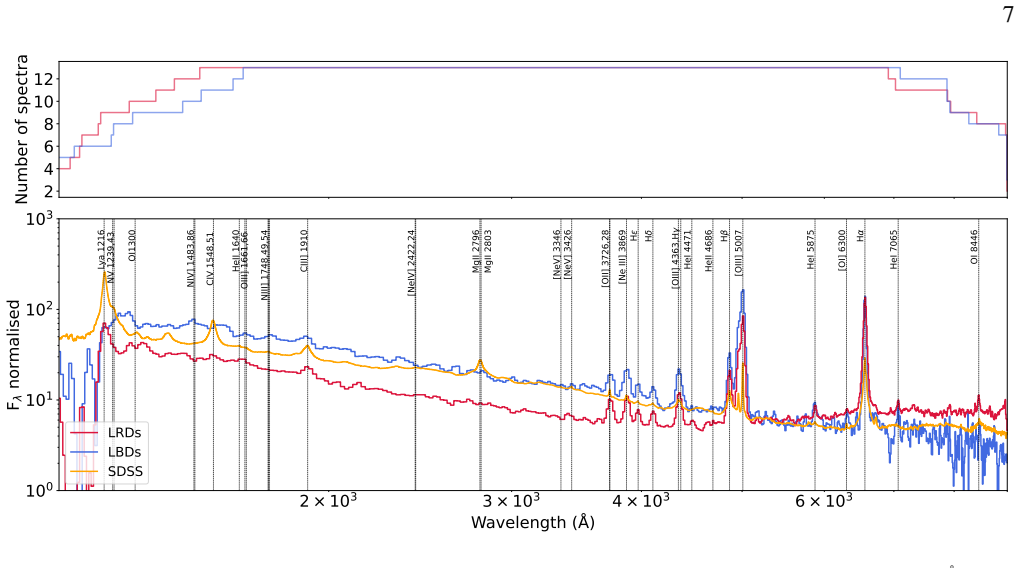
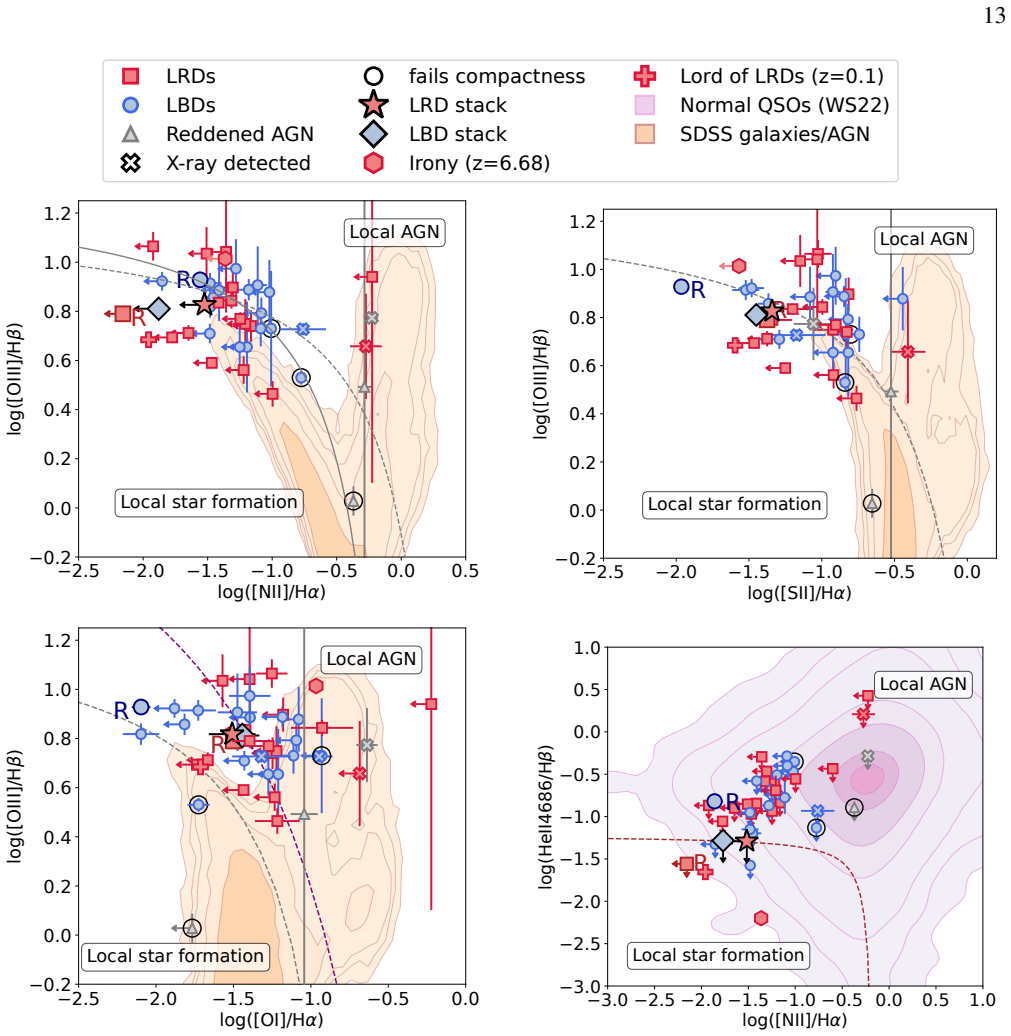
We present an analysis of a sample of 36 Little Red and Blue Dots (LRDs and LBDs) at $2.26<z<7.89$, identified by JWST in the GOODS fields. While both categories are selected to have broad Balmer lines, both of them are extremely X-ray weak. Both classes share the same location on various diagnostic diagrams, consistent with AGN excitation (with some deviations which can be ascribed to low metallicity), although their weak HeII emission suggests a generally softer ionizing spectrum than ordinary AGN. LRDs display Ly$\alpha$ emission stronger than normal star-forming galaxies, and with a broad component consistent with the broad component of H$\alpha$. Overall, these findings indicate that LRDs and LBDs are both powered by growing black holes and their ionizing radiation escapes to ionize the surrounding interstellar medium (ISM). The broad Balmer lines ($H\alpha_b$ and $H\beta_b$) have different apparent properties: LBDs have EW(H$\alpha _b$) and $H\alpha_b/H\beta_b$ broadly consistent with normal AGN, while LRDs have higher values of both quantities, although still in the tail of the quasars distribution. LRD models in which a gas envelope completely encases the black hole, are inconsistent with these results -- these scenarios need modification to include clumpiness, or a (classical) equatorial geometry, letting ionizing photons reach the ISM. The different broad Balmer properties imply that LBDs cannot simply be LRDs with more galaxy contribution. Scenarios in which LRDs are simply dust-obscured LBDs seem broadly consistent with the observations. Finally, these results indicate that LRDs' bolometric luminosities estimated assuming isotropic emission and complete covering by the absorber are inadequate. The few X-ray-detected LRDs suggest no deviation from the standard AGN bolometric corrections, once absorption is accounted for.
Editorial analysis
A structured set of objections, weighed in public.
Referee Report
Summary. The paper analyzes a sample of 36 Little Red Dots (LRDs) and Little Blue Dots (LBDs) at 2.26 < z < 7.89 selected via JWST for broad Balmer lines but found to be extremely X-ray weak. Both classes occupy similar locations on standard diagnostic diagrams (e.g., BPT and [OIII]/Hβ vs [NII]/Hα), interpreted as AGN excitation with deviations ascribed to low metallicity, despite weak HeII suggesting a softer ionizing spectrum. LRDs show stronger Lyα (including a broad component matching Hα), leading to the conclusion that both are powered by growing black holes with escaping ionizing radiation to the ISM. The work argues against fully encasing gas envelopes for LRDs, notes differences in broad-line EWs and ratios between LRDs and LBDs, and suggests that standard bolometric corrections may not apply without accounting for absorption.
Significance. If the AGN classification and escaping-radiation interpretation hold, the results would constrain models of LRDs/LBDs, require modifications to fully-covering envelope scenarios (favoring clumpiness or equatorial geometries), and imply that current bolometric luminosity estimates for these objects are inadequate. This could affect demographic studies of early supermassive black holes and the contribution of such sources to reionization.
major comments (2)
- [Abstract] Abstract and line-diagnostics discussion: The central claim that LRDs and LBDs are AGN-powered rests on their placement on diagnostic diagrams being 'consistent with AGN excitation.' However, the sample exhibits weak HeII, and no quantitative comparison to star-formation or composite models at 2.26<z<7.89 and low metallicity is provided to rule out overlap regions; the attribution of deviations solely to low metallicity lacks supporting error bars or model grids.
- [Abstract] Abstract (bolometric corrections paragraph): The statement that 'the few X-ray-detected LRDs suggest no deviation from the standard AGN bolometric corrections, once absorption is accounted for' is presented without sample sizes for the X-ray detections, absorption corrections applied, or comparison to the full sample's X-ray weakness; this underpins the claim that isotropic-emission assumptions are inadequate but lacks the quantitative basis needed to support it.
minor comments (2)
- The redshift range is given as 2.26<z<7.89 but no table or figure lists individual object redshifts, line fluxes, or diagnostic ratios with uncertainties.
- Notation for broad-line quantities (e.g., Hα_b, EW(Hα_b)) is introduced without explicit definition of measurement apertures or deblending procedures.
Simulated Author's Rebuttal
We thank the referee for their careful reading and constructive comments on our manuscript. We address each major comment below and have revised the manuscript accordingly to strengthen the presentation of our results.
read point-by-point responses
-
Referee: [Abstract] Abstract and line-diagnostics discussion: The central claim that LRDs and LBDs are AGN-powered rests on their placement on diagnostic diagrams being 'consistent with AGN excitation.' However, the sample exhibits weak HeII, and no quantitative comparison to star-formation or composite models at 2.26<z<7.89 and low metallicity is provided to rule out overlap regions; the attribution of deviations solely to low metallicity lacks supporting error bars or model grids.
Authors: We agree that additional quantitative comparisons to star-formation and composite models at the relevant redshifts and metallicities would improve the robustness of the discussion. The current analysis relies on the standard placement of the sources on BPT and related diagrams, where the observed positions align with AGN excitation, and deviations are interpreted in light of established low-metallicity shifts in these diagnostics. The weak HeII is explicitly noted in the manuscript as evidence for a softer ionizing spectrum than typical AGN, consistent with our growing black hole interpretation rather than dominant star formation. The broad Balmer line selection and Lyα properties provide independent support for the AGN classification. We will revise the text to include references to high-z, low-Z model grids from the literature, add error bars to the diagnostic figures, and clarify the limitations of the current comparison. revision: partial
-
Referee: [Abstract] Abstract (bolometric corrections paragraph): The statement that 'the few X-ray-detected LRDs suggest no deviation from the standard AGN bolometric corrections, once absorption is accounted for' is presented without sample sizes for the X-ray detections, absorption corrections applied, or comparison to the full sample's X-ray weakness; this underpins the claim that isotropic-emission assumptions are inadequate but lacks the quantitative basis needed to support it.
Authors: The abstract provides a concise summary, but we acknowledge that greater quantitative detail would better support the bolometric correction discussion. The full manuscript describes the X-ray properties of the sample, including the small number of detections versus the majority with upper limits indicating extreme weakness. We will revise the abstract to specify the number of X-ray-detected sources, note the absorption corrections applied, and briefly compare to the undetected population. This will supply the requested quantitative basis while preserving the conclusion that isotropic assumptions are inadequate for these objects. revision: yes
Circularity Check
No significant circularity in observational classification
full rationale
The paper's central claims rest on empirical placement of observed line ratios on standard diagnostic diagrams (BPT and similar), comparisons of broad Balmer line properties to known quasars, and detection of Lyα emission, none of which involve self-referential equations, fitted parameters renamed as predictions, or derivations that reduce to the paper's own inputs by construction. No self-citation load-bearing steps, uniqueness theorems, or ansatzes smuggled via prior work are present in the abstract or described chain. The analysis is self-contained against external benchmarks of AGN diagnostics and quasar properties.
Axiom & Free-Parameter Ledger
axioms (2)
- domain assumption Standard emission-line diagnostic diagrams can distinguish AGN excitation from star formation even with low-metallicity deviations and softer spectra indicated by weak HeII
- domain assumption Broad Balmer lines and their ratios trace AGN activity rather than alternative excitation or dust effects
Reference graph
Works this paper leans on
-
[1]
GA-NIFS: an extremely nitrogen-loud and chemically stratified galaxy at z 5.55. , keywords =. doi:10.1093/mnras/stae2375 , archivePrefix =. 2404.04148 , primaryClass =
-
[2]
TBD LBD: The nature of `little blue dots'
TBD LBD: The nature of `little blue dots'. arXiv e-prints , keywords =. doi:10.48550/arXiv.2606.12509 , archivePrefix =. 2606.12509 , primaryClass =
work page internal anchor Pith review Pith/arXiv arXiv doi:10.48550/arxiv.2606.12509
-
[3]
A Selection Aware View of Black Hole-Galaxy Coevolution at High Redshift. arXiv e-prints , keywords =. doi:10.48550/arXiv.2603.04358 , archivePrefix =. 2603.04358 , primaryClass =
-
[4]
arXiv e-prints , keywords =
Compact Core, Extended Reach: A Bipolar kpc-Scale Elongation in a Little Red Dot at z 5.5. arXiv e-prints , keywords =
-
[5]
Little red dots as obscured little blue dots: relative abundances, luminosities, and black-hole masses. arXiv e-prints , keywords =. doi:10.48550/arXiv.2605.05074 , archivePrefix =. 2605.05074 , primaryClass =
work page internal anchor Pith review Pith/arXiv arXiv doi:10.48550/arxiv.2605.05074
-
[6]
Synthetic Spectral Library of Optically Thick Atmospheres for Little Red Dots. arXiv e-prints , keywords =. doi:10.48550/arXiv.2603.02317 , archivePrefix =. 2603.02317 , primaryClass =
-
[7]
A Scaling Relation of LRDs between Broad H α and Bolometric Luminosities: Enhanced Broad H α Emission Relative to Low- z Type 1 AGN. arXiv e-prints , keywords =. doi:10.48550/arXiv.2606.09726 , archivePrefix =. 2606.09726 , primaryClass =
work page internal anchor Pith review Pith/arXiv arXiv doi:10.48550/arxiv.2606.09726
-
[8]
The Origin of Fe II Emission in AGN
The Origin of Fe II Emission in Active Galactic Nuclei. , keywords =. doi:10.1086/424683 , archivePrefix =. astro-ph/0407404 , primaryClass =
work page internal anchor Pith review Pith/arXiv arXiv doi:10.1086/424683
-
[9]
Spectral Uniformity of Little Red Dots: A Natural Outcome of Coevolving Seed Black Holes and Nascent Starbursts. , keywords =. doi:10.3847/1538-4357/ae42ce , archivePrefix =. 2509.19422 , primaryClass =
work page internal anchor Pith review Pith/arXiv arXiv doi:10.3847/1538-4357/ae42ce
-
[10]
A Nitrogen-rich AGN Powering a Large Ionizing Bubble at z = 8.63. , keywords =. doi:10.3847/1538-4357/ae3a7c , archivePrefix =. 2508.01372 , primaryClass =
-
[11]
The Deepest GLIMPSE of a Dense Gas Cocoon Enshrouding a Little Red Dot. arXiv e-prints , keywords =. doi:10.48550/arXiv.2511.07515 , archivePrefix =. 2511.07515 , primaryClass =
-
[12]
BlackTHUNDER: Evidence of three massive black holes in a z~5 galaxy
BlackTHUNDER: Evidence of three massive black holes in a z -0.5ex 5 galaxy. arXiv e-prints , keywords =. doi:10.48550/arXiv.2509.21575 , archivePrefix =. 2509.21575 , primaryClass =
work page internal anchor Pith review Pith/arXiv arXiv doi:10.48550/arxiv.2509.21575
-
[13]
[O III] equivalent width and orientation effects in quasars. , keywords =. doi:10.1111/j.1365-2966.2010.17843.x , archivePrefix =. 1010.2037 , primaryClass =
-
[14]
MEGA: Spectrophotometric Spectral Energy Distribution Fitting of Little Red Dots Detected in JWST MIRI. , keywords =. doi:10.3847/1538-4357/ae5e6b , archivePrefix =. 2508.20177 , primaryClass =
-
[15]
No [C II] or dust detection in two Little Red Dots at z _ spec > 7. , keywords =. doi:10.1051/0004-6361/202554361 , archivePrefix =. 2503.01945 , primaryClass =
-
[16]
COSMOS-Web: The Overabundance and Physical Nature of ``Little Red Dots'' Implications for Early Galaxy and SMBH Assembly. , keywords =. doi:10.3847/1538-4357/ade984 , archivePrefix =. 2406.10341 , primaryClass =
-
[17]
An Upper Limit of 10 ^ 6 M _ in Dust from ALMA Observations in 60 Little Red Dots. , keywords =. doi:10.3847/2041-8213/adfa91 , archivePrefix =. 2505.18873 , primaryClass =
-
[18]
GA-NIFS: JWST discovers an offset AGN 740 million years after the big bang. , keywords =. doi:10.1093/mnras/stae943 , archivePrefix =. 2312.03589 , primaryClass =
-
[19]
Connecting JWST discovered N/O-enhanced galaxies to globular clusters: evidence from chemical imprints. , keywords =. doi:10.1093/mnras/staf2110 , archivePrefix =. 2505.12505 , primaryClass =
-
[20]
RESOLVE and ECO: Finding Low-metallicity z 0 Dwarf AGN Candidates Using Optimized Emission-line Diagnostics. , keywords =. doi:10.3847/1538-4357/ac6595 , archivePrefix =. 2204.03633 , primaryClass =
-
[21]
Modelling the nebular emission from primeval to present-day star-forming galaxies
Modelling the nebular emission from primeval to present-day star-forming galaxies. , keywords =. doi:10.1093/mnras/stw1716 , archivePrefix =. 1607.06086 , primaryClass =
work page internal anchor Pith review Pith/arXiv arXiv doi:10.1093/mnras/stw1716
-
[22]
The 2 Ms Chandra Deep Field-North Survey and the 250 ks Extended Chandra Deep Field-South Survey: Improved Point-source Catalogs. , keywords =. doi:10.3847/0067-0049/224/2/15 , archivePrefix =. 1602.06299 , primaryClass =
work page internal anchor Pith review Pith/arXiv arXiv doi:10.3847/0067-0049/224/2/15
-
[23]
Do little red dots really form a distinct class of astronomical objects?
Do little red dots really form a distinct class of astronomical objects?. arXiv e-prints , keywords =. doi:10.48550/arXiv.2604.11677 , archivePrefix =. 2604.11677 , primaryClass =
work page internal anchor Pith review Pith/arXiv arXiv doi:10.48550/arxiv.2604.11677
-
[24]
GA-NIFS: Powerful and frequent outflows in moderate-luminosity AGN at $z\sim3-6$
GA-NIFS: Powerful and frequent outflows in moderate-luminosity AGN at z 3-6. arXiv e-prints , keywords =. doi:10.48550/arXiv.2512.09996 , archivePrefix =. 2512.09996 , primaryClass =
work page internal anchor Pith review Pith/arXiv arXiv doi:10.48550/arxiv.2512.09996
-
[25]
Resolving the Rise and Fall of Star Formation in Galaxies , year = 2023, editor =
The JWST/NIRSpec GTO programme ``The Physics of Galaxy Assembly: IFS observations of high-z galaxies''. Resolving the Rise and Fall of Star Formation in Galaxies , year = 2023, editor =. doi:10.1017/S174392132200374X , adsurl =
-
[26]
From ``The Cliff'' to ``Virgil'': Mapping the Spectral Diversity of Little Red Dots with JWST/NIRSpec. , keywords =. doi:10.3847/1538-4357/ae5d2c , archivePrefix =. 2512.15853 , primaryClass =
-
[27]
Not Just a Dot: The Complex UV Morphology and Underlying Properties of Little Red Dots. , keywords =. doi:10.3847/1538-4357/adfa10 , archivePrefix =. 2411.14383 , primaryClass =
-
[28]
Constraints on the host galaxy and AGN properties of three z > 6 JWST AGN from NOEMA observations. arXiv e-prints , keywords =. doi:10.48550/arXiv.2603.29652 , archivePrefix =. 2603.29652 , primaryClass =
-
[29]
Black hole envelopes in Little Red Dots. , keywords =. doi:10.1093/mnras/staf1898 , archivePrefix =. 2505.06965 , primaryClass =
-
[30]
The Extreme Rarity and Physical Properties of Low-redshift AGNs with Balmer Absorption
The Extreme Rarity and Physical Properties of Low-redshift AGNs with Balmer Absorption. arXiv e-prints , keywords =. doi:10.48550/arXiv.2606.04712 , archivePrefix =. 2606.04712 , primaryClass =
work page internal anchor Pith review Pith/arXiv arXiv doi:10.48550/arxiv.2606.04712
-
[31]
An ultra-dense fast outflow in a quasar at z=2.4
An ultra-dense fast outflow in a quasar at z = 2.4. , keywords =. doi:10.1093/mnras/stx311 , archivePrefix =. 1605.08046 , primaryClass =
work page internal anchor Pith review Pith/arXiv arXiv doi:10.1093/mnras/stx311
-
[32]
Balmer and He I absorption in the nuclear spectrum of NGC 4151
Balmer and He I Absorption in the Nuclear Spectrum of NGC 4151. , keywords =. doi:10.1086/344080 , archivePrefix =. astro-ph/0208262 , primaryClass =
work page internal anchor Pith review Pith/arXiv arXiv doi:10.1086/344080
-
[33]
The Open Journal of Astrophysics , keywords =
Massive Black Hole Seeds. The Open Journal of Astrophysics , keywords =. doi:10.33232/001c.123239 , archivePrefix =. 2405.17975 , primaryClass =
-
[34]
The growth of light seed black holes in the early Universe. Nature Astronomy , keywords =. doi:10.1038/s41550-025-02767-5 , archivePrefix =. 2601.14395 , primaryClass =
-
[35]
Local Analogs of Little Red Dots: Optical Variability and Evidence for an AGN Origin. arXiv e-prints , keywords =. doi:10.48550/arXiv.2603.01473 , archivePrefix =. 2603.01473 , primaryClass =
work page internal anchor Pith review Pith/arXiv arXiv doi:10.48550/arxiv.2603.01473
-
[36]
The GlimmIr: Spectroscopic Variability in a z -0.5ex 7 LRD Indicates Rapid Changes in Both the Narrow and Broad Line Regions. arXiv e-prints , keywords =. doi:10.48550/arXiv.2604.25991 , archivePrefix =. 2604.25991 , primaryClass =
work page internal anchor Pith review Pith/arXiv arXiv doi:10.48550/arxiv.2604.25991
-
[37]
Episodic super-Eddington accretion as a clue to Overmassive Black Holes in the early Universe. arXiv e-prints , keywords =. doi:10.48550/arXiv.2412.14248 , archivePrefix =. 2412.14248 , primaryClass =
-
[38]
The properties of primordially-seeded black holes and their hosts in the first billion years: implications for JWST. , keywords =. doi:10.1051/0004-6361/202555959 , archivePrefix =. 2506.08116 , primaryClass =
-
[39]
Overmassive Black Holes at Cosmic Noon: Linking the Local and the High-redshift Universe. , keywords =. doi:10.3847/2041-8213/ad3c2a , archivePrefix =. 2404.05793 , primaryClass =
-
[40]
Significant Evidence of an AGN Contribution in GHZ2 at z = 12.34. arXiv e-prints , keywords =. doi:10.48550/arXiv.2511.03035 , archivePrefix =. 2511.03035 , primaryClass =
-
[41]
Investigating ionising sources and the complex interstellar medium of GHZ2 at $z=12.3$
Investigating ionising sources and the complex interstellar medium of GHZ2 at z = 12.3. The Open Journal of Astrophysics , keywords =. doi:10.33232/001c.160281 , archivePrefix =. 2512.08490 , primaryClass =
work page internal anchor Pith review Pith/arXiv arXiv doi:10.33232/001c.160281
-
[42]
The Dual Nature of GHZ9: Coexisting Active Galactic Nuclei and Star Formation Activity in a Remote X-Ray Source at z = 10.145. , keywords =. doi:10.3847/1538-4357/ade706 , archivePrefix =. 2410.18763 , primaryClass =
-
[43]
Baldwin, J. A. and Phillips, M. M. and Terlevich, R. , doi =. Classification parameters for the emission-line spectra of extragalactic objects. , url =. Publications of the Astronomical Society of the Pacific , keywords =
-
[44]
The X-Ray Dot: Exotic Dust or a Late-stage Little Red Dot?. , keywords =. doi:10.3847/2041-8213/ae4c88 , archivePrefix =. 2601.09778 , primaryClass =
-
[45]
, year = 2005, month = apr, volume =
The luminosity dependence of the type 1 active galactic nucleus fraction. , keywords =. doi:10.1111/j.1365-2966.2005.09043.x , archivePrefix =. astro-ph/0503500 , primaryClass =
-
[46]
Dust covering factor, silicate emission and star formation in luminous QSOs
Dust covering factor, silicate emission, and star formation in luminous QSOs. , keywords =. doi:10.1051/0004-6361:20077252 , archivePrefix =. 0704.1559 , primaryClass =
work page internal anchor Pith review Pith/arXiv arXiv doi:10.1051/0004-6361:20077252
-
[47]
What You See Is What You Get: Empirically Measured Bolometric Luminosities of Little Red Dots. , keywords =. doi:10.3847/1538-4357/ae1836 , archivePrefix =. 2509.05434 , primaryClass =
-
[48]
Near-Infrared Spectroscopy of High-Redshift Active Galactic Nuclei. II. Disappearing Narrow-Line Regions and the Role of Accretion. , keywords =. doi:10.1086/423608 , archivePrefix =. astro-ph/0406560 , primaryClass =
work page internal anchor Pith review Pith/arXiv arXiv doi:10.1086/423608
-
[49]
(LRDs) ^2 : The Low-ReDshift Little Red Dots Survey. II. DESI DR1 Sample. arXiv e-prints , keywords =. doi:10.48550/arXiv.2605.21574 , archivePrefix =. 2605.21574 , primaryClass =
work page internal anchor Pith review Pith/arXiv arXiv doi:10.48550/arxiv.2605.21574
-
[50]
Universal bolometric corrections for active galactic nuclei over seven luminosity decades. , keywords =. doi:10.1051/0004-6361/201936817 , archivePrefix =. 2001.09984 , primaryClass =
-
[51]
Quasars as standard candles. III. Validation of a new sample for cosmological studies. , keywords =. doi:10.1051/0004-6361/202038899 , archivePrefix =. 2008.08586 , primaryClass =
-
[52]
The Discovery of Little Red Dots in the Local Universe: Signatures of Cool Gas Envelopes. , keywords =. doi:10.3847/1538-4357/ae2bdf , archivePrefix =. 2507.10659 , primaryClass =
-
[53]
Active galactic nuclei-heated dust revealed in ``little red dots''. , keywords =. doi:10.1051/0004-6361/202557164 , archivePrefix =. 2509.07100 , primaryClass =
-
[54]
Irony at z=6.68: a bright AGN with forbidden Fe emission and multi-component Balmer absorption. arXiv e-prints , keywords =. doi:10.48550/arXiv.2510.00101 , archivePrefix =. 2510.00101 , primaryClass =
-
[55]
The Little Blue and Red Dots Rosetta Stones: Non-Gaussian broad lines, hot dust, and X-ray weakness. arXiv e-prints , keywords =. doi:10.48550/arXiv.2601.22214 , archivePrefix =. 2601.22214 , primaryClass =
-
[56]
Veilleux, Sylvain and Osterbrock, Donald E. , doi =. Spectral. The Astrophysical Journal Supplement Series , keywords =
-
[57]
doi:10.1051/0004-6361/202450407 , eid =. arXiv , author =:2404.10811 , journal =
-
[58]
BlackTHUNDER: Shedding light on a dormant and extreme little red dot at z = 8.50. , keywords =. doi:10.1093/mnras/stag115 , archivePrefix =. 2509.20455 , primaryClass =
-
[59]
Little Red Dots as Obscured Little Blue Dots: A Super-Eddington Unification Model. arXiv e-prints , keywords =. doi:10.48550/arXiv.2602.22386 , archivePrefix =. 2602.22386 , primaryClass =
-
[60]
Black holes in the shadows: The missing high-ionization lines in the earliest JWST active galactic nuclei. , keywords =. doi:10.1051/0004-6361/202557687 , archivePrefix =. 2510.10772 , primaryClass =
-
[61]
X-Ray Weak Active Galactic Nuclei from Super-Eddington Accretion onto Infant Black Holes. , keywords =. doi:10.3847/2041-8213/ad90e1 , archivePrefix =. 2410.00417 , primaryClass =
-
[62]
JADES reveals a large population of low-mass black holes at high redshift. , keywords =. doi:10.1093/mnras/staf1979 , archivePrefix =. 2506.22147 , primaryClass =
-
[63]
Quiescent or dusty? Unveiling the nature of extremely red galaxies at z > 3. , keywords =. doi:10.1093/mnras/staf013 , archivePrefix =. 2404.08052 , primaryClass =
-
[64]
JWST meets Chandra: a large population of Compton thick, feedback-free, and intrinsically X-ray weak AGN, with a sprinkle of SNe. , keywords =. doi:10.1093/mnras/staf359 , archivePrefix =. 2405.00504 , primaryClass =
-
[65]
Chasing the light: Shadowing, collimation, and the super-Eddington growth of infant black holes in JWST broad-line AGNs. arXiv e-prints , keywords =. doi:10.48550/arXiv.2501.09854 , archivePrefix =. 2501.09854 , primaryClass =
-
[66]
Little Red Dot - Host Galaxy = Black Hole Star: A Gas-Enshrouded Heart at the Center of Every Little Red Dot. arXiv e-prints , keywords =. doi:10.48550/arXiv.2601.20929 , archivePrefix =. 2601.20929 , primaryClass =
work page internal anchor Pith review Pith/arXiv arXiv doi:10.48550/arxiv.2601.20929
-
[67]
The Age of Discovery with the James Webb Space Telescope: Excavating the Spectral Signatures of the First Massive Black Holes. , keywords =. doi:10.3847/2041-8213/ac6f01 , archivePrefix =. 2204.09692 , primaryClass =
-
[68]
Little Red and Blue Dots: simply stratified Broad Line Regions. arXiv e-prints , keywords =. doi:10.48550/arXiv.2603.22277 , archivePrefix =. 2603.22277 , primaryClass =
-
[69]
Little Red Dots host Black Hole Stars: A unified family of gas-reddened AGN revealed by JWST/NIRSpec spectroscopy. arXiv e-prints , keywords =. doi:10.48550/arXiv.2511.21820 , archivePrefix =. 2511.21820 , primaryClass =
-
[70]
A remarkable ruby: Absorption in dense gas, rather than evolved stars, drives the extreme Balmer break of a little red dot at z = 3.5. , keywords =. doi:10.1051/0004-6361/202554681 , archivePrefix =. 2503.16600 , primaryClass =
-
[71]
Extremely Dense Gas around Little Red Dots and High-redshift Active Galactic Nuclei: A Nonstellar Origin of the Balmer Break and Absorption Features. , keywords =. doi:10.3847/2041-8213/adaebd , archivePrefix =. 2409.07805 , primaryClass =
-
[72]
JADES - the Rosetta stone of JWST-discovered AGN: deciphering the intriguing nature of early AGN. , keywords =. doi:10.1093/mnras/stae2367 , archivePrefix =. 2407.08643 , primaryClass =
-
[73]
A Deep Dive down the Broad-line Region: Permitted O I, Ca II, and Fe II Emission in an Active Galactic Nucleus Little Red Dot at z = 5.3. , keywords =. doi:10.3847/2041-8213/ae13a9 , archivePrefix =. 2507.20684 , primaryClass =
-
[74]
A weak Ly halo for an extremely bright little red dot: Indications of enshrouded supermassive black hole growth. , keywords =. doi:10.1051/0004-6361/202555596 , archivePrefix =. 2505.09542 , primaryClass =
-
[75]
Thick Accretion Disks around Black Holes and the UV/Soft X-Ray Excess in Quasars. , keywords =. doi:10.1086/166175 , adsurl =
-
[76]
Lord of LRDs: insights into a 'Little Red Dot' with a low-ionization spectrum at z = 0.1. , keywords =. doi:10.1093/mnras/staf2235 , archivePrefix =. 2507.23774 , primaryClass =
-
[77]
Strong Rest-UV Emission Lines in a ``Little Red Dot'' Active Galactic Nucleus at z = 7: Early Supermassive Black Hole Growth alongside Compact Massive Star Formation?. , keywords =. doi:10.3847/2041-8213/adab76 , archivePrefix =. 2410.00949 , primaryClass =
-
[78]
A little red dot at z = 7.3 within a large galaxy overdensity. Nature Astronomy , keywords =. doi:10.1038/s41550-025-02660-1 , archivePrefix =. 2411.11534 , primaryClass =
-
[79]
, year = 1977, month = jun, volume =
Luminosity Indicators in the Spectra of Quasi-Stellar Objects. , year = 1977, month = jun, volume =. doi:10.1086/155294 , adsurl =
-
[80]
The Rise of Faint, Red Active Galactic Nuclei at z > 4: A Sample of Little Red Dots in the JWST Extragalactic Legacy Fields. , keywords =. doi:10.3847/1538-4357/adbc7d , archivePrefix =. 2404.03576 , primaryClass =
discussion (0)
Sign in with ORCID, Apple, or X to comment. Anyone can read and Pith papers without signing in.