REVIEW 4 major objections 5 minor 6 cited by
EgoExoBench: A Benchmark for First- and Third-person View Video Understanding in MLLMs
T0 review · 4 major / 5 minor · reviewed 2026-08-15 · deepseek-v4-flash
Pith's one-line read The paper introduces EgoExoBench, a 7,330-question benchmark showing that current multimodal large language models fall roughly 42 points behind deliberate human accuracy when asked to reason across first- and third-person video views.
desk verdict A genuinely useful new benchmark, but the headline cross-view-reasoning claim is not yet fully supported until the numeric inconsistencies are fixed and single-view solvability is controlled. read the letter →
The pith
A machine-rendered reading of the paper's core claim, the machinery that carries it, and where it could break.
The reading
What carries the argument
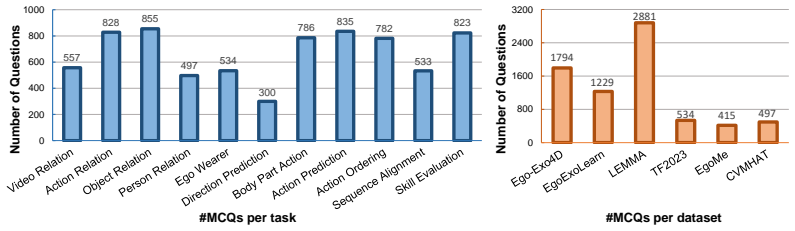
The carrying mechanism is the benchmark's construction pipeline rather than a single algorithm. EgoExoBench aggregates synchronized and asynchronous ego-exo video pairs from six public datasets; questions are produced by three strategies (annotation-derived templates, LLM generation with DeepSeek-V3, and human annotation for fine-grained spatial understanding); and a consistency check plus a vision-grounded filtering step together use Qwen2.5-32B to discard any question answerable from text alone. Each multiple-choice item presents one query video plus four candidate videos from the other viewpoint, with negative options chosen to share scene, action, or temporal cues so that only genuine cross-view reasoning selects the correct answer. This filtering is what lets the authors attribute low model scores to a missing cross-view capability rather than to language shortcuts.
What would settle it
Give an LLM the text-only version of a random sample of EgoExoBench questions (question and options, with no video frames) under the same standardized answer-extraction protocol; if accuracy on that set rises substantially above the 25 percent random baseline, the vision-grounded filter has leaked text-solvable items and the reported gap is inflated.
Extended reading notes
Core claim
EgoExoBench is the paper's central discovery: a benchmark that makes cross-view video reasoning measurable. Its eleven subtasks are organized into three dimensions: Ego-Exo Relation (task, action, object, and person matching across views), Ego-Exo View Transition (egocentric wearer identification, direction prediction, and body-part action understanding), and Ego-Exo Temporal Reasoning (action prediction, action ordering, sequence alignment, and skill evaluation). On this benchmark, 13 state-of-the-art MLLMs evaluated in a zero-shot setting score between 29.5 and 48.0 percent on average, with Gemini 2.5 Pro reaching 51.7 percent in the appendix, while deliberate human accuracy on a 330-question subset is 90.1 percent. Models that are strong on single-view benchmarks drop substantially when asked to relate two views. EgoGPT, a model fine-tuned on a large egocentric corpus, gains little over similarly sized general models, and chain-of-thought prompting hurts more than it helps on most subtasks.
Load-bearing premise
The benchmark's validity depends on the assumption that the LLM-based filtering removes every question that can be answered from text alone or from a single view, so that the remaining 7,330 multiple-choice questions genuinely require cross-view visual reasoning.
Editorial extensions
If this is right
- If the central claim is right, strong single-view video benchmarks do not predict performance on cross-view tasks, so EgoExoBench should be used alongside them when evaluating embodied and assistant models.
- Egocentric pretraining alone is not a substitute for training objectives that explicitly require associating first- and third-person views.
- Chain-of-thought-style language reasoning is not the fix; architectures or prompting methods that interleave visual and textual evidence across streams are needed.
- Providing a reference video from the other viewpoint can improve next-action prediction by up to about 9 points, so paired demonstrations may help future assistants.
- The benchmark gives the field a concrete 7,330-question yardstick: closing the 42-point gap to deliberate human accuracy is a defined target.
Reading between the lines
- The authors do not measure how often the Qwen2.5-32B filter is wrong; leaking text-solvable questions would inflate model scores and shrink the reported gap, whereas discarding questions that need visual grounding would change what the benchmark measures.
- A testable extension is to train an MLLM on the benchmark's paired videos with an explicit spatial-alignment objective, such as predicting the egocentric wearer's bounding box in the exocentric frame; the largest gains should appear on Egocentric Wearer Identification and Direction Prediction, the two spatial subtasks with the widest human-model gaps.
- Because the answer options are deliberately matched for scene and action, a model that learns viewpoint-invariant semantics without true spatial mapping could score well on Relation tasks while still failing View Transition; that dissociation would be a useful diagnostic for future systems.
Signed reviews
Editorial analysis
A structured set of objections, weighed in public.
Referee Report
Summary. The paper introduces EgoExoBench, a benchmark for evaluating multimodal large language models (MLLMs) on video understanding that requires integrating first-person (egocentric) and third-person (exocentric) views. The benchmark contains 7,330 four-choice questions across 11 subtasks grouped into three dimensions: Ego-Exo Relation, Ego-Exo View Transition, and Ego-Exo Temporal Reasoning. Questions are constructed from six public ego-exo datasets using annotation-derived templates, LLM-generated QA from Qwen2.5-32B and DeepSeek-V3, and human annotation. The authors evaluate 13 (or 14, counting the appendix) open- and closed-source MLLMs and report that the best model scores around 48% while deliberate human performance is 90.1%, leaving a 42-point gap. They further find that chain-of-thought prompting does not help and that adding a cross-view reference video helps some tasks but not others. The paper's central claim is that current MLLMs, despite strong single-view performance, lack the ability to semantically align, spatially associate, and temporally reason across ego-exo viewpoints.
Significance. If established, EgoExoBench would fill a genuine gap as the first benchmark targeting cross-view ego-exo reasoning in MLLMs, and the reported human-model gap would be an important result for embodied AI and human-robot collaboration. The paper's strengths include construction from multiple public datasets, a structured task taxonomy, a human baseline, a sanity check that MLLMs can distinguish multiple video inputs, and release of the benchmark. However, the central quantitative claim is currently under-supported: the benchmark lacks matched single-view control conditions, so low scores cannot be confidently attributed to cross-view reasoning rather than to general video difficulty or answer-format artifacts. In addition, the main table contains internal numerical contradictions and omits the best-performing model reported in the appendix. These issues are fixable and the benchmark resource is valuable, but the paper requires substantive revision before its central claim can be accepted.
major comments (4)
- [Table 1, Section 4.2, Appendix B.2] The headline human-model gap is not reproducible from the reported numbers. In Table 1, Qwen2.5-VL-72B appears twice, once with Avg 48.5 and once with Avg 44.7; the main text states that Qwen2.5-VL-72B achieves the highest overall accuracy at 47.0%, but Table 1 shows GPT-o4-mini at 48.0 as the best overall model and Qwen2.5-VL-72B at 44.7. Appendix B.2 then reports Gemini 2.5 Pro as best overall at 51.7, yet this model is absent from the main table. Depending on which table is used, the best-model-versus-human gap is approximately 38.4 to 42.1 points, and the claimed best model changes. Please reconcile these numbers, include Gemini 2.5 Pro in the main results, and report a single consistent best-model accuracy.
- [Section 3.2 and Section 3.3] The 'Vision-Grounded Filtering' step discards only questions that a text-only LLM can answer from the question text alone (Figure 11/prompt in Appendix A). This does not remove questions that are solvable from a single video view, and for tasks whose options are video clips (TR, AR, OR, PR, EWI, DP, SE, AP) there is no text for the filter to reason over at all. The comparison with single-view benchmarks in Table 5 uses different videos, question formats, and difficulty levels, so it is not a matched control. Without a control in which the same items are presented with only one view (or with same-view distractors), the reported low MLLM scores could reflect general video comprehension difficulty or MCQ artifacts rather than a cross-view reasoning deficit. Please add per-task single-view controls and an analysis of single-view solvability, and use them to substantiate the claim that the benchmark isolates cross-view reasoning.
- [Section 3.3.1, Action Relation and Object Relation] The construction of negative candidates for Action Relation is underspecified regarding viewpoint. The text says the ground-truth clip is 'temporally aligned with the query but recorded from a different viewpoint,' while negative candidates are 'selected from different temporal segments of the same video.' If the negatives come from the same viewpoint as the query, then the correct answer is the only candidate from a different viewpoint, and the task reduces to viewpoint identification rather than semantic action matching. Please clarify the viewpoint composition of all options in AR and OR, and verify with an ablation that the tasks cannot be solved by low-level viewpoint or appearance cues alone.
- [Section 4.2 and Appendix A.5] The human baseline rests on a small sample: 30 questions per subtask (330 total) answered by two graduate students. The paper reports only a single average (90.1%) with no confidence intervals, no per-annotator breakdown, and no chance-level comparison, even though some subtasks may have uneven answer distributions. This baseline is load-bearing for the central 42-point gap. Please report variance, inter-annotator agreement, and per-subtask human accuracies, and consider increasing the human evaluation set or at least providing error bars.
minor comments (5)
- [Throughout] The model name is inconsistent: the main text uses 'GPT-o4-mini' while the reference list and Appendix B.2 use 'GPT-4o mini' (or 'GPT-4o-mini'). Please unify the naming and the count of evaluated models, which is stated as 13 in the abstract but appears to be 14 including Gemini 2.5 Pro.
- [Table 5] The EgoExoBench column in Table 5 reports different values for the same models than Table 1 and Table 4 (e.g., Qwen2.5-VL-72B appears as 45.3 versus 44.7; InternVL3-78B as 40.5 versus 41.4). Please ensure that all tables report the same underlying evaluation numbers.
- [Section 3.3.2, Egocentric Wearer Identification] The construction text says TF2023 provides 'synchronized egocentric–exocentric image pairs,' but the task is described as video-based. Please clarify whether EWI (and DP) use video clips or static images, and if any subtask is image-based, qualify the 'video understanding' framing accordingly.
- [Section 4.3] The chain-of-thought analysis samples 100 questions per subtask and reports per-task accuracy differences without error bars or significance tests. Given the small sample and the magnitude of the observed differences, please add confidence intervals or a significance analysis to support the claim that CoT degrades performance.
- [Figure 2] The caption states that correct answers are 'bold-highlighted,' but the figure appears to use green highlighting. Please align the caption with the actual figure formatting.
Circularity Check
No circular derivation: the benchmark's answer keys come from annotations and human evaluation, and the central model-deficit claim is not fitted to or defined by the filtering LLMs.
full rationale
The paper's central measurements are model accuracies on MCQs whose correct answers are fixed by public dataset annotations, template construction, human annotation, and human evaluation (Sections 3.2 and A.2-A.5); no answer key is obtained from the evaluated models. The Qwen2.5-32B and DeepSeek-V3 pipeline is used for distractor generation, consistency checking, and text-only filtering, but the reported accuracy numbers are not defined in terms of those LLMs' outputs, so no prediction reduces by construction to a fitted input. Self-citations such as EgoExoLearn [23] as a data source and related-work references like CG-Bench [8] are public, independently available resources and do not carry the paper's conclusion; the paper's empirical comparison is self-contained and uses external single-view benchmarks only as context. The plausible validity concern that the vision-grounded filter removes only text-answerable questions, not single-view-solvable ones, affects construct validity of the cross-view claim but is not circularity: it does not equate any derived result with an input by definition. Reporting inconsistencies (e.g., the duplicated Qwen2.5-VL-72B row in Table 1 and Gemini 2.5 Pro appearing only in the appendix) are correctness and presentation issues, not circular steps.
Assumptions & free parameters
assumptions (4)
- domain assumption The six source datasets provide accurate ego-exo pairing and correct annotations such as synchronization, action labels, bounding boxes, and skill scores.
- domain assumption The Qwen2.5-32B and DeepSeek-V3 based filters remove all text-answerable and ambiguous questions, so the remaining MCQs require visual and cross-view understanding.
- domain assumption A four-way multiple-choice format with one correct answer is a valid instrument for measuring cross-view reasoning.
- domain assumption Two graduate students answering a 330-question subset provide a representative human performance baseline.
Cite this review
Pith. "Pith review of EgoExoBench: A Benchmark for First- and Third-person View Video Understanding in MLLMs." pith.science (2026). https://pith.science/paper/K6L7Y2LH
@misc{pith2026250718342,
  author       = {Pith},
  title        = {Pith review of: EgoExoBench: A Benchmark for First- and Third-person View Video Understanding in MLLMs},
  year         = {2026},
  howpublished = {\url{https://pith.science/paper/K6L7Y2LH}},
  note         = {Machine review of arXiv:2507.18342}
}
read the original abstract
Transferring and integrating knowledge across first-person (egocentric) and third-person (exocentric) viewpoints is intrinsic to human intelligence, enabling humans to learn from others and convey insights from their own experiences. Despite rapid progress in multimodal large language models (MLLMs), their ability to perform such cross-view reasoning remains unexplored. To address this, we introduce EgoExoBench, the first benchmark for egocentric-exocentric video understanding and reasoning. Built from publicly available datasets, EgoExoBench comprises over 7,300 question-answer pairs spanning eleven sub-tasks organized into three core challenges: semantic alignment, viewpoint association, and temporal reasoning. We evaluate 13 state-of-the-art MLLMs and find that while these models excel on single-view tasks, they struggle to align semantics across perspectives, accurately associate views, and infer temporal dynamics in the ego-exo context. We hope EgoExoBench can serve as a valuable resource for research on embodied agents and intelligent assistants seeking human-like cross-view intelligence.
Figures


Figures from the paper (24 more)


Forward citations
Cited by 6 Pith papers
-
Spatial-IQ: Deconstructing Spatial Intelligence via Hierarchical Capability Tests
A hierarchical diagnostic benchmark for counting stacked 3D objects shows that MLLMs often reach correct totals without executing the human-like prerequisite sub-tasks, and that training on those sub-tasks markedly im...
-
Vinci2: Providing Proactive Assistance in Continuous Egocentric Videos
EgoMemo uses multi-scale temporal summaries, a knowledge graph, and visual archives to decide whether and when to intervene proactively on continuous egocentric video, setting baselines on the new EgoServe benchmark o...
-
From Synchrony to Sequence: Exo-to-Ego Generation via Interpolation
Interpolating only the video frames between synchronized exo and ego clips already turns discontinuous cross-view generation into continuous sequence modeling and measurably improves diffusion-based Exo2Ego synthesis.
-
Thinking in Structures: Evaluating Spatial Intelligence in Constraint-Governed Spaces
A new human-curated benchmark of 1,000 ranking questions on real-world engineering structures shows the best vision-language model reaches 33.6% accuracy where humans reach 91.6%.
-
The N-Body Problem: Parallel Execution from Single-Person Egocentric Video
Structured prompting for a VLM, fed with ground-truth spatial zone schedules, can generate more feasible multi-agent parallel executions from single-person egocentric videos.
-
EgoExo-Con: Exploring View-Invariant Video Temporal Understanding
Most Video-LLMs answer temporal questions far less consistently when the same event is shown from ego and exo views, and a GRPO variant with a reasoning-similarity reward partially closes the gap.
Reference graph
Works this paper leans on
-
[1]
Visual-policy learning through multi-camera view to single-camera view knowledge distillation for robot manipulation tasks
Cihan Acar, Kuluhan Binici, Alp Tekirda˘g, and Yan Wu. Visual-policy learning through multi-camera view to single-camera view knowledge distillation for robot manipulation tasks. IEEE Robotics and Automation Letters, 9(1):691–698, 2023
2023
-
[2]
Claude 3.7 sonnet and claude code, 2025
Anthropic. Claude 3.7 sonnet and claude code, 2025. URL https://www.anthropic.com/news/ claude-3-7-sonnet
2025
-
[3]
Observational learning
Albert Bandura. Observational learning. The international encyclopedia of communication, 2008
2008
-
[4]
Siddhant Bansal, Chetan Arora, and C.V . Jawahar. My view is the best view: Procedure learning from egocentric videos. In Eur. Conf. Comput. Vis., 2022
2022
-
[5]
In your place: neuropsychological evidence for altercentric remapping in embodied perspective taking
Cristina Becchio, Marco Del Giudice, Olga Dal Monte, Luca Latini-Corazzini, and Lorenzo Pia. In your place: neuropsychological evidence for altercentric remapping in embodied perspective taking. Social cognitive and affective neuroscience, 8(2):165–170, 2013
2013
-
[6]
Spatial memory: how egocentric and allocentric combine
Neil Burgess. Spatial memory: how egocentric and allocentric combine. Trends in cognitive sciences, 10 (12):551–557, 2006
2006
-
[7]
Hourvideo: 1-hour video-language understanding
Keshigeyan Chandrasegaran, Agrim Gupta, Lea M Hadzic, Taran Kota, Jimming He, Cristóbal Eyzaguirre, Zane Durante, Manling Li, Jiajun Wu, and Fei-Fei Li. Hourvideo: 1-hour video-language understanding. Advances in Neural Information Processing Systems, 37:53168–53197, 2024
2024
-
[8]
Cg-bench: Clue-grounded question answering benchmark for long video understanding
Guo Chen, Yicheng Liu, Yifei Huang, Yuping He, Baoqi Pei, Jilan Xu, Yali Wang, Tong Lu, and Limin Wang. Cg-bench: Clue-grounded question answering benchmark for long video understanding. arXiv preprint arXiv:2412.12075, 2024
arXiv 2024
Show all 95 references
-
[9]
put myself into your place
Massimiliano Conson, Elisabetta Mazzarella, Dalila Esposito, Dario Grossi, Nicoletta Marino, Angelo Massagli, and Alessandro Frolli. “put myself into your place”: Embodied simulation and perspective taking in autism spectrum disorders. Autism Research, 8(4):454–466, 2015
2015
-
[10]
Scaling egocentric vision: The epic-kitchens dataset
Dima Damen, Hazel Doughty, Giovanni Maria Farinella, Sanja Fidler, Antonino Furnari, Evangelos Kazakos, Davide Moltisanti, Jonathan Munro, Toby Perrett, Will Price, et al. Scaling egocentric vision: The epic-kitchens dataset. In Proceedings of the European conference on comput...
2018
-
[11]
Epic-kitchens visor benchmark: Video segmentations and object relations
Ahmad Darkhalil, Dandan Shan, Bin Zhu, Jian Ma, Amlan Kar, Richard Higgins, Sanja Fidler, David Fouhey, and Dima Damen. Epic-kitchens visor benchmark: Video segmentations and object relations. In Proceedings of the Neural Information Processing Systems (NeurIPS) Track on Datas...
2022
-
[12]
Gemini 2.5 pro, 2025
DeepMind. Gemini 2.5 pro, 2025. URL https://deepmind.google/models/gemini/pro/
2025
-
[13]
Interacting networks of brain regions underlie human spatial navigation: a review and novel synthesis of the literature
Arne D Ekstrom, Derek J Huffman, and Michael Starrett. Interacting networks of brain regions underlie human spatial navigation: a review and novel synthesis of the literature. Journal of neurophysiology, 118 (6):3328–3344, 2017
2017
-
[14]
Video-mme: The first-ever comprehensive evaluation benchmark of multi-modal llms in video analysis
Chaoyou Fu, Yuhan Dai, Yondong Luo, Lei Li, Shuhuai Ren, Renrui Zhang, Zihan Wang, Chenyu Zhou, Yunhang Shen, Mengdan Zhang, et al. Video-mme: The first-ever comprehensive evaluation benchmark of multi-modal llms in video analysis. arXiv preprint arXiv:2405.21075, 2024
2024 arXiv
-
[15]
Complexity-based prompting for multi-step reasoning
Yao Fu, Hao Peng, Ashish Sabharwal, Peter Clark, and Tushar Khot. Complexity-based prompting for multi-step reasoning. arXiv preprint arXiv:2210.00720, 2022. 10
2022 arXiv
-
[16]
Ego4d: Around the world in 3,000 hours of egocentric video
Kristen Grauman, Andrew Westbury, Eugene Byrne, Zachary Chavis, Antonino Furnari, Rohit Girdhar, Jackson Hamburger, Hao Jiang, Miao Liu, Xingyu Liu, et al. Ego4d: Around the world in 3,000 hours of egocentric video. In Proceedings of the IEEE/CVF Conference on Computer Vision ...
2022
-
[17]
Ego-exo4d: Understanding skilled human activity from first-and third-person perspectives
Kristen Grauman, Andrew Westbury, Lorenzo Torresani, Kris Kitani, Jitendra Malik, Triantafyllos Afouras, Kumar Ashutosh, Vijay Baiyya, Siddhant Bansal, Bikram Boote, et al. Ego-exo4d: Understanding skilled human activity from first-and third-person perspectives. In Proceedings...
2024
-
[18]
Ava: A video dataset of spatio-temporally localized atomic visual actions
Chunhui Gu et al. Ava: A video dataset of spatio-temporally localized atomic visual actions. In IEEE Conf. Comput. Vis. Pattern Recog., pages 6047–6056, 2018. doi: 10.1109/CVPR.2018.00633
2018
-
[19]
Multiple human association and tracking from egocentric and complementary top views
Ruize Han, Wei Feng, Yujun Zhang, Jiewen Zhao, and Song Wang. Multiple human association and tracking from egocentric and complementary top views. IEEE Transactions on Pattern Analysis and Machine Intelligence, 44(9):5225–5242, 2022. doi: 10.1109/TPAMI.2021.3070562
2022
-
[20]
What is modelled during observational learning? Journal of sports sciences, 25(5):531–545, 2007
Nicola J Hodges, A Mark Williams, Spencer J Hayes, and Gavin Breslin. What is modelled during observational learning? Journal of sports sciences, 25(5):531–545, 2007
2007
-
[21]
An ego-vision system for discovering human joint attention
Yifei Huang, Minjie Cai, and Yoichi Sato. An ego-vision system for discovering human joint attention. IEEE Transactions on Human-Machine Systems, 50(4):306–316, 2020
2020
-
[22]
Improving action segmentation via graph-based temporal reasoning
Yifei Huang, Yusuke Sugano, and Yoichi Sato. Improving action segmentation via graph-based temporal reasoning. In Proceedings of the IEEE/CVF conference on computer vision and pattern recognition, pages 14024–14034, 2020
2020
-
[23]
Egoexolearn: A dataset for bridging asynchronous ego-and exo-centric view of procedural activities in real world
Yifei Huang, Guo Chen, Jilan Xu, Mingfang Zhang, Lijin Yang, Baoqi Pei, Hongjie Zhang, Lu Dong, Yali Wang, Limin Wang, et al. Egoexolearn: A dataset for bridging asynchronous ego-and exo-centric view of procedural activities in real world. In Proceedings of the IEEE/CVF Confer...
2024
-
[24]
Vinci: A real-time embodied smart assistant based on egocentric vision-language model
Yifei Huang, Jilan Xu, Baoqi Pei, Yuping He, Guo Chen, Lijin Yang, Xinyuan Chen, Yaohui Wang, Zheng Nie, Jinyao Liu, et al. Vinci: A real-time embodied smart assistant based on egocentric vision-language model. arXiv preprint arXiv:2412.21080, 2024
2024 arXiv
-
[25]
Gpt-4o system card
Aaron Hurst, Adam Lerer, Adam P Goucher, Adam Perelman, Aditya Ramesh, Aidan Clark, AJ Ostrow, Akila Welihinda, Alan Hayes, Alec Radford, et al. Gpt-4o system card. arXiv preprint arXiv:2410.21276, 2024
2024 arXiv
-
[26]
Lemma: A multi-view dataset for le arning m ulti-agent m ulti-task a ctivities
Baoxiong Jia, Yixin Chen, Siyuan Huang, Yixin Zhu, and Song-Chun Zhu. Lemma: A multi-view dataset for le arning m ulti-agent m ulti-task a ctivities. In European Conference on Computer Vision, pages 767–786. Springer, 2020
2020
-
[27]
Egotaskqa: Understanding human tasks in egocentric videos
Baoxiong Jia, Ting Lei, Song-Chun Zhu, and Siyuan Huang. Egotaskqa: Understanding human tasks in egocentric videos. Advances in Neural Information Processing Systems, 35:3343–3360, 2022
2022
-
[28]
Large language models are zero-shot reasoners
Takeshi Kojima, Shixiang Shane Gu, Machel Reid, Yutaka Matsuo, and Yusuke Iwasawa. Large language models are zero-shot reasoners. Advances in neural information processing systems, 35:22199–22213, 2022
2022
-
[29]
A neural code for egocentric spatial maps in the human medial temporal lobe
Lukas Kunz, Armin Brandt, Peter C Reinacher, Bernhard P Staresina, Eric T Reifenstein, Christoph T Weidemann, Nora A Herweg, Ansh Patel, Melina Tsitsiklis, Richard Kempter, et al. A neural code for egocentric spatial maps in the human medial temporal lobe. Neuron, 109(17):2781...
2021
-
[30]
H2o: Two hands manipulating objects for first person interaction recognition
Taein Kwon, Bugra Tekin, Jan Stühmer, Federica Bogo, and Marc Pollefeys. H2o: Two hands manipulating objects for first person interaction recognition. In Int. Conf. Comput. Vis., 2021
2021
-
[31]
Llava-onevision: Easy visual task transfer
Bo Li, Yuanhan Zhang, Dong Guo, Renrui Zhang, Feng Li, Hao Zhang, Kaichen Zhang, Peiyuan Zhang, Yanwei Li, Ziwei Liu, et al. Llava-onevision: Easy visual task transfer. arXiv preprint arXiv:2408.03326, 2024
2024 arXiv
-
[32]
igibson 2.0: Object-centric simulation for robot learning of everyday household tasks
Chengshu Li, Fei Xia, Roberto Martín-Martín, Michael Lingelbach, Sanjana Srivastava, Bokui Shen, Kent Vainio, Cem Gokmen, Gokul Dharan, Tanish Jain, et al. igibson 2.0: Object-centric simulation for robot learning of everyday household tasks. arXiv preprint arXiv:2108.03272, 2021
2021 arXiv
-
[33]
Videochat: Chat-centric video understanding
KunChang Li, Yinan He, Yi Wang, Yizhuo Li, Wenhai Wang, Ping Luo, Yali Wang, Limin Wang, and Yu Qiao. Videochat: Chat-centric video understanding. arXiv preprint arXiv:2305.06355, 2023. 11
2023 arXiv
-
[34]
Mvbench: A comprehensive multi-modal video understanding benchmark
Kunchang Li, Yali Wang, Yinan He, Yizhuo Li, Yi Wang, Yi Liu, Zun Wang, Jilan Xu, Guo Chen, Ping Luo, et al. Mvbench: A comprehensive multi-modal video understanding benchmark. In Proceedings of the IEEE/CVF Conference on Computer Vision and Pattern Recognition, pages 22195–22...
2024
-
[35]
Ego-exo: Transferring visual representa- tions from third-person to first-person videos
Yanghao Li, Tushar Nagarajan, Bo Xiong, and Kristen Grauman. Ego-exo: Transferring visual representa- tions from third-person to first-person videos. In Proceedings of the IEEE/CVF Conference on Computer Vision and Pattern Recognition, pages 6943–6953, 2021
2021
-
[36]
Deepseek-v3 technical report
Aixin Liu, Bei Feng, Bing Xue, Bingxuan Wang, Bochao Wu, Chengda Lu, Chenggang Zhao, Chengqi Deng, Chenyu Zhang, Chong Ruan, et al. Deepseek-v3 technical report. arXiv preprint arXiv:2412.19437, 2024
2024 arXiv
-
[37]
Skill transfer learning for autonomous robots and human–robot cooperation: A survey
Yueyue Liu, Zhijun Li, Huaping Liu, and Zhen Kan. Skill transfer learning for autonomous robots and human–robot cooperation: A survey. Robotics and Autonomous Systems, 128:103515, 2020
2020
-
[38]
Hoi4d: A 4d egocentric dataset for category-level human-object interaction
Yunze Liu, Yun Liu, Che Jiang, Kangbo Lyu, Weikang Wan, Hao Shen, Boqiang Liang, Zhoujie Fu, He Wang, and Li Yi. Hoi4d: A 4d egocentric dataset for category-level human-object interaction. In Proceedings of the IEEE/CVF Conference on Computer Vision and Pattern Recognition, pa...
2022
-
[39]
Nvila: Efficient frontier visual language models
Zhijian Liu, Ligeng Zhu, Baifeng Shi, Zhuoyang Zhang, Yuming Lou, Shang Yang, Haocheng Xi, Shiyi Cao, Yuxian Gu, Dacheng Li, et al. Nvila: Efficient frontier visual language models. arXiv preprint arXiv:2412.04468, 2024
2024 arXiv
-
[40]
Egoschema: A diagnostic benchmark for very long-form video language understanding
Karttikeya Mangalam, Raiymbek Akshulakov, and Jitendra Malik. Egoschema: A diagnostic benchmark for very long-form video language understanding. Advances in Neural Information Processing Systems, 36:46212–46244, 2023
2023
-
[41]
Howto100m: Learning a text-video embedding by watching hundred million narrated video clips
Antoine Miech, Dimitri Zhukov, Jean-Baptiste Alayrac, Makarand Tapaswi, Ivan Laptev, and Josef Sivic. Howto100m: Learning a text-video embedding by watching hundred million narrated video clips. In Proceedings of the IEEE/CVF international conference on computer vision, pages ...
2019
-
[42]
Gpt-4o mini: advancing cost-efficient intelligence, 07 2024
OpenAI. Gpt-4o mini: advancing cost-efficient intelligence, 07 2024. URL https://openai.com/ index/gpt-4o-mini-advancing-cost-efficient-intelligence/
2024
-
[43]
Egovlpv2: Egocentric video-language pre-training with fusion in the backbone
Shraman Pramanick, Yale Song, Sayan Nag, Kevin Qinghong Lin, Hardik Shah, Mike Zheng Shou, Rama Chellappa, and Pengchuan Zhang. Egovlpv2: Egocentric video-language pre-training with fusion in the backbone. In Proceedings of the IEEE/CVF International Conference on Computer Vis...
2023
-
[44]
Egome: Follow me via egocentric view in real world
Heqian Qiu, Zhaofeng Shi, Lanxiao Wang, Huiyu Xiong, Xiang Li, and Hongliang Li. Egome: Follow me via egocentric view in real world. arXiv preprint arXiv:2501.19061, 2025
2025 arXiv
-
[45]
Synchronization is all you need: Exocentric-to-egocentric transfer for temporal action segmenta- tion with unlabeled synchronized video pairs, 2023
Camillo Quattrocchi, Antonino Furnari, Daniele Di Mauro, Mario Valerio Giuffrida, and Giovanni Maria Farinella. Synchronization is all you need: Exocentric-to-egocentric transfer for temporal action segmenta- tion with unlabeled synchronized video pairs, 2023. arXiv:2312.02638
2023 arXiv
-
[46]
The meccano dataset: Understanding human-object interactions from egocentric videos in an industrial-like domain
Francesco Ragusa, Antonino Furnari, Salvatore Livatino, and Giovanni Maria Farinella. The meccano dataset: Understanding human-object interactions from egocentric videos in an industrial-like domain. In Proceedings of the IEEE/CVF Winter Conference on Applications of Computer ...
2021
-
[47]
Home action genome: Cooperative compositional action understanding
Nishant Rai, Haofeng Chen, Jingwei Ji, Rishi Desai, Kazuki Kozuka, Shun Ishizaka, Ehsan Adeli, and Juan Carlos Niebles. Home action genome: Cooperative compositional action understanding. In IEEE Conf. Comput. Vis. Pattern Recog., 2021
2021
-
[48]
Watch and learn: the cognitive neuroscience of learning from others’ actions
Richard Ramsey, David M Kaplan, and Emily S Cross. Watch and learn: the cognitive neuroscience of learning from others’ actions. Trends in neurosciences, 44(6):478–491, 2021
2021
-
[49]
Sentence-bert: Sentence embeddings using siamese bert-networks
Nils Reimers and Iryna Gurevych. Sentence-bert: Sentence embeddings using siamese bert-networks. In Proceedings of the 2019 Conference on Empirical Methods in Natural Language Processing. Association for Computational Linguistics, 11 2019. URL https://arxiv.org/abs/1908.10084
2019 arXiv
-
[50]
A systematic survey of prompt engineering in large language models: Techniques and applications
Pranab Sahoo, Ayush Kumar Singh, Sriparna Saha, Vinija Jain, Samrat Mondal, and Aman Chadha. A systematic survey of prompt engineering in large language models: Techniques and applications. arXiv preprint arXiv:2402.07927, 2024. 12
2024 arXiv
-
[51]
Sener, D
F. Sener, D. Chatterjee, D. Shelepov, K. He, D. Singhania, R. Wang, and A. Yao. Assembly101: A large-scale multi-view video dataset for understanding procedural activities. In IEEE Conf. Comput. Vis. Pattern Recog., 2022
2022
-
[52]
Self-supervised disentangled representation learning for third-person imitation learning
Jinghuan Shang and Michael S Ryoo. Self-supervised disentangled representation learning for third-person imitation learning. In 2021 IEEE/RSJ International Conference on Intelligent Robots and Systems (IROS), pages 214–221. IEEE, 2021
2021
-
[53]
Third-person visual imitation learning via decoupled hierarchical controller
Pratyusha Sharma, Deepak Pathak, and Abhinav Gupta. Third-person visual imitation learning via decoupled hierarchical controller. Advances in Neural Information Processing Systems, 32, 2019
2019
-
[54]
Actor and observer: Joint modeling of first and third-person videos
Gunnar A Sigurdsson, Abhinav Gupta, Cordelia Schmid, Ali Farhadi, and Karteek Alahari. Actor and observer: Joint modeling of first and third-person videos. In proceedings of the IEEE conference on computer vision and pattern recognition, pages 7396–7404, 2018
2018
-
[55]
Ego4d goal-step: Toward hierarchical understanding of procedural activities
Yale Song, Eugene Byrne, Tushar Nagarajan, Huiyu Wang, Miguel Martin, and Lorenzo Torresani. Ego4d goal-step: Toward hierarchical understanding of procedural activities. Adv. Neural Inform. Process. Syst., 2024
2024
-
[56]
Ucf101: A dataset of 101 human actions classes from videos in the wild, 2012
Khurram Soomro, Amir Roshan Zamir, and Mubarak Shah. Ucf101: A dataset of 101 human actions classes from videos in the wild, 2012. arXiv:1212.0402
2012 arXiv
-
[57]
Qwen2.5-vl, January 2025
Qwen Team. Qwen2.5-vl, January 2025. URL https://qwenlm.github.io/blog/qwen2.5-vl/
2025
-
[58]
Learning from semantic alignment between unpaired multiviews for egocentric video recognition
Qitong Wang, Long Zhao, Liangzhe Yuan, Ting Liu, and Xi Peng. Learning from semantic alignment between unpaired multiviews for egocentric video recognition. In Int. Conf. Comput. Vis., 2023
2023
-
[59]
Lvbench: An extreme long video understanding benchmark
Weihan Wang, Zehai He, Wenyi Hong, Yean Cheng, Xiaohan Zhang, Ji Qi, Xiaotao Gu, Shiyu Huang, Bin Xu, Yuxiao Dong, et al. Lvbench: An extreme long video understanding benchmark. arXiv preprint arXiv:2406.08035, 2024
2024 arXiv
-
[60]
Self-consistency improves chain of thought reasoning in language models
Xuezhi Wang, Jason Wei, Dale Schuurmans, Quoc Le, Ed Chi, Sharan Narang, Aakanksha Chowdhery, and Denny Zhou. Self-consistency improves chain of thought reasoning in language models. arXiv preprint arXiv:2203.11171, 2022
2022 arXiv
-
[61]
See what i see: Enabling user-centric robotic assistance using first-person demonstrations
Yeping Wang, Gopika Ajaykumar, and Chien-Ming Huang. See what i see: Enabling user-centric robotic assistance using first-person demonstrations. In Proceedings of the 2020 ACM/IEEE International Conference on Human-Robot Interaction, pages 639–648, 2020
2020
-
[62]
Chain-of-thought prompting elicits reasoning in large language models
Jason Wei, Xuezhi Wang, Dale Schuurmans, Maarten Bosma, Fei Xia, Ed Chi, Quoc V Le, Denny Zhou, et al. Chain-of-thought prompting elicits reasoning in large language models. Advances in neural information processing systems, 35:24824–24837, 2022
2022
-
[63]
Incomplete multi-view domain adaptation via channel enhancement and knowledge transfer
Haifeng Xia, Pu Wang, and Zhengming Ding. Incomplete multi-view domain adaptation via channel enhancement and knowledge transfer. In Eur. Conf. Comput. Vis., 2022
2022
-
[64]
Next-qa: Next phase of question-answering to explaining temporal actions
Junbin Xiao, Xindi Shang, Angela Yao, and Tat-Seng Chua. Next-qa: Next phase of question-answering to explaining temporal actions. In Proceedings of the IEEE/CVF conference on computer vision and pattern recognition, pages 9777–9786, 2021
2021
-
[65]
Can i trust your answer? visually grounded video question answering
Junbin Xiao, Angela Yao, Yicong Li, and Tat-Seng Chua. Can i trust your answer? visually grounded video question answering. In Proceedings of the IEEE/CVF Conference on Computer Vision and Pattern Recognition, pages 13204–13214, 2024
2024
-
[66]
Pov: Prompt-oriented view-agnostic learning for egocentric hand-object interaction in the multi-view world
Boshen Xu, Sipeng Zheng, and Qin Jin. Pov: Prompt-oriented view-agnostic learning for egocentric hand-object interaction in the multi-view world. In ACM Int. Conf. Multimedia, pages 2807–2816, 2023
2023
-
[67]
Retrieval-augmented egocentric video captioning
Jilan Xu, Yifei Huang, Junlin Hou, Guo Chen, Yuejie Zhang, Rui Feng, and Weidi Xie. Retrieval-augmented egocentric video captioning. In Proceedings of the IEEE/CVF Conference on Computer Vision and Pattern Recognition, pages 13525–13536, 2024
2024
-
[68]
Egoexo-gen: Ego-centric video prediction by watching exo-centric videos
Jilan Xu, Yifei Huang, Baoqi Pei, Junlin Hou, Qingqiu Li, Guo Chen, Yuejie Zhang, Rui Feng, and Weidi Xie. Egoexo-gen: Ego-centric video prediction by watching exo-centric videos. arXiv preprint arXiv:2504.11732, 2025
2025 arXiv
-
[69]
Advancing high-resolution video-language representation with large-scale video transcriptions
Hongwei Xue, Tiankai Hang, Yanhong Zeng, Yuchong Sun, Bei Liu, Huan Yang, Jianlong Fu, and Baining Guo. Advancing high-resolution video-language representation with large-scale video transcriptions. In Proceedings of the IEEE/CVF Conference on Computer Vision and Pattern Recog...
2022
-
[70]
An Yang, Baosong Yang, Beichen Zhang, Binyuan Hui, Bo Zheng, Bowen Yu, Chengyuan Li, Dayiheng Liu, Fei Huang, Haoran Wei, et al. Qwen2. 5 technical report. arXiv preprint arXiv:2412.15115, 2024
2024 arXiv
-
[71]
Thinking in space: How multimodal large language models see, remember, and recall spaces.arXiv preprint arXiv:2412.14171, 2024
Jihan Yang, Shusheng Yang, Anjali W Gupta, Rilyn Han, Li Fei-Fei, and Saining Xie. Thinking in space: How multimodal large language models see, remember, and recall spaces.arXiv preprint arXiv:2412.14171, 2024
2024 arXiv
-
[72]
Egolife: Towards egocentric life assistant
Jingkang Yang, Shuai Liu, Hongming Guo, Yuhao Dong, Xiamengwei Zhang, Sicheng Zhang, Pengyun Wang, Zitang Zhou, Binzhu Xie, Ziyue Wang, et al. Egolife: Towards egocentric life assistant. arXiv preprint arXiv:2503.03803, 2025
2025
-
[73]
Interact before align: Leveraging cross-modal knowledge for domain adaptive action recognition
Lijin Yang, Yifei Huang, Yusuke Sugano, and Yoichi Sato. Interact before align: Leveraging cross-modal knowledge for domain adaptive action recognition. In Proceedings of the IEEE/CVF conference on computer vision and pattern recognition, 2022
2022
-
[74]
Fine-grained affordance annotation for egocentric hand-object interaction videos
Zecheng Yu, Yifei Huang, Ryosuke Furuta, Takuma Yagi, Yusuke Goutsu, and Yoichi Sato. Fine-grained affordance annotation for egocentric hand-object interaction videos. In Proceedings of the IEEE/CVF Winter Conference on Applications of Computer Vision, 2023
2023
-
[75]
Video instruction tuning with synthetic data
Yuanhan Zhang, Jinming Wu, Wei Li, Bo Li, Zejun Ma, Ziwei Liu, and Chunyuan Li. Video instruction tuning with synthetic data. arXiv preprint arXiv:2410.02713, 2024
2024 arXiv
-
[76]
Fusing personal and environmental cues for identification and segmentation of first-person camera wearers in third-person views
Ziwei Zhao, Yuchen Wang, and Chuhua Wang. Fusing personal and environmental cues for identification and segmentation of first-person camera wearers in third-person views. In Proceedings of the IEEE/CVF Conference on Computer Vision and Pattern Recognition, pages 16477–16487, 2024
2024
-
[77]
Progressive-hint prompting improves reasoning in large language models
Chuanyang Zheng, Zhengying Liu, Enze Xie, Zhenguo Li, and Yu Li. Progressive-hint prompting improves reasoning in large language models. arXiv preprint arXiv:2304.09797, 2023
2023 arXiv
-
[78]
Mlvu: A comprehensive benchmark for multi-task long video understanding
Junjie Zhou, Yan Shu, Bo Zhao, Boya Wu, Shitao Xiao, Xi Yang, Yongping Xiong, Bo Zhang, Tiejun Huang, and Zheng Liu. Mlvu: A comprehensive benchmark for multi-task long video understanding. arXiv preprint arXiv:2406.04264, 2024
2024 arXiv
-
[79]
Internvl3: Exploring advanced training and test-time recipes for open-source multimodal models
Jinguo Zhu, Weiyun Wang, Zhe Chen, Zhaoyang Liu, Shenglong Ye, Lixin Gu, Yuchen Duan, Hao Tian, Weijie Su, Jie Shao, et al. Internvl3: Exploring advanced training and test-time recipes for open-source multimodal models. arXiv preprint arXiv:2504.10479, 2025. A Additional detai...
2025 arXiv
-
[80]
Each QA pair should include one question, four answer options, and one correct answer
-
[81]
The question must clearly address details from both descriptions, particularly focusing on the roles of the body parts, without directly referencing specific actions or objects to prevent giving away hints
-
[82]
Ensure there is one correct answer, and the other three options should be plausible but incorrect to increase the difficulty
-
[83]
Use 'Video 1' to refer Video 1, use 'Video 2' to refer Video 2
-
[84]
Question
The output must be in JSON format as follows: ```json { "Question": "The question text goes here", "Options": { "A": "Option A text", "B": "Option B text", "C": "Option C text", "D": "Option D text" }, "Answer": "Correct option letter (e.g., 'A')" } ``` Example Input: Video 1:...
-
[85]
Providing an incorrect sequence of actions
-
[86]
Video 1" and the second video as
Making false statements about the presence or absence of specific actions; Accuracy: Avoid vague or overly subjective questions. Do not introduce actions or details that are not present in the provided sequences. Naming Convention: Refer to the first video as "Video 1" and the...
-
[87]
The person appears to be preparing materials on the table
-
[88]
They seem to be handling a test tube, possibly doing a covering or sealing action
-
[89]
There's a focus on opening or handling some instruction or paper
-
[90]
Video 2:
The testing plate is being unwrapped and possibly manipulated. Video 2:
-
[91]
The person is seen handling materials on a table
-
[92]
They unwrap the testing plate and handle the test tube
-
[93]
Conclusion: After reviewing the sequences, Option B correctly describes the actions
After unwrapping, they perform actions with the test tube, such as covering it. Conclusion: After reviewing the sequences, Option B correctly describes the actions. B. In Video 1, the test tube is covered before unwrapping the testing plate, whereas in Video 2, the test tube i...
-
[94]
Query Video Analysis: The query video features a person annotated with a bounding box who is dressed in blue and is standing in a more distant position relative to others
-
[95]
Video 2: The person within the bounding box is positioned at the bottom of the scene, facing upwards, and is in a different area relative to others
Candidate Videos Analysis: Video 1: The person within the bounding box is located in the middle area, positioned closer to others, and is facing towards the lower part of the image. Video 2: The person within the bounding box is positioned at the bottom of the scene, facing up...
Reviewed August 15, 2026 · model on record in the stance chip above.
Discussion (0). Continue with ORCID to comment.