REVIEW 3 major objections 4 minor 300 references
Learning from Limited and Imperfect Data
T0 review · 3 major / 4 minor · reviewed 2026-08-06 · deepseek-v4-flash
Pith's one-line read This thesis shows that deep networks can learn effectively from long-tailed and domain-shifted data when the training loop has balanced feedback, covering GAN generation, classifier regularization, semi-supervised metric optimization, and…
desk verdict A transparent, well-organized compilation thesis of nine strong peer-reviewed papers; the new framing is honest but the practical-algorithms claim outruns the balanced-feedback assumptions the methods actually require. read the letter →
The pith
A machine-rendered reading of the paper's core claim, the machinery that carries it, and where it could break.
The reading
What carries the argument
The unifying mechanism is a regularization prior that transfers a well-behaved property from data-rich classes (head classes, source domain) to data-poor ones (tail classes, target domain). Concretely, the thesis uses spectral norm bounds on grouped conditional BatchNorm parameters to prevent class-specific mode collapse, a BarlowTwins-style cross-correlation objective to decorrelate StyleGAN W-space latents, sharpness-aware minimization on re-weighted losses to escape saddle points, a weighted consistency regularizer with a held-out balanced set to guide self-training, a selected mixup distribution to optimize non-decomposable metrics, submodular score functions for representative sample selection, and a smoothing radius for domain adversarial training. Each of these is inexpensive relative to re-curating or re-generating data.
What would settle it
Retrain NoisyTwins and its StyleGAN2-ADA baseline on ImageNet-LT with identical hyperparameters and random seeds; if the reported relative FID improvement of roughly 19 percent and the iFID-CLIP gains do not reproduce, the thesis's strongest generative claim fails.
Extended reading notes
Core claim
The central claim is that the failures of deep models on imperfect data are systematic, hence correctable. On long-tailed data, conditional GANs collapse on tail classes because class-specific conditional BatchNorm parameters explode in spectral norm and because StyleGAN latents collapse in W-space; classifiers converge to saddle points on tail-class losses; self-training ignores minority classes; and domain-adversarial training lands in sharp minima. Each part of the thesis identifies the mechanism and introduces a targeted fix—a class-balancing regularizer that uses a pretrained classifier's feedback, a group spectral regularizer on cBN parameters, a NoisyTwins contrastive decorrelation of W-space latents, sharpness-aware minimization, cost-sensitive self-training, selective mixup, submodular subset selection, and smooth domain adversarial training—so that tail classes and target domains achieve the same kind of generalizable solutions as head classes and source domains.
Load-bearing premise
All of the reported gains assume that reliable balanced feedback is available during training or evaluation—a pretrained classifier that can recognize tail classes, or a balanced held-out set—so the methods may not transfer to deployments where no such balanced signal exists.
Editorial extensions
If this is right
- Practitioners can train image generators and classifiers directly on raw long-tailed data instead of discarding samples from head classes to force balance.
- Semi-supervised long-tailed learning can be steered by non-decomposable metrics such as worst-case recall using only a small balanced held-out set for feedback.
- Domain adaptation can be made sample-efficient by labeling a few informative target points selected by submodular criteria and by converging to smooth minima in the source loss.
- Vision Transformers can be trained from scratch on long-tailed datasets via distillation from flat CNN teachers rather than requiring large balanced pre-training.
Reading between the lines
- The repeated pattern suggests a general recipe: identify a property that holds on data-rich classes and regularize to extend it to data-poor classes; this could transfer to other imbalance settings such as federated learning with skewed client data or foundation-model fine-tuning on rare categories.
- The NoisyTwins finding that W-space collapse tracks mode collapse may carry over to other generative architectures, so a similar decorrelation objective might help class-conditional diffusion models on long-tailed data.
- The CSST/SelMix idea of using a small balanced validation set to set training weights could be combined with foundation-model fine-tuning to adapt non-decomposable objectives without full re-training.
Editorial analysis
A structured set of objections, weighed in public.
Referee Report
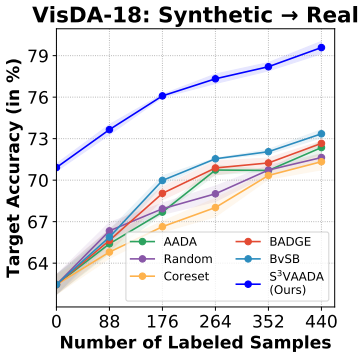
Summary. This thesis, submitted as a PhD dissertation and posted on arXiv, consolidates nine peer-reviewed papers on learning from long-tailed and domain-shifted data. Part I proposes CBGAN, gSR, and NoisyTwins to stabilize GAN training on long-tailed distributions; Part II applies sharpness-aware minimization to class-imbalanced classification and introduces DeiT-LT for vision transformers; Part III develops CSST and SelMix for semi-supervised optimization of non-decomposable metrics; Part IV contributes S3V AADA and SDAT for efficient domain adaptation. The abstract's central claim is that these methods enable deep networks to learn effectively from limited and imperfect data, with headline results such as NoisyTwins scaling StyleGAN2 to ImageNet-LT and CSST providing strong theoretical guarantees.
Significance. If the headline results hold, the thesis is significant. It offers a coherent toolbox for long-tail generation (NoisyTwins), recognition (SAM, DeiT-LT), semi-supervised metric optimization (CSST, SelMix), and efficient adaptation (S3V AADA, SDAT), each backed by peer review. The appendices include proofs of the main theoretical results, including weighted-expansion bounds for CSST, convergence analysis for SelMix, and edge-of-stability analyses for SDAT, as well as ablations for the key hyperparameters. Some chapters also report statistical analyses (App. C.3.1, E.5, F.13, H.11). The main caveat is that the end-to-end thesis claim is broader than the settings validated: most methods rely on balanced held-out feedback or a pretrained classifier, and the manuscript does not quantify behavior when that feedback is absent, noisy, or itself long-tailed.
major comments (3)
- [Abstract, Secs. 7.5, 8.4, 2.4.4] The headline claim that the methods are practical for real-world 'limited and imperfect data' is established only under curated balanced-feedback conditions. CSST sets its gain matrix from a balanced held-out set (Sec. 7.5), SelMix selects its mixup distribution by optimizing the target metric on a balanced held-out set (Sec. 8.4), CBGAN requires a pretrained classifier and diverges when tail accuracy is zero (Sec. 2.4.4), and SDAT chooses its perturbation radius per dataset (App. H.9). No experiment in the thesis varies the quality or distribution of this feedback, for example by using long-tailed, noisy, or absent validation sets. The thesis-level claim should be re-scoped or supplemented with such a sensitivity analysis; otherwise the reported gains cannot be expected to transfer to the uncurated deployment scenario emphasized in the motivation.
- [Secs. 7.5 and 8.4] There is a potential validation-fitting circularity. In CSST and SelMix, the held-out set is used both to choose training weights (or the mixup distribution) and to report the final non-decomposable metric. If the numbers in Tables 7.2-7.4 and 8.2-8.4 are computed on the same set used for this feedback, the reported improvements are optimistically biased. Please clarify explicitly whether a separate test set was used for the reported numbers. If a separate test set was used, report the held-out selection curves as well; if not, add an evaluation on a disjoint held-out set to support the state-of-the-art claims.
- [Sec. 7.3.3 and Theorem 7.4] The 'strong guarantees' claimed for CSST depend on a weighted expansion property of the unlabeled data. This property is assumed, not verified on CIFAR-LT, ImageNet, or the NLP datasets, and no diagnostic is reported. Since the guarantee is conditional on an unmeasured condition, the abstract's wording overstates what is established. Either verify the property empirically, or rephrase the theoretical claim as a conditional guarantee with the expansion assumption clearly stated in the abstract and introduction.
minor comments (4)
- [Sec. 2.3.2, Eq. (2.15)] The displayed bound in Eq. (2.15) is ambiguous because the typesetting of the denominator, involving N^k and a sum of inverse N^k terms, makes the direction and scaling of the bound hard to parse. Please rewrite the expression with explicit parentheses and define all quantities in the display.
- [Tables 6.3, 8.2, 10.1] Several headline tables report a single number for each method, while standard deviations appear only in appendices. For claims of state-of-the-art performance by small margins, please include error bars or significance tests in the main text, or clearly indicate which numbers are already reported with uncertainty in the appendix.
- [Sec. 2.4.3] The semi-supervised experiment uses a classifier fine-tuned with 0.1% labeled data. The text should state more explicitly whether the same classifier provides the labels used for the regularizer during GAN training and for the annotator used to compute KL divergence, since the two roles could lead to different conclusions about the method's data efficiency.
- [General] The thesis does not provide a single runnable artifact; individual chapters refer to different project pages or provide no code link. For reproducibility, include one consolidated code release or a table listing the available code repositories for each chapter.
Circularity Check
Partial evaluation-loop circularity: CBGAN's class-balance metric is the same classifier signal it optimizes, and CSST/SelMix tune on the same family of metrics they report; core FID/accuracy results remain externally benchmarked.
-
self definitional
[Sec. 2.3.2 (Eq. 2.7) and Sec. 2.4 'Evaluation metrics' (Table 2.1)]
"The regularizer objective is defined as the minimization of the term ( Lreg) below: min ˆp X k ˆpk log( ˆpk) N t k (2.7) ... where ˆp = Pn i=1 C(G(zi)) n ... KL Divergence w.r.t. Uniform Distribution of labels : Labels for the generated samples are obtained by using the pre-trained classifier (trained on balanced data) as an annotator."
The training regularizer in Eq. (2.7) is a weighted entropy of the pretrained classifier's predicted class distribution over generated images; the KL-Divergence evaluation in Sec. 2.4 is computed from the same classifier-predicted label distribution over generated samples. A generator that makes the classifier's outputs uniform therefore scores low KL by construction, so the reported 'balanced distribution' improvement in Table 2.1 is partly the training objective itself. FID and classifier accuracy on real labels are external and keep the core result non-circular.
-
fitted input called prediction
[Abstract; Sec. 1.3.3; Sec. 7.3.4-7.5; Sec. 8.4]
"we introduce a paradigm where we measure the performance using relevant non-decomposable metrics such as worst-case recall and recall H-mean on a held-out set, and we use their feedback to learn in a semi-supervised long-tailed setting. ... We introduce an online algorithm that periodically measures the model performance on the held-out set and then dynamically adjusts the self-training regularizer to effectively optimize the desired metric objective."
The headline metrics of CSST and SelMix (worst-case recall, H-mean, mean recall under coverage) are the same quantities computed on the held-out set and used to update the gain matrix or mixup distribution. Thus the reported gains are partially a direct optimization of the evaluation statistic rather than an independent prediction of it. Whether this is fully circular depends on whether the reported test set is disjoint from the feedback set; the thesis does not demonstrate that, and the limitations appendices (F.1.1, G.13) concede reliance on a balanced held-out set. This is a mild validation-fitting burden, not a mathematical reduction.
full rationale
The thesis is a compilation of externally benchmarked works: gSR, SAM for class-imbalanced learning, DeiT-LT, SDAT, and S3VAADA derive their regularizers or objectives from stated assumptions and evaluate on standard datasets (CIFAR-LT, ImageNet-LT, iNaturalist, Office-Home, VisDA), so most chapters are self-contained empirical derivations. No load-bearing self-citation chain or imported uniqueness theorem was found; citations of the author's prior papers are contextual. The clearest circularity is in CBGAN: the class-balance regularizer and the KL-Divergence evaluation are both classifier-predicted label distributions over generated images, making the KL result partly self-definitional. CSST and SelMix are transparent about using held-out metric feedback to set training weights, but this creates a mild validation-fitting burden because the reported metric is the same family as the feedback signal; the appendices acknowledge the balanced-validation assumption. NoisyTwins proposes a CLIP-based iFID metric, but standard FID also improves, so the main state-of-the-art claim does not rest solely on the self-defined metric. Overall score 4 reflects partial evaluation-loop circularity while the core benchmark results remain independent.
Assumptions & free parameters
free parameters (8)
- CBGAN exponential forgetting factor alpha =
0.5
- CBGAN regularizer weight lambda =
scaled by imbalance ratio (Table A.6)
- gSR effective-number alpha =
0.99
- gSR group size ng =
16
- NoisyTwins noise std sigma and loss weight lambda =
ablated ranges in Fig. 4.7
- SAM perturbation radius rho =
dataset-specific values (App. D.1, H.8)
- SelMix inverse temperature s =
ablated in App. G.11
- SDAT perturbation radius rho =
dataset-specific values (App. H.9)
assumptions (5)
- domain assumption Evaluation uses balanced held-out sets as ground truth for all classes.
- domain assumption A pretrained classifier's predicted labels are a reliable proxy for the true class of generated images.
- ad hoc to paper A weighted expansion property holds for the unlabeled data in semi-supervised long-tail learning.
- domain assumption Cluster assumption: target-domain unlabeled samples form class-consistent clusters in feature space.
- standard math Standard GAN convergence and loss landscape analyses, including power iteration for spectral norms and Hessian eigenvalue computations.
Cite this review
Pith. "Pith review of Learning from Limited and Imperfect Data." pith.science (2026). https://pith.science/paper/A3SNGKK7
@misc{pith2026250721205,
  author       = {Pith},
  title        = {Pith review of: Learning from Limited and Imperfect Data},
  year         = {2026},
  howpublished = {\url{https://pith.science/paper/A3SNGKK7}},
  note         = {Machine review of arXiv:2507.21205}
}
read the original abstract
The distribution of data in the world (eg, internet, etc.) significantly differs from the well-curated datasets and is often over-populated with samples from common categories. The algorithms designed for well-curated datasets perform suboptimally when used for learning from imperfect datasets with long-tailed imbalances and distribution shifts. To expand the use of deep models, it is essential to overcome the labor-intensive curation process by developing robust algorithms that can learn from diverse, real-world data distributions. Toward this goal, we develop practical algorithms for Deep Neural Networks which can learn from limited and imperfect data present in the real world. This thesis is divided into four segments, each covering a scenario of learning from limited or imperfect data. The first part of the thesis focuses on Learning Generative Models from Long-Tail Data, where we mitigate the mode-collapse and enable diverse aesthetic image generations for tail (minority) classes. In the second part, we enable effective generalization on tail classes through Inductive Regularization schemes, which allow tail classes to generalize as effectively as the head classes without requiring explicit generation of images. In the third part, we develop algorithms for Optimizing Relevant Metrics for learning from long-tailed data with limited annotation (semi-supervised), followed by the fourth part, which focuses on the Efficient Domain Adaptation of the model to various domains with very few to zero labeled samples.
Figures


Figures from the paper (48 more)




Reference graph
Works this paper leans on
-
[1]
Sharp-maml: Sharpness- aware model-agnostic meta learning
Momin Abbas, Quan Xiao, Lisha Chen, Pin-Yu Chen, and Tianyi Chen. Sharp-maml: Sharpness- aware model-agnostic meta learning. arXiv preprint arXiv:2206.03996 , 2022. 61
arXiv 2022
-
[2]
Labels4free: Unsupervised seg- mentation using stylegan
Rameen Abdal, Peihao Zhu, Niloy J Mitra, and Peter Wonka. Labels4free: Unsupervised seg- mentation using stylegan. In IEEE/CVF International Conference on Computer Vision (ICCV), pages 13970–13979, 2021. 3
2021
-
[3]
Quantifying attention flow in transformers
Samira Abnar and Willem Zuidema. Quantifying attention flow in transformers. arXiv preprint arXiv:2005.00928, 2020. xxi, xxvi, 85, 203
arXiv 2005
-
[4]
f-Domain-Adversarial Learning: Theory and Algorithms
David Acuna, Guojun Zhang, Marc T Law, and Sanja Fidler. f-domain-adversarial learning: Theory and algorithms. arXiv preprint arXiv:2106.11344 , 2021. 134, 135, 136, 137, 141, 269, 270, 272
work page Pith review arXiv 2021
-
[5]
Degan: Data-enriching gan for retrieving representative samples from a trained classifier
Sravanti Addepalli, Gaurav Kumar Nayak, Anirban Chakraborty, and Venkatesh Babu Rad- hakrishnan. Degan: Data-enriching gan for retrieving representative samples from a trained classifier. In AAAI Conference on Artificial Intelligence , volume 34, pages 3130–3137, 2020. 16
2020
-
[6]
One-network adversarial fairness
Tameem Adel, Isabel Valera, Zoubin Ghahramani, and Adrian Weller. One-network adversarial fairness. In AAAI Conference on Artificial Intelligence , volume 33, pages 2412–2420, 2019. 133
2019
-
[7]
Evaluating clip: towards characterization of broader capabilities and downstream implications
Sandhini Agarwal, Gretchen Krueger, Jack Clark, Alec Radford, Jong Wook Kim, and Miles Brundage. Evaluating clip: towards characterization of broader capabilities and downstream implications. arXiv preprint arXiv:2108.02818 , 2021. 74
arXiv 2021
-
[8]
Negative eigenvalues of the hessian in deep neural networks
Guillaume Alain, Nicolas Le Roux, and Pierre-Antoine Manzagol. Negative eigenvalues of the hessian in deep neural networks. arXiv preprint arXiv:1902.02366 , 2019. 61
arXiv 1902
Show all 300 references
-
[9]
Hyperstyle: Stylegan inversion with hypernetworks for real image editing
Yuval Alaluf, Omer Tov, Ron Mokady, Rinon Gal, and Amit Bermano. Hyperstyle: Stylegan inversion with hypernetworks for real image editing. In IEEE/CVF Conference on Computer Vision and Pattern Recognition (CVPR) , pages 18511–18521, June 2022. 44
2022
-
[10]
The long tail: Why the future of business is selling less of more
Chris Anderson. The long tail: Why the future of business is selling less of more. Wired, 12(10),
-
[11]
Understanding sharpness-aware minimiza- tion, 2022
Maksym Andriushchenko and Nicolas Flammarion. Understanding sharpness-aware minimiza- tion, 2022. URL https://openreview.net/forum?id=qXa0nhTRZGV. 63, 64 282
2022
-
[12]
Sharpness- aware minimization leads to low-rank features
Maksym Andriushchenko, Dara Bahri, Hossein Mobahi, and Nicolas Flammarion. Sharpness- aware minimization leads to low-rank features. arXiv preprint arXiv:2305.16292 , 2023. 79, 204
2023 arXiv
-
[13]
Wasserstein GAN
Martin Arjovsky, Soumith Chintala, and L´ eon Bottou. Wasserstein GAN. arXiv preprint arXiv:1701.07875, 2017. 10
2017 arXiv
-
[14]
Theory of deep learn- ing, 2020
Raman Arora, SANJEEV Arora, Joan Bruna, NADA V Cohen, SIMON DU, RONG GE, SURIYA GUNASEKAR, C Jin, JASON LEE, TENGYU MA, et al. Theory of deep learn- ing, 2020. 59
2020
-
[15]
Ash, Chicheng Zhang, Akshay Krishnamurthy, John Langford, and Alekh Agarwal
Jordan T. Ash, Chicheng Zhang, Akshay Krishnamurthy, John Langford, and Alekh Agarwal. Deep batch active learning by diverse, uncertain gradient lower bounds. In International Con- ference on Learning Representations (ICLR), 2020. URL https://openreview.net/forum?id= ryghZJBKP...
2020
-
[16]
Schapire
Peter Auer, Nicolo Cesa-Bianch, Yoav Freund, and Robert E. Schapire. The non-stochastic multi-armed bandit problem. SIAM Journal of Computing , 32(1):48–77, 2002. 237
2002
-
[17]
Sharpness-aware minimization improves language model generalization
Dara Bahri, Hossein Mobahi, and Yi Tay. Sharpness-aware minimization improves language model generalization. arXiv preprint arXiv:2110.08529 , 2021. 61
2021 arXiv
-
[18]
Can we gain more from orthogonality regularizations in training deep networks? Advances in Neural Information Processing Systems (NeurIPS), 31, 2018
Nitin Bansal, Xiaohan Chen, and Zhangyang Wang. Can we gain more from orthogonality regularizations in training deep networks? Advances in Neural Information Processing Systems (NeurIPS), 31, 2018. 32, 38, 40
2018
-
[19]
VICReg: Variance-invariance-covariance regu- larization for self-supervised learning
Adrien Bardes, Jean Ponce, and Yann LeCun. VICReg: Variance-invariance-covariance regu- larization for self-supervised learning. In International Conference on Learning Representations (ICLR), 2022. URL https://openreview.net/forum?id=xm6YD62D1Ub. xx, 43, 48
2022
-
[20]
A theory of learning from different domains
Shai Ben-David, John Blitzer, Koby Crammer, Alex Kulesza, Fernando Pereira, and Jen- nifer Wortman Vaughan. A theory of learning from different domains. Machine learning, 79(1): 151–175, 2010. 136, 141
2010
-
[21]
Cubuk, Alex Kurakin, Kihyuk Sohn, Han Zhang, and Colin Raffel
David Berthelot, Nicholas Carlini, Ekin D. Cubuk, Alex Kurakin, Kihyuk Sohn, Han Zhang, and Colin Raffel. Remixmatch: Semi-supervised learning with distribution alignment and aug- mentation anchoring. CoRR, abs/1911.09785, 2019. 106
1911 arXiv
-
[22]
Mixmatch: A holistic approach to semi-supervised learning
David Berthelot, Nicholas Carlini, Ian Goodfellow, Nicolas Papernot, Avital Oliver, and Colin A Raffel. Mixmatch: A holistic approach to semi-supervised learning. In H. Wallach, H. Larochelle, A. Beygelzimer, F. d 'Alch´ e-Buc, E. Fox, and R. Garnett, editors,Advances in Neura...
2019
-
[23]
Adamatch: A unified approach to semi-supervised learning and domain adaptation
David Berthelot, Rebecca Roelofs, Kihyuk Sohn, Nicholas Carlini, and Alex Kurakin. Adamatch: A unified approach to semi-supervised learning and domain adaptation. arXiv preprint arXiv:2106.04732, 2021. 280
2021 arXiv
-
[24]
Bhattacharyya
A. Bhattacharyya. On a measure of divergence between two multinomial populations. Sankhy¯ a: The Indian Journal of Statistics (1933-1960) , 7(4):401–406, 1946. ISSN 00364452. URL http: //www.jstor.org/stable/25047882. 124
1933
-
[25]
Stylegan knows normal, depth, albedo, and more
Anand Bhattad, Daniel McKee, Derek Hoiem, and David Forsyth. Stylegan knows normal, depth, albedo, and more. Advances in Neural Information Processing Systems , 36, 2024. 3
2024
-
[26]
Experiment tracking with weights and biases, 2020
Lukas Biewald. Experiment tracking with weights and biases, 2020. URL https://www.wandb. com/. Software available from wandb.com. 190, 264, 275
2020
-
[27]
Low-pass filtering sgd for recovering flat optima in the deep learning optimization landscape
Devansh Bisla, Jing Wang, and Anna Choromanska. Low-pass filtering sgd for recovering flat optima in the deep learning optimization landscape. arXiv preprint arXiv:2201.08025, 2022. 61, 70, 190
2022 arXiv
-
[28]
An isoperimetric inequality on the discrete cube, and an elementary proof of the isoperimetric inequality in gauss space
Sergey G Bobkov. An isoperimetric inequality on the discrete cube, and an elementary proof of the isoperimetric inequality in gauss space. The Annals of Probability , 25(1):206–214, 1997. 208
1997
-
[29]
Finding directions in gan’s latent space for neural face reenactment
Stella Bounareli, Vasileios Argyriou, and Georgios Tzimiropoulos. Finding directions in gan’s latent space for neural face reenactment. arXiv preprint arXiv:2202.00046 , 2022. 41
2022 arXiv
-
[30]
Large scale GAN training for high fidelity natural image synthesis
Andrew Brock, Jeff Donahue, and Karen Simonyan. Large scale GAN training for high fidelity natural image synthesis. In International Conference on Learning Representations (ICLR), 2019. URL https://openreview.net/forum?id=B1xsqj09Fm. xviii, xxv, 6, 21, 27, 28, 30, 34, 36, 38, ...
2019
-
[31]
A systematic study of the class im- balance problem in convolutional neural networks
Mateusz Buda, Atsuto Maki, and Maciej A Mazurowski. A systematic study of the class im- balance problem in convolutional neural networks. Neural Networks , 106:249–259, 2018. 57, 60
2018
-
[32]
What is the effect of importance weighting in deep learning? In International Conference on Machine Learning (ICML) , pages 872–881
Jonathon Byrd and Zachary Lipton. What is the effect of importance weighting in deep learning? In International Conference on Machine Learning (ICML) , pages 872–881. PMLR, 2019. 58
2019
-
[33]
Ace: Ally complementary experts for solving long-tailed recognition in one-shot
Jiarui Cai, Yizhou Wang, and Jenq-Neng Hwang. Ace: Ally complementary experts for solving long-tailed recognition in one-shot. In IEEE/CVF International Conference on Computer Vision (ICCV), 2021. 81
2021
-
[34]
Learning imbalanced datasets with label-distribution-aware margin loss
Kaidi Cao, Colin Wei, Adrien Gaidon, Nikos Arechiga, and Tengyu Ma. Learning imbalanced datasets with label-distribution-aware margin loss. InAdvances in Neural Information Processing Systems (NeurIPS) , volume 32, 2019. 18, 19, 28, 32, 33, 58, 60, 66, 67, 68, 73, 75, 78, 80, ...
2019
-
[35]
End-to-end object detection with transformers
Nicolas Carion, Francisco Massa, Gabriel Synnaeve, Nicolas Usunier, Alexander Kirillov, and Sergey Zagoruyko. End-to-end object detection with transformers. In European Conference on Computer Vision (ECCV) , pages 213–229. Springer, 2020. 73
2020
-
[36]
Lower bounds for finding stationary points I
Yair Carmon, John C Duchi, Oliver Hinder, and Aaron Sidford. Lower bounds for finding stationary points I. Mathematical Programming, 184(1):71–120, 2020. 140, 271
2020
-
[37]
Unsupervised learning of visual features by contrasting cluster assignments
Mathilde Caron, Ishan Misra, Julien Mairal, Priya Goyal, Piotr Bojanowski, and Armand Joulin. Unsupervised learning of visual features by contrasting cluster assignments. 2020. 45
2020
-
[38]
Emerging properties in self-supervised vision transformers
Mathilde Caron, Hugo Touvron, Ishan Misra, Herv´ e J´ egou, Julien Mairal, Piotr Bojanowski, and Armand Joulin. Emerging properties in self-supervised vision transformers. In International Conference on Computer Vision (ICCV) , 2021. 7
2021
-
[39]
Instance-conditioned gan
Arantxa Casanova, Marl` ene Careil, Jakob Verbeek, Michal Drozdzal, and Adriana Romero- Soriano. Instance-conditioned gan. In Advances in Neural Information Processing Systems (NeurIPS), 2021. 45, 51, 53
2021
-
[40]
Is facial recognition too biased to be let loose? Nature, 587(7834):347–350,
Davide Castelvecchi. Is facial recognition too biased to be let loose? Nature, 587(7834):347–350,
-
[41]
Swad: Domain generalization by seeking flat minima
Junbum Cha, Sanghyuk Chun, Kyungjae Lee, Han-Cheol Cho, Seunghyun Park, Yunsung Lee, and Sungrae Park. Swad: Domain generalization by seeking flat minima. arXiv preprint arXiv:2102.08604, 2021. 134, 146, 277
2021 arXiv
-
[42]
Adaptive batch mode active learning
Shayok Chakraborty, Vineeth Balasubramanian, and Sethuraman Panchanathan. Adaptive batch mode active learning. IEEE transactions on neural networks and learning systems , 26 (8):1747–1760, 2014. 125
2014
-
[43]
Semi-supervised learning (chapelle, o
Olivier Chapelle, Bernhard Scholkopf, and Alexander Zien. Semi-supervised learning (chapelle, o. et al., eds.; 2006)[book reviews]. IEEE Transactions on Neural Networks, 20(3):542–542, 2009. 89
2006
-
[44]
Joint transfer and batch-mode active learning
Rita Chattopadhyay, Wei Fan, Ian Davidson, Sethuraman Panchanathan, and Jieping Ye. Joint transfer and batch-mode active learning. In International Conference on Machine Learning (ICML), pages 253–261. PMLR, 2013. 121, 264
2013
-
[45]
Entropy-sgd: Biasing gradient descent into wide valleys
Pratik Chaudhari, Anna Choromanska, Stefano Soatto, Yann LeCun, Carlo Baldassi, Christian Borgs, Jennifer Chayes, Levent Sagun, and Riccardo Zecchina. Entropy-sgd: Biasing gradient descent into wide valleys. Journal of Statistical Mechanics: Theory and Experiment , 2019(12): 1...
2019
-
[46]
Smote: synthetic minority over-sampling technique
Nitesh V Chawla, Kevin W Bowyer, Lawrence O Hall, and W Philip Kegelmeyer. Smote: synthetic minority over-sampling technique. Journal of artificial intelligence research , 16:321– 357, 2002. 60 285
2002
-
[47]
Transmix: Attend to mix for vision transformers
Jie-Neng Chen, Shuyang Sun, Ju He, Philip HS Torr, Alan Yuille, and Song Bai. Transmix: Attend to mix for vision transformers. In IEEE/CVF Conference on Computer Vision and Pattern Recognition (CVPR), pages 12135–12144, 2022. 107
2022
-
[48]
Reltrans- former: A transformer-based long-tail visual relationship recognition
Jun Chen, Aniket Agarwal, Sherif Abdelkarim, Deyao Zhu, and Mohamed Elhoseiny. Reltrans- former: A transformer-based long-tail visual relationship recognition. In IEEE Conference on Computer Vision and Pattern Recognition (CVPR) , 2022. 74, 82
2022
-
[49]
Adversarial-learned loss for domain adaptation
Minghao Chen, Shuai Zhao, Haifeng Liu, and Deng Cai. Adversarial-learned loss for domain adaptation. In AAAI Conference on Artificial Intelligence , volume 34, pages 3521–3528, 2020. 118
2020
-
[50]
Adversarial-learned loss for domain adaptation
Minghao Chen, Shuai Zhao, Haifeng Liu, and Deng Cai. Adversarial-learned loss for domain adaptation. arXiv, abs/2001.01046, 2020. 128
2001 arXiv
-
[51]
A simple framework for contrastive learning of visual representations
Ting Chen, Simon Kornblith, Mohammad Norouzi, and Geoffrey Hinton. A simple framework for contrastive learning of visual representations. arXiv preprint arXiv:2002.05709 , 2020. 53
2002 arXiv
-
[52]
When vision transformers outperform resnets without pretraining or strong data augmentations
Xiangning Chen, Cho-Jui Hsieh, and Boqing Gong. When vision transformers outperform resnets without pretraining or strong data augmentations. arXiv preprint arXiv:2106.01548 , 2021. 143, 273
2021 arXiv
-
[53]
Domain adaptive faster r-cnn for object detection in the wild
Yuhua Chen, Wen Li, Christos Sakaridis, Dengxin Dai, and Luc Van Gool. Domain adaptive faster r-cnn for object detection in the wild. In IEEE/CVF Conference on Computer Vision and Pattern Recognition (CVPR) , pages 3339–3348, 2018. 144, 146, 275
2018
-
[54]
New exponential bounds and approx- imations for the computation of error probability in fading channels
Marco Chiani, Davide Dardari, and Marvin K Simon. New exponential bounds and approx- imations for the computation of error probability in fading channels. IEEE Transactions on Wireless Communications, 2(4):840–845, 2003. 214
2003
-
[55]
Smoothness and stability in gans
Casey Chu, Kentaro Minami, and Kenji Fukumizu. Smoothness and stability in gans. arXiv preprint arXiv:2002.04185, 2020. 138
2002 arXiv
-
[56]
Improving generalization with active learning
David Cohn, Les Atlas, and Richard Ladner. Improving generalization with active learning. Machine learning, 15(2):201–221, 1994. 119
1994
-
[57]
Facility location problem — Wikipedia, the free encyclopedia,
Wikipedia contributors. Facility location problem — Wikipedia, the free encyclopedia,
-
[58]
The cityscapes dataset for seman- tic urban scene understanding
Marius Cordts, Mohamed Omran, Sebastian Ramos, Timo Rehfeld, Markus Enzweiler, Rodrigo Benenson, Uwe Franke, Stefan Roth, and Bernt Schiele. The cityscapes dataset for seman- tic urban scene understanding. In IEEE/CVF Conference on Computer Vision and Pattern Recognition (CVPR...
2016
-
[59]
Training well-generalizing classifiers for fairness metrics and other data-dependent constraints
Andrew Cotter, Maya Gupta, Heinrich Jiang, Nathan Srebro, Karthik Sridharan, Serena Wang, Blake Woodworth, and Seungil You. Training well-generalizing classifiers for fairness metrics and other data-dependent constraints. In International Conference on Machine Learning (ICML) ...
2019
-
[60]
Optimization with non-differentiable constraints with applications to fairness, recall, churn, and other goals
Andrew Cotter, Heinrich Jiang, Maya R Gupta, Serena Wang, Taman Narayan, Seungil You, and Karthik Sridharan. Optimization with non-differentiable constraints with applications to fairness, recall, churn, and other goals. J. Mach. Learn. Res. , 20(172):1–59, 2019. 91, 108, 109, 207
2019
-
[61]
Parametric contrastive learning
Jiequan Cui, Zhisheng Zhong, Shu Liu, Bei Yu, and Jiaya Jia. Parametric contrastive learning. In IEEE/CVF International Conference on Computer Vision (ICCV) , pages 715–724, 2021. 70, 75, 80, 81, 83, 193, 196, 197, 198, 199
2021
-
[62]
Gradually vanishing bridge for adversarial domain adaptation
Shuhao Cui, Shuhui Wang, Junbao Zhuo, Chi Su, Qingming Huang, and Tian Qi. Gradually vanishing bridge for adversarial domain adaptation. In IEEE/CVF Conference on Computer Vision and Pattern Recognition (CVPR) , 2020. 133, 147
2020
-
[63]
Class-balanced loss based on effective number of samples
Yin Cui, Menglin Jia, Tsung-Yi Lin, Yang Song, and Serge Belongie. Class-balanced loss based on effective number of samples. In IEEE/CVF Conference on Computer Vision and Pattern Recognition (CVPR), pages 9268–9277, 2019. 47, 58, 73, 75, 78, 81, 83, 102
2019
-
[64]
Class-balanced loss based on effective number of samples
Yin Cui, Menglin Jia, Tsung-Yi Lin, Yang Song, and Serge Belongie. Class-balanced loss based on effective number of samples. In IEEE Conference on Computer Vision and Pattern Recogni- tion (CVPR) , 2019. 18, 19, 28, 32, 33
2019
-
[65]
Escaping saddles with stochastic gradients
Hadi Daneshmand, Jonas Kohler, Aurelien Lucchi, and Thomas Hofmann. Escaping saddles with stochastic gradients. In International Conference on Machine Learning (ICML) , pages 1155–1164. PMLR, 2018. 58, 61, 65, 66, 187
2018
-
[66]
Identifying and attacking the saddle point problem in high-dimensional non- convex optimization
Yann N Dauphin, Razvan Pascanu, Caglar Gulcehre, Kyunghyun Cho, Surya Ganguli, and Yoshua Bengio. Identifying and attacking the saddle point problem in high-dimensional non- convex optimization. Advances in Neural Information Processing Systems (NeurIPS) , 27, 2014. 58, 61, 63
2014
-
[67]
Modulating early visual processing by language
Harm De Vries, Florian Strub, J´ er´ emie Mary, Hugo Larochelle, Olivier Pietquin, and Aaron C Courville. Modulating early visual processing by language. In Advances in Neural Information Processing Systems (NeurIPS), pages 6594–6604, 2017. 13, 26
2017
-
[68]
J. Deng, W. Dong, R. Socher, L.-J. Li, K. Li, and L. Fei-Fei. Imagenet: A large-scale hierarchical image database. In CVPR09, 2009. 10
2009
-
[69]
Imagenet: A large-scale hierarchical image database
Jia Deng, Wei Dong, Richard Socher, Li-Jia Li, Kai Li, and Li Fei-Fei. Imagenet: A large-scale hierarchical image database. In 2009 IEEE/CVF Conference on Computer Vision and Pattern Recognition (CVPR), 2009. 28 287
2009
-
[70]
Cluster alignment with a teacher for unsupervised domain adaptation
Zhijie Deng, Yucen Luo, and Jun Zhu. Cluster alignment with a teacher for unsupervised domain adaptation. In IEEE/CVF International Conference on Computer Vision (ICCV) , pages 9944– 9953, 2019. 120
2019
-
[71]
Discriminative unsupervised feature learning with exemplar convolutional neural networks
Alexey Dosovitskiy, Philipp Fischer, Jost Tobias Springenberg, Martin Riedmiller, and Thomas Brox. Discriminative unsupervised feature learning with exemplar convolutional neural networks. IEEE TPAMI, 2015. 73
2015
-
[72]
An image is worth 16x16 words: Transformers for image recognition at scale
Alexey Dosovitskiy, Lucas Beyer, Alexander Kolesnikov, Dirk Weissenborn, Xiaohua Zhai, Thomas Unterthiner, Mostafa Dehghani, Matthias Minderer, Georg Heigold, Sylvain Gelly, et al. An image is worth 16x16 words: Transformers for image recognition at scale. In International Con...
2020
-
[73]
An image is worth 16x16 words: Transformers for image recognition at scale
Alexey Dosovitskiy, Lucas Beyer, Alexander Kolesnikov, Dirk Weissenborn, Xiaohua Zhai, Thomas Unterthiner, Mostafa Dehghani, Matthias Minderer, Georg Heigold, Sylvain Gelly, et al. An image is worth 16x16 words: Transformers for image recognition at scale. In International Con...
2021
-
[74]
Global and local mixture consistency cumulative learning for long-tailed visual recognitions
Fei Du, Peng Yang, Qi Jia, Fengtao Nan, Xiaoting Chen, and Yun Yang. Global and local mixture consistency cumulative learning for long-tailed visual recognitions. In IEEE/CVF Conference on Computer Vision and Pattern Recognition (CVPR) , pages 15814–15823, 2023. 153
2023
-
[75]
Adversarial active learning for deep networks: a margin based approach
Melanie Ducoffe and Frederic Precioso. Adversarial active learning for deep networks: a margin based approach. arXiv preprint arXiv:1802.09841 , 2018. 264
2018 arXiv
-
[76]
Computing nonvacuous generalization bounds for deep (stochastic) neural networks with many more parameters than training data
Gintare Karolina Dziugaite and Daniel M Roy. Computing nonvacuous generalization bounds for deep (stochastic) neural networks with many more parameters than training data. arXiv preprint arXiv:1703.11008, 2017. 135
2017 arXiv
-
[77]
Scalable learning of non-decomposable objectives
Elad Eban, Mariano Schain, Alan Mackey, Ariel Gordon, Ryan Rifkin, and Gal Elidan. Scalable learning of non-decomposable objectives. In Artificial intelligence and statistics , pages 832–840. PMLR, 2017. 107
2017
-
[78]
The pascal visual object classes (voc) challenge
Mark Everingham, Luc Van Gool, Christopher KI Williams, John Winn, and Andrew Zisserman. The pascal visual object classes (voc) challenge. International journal of computer vision , 88 (2):303–338, 2010. 145
2010
-
[79]
Cossl: Co-learning of representation and classifier for imbalanced semi-supervised learning
Yue Fan, Dengxin Dai, Anna Kukleva, and Bernt Schiele. Cossl: Co-learning of representation and classifier for imbalanced semi-supervised learning. In The IEEE Conference on Computer Vision and Pattern Recognition (CVPR) , 2022. 105, 106, 110, 114, 241
2022
-
[80]
Sharpness-aware mini- mization for efficiently improving generalization
Pierre Foret, Ariel Kleiner, Hossein Mobahi, and Behnam Neyshabur. Sharpness-aware mini- mization for efficiently improving generalization. arXiv preprint arXiv:2010.01412 , 2020. xxi, 6, 73, 74, 75, 79, 80, 153, 198, 199, 206 288
2010 arXiv
-
[81]
Sharpness-aware mini- mization for efficiently improving generalization
Pierre Foret, Ariel Kleiner, Hossein Mobahi, and Behnam Neyshabur. Sharpness-aware mini- mization for efficiently improving generalization. In International Conference on Learning Rep- resentations (ICLR) , 2021. URL https://openreview.net/forum?id=6Tm1mposlrM. 58, 61, 134, 13...
2021
-
[82]
A decision-theoretic generalization of on-line learning and an application to boosting
Yoav Freund and Robert E Schapire. A decision-theoretic generalization of on-line learning and an application to boosting. Journal of computer and system sciences , 55(1):119–139, 1997. 113, 236, 237, 238
1997
-
[83]
Unsupervised domain adaptation by backpropagation
Yaroslav Ganin and Victor Lempitsky. Unsupervised domain adaptation by backpropagation. In International Conference on Machine Learning (ICML) , pages 1180–1189. PMLR, 2015. 118, 120, 121, 133, 135, 139, 258, 262, 276
2015
-
[84]
Domain-adversarial training of neural net- works
Yaroslav Ganin, Evgeniya Ustinova, Hana Ajakan, Pascal Germain, Hugo Larochelle, Fran¸ cois Laviolette, Mario Marchand, and Victor Lempitsky. Domain-adversarial training of neural net- works. The journal of machine learning research , 17(1):2096–2030, 2016. 141, 143, 147, 273, 274
2016
-
[85]
Escaping from saddle points—online stochas- tic gradient for tensor decomposition
Rong Ge, Furong Huang, Chi Jin, and Yang Yuan. Escaping from saddle points—online stochas- tic gradient for tensor decomposition. In Conference on learning theory, pages 797–842. PMLR,
-
[86]
An investigation into neural net optimiza- tion via hessian eigenvalue density
Behrooz Ghorbani, Shankar Krishnan, and Ying Xiao. An investigation into neural net optimiza- tion via hessian eigenvalue density. In International Conference on Machine Learning (ICML) , pages 2232–2241. PMLR, 2019. 273
2019
-
[87]
An investigation into neural net op- timization via hessian eigenvalue density
Behrooz Ghorbani, Shankar Krishnan, and Ying Xiao. An investigation into neural net op- timization via hessian eigenvalue density. In Kamalika Chaudhuri and Ruslan Salakhutdi- nov, editors, 36th International Conference on Machine Learning (ICML) , volume 97 of Pro- ceedings o...
2019
-
[88]
A loss curvature perspective on training instability in deep learning
Justin Gilmer, Behrooz Ghorbani, Ankush Garg, Sneha Kudugunta, Behnam Neyshabur, David Cardoze, George Dahl, Zachary Nado, and Orhan Firat. A loss curvature perspective on training instability in deep learning. arXiv preprint arXiv:2110.04369 , 2021. 62, 190
-
[89]
Imagebind: One embedding space to bind them all
Rohit Girdhar, Alaaeldin El-Nouby, Zhuang Liu, Mannat Singh, Kalyan Vasudev Alwala, Ar- mand Joulin, and Ishan Misra. Imagebind: One embedding space to bind them all. arXiv preprint arXiv:2305.05665, 2023. 104
2023 arXiv
-
[90]
Satisfying real-world goals with dataset constraints
Gabriel Goh, Andrew Cotter, Maya Gupta, and Michael P Friedlander. Satisfying real-world goals with dataset constraints. Advances in Neural Information Processing Systems (NeurIPS) , 29, 2016. 90, 109
2016
-
[91]
Goluba and Henk A
H. Goluba and Henk A. van der Vorstb. Eigenvalue computation in the 20 th century gene
-
[92]
Generative adversarial nets
Ian Goodfellow, Jean Pouget-Abadie, Mehdi Mirza, Bing Xu, David Warde-Farley, Sherjil Ozair, Aaron Courville, and Yoshua Bengio. Generative adversarial nets. In Advances in Neural In- formation Processing Systems (NeurIPS) , volume 27, pages 2672–2680, 2014. 3, 10, 26, 28, 134
2014
-
[93]
Generative adversarial networks
Ian Goodfellow, Jean Pouget-Abadie, Mehdi Mirza, Bing Xu, David Warde-Farley, Sherjil Ozair, Aaron Courville, and Yoshua Bengio. Generative adversarial networks. Communications of the ACM, 63(11):139–144, 2020. 46
2020
-
[94]
Bootstrap your own latent-a new approach to self-supervised learning
Jean-Bastien Grill, Florian Strub, Florent Altch´ e, Corentin Tallec, Pierre Richemond, Elena Buchatskaya, Carl Doersch, Bernardo Avila Pires, Zhaohan Guo, Mohammad Gheshlaghi Azar, et al. Bootstrap your own latent-a new approach to self-supervised learning. Advances in Neural...
2020
-
[95]
Weighted entropy
Silviu Guia¸ su. Weighted entropy. Reports on Mathematical Physics , 2(3):165–179, 1971. 16, 157, 158
1971
-
[96]
Improved training of wasserstein gans
Ishaan Gulrajani, Faruk Ahmed, Martin Arjovsky, Vincent Dumoulin, and Aaron C Courville. Improved training of wasserstein gans. In Advances in Neural Information Processing Systems (NeurIPS), pages 5767–5777, 2017. xxxi, 10, 18, 28, 158, 160, 175
2017
-
[97]
Ganspace: Discovering interpretable gan controls
Erik H¨ ark¨ onen, Aaron Hertzmann, Jaakko Lehtinen, and Sylvain Paris. Ganspace: Discovering interpretable gan controls. Advances in Neural Information Processing Systems (NeurIPS) , 33: 9841–9850, 2020. 41
2020
-
[98]
Haibo He and Edwardo A. Garcia. Learning from imbalanced data. IEEE Transactions on Knowledge and Data Engineering , 21(9):1263–1284, 2009. doi: 10.1109/TKDE.2008.239. 60
2009 doi
-
[99]
Asymmetric valleys: beyond sharp and flat local minima
Haowei He, Gao Huang, and Yang Yuan. Asymmetric valleys: beyond sharp and flat local minima. In 33rd International Conference on Neural Information Processing Systems , pages 2553–2564, 2019. 135
2019
-
[100]
Deep residual learning for image recognition
Kaiming He, Xiangyu Zhang, Shaoqing Ren, and Jian Sun. Deep residual learning for image recognition. In IEEE Conference on Computer Vision and Pattern Recognition (CVPR) , June
-
[101]
Deep residual learning for image recognition
Kaiming He, Xiangyu Zhang, Shaoqing Ren, and Jian Sun. Deep residual learning for image recognition. In IEEE/CVF Conference on Computer Vision and Pattern Recognition (CVPR) , pages 770–778, 2016. 19, 73, 99, 141, 143, 145
2016
-
[102]
Masked autoencoders are scalable vision learners
Kaiming He, Xinlei Chen, Saining Xie, Yanghao Li, Piotr Doll´ ar, and Ross Girshick. Masked autoencoders are scalable vision learners. In IEEE/CVF Conference on Computer Vision and Pattern Recognition (CVPR), pages 16000–16009, 2022. 104 290
2022
-
[103]
Using self-supervised learning can improve model robustness and uncertainty
Dan Hendrycks, Mantas Mazeika, Saurav Kadavath, and Dawn Song. Using self-supervised learning can improve model robustness and uncertainty. Advances in neural information pro- cessing systems, 32, 2019. 7
2019
-
[104]
Gans trained by a two time-scale update rule converge to a local nash equilibrium
Martin Heusel, Hubert Ramsauer, Thomas Unterthiner, Bernhard Nessler, and Sepp Hochreiter. Gans trained by a two time-scale update rule converge to a local nash equilibrium. Advances in Neural Information Processing Systems (NeurIPS) , 30:6626–6637, 2017. 11, 20, 43, 49
2017
-
[105]
Simplifying neural nets by discovering flat minima
Sepp Hochreiter and J¨ urgen Schmidhuber. Simplifying neural nets by discovering flat minima. Advances in Neural Information Processing Systems (NeurIPS) , 7, 1994. 135
1994
-
[106]
Flat minima
Sepp Hochreiter and J¨ urgen Schmidhuber. Flat minima. Neural computation, 9(1):1–42, 1997. 61, 135
1997
-
[107]
Safa:sample-adaptive feature augmentation for long-tailed image classification
Yan Hong, Jianfu Zhang, Zhongyi Sun, and Ke Yan. Safa:sample-adaptive feature augmentation for long-tailed image classification. In European Conference on Computer Vision (ECCV), 2022. 83
2022
-
[108]
Disentangling label distribution for long-tailed visual recognition
Youngkyu Hong, Seungju Han, Kwanghee Choi, Seokjun Seo, Beomsu Kim, and Buru Chang. Disentangling label distribution for long-tailed visual recognition. In IEEE Conference on Com- puter Vision and Pattern Recognition (CVPR) , 2021. 75
2021
-
[109]
Addressing the loss-metric mismatch with adaptive loss alignment
Chen Huang, Shuangfei Zhai, Walter Talbott, Miguel Bautista Martin, Shih-Yu Sun, Carlos Guestrin, and Josh Susskind. Addressing the loss-metric mismatch with adaptive loss alignment. In International Conference on Machine Learning (ICML) , pages 2891–2900. PMLR, 2019. 103
2019
-
[110]
Group whitening: Balancing learning efficiency and representational capacity
Lei Huang, Yi Zhou, Li Liu, Fan Zhu, and Ling Shao. Group whitening: Balancing learning efficiency and representational capacity. In IEEE/CVF Conference on Computer Vision and Pattern Recognition (CVPR), 2021. 30, 32, 174
2021
-
[111]
Arbitrary style transfer in real-time with adaptive instance normalization
Xun Huang and Serge Belongie. Arbitrary style transfer in real-time with adaptive instance normalization. In IEEE international conference on computer vision , pages 1501–1510, 2017. 46
2017
-
[112]
Selecmix: Debiased learning by contradicting-pair sampling
Inwoo Hwang, Sangjun Lee, Yunhyeok Kwak, Seong Joon Oh, Damien Teney, Jin-Hwa Kim, and Byoung-Tak Zhang. Selecmix: Debiased learning by contradicting-pair sampling. Advances in Neural Information Processing Systems (NeurIPS) , 35:14345–14357, 2022. 251
2022
-
[113]
The inaturalist 2019 competition dataset
iNaturalist. The inaturalist 2019 competition dataset. https://github.com/visipedia/inat_ comp/tree/2019, 2019. 11, 21, 28, 33, 36, 158, 172
2019
-
[114]
Cross-domain weakly- supervised object detection through progressive domain adaptation
Naoto Inoue, Ryosuke Furuta, Toshihiko Yamasaki, and Kiyoharu Aizawa. Cross-domain weakly- supervised object detection through progressive domain adaptation. In IEEE/CVF Conference on Computer Vision and Pattern Recognition (CVPR) , pages 5001–5009, 2018. 145
2018
-
[115]
Batch normalization: Accelerating deep network training by reducing internal covariate shift
Sergey Ioffe and Christian Szegedy. Batch normalization: Accelerating deep network training by reducing internal covariate shift. arXiv preprint arXiv:1502.03167 , 2015. 158 291
2015 arXiv
-
[116]
Class-balanced distillation for long-tailed visual recognition
Ahmet Iscen, Andr´ e Araujo, Boqing Gong, and Cordelia Schmid. Class-balanced distillation for long-tailed visual recognition. 2021. 83, 84
2021
-
[117]
Averaging weights leads to wider optima and better generalization
Pavel Izmailov, Dmitrii Podoprikhin, Timur Garipov, Dmitry Vetrov, and Andrew Gordon Wilson. Averaging weights leads to wider optima and better generalization. arXiv preprint arXiv:1803.05407, 2018. 277
2018 arXiv
-
[118]
Rethinking class-balanced methods for long-tailed visual recognition from a domain adaptation perspective
Muhammad Abdullah Jamal, Matthew Brown, Ming-Hsuan Yang, Liqiang Wang, and Boqing Gong. Rethinking class-balanced methods for long-tailed visual recognition from a domain adaptation perspective. In IEEE Conference on Computer Vision and Pattern Recognition (CVPR), 2020. 81
2020
-
[119]
The break-even point on optimization trajectories of deep neural networks
Stanislaw Jastrzebski, Maciej Szymczak, Stanislav Fort, Devansh Arpit, Jacek Tabor, Kyunghyun Cho*, and Krzysztof Geras*. The break-even point on optimization trajectories of deep neural networks. In International Conference on Learning Representations (ICLR) ,
-
[120]
Training GANs with stronger augmentations via contrastive discriminator
Jongheon Jeong and Jinwoo Shin. Training GANs with stronger augmentations via contrastive discriminator. In International Conference on Learning Representations (ICLR) , 2021. URL https://openreview.net/forum?id=eo6U4CAwVmg. 46
2021
-
[121]
Deceive D: Adaptive Pseudo Aug- mentation for GAN training with limited data
Liming Jiang, Bo Dai, Wayne Wu, and Chen Change Loy. Deceive D: Adaptive Pseudo Aug- mentation for GAN training with limited data. In NeurIPS, 2021. 44
2021
-
[122]
How to escape saddle points efficiently
Chi Jin, Rong Ge, Praneeth Netrapalli, Sham M Kakade, and Michael I Jordan. How to escape saddle points efficiently. In International Conference on Machine Learning (ICML), pages 1724–
-
[123]
Kakade, and Michael I
Chi Jin, Praneeth Netrapalli, Rong Ge, Sham M. Kakade, and Michael I. Jordan. Stochastic gradient descent escapes saddle points efficiently. ArXiv, abs/1902.04811, 2019. 58, 61, 190
1902 arXiv
-
[124]
How does weight correlation affect generalisation ability of deep neural networks? Advances in Neural Information Processing Systems (NeurIPS) , 33:21346–21356, 2020
Gaojie Jin, Xinping Yi, Liang Zhang, Lijun Zhang, Sven Schewe, and Xiaowei Huang. How does weight correlation affect generalisation ability of deep neural networks? Advances in Neural Information Processing Systems (NeurIPS) , 33:21346–21356, 2020. 33
2020
-
[125]
Minimum class confusion for versatile domain adaptation
Ying Jin, Ximei Wang, Mingsheng Long, and Jianmin Wang. Minimum class confusion for versatile domain adaptation. In European Conference on Computer Vision (ECCV), pages 464–
-
[126]
The relativistic discriminator: a key element missing from standard gan
Alexia Jolicoeur-Martineau. The relativistic discriminator: a key element missing from standard gan. arXiv preprint arXiv:1807.00734 , 2018. 10, 12
2018 arXiv
-
[127]
On relativistic f-divergences
Alexia Jolicoeur-Martineau. On relativistic f-divergences. arXiv preprint arXiv:1901.02474 ,
1901 arXiv
-
[128]
Submodular batch selection for training deep neural networks
KJ Joseph, Krishnakant Singh, Vineeth N Balasubramanian, et al. Submodular batch selection for training deep neural networks. arXiv preprint arXiv:1906.08771 , 2019. 125 292
1906 arXiv
-
[129]
A. J. Joshi, F. Porikli, and N. Papanikolopoulos. Multi-class active learning for image classifi- cation. In 2009 IEEE/CVF Conference on Computer Vision and Pattern Recognition (CVPR) , pages 2372–2379, 2009. doi: 10.1109/CVPR.2009.5206627. 129
2009
-
[130]
Marcin Junczys-Dowmunt, Roman Grundkiewicz, Tomasz Dwojak, Hieu Hoang, Kenneth Heafield, Tom Neckermann, Frank Seide, Ulrich Germann, Alham Fikri Aji, Nikolay Bogoy- chev, Andr´ e F. T. Martins, and Alexandra Birch. Marian: Fast neural machine translation in C++. In Proceeding...
2018 doi
-
[131]
Transfer-learning-library
Bo Fu Junguang Jiang, Baixu Chen and Mingsheng Long. Transfer-learning-library. https: //github.com/thuml/Transfer-Learning-Library, 2020. 142, 275, 280
2020
-
[132]
Decoupling representation and classifier for long-tailed recognition
Bingyi Kang, Saining Xie, Marcus Rohrbach, Zhicheng Yan, Albert Gordo, Jiashi Feng, and Yannis Kalantidis. Decoupling representation and classifier for long-tailed recognition. In Inter- national Conference on Learning Representations (ICLR) , 2019. 28, 75, 81, 82, 83, 84
2019
-
[133]
Exploring balanced feature spaces for representation learning
Bingyi Kang, Yu Li, Sa Xie, Zehuan Yuan, and Jiashi Feng. Exploring balanced feature spaces for representation learning. In International Conference on Learning Representations (ICLR) ,
-
[134]
Decoupling representation and classifier for long-tailed recognition
Bingyi Kang, Saining Xie, Marcus Rohrbach, Zhicheng Yan, Albert Gordo, Jiashi Feng, and Yannis Kalantidis. Decoupling representation and classifier for long-tailed recognition. In Inter- national Conference on Learning Representations (ICLR) , 2020. URL https://openreview. net...
2020
-
[135]
Contragan: Contrastive learning for conditional image genera- tion
Minguk Kang and Jaesik Park. Contragan: Contrastive learning for conditional image genera- tion. 2020. 45, 46, 50, 274
2020
-
[136]
Contrastive generative adversarial networks
Minguk Kang and Jaesik Park. Contrastive generative adversarial networks. arXiv preprint arXiv:2006.12681, 2020. 19, 27, 33, 39, 176
2006 arXiv
-
[137]
Rebooting acgan: Auxiliary clas- sifier gans with stable training
Minguk Kang, Woohyeon Shim, Minsu Cho, and Jaesik Park. Rebooting acgan: Auxiliary clas- sifier gans with stable training. Advances in Neural Information Processing Systems (NeurIPS) , 34:23505–23518, 2021. 43, 45, 46, 51, 178, 181
2021
-
[138]
Studiogan: A taxonomy and benchmark of gans for image synthesis
MinGuk Kang, Joonghyuk Shin, and Jaesik Park. Studiogan: A taxonomy and benchmark of gans for image synthesis. 2206.09479 (arXiv) , 2022. 49, 50, 53, 179
2022 arXiv
-
[139]
Online optimization methods for the quantification problem
Purushottam Kar, Shuai Li, Harikrishna Narasimhan, Sanjay Chawla, and Fabrizio Sebastiani. Online optimization methods for the quantification problem. In 22nd ACM SIGKDD interna- tional conference on knowledge discovery and data mining , pages 1625–1634, 2016. 107
2016
-
[140]
Progressive growing of gans for improved quality, stability, and variation
Tero Karras, Timo Aila, Samuli Laine, and Jaakko Lehtinen. Progressive growing of gans for improved quality, stability, and variation. arXiv preprint arXiv:1710.10196 , 2017. 45 293
2017 arXiv
-
[141]
A style-based generator architecture for generative adversarial networks
Tero Karras, Samuli Laine, and Timo Aila. A style-based generator architecture for generative adversarial networks. In IEEE/CVF Conference on Computer Vision and Pattern Recognition (CVPR), pages 4401–4410, 2019. 3, 41, 44, 45
2019
-
[142]
Training generative adversarial networks with limited data
Tero Karras, Miika Aittala, Janne Hellsten, Samuli Laine, Jaakko Lehtinen, and Timo Aila. Training generative adversarial networks with limited data. InConference on Neural Information Processing Systems (NeurIPS), 2020. xix, 28, 42, 43, 44, 46, 51, 54, 152, 181, 182, 185
2020
-
[143]
Training generative adversarial networks with limited data
Tero Karras, Miika Aittala, Janne Hellsten, Samuli Laine, Jaakko Lehtinen, and Timo Aila. Training generative adversarial networks with limited data. arXiv preprint arXiv:2006.06676 ,
2006 arXiv
-
[144]
An- alyzing and improving the image quality of StyleGAN
Tero Karras, Samuli Laine, Miika Aittala, Janne Hellsten, Jaakko Lehtinen, and Timo Aila. An- alyzing and improving the image quality of StyleGAN. In Proc. IEEE Conference on Computer Vision and Pattern Recognition (CVPR) , 2020. 4, 45, 51, 54
2020
-
[145]
Analyzing and improving the image quality of stylegan
Tero Karras, Samuli Laine, Miika Aittala, Janne Hellsten, Jaakko Lehtinen, and Timo Aila. Analyzing and improving the image quality of stylegan. In IEEE/CVF Conference on Computer Vision and Pattern Recognition (CVPR) , pages 8110–8119, 2020. 41
2020
-
[146]
cgans with multi-hinge loss
Ilya Kavalerov, Wojciech Czaja, and Rama Chellappa. cgans with multi-hinge loss. arXiv preprint arXiv:1912.04216, 2019. 28
1912 arXiv
-
[147]
Learning without default: A study of one-class classification and the low-default portfolio problem
Kenneth Kennedy, Brian Mac Namee, and Sarah Jane Delany. Learning without default: A study of one-class classification and the low-default portfolio problem. In Artificial Intelligence and Cognitive Science: 20th Irish Conference, AICS 2009, Dublin, Ireland, August 19-21, 2009...
2009
-
[148]
Improving generalization performance by switching from adam to sgd
Nitish Shirish Keskar and Richard Socher. Improving generalization performance by switching from adam to sgd. arXiv preprint arXiv:1712.07628 , 2017. 134
2017 arXiv
-
[149]
On large-batch training for deep learning: Generalization gap and sharp minima
Nitish Shirish Keskar, Dheevatsa Mudigere, Jorge Nocedal, Mikhail Smelyanskiy, and Ping Tak Peter Tang. On large-batch training for deep learning: Generalization gap and sharp minima. arXiv preprint arXiv:1609.04836 , 2016. 61
2016 arXiv
-
[150]
On large-batch training for deep learning: Generalization gap and sharp minima
Nitish Shirish Keskar, Jorge Nocedal, Ping Tak Peter Tang, Dheevatsa Mudigere, and Mikhail Smelyanskiy. On large-batch training for deep learning: Generalization gap and sharp minima. In 5th International Conference on Learning Representations, ICLR 2017 , 2017. 135
2017
-
[151]
Distribution aligning refinery of pseudo-label for imbalanced semi-supervised learning
Jaehyung Kim, Youngbum Hur, Sejun Park, Eunho Yang, Sung Ju Hwang, and Jinwoo Shin. Distribution aligning refinery of pseudo-label for imbalanced semi-supervised learning. In 34th International Conference on Neural Information Processing Systems , NIPS’20, Red Hook, NY, USA, 2...
2020
-
[152]
Distribution aligning refinery of pseudo-label for imbalanced semi-supervised learning
Jaehyung Kim, Youngbum Hur, Sejun Park, Eunho Yang, Sung Ju Hwang, and Jinwoo Shin. Distribution aligning refinery of pseudo-label for imbalanced semi-supervised learning. Advances in neural information processing systems , 33:14567–14579, 2020. 4
2020
-
[153]
M2m: Imbalanced classification via major-to- minor translation
Jaehyung Kim, Jongheon Jeong, and Jinwoo Shin. M2m: Imbalanced classification via major-to- minor translation. In IEEE Conference on Computer Vision and Pattern Recognition (CVPR) ,
-
[154]
Puzzle mix: Exploiting saliency and local statistics for optimal mixup
Jang-Hyun Kim, Wonho Choo, and Hyun Oh Song. Puzzle mix: Exploiting saliency and local statistics for optimal mixup. In International Conference on Machine Learning (ICML) , pages 5275–5285. PMLR, 2020. 107, 116, 249
2020
-
[155]
Adam: A method for stochastic optimization
Diederik P Kingma and Jimmy Ba. Adam: A method for stochastic optimization. arXiv preprint arXiv:1412.6980, 2014. 134
2014 arXiv
-
[156]
Semi-supervised learning with deep generative models
Durk P Kingma, Shakir Mohamed, Danilo Jimenez Rezende, and Max Welling. Semi-supervised learning with deep generative models. Advances in Neural Information Processing Systems (NeurIPS), 27, 2014. 89
2014
-
[157]
Label-imbalanced and group-sensitive classification under overparameterization
Ganesh Ramachandra Kini, Orestis Paraskevas, Samet Oymak, and Christos Thrampoulidis. Label-imbalanced and group-sensitive classification under overparameterization. Advances in Neural Information Processing Systems (NeurIPS) , 34, 2021. 58, 61, 67, 68, 69
2021
-
[158]
Label-imbalanced and group-sensitive classification under overparameterization
Ganesh Ramachandra Kini, Orestis Paraskevas, Samet Oymak, and Christos Thrampoulidis. Label-imbalanced and group-sensitive classification under overparameterization. In M. Ranzato, A. Beygelzimer, Y. Dauphin, P.S. Liang, and J. Wortman Vaughan, editors, Advances in Neural Info...
2021
-
[159]
Segment anything
Alexander Kirillov, Eric Mintun, Nikhila Ravi, Hanzi Mao, Chloe Rolland, Laura Gustafson, Tete Xiao, Spencer Whitehead, Alexander C Berg, Wan-Yen Lo, et al. Segment anything. arXiv preprint arXiv:2304.02643, 2023. 104
2023 arXiv
-
[160]
Overcoming catastrophic forgetting in neural networks
James Kirkpatrick, Razvan Pascanu, Neil Rabinowitz, Joel Veness, Guillaume Desjardins, An- drei A Rusu, Kieran Milan, John Quan, Tiago Ramalho, Agnieszka Grabska-Barwinska, et al. Overcoming catastrophic forgetting in neural networks. national academy of sciences , 114(13): 35...
2017
-
[161]
Large scale learning of general visual representations for transfer
Alexander Kolesnikov, Lucas Beyer, Xiaohua Zhai, Joan Puigcerver, Jessica Yung, Sylvain Gelly, and Neil Houlsby. Large scale learning of general visual representations for transfer. arXiv preprint arXiv:1912.11370, 2019. 23
1912 arXiv
-
[162]
Big transfer (bit): General visual representation learning
Alexander Kolesnikov, Lucas Beyer, Xiaohua Zhai, Joan Puigcerver, Jessica Yung, Sylvain Gelly, and Neil Houlsby. Big transfer (bit): General visual representation learning. In European Conference on Computer Vision (ECCV) , pages 491–507. Springer, 2020. 104 295
2020
-
[163]
Sliced wasserstein kernels for probability distributions
Soheil Kolouri, Yang Zou, and Gustavo K Rohde. Sliced wasserstein kernels for probability distributions. In IEEE/CVF Conference on Computer Vision and Pattern Recognition (CVPR),
-
[164]
Optimizing sensing: From water to the web
Andreas Krause and Carlos Guestrin. Optimizing sensing: From water to the web. Computer, 42(8):38–45, 2009. 255
2009
-
[165]
Visual genome: Connecting language and vision using crowdsourced dense image annotations
Ranjay Krishna, Yuke Zhu, Oliver Groth, Justin Johnson, Kenji Hata, Joshua Kravitz, Stephanie Chen, Yannis Kalantidis, Li-Jia Li, David A Shamma, et al. Visual genome: Connecting language and vision using crowdsourced dense image annotations. International journal of computer ...
2017
-
[166]
Learning multiple layers of features from tiny images
Alex Krizhevsky. Learning multiple layers of features from tiny images. Technical report, 2009. 33, 158
2009
-
[167]
Learning multiple layers of features from tiny images
Alex Krizhevsky, Geoffrey Hinton, et al. Learning multiple layers of features from tiny images
-
[168]
Imagenet classification with deep con- volutional neural networks
Alex Krizhevsky, Ilya Sutskever, and Geoffrey E Hinton. Imagenet classification with deep con- volutional neural networks. In Advances in Neural Information Processing Systems (NeurIPS) , pages 1097–1105, 2012. 1
2012
-
[169]
Implicit rate-constrained op- timization of non-decomposable objectives
Abhishek Kumar, Harikrishna Narasimhan, and Andrew Cotter. Implicit rate-constrained op- timization of non-decomposable objectives. In International Conference on Machine Learning (ICML), pages 5861–5871. PMLR, 2021. 103
2021
-
[170]
Venkatesh Babu
Jogendra Nath Kundu, Naveen Venkat, Ambareesh Revanur, Rahul M V, and R. Venkatesh Babu. Towards inheritable models for open-set domain adaptation. In IEEE/CVF Conference on Computer Vision and Pattern Recognition (CVPR) , June 2020. 118, 135
2020
-
[171]
Venkatesh Babu
Jogendra Nath Kundu, Naveen Venkat, Rahul M V, and R. Venkatesh Babu. Universal source- free domain adaptation. In IEEE/CVF Conference on Computer Vision and Pattern Recognition (CVPR), June 2020. 118
2020
-
[172]
Venkatesh Babu
Jogendra Nath Kundu, Akshay Kulkarni, Amit Singh, Varun Jampani, and R. Venkatesh Babu. Generalize then adapt: Source-free domain adaptive semantic segmentation. In IEEE/CVF International Conference on Computer Vision (ICCV) , pages 7046–7056, October 2021. 135
2021
-
[173]
A large-scale study on regularization and normalization in gans
Karol Kurach, Mario Luˇ ci´ c, Xiaohua Zhai, Marcin Michalski, and Sylvain Gelly. A large-scale study on regularization and normalization in gans. In International Conference on Machine Learning (ICML), pages 3581–3590. PMLR, 2019. 19
2019
-
[174]
Tuomas Kynk¨ a¨ anniemi, Tero Karras, Samuli Laine, Jaakko Lehtinen, and Timo Aila.Improved Precision and Recall Metric for Assessing Generative Models . 2019. 42 296
2019
-
[175]
Improved precision and recall metric for assessing generative models
Tuomas Kynk¨ a¨ anniemi, Tero Karras, Samuli Laine, Jaakko Lehtinen, and Timo Aila. Improved precision and recall metric for assessing generative models. Advances in Neural Information Processing Systems (NeurIPS), 32, 2019. 35, 50, 168
2019
-
[176]
The role of imagenet classes in fr´ echet inception distance.CoRR, abs/2203.06026, 2022
Tuomas Kynk¨ a¨ anniemi, Tero Karras, Miika Aittala, Timo Aila, and Jaakko Lehtinen. The role of imagenet classes in fr´ echet inception distance.CoRR, abs/2203.06026, 2022. 50
2022 arXiv
-
[177]
Temporal ensembling for semi-supervised learning
Samuli Laine and Timo Aila. Temporal ensembling for semi-supervised learning. arXiv preprint arXiv:1610.02242, 2016. 102
2016 arXiv
-
[178]
Cambridge University Press, 2020
Tor Lattimore and Csaba Szepesv´ ari.Bandit algorithms. Cambridge University Press, 2020. 237
2020
-
[179]
Photo-realistic single image super-resolution using a generative adversarial network
Christian Ledig, Lucas Theis, Ferenc Husz´ ar, Jose Caballero, Andrew Cunningham, Alejandro Acosta, Andrew Aitken, Alykhan Tejani, Johannes Totz, Zehan Wang, et al. Photo-realistic single image super-resolution using a generative adversarial network. In IEEE/CVF Conference on ...
2017
-
[180]
Abc: Auxiliary balanced classifier for class- imbalanced semi-supervised learning
Hyuck Lee, Seungjae Shin, and Heeyoung Kim. Abc: Auxiliary balanced classifier for class- imbalanced semi-supervised learning. Advances in Neural Information Processing Systems (NeurIPS), 34:7082–7094, 2021. xxii, 105, 106, 109, 114
2021
-
[181]
Drop to adapt: Learn- ing discriminative features for unsupervised domain adaptation
Seungmin Lee, Dongwan Kim, Namil Kim, and Seong-Gyun Jeong. Drop to adapt: Learn- ing discriminative features for unsupervised domain adaptation. In IEEE/CVF International Conference on Computer Vision (ICCV) , pages 91–100, 2019. 120
2019
-
[182]
Dbpedia–a large- scale, multilingual knowledge base extracted from wikipedia
Jens Lehmann, Robert Isele, Max Jakob, Anja Jentzsch, Dimitris Kontokostas, Pablo N Mendes, Sebastian Hellmann, Mohamed Morsey, Patrick Van Kleef, S¨ oren Auer, et al. Dbpedia–a large- scale, multilingual knowledge base extracted from wikipedia. Semantic web, 6(2):167–195, 201...
2015
-
[183]
Freestylegan: Free-view editable portrait rendering with the camera manifold
Thomas Leimk¨ uhler and George Drettakis. Freestylegan: Free-view editable portrait rendering with the camera manifold. 40(6), 2021. doi: 10.1145/3478513.3480538. 44
2021
-
[184]
Online meta-learning for multi-source and semi-supervised domain adaptation
Da Li and Timothy Hospedales. Online meta-learning for multi-source and semi-supervised domain adaptation. In European Conference on Computer Vision (ECCV) , pages 382–403. Springer, 2020. 119
2020
-
[185]
Visualizing the loss landscape of neural nets
Hao Li, Zheng Xu, Gavin Taylor, Christoph Studer, and Tom Goldstein. Visualizing the loss landscape of neural nets. Advances in Neural Information Processing Systems (NeurIPS) , 31,
-
[186]
Domain generalization with adver- sarial feature learning
Haoliang Li, Sinno Jialin Pan, Shiqi Wang, and Alex C Kot. Domain generalization with adver- sarial feature learning. In IEEE/CVF Conference on Computer Vision and Pattern Recognition (CVPR), pages 5400–5409, 2018. 133 297
2018
-
[187]
Earning extra performance from restrictive feedbacks
Jing Li, Yuangang Pan, Yueming Lyu, Yinghua Yao, Yulei Sui, and Ivor W Tsang. Earning extra performance from restrictive feedbacks. IEEE Transactions on Pattern Analysis and Machine Intelligence, 2023. 251
2023
-
[188]
Nested collaborative learning for long-tailed visual recognition
Jun Li, Zichang Tan, Jun Wan, Zhen Lei, and Guodong Guo. Nested collaborative learning for long-tailed visual recognition. In IEEE Conference on Computer Vision and Pattern Recognition (CVPR), pages 6949–6958, 2022. 73
2022
-
[189]
Long tail visual recognition via gaussian clouded logit adjustment
Mengke Li, Yiu-ming Cheung, and Yang Lu. Long tail visual recognition via gaussian clouded logit adjustment. In IEEE Conference on Computer Vision and Pattern Recognition (CVPR) ,
-
[190]
Self supervision to distillation for long-tailed visual recognition
Tianhao Li, Limin Wang, and Gangshan Wu. Self supervision to distillation for long-tailed visual recognition. In IEEE/CVF International Conference on Computer Vision (ICCV) , 2021. 81
2021
-
[191]
Targeted supervised contrastive learning for long-tailed recognition
Tianhong Li, Peng Cao, Yuan Yuan, Lijie Fan, Yuzhe Yang, Rogerio S Feris, Piotr Indyk, and Dina Katabi. Targeted supervised contrastive learning for long-tailed recognition. In IEEE/CVF Conference on Computer Vision and Pattern Recognition (CVPR) , pages 6918–6928, 2022. 83, 84
2022
-
[192]
Hessian based analysis of sgd for deep nets: Dynamics and generalization
Xinyan Li, Qilong Gu, Yingxue Zhou, Tiancong Chen, and Arindam Banerjee. Hessian based analysis of sgd for deep nets: Dynamics and generalization. In 2020 SIAM International Con- ference on Data Mining , pages 190–198. SIAM, 2020. 62
2020
-
[193]
Support vector machines for classification in non- standard situations
Yi Lin, Yoonkyung Lee, and Grace Wahba. Support vector machines for classification in non- standard situations. Machine learning, 46(1):191–202, 2002. 102
2002
-
[194]
2d gans meet unsupervised single-view 3d reconstruction
Feng Liu and Xiaoming Liu. 2d gans meet unsupervised single-view 3d reconstruction. In European Conference on Computer Vision (ECCV) , pages 497–514, 2022. 44
2022
-
[195]
Spectral regularization for combating mode collapse in gans
Kanglin Liu, Wenming Tang, Fei Zhou, and Guoping Qiu. Spectral regularization for combating mode collapse in gans. In IEEE/CVF International Conference on Computer Vision (ICCV) , pages 6382–6390, 2019. 28
2019
-
[196]
Unsupervised image-to-image translation net- works
Ming-Yu Liu, Thomas Breuel, and Jan Kautz. Unsupervised image-to-image translation net- works. In Advances in Neural Information Processing Systems (NeurIPS) , pages 700–708, 2017. 133
2017
-
[197]
Few-shot unsupervised image-to-image translation
Ming-Yu Liu, Xun Huang, Arun Mallya, Tero Karras, Timo Aila, Jaakko Lehtinen, and Jan Kautz. Few-shot unsupervised image-to-image translation. In IEEE/CVF International Con- ference on Computer Vision (ICCV) , pages 10551–10560, 2019. 53
2019
-
[198]
Generative adversarial networks for image and video synthesis: Algorithms and applications
Ming-Yu Liu, Xun Huang, Jiahui Yu, Ting-Chun Wang, and Arun Mallya. Generative adversarial networks for image and video synthesis: Algorithms and applications. IEEE, 109(5), 2021. 28, 30, 152 298
2021
-
[199]
Towards efficient and scalable sharpness-aware minimization
Yong Liu, Siqi Mai, Xiangning Chen, Cho-Jui Hsieh, and Yang You. Towards efficient and scalable sharpness-aware minimization. arXiv preprint arXiv:2203.02714 , 2022. 63
2022 arXiv
-
[200]
Ziwei Liu, Zhongqi Miao, Xiaohang Zhan, Jiayun Wang, Boqing Gong, and Stella X. Yu. Large- scale long-tailed recognition in an open world. In IEEE/CVF Conference on Computer Vision and Pattern Recognition (CVPR) , June 2019. 18
2019
-
[201]
Large- scale long-tailed recognition in an open world
Ziwei Liu, Zhongqi Miao, Xiaohang Zhan, Jiayun Wang, Boqing Gong, and Stella X Yu. Large- scale long-tailed recognition in an open world. In IEEE/CVF Conference on Computer Vision and Pattern Recognition (CVPR) , pages 2537–2546, 2019. 43, 49, 66, 67, 80
2019
-
[202]
Retrieval augmented classification for long-tail visual recognition
Alexander Long, Wei Yin, Thalaiyasingam Ajanthan, Vu Nguyen, Pulak Purkait, Ravi Garg, Alan Blair, Chunhua Shen, and Anton van den Hengel. Retrieval augmented classification for long-tail visual recognition. In IEEE Conference on Computer Vision and Pattern Recognition (CVPR),...
2022
-
[203]
Conditional adversarial domain adaptation
Mingsheng Long, Zhangjie Cao, Jianmin Wang, and Michael I Jordan. Conditional adversarial domain adaptation. In Advances in Neural Information Processing Systems (NeurIPS) , pages 1645–1655, 2018. 118, 126, 128, 133, 134, 135, 137, 139, 141, 142, 143, 258, 262, 273, 276
2018
-
[204]
Decoupled weight decay regularization
Ilya Loshchilov and Frank Hutter. Decoupled weight decay regularization. arXiv preprint arXiv:1711.05101, 2017. 80
2017 arXiv
-
[205]
High-fidelity image generation with fewer labels
Mario Lucic, Michael Tschannen, Marvin Ritter, Xiaohua Zhai, Olivier Bachem, and Sylvain Gelly. High-fidelity image generation with fewer labels. arXiv preprint arXiv:1903.02271 , 2019. 23
1903 arXiv
-
[206]
Maas, Raymond E
Andrew L. Maas, Raymond E. Daly, Peter T. Pham, Dan Huang, Andrew Y. Ng, and Christopher Potts. Learning word vectors for sentiment analysis. In 49th Annual Meeting of the Association for Computational Linguistics: Human Language Technologies , pages 142– 150, Portland, Oregon...
2011
-
[207]
Mode seeking gener- ative adversarial networks for diverse image synthesis
Qi Mao, Hsin-Ying Lee, Hung-Yu Tseng, Siwei Ma, and Ming-Hsuan Yang. Mode seeking gener- ative adversarial networks for diverse image synthesis. In IEEE/CVF Conference on Computer Vision and Pattern Recognition (CVPR) , pages 1429–1437, 2019. 26, 28
2019
-
[208]
Least squares generative adversarial networks
Xudong Mao, Qing Li, Haoran Xie, Raymond YK Lau, Zhen Wang, and Stephen Paul Smolley. Least squares generative adversarial networks. In IEEE international conference on computer vision, 2017. 34, 175
2017
-
[209]
Long-tail learning via logit adjustment
Aditya Krishna Menon, Sadeep Jayasumana, Ankit Singh Rawat, Himanshu Jain, Andreas Veit, and Sanjiv Kumar. Long-tail learning via logit adjustment. arXiv preprint arXiv:2007.07314 ,
2007 arXiv
-
[210]
Long-tail learning via logit adjustment
Aditya Krishna Menon, Sadeep Jayasumana, Ankit Singh Rawat, Himanshu Jain, Andreas Veit, and Sanjiv Kumar. Long-tail learning via logit adjustment. In International Conference on Learning Representations (ICLR), 2021. 28, 33
2021
-
[211]
Empirical study of extreme overfitting points of neural networks
DM Merkulov and Ivan V Oseledets. Empirical study of extreme overfitting points of neural networks. Journal of Communications Technology and Electronics , 64(12):1527–1534, 2019. 63
2019
-
[212]
Which training methods for gans do actually converge? In International Conference on Machine Learning (ICML), pages 3481–3490
Lars Mescheder, Andreas Geiger, and Sebastian Nowozin. Which training methods for gans do actually converge? In International Conference on Machine Learning (ICML), pages 3481–3490. PMLR, 2018. 49
2018
-
[213]
Conditional generative adversarial nets, 2014
Mehdi Mirza and Simon Osindero. Conditional generative adversarial nets, 2014. 10, 12
2014
-
[214]
Miyato, S
T. Miyato, S. Maeda, M. Koyama, and S. Ishii. Virtual adversarial training: A regularization method for supervised and semi-supervised learning. IEEE Transactions on Pattern Analysis and Machine Intelligence , 41(8):1979–1993, 2019. doi: 10.1109/TPAMI.2018.2858821. 123, 146, 277
1979
-
[215]
cGANs with projection discriminator
Takeru Miyato and Masanori Koyama. cGANs with projection discriminator. In International Conference on Learning Representations (ICLR), 2018. URL https://openreview.net/forum? id=ByS1VpgRZ. 6, 10, 13, 30, 34, 36, 40, 168
2018
-
[216]
61, 73, 75, 81, 83, 92, 93, 99, 114 299
-
[217]
Virtual adversarial training: a regularization method for supervised and semi-supervised learning
Takeru Miyato, Shin-ichi Maeda, Masanori Koyama, and Shin Ishii. Virtual adversarial training: a regularization method for supervised and semi-supervised learning. IEEE transactions on pattern analysis and machine intelligence , 41(8):1979–1993, 2018. 90, 93, 97, 102
1979
-
[218]
Agnostic federated learning
Mehryar Mohri, Gary Sivek, and Ananda Theertha Suresh. Agnostic federated learning. In International Conference on Machine Learning (ICML) , pages 4615–4625. PMLR, 2019. 90, 105, 107
2019
-
[219]
Moosavi-Dezfooli, A
S. Moosavi-Dezfooli, A. Fawzi, and P. Frossard. Deepfool: A simple and accurate method to fool deep neural networks. In 2016 IEEE Conference on Computer Vision and Pattern Recognition (CVPR), pages 2574–2582, 2016. doi: 10.1109/CVPR.2016.282. 264
2016 doi
-
[220]
Generative adversarial minority oversampling
Sankha Subhra Mullick, Shounak Datta, and Swagatam Das. Generative adversarial minority oversampling. In The IEEE International Conference on Computer Vision (ICCV) , October
-
[221]
Reliable fidelity and diversity metrics for generative models
Muhammad Ferjad Naeem, Seong Joon Oh, Youngjung Uh, Yunjey Choi, and Jaejun Yoo. Reliable fidelity and diversity metrics for generative models. 2020. 35 300
2020
-
[222]
Training over-parameterized models with non- decomposable objectives
Harikrishna Narasimhan and Aditya K Menon. Training over-parameterized models with non- decomposable objectives. Advances in Neural Information Processing Systems (NeurIPS) , 34,
-
[223]
Spectral normalization for generative adversarial networks
Takeru Miyato, Toshiki Kataoka, Masanori Koyama, and Yuichi Yoshida. Spectral normalization for generative adversarial networks. arXiv preprint arXiv:1802.05957, 2018. xxxi, 10, 16, 18, 19, 27, 28, 30, 34, 36, 38, 40, 158, 159, 160, 162, 168, 175, 273
2018 arXiv
-
[224]
Optimizing non-decomposable performance measures: A tale of two classes
Harikrishna Narasimhan, Purushottam Kar, and Prateek Jain. Optimizing non-decomposable performance measures: A tale of two classes. In International Conference on Machine Learning (ICML), pages 199–208. PMLR, 2015. 105, 107
2015
-
[225]
Consis- tent multiclass algorithms for complex performance measures
Harikrishna Narasimhan, Harish Ramaswamy, Aadirupa Saha, and Shivani Agarwal. Consis- tent multiclass algorithms for complex performance measures. In International Conference on Machine Learning (ICML) , pages 2398–2407. PMLR, 2015. 92, 102, 112
2015
-
[226]
Consistent multiclass algorithms for complex metrics and constraints
Harikrishna Narasimhan, Harish G Ramaswamy, Shiv Kumar Tavker, Drona Khurana, Praneeth Netrapalli, and Shivani Agarwal. Consistent multiclass algorithms for complex metrics and constraints. arXiv preprint arXiv:2210.09695 , 2022. 108, 112, 113
-
[227]
Optimal classification with multivariate losses
Nagarajan Natarajan, Oluwasanmi Koyejo, Pradeep Ravikumar, and Inderjit Dhillon. Optimal classification with multivariate losses. InInternational Conference on Machine Learning (ICML), pages 1530–1538. PMLR, 2016. 103
2016
-
[228]
Effectiveness of ar- bitrary transfer sets for data-free knowledge distillation
Gaurav Kumar Nayak, Konda Reddy Mopuri, and Anirban Chakraborty. Effectiveness of ar- bitrary transfer sets for data-free knowledge distillation. In IEEE/CVF Winter Conference on Applications of Computer Vision (WACV) , pages 1430–1438, 2021. 77
2021
-
[229]
An analysis of approximations for maximizing submodular set functions—i
George L Nemhauser, Laurence A Wolsey, and Marshall L Fisher. An analysis of approximations for maximizing submodular set functions—i. Mathematical programming, 14(1):265–294, 1978. 120, 255
1978
-
[230]
xxii, 90, 92, 93, 94, 97, 98, 105, 106, 107, 109, 113, 208, 219, 225, 241
-
[231]
On the statistical consistency of plug-in classifiers for non-decomposable performance measures
Harikrishna Narasimhan, Rohit Vaish, and Shivani Agarwal. On the statistical consistency of plug-in classifiers for non-decomposable performance measures. Advances in Neural Information Processing Systems (NeurIPS), 27, 2014. 99, 103, 105, 107
2014
-
[232]
Daso: Distribution-aware semantics-oriented pseudo-label for imbalanced semi-supervised learning
Youngtaek Oh, Dong-Jin Kim, and In So Kweon. Daso: Distribution-aware semantics-oriented pseudo-label for imbalanced semi-supervised learning. In IEEE/CVF Conference on Computer Vision and Pattern Recognition (CVPR), pages 9786–9796, 2022. xxii, 4, 105, 106, 107, 114, 242
2022
-
[233]
A class of discrete distributions suited to fitting very long-tailed data
SH Ong and Subarau Muthaloo. A class of discrete distributions suited to fitting very long-tailed data. Communications in Statistics-Simulation and Computation , 24(4):929–945, 1995. 2 301
1995
-
[234]
Probing toxic content in large pre-trained language models
Nedjma Ousidhoum, Xinran Zhao, Tianqing Fang, Yangqiu Song, and Dit-Yan Yeung. Probing toxic content in large pre-trained language models. In 59th Annual Meeting of the Association for Computational Linguistics and the 11th International Joint Conference on Natural Language Pr...
2021
-
[235]
Improving domain generalization with interpolation robustness
Ragja Palakkadavath, Thanh Nguyen-Tang, Sunil Gupta, and Svetha Venkatesh. Improving domain generalization with interpolation robustness. In NeurIPS 2022 Workshop on Distribution Shifts: Connecting Methods and Applications , 2022. 251
2022
-
[236]
Venkatesh Babu
Rishubh Parihar, Ankit Dhiman, Tejan Karmali, and R. Venkatesh Babu. Everything is there in latent space: Attribute editing and attribute style manipulation by stylegan latent space exploration. In 30th ACM International Conference on Multimedia , pages 1828–1836, 2022. 44
2022
-
[237]
Influence-balanced loss for imbalanced visual classification
Seulki Park, Jongin Lim, Younghan Jeon, and Jin Young Choi. Influence-balanced loss for imbalanced visual classification. In IEEE/CVF International Conference on Computer Vision (ICCV), pages 735–744, October 2021. 70, 193
2021
-
[238]
Estimating divergence func- tionals and the likelihood ratio by convex risk minimization
XuanLong Nguyen, Martin J Wainwright, and Michael I Jordan. Estimating divergence func- tionals and the likelihood ratio by convex risk minimization. IEEE Transactions on Information Theory, 56(11):5847–5861, 2010. 136
2010
-
[239]
Conditional image synthesis with auxiliary classifier gans
Augustus Odena, Christopher Olah, and Jonathon Shlens. Conditional image synthesis with auxiliary classifier gans. In 34th International Conference on Machine Learning (ICML) , pages 2642–2651. JMLR. org, 2017. 13, 36
2017
-
[240]
Mak- ing deep neural networks robust to label noise: A loss correction approach
Giorgio Patrini, Alessandro Rozza, Aditya Krishna Menon, Richard Nock, and Lizhen Qu. Mak- ing deep neural networks robust to label noise: A loss correction approach. In IEEE/CVF Conference on Computer Vision and Pattern Recognition (CVPR) , pages 1944–1952, 2017. 92
1944
-
[241]
X. Peng, B. Usman, N. Kaushik, D. Wang, J. Hoffman, and K. Saenko. Visda: A synthetic- to-real benchmark for visual domain adaptation. In 2018 IEEE/CVF Conference on Computer Vision and Pattern Recognition Workshops (CVPR W), pages 2102–21025, 2018. doi: 10.1109/ CVPR W.2018.0...
2018
-
[242]
Visda: The visual domain adaptation challenge, 2017
Xingchao Peng, Ben Usman, Neela Kaushik, Judy Hoffman, Dequan Wang, and Kate Saenko. Visda: The visual domain adaptation challenge, 2017. 142
2017
-
[243]
Moment matching for multi-source domain adaptation
Xingchao Peng, Qinxun Bai, Xide Xia, Zijun Huang, Kate Saenko, and Bo Wang. Moment matching for multi-source domain adaptation. In IEEE International Conference on Computer Vision, pages 1406–1415, 2019. 131, 142, 265 302
2019
-
[244]
Meta pseudo labels
Hieu Pham, Zihang Dai, Qizhe Xie, and Quoc V Le. Meta pseudo labels. In IEEE/CVF Conference on Computer Vision and Pattern Recognition (CVPR) , pages 11557–11568, 2021. 90
2021
-
[245]
Acceleration of stochastic approximation by averaging
Boris T Polyak and Anatoli B Juditsky. Acceleration of stochastic approximation by averaging. SIAM journal on control and optimization , 30(4):838–855, 1992. 259
1992
-
[246]
Pytorch: An imperative style, high-performance deep learning library
Adam Paszke, Sam Gross, Francisco Massa, Adam Lerer, James Bradbury, Gregory Chanan, Trevor Killeen, Zeming Lin, Natalia Gimelshein, Luca Antiga, Alban Desmaison, Andreas Kopf, Edward Yang, Zachary DeVito, Martin Raison, Alykhan Tejani, Sasank Chilamkurthy, Benoit Steiner, Lu ...
2019
-
[247]
Styleclip: Text-driven manipulation of stylegan imagery
Or Patashnik, Zongze Wu, Eli Shechtman, Daniel Cohen-Or, and Dani Lischinski. Styleclip: Text-driven manipulation of stylegan imagery. InIEEE/CVF International Conference on Com- puter Vision (ICCV) , pages 2085–2094, October 2021. 44
2021
-
[248]
Unsupervised representation learning with deep convolutional generative adversarial networks
Alec Radford, Luke Metz, and Soumith Chintala. Unsupervised representation learning with deep convolutional generative adversarial networks. arXiv preprint arXiv:1511.06434 , 2015. xxxi, 10, 159
2015 arXiv
-
[249]
Learning transferable visual models from natural language supervision
Alec Radford, Jong Wook Kim, Chris Hallacy, Aditya Ramesh, Gabriel Goh, Sandhini Agarwal, Girish Sastry, Amanda Askell, Pamela Mishkin, Jack Clark, et al. Learning transferable visual models from natural language supervision. In International conference on machine learning , p...
2021
-
[250]
Learning transferable visual models from natural language supervision
Alec Radford, Jong Wook Kim, Chris Hallacy, Aditya Ramesh, Gabriel Goh, Sandhini Agarwal, Girish Sastry, Amanda Askell, Pamela Mishkin, Jack Clark, et al. Learning transferable visual models from natural language supervision. In International Conference on Machine Learning (IC...
2021
-
[251]
De- signing network design spaces
Ilija Radosavovic, Raj Prateek Kosaraju, Ross Girshick, Kaiming He, and Piotr Doll´ ar. De- signing network design spaces. In IEEE/CVF Conference on Computer Vision and Pattern Recognition (CVPR), pages 10428–10436, 2020. 77
2020
-
[252]
Do vision transformers see like convolutional neural networks? Advances in Neural Information Processing Systems (NeurIPS), 34:12116–12128, 2021
Maithra Raghu, Thomas Unterthiner, Simon Kornblith, Chiyuan Zhang, and Alexey Dosovitskiy. Do vision transformers see like convolutional neural networks? Advances in Neural Information Processing Systems (NeurIPS), 34:12116–12128, 2021. 79, 203, 204
2021
-
[253]
Domain adaptation meets active learning
Piyush Rai, Avishek Saha, Hal Daum´ e III, and Suresh Venkatasubramanian. Domain adaptation meets active learning. In NAACL HLT 2010 Workshop on Active Learning for Natural Language Processing, pages 27–32, 2010. 119, 121
2010
-
[254]
Active domain adap- tation via clustering uncertainty-weighted embeddings, 2020
Viraj Prabhu, Arjun Chandrasekaran, Kate Saenko, and Judy Hoffman. Active domain adap- tation via clustering uncertainty-weighted embeddings, 2020. 121
2020
-
[255]
Optimizing f-measures by cost-sensitive classification
Shameem Puthiya Parambath, Nicolas Usunier, and Yves Grandvalet. Optimizing f-measures by cost-sensitive classification. Advances in Neural Information Processing Systems (NeurIPS) , 27, 2014. 103
2014
-
[256]
Venkatesh Babu
Harsh Rangwani, Sumukh K Aithal, Mayank Mishra, Arihant Jain, and R. Venkatesh Babu. A closer look at smoothness in domain adversarial training. In 39th International Conference on Machine Learning (ICML) , 2022. 61
2022
-
[257]
Escaping sad- dle points for effective generalization on class-imbalanced data
Harsh Rangwani, Sumukh K Aithal, Mayank Mishra, and Venkatesh Babu R. Escaping sad- dle points for effective generalization on class-imbalanced data. In S. Koyejo, S. Mohamed, A. Agarwal, D. Belgrave, K. Cho, and A. Oh, editors, Advances in Neural Information Process- ing Syst...
2022
-
[258]
Venkatesh Babu
Harsh Rangwani, Naman Jaswani, Tejan Karmali, Varun Jampani, and R. Venkatesh Babu. Im- proving gans for long-tailed data through group spectral regularization. In European Conference on Computer Vision (ECCV) , 2022. 75
2022
-
[259]
Venkatesh Babu
Harsh Rangwani, Naman Jaswani, Tejan Karmali, Varun Jampani, and R. Venkatesh Babu. Im- proving gans for long-tailed data through group spectral regularization. In European Conference on Computer Vision (ECCV) , 2022. xix, 43, 44, 46, 47, 51, 52, 181
2022
-
[260]
Cost-sensitive self-training for optimizing non-decomposable metrics
Harsh Rangwani, Shrinivas Ramasubramanian, Sho Takemori, Kato Takashi, Yuhei Umeda, and Venkatesh Babu Radhakrishnan. Cost-sensitive self-training for optimizing non-decomposable metrics. In Alice H. Oh, Alekh Agarwal, Danielle Belgrave, and Kyunghyun Cho, editors, Advances in...
2022
-
[261]
Venkatesh Babu
Harsh Rangwani ∗, Lavish Bansal ∗, Kartik Sharma, Tejan Karmali, Varun Jampani, and R. Venkatesh Babu. Noisytwins: Class-consistent and diverse image generation through style- GANs. In IEEE Conference on Computer Vision and Pattern Recognition (CVPR) , 2023. 75
2023
-
[262]
Venkatesh Babu
Harsh Rangwani, Arihant Jain, Sumukh K Aithal, and R. Venkatesh Babu. S3vaada: Submodu- lar subset selection for virtual adversarial active domain adaptation. InIEEE/CVF International Conference on Computer Vision (ICCV) , pages 7516–7525, October 2021. 133 303
2021
-
[263]
Class balancing gan with a classifier in the loop
Harsh Rangwani, Konda Reddy Mopuri, and R Venkatesh Babu. Class balancing gan with a classifier in the loop. In Uncertainty in Artificial Intelligence , pages 1618–1627. PMLR, 2021. 29, 33, 34, 36, 44, 75, 172, 174
2021
-
[264]
Faster r-cnn: Towards real-time object detection with region proposal networks
Shaoqing Ren, Kaiming He, Ross Girshick, and Jian Sun. Faster r-cnn: Towards real-time object detection with region proposal networks. Advances in Neural Information Processing Systems (NeurIPS), 28:91–99, 2015. 1, 145, 275
2015
-
[265]
High- resolution image synthesis with latent diffusion models, 2021
Robin Rombach, Andreas Blattmann, Dominik Lorenz, Patrick Esser, and Bj¨ orn Ommer. High- resolution image synthesis with latent diffusion models, 2021. 3, 54 304
2021
-
[266]
U-net: Convolutional networks for biomedical image segmentation
Olaf Ronneberger, Philipp Fischer, and Thomas Brox. U-net: Convolutional networks for biomedical image segmentation. In Medical image computing and computer-assisted intervention–MICCAI 2015: 18th international conference, Munich, Germany, October 5-9, 2015, proceedings, part ...
2015
-
[267]
Imagenet large scale visual recognition challenge
Olga Russakovsky, Jia Deng, Hao Su, Jonathan Krause, Sanjeev Satheesh, Sean Ma, Zhiheng Huang, Andrej Karpathy, Aditya Khosla, Michael Bernstein, et al. Imagenet large scale visual recognition challenge. International journal of computer vision , 115(3):211–252, 2015. 57, 67, ...
2015
-
[268]
Adapting visual category models to new domains
Kate Saenko, Brian Kulis, Mario Fritz, and Trevor Darrell. Adapting visual category models to new domains. In European Conference on Computer Vision (ECCV) , pages 213–226. Springer,
-
[269]
Empirical analysis of the hessian of over-parametrized neural networks
Levent Sagun, Utku Evci, V Ugur Guney, Yann Dauphin, and Leon Bottou. Empirical analysis of the hessian of over-parametrized neural networks. arXiv preprint arXiv:1706.04454 , 2017. 61
2017 arXiv
-
[270]
Classification accuracy score for conditional generative models
Suman Ravuri and Oriol Vinyals. Classification accuracy score for conditional generative models. In Advances in Neural Information Processing Systems (NeurIPS), pages 12268–12279, 2019. 11, 20, 21
2019
-
[271]
Balanced meta-softmax for long-tailed visual recognition
Jiawei Ren, Cunjun Yu, Shunan Sheng, Xiao Ma, Haiyu Zhao, Shuai Yi, and Hongsheng Li. Balanced meta-softmax for long-tailed visual recognition. arXiv preprint arXiv:2007.10740 ,
2007 arXiv
-
[272]
Maximum classifier discrepancy for unsupervised domain adaptation
Kuniaki Saito, Kohei Watanabe, Yoshitaka Ushiku, and Tatsuya Harada. Maximum classifier discrepancy for unsupervised domain adaptation. InIEEE/CVF Conference on Computer Vision and Pattern Recognition (CVPR) , pages 3723–3732, 2018. 120, 121, 125, 126, 143, 273
2018
-
[273]
Semi-supervised domain adaptation via minimax entropy
Kuniaki Saito, Donghyun Kim, Stan Sclaroff, Trevor Darrell, and Kate Saenko. Semi-supervised domain adaptation via minimax entropy. InIEEE International Conference on Computer Vision, pages 8050–8058, 2019. xxiii, 119, 121, 128, 129
2019
-
[274]
Strong-weak distribution alignment for adaptive object detection
Kuniaki Saito, Yoshitaka Ushiku, Tatsuya Harada, and Kate Saenko. Strong-weak distribution alignment for adaptive object detection. In IEEE/CVF Conference on Computer Vision and Pattern Recognition (CVPR), pages 6956–6965, 2019. 133, 145
2019
-
[275]
Semantic foggy scene understanding with synthetic data
Christos Sakaridis, Dengxin Dai, and Luc Van Gool. Semantic foggy scene understanding with synthetic data. International Journal of Computer Vision , 126(9):973–992, 2018. 145
2018
-
[276]
Improved techniques for training gans
Tim Salimans, Ian Goodfellow, Wojciech Zaremba, Vicki Cheung, Alec Radford, and Xi Chen. Improved techniques for training gans. In Advances in Neural Information Processing Systems (NeurIPS), pages 2234–2242, 2016. 11, 33
2016
-
[277]
Distributional robustness loss for long-tail learning
Dvir Samuel and Gal Chechik. Distributional robustness loss for long-tail learning. InIEEE/CVF International Conference on Computer Vision (ICCV) , pages 9495–9504, October 2021. 60, 69, 191, 194 305
2021
-
[278]
Asymmetric tri-training for unsupervised domain adaptation
Kuniaki Saito, Yoshitaka Ushiku, and Tatsuya Harada. Asymmetric tri-training for unsupervised domain adaptation. In International Conference on Machine Learning (ICML), pages 2988–2997. PMLR, 2017. 102
2017
-
[279]
Adversarial dropout reg- ularization
Kuniaki Saito, Yoshitaka Ushiku, Tatsuya Harada, and Kate Saenko. Adversarial dropout reg- ularization. In International Conference on Learning Representations (ICLR) , 2018. 118, 139
2018
-
[280]
Optimizing non-decomposable measures with deep networks
Amartya Sanyal, Pawan Kumar, Purushottam Kar, Sanjay Chawla, and Fabrizio Sebastiani. Optimizing non-decomposable measures with deep networks. Machine Learning, 107(8):1597– 1620, 2018. 90, 103, 107
2018
-
[281]
Projected gans converge faster
Axel Sauer, Kashyap Chitta, Jens M¨ uller, and Andreas Geiger. Projected gans converge faster. In Advances in Neural Information Processing Systems (NeurIPS) , 2021. 4, 42, 49
2021
-
[282]
Stylegan-xl: Scaling stylegan to large diverse datasets
Axel Sauer, Katja Schwarz, and Andreas Geiger. Stylegan-xl: Scaling stylegan to large diverse datasets. volume abs/2201.00273, 2022. URL https://arxiv.org/abs/2201.00273. 41, 49, 50, 179, 185
2022 arXiv
-
[283]
Adversarial diffusion distillation
Axel Sauer, Dominik Lorenz, Andreas Blattmann, and Robin Rombach. Adversarial diffusion distillation. arXiv preprint arXiv:2311.17042 , 2023. 4
2023 arXiv
-
[284]
Active learning for convolutional neural networks: A core- set approach
Ozan Sener and Silvio Savarese. Active learning for convolutional neural networks: A core- set approach. In International Conference on Learning Representations (ICLR) , 2018. URL https://openreview.net/forum?id=H1aIuk-RW. 121, 129, 256
2018
-
[285]
Learning transferrable rep- resentations for unsupervised domain adaptation
Ozan Sener, Hyun Oh Song, Ashutosh Saxena, and Silvio Savarese. Learning transferrable rep- resentations for unsupervised domain adaptation. In Advances in Neural Information Processing Systems (NeurIPS) , pages 2110–2118, 2016. 125, 256
2016
-
[286]
Distilbert, a distilled version of bert: smaller, faster, cheaper and lighter
Victor Sanh, Lysandre Debut, Julien Chaumond, and Thomas Wolf. Distilbert, a distilled version of bert: smaller, faster, cheaper and lighter. arXiv preprint arXiv:1910.01108 , 2019. 99, 224
1910 arXiv
-
[287]
A classification-based study of covariate shift in gan distributions
Shibani Santurkar, Ludwig Schmidt, and Aleksander Madry. A classification-based study of covariate shift in gan distributions. In International Conference on Machine Learning (ICML) , pages 4480–4489. PMLR, 2018. 11, 12, 18, 33, 172
2018
-
[288]
Closed-form factorization of latent semantics in gans
Yujun Shen and Bolei Zhou. Closed-form factorization of latent semantics in gans. In IEEE Conference on Computer Vision and Pattern Recognition (CVPR) , 2021. 44
2021
-
[289]
Interpreting the latent space of gans for semantic face editing
Yujun Shen, Jinjin Gu, Xiaoou Tang, and Bolei Zhou. Interpreting the latent space of gans for semantic face editing. In IEEE Conference on Computer Vision and Pattern Recognition (CVPR), 2020. 41
2020
-
[290]
Interfacegan: Interpreting the disen- tangled face representation learned by gans
Yujun Shen, Ceyuan Yang, Xiaoou Tang, and Bolei Zhou. Interfacegan: Interpreting the disen- tangled face representation learned by gans. IEEE TPAMI, 2020. 44 306
2020
-
[291]
Parameter- efficient long-tailed recognition
Jiang-Xin Shi, Tong Wei, Zhi Zhou, Xin-Yan Han, Jie-Jing Shao, and Yu-Feng Li. Parameter- efficient long-tailed recognition. arXiv preprint arXiv:2309.10019 , 2023. 202
2023 arXiv
-
[292]
Yichun Shi, Divyansh Aggarwal, and Anil K. Jain. Lifting 2d stylegan for 3d-aware face gen- eration. 2021 IEEE/CVF Conference on Computer Vision and Pattern Recognition (CVPR) , pages 6254–6262, 2021. 44
2021
-
[294]
Active learning literature survey
Burr Settles. Active learning literature survey. 2009. 119
2009
-
[295]
Collapse by conditioning: Training class-conditional GANs with limited data
Mohamad Shahbazi, Martin Danelljan, Danda Pani Paudel, and Luc Van Gool. Collapse by conditioning: Training class-conditional GANs with limited data. In International Confer- ence on Learning Representations (ICLR) , 2022. URL https://openreview.net/forum?id= 7TZeCsNOUB_. 44, ...
2022
-
[480]
142, 143, 273, 274, 276
Springer, 2020. 142, 143, 273, 274, 276
2020
-
[1732]
58, 61, 70, 190
PMLR, 2017. 58, 61, 70, 190
2017
-
[2004]
URL https://www.wired.com/2004/10/tail/. 2
2004
-
[2009]
57, 80, 99, 158, 171, 221, 243, 274
Technical report, University of Toronto. 57, 80, 99, 158, 171, 221, 243, 274
-
[2020]
URL https://openreview.net/forum?id=r1g87C4KwB. 138
-
[2021]
[Online; accessed 17-March-2021]
URL https://en.wikipedia.org/w/index.php?title=Facility_location_problem& oldid=1012600046. [Online; accessed 17-March-2021]. 124
2021
Reviewed August 6, 2026 · model on record in the stance chip above.
Discussion (0). Sign in to comment.