REVIEW 2 major objections 5 minor 1 cited by
Boosting Ensembles for Statistics of Tails at Conditionally Optimal Advance Split Times
T0 review · 2 major / 5 minor · reviewed 2026-08-06 · deepseek-v4-flash
Pith's one-line read Boosting plus a well-timed split samples rare tails accurately
desk verdict A careful, honest empirical study of AST selection for ensemble boosting; the main gap is that the recommended entropy rule is only tested with ground-truth bin boundaries. read the letter →
The pith
A machine-rendered reading of the paper's core claim, the machinery that carries it, and where it could break.
The reading
What carries the argument
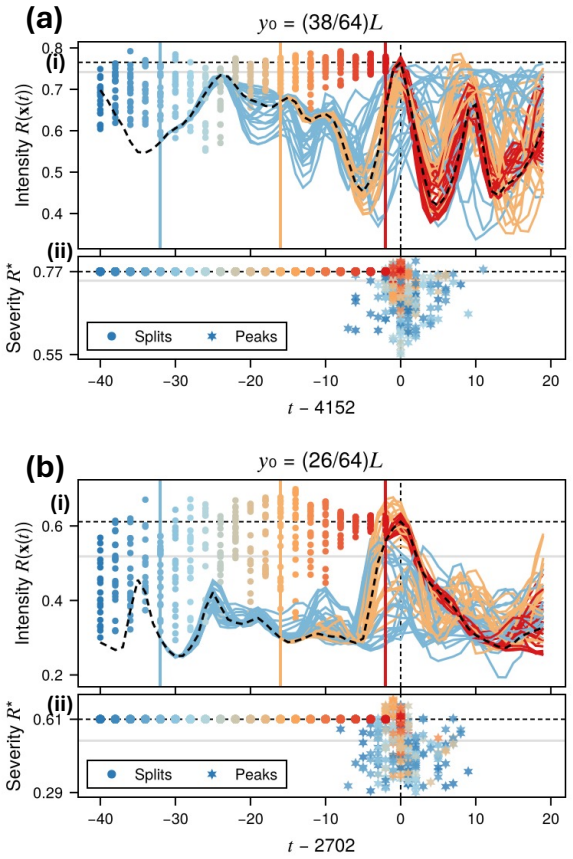
The load-bearing object is the thresholded entropy functional, $S[(R^* - \mu)^+] = -\sum_k \Delta Q_k \log \Delta Q_k$, defined on the conditional severity distribution of a boosted ensemble restricted to values above a threshold $\mu$. It is designed to maximize when the ensemble's extreme severities are both abundant and diverse, thereby selecting a conditionally optimal advance split time without access to ground truth. The argument is carried by two probability estimators, MoCTail and PoPTail, which aggregate conditional tail distributions across ancestors, and by a quadratic response model that maps the low-dimensional perturbation parameter $\omega$ to the resulting event severity.
What would settle it
Run the selection protocol twice at one target latitude: once with thresholded-entropy bins fixed by the long-run quantiles as in the paper, and once with bins estimated from the short simulation alone, then compare each selected advance split time against the optimum found by exhaustive search. If the short-run bins shift the thresholded-entropy maximum outside the region where chi-squared divergence is near its minimum, the practical claim that thresholded entropy is a usable selection rule fails.
Extended reading notes
Core claim
The central claim is that a boosted ensemble, built by perturbing observed extreme events at a well-chosen advance split time and then reweighting the conditional tails, can reproduce the climatological tail of local tracer fluctuations more accurately than a direct simulation of equal computational cost. The paper introduces the MoCTail estimator, a mixture of conditional tail distributions, and compares it with the PoPTail estimator, and finds both accurately approximate the long-run ground truth when the split time is chosen near the optimum. It further claims that the thresholded entropy functional, which rewards ensembles whose above-threshold severities spread across many bins, selects an advance split time close to the one that minimizes chi-squared divergence from the true tail, and that this selection rule captures how the optimal split time changes across latitudes.
Load-bearing premise
The thresholded entropy proxy is defined using bin boundaries taken from quantiles of the true long-run distribution, and the paper only demonstrates that it selects good advance split times when those exact quantiles are available.
Editorial extensions
If this is right
- Boosted ensembles with a thresholded-entropy-selected advance split time yield tail estimates closer to a long reference simulation than an equal-number direct simulation, with modest speedups relative to equal-cost direct simulation.
- The optimal advance split time is strictly positive and approximately one to three eddy turnover timescales in the quasigeostrophic system, indicating that splitting too early or too late both degrade tail accuracy.
- The thresholded entropy rule selects different optimal split times for different target locations, mirroring the variation found by exhaustive search, which suggests the rule is sensitive to local predictability rather than being a fixed global prescription.
- Optimization-based selection rules like thresholded entropy avoid the arbitrary threshold choices required by uniform or correlation-threshold rules, making them more suitable for adaptive deployment in a rare-event sampling algorithm.
Reading between the lines
- If thresholded entropy generalizes, it could replace heuristic rules such as the 3/8-dispersion rule, since it requires no arbitrary threshold and naturally adapts to the target event and initial condition.
- The location dependence of the optimal advance split time hints that the COAST is tied to the local growth of extreme fluctuations, so one testable extension is whether the entropy-selected split time correlates with local Lyapunov-type predictability timescales across different flow regimes.
- A practical deployment would need to estimate the bin boundaries of thresholded entropy from the short simulation rather than from the long reference run; the paper does not test this, so the most direct extension is to compare the selected split times under short-run bins against the true optima.
Editorial analysis
A structured set of objections, weighed in public.
Referee Report
Summary. Finkel and O'Gorman study the choice of advance split time (AST) in ensemble boosting for rare-event tail estimation. Using a two-layer quasigeostrophic model with a passive tracer, they identify extreme events from a short direct numerical simulation (DNS), launch perturbed ensembles at ASTs from 2 to 40 days, fit quadratic response surfaces for event severity, and aggregate conditional tail distributions into climatological estimates via two estimators, 'MoCTail' and 'PoPTail'. They evaluate several AST selection rules: a uniform AST, a pattern-correlation threshold, expected improvement, and thresholded entropy, comparing the resulting tail CCDFs against a long DNS through chi-squared divergence. They report that boosting improves over equal-N DNS and is competitive at fixed cost, that an optimal AST exists at intermediate times (roughly 1-3 eddy turnover times), and that thresholded entropy and expected improvement track this optimum. They recommend thresholded entropy as a generic selection rule and provide open-source code for the experiments.
Significance. If the claims hold, this is a useful contribution to rare-event sampling for climate applications: it offers an intermediate-complexity testbed between Lorenz-96 and a general circulation model, a careful comparison of two probability estimators, and a candidate objective (thresholded entropy) for AST selection that could inform larger-scale deployments. The paper's strengths include the explicit formulation of AST selection as an optimization problem, the use of longitudinal rotation and bootstrapping to quantify uncertainty, the consistent boosting advantage over equal-N DNS, and the public code. The main caveat is that the advertised 'ground-truth-free' status of thresholded entropy is not established by the present experiments, and that parts of the rule comparison are oracle-tuned. These issues are fixable but currently limit the strength of the central recommendation.
major comments (2)
- [Section 6, Fig. 13; Section 7, conclusion 3] The thresholded entropy criterion S = -sum_k Delta Q_k log Delta Q_k uses bin boundaries r_k that, as specified in Section 2.3 and used throughout Figs. 10-12 and 15, are quantiles of the ground-truth long-DNS severity distribution, Q^Theta_k = (1/2)^(5+k). The threshold mu is likewise the ground-truth (1/2)^5 complementary quantile (Sect. 3.3). Thus the paper's central practical claim that TE can select the optimal AST without ground truth is not supported by the evidence presented: the reported success of TE is conditional on having the very quantity that the proxy is meant to replace. The paper itself notes in Sect. 2.4 that TE 'would change if the bins were changed.' In a real deployment the bins would need to be estimated from the short DNS, which contains only 14-32 peaks per latitude, with especially noisy far-tail bins; a change in bin boundaries can change the objective and its maximizer. I therefore request a limited-data test: recompute TE with bins and threshold estimated from the short DNS (or from the pooled boosted ensembles) and report how often the TE-selected AST remains close to the chi-squared-optimal AST. This is an empirical gap rather than a logical contradiction, but it directly affects the abstract's claim that a ground-truth-free proxy objective is proposed.
- [Section 6, Fig. 13; Section 7, conclusion 3] The comparison of AST selection rules is partly oracle-based. In Fig. 13, the uniform AST A_U and the pattern-correlation thresholds are chosen post hoc to minimize chi-squared divergence from ground truth for each subsample; the caption states that the reported chi-squared values are therefore 'practical lower bounds,' and the conclusion in Sect. 7 acknowledges that thresholds were selected 'with knowledge of the ground truth.' As a result, the finding that 'no single selection rule is superior' and the impression that TE performs comparably to A_U and A_PC are not yet a fair practical comparison: A_U and A_PC have been given access to the validation target, while EI is not tuned in this way (though TE still uses ground-truth bins). A deployment-oriented comparison should set all thresholds using short-DNS information only, and then evaluate skill against the long DNS. This does not invalidate the boosting-versus-DNS result, but it does weaken the paper's claims about the relative merits of the selection rules.
minor comments (5)
- [Section 2.4, Eq. (28)] The entropy is undefined when a bin probability is zero; please state the convention 0 log 0 = 0 or otherwise exclude empty bins.
- [Fig. 15] The caption lists panels (a)-(d) and then (g) for topography; the missing panel labels or the reference to panel (g) should be corrected for consistency.
- [Section 5.2, Eqs. (42)-(43)] The quadratic response model is fitted to only 21 quasi-Monte Carlo points plus one ancestor per (n, j); a cross-validation check or residual summary at the selected ASTs would make the probability estimates more transparent, especially because the estimators rely on extrapolation of the fitted response beyond the sampled impulses.
- [Section 3.3] It is not explicitly stated whether the threshold mu[(1/2)^5] is computed from the short DNS or the long DNS; please clarify, as this matters for the deployment of the thresholded-entropy criterion.
- [Section 2.2, Eqs. (17)-(18)] The notation for MoCTail and PoPTail is introduced in sequence across two paragraphs; consider defining both estimators in one place with parallel notation to improve readability.
Circularity Check
Thresholded entropy is advertised as a ground-truth-free proxy but is defined using ground-truth-derived bin boundaries, so the central AST-selection recommendation is partially circular; A_U and A_PC thresholds are also tuned post hoc against the same ground truth.
-
self definitional
[Abstract; Sect. 2.4 Eq. (28); Sect. 2.3 (bin construction); Sect. 3.3 (threshold)]
"Abstract: 'Since ground truth is not known in practice, we propose a proxy objective function of thresholded entropy.' Sect. 2.4: 'The thresholded entropy is thus defined based on probability over discrete bins (with the bin boundaries r_k set based on quantiles of the ground-truth distribution) and would change if the bins were changed.' Sect. 2.3: 'Note the same set of r_k's based on the climatological distribution is used also for evaluating estimated distributions.'"
Eq. (28) is not a self-contained proxy: its bin boundaries r_k are the long-DNS quantiles Q^Theta_k = (1/2)^(5+k) (Sect. 2.3), and its starting bin mu is also a ground-truth complementary quantile (Sect. 3.3). The abstract promises a proxy for use when 'ground truth is not known in practice,' but the objective is constructed from that ground truth. Moreover, the chi^2 skill metric in Eq. (19) uses the same ground-truth r_k's, so the reported agreement between TE-maximizing AST and chi^2-optimal AST (Figs. 10-12, 15) is evaluated under the very knowledge the proxy is supposed to replace. The maximizer is not fully forced, because the boosted conditional distributions still enter Eq.
-
fitted input called prediction
[Sect. 2.4 (A_U, A_PC); Fig. 13 caption; Sect. 6]
"Sect. 2.4: 'Both A_U and A_PC ... both unfortunately require a threshold choice, which there is no established method for selecting. Here we selected thresholds post hoc with knowledge of the ground truth.' Fig. 13 caption: 'Because this requires ground truth knowledge, the chi^2 divergences must be interpreted as practical lower bounds.'"
The A_U and A_PC thresholds are not independent selection rules; they are tuned post hoc against the long-DNS ground truth, and their resulting chi^2 errors are then presented as evidence that these rules 'improve substantially' and are 'equally effective' (Sect. 6, Figs. 13-14). Because the tuning target and evaluation target are the same ground-truth CCDF, the reported skill and error bars are lower bounds rather than predictions, as the Fig. 13 caption concedes. The paper is transparent about this, but the across-the-board comparison still mixes fitted thresholds with genuine prediction and does not support a claim that these rules work without ground-truth knowledge.
full rationale
The core estimator comparison (MoCTail and PoPTail against the long-DNS ground truth) is a legitimate external evaluation: the long DNS is independent of the short-DNS boosted ensembles, and the fixed-cost comparison uses a stated cost model. The 3/8 rule from Finkel and O'Gorman (2024) is tested rather than assumed, so self-citation is not load-bearing. The circularity is concentrated in the AST-selection rules. Thresholded entropy is advertised as the practical ground-truth-free objective, yet its definition (Eq. 28) requires bin boundaries that are quantiles of the ground-truth distribution; the paper explicitly says the bin boundaries are 'set based on quantiles of the ground-truth distribution' and that the same r_k's are used in the chi^2 evaluation. This makes the demonstration that TE identifies the chi^2-optimal AST partially a construction: the proxy has been handed the target's own tail quantiles. A real deployment would have to estimate those bins from limited data, which is never tested. The A_U and A_PC rules are additionally selected post hoc with ground-truth knowledge, so their success is a fitted lower bound. These issues make the paper's headline 'proxy' claim partially circular, while the numerical method itself remains a legitimate empirical study.
Assumptions & free parameters
free parameters (8)
- Threshold mu =
0.52 at y0=26/64 L
- TE bin boundaries r_k =
Quantiles of ground-truth severity distribution at (1/2)^(5+k)
- Pattern correlation threshold rho_U =
Selected post hoc (e.g., 0.92 local, 0.86 nominal 3/8 rule)
- Perturbation scale s =
0.24 chosen as nominal
- Perturbation amplitude bound W =
0.3
- Argmax drift delta_t* =
5 days
- Buffer times A_max and B =
40 and 20 days
- Quadratic response model coefficients =
Fitted per ancestor and AST via OLS
assumptions (6)
- domain assumption The 2-layer quasigeostrophic model with a passive tracer is a representative intermediate-complexity testbed for midlatitude storm-track extreme statistics.
- domain assumption The long DNS (44 years) provides a reliable ground truth for tail statistics.
- domain assumption Cluster maxima separated by buffers A_max and B are independent events.
- ad hoc to paper A single linearly unstable Fourier mode perturbation is sufficient to probe the extreme tail.
- ad hoc to paper The quadratic response model is adequate for the ASTs near the optimum.
- ad hoc to paper Bin boundaries for TE can be estimated from the short DNS in practice.
invented entities (2)
-
MoCTail estimator
-
COAST (conditionally optimal advance split time)
Cite this review
Pith. "Pith review of Boosting Ensembles for Statistics of Tails at Conditionally Optimal Advance Split Times." pith.science (2026). https://pith.science/paper/3DAIAPYX
@misc{pith2026250722310,
  author       = {Pith},
  title        = {Pith review of: Boosting Ensembles for Statistics of Tails at Conditionally Optimal Advance Split Times},
  year         = {2026},
  howpublished = {\url{https://pith.science/paper/3DAIAPYX}},
  note         = {Machine review of arXiv:2507.22310}
}
read the original abstract
Climate science needs more efficient ways to study high-impact, low-probability extreme events. Ensemble boosting, a form of rare event sampling, offers a novel strategy to extract more information from those occasional simulated events, by perturbing them slightly to probe alternative scenarios immediately instead of waiting many simulation-years for the next event. But statistical accuracy and efficiency depend on the perturbation details. In particular for sudden and transient events like precipitation, performance of boosting depends sensitively on the \emph{advance split time} (AST), which must be long enough before the event to let the ensemble diversify, but not so much as to destroy the event. In pursuit of principled guidelines, we study the effect of AST for sampling tracer fluctuations in a quasigeostrophic flow, an idealized but informative model of midlatitude storm track dynamics. We formulate AST selection as an optimization problem for statistical fidelity with a ground truth. Since ground truth is not known in practice, we propose a proxy objective function of \emph{thresholded entropy}, which rewards ensembles with both a high mean and a large spread. We show that ensemble boosting, when given a well-chosen AST and equipped with methods to estimate probabilities, can accurately sample extremes at long return periods. We furthermore find evidence that thresholded entropy successfully identifies an optimal AST, which is roughly 1-3 eddy turnover timescales in the quasigeostrophic system. Moreover, this proxy captures the \emph{variation} of AST with the target location of the tracer within the flow field, suggesting generalizability to climate models. Large-scale deployment of our method will require further development in adaptive optimization strategies, but our work here is an essential first step for establishing what must be optimized.
Figures


Figures from the paper (12 more)




Forward citations
Cited by 1 Pith paper
-
AI-boosted rare event sampling to characterize extreme weather
AI+RES uses AI weather-forecast ensembles as a guide for rare-event simulation, yielding accurate return-period statistics for 1-in-50,000-year heatwaves at roughly 100× lower computational cost.
Reference graph
Works this paper leans on
-
[1]
Au, S.-K. and Beck, J. L.: Estimation of small failure probabilities in high dimensions by subset simulation, Probabilistic Engineering Mechanics, 16, 263–277, https://doi.org/https://doi.org/10.1016/S0266-8920(01)00019-4,
-
[9]
Castaing, B., Gunaratne, G., Heslot, F., Kadanoff, L., Libchaber, A., Thomae, S., Wu, X.-Z., Zaleski, S., and Zanetti, G.: Scaling of hard thermal turbulence in Rayleigh-Bénard convection, Journal of Fluid Mechanics, 204, 1–30, https://doi.org/10.1017/S0022112089001643,
-
[11]
Cérou, F. and Guyader, A.: Adaptive Multilevel Splitting for Rare Event Analysis, Stochastic Analysis and Applications, 25, 417–443, https://doi.org/10.1080/07362990601139628,
-
[13]
Diaconescu, E. P. and Laprise, R.: Singular vectors in atmospheric sciences: A review, Earth-Science Reviews, 113, 161–175, https://doi.org/https://doi.org/10.1016/j.earscirev.2012.05.005,
-
[19]
Gálfi, V . M., Bódai, T., and Lucarini, V .: Convergence of Extreme Value Statistics in a Two-Layer Quasi-Geostrophic Atmospheric Model, Complexity, 2017, 5340 858, https://doi.org/10.1155/2017/5340858,
-
[20]
Gessner, C., Fischer, E. M., Beyerle, U., and Knutti, R.: Very Rare Heat Extremes: Quantifying and Understanding Using Ensemble Reinitialization, Journal of Climate, 34, 6619 – 6634, https://doi.org/10.1175/JCLI-D-20-0916.1,
-
[21]
Ghil, M., Yiou, P., Hallegatte, S., Malamud, B. D., Naveau, P., Soloviev, A., Friederichs, P., Keilis-Borok, V ., Kondrashov, D., Kossobokov, V ., Mestre, O., Nicolis, C., Rust, H. W., Shebalin, P., Vrac, M., Witt, A., and Zaliapin, I.: Extreme events: dynamics, statistics and prediction, Nonlinear Processes in Geophysics, 18, 295–350, https://doi.org/10....
-
[23]
P., Clarke, J., Gharib, M., Lane, B., and Mesquita, O
Gollub, J. P., Clarke, J., Gharib, M., Lane, B., and Mesquita, O. N.: Fluctuations and transport in a stirred fluid with a mean gradient, Phys. Rev. Lett., 67, 3507–3510, https://doi.org/10.1103/PhysRevLett.67.3507,
Show all 69 references
-
[27]
L.: Modeling of spatial extremes in environmental data science: time to move away from max-stable processes, Environmental Data Science, 4, e3, https://doi.org/10.1017/eds.2024.54,
Huser, R., Opitz, T., and Wadsworth, J. L.: Modeling of spatial extremes in environmental data science: time to move away from max-stable processes, Environmental Data Science, 4, e3, https://doi.org/10.1017/eds.2024.54,
2024 doi
-
[28]
Jalbert, J., Farmer, M., Gobeil, G., and Roy, P.: Extremes.jl: Extreme Value Analysis in Julia, Journal of Statistical Software, 109, 1–35, https://doi.org/10.18637/jss.v109.i06,
-
[29]
John, A., Douville, H., Ribes, A., and Yiou, P.: Quantifying CMIP6 model uncertainties in extreme precipitation projections, Weather and Climate Extremes, 36, 100 435, https://doi.org/https://doi.org/10.1016/j.wace.2022.100435,
2022
-
[30]
justinfocus12: justinfocus12/COAST: Initial release for submission of BEST COAST paper to NPG, https://doi.org/10.5281/zenodo.17355215,
-
[31]
49 Kabir, H. M. D., Khosravi, A., Hosen, M. A., and Nahavandi, S.: Neural Network-Based Uncertainty Quantification: A Survey of Methodologies and Applications, IEEE Access, 6, 36 218–36 234, https://doi.org/10.1109/ACCESS.2018.2836917,
-
[37]
Lucente, D., Rolland, J., Herbert, C., and Bouchet, F.: Coupling rare event algorithms with data-based learned committor functions using the analogue Markov chain, Journal of Statistical Mechanics: Theory and Experiment, 2022, 083 201, https://doi.org/10.1088/1742- 5468/ac7aa7,
2022 doi
-
[38]
Mahesh, A., Collins, W., Bonev, B., Brenowitz, N., Cohen, Y ., Elms, J., Harrington, P., Kashinath, K., Kurth, T., North, J., OBrien, T., Pritchard, M., Pruitt, D., Risser, M., Subramanian, S., and Willard, J.: Huge Ensembles Part I: Design of Ensemble Weather Forecasts using ...
-
[39]
Mohamad, M. A. and Sapsis, T. P.: Sequential sampling strategy for extreme event statistics in nonlinear dynamical systems, Proceedings of the National Academy of Sciences, 115, 11 138–11 143, https://doi.org/10.1073/pnas.1813263115,
-
[40]
D., Lintner, B
Neelin, J. D., Lintner, B. R., Tian, B., Li, Q., Zhang, L., Patra, P. K., Chahine, M. T., and Stechmann, S. N.: Long tails in deep columns of natural and anthropogenic tropospheric tracers, Geophysical Research Letters, 37, https://doi.org/https://doi.org/10.1029/2009GL041726,
-
[42]
O’Gorman, P. A. and Schneider, T.: Scaling of Precipitation Extremes over a Wide Range of Climates Simulated with an Idealized GCM, Journal of Climate, 22, 5676 – 5685, https://doi.org/10.1175/2009JCLI2701.1,
-
[44]
Penland, C. and Magorian, T.: Prediction of Niño 3 Sea Surface Temperatures Using Linear Inverse Modeling, Journal of Climate, 6, 1067 – 1076, https://doi.org/10.1175/1520-0442(1993)006<1067:PONSST>2.0.CO;2,
1993 doi
-
[47]
Pons, F. M. E., Yiou, P., Jézéquel, A., and Messori, G.: Simulating the Western North America heatwave of 2021 with analogue importance sampling, Weather and Climate Extremes, 43, 100 651, https://doi.org/https://doi.org/10.1016/j.wace.2024.100651,
2021
-
[48]
I., and Siggia, E
Pumir, A., Shraiman, B. I., and Siggia, E. D.: Exponential tails and random advection, Phys. Rev. Lett., 66, 2984–2987, https://doi.org/10.1103/PhysRevLett.66.2984,
-
[49]
Rackauckas, C.: QuasiMonteCarlo.jl, https://github.com/SciML/QuasiMonteCarlo.jl, accessed: 2025-05-09,
2025
-
[50]
Ragone, F. and Bouchet, F.: Rare Event Algorithm Study of Extreme Warm Summers and Heatwaves Over Europe, Geophysical Research Letters, 48, e2020GL091 197, https://doi.org/https://doi.org/10.1029/2020GL091197, e2020GL091197 2020GL091197,
-
[51]
Ragone, F., Wouters, J., and Bouchet, F.: Computation of extreme heat waves in climate models using a large deviation algorithm, Proceedings of the National Academy of Sciences, 115, 24–29, https://doi.org/10.1073/pnas.1712645115,
-
[52]
Rampal, N., Gibson, P. B., Sherwood, S., Abramowitz, G., and Hobeichi, S.: A Reliable Generative Adversarial Network Approach for Climate Downscaling and Weather Generation, Journal of Advances in Modeling Earth Systems, 17, e2024MS004 668, https://doi.org/https://doi.org/10.1...
-
[53]
Rolland, J.: Collapse of transitional wall turbulence captured using a rare events algorithm, Journal of Fluid Mechanics, 931, A22, https://doi.org/10.1017/jfm.2021.957,
2021 doi
-
[54]
Saha, A. and Ravela, S.: Statistical-Physical Adversarial Learning From Data and Models for Downscaling Rainfall Extremes, Journal of Advances in Modeling Earth Systems, 16, e2023MS003 860, https://doi.org/https://doi.org/10.1029/2023MS003860, e2023MS003860 2023MS003860,
-
[55]
Sapsis, T. P.: Output-weighted optimal sampling for Bayesian regression and rare event statistics using few samples, Proceedings of the Royal Society A: Mathematical, Physical and Engineering Sciences, 476, 20190 834, https://doi.org/10.1098/rspa.2019.0834,
-
[56]
51 Sundar, R., Parashar, N., Blanchard, A., and Dodov, B.: TAUDiff: Improving statistical downscaling for extreme weather events using generative diffusion models, https://arxiv.org/abs/2412.13627,
-
[57]
P., and Link, R.: Emulating climate extreme indices, Environmental Research Letters, 15, 074 006, https://doi.org/10.1088/1748-9326/ab8332,
Tebaldi, C., Armbruster, A., Engler, H. P., and Link, R.: Emulating climate extreme indices, Environmental Research Letters, 15, 074 006, https://doi.org/10.1088/1748-9326/ab8332,
-
[58]
F.: Jet Formation and Evolution in Baroclinic Turbulence with Simple Topography, Journal of Physical Oceanography, 40, 257 – 278, https://doi.org/10.1175/2009JPO4218.1,
Thompson, A. F.: Jet Formation and Evolution in Baroclinic Turbulence with Simple Topography, Journal of Physical Oceanography, 40, 257 – 278, https://doi.org/10.1175/2009JPO4218.1,
-
[59]
J., Scaife, A
Thompson, V ., Dunstone, N. J., Scaife, A. A., Smith, D. M., Slingo, J. M., Brown, S., and Belcher, S. E.: High risk of unprecedented UK rainfall in the current climate, Nature Communications, 8, 107, https://doi.org/10.1038/s41467-017-00275-3,
-
[60]
M.: A New Look at Weather Forecasting through Analogues, Monthly Weather Review, 117, 2230 – 2247, https://doi.org/10.1175/1520-0493(1989)117<2230:ANLAWF>2.0.CO;2,
van den Dool, H. M.: A New Look at Weather Forecasting through Analogues, Monthly Weather Review, 117, 2230 – 2247, https://doi.org/10.1175/1520-0493(1989)117<2230:ANLAWF>2.0.CO;2,
1989 doi
-
[61]
van Kekem, D. L. and Sterk, A. E.: Wave propagation in the Lorenz-96 model, Nonlinear Processes in Geophysics, 25, 301–314, https://doi.org/10.5194/npg-25-301-2018,
2018 doi
-
[62]
Vandal, T., Kodra, E., Ganguly, S., Michaelis, A., Nemani, R., and Ganguly, A. R.: DeepSD: Generating High Resolution Climate Change Projections through Single Image Super-Resolution, in: Proceedings of the 23rd ACM SIGKDD International Conference on Knowledge Discovery and Da...
-
[63]
V onich, P. T. and Hakim, G. J.: Predictability Limit of the 2021 Pacific Northwest Heatwave From Deep-Learning Sensitivity Analysis, Geophysical Research Letters, 51, e2024GL110 651, https://doi.org/https://doi.org/10.1029/2024GL110651, e2024GL110651 2024GL110651,
2021 doi
-
[64]
Wang, Q., Mu, M., and Sun, G.: A useful approach to sensitivity and predictability studies in geophysical fluid dynamics: conditional non- linear optimal perturbation, National Science Review, 7, 214–223, https://doi.org/10.1093/nsr/nwz039,
-
[65]
Watt, R. A. and Mansfield, L. A.: Generative Diffusion-based Downscaling for Climate, https://arxiv.org/abs/2404.17752,
-
[66]
J., Plotkin, D
Webber, R. J., Plotkin, D. A., O’Neill, M. E., Abbot, D. S., and Weare, J.: Practical rare event sampling for extreme mesoscale weather, Chaos: An Interdisciplinary Journal of Nonlinear Science, 29, 053 109, https://doi.org/10.1063/1.5081461,
-
[67]
Yang, Y ., Blanchard, A., Sapsis, T., and Perdikaris, P.: Output-weighted sampling for multi-armed bandits with extreme payoffs, Proceedings of the Royal Society A: Mathematical, Physical and Engineering Sciences, 478, 20210 781, https://doi.org/10.1098/rspa.2021.0781,
-
[68]
and Jézéquel, A.: Simulation of extreme heat waves with empirical importance sampling, Geoscientific Model Development, 13, 763–781, https://doi.org/10.5194/gmd-13-763-2020,
Yiou, P. and Jézéquel, A.: Simulation of extreme heat waves with empirical importance sampling, Geoscientific Model Development, 13, 763–781, https://doi.org/10.5194/gmd-13-763-2020,
2020 doi
-
[69]
Zuckerman, D. M. and Chong, L. T.: Weighted Ensemble Simulation: Review of Methodology, Applications, and Software, Annual Review of Biophysics, 46, 43–57, https://doi.org/10.1146/annurev-biophys-070816-033834, pMID: 28301772,
-
[1951]
and Held, I
Lapeyre, G. and Held, I. M.: The Role of Moisture in the Dynamics and Energetics of Turbulent Baroclinic Eddies, Journal of the Atmospheric Sciences, 61, 1693 – 1710, https://doi.org/10.1175/1520-0469(2004)061<1693:TROMIT>2.0.CO;2,
2004 doi
-
[1956]
E., and Sapsis, T
Pickering, E., Guth, S., Karniadakis, G. E., and Sapsis, T. P.: Discovering and forecasting extreme events via active learning in neural operators, Nature Computational Science, 2, 823–833, https://doi.org/10.1038/s43588-022-00376-0,
-
[1980]
K., Stein, M
Huang, W. K., Stein, M. L., McInerney, D. J., Sun, S., and Moyer, E. J.: Estimating changes in temperature extremes from millennial- scale climate simulations using generalized extreme value (GEV) distributions, Advances in Statistical Climatology, Meteorology and Oceanography...
-
[1989]
Coles, S.: An introduction to statistical modeling of extreme values, Springer Series in Statistics, Springer, 1 edn., ISBN 978-1-85233-459-8, https://doi.org/10.1007/978-1-4471-3675-0,
-
[1991]
Haidvogel, D. B. and Held, I. M.: Homogeneous Quasi-Geostrophic Turbulence Driven by a Uniform Temperature Gradient, Journal of Atmospheric Sciences, 37, 2644 – 2660, https://doi.org/10.1175/1520-0469(1980)037<2644:HQGTDB>2.0.CO;2,
1980 doi
-
[1993]
Phillips, N. A.: The general circulation of the atmosphere: A numerical experiment, Quarterly Journal of the Royal Meteorological Society, 82, 123–164, https://doi.org/https://doi.org/10.1002/qj.49708235202,
-
[1998]
and Gritsun, A.: A new mathematical framework for atmospheric blocking events, Climate Dynamics, 54, 575–598, https://doi.org/10.1007/s00382-019-05018-2,
Lucarini, V . and Gritsun, A.: A new mathematical framework for atmospheric blocking events, Climate Dynamics, 54, 575–598, https://doi.org/10.1007/s00382-019-05018-2,
-
[2001]
Baars, S., Castellana, D., Wubs, F., and Dijkstra, H.: Application of adaptive multilevel splitting to high-dimensional dynamical systems, Journal of Computational Physics, 424, 109 876, https://doi.org/https://doi.org/10.1016/j.jcp.2020.109876,
-
[2002]
Breitung, K.: SORM, Design Points, Subset Simulation, and Markov Chain Monte Carlo, ASCE-ASME Journal of Risk and Uncertainty in Engineering Systems, Part A: Civil Engineering, 7, 04021 052, https://doi.org/10.1061/AJRUA6.0001166,
-
[2007]
Dematteis, G., Grafke, T., and Vanden-Eijnden, E.: Extreme Event Quantification in Dynamical Systems with Random Components, SIAM/ASA Journal on Uncertainty Quantification, 7, 1029–1059, https://doi.org/10.1137/18M1211003,
-
[2009]
Panetta, R. L.: Zonal Jets in Wide Baroclinically Unstable Regions: Persistence and Scale Selection, Journal of Atmospheric Sciences, 50, 2073 – 2106, https://doi.org/10.1175/1520-0469(1993)050<2073:ZJIWBU>2.0.CO;2,
1993 doi
-
[2010]
Norwood, A., Kalnay, E., Ide, K., Yang, S.-C., and Wolfe, C.: Lyapunov, singular and bred vectors in a multi-scale system: an empirical exploration of vectors related to instabilities, Journal of Physics A: Mathematical and Theoretical, 46, 254 021, https://doi.org/10.1088/175...
-
[2011]
T., Deck, K., Bischoff, T., and Souza, A.: Response Theory via Generative Score Modeling, Phys
Giorgini, L. T., Deck, K., Bischoff, T., and Souza, A.: Response Theory via Generative Score Modeling, Phys. Rev. Lett., 133, 267 302, https://doi.org/10.1103/PhysRevLett.133.267302,
-
[2012]
and Sapsis, T
Farazmand, M. and Sapsis, T. P.: A variational approach to probing extreme events in turbulent dynamical systems, Science Advances, 3, e1701 533, https://doi.org/10.1126/sciadv.1701533,
-
[2014]
Lestang, T., Ragone, F., Bréhier, C.-E., Herbert, C., and Bouchet, F.: Computing return times or return periods with rare event algorithms, Journal of Statistical Mechanics: Theory and Experiment, 2018, 043 213, https://doi.org/10.1088/1742-5468/aab856,
2018 doi
-
[2015]
Bloin-Wibe, L., Noyelle, R., Humphrey, V ., Beyerle, U., Knutti, R., and Fischer, E.: Estimating return periods for extreme events in climate models through Ensemble Boosting, EGUsphere, 2025, 1–40, https://doi.org/10.5194/egusphere-2025-525,
2025 doi
-
[2016]
and Wadsworth, J
Huser, R. and Wadsworth, J. L.: Advances in statistical modeling of spatial extremes, WIREs Computational Statistics, 14, e1537, https://doi.org/https://doi.org/10.1002/wics.1537,
-
[2017]
Farrell, B. F. and Ioannou, P. J.: Generalized Stability Theory. Part I: Autonomous Operators, Journal of Atmospheric Sciences, 53, 2025 – 2040, https://doi.org/10.1175/1520-0469(1996)053<2025:GSTPIA>2.0.CO;2, 1996a. Farrell, B. F. and Ioannou, P. J.: Generalized Stability The...
1996 doi
-
[2018]
Linz, M., Chen, G., Zhang, B., and Zhang, P.: A Framework for Understanding How Dynamics Shape Temperature Distributions, Geophysical Research Letters, 47, e2019GL085 684, https://doi.org/https://doi.org/10.1029/2019GL085684, e2019GL085684 10.1029/2019GL085684,
-
[2019]
Boulaguiem, Y ., Zscheischler, J., Vignotto, E., van der Wiel, K., and Engelke, S.: Modeling and simulating spatial extremes by combining extreme value theory with generative adversarial networks, Environmental Data Science, 1, e5, https://doi.org/10.1017/eds.2022.4,
-
[2020]
Lorenz, E. N. and Emanuel, K. A.: Optimal Sites for Supplementary Weather Observations: Simulation with a Small Model, Journal of the Atmospheric Sciences, 55, 399 – 414, https://doi.org/10.1175/1520-0469(1998)055<0399:OSFSWO>2.0.CO;2,
1998 doi
-
[2021]
R., Ha, S.-Y ., Hacker, J
Berner, J., Fossell, K. R., Ha, S.-Y ., Hacker, J. P., and Snyder, C.: Increasing the Skill of Probabilistic Forecasts: Understanding Performance Improvements from Model-Error Representations, Monthly Weather Review, 143, 1295 – 1320, https://doi.org/10.1175/MWR-D-14- 00091.1,
-
[2022]
and Majda, A
Bourlioux, A. and Majda, A. J.: Elementary models with probability distribution function intermittency for passive scalars with a mean gradient, Physics of Fluids, 14, 881–897, https://doi.org/10.1063/1.1430736,
-
[2023]
M., Beyerle, U., Bloin-Wibe, L., Gessner, C., Humphrey, V ., Lehner, F., Pendergrass, A
Fischer, E. M., Beyerle, U., Bloin-Wibe, L., Gessner, C., Humphrey, V ., Lehner, F., Pendergrass, A. G., Sippel, S., Zeder, J., and Knutti, R.: Storylines for unprecedented heatwaves based on ensemble boosting, Nature Communications, 14, 4643, https://doi.org/10.1038/s41467- 0...
-
[2024]
and O’Gorman, P
Finkel, J. and O’Gorman, P. A.: Rare Event Sampling for Moving Targets: Extremes of Temperature and Daily Precipitation in a General Circulation Model, Journal of Advances in Modeling Earth Systems, 18, e2025MS005 456, https://doi.org/https://doi.org/10.1029/2025MS005456, e202...
-
[2025]
J., Farazmand, M., and Sapsis, T
Blonigan, P. J., Farazmand, M., and Sapsis, T. P.: Are extreme dissipation events predictable in turbulent fluid flows?, Phys. Rev. Fluids, 4, 044 606, https://doi.org/10.1103/PhysRevFluids.4.044606,
-
[2026]
P., Abbot, D
Finkel, J., Gerber, E. P., Abbot, D. S., and Weare, J.: Revealing the Statistics of Extreme Events Hidden in Short Weather Forecast Data, AGU Advances, 4, e2023A V000 881, https://doi.org/https://doi.org/10.1029/2023A V000881, e2023A V000881 2023A V000881,
Reviewed August 6, 2026 · model on record in the stance chip above.
Discussion (0). Continue with ORCID to comment.