SPT-3G D1: Axion Early Dark Energy with CMB experiments and DESI
Pith reviewed 2026-05-21 23:31 UTC · model grok-4.3
The pith
DESI data combined with CMB observations yields mild preference for axion early dark energy and reduces the Hubble tension to 2.6 sigma.
A machine-rendered reading of the paper's core claim, the machinery that carries it, and where it could break.
Core claim
Combining DESI BAO measurements with CMB data from SPT, ACT, and Planck gives f_EDE = 0.055^{+0.024}_{-0.047} at 68% CL together with a weak preference for the axion early dark energy model over Lambda CDM; this combination reduces the Hubble tension to 2.6 sigma. CMB-only analyses find no statistically significant evidence for AEDE and only moderate tension reduction, while the parameter shift upon adding DESI traces directly to the discrepancy between DESI and CMB measurements already present in the baseline Lambda CDM model.
What carries the argument
Axion early dark energy (AEDE), a model in which a light axion field contributes a fractional energy density f_EDE near matter-radiation equality and thereby alters the sound horizon scale.
If this is right
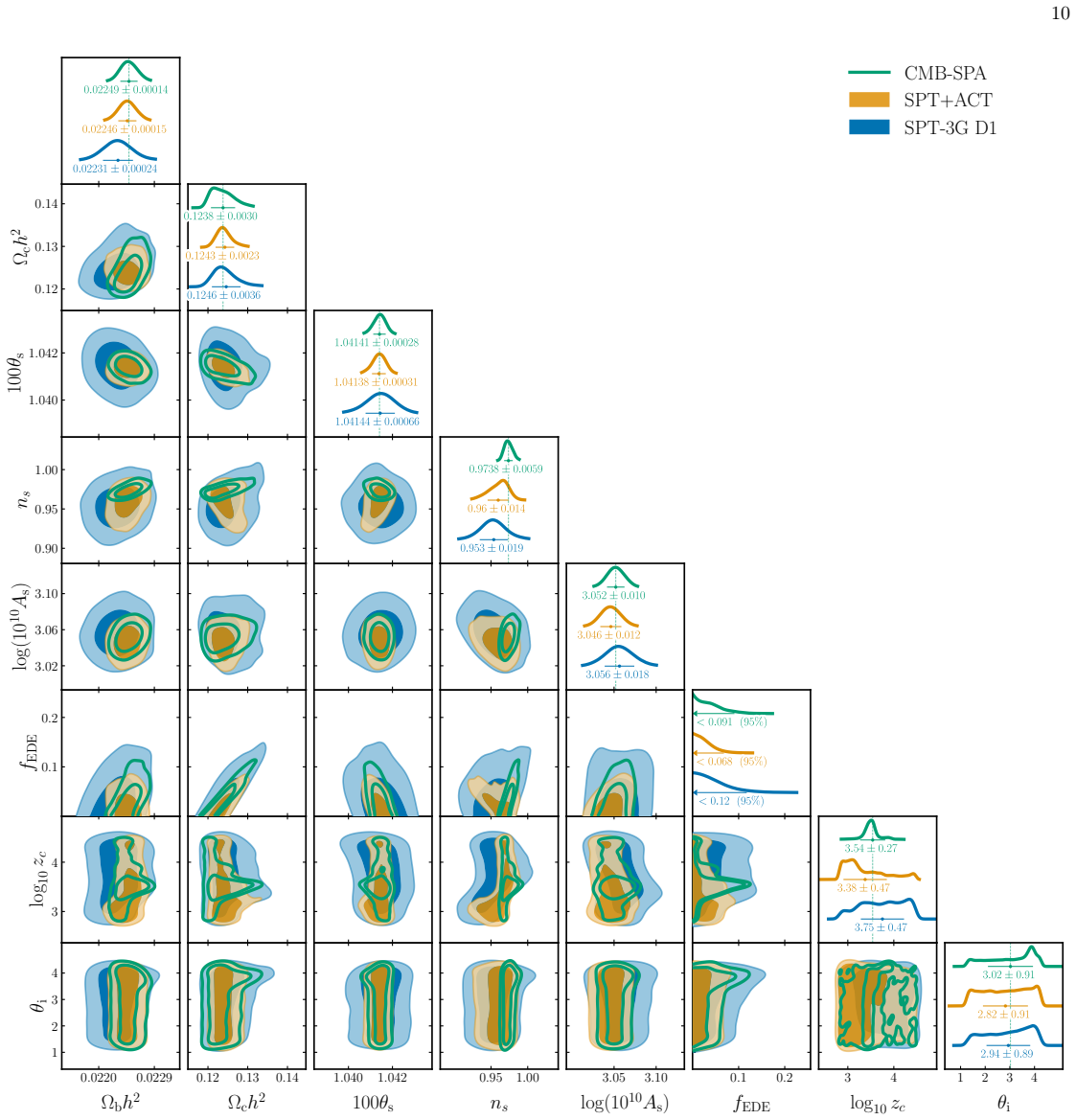
- SPT data alone limit f_EDE below 0.12 at 95% CL and reduce the Hubble tension to 2.3 sigma.
- The full CMB combination (SPT+ACT+Planck) limits f_EDE below 0.07 at 95% CL and leaves the tension at 3.6 sigma.
- DESI plus SPT alone gives f_EDE = 0.081^{+0.037}_{-0.052} at 68% CL and lowers the tension to 1.5 sigma.
- The reported shift occurs specifically because DESI and CMB disagree inside Lambda CDM.
Where Pith is reading between the lines
- If the mild preference strengthens with future data releases, targeted axion searches in particle-physics experiments could become higher priority.
- The same dataset tension could be tested by comparing AEDE against other early-dark-energy parameterizations to see which fits best.
- Improved control of systematics in either DESI or CMB pipelines could remove the need for AEDE altogether.
Load-bearing premise
The discrepancy between DESI BAO measurements and CMB data in the standard Lambda CDM model is assumed to be best explained by adding axion early dark energy rather than by unaccounted systematics or other extensions.
What would settle it
A future high-precision BAO measurement that aligns DESI and CMB results inside Lambda CDM without any room for positive f_EDE would eliminate the reported preference.
Figures



read the original abstract
We present the most up-to-date constraints on axion early dark energy (AEDE) from cosmic microwave background (CMB) and baryon acoustic oscillation (BAO) measurements. In particular, we assess the impact of data from ground-based CMB experiments, the South Pole Telescope (SPT) and the Atacama Cosmology Telescope (ACT) -- both with and without $Planck$ -- on constraints on AEDE. We also highlight the impact that BAO information from the Dark Energy Spectroscopic Instrument (DESI) has on these constraints. From CMB data alone, we do not find statistically significant evidence for the presence of AEDE, and we find only moderate reduction in the Hubble tension. From the latest SPT data alone, we find the maximal fractional contribution of AEDE to the cosmic energy budget is $f_{\rm EDE}\,<\,0.12$ at $95\,$% confidence level (CL), and the Hubble tension between the SPT and SH0ES results is reduced to the $2.3\,\sigma$ level. When combining the latest SPT, ACT, and $Planck$ datasets, we find $f_{\rm EDE}\,<\,0.070$ at $95\,$% CL and the Hubble tension at the $3.6\, \sigma$ level. In contrast, adding DESI data to the CMB datasets results in mild preference for AEDE and, in some cases, non-negligible reduction in the Hubble tension. From SPT+DESI, we find $f_{\rm EDE}\,=\,0.081^{+0.037}_{-0.052}$ at $68\,$% CL, and the Hubble tension reduces to $1.5\,\sigma$. From the combination of DESI with all three CMB experiments, we get $f_{\rm EDE}\,=\, 0.055^{+0.024}_{-0.047}$ at $68\,$% CL and a weak preference for AEDE over $\Lambda$CDM. This data combination, in turn, reduces the Hubble tension to $2.6\, \sigma$. We highlight that this shift in parameters when adding the DESI dataset is a manifestation of the discrepancy currently present between DESI and CMB experiments in the concordance model $\Lambda$CDM.
Editorial analysis
A structured set of objections, weighed in public.
Referee Report
Summary. The paper presents the most up-to-date constraints on axion early dark energy (AEDE) using CMB data from SPT-3G, ACT, and Planck (individually and combined) together with BAO measurements from DESI. CMB data alone show no statistically significant evidence for AEDE and only moderate reduction of the Hubble tension. Adding DESI data produces a mild preference for AEDE, with f_EDE = 0.055^{+0.024}_{-0.047} at 68% CL from the full CMB+DESI combination, a weak preference over ΛCDM, and reduction of the Hubble tension to 2.6σ; the authors attribute the parameter shift to the existing DESI-CMB discrepancy in baseline ΛCDM.
Significance. If the results hold, the work is significant because it supplies timely, multi-experiment constraints on AEDE using the latest ground-based CMB and DESI BAO data. The explicit comparison across data combinations and the clear statement that the shift is a manifestation of the known ΛCDM tension between DESI and CMB are useful for the community. The analysis employs standard cosmological likelihood methods and reports both upper limits and best-fit values with credible intervals.
major comments (1)
- [Abstract] Abstract: the reported mild preference for AEDE (f_EDE = 0.055^{+0.024}_{-0.047} at 68% CL) and the associated 2.6σ Hubble-tension reduction when DESI is added rest on the modeling choice that the DESI-CMB offset in ΛCDM is physical and best absorbed by AEDE. The abstract provides no details on priors for f_EDE or other AEDE parameters, nuisance parameters, or robustness tests against data splits or systematics; without these, it is difficult to evaluate whether the weak preference could be driven by unaccounted systematics in DESI reconstruction or CMB foregrounds instead.
minor comments (1)
- [Results] Ensure that all reported confidence levels (68% CL and 95% CL) and the exact data combinations are stated uniformly in the text, tables, and figure captions.
Simulated Author's Rebuttal
We thank the referee for their positive evaluation of the significance of our work and for their detailed feedback. We address the single major comment below.
read point-by-point responses
-
Referee: [Abstract] Abstract: the reported mild preference for AEDE (f_EDE = 0.055^{+0.024}_{-0.047} at 68% CL) and the associated 2.6σ Hubble-tension reduction when DESI is added rest on the modeling choice that the DESI-CMB offset in ΛCDM is physical and best absorbed by AEDE. The abstract provides no details on priors for f_EDE or other AEDE parameters, nuisance parameters, or robustness tests against data splits or systematics; without these, it is difficult to evaluate whether the weak preference could be driven by unaccounted systematics in DESI reconstruction or CMB foregrounds instead.
Authors: We thank the referee for this observation. The abstract already states that the parameter shift upon including DESI is a manifestation of the existing DESI-CMB discrepancy in ΛCDM, rather than claiming AEDE as the unique physical resolution. The model is presented as one that can accommodate the offset, yielding the reported mild preference and tension reduction. Full details on the AEDE parameter priors (flat prior on f_EDE from 0 to 0.3, following standard practice), other AEDE parameters, nuisance parameters in the CMB and BAO likelihoods, and robustness tests across data splits and systematics checks are provided in Sections 2–5 of the manuscript. To improve accessibility, we will revise the abstract to include a brief statement on the f_EDE prior range. revision: yes
Circularity Check
No significant circularity in direct data-driven constraints on AEDE
full rationale
The paper reports Bayesian posterior constraints on AEDE parameters (f_EDE, etc.) obtained by fitting the model directly to external CMB (SPT, ACT, Planck) and BAO (DESI) datasets. The quoted results, including f_EDE = 0.055^{+0.024}_{-0.047} and the 2.6σ Hubble tension reduction, are standard outputs of likelihood sampling on independent observations. No internal equation derives a quantity that is then renamed or refit as a prediction; no self-citation chain supplies a uniqueness theorem or ansatz that the present analysis depends upon; and the abstract explicitly frames the parameter shift as a consequence of the known DESI-CMB offset in ΛCDM rather than an internal construction. The derivation chain is therefore self-contained against external benchmarks.
Axiom & Free-Parameter Ledger
free parameters (1)
- f_EDE
axioms (1)
- domain assumption Standard flat ΛCDM background cosmology modified by an early axion field component
invented entities (1)
-
Axion early dark energy field
no independent evidence
Forward citations
Cited by 5 Pith papers
-
Double the axions, half the tension: multi-field early dark energy eases the Hubble tension
Two-field axion-like early dark energy reduces Hubble tension to 1.5 sigma residual and improves high-ell CMB fits over single-field models.
-
Nonlinear Matter Power Spectrum from relativistic $N$-body Simulations: $\Lambda_{\rm s}$CDM versus $\Lambda$CDM
Relativistic N-body simulations of Lambda_s CDM produce a redshift-dependent crest in the matter power spectrum ratio, peaking at 20-25% near the transition and leaving a 15-20% uplift at z=0 on group scales.
-
The End of the First Act: Spectral Running, Interacting Dark Radiation, and the Hubble Tension in Light of ACT DR6 Data
Including spectral running α_s, β_s and self-interacting dark radiation relaxes the ACT DR6 bound on ΔN_eff to <0.58 and lowers the Hubble tension to 2.2σ with three extra parameters.
-
Disentangling cosmic distance tensions with early and late dark energy
Early dark energy resolves CMB-BAO tension and, combined with thawing quintessence, reduces overall cosmological tensions without phantom crossing.
-
Probing Dynamical Dark Energy with Late-Time Data: Evidence, Tensions, and the Limits of the $w_0w_a$CDM Framework
Evidence for dynamical dark energy in the w0waCDM framework is strongly dataset-dependent, driven by mismatches in low-redshift BAO distance ratios that produce divergent expansion histories and inconsistent Hubble te...
Reference graph
Works this paper leans on
-
[1]
Camphuis, E., et al. SPT-3G D1: CMB temperature and polarization power spectra and cosmology from 2019 and 2020 observations of the SPT-3G Main field. 2025. https://arxiv.org/abs/2506.20707
work page internal anchor Pith review Pith/arXiv arXiv 2019
-
[2]
Cosmology from CMB lensing and delensed EE power spectra using 2019–2020 SPT-3G polarization data
Ge, F., et al. Cosmology from CMB lensing and delensed EE power spectra using 2019–2020 SPT-3G polarization data. 2025, Phys. Rev. D, 111, 083534, doi: 10.1103/ PhysRevD.111.083534
work page 2019
-
[3]
TheAtacamaCosmologyTelescope: DR6 Maps
Naess, S., etal. TheAtacamaCosmologyTelescope: DR6 Maps. 2025. https://arxiv.org/abs/2503.14451
-
[6]
The Atacama Cosmology Telescope: DR6 Constraints on Extended Cosmological Models
Calabrese, E., et al. The Atacama Cosmology Telescope: DR6 Constraints on Extended Cosmological Models
-
[7]
https://arxiv.org/abs/2503.14454
work page internal anchor Pith review Pith/arXiv arXiv
-
[8]
DESI DR2 Results II: Measurements of Baryon Acoustic Oscillations and Cosmological Constraints
Abdul Karim, M., et al. DESI DR2 Results II: Measure- ments of Baryon Acoustic Oscillations and Cosmological Constraints. 2025. https://arxiv.org/abs/2503.14738
work page internal anchor Pith review Pith/arXiv arXiv 2025
-
[9]
The Dark Energy Spectroscopic Instrument (DESI)
The Dark Energy Spectroscopic Instrument (DESI). 2019, in Bulletin of the American Astronomical Society, Vol. 51, 57.https://arxiv.org/abs/1907.10688
work page internal anchor Pith review Pith/arXiv arXiv 2019
-
[10]
Prabhu, K., et al. Testing the ΛCDM Cosmological Model with Forthcoming Measurements of the Cosmic Microwave Background with SPT-3G. 2024, Astrophys. J., 973, 4, doi:10.3847/1538-4357/ad5ff1
-
[11]
BFV quantization of the nonprojectable (2+1)- dimen- sional Hořava theory
Karwal, T., & Kamionkowski, M. Dark energy at early times, the Hubble parameter, and the string axiverse. 2016, Phys. Rev. D, 94, 103523, doi:10.1103/PhysRevD. 94.103523
-
[12]
Mörtsell, E., & Dhawan, S. Does the Hubble constant tension call for new physics? 2018, JCAP, 09, 025, doi: 10.1088/1475-7516/2018/09/025
-
[13]
L., Karwal, T., & Kamionkowski, M
Poulin, V., Smith, T. L., Karwal, T., & Kamionkowski, M. Early Dark Energy Can Resolve The Hubble Tension. 2019, Phys. Rev. Lett., 122, 221301, doi: 10.1103/ PhysRevLett.122.221301
work page 2019
-
[14]
Poulin, V., Smith, T. L., & Karwal, T. The Ups and Downs of Early Dark Energy solutions to the Hubble tension: a review of models, hints and constraints circa
- [15]
-
[16]
Abdalla, E., et al. Cosmology intertwined: A review of the particle physics, astrophysics, and cosmology associated with the cosmological tensions and anomalies. 2022, JHEAp, 34, 49, doi: 10.1016/j.jheap.2022.04. 002
-
[17]
Di Valentino, E., Mena, O., Pan, S., Visinelli, L., Yang, W., Melchiorri, A., Mota, D. F., Riess, A. G., & Silk, J. In the realm of the Hubble tension—a review of solutions. 2021, Class. Quant. Grav., 38, 153001, doi: 10.1088/ 1361-6382/ac086d
work page 2021
-
[18]
Local determination of the Hubble constant and the deceleration parameter
Camarena, D., & Marra, V. Local determination of the Hubble constant and the deceleration parameter. 2020, Phys. Rev. Res., 2, 013028, doi: 10.1103/ PhysRevResearch.2.013028
work page 2020
-
[19]
—. On the use of the local prior on the absolute magnitude of Type Ia supernovae in cosmological in- ference. 2021, Mon. Not. Roy. Astron. Soc., 504, 5164, doi: 10.1093/mnras/stab1200
-
[20]
Planck and the local Universe: Quantifying the tension
Verde, L., Protopapas, P., & Jimenez, R. Planck and the local Universe: Quantifying the tension. 2013, Phys. Dark Univ., 2, 166, doi:10.1016/j.dark.2013.09.002
-
[22]
Verde, L., Treu, T., & Riess, A. G. Tensions between the 10 0.0220 0.0229 Ωbh2 1 2 3 4θi 3 4log10 zc 0.1 0.2 fEDE 3.02 3.06 3.10 log(1010As) 0.90 0.95 1.00 ns 1.040 1.042 100θs 0.12 0.13 0.14 Ωch2 0.12 0.13 0.14 Ωch2 1.040 1.042 100θs 0.95 1.00 ns 3.05 3.10 log(1010As) 0.1 0.2 fEDE 3 4 log10 zc 1 2 3 4 θi CMB-SPA SPT+ACT SPT-3G D1 FIG. 4. Same as the top ...
work page internal anchor Pith review doi:10.1038/s41550-019-0902-0 2019
-
[23]
J., Poulin, V., & Lesgourgues, J
Schöneberg, N., Franco Abellán, G., Pérez Sánchez, A., Witte, S. J., Poulin, V., & Lesgourgues, J. The H0 Olympics: Afairrankingofproposedmodels.2022, Phys. Rept., 984, 1, doi:10.1016/j.physrep.2022.07.001
-
[24]
The Atacama Cosmology Telescope: DR6 Gravitational Lensing Map and Cosmological Parameters
Madhavacheril, M. S., et al. The Atacama Cosmology Telescope: DR6 Gravitational Lensing Map and Cos- mological Parameters. 2023. https://arxiv.org/abs/ 2304.05203 11 0.022 0.023 Ωbh2 1 2 3 4θi 3.0 3.5 4.0 4.5 log10 zc 0.1 0.2 fEDE 3.05 3.10 log(1010As) 0.90 0.95 1.00 1.05 ns 1.040 1.041 1.042 1.043 100θs 0.12 0.13 0.14 Ωch2 0.12 0.14 Ωch2 1.041 1.043 100θ...
work page internal anchor Pith review Pith/arXiv arXiv 2023
-
[26]
M., Romaniello, M., Murakami, Y
Breuval, L., Riess, A.G., Casertano, S., Yuan, W., Macri, L. M., Romaniello, M., Murakami, Y. S., Scolnic, D., Anand, G. S., & Soszyński, I. Small Magellanic Cloud Cepheids Observed with the Hubble Space Telescope Provide a New Anchor for the SH0ES Distance Ladder. 2024, Astrophys. J., 973, 30, doi: 10.3847/1538-4357/ ad630e
-
[27]
Khalife, A. R., Zanjani, M. B., Galli, S., Günther, S., Lesgourgues, J., & Benabed, K. Review of Hubble 12 dataset Link to Package SPT-3G D1 https://pole.uchicago.edu/public/data/camphuis25/ https://github.com/SouthPoleTelescope/spt_candl_data https://pole.uchicago.edu/public/data/ge25/ Planck https://github.com/benabed/clipy https://pla.esac.esa.int/ htt...
-
[28]
Kamionkowski, M., Pradler, J., & Walker, D. G. E. Dark energy from the string axiverse. 2014, Phys. Rev. Lett., 113, 251302, doi:10.1103/PhysRevLett.113.251302
-
[29]
J., Schwindt, J., & Wetterich, C
Doran, M., Lilley, M. J., Schwindt, J., & Wetterich, C. Quintessence and the separation of CMB peaks. 2001, Astrophys. J., 559, 501, doi:10.1086/322253
-
[30]
Phenomenological parameterization of quintessence
Wetterich, C. Phenomenological parameterization of quintessence. 2004, Phys. Lett. B, 594, 17, doi:10.1016/ j.physletb.2004.05.008
work page 2004
-
[32]
Hubble constant hunter’s guide
Knox, L., & Millea, M. Hubble constant hunter’s guide. 2020, Phys. Rev. D, 101, 043533, doi:10.1103/ PhysRevD.101.043533
work page 2020
-
[33]
Sachs, R. K., & Wolfe, A. M. Perturbations of a Cosmo- logical Model and Angular Variations of the Microwave Background. 1967, The Astrophysical Journal, 147, 73, doi: 10.1086/148982
-
[34]
Hu, W., & White, M. J. The Damping tail of CMB anisotropies. 1997, Astrophys. J., 479, 568, doi:10.1086/ 303928
work page 1997
-
[35]
Niedermann, F., & Sloth, M. S. Resolving the Hubble tension with new early dark energy. 2020, Phys. Rev. D, 102, 063527, doi:10.1103/PhysRevD.102.063527
-
[36]
Herold, L., Ferreira, E. G. M., & Komatsu, E. New Constraint on Early Dark Energy from Planck and BOSS Data Using the Profile Likelihood. 2022, Astrophys. J. Lett., 929, L16, doi:10.3847/2041-8213/ac63a3
- [37]
-
[38]
Isotropic cosmic birefringence from early dark energy
Murai, K., Naokawa, F., Namikawa, T., & Komatsu, E. Isotropic cosmic birefringence from early dark energy. 2023, Phys. Rev. D, 107, L041302, doi:10.1103/ PhysRevD.107.L041302
work page 2023
-
[39]
R., Herold, L., Komatsu, E., Murai, K., Namikawa, T., & Naokawa, F
Eskilt, J. R., Herold, L., Komatsu, E., Murai, K., Namikawa, T., & Naokawa, F. Constraint on Early Dark Energy from Isotropic Cosmic Birefringence. 2023. https://arxiv.org/abs/2303.15369
-
[40]
Stevens, J., Khoraminezhad, H., &Saito, S. Constraining the spatial curvature with cosmic expansion history in a cosmological model with a non-standard sound horizon. 2023, JCAP, 07, 046, doi:10.1088/1475-7516/2023/07/ 046
-
[41]
Smith, T. L., & Schöneberg, N. Predictions for new physics in the CMB damping tail. 2025.https://arxiv. org/abs/2503.20002
-
[42]
Smith, T. L., Poulin, V., & Amin, M. A. Oscillating scalar fields and the Hubble tension: a resolution with novel signatures. 2020, Phys. Rev. D, 101, 063523, doi: 10.1103/PhysRevD.101.063523
-
[43]
Towards Early Dark Energy in string theory
McDonough, E., & Scalisi, M. Towards Early Dark Energy in string theory. 2023, JHEP, 10, 118, doi:10. 1007/JHEP10(2023)118
work page 2023
-
[44]
Cicoli, M., Licheri, M., Mahanta, R., McDonough, E., Pedro, F. G., & Scalisi, M. Early Dark Energy in Type IIB String Theory. 2023, JHEP, 06, 052, doi:10.1007/ JHEP06(2023)052
work page 2023
-
[45]
L., Lucca, M., Poulin, V., Abellan, G
Smith, T. L., Lucca, M., Poulin, V., Abellan, G. F., Balkenhol, L., Benabed, K., Galli, S., & Murgia, R. Hints of early dark energy in Planck, SPT, and ACT data: New physics or systematics? 2022, Phys. Rev. D, 106, 043526, doi: 10.1103/PhysRevD.106.043526
-
[46]
Hill, J. C., et al. Atacama Cosmology Telescope: Constraints on prerecombination early dark energy. 2022, Phys. Rev. D, 105, 123536, doi:10.1103/PhysRevD.105. 123536
-
[47]
Hill, J. C., McDonough, E., Toomey, M. W., & Alexander, S. Early dark energy does not restore cosmological concordance. 2020, Phys. Rev. D, 102, 043507, doi: 10.1103/PhysRevD.102.043507
-
[48]
Non-Gaussian estimates of tensions in cosmological parameters
Raveri, M., & Doux, C. Non-Gaussian estimates of tensions in cosmological parameters. 2021, Phys. Rev. D, 104, 043504, doi:10.1103/PhysRevD.104.043504
-
[49]
Leizerovich, M., Landau, S. J., & Scóccola, C. G. Tensions in cosmology: a discussion of statistical tools to determine inconsistencies. 2023.https://arxiv.org/ abs/2312.08542
-
[50]
Concordance and Discordance in Cosmology
Raveri, M., & Hu, W. Concordance and Discordance in Cosmology. 2019, Phys. Rev. D, 99, 043506, doi:10. 1103/PhysRevD.99.043506
work page 2019
-
[51]
Improved Planck Constraints on Axionlike Early Dark Energy as a Resolution of the Hubble Tension
Efstathiou, G., Rosenberg, E., & Poulin, V. Improved Planck Constraints on Axionlike Early Dark Energy as a Resolution of the Hubble Tension. 2024, Phys. Rev. Lett., 132, 221002, doi:10.1103/PhysRevLett.132.221002
-
[52]
Akaike, H. A new look at the statistical model 13 identification. 1974, IEEE Transactions on Automatic Control, 19, 716, doi:10.1109/TAC.1974.1100705
-
[53]
Andreon, S., & Weaver, B. 2015, Bayesian Methods for the Physical Sciences Learning from Examples in Astron- omy and Physics (Springer Series in Astrostatistics)
work page 2015
-
[54]
1939, Theory of Probability (Oxford, Eng- land)
Jeffreys, H. 1939, Theory of Probability (Oxford, Eng- land)
work page 1939
-
[55]
Nesseris, S., & Garcia-Bellido, J. Is the Jeffreys’ scale a reliable tool for Bayesian model comparison in cosmology? 2013, JCAP, 08, 036, doi: 10.1088/ 1475-7516/2013/08/036
work page 2013
-
[56]
Smith, T. L., Poulin, V., Bernal, J. L., Boddy, K. K., Kamionkowski, M., & Murgia, R. Early dark energy is not excluded by current large-scale structure data. 2021, Phys. Rev. D, 103, 123542, doi:10.1103/PhysRevD.103. 123542
-
[57]
La Posta, A., Louis, T., Garrido, X., & Hill, J. C. Constraints on prerecombination early dark energy from SPT-3G public data. 2022, Phys. Rev. D, 105, 083519, doi: 10.1103/PhysRevD.105.083519
-
[58]
Feldman, G. J., & Cousins, R. D. A Unified approach to the classical statistical analysis of small signals. 1998, Phys. Rev. D, 57, 3873, doi:10.1103/PhysRevD.57.3873
-
[59]
L., Grin, D., Karwal, T., & Kamionkowski, M
Poulin, V., Smith, T. L., Grin, D., Karwal, T., & Kamionkowski, M. Cosmological implications of ultralightaxionlikefields.2018, Phys.Rev.D,98, 083525, doi: 10.1103/PhysRevD.98.083525
-
[60]
The Cosmic Linear Anisotropy Solving System (CLASS) I: Overview
Lesgourgues, J. The Cosmic Linear Anisotropy Solving System (CLASS) I: Overview. 2011. https://arxiv. org/abs/1104.2932
work page internal anchor Pith review Pith/arXiv arXiv 2011
-
[61]
Blas, D., Lesgourgues, J., & Tram, T. The Cosmic Linear Anisotropy Solving System (CLASS) II: Approximation schemes. 2011, JCAP, 07, 034, doi:10.1088/1475-7516/ 2011/07/034
-
[63]
Cobaya: code for Bayesian analysis of hierarchical physical models
Torrado, J., & Lewis, A. Cobaya: code for Bayesian analysis of hierarchical physical models. 2021, JCAP, 2021, 057, doi:10.1088/1475-7516/2021/05/057
-
[64]
2019, Cobaya: Bayesian analysis in cosmology, Astrophysics Source Code Library, record ascl:1910.019
—. 2019, Cobaya: Bayesian analysis in cosmology, Astrophysics Source Code Library, record ascl:1910.019. http://ascl.net/1910.019
work page 2019
-
[65]
Hastings, W. K. Monte Carlo Sampling Methods Using Markov Chains and Their Applications. 1970, Biometrika, 57, 97. http://www.jstor.org/stable/ 2334940
work page 1970
-
[66]
Metropolis, N., Rosenbluth, A. W., Rosenbluth, M. N., Teller, A. H., & Teller, E. Equation of State Calculations by Fast Computing Machines. 1953, Journal of Chemical Physics, 21, 1087, doi:10.1063/1.1699114
-
[67]
Gelman, A., & Rubin, D. B. Inference from Iterative Simulation Using Multiple Sequences. 1992, Statisti- cal Science, 7, 457. http://www.jstor.org/stable/ 2246093
work page 1992
-
[68]
Improving the Flexibility and Robustness of Model-Based Derivative-Free Optimization Solvers
Cartis, C., Fiala, J., Marteau, B., & Roberts, L. Improving the Flexibility and Robustness of Model- Based Derivative-Free Optimization Solvers. 2018, arXiv e-prints, arXiv:1804.00154, doi: 10.48550/arXiv.1804. 00154
work page internal anchor Pith review Pith/arXiv arXiv doi:10.48550/arxiv.1804 2018
-
[69]
Escap- ing local minima with derivative-free methods: a numeri- cal investigation
Cartis, C., Roberts, L., & Sheridan-Methven, O. Escap- ing local minima with derivative-free methods: a numeri- cal investigation. 2018, arXiv e-prints, arXiv:1812.11343, doi: 10.48550/arXiv.1812.11343
-
[70]
R., Lesgourgues, J., Mosbech, M
Günther, S., Balkenhol, L., Fidler, C., Khalife, A. R., Lesgourgues, J., Mosbech, M. R., & Sharma, R. K. OLÉ– Online Learning Emulation in Cosmology. 2025.https: //arxiv.org/abs/2503.13183
-
[71]
Planck Collaboration, Akrami, Y., Andersen, K. J., et al. Planck intermediate results - LVII. Joint Planck LFI and HFI data processing. 2020, A&A, 643, A42, doi: 10.1051/0004-6361/202038073
-
[72]
candl: cosmic microwave background analysis with a differentiable likelihood
Balkenhol, L., Trendafilova, C., Benabed, K., & Galli, S. candl: cosmic microwave background analysis with a differentiable likelihood. 2024, Astron. Astrophys., 686, A10, doi: 10.1051/0004-6361/202449432
-
[73]
Aghanim, N., et al. Planck 2018 results. V. CMB power spectra and likelihoods. 2020, Astron. Astrophys., 641, A5, doi: 10.1051/0004-6361/201936386
-
[74]
—. Planck 2018 results. I. Overview and the cosmological legacy of Planck. 2020, Astron. Astrophys., 641, A1, doi: 10.1051/0004-6361/201833880
-
[75]
—. Planck 2018 results. VI. Cosmological parameters. 2020, Astron. Astrophys., 641, A6, doi: 10.1051/ 0004-6361/201833910
work page 2018
-
[76]
CMB lensing from Planck PR4 maps
Carron, J., Mirmelstein, M., & Lewis, A. CMB lensing from Planck PR4 maps. 2022, JCAP, 09, 039, doi:10. 1088/1475-7516/2022/09/039
work page 2022
-
[77]
The Atacama Cosmology Telescope: DR6 Power Spectra, Likelihoods andΛCDM Parameters
Louis, T., et al. The Atacama Cosmology Telescope: DR6 Power Spectra, Likelihoods andΛCDM Parameters
-
[78]
https://arxiv.org/abs/2503.14452
work page internal anchor Pith review Pith/arXiv arXiv
-
[79]
Qu, F. J., et al. The Atacama Cosmology Telescope: A Measurement of the DR6 CMB Lensing Power Spectrum and Its Implications for Structure Growth. 2024, Astro- phys. J., 962, 112, doi:10.3847/1538-4357/acfe06
-
[80]
Madhavacheril, M. S., et al. The Atacama Cosmology Telescope: DR6 Gravitational Lensing Map and Cos- mological Parameters. 2024, Astrophys. J., 962, 113, doi: 10.3847/1538-4357/acff5f
-
[81]
Eisenstein, D. J., & Hu, W. Baryonic features in the matter transfer function. 1998, Astrophys. J., 496, 605, doi: 10.1086/305424
-
[82]
Small scale cosmological perturbations: An Analytic approach
Hu, W., & Sugiyama, N. Small scale cosmological perturbations: An Analytic approach. 1996, Astrophys. J., 471, 542, doi:10.1086/177989
-
[83]
CMB power spectra and cosmological parameters from Planck PR4 with CamSpec
Rosenberg, E., Gratton, S., & Efstathiou, G. CMB power spectra and cosmological parameters from Planck PR4 with CamSpec. 2022, Mon. Not. Roy. Astron. Soc., 517, 4620, doi: 10.1093/mnras/stac2744
-
[84]
2017, A&A, 607, A24, doi:10.1051/0004-6361/ 201730852
Pagano, L., Delouis, J. M., Mottet, S., Puget, J. L., & Vibert, L. Reionization optical depth determination from Planck HFI data with ten percent accuracy. 2020, Astron. Astrophys., 635, A99, doi:10.1051/0004-6361/ 201936630
-
[85]
Varying Constants, Gravitation and Cos- mology
Uzan, J.-P. Varying Constants, Gravitation and Cos- mology. 2011, Living Rev. Rel., 14, 2, doi: 10.12942/ lrr-2011-2
work page 2011
-
[86]
Ade, P. A. R., et al. Planck intermediate results - XXIV. Constraints on variations in fundamental constants. 2015, Astron. Astrophys., 580, A22, doi: 10.1051/ 0004-6361/201424496
work page 2015
discussion (0)
Sign in with ORCID, Apple, or X to comment. Anyone can read and Pith papers without signing in.