REVIEW 3 major objections 5 minor 1 cited by
GR-Gaussian: Graph-Based Radiative Gaussian Splatting for Sparse-View CT Reconstruction
T0 review · 3 major / 5 minor · reviewed 2026-08-06 · deepseek-v4-flash
Pith's one-line read Graph-based density-aware gradients suppress needle artifacts and improve sparse-view CT reconstruction.
desk verdict A plausible, incremental extension of R2-Gaussian with a useful denoised initialization and a graph-aware splitting heuristic, but the gradient mechanism in Eq. 16 is mathematically unsupported and the paper needs major revision before the numbers can be trusted. read the letter →
The pith
A machine-rendered reading of the paper's core claim, the machinery that carries it, and where it could break.
The reading
What carries the argument
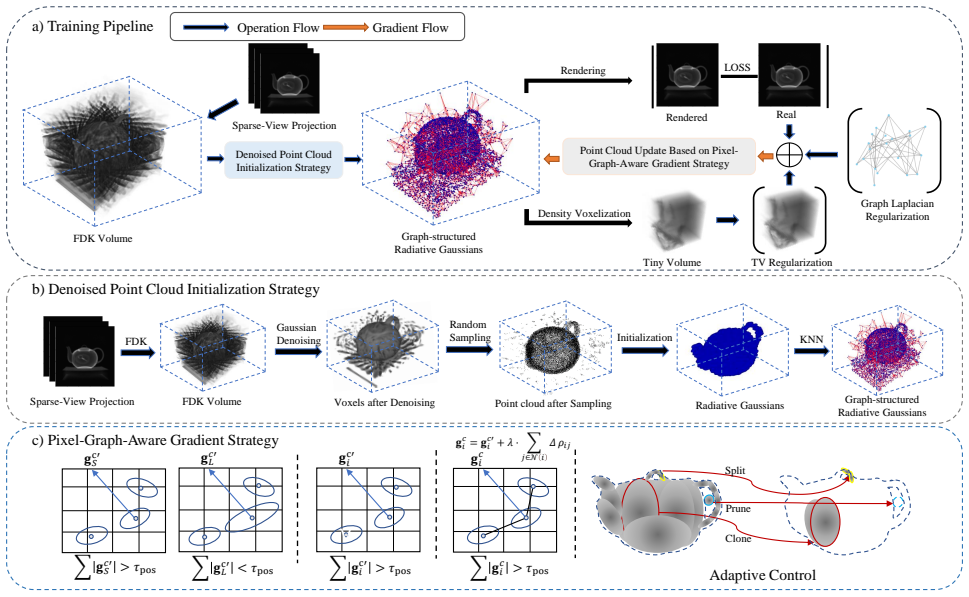
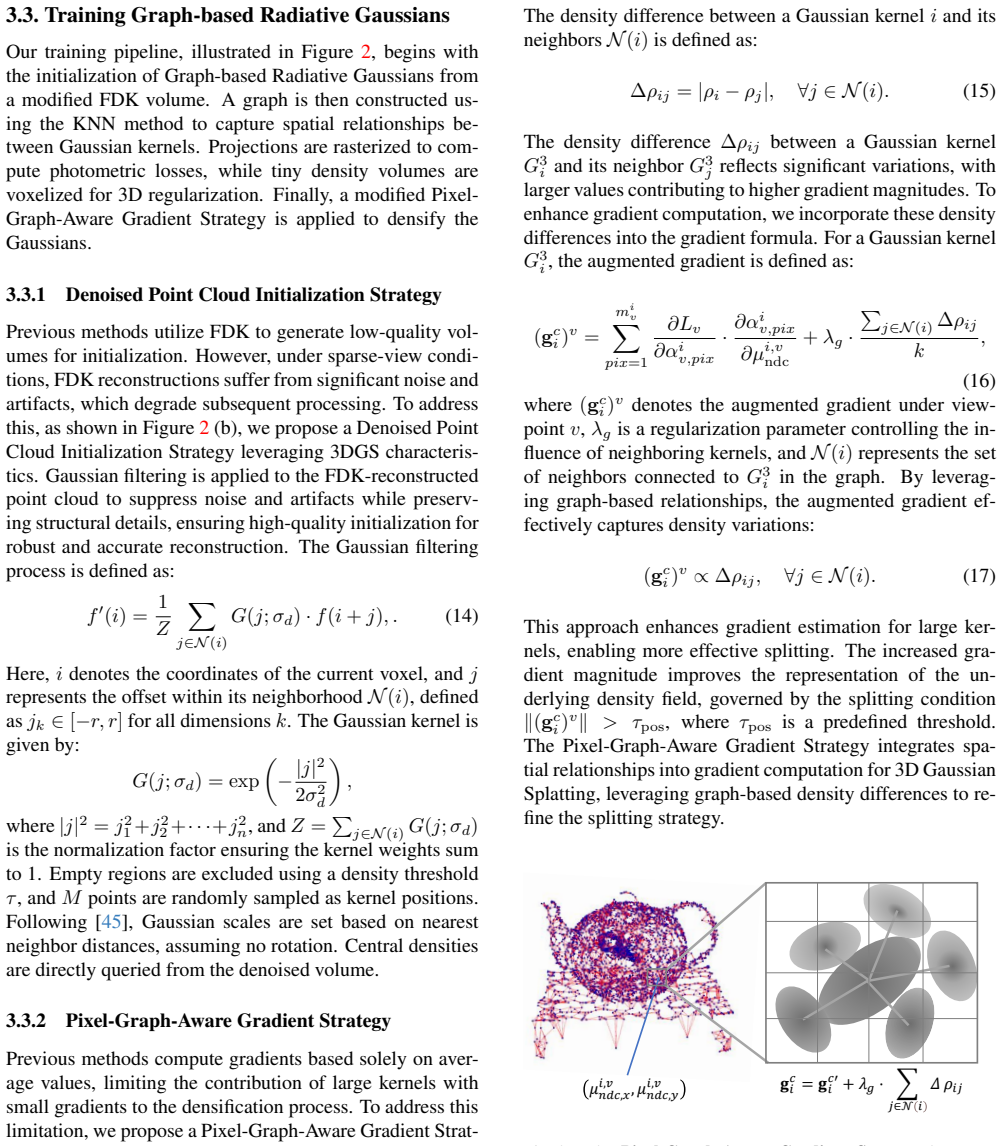
The load-bearing object is the Pixel-Graph-Aware Gradient (PGA), defined by Eq. (16) as $(g^c_i)_v = \sum_{pix=1}^{m^v_i} \frac{\partial L_v}{\partial \alpha^{v,pix}_i}\frac{\partial \alpha^{v,pix}_i}{\partial \mu^{i,v}_{ndc}} + \lambda_g \frac{\sum_{j\in\mathcal{N}(i)} \Delta\rho_{ij}}{k}$, where $\Delta\rho_{ij}=|\rho_i-\rho_j|$ is the absolute density difference between Gaussian $i$ and its graph neighbor $j$, $\mathcal{N}(i)$ is the KNN neighbor set, $k$ is a scaling factor, and $\lambda_g$ is a weight. This adds a scalar graph-density correction to the vector pixel gradient in NDC space, so kernels near density boundaries receive larger gradient magnitudes even when their per-pixel gradients are small. That pushes them over the splitting threshold $\tau_{pos}$ used by adaptive density control, which is the mechanism the paper invokes to explain why needle-like artifacts are suppressed and why the density field is better represented. The Denoised Point Cloud Initialization (Gaussian filtering of the FDK volume, Eq. (14)) and the graph-Laplacian regularization Eq. (18) support the same goal but are secondary.
What would settle it
Replace the density-difference term $\lambda_g \sum_{j\in\mathcal{N}(i)} \Delta\rho_{ij}/k$ in Eq. (16) with a random scalar perturbation of matched magnitude while keeping the same splitting schedule; if the PSNR gain over the baseline persists, the graph-density signal is not the cause of the artifact suppression, whereas if the gain disappears the specific density-difference content is doing the work, as the paper claims.
Extended reading notes
Core claim
GR-Gaussian's central discovery is that the needle artifacts in sparse-view radiative Gaussian splatting are not cured by better rendering but by changing what triggers densification. The paper represents the object as a graph whose vertices are Gaussian kernels, edges from bidirectional KNN, and each kernel's field includes weighted contributions from neighbors. It then replaces the usual average NDC-space gradient with an augmented gradient that adds $\lambda_g \frac{\sum_{j\in\mathcal{N}(i)} \Delta\rho_{ij}}{k}$ — a scaled sum of absolute density differences between a kernel and its graph neighbors — to the pixel-driven gradient. This makes kernels sitting at density boundaries, which may have small pixel gradients, generate large enough magnitudes to pass the splitting threshold $\tau_{pos}$, so they are split rather than left as elongated needles. A denoised initialization from a Gaussian-filtered FDK volume and a graph-Laplacian smoothness term complete the framework. The paper reports that this combination outperforms prior NeRF- and 3DGS-based methods on the X-3D and real-world 25-view datasets in both PSNR and SSIM, with visual results showing fewer streak artifacts.
Load-bearing premise
The method assumes that the augmented quantity in Eq. (16) — a pixel gradient plus a scalar density-difference penalty — is a meaningful gradient-like signal for splitting decisions, even though no derivation in the paper shows it is a true gradient or a valid descent direction.
Editorial extensions
If this is right
- If the method is right, sparse-view CT reconstruction from around 25 projections can approach the quality of denser-view reconstructions without changing scanner hardware.
- The graph-based augmented gradient should reduce needle-like artifacts in any radiative-Gaussian inverse problem where density is piecewise constant, not just CT.
- The dynamic stopping criterion means the reported gains come with a built-in guard against overfitting on noisy real-world projections, making the results reproducible under the stated protocol.
- Ablation results indicate the two innovations are complementary: the denoised initialization contributes most on real-world noise, while the graph-aware gradient contributes most in smooth regions.
Reading between the lines
- Editorial extension: the density-difference term in Eq. (16) is functionally similar to a graph-Laplacian penalty on density, so the PGA mechanism may be re-expressing in gradient form the smoothness that the loss already enforces through $L_{lap}$; isolating the two effects would clarify which component actually carries the artifact suppression.
- Editorial extension: all headline comparisons are at 25 views, so a natural stress test is 10-view and 50-view settings to see whether the graph-gradient advantage grows, shrinks, or plateaus as sparsity changes.
- Editorial extension: because the gradient augmentation is color-free and density-based, the same idea could transfer to other mono-modal inverse problems such as PET or SPECT, where attenuation is also roughly piecewise constant.
Editorial analysis
A structured set of objections, weighed in public.
Referee Report
Summary. The paper proposes GR-Gaussian, a 3D Gaussian Splatting framework for sparse-view CT reconstruction. It augments the R2-Gaussian baseline with two components: a denoised FDK-based point cloud initialization (De-Init) and a pixel-graph-aware gradient strategy (PGA) that adds a KNN density-difference term to the per-Gaussian gradient, together with graph Laplacian regularization. Experiments on the simulated X-3D dataset and a real-world CT dataset under 25-view conditions report PSNR/SSIM improvements of 0.67 dB/0.011 and 0.92 dB/0.021 over R2-Gaussian, with ablations attributing gains to both components.
Significance. If the empirical claims hold, the contribution is modest but useful: consistent gains across two datasets and several object categories, supported by component ablations and a sensitivity analysis for k and sigma_d. The real-world validation and the visual reduction of needle-like artifacts are concrete strengths. The main caveat is that the central PGA mechanism, as written in Eq. (16), is not a mathematically well-defined gradient, so the mechanistic explanation for artifact suppression is unsupported unless the term is rederived or explicitly reframed as a heuristic. The small absolute gains and the absence of variance reporting temper, but do not eliminate, the practical interest of the method.
major comments (3)
- [§3.3.2, Eqs. (16)–(17)] Equation (16) is dimensionally ill-defined: the first term is a 2D NDC-space gradient vector, while the second term lambda_g * sum_{j in N(i)} Delta_rho_ij / k is a nonnegative scalar, and no operation is specified for adding them. Equation (17) then states that (g^c_i)_v is proportional to Delta_rho_ij, which can hold only if the photometric gradient term vanishes, but this is not argued. More fundamentally, Delta_rho_ij depends on the densities rho_i and rho_j, not on the NDC positions mu^{i,v}_{ndc}, so the added term is not the derivative of any term in L_total (Eq. (20)) with respect to mu^{i,v}_{ndc}; the graph Laplacian in Eq. (18) also depends on rho, not on mu. The PGA component is therefore not a gradient or a guaranteed descent direction, and the mechanistic explanation that it improves splitting accuracy is unsupported. The Table 2 ablation suggests a real heuristic benefit, but the paper should either derive the term as a proper gradient of a modified loss or present it explicitly as a heuristic augmentation and drop the gradient/proportionality claims.
- [§4.3.2, Table 3] The text states that k = 6 and sigma_d = 3 achieve the optimal reconstruction quality, but Table 3 shows that k = 8 yields higher PSNR and SSIM on both datasets (35.89/0.934 on X-3D and 36.01/0.860 on real-world, versus 35.86/0.933 and 35.95/0.858 for k = 6). If k = 6 is chosen as an efficiency-quality tradeoff, the paper should say so and report the tradeoff explicitly. In addition, both k and sigma_d are selected on the same X-3D and real-world datasets used for the final comparisons (Tables 1 and 3), which introduces a mild circularity; a validation split or a clear statement of the selection protocol is needed to support the state-of-the-art claim.
- [§4.1.2 and §4.3.3] No variance across runs is reported anywhere, and the dynamic stopping criterion (Iter_stop) evaluates PSNR every 500 iterations and stops when PSNR declines by more than 0.5%, with PSNR being the same metric used for final evaluation. Early stopping on the evaluation metric can bias the reported numbers upward. The authors should report mean +/- std over at least three seeds and clarify whether the stopping PSNR is computed on the same slices/volumes as the final reported PSNR, or use a validation-based stopping rule.
minor comments (5)
- [§3.2, Eqs. (7) and (12)] The symbol k is used both for the number of KNN neighbors in Eq. (7) and as the scaling factor in the edge-weight denominator of Eq. (12); these are different quantities and should be denoted separately.
- [§4.1.1–4.1.2] There are typos: 'ponton scatter' should be 'photon scatter' (Sec. 4.1.1), and 'television volume level' should be 'total variation volume' (Sec. 4.1.2).
- [§4.3.2, Table 4] Table 4 introduces the 'SSGU extension' and reports SDS/DDS/CoSD timings, but SSGU is never defined in the method or experiments, and its connection to the proposed framework is unclear.
- [§4.2, Table 1] It is not stated whether the baseline numbers (FDK, SART, ASD-POCS, NAF, SAX-NeRF, R2-GS) are rerun under identical conditions or taken from prior papers; this should be clarified for a fair comparison.
- [Fig. 4] The caption's equation g_i^c = g_i^{c'} + lambda_g * sum Delta_rho_ij (mu_ndc,x, mu_ndc,y) is ambiguous: if the scalar is broadcast to both components, this should be stated explicitly, since it directly relates to the issue in Eq. (16).
Circularity Check
PGA's density-variation claim is tautological (Eq. 17 restates the term inserted in Eq. 16), and final PSNR gains use hyperparameters and early stopping on the same test datasets; the central empirical comparison is still externally anchored.
-
self definitional
[Section 3.3.2, Eqs. (16)-(17)]
"the augmented gradient is defined as: (g_i^c)_v = Σ_{pix=1}^{m_i^v} ∂L_v/∂α_i^{v,pix} · ∂α_i^{v,pix}/∂μ_{ndc}^{i,v} + λ_g · (Σ_{j∈N(i)} Δρ_ij)/k ... By leveraging graph-based relationships, the augmented gradient effectively captures density variations: (g_i^c)_v ∝ Δρ_ij, ∀j ∈ N(i)."
Equation (17) is not a derived consequence of the rendering model; it is a restatement of Equation (16) because the density-difference sum was inserted directly into the definition of (g_i^c)_v. The photometric gradient term depends on the NDC positions μ_ndc, not on the densities ρ_i and ρ_j, so the only part of the augmented quantity that has any built-in dependence on Δρ_ij is the added λ_g·ΣΔρ/k term. Thus the paper's mechanistic explanation that the augmented gradient 'captures density variations' is true by construction, and the claimed improvement in splitting decisions is attributed to a property that was put in by hand, not to a gradient of any term in L_total (Eq. 20).
-
fitted input called prediction
[Section 4.3.2 (Table 3), Section 4.1.2, Section 4.2 (Table 1)]
"Sensitivity analysis on the X-3D and real-world datasets (Table 3) shows optimal reconstruction quality at k = 6 and σd = 3, achieving the highest PSNR and SSIM. ... A dynamic stopping criterion (Iter stop) evaluates PSNR every 500 iterations, terminating if PSNR decreases by more than 0.5%. ... it achieves a PSNR increase of 0.67 dB and an SSIM improvement of 0.011."
The reported improvements in Table 1 are measured on the same X-3D and real-world datasets that were used in Table 3 to analyze and select the hyperparameters k and σd, and the dynamic stopping criterion directly uses the PSNR computed on those same datasets. The final numbers are therefore not independent evaluations: the model's hyperparameters and stopping point are chosen using the evaluation metric on the evaluation set, making the headline PSNR/SSIM gains test-set-optimized rather than out-of-sample predictions. This is an evaluation-loop circularity, distinct from the logical derivation of the method.
full rationale
The paper's central empirical claim — that GR-Gaussian outperforms R2-Gaussian by 0.67/0.92 dB PSNR on the X-3D and real-world datasets — is an externally anchored measurement against ground-truth volumes and independent baselines, not an algebraically forced consequence of the model's definition. There is no load-bearing self-citation: the cited [45] is an external baseline, and the authors' earlier works [27]-[31] are unrelated background. The method is therefore not a renamed known result and does not import a uniqueness theorem from the authors. Two localized issues contribute a small circular component. First, Eq. (17) is presented as evidence that the augmented gradient captures density variations, but this is tautological because the density-difference term is inserted into Eq. (16); the photometric gradient term does not depend on ρ, so Eq. (17) restates the definition. Second, the evaluation loop is circular: k and σd are analyzed/selected on the same X-3D and real-world datasets used for the final comparisons (Table 3 vs Table 1), and the dynamic stopping criterion uses test PSNR to decide when to stop. The scalar-to-vector addition in Eq. (16) and the unsupported proportionality in Eq. (17) are also correctness risks — the augmented quantity is not a true gradient of L_total — but that is a mechanistic weakness, not itself a circularity. Overall, because the central contribution is an empirical method whose headline result does not reduce to its fit or to a self-citation chain, the circularity score is low.
Assumptions & free parameters
free parameters (10)
- lambda_g (graph gradient weight) =
1e-4
- k (KNN neighbors) =
6
- sigma_d (denoising width) =
3
- lambda_lap =
8e-4
- lambda_tv =
0.05
- lambda_ssim =
0.25
- tau (density threshold) =
0.001
- M (number of Gaussians) =
50000
- Iter_stop PSNR decline threshold =
0.5%
- edge weight denominator k in Eq. 12 =
unstated
assumptions (7)
- domain assumption X-ray attenuation can be represented by an isotropic density field without view-dependent color.
- domain assumption Similar tissues and materials have approximately constant attenuation coefficients, so density differences between neighboring kernels are a meaningful splitting signal.
- domain assumption Gaussian filtering of the FDK volume removes sparse-view noise while preserving structural detail.
- domain assumption The graph Laplacian penalty on densities preserves boundaries while smoothing interiors.
- ad hoc to paper A KNN graph with small k captures relevant spatial relationships for splitting decisions.
- domain assumption Differentiable voxelization and 3D tile culling approximate the continuous density field accurately.
- standard math The rendering and voxelization operations are differentiable, enabling end-to-end gradient descent.
Cite this review
Pith. "Pith review of GR-Gaussian: Graph-Based Radiative Gaussian Splatting for Sparse-View CT Reconstruction." pith.science (2026). https://pith.science/paper/INGGJS77
@misc{pith2026250802408,
  author       = {Pith},
  title        = {Pith review of: GR-Gaussian: Graph-Based Radiative Gaussian Splatting for Sparse-View CT Reconstruction},
  year         = {2026},
  howpublished = {\url{https://pith.science/paper/INGGJS77}},
  note         = {Machine review of arXiv:2508.02408}
}
read the original abstract
3D Gaussian Splatting (3DGS) has emerged as a promising approach for CT reconstruction. However, existing methods rely on the average gradient magnitude of points within the view, often leading to severe needle-like artifacts under sparse-view conditions. To address this challenge, we propose GR-Gaussian, a graph-based 3D Gaussian Splatting framework that suppresses needle-like artifacts and improves reconstruction accuracy under sparse-view conditions. Our framework introduces two key innovations: (1) a Denoised Point Cloud Initialization Strategy that reduces initialization errors and accelerates convergence; and (2) a Pixel-Graph-Aware Gradient Strategy that refines gradient computation using graph-based density differences, improving splitting accuracy and density representation. Experiments on X-3D and real-world datasets validate the effectiveness of GR-Gaussian, achieving PSNR improvements of 0.67 dB and 0.92 dB, and SSIM gains of 0.011 and 0.021. These results highlight the applicability of GR-Gaussian for accurate CT reconstruction under challenging sparse-view conditions.
Figures


Figures from the paper (4 more)


Forward citations
Cited by 1 Pith paper
-
URS-Stereo: Uncertainty-Guided Residual Search for Real-Time Stereo Matching
Uncertainty-modulated residual offsets relocate local cost-volume centers in coarse-to-fine stereo matching, improving zero-shot disparity accuracy while keeping real-time speed.
Reference graph
Works this paper leans on
-
[1]
Anders H Andersen and Avinash C Kak. Simultaneous alge- braic reconstruction technique (sart): a superior implemen- tation of the art algorithm. Ultrasonic imaging, 6(1):81–94,
-
[2]
Lose the views: Limited angle ct reconstruction via implicit sino- gram completion
Rushil Anirudh, Hyojin Kim, Jayaraman J Thiagarajan, K Aditya Mohan, Kyle Champley, and Timo Bremer. Lose the views: Limited angle ct reconstruction via implicit sino- gram completion. In Proceedings of the IEEE Conference on Computer Vision and Pattern Recognition , pages 6343– 6352, 2018. 3
work page 2018
-
[3]
Radiative gaussian splatting for efficient x-ray novel view synthesis
Yuanhao Cai, Yixun Liang, Jiahao Wang, Angtian Wang, Yu- lun Zhang, Xiaokang Yang, Zongwei Zhou, and Alan Yuille. Radiative gaussian splatting for efficient x-ray novel view synthesis. In European Conference on Computer Vision , pages 283–299. Springer, 2024. 3
work page 2024
-
[4]
Structure-aware sparse-view x-ray 3d re- construction
Yuanhao Cai, Jiahao Wang, Alan Yuille, Zongwei Zhou, and Angtian Wang. Structure-aware sparse-view x-ray 3d re- construction. In Proceedings of the IEEE/CVF Conference 8 on Computer Vision and Pattern Recognition, pages 11174– 11183, 2024. 1, 2, 3, 6
work page 2024
-
[5]
Solving 3d inverse problems us- ing pre-trained 2d diffusion models
Hyungjin Chung, Dohoon Ryu, Michael T Mccann, Marc L Klasky, and Jong Chul Ye. Solving 3d inverse problems us- ing pre-trained 2d diffusion models. ieee. InCVF Conference on Computer Vision and Pattern Recognition, pages 10–12,
-
[6]
Industrial applications of computed tomography
Leonardo De Chiffre, Simone Carmignato, J-P Kruth, Robert Schmitt, and Albert Weckenmann. Industrial applications of computed tomography. CIRP annals, 63(2):655–677, 2014. 3
work page 2014
-
[7]
Adam: A method for stochastic optimiza- tion
Kingma Diederik. Adam: A method for stochastic optimiza- tion. (No Title), 2014. 6
work page 2014
-
[8]
Prac- tical cone-beam algorithm
Lee A Feldkamp, Lloyd C Davis, and James W Kress. Prac- tical cone-beam algorithm. Journal of the Optical Society of America A, 1(6):612–619, 1984. 1, 3, 6
work page 1984
Show all 46 references
-
[9]
Fast graph repre- sentation learning with pytorch geometric
Matthias Fey and Jan Eric Lenssen. Fast graph repre- sentation learning with pytorch geometric. arXiv preprint arXiv:1903.02428, 2019. 6
1903 arXiv
-
[10]
Deep learning- based sinogram completion for low-dose ct
Muhammad Usman Ghani and W Clem Karl. Deep learning- based sinogram completion for low-dose ct. In 2018 IEEE 13th Image, Video, and Multidimensional Signal Processing Workshop (IVMSP), pages 1–5. IEEE, 2018. 3
2018
-
[11]
Sugar: Surface- aligned gaussian splatting for efficient 3d mesh reconstruc- tion and high-quality mesh rendering
Antoine Gu ´edon and Vincent Lepetit. Sugar: Surface- aligned gaussian splatting for efficient 3d mesh reconstruc- tion and high-quality mesh rendering. In Proceedings of the IEEE/CVF Conference on Computer Vision and Pattern Recognition, pages 5354–5363, 2024. 2
2024
-
[12]
Cuda c programming guide
Design Guide. Cuda c programming guide. NVIDIA, July, 29:31, 2013. 6
2013
-
[13]
Bloomscene: Lightweight structured 3d gaussian splatting for crossmodal scene generation.Proceed- ings of the AAAI Conference on Artificial Intelligence, 39(4): 3536–3544, 2025
Xiaolu Hou, Mingcheng Li, Dingkang Yang, Jiawei Chen, Ziyun Qian, Xiao Zhao, Yue Jiang, Jinjie Wei, Qingyao Xu, and Lihua Zhang. Bloomscene: Lightweight structured 3d gaussian splatting for crossmodal scene generation.Proceed- ings of the AAAI Conference on Artificial Intellig...
2025
-
[14]
Computed medical imaging
Godfrey N Hounsfield. Computed medical imaging. Science, 210(4465):22–28, 1980. 3
1980
-
[15]
Fatesgs: Fast and accurate sparse-view surface reconstruction using gaussian splatting with depth-feature consistency
Han Huang, Yulun Wu, Chao Deng, Ge Gao, Ming Gu, and Yu-Shen Liu. Fatesgs: Fast and accurate sparse-view surface reconstruction using gaussian splatting with depth-feature consistency. Proceedings of the AAAI Conference on Arti- ficial Intelligence, 39(4):3644–3652, 2025. 3
2025
-
[16]
Computer-aided di- agnosis in chest radiography
Shigehiko Katsuragawa and Kunio Doi. Computer-aided di- agnosis in chest radiography. Computerized Medical Imag- ing and Graphics, 31(4-5):212–223, 2007. 3
2007
-
[17]
3d gaussian splatting for real-time radiance field rendering
Bernhard Kerbl, Georgios Kopanas, Thomas Leimk ¨uhler, and George Drettakis. 3d gaussian splatting for real-time radiance field rendering. ACM Trans. Graph., 42(4):139–1,
-
[18]
Improving 3d imag- ing with pre-trained perpendicular 2d diffusion models
Suhyeon Lee, Hyungjin Chung, Minyoung Park, Jonghyuk Park, Wi-Sun Ryu, and Jong Chul Ye. Improving 3d imag- ing with pre-trained perpendicular 2d diffusion models. In Proceedings of the IEEE/CVF International Conference on Computer Vision, pages 10710–10720, 2023. 3
2023
-
[19]
Micro- macro wavelet-based gaussian splatting for 3d reconstruction from unconstrained images
Yihui Li, Chengxin Lv, Hongyu Yang, and Di Huang. Micro- macro wavelet-based gaussian splatting for 3d reconstruction from unconstrained images. Proceedings of the AAAI Con- ference on Artificial Intelligence, 39:5057–5065, 2025. 3
2025
-
[20]
Ani- matable gaussians: Learning pose-dependent gaussian maps for high-fidelity human avatar modeling
Zhe Li, Zerong Zheng, Lizhen Wang, and Yebin Liu. Ani- matable gaussians: Learning pose-dependent gaussian maps for high-fidelity human avatar modeling. In Proceedings of the IEEE/CVF conference on computer vision and pattern recognition, pages 19711–19722, 2024. 3
2024
-
[21]
Gs-ir: 3d gaussian splatting for inverse rendering
Zhihao Liang, Qi Zhang, Ying Feng, Ying Shan, and Kui Jia. Gs-ir: 3d gaussian splatting for inverse rendering. In Pro- ceedings of the IEEE/CVF Conference on Computer Vision and Pattern Recognition, pages 21644–21653, 2024. 2
2024
-
[22]
Decoupling appearance variations with 3d consistent features in gaussian splatting
Jiaqi Lin, Zhihao Li, Binxiao Huang, Xiao Tang, Jianzhuang Liu, Shiyong Liu, Xiaofei Wu, Fenglong Song, and Wen- ming Yang. Decoupling appearance variations with 3d consistent features in gaussian splatting. Proceedings of the AAAI Conference on Artificial Intelligence, 39(5):...
2025
-
[23]
Learning deep intensity field for extremely sparse-view cbct reconstruction
Yiqun Lin, Zhongjin Luo, Wei Zhao, and Xiaomeng Li. Learning deep intensity field for extremely sparse-view cbct reconstruction. In International Conference on Medical Im- age Computing and Computer-Assisted Intervention , pages 13–23. Springer, 2023. 2, 3
2023
-
[24]
Dolce: A model-based probabilistic diffusion framework for limited-angle ct reconstruction
Jiaming Liu, Rushil Anirudh, Jayaraman J Thiagarajan, Stewart He, K Aditya Mohan, Ulugbek S Kamilov, and Hy- ojin Kim. Dolce: A model-based probabilistic diffusion framework for limited-angle ct reconstruction. In Proceed- ings of the IEEE/CVF International conference on compu...
2023
-
[25]
Tomogan: low- dose synchrotron x-ray tomography with generative adver- sarial networks: discussion
Zhengchun Liu, Tekin Bicer, Rajkumar Kettimuthu, Doga Gursoy, Francesco De Carlo, and Ian Foster. Tomogan: low- dose synchrotron x-ray tomography with generative adver- sarial networks: discussion. Journal of the Optical Society of America A, 37:422–434, 2020. 3
2020
-
[26]
Scaffold-gs: Structured 3d gaussians for view-adaptive rendering
Tao Lu, Mulin Yu, Linning Xu, Yuanbo Xiangli, Limin Wang, Dahua Lin, and Bo Dai. Scaffold-gs: Structured 3d gaussians for view-adaptive rendering. In Proceedings of the IEEE/CVF Conference on Computer Vision and Pattern Recognition, pages 20654–20664, 2024. 2
2024
-
[27]
Follow your pose: Pose- guided text-to-video generation using pose-free videos
Yue Ma, Yingqing He, Xiaodong Cun, Xintao Wang, Siran Chen, Xiu Li, and Qifeng Chen. Follow your pose: Pose- guided text-to-video generation using pose-free videos. In Proceedings of the AAAI Conference on Artificial Intelli- gence, pages 4117–4125, 2024. 2
2024
-
[28]
Follow-your-emoji: Fine-controllable and expressive freestyle portrait animation
Yue Ma, Hongyu Liu, Hongfa Wang, Heng Pan, Yingqing He, Junkun Yuan, Ailing Zeng, Chengfei Cai, Heung-Yeung Shum, Wei Liu, et al. Follow-your-emoji: Fine-controllable and expressive freestyle portrait animation. In SIGGRAPH Asia 2024 Conference Papers, pages 1–12, 2024. 1
2024
-
[29]
Follow-your-creation: Empowering 4d creation through video inpainting
Yue Ma, Kunyu Feng, Xinhua Zhang, Hongyu Liu, David Junhao Zhang, Jinbo Xing, Yinhan Zhang, Ayden Yang, Zeyu Wang, and Qifeng Chen. Follow-your-creation: Empowering 4d creation through video inpainting. arXiv preprint arXiv:2506.04590, 2025. 2
2025 arXiv
-
[30]
Follow-your-click: Open-domain regional image animation via motion prompts
Yue Ma, Yingqing He, Hongfa Wang, Andong Wang, Leqi Shen, Chenyang Qi, Jixuan Ying, Chengfei Cai, Zhifeng Li, Heung-Yeung Shum, et al. Follow-your-click: Open-domain regional image animation via motion prompts. In Proceed- 9 ings of the AAAI Conference on Artificial Intelligen...
2025
-
[31]
Follow-your-motion: Video motion transfer via efficient spatial-temporal decoupled finetuning
Yue Ma, Yulong Liu, Qiyuan Zhu, Ayden Yang, Kunyu Feng, Xinhua Zhang, Zhifeng Li, Sirui Han, Chenyang Qi, and Qifeng Chen. Follow-your-motion: Video motion transfer via efficient spatial-temporal decoupled finetuning. arXiv preprint arXiv:2506.05207, 2025. 2
2025
-
[32]
Trans- mission maximum-likelihood reconstruction with ordered subsets for cone beam ct
Stephen H Manglos, George M Gagne, Andrzej Krol, F Deaver Thomas, and Rammohan Narayanaswamy. Trans- mission maximum-likelihood reconstruction with ordered subsets for cone beam ct. Physics in Medicine & Biology , 40:1225, 1995. 3
1995
-
[33]
Nerf: Representing scenes as neural radiance fields for view syn- thesis
Ben Mildenhall, Pratul P Srinivasan, Matthew Tancik, Jonathan T Barron, Ravi Ramamoorthi, and Ren Ng. Nerf: Representing scenes as neural radiance fields for view syn- thesis. Communications of the ACM, 65(1):99–106, 2021. 2, 3
2021
-
[34]
Pytorch: An imperative style, high-performance deep learning library
A Paszke. Pytorch: An imperative style, high-performance deep learning library. arXiv preprint arXiv:1912.01703 ,
1912 arXiv
-
[35]
Hogsa: Bimanual hand-object interaction under- standing with 3d gaussian splatting based data augmenta- tion
Wentian Qu, Jiahe Li, Jian Cheng, Jian Shi, Chenyu Meng, Cuixia Ma, Hongan Wang, Xiaoming Deng, and Yinda Zhang. Hogsa: Bimanual hand-object interaction under- standing with 3d gaussian splatting based data augmenta- tion. Proceedings of the AAAI Conference on Artificial In- t...
2025
-
[36]
A local update strategy for iterative reconstruction from projections
Ken Sauer and Charles Bouman. A local update strategy for iterative reconstruction from projections. IEEE Transactions on Signal Processing, 41(2):534–548, 2002. 3
2002
-
[37]
Image reconstruction in circular cone-beam computed tomography by constrained, total-variation minimization
Emil Y Sidky and Xiaochuan Pan. Image reconstruction in circular cone-beam computed tomography by constrained, total-variation minimization. Physics in Medicine & Biol- ogy, 53:4777, 2008. 3, 6
2008
-
[38]
X-ray tomographic datasets, 2024
The Finnish Inverse Problems Society. X-ray tomographic datasets, 2024. 2, 6
2024
-
[39]
Image quality assessment: from error visibility to structural similarity
Zhou Wang, Alan C Bovik, Hamid R Sheikh, and Eero P Si- moncelli. Image quality assessment: from error visibility to structural similarity. IEEE transactions on image processing, 13(4):600–612, 2004. 6
2004
-
[40]
4d gaussian splatting for real-time dynamic scene rendering
Guanjun Wu, Taoran Yi, Jiemin Fang, Lingxi Xie, Xiaopeng Zhang, Wei Wei, Wenyu Liu, Qi Tian, and Xinggang Wang. 4d gaussian splatting for real-time dynamic scene rendering. In Proceedings of the IEEE/CVF conference on computer vi- sion and pattern recognition, pages 20310–2032...
2024
-
[41]
Mip-splatting: Alias-free 3d gaussian splat- ting
Zehao Yu, Anpei Chen, Binbin Huang, Torsten Sattler, and Andreas Geiger. Mip-splatting: Alias-free 3d gaussian splat- ting. In Proceedings of the IEEE/CVF conference on com- puter vision and pattern recognition , pages 19447–19456,
-
[42]
Warp-and-project to- mography for rapidly deforming objects
Guangming Zang, Ramzi Idoughi, Ran Tao, Gilles Lubineau, Peter Wonka, and Wolfgang Heidrich. Warp-and-project to- mography for rapidly deforming objects. ACM Transactions on Graphics (TOG), 38:1–13, 2019. 3
2019
-
[43]
Intratomo: self-supervised learning- based tomography via sinogram synthesis and prediction
Guangming Zang, Ramzi Idoughi, Rui Li, Peter Wonka, and Wolfgang Heidrich. Intratomo: self-supervised learning- based tomography via sinogram synthesis and prediction. In Proceedings of the IEEE/CVF International Conference on Computer Vision, pages 1960–1970, 2021. 2, 3
1960
-
[44]
Naf: neural attenuation fields for sparse-view cbct reconstruction
Ruyi Zha, Yanhao Zhang, and Hongdong Li. Naf: neural attenuation fields for sparse-view cbct reconstruction. In In- ternational Conference on Medical Image Computing and Computer-Assisted Intervention , pages 442–452. Springer,
-
[45]
R 2-gaussian: Rectifying radiative gaussian splatting for tomographic reconstruction
Ruyi Zha, Tao Jun Lin, Yuanhao Cai, Jiwen Cao, Yanhao Zhang, and Hongdong Li. R 2-gaussian: Rectifying radiative gaussian splatting for tomographic reconstruction. In Ad- vances in Neural Information Processing Systems (NeurIPS),
-
[46]
Large images are gaussians: High-quality large image representation with lev- els of 2d gaussian splatting
Lingting Zhu, Guying Lin, Jinnan Chen, Xinjie Zhang, Zhenchao Jin, Zhao Wang, and Lequan Yu. Large images are gaussians: High-quality large image representation with lev- els of 2d gaussian splatting. Proceedings of the AAAI Con- ference on Artificial Intelligence, 39:10977–10...
2025
Reviewed August 6, 2026 · model on record in the stance chip above.
Discussion (0). Sign in to comment.