REVIEW 4 major objections 5 minor 31 references
GL-LCM: Global-Local Latent Consistency Models for Fast High-Resolution Bone Suppression in Chest X-Ray Images
T0 review · 4 major / 5 minor · reviewed 2026-08-06 · deepseek-v4-flash
Pith's one-line read The paper claims that a global-local latent consistency model suppresses bones in chest X-rays with better image quality and detail retention than prior diffusion methods, at roughly one tenth of their inference time.
desk verdict Useful empirical study undermined by a mismatch between the stated training loss and the consistency-model sampler; the speed claim rests on a technical inconsistency that needs fixing before the LCM label is credible. read the letter →
The pith
A machine-rendered reading of the paper's core claim, the machinery that carries it, and where it could break.
The reading
What carries the argument
The load-bearing object is a conditional Latent Consistency Model whose reverse sampling is run in two parallel paths: a global path conditioned on the full CXR and a local path conditioned on a lung-masked CXR. Local-Enhanced Guidance blends the two conditional score estimates with a weight $\alpha_l = 3$, interpolating between local and global guidance without any additional training. The global result and local result are decoded back to pixel space and merged with Poisson fusion inside the segmented lung mask, so low-frequency bone suppression comes from the global path while high-frequency texture detail is carried by the local path. A VQGAN encoder and decoder move images between the 1024x1024 pixel space and a 4x128x128 latent space where the few-step LCM sampling happens.
What would settle it
Run GL-LCM side-by-side with a fully converged DDPM sampler from the same latent noise on the same test images and measure the per-image distance between the two outputs; if a substantial fraction of images deviate far from the converged result, the consistency parameterization is not actually enforced and the speed claim loses its basis.
Extended reading notes
Core claim
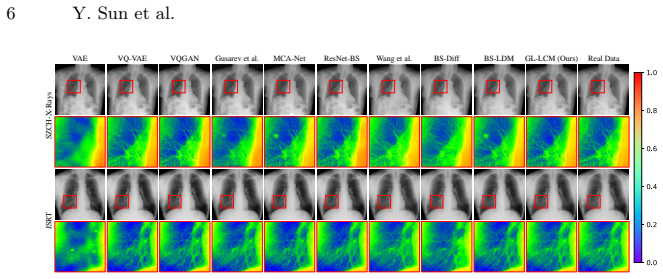
On its own terms, the paper claims that GL-LCM delivers both the strongest bone suppression and the best detail preservation among the methods tested. On SZCH-X-Rays, GL-LCM reports MSE $0.512\times10^{-3}$, PSNR 33.347 dB, LPIPS 0.056, and a bone suppression ratio of 95.61%, improving on the next-best method by 16.20% in MSE, 0.66 dB in PSNR, and 20.00% in LPIPS. On JSRT, it reports PSNR 32.951 dB, LPIPS 0.052, and BSR 90.06%, with PSNR 0.64 dB higher and LPIPS 8.77% lower than the comparison methods. The speed claim is that the full pipeline runs in 8.54 seconds per 1024x1024 image, versus 108.86 seconds for BS-Diff and 84.62 seconds for BS-LDM.
Load-bearing premise
The method's central bet is that a network trained only to predict noise will behave, at inference, as a consistency model whose few-step outputs match the true reverse process; if that equivalence fails, the tenfold speed advantage and the reported quality both lose their footing.
Editorial extensions
If this is right
- Bone suppression for a 1024x1024 chest X-ray drops from roughly 85-109 seconds to 8.54 seconds on a single A100 GPU, moving the method an order of magnitude closer to clinical workflow times.
- The ablations show that the global-local fusion is what preserves texture: removing fusion costs 1.99 dB on SZCH-X-Rays and 1.12 dB on JSRT, while keeping the global path alone is markedly worse.
- Local-Enhanced Guidance needs no retraining and can be layered onto the same dual-path weights, so the benefit of blending local and global conditioning is available at inference time.
- The design suggests that consistency-model sampling, rather than full DDPM chains, is a viable route for high-resolution medical image translation tasks where latency matters.
Reading between the lines
- A natural extension is to measure whether the 8.54-second figure holds in a deployed pipeline on lower-end clinical hardware, since the paper reports total time without separating LCM sampling from VQGAN encode/decode and Poisson fusion.
- An editorial test would be to train the same GL-LCM architecture with an explicit consistency objective and compare it against the paper's noise-prediction-only training; if the explicit-consistency version is clearly better, the speed and quality claims may depend on an unverified equivalence.
- The training-free LEG blending idea could plausibly transfer to other region-conditional image-to-image tasks, such as masked inpainting or organ-specific enhancement, where a local condition alone causes boundary artifacts.
Signed reviews
Editorial analysis
A structured set of objections, weighed in public.
Referee Report
Summary. The paper proposes GL-LCM, a global-local framework for fast bone suppression in chest X-rays. It combines a Dense-U-Net lung segmentation, a conditional latent model with global and local sampling paths, a Local-Enhanced Guidance (LEG) scheme that interpolates between local and global conditions, and Poisson fusion in pixel space. The authors evaluate on a private SZCH-X-Rays dataset and the public JSRT dataset, reporting consistent improvements in BSR, MSE, PSNR, and LPIPS over AE-, GAN-, and diffusion-based baselines, together with an inference time of 8.54 s versus roughly 85–109 s for 1000-step diffusion baselines. Ablations are provided for the guidance and fusion components.
Significance. If the described method is correctly implemented, the paper makes a practically relevant contribution to CXR bone suppression: the global-local decomposition is sensible, the LEG idea is simple and training-free at inference, and the public JSRT evaluation plus released code are strengths. The reported gains are plausible as system-level results. However, the text does not currently establish that the trained model is a consistency model: the training loss in Eq. (2) is a standard noise-prediction loss, while the sampler in Eq. (3) uses consistency-model machinery. This mismatch is load-bearing because the LCM label and the 50-step speed claim rely on it. With that mismatch resolved, the paper would be a solid empirical contribution; as written, the central methodological claim is not yet supported.
major comments (4)
- [§2.1, Eqs. (2)–(3)] The training objective in Eq. (2) is exactly the standard conditional noise-prediction MSE used for DDPM/DDIM-style latent diffusion: it contains no consistency loss, no self-consistency constraint f(z_t,t)=f(z_{t-1},t-1), and no distillation target. The reverse update in Eq. (3), however, is presented as an LCM-style sampler using c_out/c_skip interpolation and an injected-noise term for 1<t≤T. For a network trained only with Eq. (2), iterating Eq. (3) has no consistency-model justification, and the error may compound over 50 steps. This is the load-bearing point behind the LCM label and the inference-time claim in Table 3. Please either provide the actual consistency objective and the exact c_out/c_skip schedules used in training, or re-frame the sampler as a 50-step latent diffusion sampler and compare it against a same-architecture, same-step-count DDIM baseline to support the efficiency claim.
- [§2.2, Eq. (4)] The Local-Enhanced Guidance formula in Eq. (4) is written as a combination of score functions, but the model is trained with the noise-prediction loss in Eq. (2). The paper does not state how ∇_{z_{l,t}} log p is obtained from the predicted noise ε_θ, nor how a CFG-style combination is implemented when Eq. (2) contains no explicit condition-dropout term. Please specify how the local and global conditions are presented during training, how Eq. (4) is converted into an epsilon-domain combination in the sampler, and how the CFG baseline in Table 4 was trained and evaluated.
- [§2.1, Eq. (3) and implementation details] The functions c_skip(t), c_out(t), and the condition notation e_z (also written ztilde) are never defined. The statement that c_out(0)=0 and c_skip(0)=1 is not sufficient to reproduce the sampler. Moreover, the first line of Eq. (3) contains a noise-injection term sqrt((1−α_{t−1})/(1−ar α_{t−1})) ε, which is not part of the LCM update in the cited reference [14]; a derivation or citation for this schedule is needed. Without these definitions, the 50-step sampling algorithm is not fully specified.
- [Table 3] The inference-efficiency comparison is confounded by the number of sampling steps and by the latent-space operating point: BS-Diff and BS-LDM are evaluated with 1000 DDPM steps, while GL-LCM uses 50 steps in a VQGAN latent space. To attribute the approximately 10x speedup to the LCM sampler rather than to the reduced step count and latent resolution, the authors should include a 50-step DDIM or DDPM variant of GL-LCM in Table 3. The system-level speed number is useful, but the current comparison does not isolate the contribution of the consistency-model machinery.
minor comments (5)
- [Table 5] The first row of Table 5 is missing its method name and the reported value appears as ' %31.360'; please label the no-fusion baseline explicitly and fix the formatting.
- [§2.1, Eqs. (1)–(3)] The conditioning variable e_z (also ztilde) is used before it is defined; please define it in §2.1 as the global or local CXR condition and clarify which condition is used in each path in §2.2.
- [§3.1, implementation details] Please state the noise-prediction weighting used in Eq. (2) (e.g., unweighted MSE vs standard DDPM weighting) and the exact conditioning dropout probability if classifier-free guidance was used.
- [Tables 4 and 5] The ablation tables report mean ± std, but the number of repeated runs is not stated; please specify whether these are single-run statistics or averages over multiple runs, and if possible add a significance test for the main comparisons.
- [§1 and §3.2] The claim that existing diffusion methods fail to 'balance bone suppression and detail retention' is somewhat overstated given the small quantitative margins on JSRT (e.g., LPIPS 0.057 vs 0.052 for MCA-Net); please temper the wording to match the measured differences.
Circularity Check
No significant circularity: the reported bone-suppression gains and 8.54 s inference time are empirical measurements on held-out test data with hand-set hyperparameters; none of the claims reduces to its inputs by construction.
full rationale
The paper's central claims—16.20% MSE, 0.66 dB PSNR, and 20.00% LPIPS improvements on SZCH-X-Rays, and 5.49% BSR, 0.64 dB PSNR, and 8.77% LPIPS improvements on JSRT, plus the 8.54 s inference time—are test-set measurements, not derived quantities. The training loss in Eq. (2) is a standard conditional noise-prediction MSE, and the sampler in Eq. (3) is an adopted LCM-style update; no equation is defined in terms of the reported outcome. Hyperparameters such as alpha_l = 3, T = 50, and the beta schedule are hand-set, and no parameter is fitted to the evaluation metrics, so no fitted input is renamed as a prediction. The LCM formulation is cited to external prior work [14], and the speed comparison is empirically measured against BS-Diff and BS-LDM baselines in Table 3; the speed superiority is measured, not forced by the LCM label. The skeptical concern that Eq. (2) does not enforce the consistency-model self-consistency property is an internal-consistency or correctness risk, not a demonstration that any claim is equivalent to its inputs by construction. Accordingly, no circular step can be exhibited, and the paper is self-contained against external benchmarks; the score is 0.
Assumptions & free parameters
free parameters (2)
- alpha_l (LEG weight) =
3
- Number of sampling steps T =
50
assumptions (4)
- domain assumption Paired CXR and DES soft-tissue images from SZCH-X-Rays and JSRT provide ground truth for supervised training.
- domain assumption The standard LPIPS, PSNR, MSE, and BSR metrics correctly capture clinical bone suppression quality.
- domain assumption A pre-trained Dense-U-Net produces a reliable lung mask for every input.
- ad hoc to paper The noise prediction loss in Eq. (2) is sufficient to train a consistency model.
Cite this review
Pith. "Pith review of GL-LCM: Global-Local Latent Consistency Models for Fast High-Resolution Bone Suppression in Chest X-Ray Images." pith.science (2026). https://pith.science/paper/WRHIJWWZ
@misc{pith2026250803357,
  author       = {Pith},
  title        = {Pith review of: GL-LCM: Global-Local Latent Consistency Models for Fast High-Resolution Bone Suppression in Chest X-Ray Images},
  year         = {2026},
  howpublished = {\url{https://pith.science/paper/WRHIJWWZ}},
  note         = {Machine review of arXiv:2508.03357}
}
read the original abstract
Chest X-Ray (CXR) imaging for pulmonary diagnosis raises significant challenges, primarily because bone structures can obscure critical details necessary for accurate diagnosis. Recent advances in deep learning, particularly with diffusion models, offer significant promise for effectively minimizing the visibility of bone structures in CXR images, thereby improving clarity and diagnostic accuracy. Nevertheless, existing diffusion-based methods for bone suppression in CXR imaging struggle to balance the complete suppression of bones with preserving local texture details. Additionally, their high computational demand and extended processing time hinder their practical use in clinical settings. To address these limitations, we introduce a Global-Local Latent Consistency Model (GL-LCM) architecture. This model combines lung segmentation, dual-path sampling, and global-local fusion, enabling fast high-resolution bone suppression in CXR images. To tackle potential boundary artifacts and detail blurring in local-path sampling, we further propose Local-Enhanced Guidance, which addresses these issues without additional training. Comprehensive experiments on a self-collected dataset SZCH-X-Rays, and the public dataset JSRT, reveal that our GL-LCM delivers superior bone suppression and remarkable computational efficiency, significantly outperforming several competitive methods. Our code is available at https://github.com/diaoquesang/GL-LCM.
Figures


Reference graph
Works this paper leans on
-
[14]
arXiv preprint arXiv:2310.04378 (2023)
Luo, S., Tan, Y., Huang, L., Li, J., Zhao, H.: Latent consistency mod- els: Synthesizing high-resolution images with few-step inference. arXiv preprint arXiv:2310.04378 (2023)
arXiv 2023
-
[1]
In: 2024 IEEE International Symposium on Biomedical Imaging (ISBI)
Chen, Z., Sun, Y., Ge, R., Qin, W., Pan, C., Deng, W., Liu, Z., Min, W., Elazab, A., Wan, X., et al.: Bs-diff: Effective bone suppression using conditional diffu- sion models from chest x-ray images. In: 2024 IEEE International Symposium on Biomedical Imaging (ISBI). pp. 1–5. IEEE (2024)
work page 2024
-
[2]
Advances in Neural Information Processing Systems34, 8780–8794 (2021)
Dhariwal, P., Nichol, A.: Diffusion models beat gans on image synthesis. Advances in Neural Information Processing Systems34, 8780–8794 (2021)
2021
-
[3]
In: Proceedings of the IEEE/CVF Conference on Computer Vision and Pattern Recognition
Esser, P., Rombach, R., Ommer, B.: Taming transformers for high-resolution image synthesis. In: Proceedings of the IEEE/CVF Conference on Computer Vision and Pattern Recognition. pp. 12873–12883 (2021)
work page 2021
-
[4]
In: European Conference on Computer Vision
Fu, X., Yin, W., Hu, M., Wang, K., Ma, Y., Tan, P., Shen, S., Lin, D., Long, X.: Geowizard: Unleashing the diffusion priors for 3d geometry estimation from a single image. In: European Conference on Computer Vision. pp. 241–258. Springer (2024)
work page 2024
-
[5]
Advances in Neural Infor- mation Processing Systems27(2014)
Goodfellow, I., Pouget-Abadie, J., Mirza, M., Xu, B., Warde-Farley, D., Ozair, S., Courville, A., Bengio, Y.: Generative adversarial nets. Advances in Neural Infor- mation Processing Systems27(2014)
work page 2014
-
[6]
Gusarev, M., Kuleev, R., Khan, A., Rivera, A.R., Khattak, A.M.: Deep learn- ing models for bone suppression in chest radiographs. In: 2017 IEEE Confer- ence on Computational Intelligence in Bioinformatics and Computational Biology (CIBCB). pp. 1–7. IEEE (2017)
work page 2017
-
[7]
In: NeurIPS 2021 Workshop on Deep Generative Models and Downstream Applications (2021) 10 Y
Ho, J., Salimans, T.: Classifier-free diffusion guidance. In: NeurIPS 2021 Workshop on Deep Generative Models and Downstream Applications (2021) 10 Y. Sun et al
work page 2021
Show all 31 references
-
[8]
IEEE Transactions on Medical Imaging32(11), 2099–2113 (2013)
Hogeweg, L., Sánchez, C.I., van Ginneken, B.: Suppression of translucent elon- gated structures: applications in chest radiography. IEEE Transactions on Medical Imaging32(11), 2099–2113 (2013)
2013
-
[9]
Electronics Letters44(13), 800–801 (2008)
Huynh-Thu, Q., Ghanbari, M.: Scope of validity of psnr in image/video quality assessment. Electronics Letters44(13), 800–801 (2008)
2008
-
[10]
In: XII Mediterranean Conference on Medical and Biological Engineering and Computing
Juhász, S., Horváth, Á., Nikházy, L., Horváth, G., Horváth, Á.: Segmentation of anatomical structures on chest radiographs. In: XII Mediterranean Conference on Medical and Biological Engineering and Computing. pp. 359–362. Springer (2010)
2010
-
[11]
Foundations and Trends in Machine Learning12(4), 307–392 (2019)
Kingma, D.P., Welling, M., et al.: An introduction to variational autoencoders. Foundations and Trends in Machine Learning12(4), 307–392 (2019)
2019
-
[12]
IEEE Transactions on Medical Imaging39(10), 3053–3063 (2020)
Li, H., Han, H., Li, Z., Wang, L., Wu, Z., Lu, J., Zhou, S.K.: High-resolution chest x-ray bone suppression using unpaired ct structural priors. IEEE Transactions on Medical Imaging39(10), 3053–3063 (2020)
2020
-
[13]
Computerized Medical Imaging and Graphics105, 102186 (2023)
Liu, Y., Zeng, F., Ma, M., Zheng, B., Yun, Z., Qin, G., Yang, W., Feng, Q.: Bone suppression of lateral chest x-rays with imperfect and limited dual-energy subtraction images. Computerized Medical Imaging and Graphics105, 102186 (2023)
2023
-
[15]
IEEE Journal of Biomedical and Health Informatics25(8), 2938–2947 (2021)
Pham, L., Phan, H., Palaniappan, R., Mertins, A., McLoughlin, I.: Cnn-moe based framework for classification of respiratory anomalies and lung disease detection. IEEE Journal of Biomedical and Health Informatics25(8), 2938–2947 (2021)
2021
-
[16]
Porter,T.,Duff,T.:Compositingdigitalimages.In:Proceedingsofthe11thAnnual Conference on Computer Graphics and Interactive Techniques. pp. 253–259 (1984)
1984
-
[17]
Diag- nostics11(5), 840 (2021)
Rajaraman, S., Zamzmi, G., Folio, L., Alderson, P., Antani, S.: Chest x-ray bone suppression for improving classification of tuberculosis-consistent findings. Diag- nostics11(5), 840 (2021)
2021
-
[18]
American Journal of Roentgenology174(1), 71–74 (2000)
Shiraishi, J., Katsuragawa, S., Ikezoe, J., Matsumoto, T., Kobayashi, T., Komatsu, K.i., Matsui, M., Fujita, H., Kodera, Y., Doi, K.: Development of a digital image database for chest radiographs with and without a lung nodule: receiver operating characteristic analysis of rad...
2000
-
[19]
In: 4th European Conference of the International Federation for Medical and Biological Engineering: ECIFMBE
Simkó, G., Orbán, G., Máday, P., Horváth, G.: Elimination of clavicle shadows to help automatic lung nodule detection on chest radiographs. In: 4th European Conference of the International Federation for Medical and Biological Engineering: ECIFMBE. pp. 488–491. Springer (2009)
2009
-
[20]
In: Interna- tional Conference on Machine Learning
Song, Y., Dhariwal, P., Chen, M., Sutskever, I.: Consistency models. In: Interna- tional Conference on Machine Learning. pp. 32211–32252. PMLR (2023)
2023
-
[21]
arXiv preprint arXiv:2412.15670 (2024)
Sun, Y., Chen, Z., Zheng, H., Ge, R., Liu, J., Min, W., Elazab, A., Wan, X., Wang, C.: Bs-ldm: Effective bone suppression in high-resolution chest x-ray images with conditional latent diffusion models. arXiv preprint arXiv:2412.15670 (2024)
2024 arXiv
-
[22]
Advances in Neural Information Processing Systems30(2017)
Van Den Oord, A., Vinyals, O., et al.: Neural discrete representation learning. Advances in Neural Information Processing Systems30(2017)
2017
-
[23]
Scientific Reports15(1), 4416 (2025)
Wang, Y., Qu, Z., Dai, Z., Li, Y., Liu, Y., Wang, W., Xiao, L., Zhang, Y.: Rib suppression-basedradiomicsfordiagnosisofneonatalrespiratorydistresssyndrome in chest x-rays. Scientific Reports15(1), 4416 (2025)
2025
-
[24]
In: Pacific-Asia Conference on Knowledge Discovery and Data Mining
Weber, T., Ingrisch, M., Bischl, B., Rügamer, D.: Cascaded latent diffusion models for high-resolution chest x-ray synthesis. In: Pacific-Asia Conference on Knowledge Discovery and Data Mining. pp. 180–191. Springer (2023) Global-Local Latent Consistency Models for Bone Suppression 11
2023
-
[25]
In: International Conference on Medical Image Computing and Computer- Assisted Intervention
Wolleb, J., Bieder, F., Friedrich, P., Zhang, P., Durrer, A., Cattin, P.C.: Binary noise for binary tasks: Masked bernoulli diffusion for unsupervised anomaly detec- tion. In: International Conference on Medical Image Computing and Computer- Assisted Intervention. pp. 135–145....
2024
-
[26]
In: 2020 42nd Annual International Conference of the IEEE Engineering in Medicine & Biology Society (EMBC)
Yahyatabar, M., Jouvet, P., Cheriet, F.: Dense-unet: a light model for lung fields segmentation in chest x-ray images. In: 2020 42nd Annual International Conference of the IEEE Engineering in Medicine & Biology Society (EMBC). pp. 1242–1245. IEEE (2020)
2020
-
[27]
In: 2019 IEEE International Con- ference on Prognostics and Health Management (ICPHM)
Yao, R., Liu, C., Zhang, L., Peng, P.: Unsupervised anomaly detection using vari- ational auto-encoder based feature extraction. In: 2019 IEEE International Con- ference on Prognostics and Health Management (ICPHM). pp. 1–7. IEEE (2019)
2019
-
[28]
Advances in Neural Information Processing Systems37, 22370–22417 (2025)
Ye, H., Lin, H., Han, J., Xu, M., Liu, S., Liang, Y., Ma, J., Zou, J.Y., Ermon, S.: Tfg: Unified training-free guidance for diffusion models. Advances in Neural Information Processing Systems37, 22370–22417 (2025)
2025
-
[29]
In: Proceedings of the IEEE Conference on Computer Vision and Pattern Recognition
Zhang, R., Isola, P., Efros, A.A., Shechtman, E., Wang, O.: The unreasonable effectiveness of deep features as a perceptual metric. In: Proceedings of the IEEE Conference on Computer Vision and Pattern Recognition. pp. 586–595 (2018)
2018
-
[30]
The Lancet Respiratory Medicine (2025)
Zhen, K., Yang, P., Zhai, Z.: Epidemiology and management of paediatric pul- monary embolism: a much-needed focus of research. The Lancet Respiratory Medicine (2025)
2025
-
[31]
In: Asian Conference on Computer Vision
Zhou, B., Lin, X., Eck, B., Hou, J., Wilson, D.: Generation of virtual dual energy images from standard single-shot radiographs using multi-scale and conditional ad- versarial network. In: Asian Conference on Computer Vision. pp. 298–313. Springer (2019)
2019
Reviewed August 6, 2026 · model on record in the stance chip above.
Discussion (0). Continue with ORCID to comment.