VRPRM: Process Reward Modeling via Visual Reasoning
Pith reviewed 2026-05-22 12:16 UTC · model grok-4.3
The pith
A process reward model gains deep reasoning ability by injecting visual reasoning through a two-stage training pipeline.
A machine-rendered reading of the paper's core claim, the machinery that carries it, and where it could break.
Core claim
VRPRM is a process reward model that incorporates visual reasoning via an efficient two-stage training strategy. Using only 3.6K CoT-PRM Supervised Fine-Tuning data and 50K non-CoT PRM Reinforcement Learning training data, VRPRM surpasses non-thinking PRMs trained on a total of 400K data and delivers a relative performance improvement of up to 118% over the base model in Best-of-N experiments. This confirms that the combined training strategy achieves higher quality reasoning capabilities at lower data annotation cost.
What carries the argument
The two-stage training pipeline that first applies supervised fine-tuning on CoT-PRM data to inject visual reasoning and then uses reinforcement learning on non-CoT PRM data to refine the model.
If this is right
- Process reward models can reach higher reasoning quality with far smaller annotated datasets.
- The separation of visual-reasoning SFT from standard RL allows efficient scaling of PRM capabilities.
- Annotation budgets for fine-grained LLM evaluation can be reduced while maintaining or improving step-level accuracy.
- A new training paradigm emerges that combines limited CoT data with abundant non-CoT data for reward modeling.
Where Pith is reading between the lines
- The same two-stage injection of visual reasoning might improve outcome reward models or other preference models without proportional data increases.
- If visual reasoning transfers across domains, the method could lower costs for training reward models on math, code, or multimodal tasks.
- Future work could test whether the visual-reasoning stage reduces specific error types such as step hallucination in long reasoning chains.
Load-bearing premise
Visual reasoning can be reliably added to a process reward model through this two-stage pipeline without creating new failure modes or needing extra task-specific visual data.
What would settle it
Train a non-thinking PRM on 400K examples and compare its Best-of-N performance against VRPRM trained on the claimed 3.6K plus 50K data; if VRPRM does not show at least an 80 percent relative gain over the base model, the central efficiency claim fails.
Figures




read the original abstract
Process Reward Model (PRM) is widely used in the post-training of Large Language Model (LLM) because it can perform fine-grained evaluation of the reasoning steps of generated content. However, most PRMs lack long-term reasoning and deep thinking capabilities. On the other hand, although a few works have tried to introduce Chain-of-Thought (CoT) capability into PRMs, the annotation cost of CoT-PRM data is too expensive to play a stable role in various tasks. To address the above challenges, we propose VRPRM, a process reward model via visual reasoning, and design an efficient two-stage training strategy. Experimental results show that using only 3.6K CoT-PRM Supervised Fine-Tuning(SFT) data and 50K non-CoT PRM Reinforcement Learning (RL) training data, VRPRM can surpass the non-thinking PRM with a total data volume of 400K and achieved a relative performance improvement of up to 118\% over the base model in the BoN experiment. This result confirms that the proposed combined training strategy can achieve higher quality reasoning capabilities at a lower data annotation cost, thus providing a new paradigm for PRM training with more efficient data utilization.
Editorial analysis
A structured set of objections, weighed in public.
Referee Report
Summary. The paper introduces VRPRM, a process reward model that incorporates visual reasoning to improve long-term and deep thinking in step-wise evaluation of LLM outputs. It proposes a two-stage training pipeline consisting of supervised fine-tuning on 3.6K CoT-PRM data followed by reinforcement learning on 50K non-CoT PRM data, claiming this enables VRPRM to surpass non-thinking PRMs trained on a total of 400K data while delivering up to 118% relative improvement over the base model in Best-of-N (BoN) experiments.
Significance. If the empirical results hold after proper verification, the work would be significant for demonstrating a data-efficient paradigm for PRM training that reduces expensive CoT annotation costs by leveraging visual reasoning transfer. This could meaningfully advance post-training techniques for LLMs by achieving higher-quality reasoning capabilities with substantially lower data volumes.
major comments (2)
- Abstract: the headline claim that 3.6K CoT-PRM SFT + 50K non-CoT RL data surpasses a 400K non-thinking PRM with up to 118% relative BoN gain is presented without any details on visual reasoning implementation, exact baseline models and training procedures, statistical significance, or ablations isolating the visual component; this prevents evaluation of the central performance claim.
- Two-stage pipeline (described in abstract and training sections): the assumption that visual reasoning reliably transfers from the small SFT set to the larger RL set without introducing new failure modes (e.g., hallucinated diagrams or modality misalignment) is unverified by ablations or cross-task generalization tests, which is load-bearing for the claimed annotation savings.
minor comments (2)
- Provide explicit description of how visual elements are generated, referenced, or rendered within the CoT-PRM data and how they are fused into the PRM architecture.
- Include tables reporting exact baseline configurations, dataset compositions, and ablation results for the visual reasoning component.
Simulated Author's Rebuttal
We thank the referee for the thoughtful and constructive report. We address each major comment below with clarifications from the manuscript and indicate where revisions have been made to improve transparency and rigor.
read point-by-point responses
-
Referee: Abstract: the headline claim that 3.6K CoT-PRM SFT + 50K non-CoT RL data surpasses a 400K non-thinking PRM with up to 118% relative BoN gain is presented without any details on visual reasoning implementation, exact baseline models and training procedures, statistical significance, or ablations isolating the visual component; this prevents evaluation of the central performance claim.
Authors: We agree that the abstract, as a concise summary, does not include implementation specifics. These are provided in the main text: visual reasoning is implemented via diagram generation and interpretation in Section 3, baseline models and training details (including the 400K non-thinking PRM) are in Section 4, statistical significance via multiple runs with standard deviations appears in Section 5, and ablations isolating the visual component are in Section 5.3. To address the concern, we have revised the abstract to briefly reference the two-stage pipeline and direct readers to the relevant sections for full experimental context. revision: yes
-
Referee: Two-stage pipeline (described in abstract and training sections): the assumption that visual reasoning reliably transfers from the small SFT set to the larger RL set without introducing new failure modes (e.g., hallucinated diagrams or modality misalignment) is unverified by ablations or cross-task generalization tests, which is load-bearing for the claimed annotation savings.
Authors: We acknowledge the importance of verifying transfer and failure modes. The manuscript reports ablations in Section 5.2 that compare the full two-stage VRPRM against SFT-only and RL-only variants, showing performance gains attributable to visual reasoning transfer. Cross-task results on math, coding, and science benchmarks are presented in Table 3. Manual analysis of outputs (Section 5.4) indicates low incidence of hallucinated diagrams. We have added explicit discussion of modality alignment checks and additional failure-mode analysis to the revised version to further substantiate the annotation savings claim. revision: partial
Circularity Check
No significant circularity; empirical results on external benchmarks.
full rationale
The paper describes an empirical two-stage training pipeline for VRPRM using 3.6K CoT-PRM SFT data followed by 50K non-CoT RL data, with performance claims supported by direct comparisons to baselines on external benchmarks such as BoN. No mathematical derivation chain, equations, or fitted parameters are presented that reduce to the inputs by construction. The central result is a reported empirical improvement rather than a self-referential prediction or self-citation load-bearing premise. The work is therefore self-contained against external benchmarks with no load-bearing circular steps.
Axiom & Free-Parameter Ledger
Lean theorems connected to this paper
-
IndisputableMonolith/Foundation/AbsoluteFloorClosure.leanreality_from_one_distinction unclear?
unclearRelation between the paper passage and the cited Recognition theorem.
We propose VRPRM, a process reward model via visual reasoning, and design an efficient two-stage training strategy... using only 3.6K CoT-PRM SFT data and 50K non-CoT PRM RL training data
-
IndisputableMonolith/Cost/FunctionalEquation.leanwashburn_uniqueness_aczel unclear?
unclearRelation between the paper passage and the cited Recognition theorem.
Reward Function Design... Rf ormat(O) = has think(O) ∧ has step judge(O) ∧ has final judge(O)
What do these tags mean?
- matches
- The paper's claim is directly supported by a theorem in the formal canon.
- supports
- The theorem supports part of the paper's argument, but the paper may add assumptions or extra steps.
- extends
- The paper goes beyond the formal theorem; the theorem is a base layer rather than the whole result.
- uses
- The paper appears to rely on the theorem as machinery.
- contradicts
- The paper's claim conflicts with a theorem or certificate in the canon.
- unclear
- Pith found a possible connection, but the passage is too broad, indirect, or ambiguous to say the theorem truly supports the claim.
Forward citations
Cited by 1 Pith paper
-
PDCR: Perception-Decomposed Confidence Reward for Vision-Language Reasoning
PDCR improves vision-language reasoning by computing separate normalized confidence advantages for perception steps and reasoning steps after unsupervised decomposition.
Reference graph
Works this paper leans on
-
[1]
Open Com- pass: Accelerating the Adoption of AI in Open Research. In Practice and Experience in Advanced Research Comput- ing 2019: Rise of the Machines (Learning) , PEARC ’19. New York, NY , USA: Association for Computing Machin- ery. ISBN 9781450372275. Chen, X.; Li, G.; Wang, Z.; Jin, B.; Qian, C.; Wang, Y .; Wang, H.; Zhang, Y .; Zhang, D.; Zhang, T.;...
-
[2]
SFT Memorizes, RL Generalizes: A Comparative Study of Foundation Model Post-training
Sft memorizes, rl generalizes: A comparative study of foundation model post- training. arXiv preprint arXiv:2501.17161. Guo, J.; Chi, Z.; Dong, L.; Dong, Q.; Wu, X.; Huang, S.; and Wei, F
work page internal anchor Pith review Pith/arXiv arXiv
-
[3]
arXiv preprint arXiv:2505.14674
Reward reasoning model. arXiv preprint arXiv:2505.14674. Hong, I.; Yu, C.; Qiu, L.; Yan, W.; Xu, Z.; Jiang, H.; Zhang, Q.; Lu, Q.; Liu, X.; Zhang, C.; et al
-
[4]
arXiv preprint arXiv:2505.16265
Think-RM: Enabling Long-Horizon Reasoning in Generative Reward Models. arXiv preprint arXiv:2505.16265. Lu, P.; Bansal, H.; Xia, T.; Liu, J.; Li, C.; Hajishirzi, H.; Cheng, H.; Chang, K.-W.; Galley, M.; and Gao, J
-
[5]
We-Math: Does Your Large Multimodal Model Achieve Human-like Mathematical Reasoning?
We-Math: Does Your Large Multimodal Model Achieve Human-like Mathematical Reasoning? arXiv preprint arXiv:2407.01284. Shao, Z.; Wang, P.; Zhu, Q.; Xu, R.; Song, J.; Bi, X.; Zhang, H.; Zhang, M.; Li, Y .; Wu, Y .; et al
work page internal anchor Pith review Pith/arXiv arXiv
-
[6]
DeepSeekMath: Pushing the Limits of Mathematical Reasoning in Open Language Models
Deepseekmath: Pushing the limits of mathematical reasoning in open lan- guage models. arXiv preprint arXiv:2402.03300. Sheng, G.; Zhang, C.; Ye, Z.; Wu, X.; Zhang, W.; Zhang, R.; Peng, Y .; Lin, H.; and Wu, C
work page internal anchor Pith review Pith/arXiv arXiv
-
[7]
HybridFlow: A Flexible and Efficient RLHF Framework
HybridFlow: A Flexi- ble and Efficient RLHF Framework. arXiv preprint arXiv: 2409.19256. Wang, B.; Lin, R.; Lu, K.; Yu, L.; Zhang, Z.; Huang, F.; Zheng, C.; Dang, K.; Fan, Y .; Ren, X.; et al. 2025a. WorldPM: Scaling Human Preference Modeling. arXiv preprint arXiv:2505.10527. Wang, K.; Pan, J.; Shi, W.; Lu, Z.; Ren, H.; Zhou, A.; Zhan, M.; and Li, H
work page internal anchor Pith review Pith/arXiv arXiv
-
[8]
VisualPRM: An effective process reward model for multimodal reasoning,
Measuring Multimodal Mathemati- cal Reasoning with MATH-Vision Dataset. In The Thirty- eight Conference on Neural Information Processing Systems Datasets and Benchmarks Track. Wang, W.; Gao, Z.; Chen, L.; Chen, Z.; Zhu, J.; Zhao, X.; Liu, Y .; Cao, Y .; Ye, S.; Zhu, X.; et al. 2025b. Visualprm: An effective process reward model for multimodal reasoning. a...
-
[9]
arXiv preprint arXiv:2505.10320
J1: Incentivizing thinking in llm-as-a-judge via reinforcement learning. arXiv preprint arXiv:2505.10320. Xiao, Y .; Sun, E.; Liu, T.; and Wang, W
-
[10]
LogicVista: Multimodal LLM Logical Reasoning Benchmark in Visual Contexts
LogicVista: Multimodal LLM Logical Reasoning Benchmark in Visual Contexts. arXiv:2407.04973. Zhang, L.; Hosseini, A.; Bansal, H.; Kazemi, M.; Kumar, A.; and Agarwal, R. 2024a. Generative verifiers: Re- ward modeling as next-token prediction. arXiv preprint arXiv:2408.15240. Zhang, R.; Jiang, D.; Zhang, Y .; Lin, H.; Guo, Z.; Qiu, P.; Zhou, A.; Lu, P.; Cha...
work page internal anchor Pith review Pith/arXiv arXiv
-
[11]
arXiv preprint arXiv:2504.00891
Genprm: Scaling test-time compute of process reward models via generative reasoning. arXiv preprint arXiv:2504.00891. Zheng, C.; Zhang, Z.; Zhang, B.; Lin, R.; Lu, K.; Yu, B.; Liu, D.; Zhou, J.; and Lin, J
-
[12]
Processbench: Identifying process errors in mathematical reasoning
Processbench: Identifying process errors in mathematical reasoning. arXiv preprint arXiv:2412.06559. Rollout Prompt and Data Statistics In this section we give a Prompt for synthetic data and an example of synthetic data. The prompt for using Claude-3.7- Sonnet to synthetic CoT-PRM Data is shown in Fig
-
[13]
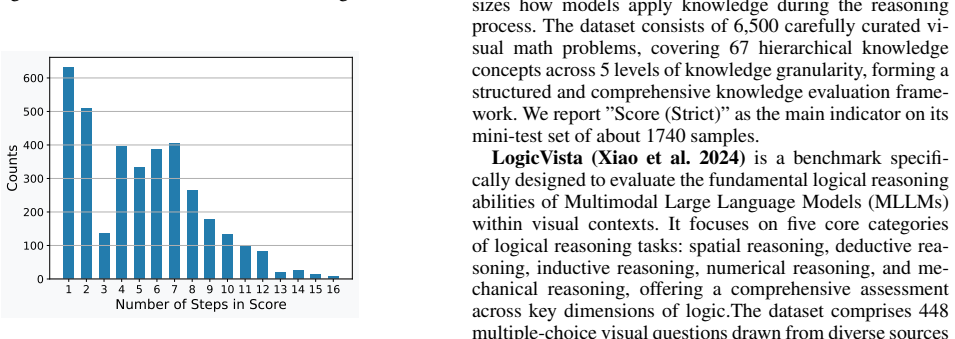
Among these solutions with fewer than 15 steps, the number of steps has a sample distribution
We observe that most solutions consist of fewer than 15 steps. Among these solutions with fewer than 15 steps, the number of steps has a sample distribution. 0 1000 2000 3000 4000 5000 6000 7000 Length of <think> content (characters) 0 200 400 600 800 1000Counts Figure 3: Distribution of think Content Length 4 65 11 151 7 8 14132 3 129 10 16 Number of Ste...
work page 2000
discussion (0)
Sign in with ORCID, Apple, or X to comment. Anyone can read and Pith papers without signing in.