CSNR and JMIM Based Spectral Band Selection for Reducing Metamerism in Urban Driving
Pith reviewed 2026-05-18 23:06 UTC · model grok-4.3
The pith
Three selected hyperspectral bands sharply increase material separability over RGB and reduce metameric confusion in urban driving scenes.
A machine-rendered reading of the paper's core claim, the machinery that carries it, and where it could break.
Core claim
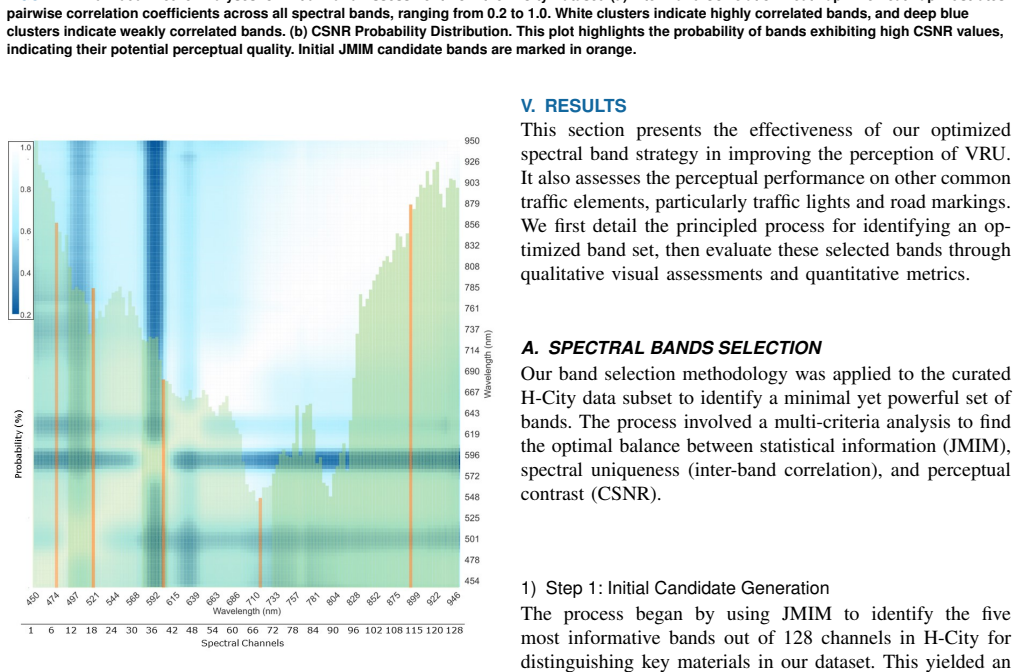
Applying contrast signal-to-noise ratio together with joint mutual information maximization and correlation analysis to hyperspectral data identifies three informative bands at 497 nm, 607 nm, and 895 nm that reconstruct pseudo-color images with substantially higher dissimilarity and perceptual separability for vulnerable road users than co-registered RGB images. The selected bands deliver measured improvements of 70.24 percent in Euclidean dissimilarity, 528.46 percent in spectral angle mapper, 1206.83 percent in Hotelling's T-squared, and 246.62 percent in CIE delta E, confirming a marked reduction in metameric confusion.
What carries the argument
The band selection strategy that integrates joint mutual information maximization, correlation analysis, and contrast signal-to-noise ratio to identify the most spectrally informative wavelengths from hyperspectral imagery.
If this is right
- The selected bands produce pseudo-color images with increased dissimilarity and perceptual separability of VRUs from the background.
- The method consistently outperforms RGB across Euclidean, SAM, T-squared, and CIE delta E metrics.
- Spectrally optimized input from these bands supplies a foundation for downstream perception tasks in ADAS and autonomous driving.
- The approach ultimately supports improved protection of vulnerable road users and road safety.
Where Pith is reading between the lines
- The band choices would benefit from direct testing in end-to-end VRU detection pipelines to confirm whether metric gains produce higher recall or fewer false negatives.
- The three wavelengths could be realized in compact multispectral sensors for practical automotive deployment.
- Repeating the selection process on datasets from different cities or weather conditions would test whether the same bands remain optimal outside the original H-City collection.
Load-bearing premise
The quantitative gains in dissimilarity and perception metrics measured on the H-City dataset will translate into improved real-world detection performance in ADAS pipelines under varying illumination and weather.
What would settle it
Running an object detector on both the three-band pseudo-color images and standard RGB images from scenes containing known metameric material pairs and comparing detection accuracy under controlled changes in lighting.
Figures




read the original abstract
Protecting Vulnerable Road Users (VRU) is a critical safety challenge for automotive perception systems, particularly under visual ambiguity caused by metamerism, a phenomenon where distinct materials appear similar in RGB imagery. This work investigates hyperspectral imaging (HSI) to overcome this limitation by capturing unique material signatures beyond the visible spectrum, especially in the Near-Infrared (NIR). To manage the inherent high-dimensionality of HSI data, we propose a band selection strategy that integrates information theory techniques (joint mutual information maximization, correlation analysis) with a novel application of an image quality metric (contrast signal-to-noise ratio) to identify the most spectrally informative bands. Using the Hyperspectral City V2 (H-City) dataset, we identify three informative bands (497 nm, 607 nm, and 895 nm, $\pm$27 nm) and reconstruct pseudo-color images for comparison with co-registered RGB. Quantitative results demonstrate increased dissimilarity and perceptual separability of VRU from the background. The selected HSI bands yield improvements of 70.24%, 528.46%, 1206.83%, and 246.62% for dissimilarity (Euclidean, SAM, $T^2$) and perception (CIE $\Delta E$) metrics, consistently outperforming RGB and confirming a marked reduction in metameric confusion. By providing a spectrally optimized input, our method enhances VRU separability, establishing a robust foundation for downstream perception tasks in Advanced Driver Assistance Systems (ADAS) and Autonomous Driving (AD), ultimately contributing to improved road safety.
Editorial analysis
A structured set of objections, weighed in public.
Referee Report
Summary. The paper claims that by using CSNR and JMIM for spectral band selection on the H-City hyperspectral dataset, three bands (497 nm, 607 nm, 895 nm) can be identified that, when used to form pseudo-color images, significantly increase the dissimilarity and perceptual separability between VRUs and background compared to standard RGB, with reported improvements of 70.24% (Euclidean), 528.46% (SAM), 1206.83% (T²), and 246.62% (CIE ΔE), thereby reducing metameric confusion for better urban driving perception.
Significance. Should the results prove robust, this band selection strategy could provide an efficient means to leverage hyperspectral information for improved material discrimination in automotive applications, particularly for VRU protection. It builds on information-theoretic and image quality metrics to address high-dimensional HSI data, offering a foundation for enhanced ADAS inputs. However, the significance hinges on demonstrating that the gains specifically address metamerism and translate to real-world detection performance.
major comments (2)
- [Quantitative Results] The abstract and results report large percentage improvements without accompanying error bars, statistical significance tests, or details on how the post-selection pseudo-color images were generated from the selected bands. This makes the central quantitative claim difficult to verify and assess for robustness.
- [Metamerism Evaluation] The paper does not describe a targeted evaluation using metameric pairs (i.e., distinct spectra that appear identical in RGB but separable in HSI). The aggregate class dissimilarity metrics may reflect general contrast benefits from the NIR band (895 nm) rather than specific resolution of metameric confusion, weakening the interpretation of the results as confirming 'marked reduction in metameric confusion'.
minor comments (2)
- [Abstract] The tolerance '±27 nm' for the selected bands is mentioned but not explained whether it refers to spectral resolution, selection uncertainty, or something else.
- [Method Description] Provide more explicit details or pseudocode on how CSNR and JMIM are integrated in the band selection procedure.
Simulated Author's Rebuttal
We thank the referee for the constructive comments on our manuscript. We address each major comment point by point below, indicating where revisions will be made to improve clarity and robustness.
read point-by-point responses
-
Referee: [Quantitative Results] The abstract and results report large percentage improvements without accompanying error bars, statistical significance tests, or details on how the post-selection pseudo-color images were generated from the selected bands. This makes the central quantitative claim difficult to verify and assess for robustness.
Authors: We agree that the manuscript would benefit from additional details to support the reported improvements. The pseudo-color images are generated by directly assigning the selected bands (497 nm, 607 nm, 895 nm) to the RGB channels after per-band normalization using the mean and standard deviation from the H-City training scenes. The band selection itself is deterministic given the CSNR and JMIM criteria on this fixed dataset. In the revision we will add an explicit description of this mapping process, report standard deviations of the metrics computed across multiple independent scenes, and include a brief discussion of consistency. We will also note that formal statistical significance testing (e.g., paired comparisons) can be added if the editor deems it necessary, though the magnitude of the observed differences already exceeds typical scene-to-scene variation in the dataset. revision: yes
-
Referee: [Metamerism Evaluation] The paper does not describe a targeted evaluation using metameric pairs (i.e., distinct spectra that appear identical in RGB but separable in HSI). The aggregate class dissimilarity metrics may reflect general contrast benefits from the NIR band (895 nm) rather than specific resolution of metameric confusion, weakening the interpretation of the results as confirming 'marked reduction in metameric confusion'.
Authors: We acknowledge that a dedicated metameric-pair analysis would provide more direct evidence. The H-City dataset does not contain pre-identified metameric pairs, and constructing them would require additional spectral matching steps beyond the scope of the present band-selection study. Nevertheless, the selected set includes two visible bands (497 nm and 607 nm) in addition to the NIR band, and the large gains in SAM and T²—metrics that penalize differences in spectral shape rather than simple intensity—cannot be explained by NIR contrast alone. We will revise the discussion to clarify this point, emphasize that improved class separability in these metrics directly reduces the conditions under which metamerism occurs, and explicitly state the lack of pair-wise metameric testing as a limitation and avenue for future work. revision: partial
Circularity Check
Data-driven selection on external dataset; no reduction to fitted parameters or self-citation chains
full rationale
The paper selects bands via JMIM, correlation analysis, and CSNR applied to the H-City dataset, then reports percentage gains in separate dissimilarity (Euclidean, SAM, T²) and perceptual (CIE ΔE) metrics on reconstructed pseudo-color images versus RGB. These steps constitute a standard feature-selection pipeline whose objective functions do not mathematically define or force the reported improvement percentages by construction. No equations are shown that equate the selection criterion to the evaluation metric, no self-citation is invoked to justify uniqueness or an ansatz, and the dataset is external to the authors' prior work. Minor risk of train-test overlap in evaluation exists but is not load-bearing for the central claim.
Axiom & Free-Parameter Ledger
free parameters (1)
- number of selected bands
axioms (1)
- domain assumption Hyperspectral signatures in the NIR range are sufficiently distinct to overcome visible-spectrum metamerism for common urban materials.
Lean theorems connected to this paper
-
IndisputableMonolith/Cost/FunctionalEquation.leanwashburn_uniqueness_aczel unclear?
unclearRelation between the paper passage and the cited Recognition theorem.
propose a band selection strategy that integrates information theory techniques (joint mutual information maximization, correlation analysis) with a novel application of an image quality metric (contrast signal-to-noise ratio)
-
IndisputableMonolith/Foundation/AbsoluteFloorClosure.leanreality_from_one_distinction unclear?
unclearRelation between the paper passage and the cited Recognition theorem.
Quantitative results demonstrate increased dissimilarity and perceptual separability of VRU from the background... improvements of 70.24%, 528.46%, 1206.83%, and 246.62%
What do these tags mean?
- matches
- The paper's claim is directly supported by a theorem in the formal canon.
- supports
- The theorem supports part of the paper's argument, but the paper may add assumptions or extra steps.
- extends
- The paper goes beyond the formal theorem; the theorem is a base layer rather than the whole result.
- uses
- The paper appears to rely on the theorem as machinery.
- contradicts
- The paper's claim conflicts with a theorem or certificate in the canon.
- unclear
- Pith found a possible connection, but the passage is too broad, indirect, or ambiguous to say the theorem truly supports the claim.
Forward citations
Cited by 1 Pith paper
-
Learnable Quantum Efficiency Filters for Urban Hyperspectral Segmentation
LQE is a physics-constrained learnable dimensionality reduction technique that improves average mIoU in hyperspectral urban segmentation on three datasets while using only 12-36 parameters.
Reference graph
Works this paper leans on
-
[1]
Urban scene understanding via hyperspectral images: Dataset and benchmark,
Q. Shen, Y . Huang, T. Ren, Y . Fu, and S. You, “Urban scene understanding via hyperspectral images: Dataset and benchmark,” Available at SSRN 4560035
-
[2]
Color metamerism and the structure of illuminant space,
A. Akbarinia and K. R. Gegenfurtner, “Color metamerism and the structure of illuminant space,” Journal of the Optical Society of America A, vol. 35, no. 4, pp. B231–B238, 2018
work page 2018
-
[3]
Au- tonomous vehicle perception: The technology of today and tomorrow,
J. Van Brummelen, M. O’brien, D. Gruyer, and H. Najjaran, “Au- tonomous vehicle perception: The technology of today and tomorrow,” Transportation research part C: emerging technologies , vol. 89, pp. 384–406, 2018
work page 2018
-
[4]
Sensor technology in autonomous vehicles: A review,
S. Campbell, N. O’Mahony, L. Krpalcova, D. Riordan, J. Walsh, A. Murphy, and C. Ryan, “Sensor technology in autonomous vehicles: A review,” in 2018 29th Irish Signals and Systems Conference (ISSC) . IEEE, 2018, pp. 1–4
work page 2018
-
[5]
How strong metamerism disturbs color spaces,
W. A. Thornton, “How strong metamerism disturbs color spaces,” Color Research & Application: Endorsed by Inter-Society Color Council, The Colour Group (Great Britain), Canadian Society for Color, Color Science Association of Japan, Dutch Society for the Study of Color, The Swedish Colour Centre Foundation, Colour Society of Australia, Centre Français de l...
work page 1998
-
[6]
Recent advances of hyperspectral imaging technology and applications in agriculture,
B. Lu, P. D. Dao, J. Liu, Y . He, and J. Shang, “Recent advances of hyperspectral imaging technology and applications in agriculture,” Remote Sensing, vol. 12, no. 16, p. 2659, 2020
work page 2020
-
[7]
Spectral textile detection in the vnir/swir band,
J. A. Arneal, “Spectral textile detection in the vnir/swir band,” 2015
work page 2015
-
[8]
Snapshot hyperspectral imaging with quantum correlated photons,
Y . Zhang, D. England, and B. Sussman, “Snapshot hyperspectral imaging with quantum correlated photons,” Optics Express , vol. 31, no. 2, pp. 2282–2291, 2023
work page 2023
-
[9]
Feature selection using joint mutual information maximisation,
M. Bennasar, Y . Hicks, and R. Setchi, “Feature selection using joint mutual information maximisation,” Expert Systems with Applications , vol. 42, no. 22, pp. 8520–8532, 2015
work page 2015
-
[10]
J. C. De Winter, S. D. Gosling, and J. Potter, “Comparing the pearson and spearman correlation coefficients across distributions and sample sizes: A tutorial using simulations and empirical data.” Psychological methods, vol. 21, no. 3, p. 273, 2016
work page 2016
-
[11]
Evaluation of image quality metrics designed for dri tasks with automotive cameras,
V . Klein, T. Eleftheriou, L. Yiqi, E. Baudin, C. Greco, L. Chanas, and F. Guichard, “Evaluation of image quality metrics designed for dri tasks with automotive cameras,” Electronic Imaging, vol. 35, pp. 1–6, 2023
work page 2023
-
[12]
Vulnerable road user detection and safety enhancement: A comprehensive survey,
R. M. Silva, G. F. Azevedo, M. V . Berto, J. R. Rocha, E. C. Fidelis, M. V . Nogueira, P. H. Lisboa, and T. A. Almeida, “Vulnerable road user detection and safety enhancement: A comprehensive survey,” arXiv preprint arXiv:2405.19202 , 2024
-
[13]
S. Sivaraman and M. M. Trivedi, “Looking at vehicles on the road: A survey of vision-based vehicle detection, tracking, and behavior analysis,” IEEE transactions on intelligent transportation systems , vol. 14, no. 4, pp. 1773–1795, 2013
work page 2013
-
[14]
Perception and sensing for autonomous vehicles under adverse weather conditions: A survey,
Y . Zhang, A. Carballo, H. Yang, and K. Takeda, “Perception and sensing for autonomous vehicles under adverse weather conditions: A survey,” ISPRS Journal of Photogrammetry and Remote Sensing , vol. 196, pp. 146–177, 2023
work page 2023
-
[15]
Object detection in adverse weather for autonomous driving through data merging and yolov8,
D. Kumar and N. Muhammad, “Object detection in adverse weather for autonomous driving through data merging and yolov8,” Sensors, vol. 23, no. 20, p. 8471, 2023
work page 2023
-
[16]
A survey on radar-based continuous human activity recognition,
I. Ullmann, R. G. Guendel, N. C. Kruse, F. Fioranelli, and A. Yarovoy, “A survey on radar-based continuous human activity recognition,” IEEE Journal of Microwaves , vol. 3, no. 3, pp. 938–950, 2023
work page 2023
-
[17]
You only look once: Unified, real-time object detection,
J. Redmon, S. Divvala, R. Girshick, and A. Farhadi, “You only look once: Unified, real-time object detection,” in Proceedings of the IEEE conference on computer vision and pattern recognition, 2016, pp. 779– 788
work page 2016
-
[18]
Faster r-cnn: Towards real- time object detection with region proposal networks,
S. Ren, K. He, R. Girshick, and J. Sun, “Faster r-cnn: Towards real- time object detection with region proposal networks,” Advances in neural information processing systems , vol. 28, 2015
work page 2015
-
[19]
I. A. Shah, J. Li, T. Brophy, M. Glavin, E. Jones, E. Ward, and B. Deegan, “Multi-scale spectral attention module-based hyperspec- tral segmentation in autonomous driving scenarios,” arXiv preprint arXiv:2506.18682, 2025
work page internal anchor Pith review Pith/arXiv arXiv 2025
-
[20]
Hyperspectral terrain classifi- cation for ground vehicles,
C. Winkens, F. Sattler, and D. Paulus, “Hyperspectral terrain classifi- cation for ground vehicles,” in International Conference on Computer Vision Theory and Applications , vol. 6. SCITEPRESS, 2017, pp. 417–424
work page 2017
-
[21]
J. Gutiérrez-Zaballa, K. Basterretxea, J. Echanobe, M. V . Martínez, U. Martinez-Corral, O. Mata-Carballeira, and I. del Campo, “On-chip hyperspectral image segmentation with fully convolutional networks for scene understanding in autonomous driving,” Journal of Systems Architecture, vol. 139, p. 102878, 2023
work page 2023
-
[22]
Pedestrian detection on a moving vehicle: an investigation about near infra-red images,
A. Broggi, R. I. Fedriga, A. Tagliati, T. Graf, and M. Meinecke, “Pedestrian detection on a moving vehicle: an investigation about near infra-red images,” in 2006 IEEE Intelligent Vehicles Symposium . IEEE, 2006, pp. 431–436
work page 2006
-
[23]
Pedestrian detection using multispectral images and a deep neural network,
J. Nataprawira, Y . Gu, I. Goncharenko, and S. Kamijo, “Pedestrian detection using multispectral images and a deep neural network,” Sensors, vol. 21, no. 7, p. 2536, 2021
work page 2021
-
[24]
A low-cost vis-nir true color night vision video system based on a wide dynamic range cmos imager,
D. Hertel, H. Marechal, D. A. Tefera, W. Fan, and R. Hicks, “A low-cost vis-nir true color night vision video system based on a wide dynamic range cmos imager,” in 2009 IEEE Intelligent Vehicles Symposium. IEEE, 2009, pp. 273–278
work page 2009
-
[25]
Potentials of combined visi- ble light and near infrared imaging for driving automation,
K. Weikl, D. Schroeder, and W. Stechele, “Potentials of combined visi- ble light and near infrared imaging for driving automation,” Electronic Imaging, vol. 34, pp. 1–5, 2022
work page 2022
-
[26]
Hyperspectral imaging phenomenology for the detection and tracking of pedestrians,
J. Herweg, J. Kerekes, and M. Eismann, “Hyperspectral imaging phenomenology for the detection and tracking of pedestrians,” in 2012 IEEE International Geoscience and Remote Sensing Symposium . IEEE, 2012, pp. 5482–5485
work page 2012
-
[27]
Separability between pedestrians in<? a3b2 show [pmg: line- break justify=
——, “Separability between pedestrians in<? a3b2 show [pmg: line- break justify=" yes"/]?> hyperspectral imagery,” Applied Optics , vol. 52, no. 6, pp. 1330–1338, 2013. VOLUME , 11 Li et al.: CSNR and JMIM Based Spectral Band Selection for Reducing Metamerism in Urban Driving
work page 2013
-
[28]
Hyperspectral band selection by multitask sparsity pursuit,
Y . Yuan, G. Zhu, and Q. Wang, “Hyperspectral band selection by multitask sparsity pursuit,” IEEE Transactions on Geoscience and Remote Sensing, vol. 53, no. 2, pp. 631–644, 2014
work page 2014
-
[29]
A survey of band selection techniques for hyperspectral image classification,
S. Sawant and M. Prabukumar, “A survey of band selection techniques for hyperspectral image classification,” Journal of Spectral Imaging , vol. 9, 06 2020
work page 2020
-
[30]
A review of feature selection techniques in bioinformatics,
Y . Saeys, I. Inza, and P. Larrañaga, “A review of feature selection techniques in bioinformatics,” Bioinformatics, vol. 23, no. 19, pp. 2507–2517, 08 2007. [Online]. Available: https://doi.org/10.1093/bioinformatics/btm344
-
[31]
Estimating mutual information,
A. Kraskov, H. Stögbauer, and P. Grassberger, “Estimating mutual information,” Physical Review E—Statistical, Nonlinear, and Soft Matter Physics, vol. 69, no. 6, p. 066138, 2004
work page 2004
-
[32]
S. Ma, B. Zhao, Z. Hou, W. Yu, L. Pu, and X. Yang, “Socf: A correlation filter for real-time uav tracking based on spatial distur- bance suppression and object saliency-aware,” Expert Systems with Applications, vol. 238, p. 122131, 2024
work page 2024
-
[33]
Hyperspectral image classification using spectral angle mapper,
S. Chakravarty, B. K. Paikaray, R. Mishra, and S. Dash, “Hyperspectral image classification using spectral angle mapper,” in 2021 IEEE International Women in Engineering (WIE) Conference on Electrical and Computer Engineering (WIECON-ECE) , 2021, pp. 87–90
work page 2021
-
[34]
Feature extraction: foundations and applications,
I. Guyon, S. Gunn, M. Nikravesh, and L. Zadeh, “Feature extraction: foundations and applications,” 01 2006
work page 2006
-
[35]
G. Brown, A. Pocock, M.-J. Zhao, and M. Luján, “Conditional likelihood maximisation: A unifying framework for information theoretic feature selection,” Journal of Machine Learning Research, vol. 13, no. 2, pp. 27–66, 2012. [Online]. Available: http://jmlr.org/papers/v13/brown12a.html
work page 2012
-
[36]
A. R. Webb, Statistical pattern recognition . John Wiley & Sons, 2003
work page 2003
-
[37]
Bhattacharyya distance feature selection,
X. Guorong, C. Peiqi, and W. Minhui, “Bhattacharyya distance feature selection,” in Proceedings of 13th International Conference on Pattern Recognition, vol. 2. IEEE, 1996, pp. 195–199
work page 1996
-
[38]
Visual detection of spatial contrast patterns: Evaluation of five simple models
A. B. Watson, “Visual detection of spatial contrast patterns: Evaluation of five simple models.” Optics Express, vol. 6, no. 1, pp. 12–33, 2000
work page 2000
-
[39]
Band selection based on optimization approach for hyperspectral image classification,
S. A. Medjahed and M. Ouali, “Band selection based on optimization approach for hyperspectral image classification,” The Egyptian Journal of Remote Sensing and Space Science, vol. 21, pp. 413–418, 2018. [Online]. Available: https://www.sciencedirect.com/science/article/pii/S1110982317303101
work page 2018
-
[40]
Methodology for hyperspectral band se- lection,
P. Bajcsy and P. Groves, “Methodology for hyperspectral band se- lection,” Photogrammetric Engineering and Remote Sensing journal , vol. 70, pp. 793–802, 08 2004
work page 2004
-
[41]
Feature selection techniques for machine learning: a survey of more than two decades of research,
D. Theng and K. K. Bhoyar, “Feature selection techniques for machine learning: a survey of more than two decades of research,” Knowledge and Information Systems , vol. 66, no. 3, pp. 1575–1637, 2024
work page 2024
-
[42]
G. Brown, A. Pocock, M.-J. Zhao, and M. Luján, “Conditional like- lihood maximisation: a unifying framework for information theoretic feature selection,” The journal of machine learning research , vol. 13, no. 1, pp. 27–66, 2012
work page 2012
-
[43]
On the spectral cor- relation structure of hyperspectral imaging data,
D. Manolakis, R. Lockwood, and T. Cooley, “On the spectral cor- relation structure of hyperspectral imaging data,” in IGARSS 2008- 2008 IEEE International Geoscience and Remote Sensing Symposium , vol. 2. IEEE, 2008, pp. II–581
work page 2008
-
[44]
E. Peli, “Contrast in complex images,” Journal of the Optical Society of America A , vol. 7, no. 10, pp. 2032–2040, 1990
work page 2032
-
[45]
I. A. Shah, J. Li, M. Glavin, E. Jones, E. Ward, and B. Deegan, “Hy- perspectral imaging-based perception in autonomous driving scenarios: Benchmarking baseline semantic segmentation models,” in 2024 14th Workshop on Hyperspectral Imaging and Signal Processing: Evolution in Remote Sensing (WHISPERS) , 2024, pp. 1–5
work page 2024
-
[46]
The ecostress spectral library version 1.0,
S. K. Meerdink, S. J. Hook, D. A. Roberts, and E. A. Abbott, “The ecostress spectral library version 1.0,” Remote Sensing of Environment, vol. 230, p. 111196, 2019
work page 2019
-
[47]
The aster spectral library version 2.0,
A. M. Baldridge, S. J. Hook, C. Grove, and G. Rivera, “The aster spectral library version 2.0,” Remote sensing of environment, vol. 113, no. 4, pp. 711–715, 2009
work page 2009
-
[48]
Selecting out of control variables with the t2 multivariate quality control procedure,
B. Murphy, “Selecting out of control variables with the t2 multivariate quality control procedure,” Journal of the Royal Statistical Society Series D: The Statistician , vol. 36, no. 5, pp. 571–581, 1987
work page 1987
-
[49]
Evaluation of the performance of metameric indices,
A. R. Choudhury and S. Chatterjee, “Evaluation of the performance of metameric indices,” Color Research & Application , vol. 21, no. 1, pp. 26–34, 1996
work page 1996
-
[50]
What good is swir? passive day comparison of vis, nir, and swir,
R. G. Driggers, V . Hodgkin, and R. V ollmerhausen, “What good is swir? passive day comparison of vis, nir, and swir,” inInfrared Imaging Systems: Design, Analysis, Modeling, and Testing XXIV , vol. 8706. SPIE, 2013, pp. 187–201. 12 VOLUME ,
work page 2013
discussion (0)
Sign in with ORCID, Apple, or X to comment. Anyone can read and Pith papers without signing in.