Shedding light on dark matter spikes through refractive neutrino masses
Pith reviewed 2026-05-25 07:40 UTC · model grok-4.3
The pith
DUNE can bound refractive neutrino masses from ultralight dark matter using supernova time-of-flight delays, with limits strengthened by galactic center density spikes.
A machine-rendered reading of the paper's core claim, the machinery that carries it, and where it could break.
Core claim
Our analysis shows that DUNE can set competitive bounds on the refractive neutrino mass, with sensitivity significantly enhanced if neutrinos traverse a dark matter density spike near the Galactic Center. Supernova neutrino observations at DUNE provide a powerful and novel avenue to test both the nature of neutrino masses and the distribution of dark matter in the innermost regions of the Milky Way.
What carries the argument
The refractive neutrino mass: an effective mass acquired through interactions with ultralight dark matter during propagation, which produces a density-dependent time-of-flight delay.
If this is right
- DUNE observations of supernova neutrinos can place competitive upper limits on the refractive neutrino mass parameter.
- The presence of a dark matter density spike near the Galactic Center tightens those projected limits by a significant factor.
- Supernova neutrino data supplies an independent probe of both neutrino mass generation and the inner-galactic dark matter distribution.
Where Pith is reading between the lines
- Confirmation of the effect would favor ultralight dark matter models that produce refractive behavior without violating other constraints.
- Absence of the delay would restrict the allowed range of dark matter density profiles along galactic lines of sight.
- Repeated supernova detections could test whether density spikes vary with direction through the galactic center.
Load-bearing premise
Neutrinos interact with ultralight dark matter to acquire a refractive mass that creates a measurable time-of-flight delay while remaining consistent with existing oscillation and cosmological bounds.
What would settle it
DUNE records no detectable time-of-flight delay in neutrinos from a galactic supernova, or the extracted upper limit on the refractive mass shows no improvement when a galactic-center density spike is assumed.
Figures


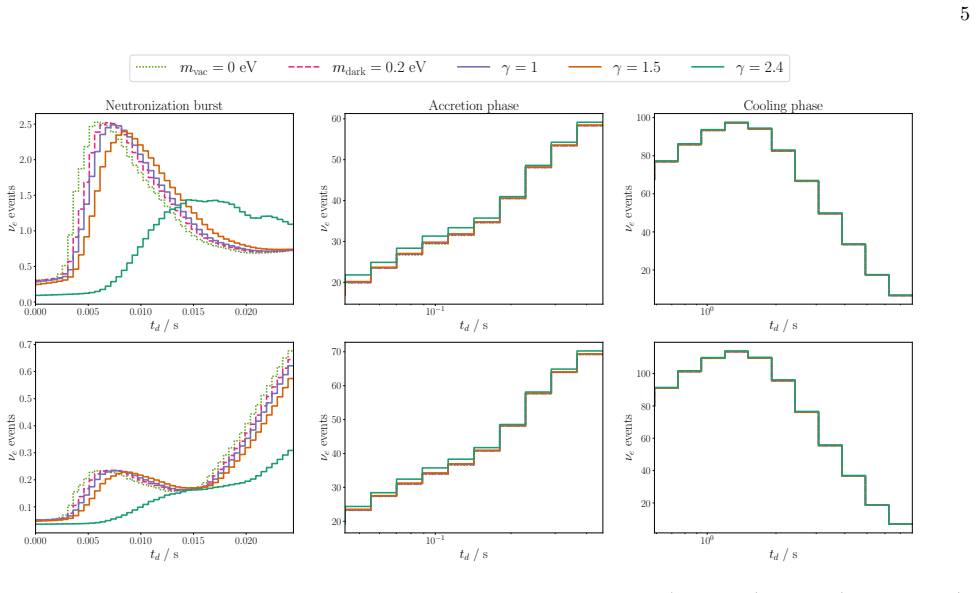


read the original abstract
The origin of neutrino mass remains an open question in particle physics. One intriguing possibility is that neutrinos are massless in vacuum but acquire an effective refractive mass through interactions with ultralight dark matter during propagation. We investigate the capability of the upcoming Deep Underground Neutrino Experiment (DUNE) to probe such refractive masses using the time-of-flight delays of neutrinos from a galactic core-collapse supernova. Our analysis shows that DUNE can set competitive bounds on the refractive neutrino mass, with sensitivity significantly enhanced if neutrinos traverse a dark matter density spike near the Galactic Center. In particular, we quantify how the presence of a spike modifies the projected limits, demonstrating that supernova neutrino observations at DUNE provide a powerful and novel avenue to test both the nature of neutrino masses and the distribution of dark matter in the innermost regions of the Milky Way.
Editorial analysis
A structured set of objections, weighed in public.
Referee Report
Summary. The manuscript proposes that neutrinos, massless in vacuum, acquire an effective refractive mass through interactions with ultralight dark matter (ULDM), inducing observable time-of-flight delays in galactic supernova neutrinos at DUNE. It projects competitive bounds on this refractive mass, with sensitivity significantly enhanced when neutrinos traverse a dark matter density spike near the Galactic Center, thereby testing both neutrino mass origins and inner Milky Way DM distributions.
Significance. If the ULDM-neutrino coupling model is internally consistent and evades existing constraints while producing detectable delays, the work offers a novel astrophysical probe combining neutrino timing with DM spike phenomenology. The projection approach is standard for future experiments, but its impact hinges on explicit model viability rather than new data.
major comments (2)
- [§2] §2 (model definition): the refractive mass m_refr(ρ_DM) and associated dispersion relation must be derived explicitly from a Lagrangian to confirm the delay formula δt ≈ ∫ [m_refr²(E,x)/(2E²)] dx does not reduce to a parameter choice that trivially satisfies or violates oscillation bounds; without this, the claim that DUNE sensitivity is competitive remains unverified.
- [§4] §4 (spike enhancement): the assumed ρ_DM(r) profile for the Galactic Center spike and its line-of-sight integral must be shown to be compatible with SN1987A timing constraints and other ULDM bounds; if the spike dominates the delay by construction, the enhancement factor requires a quantitative error budget to support the 'significantly enhanced' claim.
minor comments (1)
- [Abstract] Abstract: the phrase 'competitive bounds' should be quantified with a specific comparison to existing limits (e.g., from cosmology or oscillations) for clarity.
Simulated Author's Rebuttal
We thank the referee for their careful reading of the manuscript and for the constructive comments. We respond to each major comment below, indicating the revisions that will be incorporated.
read point-by-point responses
-
Referee: [§2] §2 (model definition): the refractive mass m_refr(ρ_DM) and associated dispersion relation must be derived explicitly from a Lagrangian to confirm the delay formula δt ≈ ∫ [m_refr²(E,x)/(2E²)] dx does not reduce to a parameter choice that trivially satisfies or violates oscillation bounds; without this, the claim that DUNE sensitivity is competitive remains unverified.
Authors: We agree that an explicit derivation from a Lagrangian is required to substantiate the model. In the revised manuscript we will add a dedicated subsection deriving m_refr(ρ_DM) from the neutrino-ULDM interaction Lagrangian, obtaining the dispersion relation and confirming that the integrated delay formula follows directly. We will also clarify that the refractive effect is energy-dependent and arises only during propagation through the DM medium, thereby remaining compatible with vacuum oscillation data that constrain constant mass-squared differences. revision: yes
-
Referee: [§4] §4 (spike enhancement): the assumed ρ_DM(r) profile for the Galactic Center spike and its line-of-sight integral must be shown to be compatible with SN1987A timing constraints and other ULDM bounds; if the spike dominates the delay by construction, the enhancement factor requires a quantitative error budget to support the 'significantly enhanced' claim.
Authors: The adopted spike profile follows standard parametrizations from the literature. In revision we will add an explicit comparison of the predicted delays against SN1987A timing limits, demonstrating consistency within the large statistical uncertainties of that dataset, and will reference existing ULDM bounds to show the chosen coupling remains allowed. We will also include a quantitative error budget obtained by varying the spike parameters (inner slope, normalization, and cutoff radius) over their observationally permitted ranges and reporting the resulting spread in the projected DUNE sensitivity. revision: yes
Circularity Check
Sensitivity projections for refractive neutrino mass at DUNE rely on external model assumptions without internal reduction to fitted inputs or self-citations
full rationale
The paper performs a phenomenological sensitivity study: it assumes an effective refractive neutrino mass arising from ULDM-neutrino interactions (taken as given), computes time-of-flight delays for supernova neutrinos, and projects DUNE reach with and without a DM density spike. No derivation chain reduces a claimed prediction to a fitted parameter or self-citation by construction; the refractive mass and spike profile are external inputs, and the output is a set of projected bounds rather than a closed loop. The analysis is self-contained as a forward projection against external benchmarks and contains no load-bearing self-citations or ansatz smuggling.
Axiom & Free-Parameter Ledger
Lean theorems connected to this paper
-
IndisputableMonolith/Cost/FunctionalEquation.leanwashburn_uniqueness_aczel unclear?
unclearRelation between the paper passage and the cited Recognition theorem.
V = m_dark²/(2E) (y-ϵ)/(y²-1) with m_dark² ≡ g² ρ_ϕ / m_ϕ²; Δt_dark(φ,γ) = D/2 (m_dark/E)² ρ_ϕ(r*,φ,γ)/ρ_ϕ(r_⊙)
-
IndisputableMonolith/Foundation/AlexanderDuality.leanalexander_duality_circle_linking unclear?
unclearRelation between the paper passage and the cited Recognition theorem.
ρ_spike(r,γ) = ρ_NFW(R_spike) (r/R_spike)^{-γ}; piecewise with NFW outside R_spike
What do these tags mean?
- matches
- The paper's claim is directly supported by a theorem in the formal canon.
- supports
- The theorem supports part of the paper's argument, but the paper may add assumptions or extra steps.
- extends
- The paper goes beyond the formal theorem; the theorem is a base layer rather than the whole result.
- uses
- The paper appears to rely on the theorem as machinery.
- contradicts
- The paper's claim conflicts with a theorem or certificate in the canon.
- unclear
- Pith found a possible connection, but the passage is too broad, indirect, or ambiguous to say the theorem truly supports the claim.
Forward citations
Cited by 1 Pith paper
-
Formation and Redshift Evolution of Dark Matter Spikes
Stellar gravitational heating reduces dark matter spike overdensities by 2-4 orders of magnitude and drives the inner slope to γ_χ ≈ 1.5 within a few Gyrs, remaining above NFW cusps.
Reference graph
Works this paper leans on
- [1]
-
[2]
P. W. Higgs, Phys. Rev. Lett.13, 508 (1964)
work page 1964
- [3]
- [4]
- [5]
-
[6]
L. Hui, J. P. Ostriker, S. Tremaine, and E. Witten, Phys. Rev. D95, 043541 (2017), arXiv:1610.08297 [astro- ph.CO]
work page internal anchor Pith review Pith/arXiv arXiv 2017
- [7]
- [8]
- [9]
-
[10]
S. P. Mikheev and A. Y. Smirnov, Nuovo Cim. C9, 17 (1986)
work page 1986
- [11]
-
[12]
Neutrino Oscillations as a Probe of Light Scalar Dark Matter
A. Berlin, Phys. Rev. Lett. 117, 231801 (2016), arXiv:1608.01307 [hep-ph]
work page internal anchor Pith review Pith/arXiv arXiv 2016
-
[13]
Fuzzy Dark Matter and Non-Standard Neutrino Interactions
V. Brdar, J. Kopp, J. Liu, P. Prass, and X.-P. Wang, Phys. Rev. D97, 043001 (2018), arXiv:1705.09455 [hep- ph]
work page internal anchor Pith review Pith/arXiv arXiv 2018
-
[14]
Neutrino Oscillations in Dark Backgrounds
F. Capozzi, I. M. Shoemaker, and L. Vecchi, JCAP07, 004 (2018), arXiv:1804.05117 [hep-ph]
work page internal anchor Pith review Pith/arXiv arXiv 2018
- [15]
- [16]
- [17]
- [18]
-
[19]
H. Davoudiasl and P. B. Denton, Phys. Rev. D 108, 035013 (2023), arXiv:2301.09651 [hep-ph]
-
[20]
P. Martínez-Miravé, Y. F. Perez-Gonzalez, and M. Sen, Phys. Rev. D110, 055005 (2024), arXiv:2406.01682 [hep- ph]
- [21]
-
[22]
Amplifying muon-to-positron conversion in nuclei with ultralight dark matter
P. Sahu and M. Sen, (2025), arXiv:2507.07176 [hep-ph]
work page internal anchor Pith review Pith/arXiv arXiv 2025
-
[23]
135, 031801 (2025), arXiv:2503.08439 [hep-ph]
A.Cheek, L.Visinelli, andH.-Y.Zhang,Phys.Rev.Lett. 135, 031801 (2025), arXiv:2503.08439 [hep-ph]
- [24]
-
[25]
R. M. Biontaet al., Phys. Rev. Lett.58, 1494 (1987)
work page 1987
-
[26]
E. N. Alekseev, L. N. Alekseeva, I. V. Krivosheina, and V. I. Volchenko, Phys. Lett. B205, 209 (1988)
work page 1988
-
[27]
E. N. Alekseev, L. N. Alekseeva, V. I. Volchenko, and I. V. Krivosheina, JETP Lett.45, 589 (1987)
work page 1987
-
[28]
Neutrino mass bound in the standard scenario for supernova electronic antineutrino emission
G. Pagliaroli, F. Rossi-Torres, and F. Vissani, Astropart. Phys. 33, 287 (2010), arXiv:1002.3349 [hep-ph]
work page internal anchor Pith review Pith/arXiv arXiv 2010
-
[29]
T. J. Loredo and D. Q. Lamb, Phys. Rev. D65, 063002 (2002), arXiv:astro-ph/0107260
work page internal anchor Pith review Pith/arXiv arXiv 2002
- [30]
- [31]
-
[32]
Dark matter annihilation at the galactic center
P. Gondolo and J. Silk, Phys. Rev. Lett.83, 1719 (1999), arXiv:astro-ph/9906391
work page internal anchor Pith review Pith/arXiv arXiv 1999
- [33]
- [34]
- [35]
-
[36]
M. Fujiwara and G. Herrera, Phys. Lett. B851, 138573 (2024), arXiv:2312.11670 [hep-ph]
- [37]
- [38]
-
[39]
DESI DR2 Results II: Measurements of Baryon Acoustic Oscillations and Cosmological Constraints
M. Abdul Karimet al. (DESI), (2025), arXiv:2503.14738 [astro-ph.CO]
work page internal anchor Pith review Pith/arXiv arXiv 2025
-
[40]
G. T. Zatsepin, Pisma Zh. Eksp. Teor. Fiz.8, 333 (1968). 8
work page 1968
-
[41]
Exploiting the neutronization burst of a galactic supernova
M. Kachelriess, R. Tomas, R. Buras, H. T. Janka, A. Marek, and M. Rampp, Phys. Rev. D 71, 063003 (2005), arXiv:astro-ph/0412082
work page internal anchor Pith review Pith/arXiv arXiv 2005
-
[42]
Supernova Neutrinos: Production, Oscillations and Detection
A. Mirizzi, I. Tamborra, H.-T. Janka, N. Sa- viano, K. Scholberg, R. Bollig, L. Hudepohl, and S. Chakraborty, Riv. Nuovo Cim. 39, 1 (2016), arXiv:1508.00785 [astro-ph.HE]
work page internal anchor Pith review Pith/arXiv arXiv 2016
-
[43]
High-resolution supernova neutrino spectra represented by a simple fit
I. Tamborra, B. Muller, L. Hudepohl, H.-T. Janka, and G. Raffelt, Phys. Rev. D 86, 125031 (2012), arXiv:1211.3920 [astro-ph.SR]
work page internal anchor Pith review Pith/arXiv arXiv 2012
-
[44]
M. T. Keil, G. G. Raffelt, and H.-T. Janka, Astrophys. J. 590, 971 (2003), arXiv:astro-ph/0208035
work page internal anchor Pith review Pith/arXiv arXiv 2003
-
[45]
R. F. Lang, C. McCabe, S. Reichard, M. Selvi, and I. Tamborra, Phys. Rev. D 94, 103009 (2016), arXiv:1606.09243 [astro-ph.HE]
work page internal anchor Pith review Pith/arXiv arXiv 2016
-
[46]
https://webhome.phy.duke.edu/~schol/snowglobes/
-
[47]
Neutrino Signal of Electron-Capture Supernovae from Core Collapse to Cooling
L. Hudepohl, B. Muller, H. T. Janka, A. Marek, and G. G. Raffelt, Phys. Rev. Lett. 104, 251101 (2010), [Erratum: Phys.Rev.Lett. 105, 249901 (2010)], arXiv:0912.0260 [astro-ph.SR]
work page internal anchor Pith review Pith/arXiv arXiv 2010
-
[48]
A. S. Dighe and A. Y. Smirnov, Phys. Rev. D62, 033007 (2000), arXiv:hep-ph/9907423
work page internal anchor Pith review Pith/arXiv arXiv 2000
-
[49]
R. Acciarri et al. (DUNE), (2015), arXiv:1512.06148 [physics.ins-det]
- [50]
-
[51]
M. Aker et al. (KATRIN), JINST 16, T08015 (2021), arXiv:2103.04755 [physics.ins-det]
-
[52]
KATRIN Collaboration, KATRIN design report 2004 , Tech. Rep. (Forschungszentrum Jülich, 2005) 51.54.01; LK 01
work page 2004
- [53]
-
[54]
NuFit-6.0: Updated global analysis of three-flavor neutrino oscillations
I. Esteban, M. C. Gonzalez-Garcia, M. Maltoni, I. Martinez-Soler, J. P. Pinheiro, and T. Schwetz, JHEP 12, 216 (2024), arXiv:2410.05380 [hep-ph]
work page internal anchor Pith review Pith/arXiv arXiv 2024
-
[55]
P. F. de Salas, D. V. Forero, S. Gariazzo, P. Martínez- Miravé, O. Mena, C. A. Ternes, M. Tórtola, and J. W. F. Valle, JHEP02, 071 (2021), arXiv:2006.11237 [hep-ph]
work page internal anchor Pith review Pith/arXiv arXiv 2021
-
[56]
Current unknowns in the three neutrino framework
F. Capozzi, E. Lisi, A. Marrone, and A. Palazzo, Prog. Part. Nucl. Phys.102, 48 (2018), arXiv:1804.09678 [hep- ph]
work page internal anchor Pith review Pith/arXiv arXiv 2018
discussion (0)
Sign in with ORCID, Apple, or X to comment. Anyone can read and Pith papers without signing in.