REVIEW 5 major objections 5 minor 51 references
Adaptive Output Steps: FlexiSteps Network for Dynamic Trajectory Prediction
T0 review · 5 major / 5 minor · reviewed 2026-08-05 · deepseek-v4-flash
Pith's one-line read The FlexiSteps Network's core claim: a trajectory predictor should choose its own output horizon per scene, guided by a Frechet-distance score, rather than always predicting a fixed number of steps.
desk verdict Plausible idea for adaptive output horizons, but the central adaptivity claim is never tested and the experiments are unfinished; not ready for review in its current form. read the letter →
The pith
A machine-rendered reading of the paper's core claim, the machinery that carries it, and where it could break.
The reading
What carries the argument
The load-bearing object is the pair formed by the Adaptive Prediction Module (APM) and the Dynamic Decoder (DD), tied together by a horizon-scoring identity: q_i^f = FDK(μ_i^f, gt_i^f)/f. Dividing the Frechet distance by the number of steps makes shorter horizons cheaper unless the longer prediction is genuinely closer geometrically, and taking the argmin over f produces the supervised label used to train the APM. The new Frechet distance kernel (FDK) replaces a hard minimax alignment with a Huber-smoothed soft-min, making the score usable in gradient-based training. The DD is a set of per-horizon sub-decoders, with only the sub-network matching the predicted horizon activated, plus KL disti
What would settle it
Run FSN in its fully adaptive mode and compare each chosen output step with the oracle-optimal step computed from the ground-truth future using the paper's own score. If the APM's step choices match the oracle no better than a constant or random baseline, or if the adaptive outputs do not beat the best fixed horizon under the same metric, the central adaptivity claim would be refuted.
Extended reading notes
Core claim
The paper's central claim is that output-step selection is itself a learnable, context-dependent quantity. Given a latent encoding of agent history and map context, the Adaptive Prediction Module outputs a distribution over horizons and is trained to match the horizon that minimizes the score q_i^f = FDK(μ_i^f, gt_i^f)/f, where FDK is a Huber-smoothed Frechet distance kernel. The Dynamic Decoder contains separate sub-decoders for each horizon, only the one matching the selected horizon is active, and KL divergence transfers knowledge from lower-scoring sequences to higher-scoring ones. On Argoverse and INTERACTION, wrapping HiVT and HPNet this way yields lower minADE/minFDE and lower miss or
Load-bearing premise
The load-bearing premise is that the best prediction horizon for an agent can be inferred from what the model can observe (past positions and map context), since the training labels for that horizon come from future ground truth that is unavailable during inference.
Editorial extensions
If this is right
- A single FSN-wrapped model can serve downstream tasks needing 5, 10, 20, or 30 steps without retraining or post-hoc truncation.
- Prediction quality no longer has to degrade monotonically with horizon: the model can choose shorter horizons where the situation is ambiguous and longer ones where context supports them.
- The plug-and-play design transfers adaptivity to any encoder-based trajectory model, so better input encoders compose with output-step flexibility.
- Because the score divides Frechet distance by horizon, model selection across horizons is no longer biased toward always emitting the shortest trajectory.
- Measured reductions in miss rate and collision rate relative to fixed-horizon baselines imply the chosen horizon matches the scenario better, not just that the decoder is more accurate.
Reading between the lines
- If the APM's horizon prediction is reliable, the same latent feature could be used to budget computation at run time, e.g., skipping long-horizon decoding in low-risk scenes; the paper does not test this.
- A natural stress test not reported in the paper: compare the APM's chosen horizon against the oracle-optimal horizon computed from future ground truth. Low agreement would mean the gains come from the Dynamic Decoder rather than from adaptivity.
- The Frechet-per-step score could be converted into a differentiable training reward or loss for the predictor itself, not just for label generation, making the whole model horizon-aware.
- The dynamic-decoder trick may transfer to other variable-length sequence tasks, such as human motion prediction or multi-agent behavior generation, where output length is a decision rather than a constant.
Editorial analysis
A structured set of objections, weighed in public.
Referee Report
Summary. The paper proposes FlexiSteps Network (FSN), a trajectory prediction framework with three components: an Adaptive Prediction Module (APM) that predicts an output horizon per agent from encoded context, a Dynamic Decoder (DD) trained to produce variable-length outputs, and a scoring mechanism that combines a smoothed Fréchet distance with the prediction length to define an 'optimal' horizon. The authors claim that FSN dynamically adjusts prediction output steps to achieve optimal accuracy/efficiency and outperforms prior fixed-horizon methods on Argoverse and INTERACTION. The reported experiments, however, evaluate FSN only at fixed horizons (5–30 timesteps), not in the fully adaptive setting; the adaptive prediction is illustrated qualitatively but never scored.
Significance. If the central claim were established, adaptive output-step selection would be a practically useful plug-and-play module for trajectory predictors, and the Fréchet-based scoring mechanism could contribute to the under-explored problem of balancing horizon length against accuracy. The paper also highlights a real limitation of fixed-horizon evaluation. That said, at present the contribution is not validated: the adaptive module is never evaluated end-to-end, the 'optimal' label is defined by the paper's own scoring rule, and the main table contains explicit placeholders. The significance of the work therefore remains potential rather than demonstrated.
major comments (5)
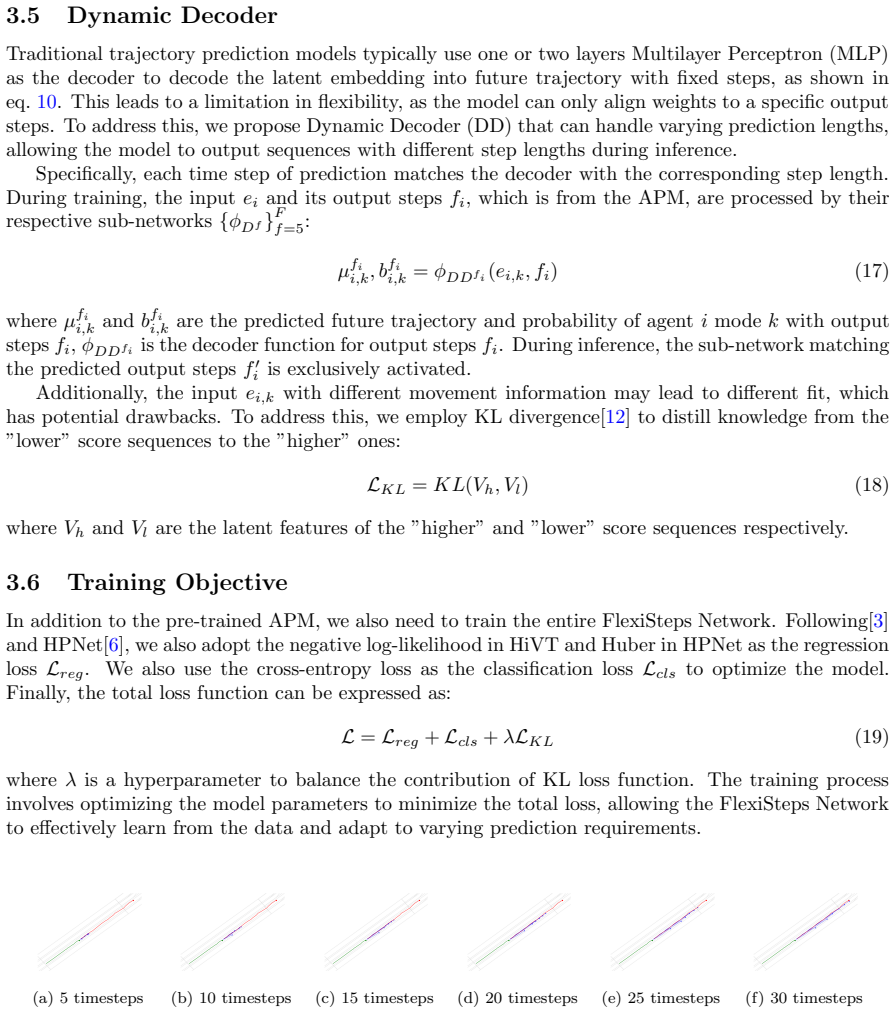
- [Sec. 5 / Table 1] The central claim that FSN 'dynamically adjusts prediction output time steps' and 'outperforms state-of-the-art methods' is not tested. Table 1 reports FSN only at fixed horizons f = 5,...,30; these numbers can be produced by forcing the Dynamic Decoder to a prescribed f and do not evaluate the APM's inference-time step choice (Eq. 16). Neither the accuracy of the APM's predicted step f'_i against the oracle f_i^gt (Eq. 8), nor a cost/latency comparison of the full adaptive pipeline against a fixed 30-step baseline, is reported. Fig. 6(g) is illustrative only. Without scoring the adaptive predictions, the paper does not support its main claim.
- [Table 1 / Sec. 4.2] The main results table is not in a publishable state: it contains placeholder notes 'HPNet-IT[6](need real data)' and 'HPNet-FSN(ours)(need to reconsider)', and the HPNet rows for Argoverse 1 appear incomplete. No confidence intervals or repeated-run statistics are provided for any result. The quantitative conclusions in Sec. 4.2 are therefore not reliable, and the comparison to FLN/LaKD is based on a single column of unreported runs.
- [Sec. 3.3.2 / Sec. 3.4.1] The APM is trained to predict the label f_i^gt defined by the paper's own scoring mechanism q = d/f (Eqs. 6–9). The claim that FSN achieves an 'optimal' accuracy/efficiency balance is thus a restatement of the chosen scoring rule, not an independent measure of quality. To break the circularity, the paper must show that (i) the APM recovers f_i^gt accurately, and (ii) the adaptive outputs improve a downstream or external cost relative to fixed-horizon outputs. Neither is reported.
- [Sec. 3.3.1 / Eqs. (4)–(5)] The Fréchet distance kernel (FDK) is not clearly defined. Eq. (4) states a soft-min approximation of min over pairs inside an alignment, but the right-hand side is a weighted sum over pairs with a normalization Z_A and no sum over alignments. Eq. (5) then sums over 'A in A' with a different exponential term. The roles of the alignment set, the normalization, and the free parameters β, γ, ε, Z_A need precise definitions. As written, the equations do not unambiguously define a smooth Fréchet-like distance, and the sensitivity to these hyperparameters is not analyzed.
- [Sec. 3.3.2 / Eq. (6)] The score q_f^i = d_f^i / f is ad hoc and its behavior is not analyzed. Dividing a Fréchet distance by the horizon length is not obviously a meaningful accuracy-efficiency trade-off; for example, if d_f grows sublinearly with f, the score could systematically favor long horizons, while if it grows superlinearly, it favors short horizons. The paper provides no evidence that this score produces sensible task-level choices, and it is the sole source of the oracle labels. A direct analysis of the distribution of f_i^gt and its correlation with context would be needed.
minor comments (5)
- [Throughout] The manuscript contains many typos and formatting errors: 'Howerver', 'Kernal', 'trainging', 'Expreiments', 'socring', 'Fr´ echet' spacing, and an unresolved reference '[ ?]' in Sec. 1. The paper needs thorough proofreading.
- [Sec. 3.3.2 / Eq. (7)] The notation 'qi = min(qf_i | F f=5)' is confusing; it should be written as min_{f in {5,...,F}} q_f^i, and the indexing of q_f^i vs. q^f_i is inconsistent.
- [Sec. 3.5 / Eq. (18)] The KL divergence term L_KL = KL(V_h, V_l) is not specified: which distributions are V_h and V_l, and what 'lower score' and 'higher score' mean is not defined. The direction of the KL is also unclear.
- [Sec. 6 / Data Availability] The data availability statement cites arXiv DOI links for Argoverse and INTERACTION papers rather than the actual dataset DOIs or URLs. This should be corrected.
- [Fig. 6] The qualitative figure for 'flexible prediction' is not accompanied by any quantitative evaluation, so it does not provide evidence for the adaptive claim. Consider adding a scored example or a quantitative analysis of the APM's chosen horizons.
Circularity Check
No significant circularity: adaptive-step selection is a trained classifier over the authors' own score, not a reduction by construction; main problems are missing adaptivity evaluation and incomplete tables.
full rationale
The claimed derivation chain is: Eqs. (6)-(9) define an optimal step fgt_i as the minimizer of the paper's own score q=d/f; Eqs. (10)-(15) train the APM to predict that step from the encoder features; Eq. (17) trains the Dynamic Decoder for the selected step. This is a standard supervised-learning pipeline: fgt_i is a label computed from ground truth, and the APM's output f'_i (Eq. 16) is a learned function of the observed context, not equal to fgt_i by construction. The 'optimal' language is explicitly relative to the authors' own scoring mechanism ('i.e. the best result, under our scoring mechanism'), so the optimality claim is a design definition rather than an external discovery; it becomes circular only if one assumes the APM recovers the oracle, which the paper never demonstrates. No load-bearing self-citation exists: [9] and [10] are author citations but are not used to justify the adaptivity mechanism, and [11]/[12] are external baselines. The main weaknesses are empirical, not circular: the fully adaptive setting is never scored, APM accuracy vs oracle fgt_i is not reported, Table 1's FSN rows appear to be fixed-horizon DD evaluations and do not validate dynamic selection, and the table itself flags HPNet-IT ('need real data') and HPNet-FSN ('need to reconsider') as incomplete, while the unresolved '[ ?]' citation in Sec. 1 also indicates an unfinished manuscript. These omissions undermine the paper's conclusion but do not make the derivation equivalent to its inputs.
Assumptions & free parameters
free parameters (4)
- Fréchet kernel constants beta, gamma, epsilon, ZA
- Huber threshold delta =
0.1
- KL distillation weight lambda =
0.5
- Length normalization in score q=d/f
assumptions (4)
- domain assumption Optimal prediction horizon is a deterministic function of the observed context
- domain assumption FDK is a valid smooth, differentiable approximation of the Fréchet distance
- domain assumption Separate decoder heads for each horizon can be trained jointly and distilled via KL
- ad hoc to paper Ground-truth labels fgt_i from the scoring rule are appropriate training targets
Cite this review
Pith. "Pith review of Adaptive Output Steps: FlexiSteps Network for Dynamic Trajectory Prediction." pith.science (2026). https://pith.science/paper/JAQUZQWL
@misc{pith2026250817797,
  author       = {Pith},
  title        = {Pith review of: Adaptive Output Steps: FlexiSteps Network for Dynamic Trajectory Prediction},
  year         = {2026},
  howpublished = {\url{https://pith.science/paper/JAQUZQWL}},
  note         = {Machine review of arXiv:2508.17797}
}
read the original abstract
Accurate trajectory prediction is vital for autonomous driving, robotics, and intelligent decision-making systems, yet traditional models typically rely on fixed-length output predictions, limiting their adaptability to dynamic real-world scenarios. In this paper, we introduce the FlexiSteps Network (FSN), a novel framework that dynamically adjusts prediction output time steps based on varying contextual conditions. Inspired by recent advancements addressing observation length discrepancies and dynamic feature extraction, FSN incorporates an pre-trained Adaptive Prediction Module (APM) to evaluate and adjust the output steps dynamically, ensuring optimal prediction accuracy and efficiency. To guarantee the plug-and-play of our FSN, we also design a Dynamic Decoder(DD). Additionally, to balance the prediction time steps and prediction accuracy, we design a scoring mechanism, which not only introduces the Fr\'echet distance to evaluate the geometric similarity between the predicted trajectories and the ground truth trajectories but the length of predicted steps is also considered. Extensive experiments conducted on benchmark datasets including Argoverse and INTERACTION demonstrate the effectiveness and flexibility of our proposed FSN framework.
Figures


Figures from the paper (3 more)


Reference graph
Works this paper leans on
-
[6]
Hpnet: Dynamic trajectory forecasting with historical prediction attention,
X. Tang, M. Kan, S. Shan, Z. Ji, J. Bai, and X. Chen, “Hpnet: Dynamic trajectory forecasting with historical prediction attention,” in Proceedings of the IEEE/CVF Conference on Computer Vision and Pattern Recognition, pp. 15261–15270, 2024
work page 2024
-
[1]
Multipath: Multiple probabilistic anchor trajec- tory hypotheses for behavior prediction,
Y. Chai, B. Sapp, M. Bansal, and D. Anguelov, “Multipath: Multiple probabilistic anchor trajec- tory hypotheses for behavior prediction,” arXiv preprint arXiv:1910.05449, 2019
arXiv 1910
-
[2]
Multipath++: Efficient information fusion and trajectory aggregation for behavior prediction,
B. Varadarajan, A. Hefny, A. Srivastava, K. S. Refaat, N. Nayakanti, A. Cornman, K. Chen, B. Douillard, C. P. Lam, D. Anguelov, et al., “Multipath++: Efficient information fusion and trajectory aggregation for behavior prediction,” in 2022 International Conference on Robotics and Automation (ICRA), pp. 7814–7821, IEEE, 2022
work page 2022
-
[3]
Hivt: Hierarchical vector transformer for multi- agent motion prediction,
Z. Zhou, L. Ye, J. Wang, K. Wu, and K. Lu, “Hivt: Hierarchical vector transformer for multi- agent motion prediction,” in Proceedings of the IEEE/CVF Conference on Computer Vision and Pattern Recognition, pp. 8823–8833, 2022
work page 2022
-
[4]
Query-centric trajectory prediction,
Z. Zhou, J. Wang, Y.-H. Li, and Y.-K. Huang, “Query-centric trajectory prediction,” in Proceed- ings of the IEEE/CVF Conference on Computer Vision and Pattern Recognition, pp. 17863–17873, 2023
work page 2023
-
[5]
Smartrefine: A scenario- adaptive refinement framework for efficient motion prediction,
Y. Zhou, H. Shao, L. Wang, S. L. Waslander, H. Li, and Y. Liu, “Smartrefine: A scenario- adaptive refinement framework for efficient motion prediction,” in Proceedings of the IEEE/CVF Conference on Computer Vision and Pattern Recognition, pp. 15281–15290, 2024
work page 2024
-
[7]
A dynamics-enhanced learning model for multi- horizon trajectory prediction in autonomous vehicles,
C. Wang, H. Liao, K. Zhu, G. Zhang, and Z. Li, “A dynamics-enhanced learning model for multi- horizon trajectory prediction in autonomous vehicles,” Information Fusion, vol. 118, p. 102924, 2025
work page 2025
-
[8]
Learning isometric embeddings of road networks using multidimensional scaling,
J. C. Climent Pardo, “Learning isometric embeddings of road networks using multidimensional scaling,” arXiv e-prints, pp. arXiv–2504, 2025
work page 2025
Show all 51 references
-
[9]
Gamdtp: Dynamic trajectory prediction with graph attention mamba network,
Y. Liu, H. Niu, and J. Zhu, “Gamdtp: Dynamic trajectory prediction with graph attention mamba network,” arXiv preprint arXiv:2504.04862, 2025
2025 arXiv
-
[10]
Dyttp: Trajectory prediction with normalization-free transformers,
J. Zhu and H. Niu, “Dyttp: Trajectory prediction with normalization-free transformers,” arXiv preprint arXiv:2504.05356, 2025
2025 arXiv
-
[11]
Adapting to length shift: Flexilength network for trajectory prediction,
Y. Xu and Y. Fu, “Adapting to length shift: Flexilength network for trajectory prediction,” inPro- ceedings of the IEEE/CVF Conference on Computer Vision and Pattern Recognition, pp. 15226– 15237, 2024
2024
-
[12]
Lakd: Length-agnostic knowledge distil- lation for trajectory prediction with any length observations,
Y. Li, C. Li, R. Lv, R. Li, Y. Yuan, and G. Wang, “Lakd: Length-agnostic knowledge distil- lation for trajectory prediction with any length observations,” Advances in Neural Information Processing Systems, vol. 37, pp. 28720–28744, 2024
2024
-
[13]
A fr´ echet distance-hierarchical density-based spatial clustering of applications with noise for ship trajectory clustering and route recognition,
S. He and C. Wu, “A fr´ echet distance-hierarchical density-based spatial clustering of applications with noise for ship trajectory clustering and route recognition,” in 2024 International Conference on Distributed Systems, Computer Networks and Cybersecurity (ICDSCNC), pp. 1–...
2024
-
[14]
Trajectory prediction with linguistic representations,
Y.-L. Kuo, X. Huang, A. Barbu, S. G. McGill, B. Katz, J. J. Leonard, and G. Rosman, “Trajectory prediction with linguistic representations,” in 2022 International Conference on Robotics and Automation (ICRA), pp. 2868–2875, IEEE, 2022
2022
-
[15]
Computing discrete fr´ echet distance,
T. Eiter and H. Mannila, “Computing discrete fr´ echet distance,” 1994
1994
-
[16]
A fr´ echet distance -hierarchical density-based spatial clustering of applications with noise for ship trajectory clustering and route recognition,
S. He and C. Wu, “A fr´ echet distance -hierarchical density-based spatial clustering of applications with noise for ship trajectory clustering and route recognition,” in 2024 International Conference on Distributed Systems, Computer Networks and Cybersecurity (ICDSCNC), pp. 1...
2024
-
[17]
Argoverse: 3d tracking and forecasting with rich maps,
M.-F. Chang, J. Lambert, P. Sangkloy, J. Singh, S. Bak, A. Hartnett, D. Wang, P. Carr, S. Lucey, D. Ramanan, et al., “Argoverse: 3d tracking and forecasting with rich maps,” in Proceedings of the IEEE/CVF conference on computer vision and pattern recognition, pp. 8748–8757, 2019
2019
-
[18]
Interaction dataset: An international, adversarial and co- operative motion dataset in interactive driving scenarios with semantic maps,
W. Zhan, L. Sun, D. Wang, H. Shi, A. Clausse, M. Naumann, J. Kummerle, H. Konigshof, C. Stiller, A. de La Fortelle, et al., “Interaction dataset: An international, adversarial and co- operative motion dataset in interactive driving scenarios with semantic maps,” arXiv preprint...
1910 arXiv
-
[19]
Learning lane graph repre- sentations for motion forecasting,
M. Liang, B. Yang, R. Hu, Y. Chen, R. Liao, S. Feng, and R. Urtasun, “Learning lane graph repre- sentations for motion forecasting,” in Computer Vision–ECCV 2020: 16th European Conference, Glasgow, UK, August 23–28, 2020, Proceedings, Part II 16, pp. 541–556, Springer, 2020
2020
-
[20]
Multi-vehicle collaborative learning for tra- jectory prediction with spatio-temporal tensor fusion,
Y. Wang, S. Zhao, R. Zhang, X. Cheng, and L. Yang, “Multi-vehicle collaborative learning for tra- jectory prediction with spatio-temporal tensor fusion,” IEEE Transactions on Intelligent Trans- portation Systems, vol. 23, no. 1, pp. 236–248, 2020
2020
-
[21]
Mvhgn: Multi-view adaptive hierarchical spatial graph convolution network based trajectory prediction for heterogeneous traffic-agents,
D. Xu, X. Shang, H. Peng, and H. Li, “Mvhgn: Multi-view adaptive hierarchical spatial graph convolution network based trajectory prediction for heterogeneous traffic-agents,” IEEE Transac- tions on Intelligent Transportation Systems, vol. 24, no. 6, pp. 6217–6226, 2023
2023
-
[22]
Ai-tp: Attention-based interaction-aware trajectory prediction for autonomous driving,
K. Zhang, L. Zhao, C. Dong, L. Wu, and L. Zheng, “Ai-tp: Attention-based interaction-aware trajectory prediction for autonomous driving,” IEEE Transactions on Intelligent Vehicles, vol. 8, no. 1, pp. 73–83, 2022
2022
-
[23]
Graph-based spatial-temporal convolutional network for vehicle trajectory prediction in autonomous driving,
Z. Sheng, Y. Xu, S. Xue, and D. Li, “Graph-based spatial-temporal convolutional network for vehicle trajectory prediction in autonomous driving,” IEEE Transactions on Intelligent Trans- portation Systems, vol. 23, no. 10, pp. 17654–17665, 2022
2022
-
[24]
Generative adversarial nets,
I. J. Goodfellow, J. Pouget-Abadie, M. Mirza, B. Xu, D. Warde-Farley, S. Ozair, A. Courville, and Y. Bengio, “Generative adversarial nets,” Advances in neural information processing systems, vol. 27, 2014
2014
-
[25]
Social gan: Socially acceptable trajectories with generative adversarial networks,
A. Gupta, J. Johnson, L. Fei-Fei, S. Savarese, and A. Alahi, “Social gan: Socially acceptable trajectories with generative adversarial networks,” in Proceedings of the IEEE conference on com- puter vision and pattern recognition, pp. 2255–2264, 2018
2018
-
[26]
Stag: A novel interaction-aware path prediction method based on spatio-temporal attention graphs for connected automated vehicles,
M. N. Azadani and A. Boukerche, “Stag: A novel interaction-aware path prediction method based on spatio-temporal attention graphs for connected automated vehicles,” Ad Hoc Networks, vol. 138, p. 103021, 2023
2023
-
[27]
Densetnt: End-to-end trajectory prediction from dense goal sets,
J. Gu, C. Sun, and H. Zhao, “Densetnt: End-to-end trajectory prediction from dense goal sets,” in Proceedings of the IEEE/CVF International Conference on Computer Vision, pp. 15303–15312, 2021
2021
-
[28]
Scene transformer: A unified architecture for predicting multiple agent trajectories,
J. Ngiam, B. Caine, V. Vasudevan, Z. Zhang, H.-T. L. Chiang, J. Ling, R. Roelofs, A. Bewley, C. Liu, A. Venugopal, et al., “Scene transformer: A unified architecture for predicting multiple agent trajectories,” arXiv preprint arXiv:2106.08417, 2021
2021 arXiv
-
[29]
Social-stgcnn: A social spatio-temporal graph convolutional neural network for human trajectory prediction,
A. Mohamed, K. Qian, M. Elhoseiny, and C. Claudel, “Social-stgcnn: A social spatio-temporal graph convolutional neural network for human trajectory prediction,” in Proceedings of the IEEE/CVF conference on computer vision and pattern recognition, pp. 14424–14432, 2020
2020
-
[30]
Dual transformer based prediction for lane change intentions and trajectories in mixed traffic environment,
K. Gao, X. Li, B. Chen, L. Hu, J. Liu, R. Du, and Y. Li, “Dual transformer based prediction for lane change intentions and trajectories in mixed traffic environment,” IEEE Transactions on Intelligent Transportation Systems, vol. 24, no. 6, pp. 6203–6216, 2023
2023
-
[31]
Spatiotemporal attention-based pedes- trian trajectory prediction considering traffic-actor interaction,
X. Zhou, W. Zhao, A. Wang, C. Wang, and S. Zheng, “Spatiotemporal attention-based pedes- trian trajectory prediction considering traffic-actor interaction,” IEEE Transactions on Vehicular Technology, vol. 72, no. 1, pp. 297–311, 2022. 13
2022
-
[32]
Trajectory prediction neural network and model inter- pretation based on temporal pattern attention,
H. Hu, Q. Wang, M. Cheng, and Z. Gao, “Trajectory prediction neural network and model inter- pretation based on temporal pattern attention,” IEEE Transactions on Intelligent Transportation Systems, vol. 24, no. 3, pp. 2746–2759, 2022
2022
-
[33]
Structural transformer improves speed- accuracy trade-off in interactive trajectory prediction of multiple surrounding vehicles,
L. Hou, S. E. Li, B. Yang, Z. Wang, and K. Nakano, “Structural transformer improves speed- accuracy trade-off in interactive trajectory prediction of multiple surrounding vehicles,” IEEE Transactions on Intelligent Transportation Systems, vol. 23, no. 12, pp. 24778–24790, 2022
2022
-
[34]
Self-evaluation of trajectory predictors for autonomous driving,
P. Karle, L. Furtner, and M. Lienkamp, “Self-evaluation of trajectory predictors for autonomous driving,” Electronics, vol. 13, no. 5, p. 946, 2024
2024
-
[35]
A self-adaptive parameter selection trajectory prediction approach via hidden markov models,
S. Qiao, D. Shen, X. Wang, N. Han, and W. Zhu, “A self-adaptive parameter selection trajectory prediction approach via hidden markov models,” IEEE Transactions on Intelligent Transportation Systems, vol. 16, no. 1, pp. 284–296, 2014
2014
-
[36]
Vehicle trajectory prediction considering driver uncertainty and vehicle dynamics based on dynamic bayesian network,
Y. Jiang, B. Zhu, S. Yang, J. Zhao, and W. Deng, “Vehicle trajectory prediction considering driver uncertainty and vehicle dynamics based on dynamic bayesian network,” IEEE Transactions on Systems, Man, and Cybernetics: Systems, vol. 53, no. 2, pp. 689–703, 2022
2022
-
[37]
Naturalistic driver intention and path prediction using recurrent neural networks,
A. Zyner, S. Worrall, and E. Nebot, “Naturalistic driver intention and path prediction using recurrent neural networks,” IEEE transactions on intelligent transportation systems, vol. 21, no. 4, pp. 1584–1594, 2019
2019
-
[38]
Intention-aware vehicle trajectory prediction based on spatial-temporal dynamic attention network for internet of vehicles,
X. Chen, H. Zhang, F. Zhao, Y. Hu, C. Tan, and J. Yang, “Intention-aware vehicle trajectory prediction based on spatial-temporal dynamic attention network for internet of vehicles,” IEEE Transactions on Intelligent Transportation Systems, vol. 23, no. 10, pp. 19471–19483, 2022
2022
-
[39]
Trajectory prediction for autonomous driving using spatial-temporal graph attention transformer,
K. Zhang, X. Feng, L. Wu, and Z. He, “Trajectory prediction for autonomous driving using spatial-temporal graph attention transformer,” IEEE Transactions on Intelligent Transportation Systems, vol. 23, no. 11, pp. 22343–22353, 2022
2022
-
[40]
Tnt: Target-driven trajectory prediction,
H. Zhao, J. Gao, T. Lan, C. Sun, B. Sapp, B. Varadarajan, Y. Shen, Y. Shen, Y. Chai, C. Schmid, et al., “Tnt: Target-driven trajectory prediction,” in Conference on robot learning, pp. 895–904, PMLR, 2021
2021
-
[41]
Don’t shake the wheel: Momentum-aware planning in end-to-end autonomous driving,
Z. Song, C. Jia, L. Liu, H. Pan, Y. Zhang, J. Wang, X. Zhang, S. Xu, L. Yang, and Y. Luo, “Don’t shake the wheel: Momentum-aware planning in end-to-end autonomous driving,” in Proceedings of the Computer Vision and Pattern Recognition Conference, pp. 22432–22441, 2025
2025
-
[42]
Comparing images using the hausdorff distance,
D. P. Huttenlocher, G. A. Klanderman, and W. J. Rucklidge, “Comparing images using the hausdorff distance,” IEEE Transactions on pattern analysis and machine intelligence, vol. 15, no. 9, pp. 850–863, 1993
1993
-
[43]
A modified hausdorff distance for object matching,
M.-P. Dubuisson and A. K. Jain, “A modified hausdorff distance for object matching,” in Pro- ceedings of 12th international conference on pattern recognition, vol. 1, pp. 566–568, IEEE, 1994
1994
-
[44]
Calculating the hausdorff distance between curves,
E. Belogay, C. Cabrelli, U. Molter, and R. Shonkwiler, “Calculating the hausdorff distance between curves,” Information Processing Letters, vol. 64, no. 1, 1997
1997
-
[45]
Applied similarity problems using fr´ echet distance,
K. Shahbaz, “Applied similarity problems using fr´ echet distance,”arXiv preprint arXiv:1307.6628, 2013
2013 arXiv
-
[46]
3d face similarity measure by fr´ echet distances of geodesics,
J.-L. Zhao, Z.-K. Wu, Z.-K. Pan, F.-Q. Duan, J.-H. Li, Z.-H. Lv, K. Wang, and Y.-C. Chen, “3d face similarity measure by fr´ echet distances of geodesics,”Journal of Computer Science and Technology, vol. 33, pp. 207–222, 2018
2018
-
[47]
Long-term on-board prediction of people in traffic scenes under uncertainty,
A. Bhattacharyya, M. Fritz, and B. Schiele, “Long-term on-board prediction of people in traffic scenes under uncertainty,” in Proceedings of the IEEE conference on computer vision and pattern recognition, pp. 4194–4202, 2018
2018
-
[48]
Computing the fr´ echet distance between two polygonal curves,
H. Alt and M. Godau, “Computing the fr´ echet distance between two polygonal curves,” Interna- tional Journal of Computational Geometry & Applications, vol. 5, no. 01n02, pp. 75–91, 1995. 14
1995
-
[49]
Fr´ echet kernel for trajectory data analysis,
K. Takeuchi, M. Imaizumi, S. Kanda, Y. Tabei, K. Fujii, K. Yoda, M. Ishihata, and T. Maekawa, “Fr´ echet kernel for trajectory data analysis,” in Proceedings of the 29th International Confer- ence on Advances in Geographic Information Systems, SIGSPATIAL ’21, (New York, NY, US...
2021
-
[50]
Robust regularized extreme learning machine with asymmetric huber loss function,
D. Gupta, B. B. Hazarika, and M. Berlin, “Robust regularized extreme learning machine with asymmetric huber loss function,” Neural Computing and Applications, vol. 32, no. 16, pp. 12971– 12998, 2020
2020
-
[51]
An alternative probabilistic interpretation of the huber loss,
G. P. Meyer, “An alternative probabilistic interpretation of the huber loss,” in Proceedings of the ieee/cvf conference on computer vision and pattern recognition, pp. 5261–5269, 2021. 15
2021
Reviewed August 5, 2026 · model on record in the stance chip above.
Discussion (0). Sign in to comment.