Estimating Parameter Fields in Multi-Physics PDEs from Scarce Measurements
Pith reviewed 2026-05-18 19:13 UTC · model grok-4.3
The pith
Neptune uses independent neural networks to recover each parameter field in multi-physics PDEs from sparse response measurements alone.
A machine-rendered reading of the paper's core claim, the machinery that carries it, and where it could break.
Core claim
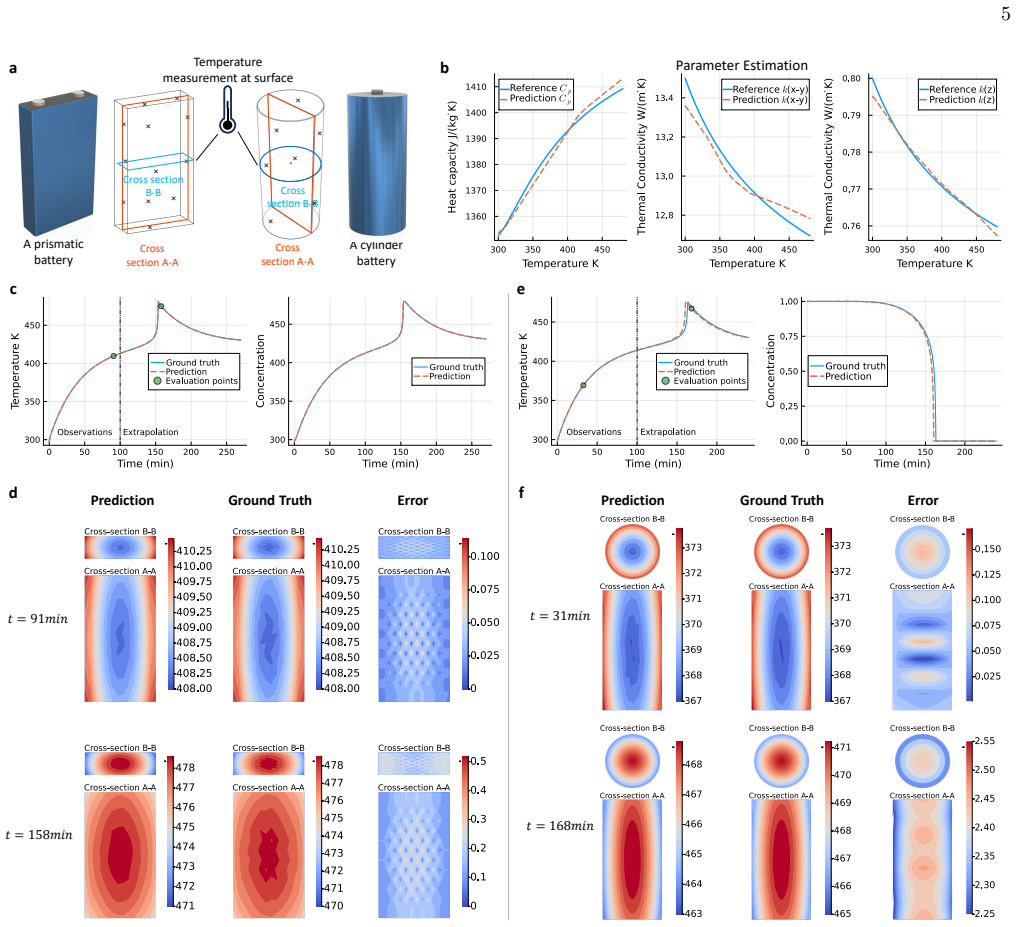
Neptune employs independent coordinate neural networks to continuously represent each parameter field in physical space or in state variables, enabling robust inference of these fields from as few as 45 sparse measurements of system responses in parameterized multi-physics PDEs while achieving lower errors and stronger extrapolation than PINNs or neural operators.
What carries the argument
Independent coordinate neural networks, each mapping coordinates or states to values for one parameter field.
If this is right
- Parameter estimation errors fall by roughly two orders of magnitude relative to PINNs and neural operators.
- Dynamic response prediction errors drop by a factor of approximately ten.
- Predictions remain reliable in physical regimes far from the training measurements.
- The approach applies across nonlinear dynamics and multiphysics problems in engineering and biomedicine.
Where Pith is reading between the lines
- Direct, costly parameter sensors could be replaced by indirect response measurements in many practical settings.
- The same separation of networks might allow parameter fields to be updated online as new sparse data arrive.
- Combining Neptune with uncertainty quantification could flag regions where the inferred parameters are least reliable.
Load-bearing premise
Every parameter field can be accurately captured by a continuous neural network and the governing PDE equations are known in advance.
What would settle it
A controlled test on a multi-physics PDE whose true parameter fields are known, supplied with only 45 response measurements, in which Neptune's recovered fields deviate by far more than two orders of magnitude from the ground truth.
Figures




read the original abstract
Parameterized partial differential equations (PDEs) underpin the mathematical modeling of complex systems in diverse domains, including engineering, healthcare, and physics. A central challenge in using PDEs for real-world applications is to accurately infer the parameters, particularly when the parameters exhibit non-linear and spatiotemporal variations. Existing parameter estimation methods, such as sparse identification, physics-informed neural networks (PINNs), and neural operators, struggle in such cases, especially with nonlinear dynamics, multiphysics interactions, or limited observations of the system response. To address these challenges, we introduce Neptune, a general-purpose method capable of inferring parameter fields from sparse measurements of system responses. Neptune employs independent coordinate neural networks to continuously represent each parameter field in physical space or in state variables. Across various physical and biomedical problems, where direct parameter measurements are prohibitively expensive or unattainable, Neptune significantly outperforms existing methods, achieving robust parameter estimation from as few as 45 measurements, reducing parameter estimation errors by two orders of magnitude and dynamic response prediction errors by a factor of ten to baselines such as PINNs and neural operators. More importantly, it exhibits superior physical extrapolation capabilities, enabling reliable predictions in regimes far beyond the training data. By facilitating reliable and data-efficient parameter inference, Neptune promises broad transformative impacts in engineering, healthcare, and beyond.
Editorial analysis
A structured set of objections, weighed in public.
Referee Report
Summary. The manuscript introduces Neptune, a method for estimating parameter fields in multi-physics PDEs from scarce measurements of system responses. It represents each parameter field using an independent coordinate neural network in physical or state space and optimizes these networks by minimizing PDE residuals and matching sparse observations. The paper claims that Neptune achieves robust parameter estimation from as few as 45 measurements, reducing parameter estimation errors by two orders of magnitude and dynamic response prediction errors by a factor of ten compared to baselines like PINNs and neural operators, while also showing superior extrapolation capabilities.
Significance. If the performance claims hold, Neptune would represent a substantial advance in solving inverse problems for parameterized PDEs with limited data, enabling more accurate modeling in domains where direct parameter measurements are costly or impossible. The use of independent NNs for parameter fields and the focus on extrapolation are notable strengths, though the gains appear tied to the smoothness of the parameter fields in the evaluated cases.
major comments (1)
- [Numerical Experiments] The headline performance claims (two-order error reduction from 45 measurements, 10x prediction improvement, and superior extrapolation) rest on the premise that each parameter field admits an accurate continuous representation by an independent coordinate MLP trained only via PDE residuals and sparse observations. This is load-bearing for the central claim but is only weakly tested if the benchmarks use smooth or synthetically generated fields; explicit evaluation on discontinuous or high-frequency parameter fields (e.g., material interfaces) is required to establish generality.
minor comments (1)
- [Abstract] The abstract states results 'across various physical and biomedical problems' without enumerating the specific test cases or their characteristics; adding a short list or table reference would improve readability.
Simulated Author's Rebuttal
We thank the referee for their insightful comments, which have helped us clarify the scope and limitations of our work. We address the major comment point by point below.
read point-by-point responses
-
Referee: The headline performance claims (two-order error reduction from 45 measurements, 10x prediction improvement, and superior extrapolation) rest on the premise that each parameter field admits an accurate continuous representation by an independent coordinate MLP trained only via PDE residuals and sparse observations. This is load-bearing for the central claim but is only weakly tested if the benchmarks use smooth or synthetically generated fields; explicit evaluation on discontinuous or high-frequency parameter fields (e.g., material interfaces) is required to establish generality.
Authors: We agree that explicit evaluation on discontinuous or high-frequency parameter fields is necessary to substantiate the generality of the claims. Our original benchmarks cover a range of multi-physics and biomedical problems with spatially varying parameters, but these are predominantly smooth or synthetically generated. To directly address this point, the revised manuscript includes new numerical experiments on a heat conduction problem with discontinuous thermal conductivity fields representing material interfaces. These results show that Neptune still achieves lower parameter estimation and prediction errors than the PINN and neural operator baselines, although the improvement is smaller than in the smooth cases, as expected given the representational challenges of MLPs for sharp discontinuities. We have added a dedicated subsection to the Numerical Experiments section, new figures, and an expanded discussion of limitations for non-smooth fields. revision: yes
Circularity Check
No significant circularity; derivation is self-contained inverse-problem optimization
full rationale
The paper defines Neptune as independent coordinate NNs representing each parameter field, trained by minimizing PDE residuals plus sparse response observations. This setup does not reduce any claimed prediction or performance gain to a fitted input by construction, nor does it rely on load-bearing self-citations or imported uniqueness theorems. The reported error reductions versus PINNs and neural operators are external benchmarks, not internal re-statements of the same fit. The continuous-NN representation is an explicit modeling choice with stated assumptions rather than a hidden tautology. No quoted equation or section exhibits the forbidden patterns of self-definition or renaming.
Axiom & Free-Parameter Ledger
axioms (1)
- domain assumption Parameter fields admit continuous representation by independent coordinate neural networks
Reference graph
Works this paper leans on
-
[1]
G. Steenackers and P. Guillaume, Finite element model updating taking into account the uncertainty on the modal parameters estimates, Journal of Sound and vi- bration 296, 919 (2006)
work page 2006
-
[2]
H. Ebrahimian, R. Astroza, J. P. Conte, and R. A. de Callafon, Nonlinear finite element model updating for damage identification of civil structures using batch bayesian estimation, Mechanical Systems and Signal Processing 84, 194 (2017)
work page 2017
- [3]
-
[4]
L. Yang, X. Meng, and G. E. Karniadakis, B-pinns: Bayesian physics-informed neural networks for forward and inverse pde problems with noisy data, Journal of Computational Physics 425, 109913 (2021)
work page 2021
-
[5]
Y. Ji, X. Jiang, and L. Wan, Hierarchical least squares parameter estimation algorithm for two-input hammer- stein finite impulse response systems, Journal of the Franklin Institute 357, 5019 (2020)
work page 2020
- [6]
-
[7]
D. Varshney, M. Bhushan, and S. C. Patwardhan, State and parameter estimation using extended kitani- dis kalman filter, Journal of Process Control 76, 98 (2019)
work page 2019
-
[8]
M. Hossain, M. Haque, and M. T. Arif, Kalman filtering techniques for the online model parameters and state of charge estimation of the li-ion batteries: A comparative analysis, Journal of Energy Storage 51, 104174 (2022)
work page 2022
-
[9]
W. Zhang and W. Gu, Parameter estimation for several types of linear partial differential equations based on gaussian processes, Fractal and Fractional6, 433 (2022)
work page 2022
-
[10]
Z. Deng, X. Hu, X. Lin, Y. Che, L. Xu, and W. Guo, Data-driven state of charge estimation for lithium-ion battery packs based on gaussian process regression, En- ergy 205, 118000 (2020)
work page 2020
-
[11]
X. Li, C. Yuan, X. Li, and Z. Wang, State of health estimation for li-ion battery using incremental capacity analysis and gaussian process regression, Energy 190, 116467 (2020)
work page 2020
-
[12]
S. L. Brunton, J. L. Proctor, and J. N. Kutz, Discover- ing governing equations from data by sparse identifica- tion of nonlinear dynamical systems, Proceedings of the national academy of sciences 113, 3932 (2016)
work page 2016
-
[13]
Z. Chen, Y. Liu, and H. Sun, Physics-informed learning of governing equations from scarce data, Nature com- munications 12, 6136 (2021)
work page 2021
-
[14]
R. Tipireddy, D. A. Barajas-Solano, and A. M. Tar- takovsky, Conditional karhunen-loeve expansion for un- certainty quantification and active learning in partial differential equation models, Journal of Computational Physics 418, 109604 (2020)
work page 2020
-
[15]
A. M. Tartakovsky, D. A. Barajas-Solano, and Q. He, Physics-informed machine learning with conditional karhunen-lo` eve expansions, Journal of Computational Physics 426, 109904 (2021)
work page 2021
- [16]
-
[17]
Q. He, D. Barajas-Solano, G. Tartakovsky, and A. M. Tartakovsky, Physics-informed neural networks for mul- tiphysics data assimilation with application to sub- surface transport, Advances in Water Resources 141, 103610 (2020)
work page 2020
-
[18]
J. D. Toscano, V. Oommen, A. J. Varghese, Z. Zou, N. Ahmadi Daryakenari, C. Wu, and G. E. Karniadakis, From pinns to pikans: Recent advances in physics- informed machine learning, Machine Learning for Com- putational Science and Engineering 1, 1 (2025)
work page 2025
-
[19]
G. E. Karniadakis, I. G. Kevrekidis, L. Lu, P. Perdikaris, S. Wang, and L. Yang, Physics-informed machine learn- ing, Nature Reviews Physics 3, 422 (2021)
work page 2021
- [20]
- [21]
-
[22]
S. Wang, S. Sankaran, and P. Perdikaris, Respecting causality for training physics-informed neural networks, Computer Methods in Applied Mechanics and Engineer- ing 421, 116813 (2024)
work page 2024
-
[23]
G. Pang, L. Lu, and G. E. Karniadakis, fpinns: Frac- tional physics-informed neural networks, SIAM Journal on Scientific Computing 41, A2603 (2019)
work page 2019
- [24]
-
[25]
S. Subramanian, R. M. Kirby, M. W. Mahoney, and A. Gholami, Adaptive self-supervision algorithms for physics-informed neural networks, in ECAI 2023 (IOS Press, 2023) pp. 2234–2241
work page 2023
-
[26]
A. Krishnapriyan, A. Gholami, S. Zhe, R. Kirby, and M. W. Mahoney, Characterizing possible failure modes in physics-informed neural networks, Advances in neural information processing systems 34, 26548 (2021)
work page 2021
-
[27]
S. Mishra and R. Molinaro, Estimates on the general- ization error of physics-informed neural networks for ap- proximating pdes, IMA Journal of Numerical Analysis 43, 1 (2023)
work page 2023
- [28]
-
[29]
T. X. Nghiem, J. Drgoˇ na, C. Jones, Z. Nagy, R. Schwan, B. Dey, A. Chakrabarty, S. Di Cairano, J. A. Paulson, A. Carron, et al. , Physics-informed machine learning for modeling and control of dynamical systems, in 2023 American Control Conference (ACC) (IEEE, 2023) pp. 3735–3750
work page 2023
-
[30]
E. Qian, B. Kramer, B. Peherstorfer, and K. Will- cox, Lift & learn: Physics-informed machine learning for large-scale nonlinear dynamical systems, Physica D: Nonlinear Phenomena 406, 132401 (2020)
work page 2020
- [31]
- [32]
-
[33]
L. Lu, P. Jin, G. Pang, Z. Zhang, and G. E. Karniadakis, Learning nonlinear operators via deeponet based on the universal approximation theorem of operators, Nature machine intelligence 3, 218 (2021)
work page 2021
-
[34]
Z. Li, N. Kovachki, K. Azizzadenesheli, B. Liu, K. Bhat- tacharya, A. Stuart, and A. Anandkumar, Fourier neu- ral operator for parametric partial differential equa- tions, arXiv preprint arXiv:2010.08895 (2020)
work page internal anchor Pith review Pith/arXiv arXiv 2010
-
[35]
S. Wang, H. Wang, and P. Perdikaris, Improved archi- tectures and training algorithms for deep operator net- works, Journal of Scientific Computing 92, 35 (2022)
work page 2022
- [36]
- [37]
-
[38]
Z. Li, N. Kovachki, K. Azizzadenesheli, B. Liu, K. Bhat- tacharya, A. Stuart, and A. Anandkumar, Neural oper- ator: Graph kernel network for partial differential equa- tions, arXiv preprint arXiv:2003.03485 (2020)
work page internal anchor Pith review Pith/arXiv arXiv 2003
-
[39]
S. Wang, H. Wang, and P. Perdikaris, Learning the solu- tion operator of parametric partial differential equations with physics-informed deeponets, Science advances 7, eabi8605 (2021)
work page 2021
-
[40]
N. Kovachki, Z. Li, B. Liu, K. Azizzadenesheli, K. Bhat- tacharya, A. Stuart, and A. Anandkumar, Neural opera- tor: Learning maps between function spaces with appli- cations to pdes, Journal of Machine Learning Research 24, 1 (2023)
work page 2023
- [41]
-
[42]
R. Pestourie, Y. Mroueh, C. Rackauckas, P. Das, and S. G. Johnson, Physics-enhanced deep surrogates for partial differential equations, Nature Machine Intelli- gence 5, 1458 (2023)
work page 2023
-
[43]
Y. Wang, Y. Zong, J. L. McCreight, J. D. Hughes, and A. M. Tartakovsky, Bayesian reduced-order deep learn- ing surrogate model for dynamic systems described by partial differential equations, Computer Methods in Ap- plied Mechanics and Engineering 429, 117147 (2024)
work page 2024
-
[44]
N. R. Franco, S. Fresca, F. Tombari, and A. Manzoni, Deep learning-based surrogate models for parametrized pdes: Handling geometric variability through graph neural networks, Chaos: An Interdisciplinary Journal of Nonlinear Science 33 (2023)
work page 2023
-
[45]
N. McGreivy and A. Hakim, Weak baselines and report- ing biases lead to overoptimism in machine learning for fluid-related partial differential equations, Nature ma- chine intelligence 6, 1256 (2024)
work page 2024
-
[46]
H. Gao, M. J. Zahr, and J.-X. Wang, Physics-informed graph neural galerkin networks: A unified framework for solving pde-governed forward and inverse problems, Computer Methods in Applied Mechanics and Engineer- ing 390, 114502 (2022)
work page 2022
-
[47]
L. Yuan, Y.-Q. Ni, X.-Y. Deng, and S. Hao, A- pinn: Auxiliary physics informed neural networks for forward and inverse problems of nonlinear integro- differential equations, Journal of Computational Physics 462, 111260 (2022)
work page 2022
-
[48]
A. D. Jagtap, E. Kharazmi, and G. E. Karniadakis, Conservative physics-informed neural networks on dis- crete domains for conservation laws: Applications to forward and inverse problems, Computer Methods in Applied Mechanics and Engineering 365, 113028 (2020)
work page 2020
-
[49]
L. Lu, R. Pestourie, W. Yao, Z. Wang, F. Verdugo, and S. G. Johnson, Physics-informed neural networks with hard constraints for inverse design, SIAM Journal on Scientific Computing 43, B1105 (2021)
work page 2021
-
[50]
J. Yu, L. Lu, X. Meng, and G. E. Karniadakis, Gradient- enhanced physics-informed neural networks for forward and inverse pde problems, Computer Methods in Ap- plied Mechanics and Engineering 393, 114823 (2022)
work page 2022
-
[51]
C. Herrero Martin, A. Oved, R. A. Chowdhury, E. Ull- mann, N. S. Peters, A. A. Bharath, and M. Varela, Ep- pinns: Cardiac electrophysiology characterisation using physics-informed neural networks, Frontiers in Cardio- vascular Medicine 8, 768419 (2022)
work page 2022
-
[52]
Q. He, P. Stinis, and A. M. Tartakovsky, Physics- constrained deep neural network method for estimating parameters in a redox flow battery, Journal of Power Sources 528, 231147 (2022)
work page 2022
-
[53]
A. M. Tartakovsky, C. O. Marrero, P. Perdikaris, G. D. Tartakovsky, and D. Barajas-Solano, Physics-informed deep neural networks for learning parameters and con- stitutive relationships in subsurface flow problems, Wa- ter Resources Research 56, e2019WR026731 (2020)
work page 2020
- [54]
-
[55]
D. Long and S. Zhe, Invertible fourier neural operators for tackling both forward and inverse problems, arXiv preprint arXiv:2402.11722 (2024)
- [56]
-
[57]
R. Molinaro, Y. Yang, B. Engquist, and S. Mishra, Neu- ral inverse operators for solving pde inverse problems, 15 arXiv preprint arXiv:2301.11167 (2023)
-
[58]
Z. Li, H. Zheng, N. Kovachki, D. Jin, H. Chen, B. Liu, K. Azizzadenesheli, and A. Anandkumar, Physics- informed neural operator for learning partial differen- tial equations, ACM/JMS Journal of Data Science 1, 1 (2024)
work page 2024
-
[59]
A. Behroozi, C. Shen, and D. Kifer, Sensitivity- constrained fourier neural operators for forward and inverse problems in parametric differential equations, arXiv preprint arXiv:2505.08740 (2025)
-
[60]
K. Azizzadenesheli, N. Kovachki, Z. Li, M. Liu- Schiaffini, J. Kossaifi, and A. Anandkumar, Neural op- erators for accelerating scientific simulations and design, Nature Reviews Physics , 1 (2024)
work page 2024
-
[61]
G. Lin, C. Moya, and Z. Zhang, Learning the dynam- ical response of nonlinear non-autonomous dynamical systems with deep operator neural networks, Engineer- ing Applications of Artificial Intelligence 125, 106689 (2023)
work page 2023
-
[62]
R. T. Chen, Y. Rubanova, J. Bettencourt, and D. K. Duvenaud, Neural ordinary differential equations, Ad- vances in neural information processing systems 31 (2018)
work page 2018
-
[63]
DiffEqFlux.jl - A Julia Library for Neural Differential Equations
C. Rackauckas, M. Innes, Y. Ma, J. Bettencourt, L. White, and V. Dixit, Diffeqflux. jl-a julia li- brary for neural differential equations, arXiv preprint arXiv:1902.02376 (2019)
work page internal anchor Pith review Pith/arXiv arXiv 1902
-
[64]
R. Dandekar, K. Chung, V. Dixit, M. Tarek, A. Garcia- Valadez, K. V. Vemula, and C. Rackauckas, Bayesian neural ordinary differential equations, arXiv preprint arXiv:2012.07244 (2020)
-
[65]
R. T. Q. Chen, B. Amos, and M. Nickel, Learning neu- ral event functions for ordinary differential equations, International Conference on Learning Representations (2021)
work page 2021
-
[66]
Kidger, On neural differential equations, arXiv preprint arXiv:2202.02435 (2022)
P. Kidger, On neural differential equations, arXiv preprint arXiv:2202.02435 (2022)
- [67]
-
[68]
Universal Differential Equations for Scientific Machine Learning
C. Rackauckas, Y. Ma, J. Martensen, C. Warner, K. Zubov, R. Supekar, D. Skinner, A. Ramadhan, and A. Edelman, Universal differential equations for scien- tific machine learning, arXiv preprint arXiv:2001.04385 (2020)
work page internal anchor Pith review Pith/arXiv arXiv 2001
-
[69]
Y. Yang and H. Li, Neural ordinary differential equa- tions for robust parameter estimation in dynamic sys- tems with physical priors, Applied Soft Computing169, 112649 (2025)
work page 2025
-
[70]
X. Kong, K. Yamashita, B. Foggo, and N. Yu, Dynamic parameter estimation with physics-based neural ordi- nary differential equations, in 2022 IEEE Power & En- ergy Society General Meeting (PESGM) (IEEE, 2022) pp. 1–5
work page 2022
-
[71]
W. Bradley and F. Boukouvala, Two-stage approach to parameter estimation of differential equations using neural odes, Industrial & Engineering Chemistry Re- search 60, 16330 (2021)
work page 2021
-
[72]
A. Norcliffe, C. Bodnar, B. Day, J. Moss, and P. Li` o, Neural ode processes, arXiv preprint arXiv:2103.12413 (2021)
-
[73]
V. Kashtanova, M. Pop, I. Ayed, P. Gallinari, and M. Sermesant, Simultaneous data assimilation and car- diac electrophysiology model correction using differen- tiable physics and deep learning, Interface Focus 13, 20230043 (2023)
work page 2023
-
[74]
V. Kashtanova, M. Pop, I. Ayed, P. Gallinari, and M. Sermesant, Aphyn-ep: Physics-based deep learning framework to learn and forecast cardiac electrophysi- ology dynamics, in International Workshop on Statis- tical Atlases and Computational Models of the Heart (Springer, 2022) pp. 190–199
work page 2022
-
[75]
Y. B. Werneck, R. W. dos Santos, B. M. Rocha, and R. S. Oliveira, Replacing the fitzhugh-nagumo electro- physiology model by physics-informed neural networks, in International Conference on Computational Science (Springer, 2023) pp. 699–713
work page 2023
-
[76]
M. S. Zaman, J. Dhamala, P. Bajracharya, J. L. Sapp, B. M. Hor´ acek, K. C. Wu, N. A. Trayanova, and L. Wang, Fast posterior estimation of cardiac elec- trophysiological model parameters via bayesian active learning, Frontiers in Physiology 12, 740306 (2021)
work page 2021
-
[77]
K. Ntagiantas, E. Pignatelli, N. S. Peters, C. D. Cantwell, R. A. Chowdhury, and A. A. Bharath, Es- timation of fibre architecture and scar in myocardial tissue using electrograms: An in-silico study, Biomedi- cal Signal Processing and Control 89, 105746 (2024)
work page 2024
-
[78]
J. Hong, Z. Wang, C. Qu, Y. Zhou, T. Shan, J. Zhang, and Y. Hou, Investigation on overcharge-caused thermal runaway of lithium-ion batteries in real-world electric vehicles, Applied Energy 321, 119229 (2022)
work page 2022
- [79]
- [80]
discussion (0)
Sign in with ORCID, Apple, or X to comment. Anyone can read and Pith papers without signing in.