Probing modified gravitational-wave dispersion with bursts from eccentric black-hole binaries
Pith reviewed 2026-05-18 19:32 UTC · model grok-4.3
The pith
Dispersion effects on bursts from eccentric black-hole binaries can yield bounds on some modified gravity models that are 1-3 orders of magnitude stronger than existing limits when observed by LIGO.
A machine-rendered reading of the paper's core claim, the machinery that carries it, and where it could break.
Core claim
Within the low-energy effective-field-theory parameterization of modified dispersion, the waveform of an eccentric-binary burst acquires both a time-of-arrival shift between successive bursts and an internal harmonic amplitude modulation. Fisher-matrix projections on these features show that LIGO observations of repeating bursts can place bounds on the coupling constants of Hořava-Lifschitz gravity and extra-dimension scenarios that are one to three orders of magnitude tighter than present limits, while the same signals yield only weaker bounds for massive-graviton and multifractional models.
What carries the argument
Parameterized low-energy dispersion relation that produces a 2.5PN correction to inter-burst arrival-time differences together with a Bessel-type modulation of the orbital-harmonic amplitudes.
If this is right
- Projected constraints on dispersion parameters are stronger for Lorentz-invariance-breaking models such as Hořava-Lifschitz gravity and extra dimensions than for massive-graviton or multifractional scenarios.
- Repeating burst signals supply an independent channel for testing modified dispersion that is distinct from the usual inspiral-merger-ringdown analysis.
- The dispersion-induced effects enter the waveform at 2.5PN order in the timing and through amplitude modulation of the harmonics.
- Optimal LIGO observations of such bursts can improve existing bounds by 1-3 orders of magnitude for certain modified-gravity theories.
Where Pith is reading between the lines
- The same burst signals might be cross-checked against standard quasi-circular inspirals to separate propagation effects from source-intrinsic modifications.
- Higher-sensitivity detectors could extend the reach of these constraints to still weaker coupling values.
- Non-detection of the predicted timing or amplitude signatures would directly rule out ranges of dispersion parameters in the favored models.
Load-bearing premise
The Fisher information matrix applied to the modified burst waveforms accurately captures the information content without significant bias from waveform systematics or noise non-stationarity.
What would settle it
A measured difference in arrival times or harmonic amplitudes in a repeating eccentric-binary burst signal that either matches or deviates from the specific 2.5PN shift and Bessel modulation predicted for a chosen dispersion parameter value.
Figures



read the original abstract
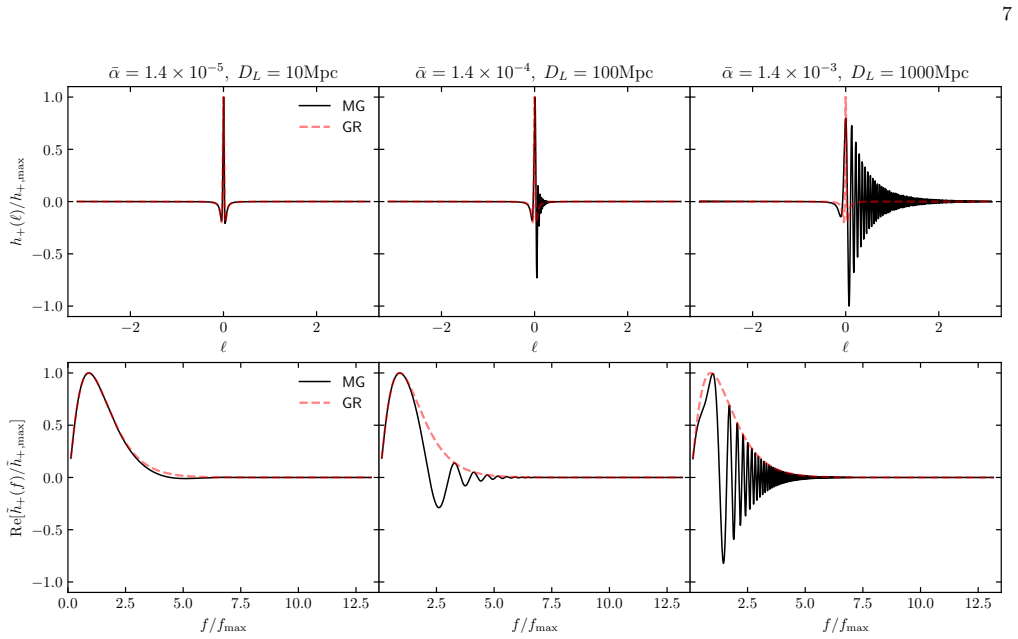
Gravitational waves in general relativity are non-dispersive, yet a host of modified theories predict dispersion effects during propagation. In this work, we consider the impact of dispersion effects on gravitational-wave bursts from highly eccentric binary black holes. We consider the dispersion effects within the low-energy, effective field theory limit, and model the dispersion relation via standard parameterized deformations. Such modified dispersion relations produce two modifications to the burst waveform: a modification to the time of arrival of the bursts in the detector, which appears as a 2.5PN correction to the difference in burst arrival times, and a modification to the arrival time of individual orbital harmonics within the bursts themselves, resulting in a Bessel-type amplitude modulation of the waveform. Using the Fisher information matrix, we study projected constraints one might obtain with future observations of repeating burst signals with LIGO. We find that the projected constraints vary significantly depending on the theoretical mechanism producing the modified dispersion. For massive gravitons and multifractional spacetimes that break Lorentz invariance, bounds on the coupling parameters are generally weaker than current bounds. For other Lorentz invariance breaking models such as Ho\v{r}ava-Lifschitz gravity, as well as scenarios with extra dimensions, the bounds in optimal cases can be 1-3 orders of magnitude stronger than current bounds.
Editorial analysis
A structured set of objections, weighed in public.
Referee Report
Summary. The paper claims that modified dispersion relations in gravity can be probed using gravitational-wave bursts from eccentric black-hole binaries. By modeling dispersion via standard parameterized deformations in the low-energy EFT limit, two effects are identified: a 2.5PN time-of-arrival shift between bursts and a Bessel-type amplitude modulation within bursts. Using the Fisher information matrix, projected constraints from future LIGO observations are derived, suggesting that for Hořava-Lifshitz gravity and extra-dimension models, bounds can be 1-3 orders of magnitude stronger than current ones in optimal cases.
Significance. If the results hold, this work demonstrates the utility of eccentric binary bursts for testing modified gravity, potentially offering tighter constraints on Lorentz-violating dispersion effects compared to existing methods. The distinction between different theoretical mechanisms leading to varying bound strengths is a notable contribution.
major comments (2)
- [Section on Fisher information matrix analysis] Section on Fisher information matrix analysis: The validity of the Fisher information matrix approximation for these low-SNR, burst-like signals is not demonstrated (e.g., via Monte Carlo injections or comparison to full likelihood sampling), which is critical since the projected constraints on the dispersion coupling parameters rest on this approximation.
- [Abstract and waveform modeling] Abstract and waveform modeling: The assumption that the standard parameterized dispersion relations accurately reproduce the waveform modifications for Hořava-Lifshitz gravity and extra-dimension scenarios may not hold due to possible higher-order terms (e.g., k^4) or anisotropies in those theories, which could introduce unaccounted degeneracies with eccentricity or sky position and invalidate the claimed 1-3 order improvements.
minor comments (2)
- The paper would benefit from a clearer discussion of the limitations of the low-energy EFT approximation when applied to specific modified gravity models.
- [Figure captions] Ensure that all figures clearly distinguish between the different dispersion models considered.
Simulated Author's Rebuttal
We thank the referee for their constructive and detailed comments, which have helped us clarify important aspects of our analysis. We address each major comment below and have revised the manuscript accordingly to strengthen the presentation of our results.
read point-by-point responses
-
Referee: Section on Fisher information matrix analysis: The validity of the Fisher information matrix approximation for these low-SNR, burst-like signals is not demonstrated (e.g., via Monte Carlo injections or comparison to full likelihood sampling), which is critical since the projected constraints on the dispersion coupling parameters rest on this approximation.
Authors: We agree that the Fisher matrix provides only an approximation to the true posterior, and its accuracy for low-SNR burst signals merits explicit discussion. In the revised manuscript we have added a dedicated paragraph in the Fisher analysis section that reviews the conditions under which the Fisher approximation remains useful for burst-like waveforms, cites relevant validation studies in the gravitational-wave literature, and explicitly states that the reported constraints should be viewed as indicative forecasts. A full Monte-Carlo injection study or comparison with nested sampling would provide a more rigorous validation but is computationally demanding and lies outside the scope of the present work, which centers on deriving the dispersion-induced waveform modifications and obtaining first-order projections. revision: partial
-
Referee: Abstract and waveform modeling: The assumption that the standard parameterized dispersion relations accurately reproduce the waveform modifications for Hořava-Lifshitz gravity and extra-dimension scenarios may not hold due to possible higher-order terms (e.g., k^4) or anisotropies in those theories, which could introduce unaccounted degeneracies with eccentricity or sky position and invalidate the claimed 1-3 order improvements.
Authors: The manuscript works strictly within the low-energy effective-field-theory limit, where the leading dispersion correction is captured by the standard parameterized form we adopt. For the Hořava-Lifshitz and extra-dimension models considered, this leading term dominates at LIGO frequencies. We have revised both the abstract and the waveform-modeling section to state explicitly that higher-order terms (such as k^4) and possible anisotropies are neglected in the present approximation. The Fisher matrix already marginalizes over eccentricity and sky-position parameters, thereby incorporating the leading degeneracies with those quantities. Our quoted improvements therefore apply to the effective dispersion model under the stated assumptions rather than to the complete ultraviolet completions of the theories. revision: yes
Circularity Check
No circularity: forward projections via standard Fisher analysis on parameterized EFT deformations
full rationale
The paper derives projected bounds on dispersion parameters by applying the Fisher information matrix to modeled burst waveforms from eccentric binaries. The two waveform modifications (2.5PN inter-burst timing shift and Bessel intra-burst modulation) follow directly from the chosen low-energy parameterized dispersion relation, which is adopted as standard input rather than fitted or derived within the paper. No equation reduces a claimed bound to a quantity already determined by the paper's own data or ansatz; results are explicit forward projections onto future LIGO observations, not retrofits. Self-citations, if present, are not load-bearing for the central mapping or covariance calculation. The derivation remains self-contained against the external Fisher formalism and EFT parameterization conventions.
Axiom & Free-Parameter Ledger
free parameters (1)
- dispersion coupling parameter
axioms (2)
- domain assumption Dispersion relation can be modeled by standard parameterized deformations in the low-energy effective-field-theory limit
- domain assumption Fisher information matrix provides a reliable estimate of parameter uncertainties for the simulated burst signals
Lean theorems connected to this paper
-
IndisputableMonolith/Cost/FunctionalEquation.leanwashburn_uniqueness_aczel unclear?
unclearRelation between the paper passage and the cited Recognition theorem.
We consider the dispersion effects within the low-energy, effective field theory limit, and model the dispersion relation via standard parameterized deformations... ω² = k² + α L_P^{2a-4} k^a
-
IndisputableMonolith/Foundation/AlexanderDuality.leanalexander_duality_circle_linking unclear?
unclearRelation between the paper passage and the cited Recognition theorem.
For Hořava-Lifschitz gravity... bounds... 1-3 orders of magnitude stronger
What do these tags mean?
- matches
- The paper's claim is directly supported by a theorem in the formal canon.
- supports
- The theorem supports part of the paper's argument, but the paper may add assumptions or extra steps.
- extends
- The paper goes beyond the formal theorem; the theorem is a base layer rather than the whole result.
- uses
- The paper appears to rely on the theorem as machinery.
- contradicts
- The paper's claim conflicts with a theorem or certificate in the canon.
- unclear
- Pith found a possible connection, but the passage is too broad, indirect, or ambiguous to say the theorem truly supports the claim.
Reference graph
Works this paper leans on
-
[1]
Tests of General Relativity with GWTC-3
R. Abbottet al., (2021), arXiv:2112.06861 [gr-qc]. [2] T. Baker, E. Bellini, P. G. Ferreira, M. Lagos, J. Noller, 17 and I. Sawicki, Phys. Rev. Lett.119, 251301 (2017), arXiv:1710.06394 [astro-ph.CO]
work page internal anchor Pith review Pith/arXiv arXiv 2021
-
[2]
B. P. Abbottet al.(LIGO Scientific, Virgo), Phys. Rev. Lett. 123, 011102 (2019), arXiv:1811.00364 [gr-qc]
work page internal anchor Pith review Pith/arXiv arXiv 2019
-
[3]
A. Ashtekar, A. del Río, and M. Schneider, Gen. Relat. Gravit. 54, 45 (2022), arXiv:2205.00298 [gr-qc]
- [4]
-
[5]
Scales and hierachies in asymptotically safe quantum gravity: a review
G. Gubitosi, C. Ripken, and F. Saueressig, Found. Phys. 49, 972 (2019), arXiv:1901.01731 [gr-qc]
work page internal anchor Pith review Pith/arXiv arXiv 2019
-
[6]
An asymptotically safe guide to quantum gravity and matter
A. Eichhorn, Front. Astron. Space Sci.5, 47 (2019), arXiv:1810.07615 [hep-th]
work page internal anchor Pith review Pith/arXiv arXiv 2019
- [7]
-
[8]
Asymptotic safety of quantum gravity beyond Ricci scalars
K. Falls, C. R. King, D. F. Litim, K. Nikolakopou- los, and C. Rahmede, Phys. Rev. D97, 086006 (2018), arXiv:1801.00162 [hep-th]
work page internal anchor Pith review Pith/arXiv arXiv 2018
-
[9]
Rachwal, Universe8, 229 (2022), arXiv:2204.09858 [hep-th]
L. Rachwal, Universe8, 229 (2022), arXiv:2204.09858 [hep-th]
-
[10]
M. B. Green, J. H. Schwarz, and E. Witten,Superstring Theory Vol. 1: 25th Anniversary Edition(Cambridge University Press, 2012)
work page 2012
-
[11]
M. B. Green, J. H. Schwarz, and E. Witten,Superstring Theory Vol. 2: 25th Anniversary Edition(Cambridge University Press, 2012)
work page 2012
-
[12]
Polchinski, String Theory (Cambridge University Press, 1998)
J. Polchinski, String Theory (Cambridge University Press, 1998)
work page 1998
-
[13]
A. Ashtekar and E. Bianchi, Rep. Prog. Phys.84, 042001 (2021), arXiv:2104.04394 [gr-qc]
-
[14]
Thiemann,Modern Canonical Quantum General Rel- ativity (Cambridge University Press, 2007)
T. Thiemann,Modern Canonical Quantum General Rel- ativity (Cambridge University Press, 2007)
work page 2007
-
[15]
R. Loll, Class. Quantum Grav. 37, 013002 (2020), arXiv:1905.08669 [hep-th]
- [16]
-
[17]
Membranes at Quantum Criticality
P. Horava, J. High Energy Phys. 03, 020 (2009), arXiv:0812.4287 [hep-th]
work page internal anchor Pith review Pith/arXiv arXiv 2009
-
[18]
Quantum Gravity at a Lifshitz Point
P. Horava, Phys. Rev. D 79, 084008 (2009), arXiv:0901.3775 [hep-th]
work page internal anchor Pith review Pith/arXiv arXiv 2009
-
[19]
C. D. Hoyle, D. J. Kapner, B. R. Heckel, E. G. Adel- berger, J. H. Gundlach, U. Schmidt, and H. E. Swanson, Phys. Rev. D70, 042004 (2004), arXiv:hep-ph/0405262
work page internal anchor Pith review Pith/arXiv arXiv 2004
-
[20]
P. Touboulet al. (MICROSCOPE), Phys. Rev. Lett. 129, 121102 (2022), arXiv:2209.15487 [gr-qc]
- [21]
- [22]
-
[23]
Chern-Simons Modified General Relativity
S. Alexander and N. Yunes, Phys. Rep.480, 1 (2009), arXiv:0907.2562 [hep-th]
work page internal anchor Pith review Pith/arXiv arXiv 2009
- [24]
-
[25]
J. F. Donoghue, AIP Conf. Proc. 1483, 73 (2012), arXiv:1209.3511 [gr-qc]
work page internal anchor Pith review Pith/arXiv arXiv 2012
-
[26]
J. F. Donoghue and B. R. Holstein, J. Phys. G42, 103102 (2015), arXiv:1506.00946 [gr-qc]
work page internal anchor Pith review Pith/arXiv arXiv 2015
- [27]
-
[28]
Effective field theory from modified gravity with massive modes
S. Capozziello, M. De Laurentis, M. Paolella, and G. Ric- ciardi, Int. J. Geom. Meth. Mod. Phys.12, 1550004 (2015), arXiv:1311.6319 [gr-qc]
work page internal anchor Pith review Pith/arXiv arXiv 2015
- [29]
-
[30]
N. Yunes and F. Pretorius, Phys. Rev. D80, 122003 (2009), arXiv:0909.3328 [gr-qc]
work page internal anchor Pith review Pith/arXiv arXiv 2009
-
[31]
A Parametrized post-Einsteinian Framework for Gravitational Wave Bursts
N. Loutrel, N. Yunes, and F. Pretorius, Phys. Rev. D 90, 104010 (2014), arXiv:1404.0092 [gr-qc]
work page internal anchor Pith review Pith/arXiv arXiv 2014
-
[32]
N. Loutrel, P. Pani, and N. Yunes, Phys. Rev. D107, 044046 (2023), arXiv:2210.10571 [gr-qc]
-
[33]
S. Tahura and K. Yagi, Phys. Rev. D 98, 084042 (2018), [Erratum: Phys.Rev.D 101, 109902 (2020)], arXiv:1809.00259 [gr-qc]
-
[34]
C. M. Will, Living Rev. Relativ. 17, 4 (2014), arXiv:1403.7377 [gr-qc]
work page internal anchor Pith review Pith/arXiv arXiv 2014
-
[35]
Hohmann, in Modified Gravity and Cosmology (Springer, 2022)
M. Hohmann, in Modified Gravity and Cosmology (Springer, 2022)
work page 2022
-
[36]
T. Damour and N. Deruelle, Annales de L’Institut Henri Poincare Section (A) Physique Theorique43, 107 (1985)
work page 1985
-
[37]
T. Damour and N. Deruelle, Annales de L’Institut Henri Poincare Section (A) Physique Theorique44, 263 (1986)
work page 1986
- [38]
-
[39]
Theoretical Physics Implications of the Binary Black-Hole Mergers GW150914 and GW151226
N. Yunes, K. Yagi, and F. Pretorius, Phys. Rev. D94, 084002 (2016), arXiv:1603.08955 [gr-qc]
work page internal anchor Pith review Pith/arXiv arXiv 2016
-
[40]
Z. Carson and K. Yagi, inHandbook of Gravitational Wave Astronomy(Springer, 2022) arXiv:2011.02938 [gr- qc]
-
[41]
Constraining Lorentz-violating, Modified Dispersion Relations with Gravitational Waves
S. Mirshekari, N. Yunes, and C. M. Will, Phys. Rev. D 85, 024041 (2012), arXiv:1110.2720 [gr-qc]
work page internal anchor Pith review Pith/arXiv arXiv 2012
- [42]
-
[43]
I. Romero-Shaw, J. Stegmann, H. Tagawa, D. Gerosa, J. Samsing, N. Gupte, and S. R. Green, (2025), arXiv:2506.17105 [astro-ph.HE]
-
[44]
Evidence for eccentricity in the population of binary black holes observed by LIGO-Virgo-KAGRA
N. Gupteet al., (2024), arXiv:2404.14286 [gr-qc]
work page internal anchor Pith review Pith/arXiv arXiv 2024
-
[45]
R. Abbott et al. (LIGO Scientific, Virgo), Phys. Rev. Lett. 125, 101102 (2020), arXiv:2009.01075 [gr-qc]
- [46]
- [47]
-
[48]
B. Moore and N. Yunes, Class. Quantum Grav.37, 165006 (2020), arXiv:2002.05775 [gr-qc]
-
[49]
A. Guptaet al., SciPost Phys. Comm. Rep.5, (2024), arXiv:2405.02197 [gr-qc]
- [50]
- [51]
-
[52]
P. Narayan, N. K. Johnson-McDaniel, and A. Gupta, Phys. Rev. D108, 064003 (2023), arXiv:2306.04068 [gr- qc]
- [53]
- [54]
-
[55]
N. Loutrel, Class. Quantum Grav.37, 075008 (2020), arXiv:1909.02143 [gr-qc]
-
[56]
N. Loutrel, Class. Quantum Grav.38, 015005 (2021), arXiv:2003.13673 [gr-qc]
- [57]
-
[58]
C. Cutler and E. E. Flanagan, Phys. Rev. D49, 2658 (1994), arXiv:gr-qc/9402014
work page internal anchor Pith review Pith/arXiv arXiv 1994
- [59]
-
[60]
V. A. Rubakov and P. G. Tinyakov, Phys. Usp.51, 759 (2008), arXiv:0802.4379 [hep-th]
work page internal anchor Pith review Pith/arXiv arXiv 2008
-
[61]
Theoretical Aspects of Massive Gravity
K. Hinterbichler, Rev. Mod. Phys. 84, 671 (2012), arXiv:1105.3735 [hep-th]
work page internal anchor Pith review Pith/arXiv arXiv 2012
-
[62]
C. de Rham, Living Rev. Relativ. 17, 7 (2014), arXiv:1401.4173 [hep-th]
work page internal anchor Pith review Pith/arXiv arXiv 2014
-
[63]
A. S. Sefiedgar, K. Nozari, and H. R. Sepangi, Phys. Lett. B696, 119 (2011), arXiv:1012.1406 [gr-qc]
work page internal anchor Pith review Pith/arXiv arXiv 2011
-
[64]
Testable scenario for Relativity with minimum-length
G. Amelino-Camelia, Phys. Lett. B510, 255 (2001), arXiv:hep-th/0012238
work page internal anchor Pith review Pith/arXiv arXiv 2001
-
[65]
Lorentz invariance with an invariant energy scale
J. Magueijo and L. Smolin, Phys. Rev. Lett.88, 190403 (2002), arXiv:hep-th/0112090
work page internal anchor Pith review Pith/arXiv arXiv 2002
-
[66]
Amelino-Camelia, Nature418, 34 (2002), arXiv:gr- qc/0207049
G. Amelino-Camelia, Nature418, 34 (2002), arXiv:gr- qc/0207049
-
[67]
S. I. Vacaru, Gen. Relat. Gravit. 44, 1015 (2012), arXiv:1010.5457 [math-ph]
work page internal anchor Pith review Pith/arXiv arXiv 2012
-
[68]
Gravitational Radiation in Horava Gravity
D. Blas and H. Sanctuary, Phys. Rev. D84, 064004 (2011), arXiv:1105.5149 [gr-qc]
work page internal anchor Pith review Pith/arXiv arXiv 2011
-
[69]
Fractal universe and quantum gravity
G. Calcagni, Phys. Rev. Lett. 104, 251301 (2010), arXiv:0912.3142 [hep-th]
work page internal anchor Pith review Pith/arXiv arXiv 2010
-
[70]
G. Calcagni, Adv. Theor. Math. Phys.16, 549 (2012), arXiv:1106.5787 [hep-th]
work page internal anchor Pith review Pith/arXiv arXiv 2012
-
[71]
Geometry and field theory in multi-fractional spacetime
G. Calcagni, J. High Energy Phys. 01, 065 (2012), arXiv:1107.5041 [hep-th]
work page internal anchor Pith review Pith/arXiv arXiv 2012
-
[72]
Lorentz violations in multifractal spacetimes
G. Calcagni, Eur. Phys. J. C 77, 291 (2017), arXiv:1603.03046 [gr-qc]
work page internal anchor Pith review Pith/arXiv arXiv 2017
-
[73]
V. A. Kostelecký and M. Mewes, Phys. Lett. B757, 510 (2016), arXiv:1602.04782 [gr-qc]
work page internal anchor Pith review Pith/arXiv arXiv 2016
- [74]
-
[75]
K. Martel and E. Poisson, Phys. Rev. D60, 124008 (1999), arXiv:gr-qc/9907006
work page internal anchor Pith review Pith/arXiv arXiv 1999
-
[76]
C. Moreno-Garrido, E. Mediavilla, and J. Buitrago, Mon. Not. R. Astron. Soc.274, 115 (1995)
work page 1995
-
[77]
A Fourier Domain Waveform for Non-Spinning Binaries with Arbitrary Eccentricity
B. Moore, T. Robson, N. Loutrel, and N. Yunes, Class. Quantum Grav.35, 235006 (2018), arXiv:1807.07163 [gr-qc]
work page internal anchor Pith review Pith/arXiv arXiv 2018
- [78]
-
[79]
Spin-Precessing Black Hole Binaries in Dynamical Chern-Simons Gravity
N. Loutrel, T. Tanaka, and N. Yunes, Phys. Rev. D98, 064020 (2018), arXiv:1806.07431 [gr-qc]
work page internal anchor Pith review Pith/arXiv arXiv 2018
-
[80]
M. Abramowitz and I. A. Stegun,Handbook of mathemat- ical functions with formulas, graphs, and mathematical tables (Dover Publications, 1965)
work page 1965
discussion (0)
Sign in with ORCID, Apple, or X to comment. Anyone can read and Pith papers without signing in.