REVIEW 2 major objections 5 minor 47 references
SALAD -- Semantics-Aware Logical Anomaly Detection
T0 review · 2 major / 5 minor · reviewed 2026-08-05 · deepseek-v4-flash
Pith's one-line read SALAD claims that explicit modeling of object composition maps—not aggregated features—is what detects logical anomalies, and reports 96.1% AUROC on MVTec LOCO.
desk verdict Solid empirical win on MVTec LOCO with a new composition branch, but the label-free map extraction has an underspecified alignment step that needs to be pinned down. read the letter →
The pith
A machine-rendered reading of the paper's core claim, the machinery that carries it, and where it could break.
The reading
What carries the argument
The load-bearing object is the composition branch: a discriminative network operating on composition maps C, where each pixel carries a component-class label. It has a reconstruction subnetwork that restores synthetically anomalous maps to their anomaly-free form using focal and dice losses, and a discriminative subnetwork that, given the original and reconstructed maps, predicts an anomaly mask. The maps themselves are produced by a label-free pipeline: per-image K-means on DINO features, alignment of SAM-HQ mask proposals to those clusters, and a UNet trained on the resulting pseudo-labels to segment components at inference.
What would settle it
Compute a correspondence-aware agreement (e.g., Hungarian-matched IoU or adjusted Rand index) between the per-image cluster pseudo-labels and a set of known component masks on MVTec LOCO, such as PSAD's supervised maps; low or unstable agreement would falsify the claim that the maps encode stable component semantics. A cheaper test: randomly permute cluster indices per image before training the UNet; if downstream AUROC barely changes, the automatic extraction is not responsible for the improvement.
Extended reading notes
Core claim
The central claim is that logical anomalies—missing, extra, misplaced, or oddly shaped components—are best detected by learning the distribution of composition maps directly. A composition map labels every pixel with its object component, compressing class, shape, and position while discarding appearance. SALAD trains a dedicated composition branch on these maps: a reconstruction subnetwork first restores synthetically corrupted maps to anomaly-free form, and a discriminative subnetwork then learns to segment the difference. The maps themselves are generated without human labels by clustering DINO features into K=6 components, using SAM-HQ mask proposals to refine the clusters into pseudo-la
Load-bearing premise
The automatic composition map generation assumes that per-image K-means clustering of DINO features yields semantically consistent cluster labels across images: the same cluster index in different training images must correspond to the same object component. This consistency is not verified; if cluster indices are not aligned across images, the composition maps and the per-class global statistics are built from arbitrary labels.
Editorial extensions
If this is right
- Logical anomaly detection can be posed as distribution learning over discrete part-layout maps, with synthetic corruptions (erasing, inpainting, Perlin-noise pasting) sufficient to define a normal boundary.
- The automatic composition-map pipeline removes the need for hand-labeled part masks or category-specific tuning that limits PSAD and CSAD, so new categories can be handled without per-category engineering.
- Per-branch ablations indicate the composition branch is the main logical-anomaly driver (3.5-point drop when removed), while the appearance branch remains necessary for structural anomalies and the global branch contributes a smaller overall gain.
- The composition branch is transferable across appearance backbones: swapping EfficientAD for DSR, TransFusion, or DRÆM keeps results at or above state of the art, suggesting the gain is not an artifact of one base model.
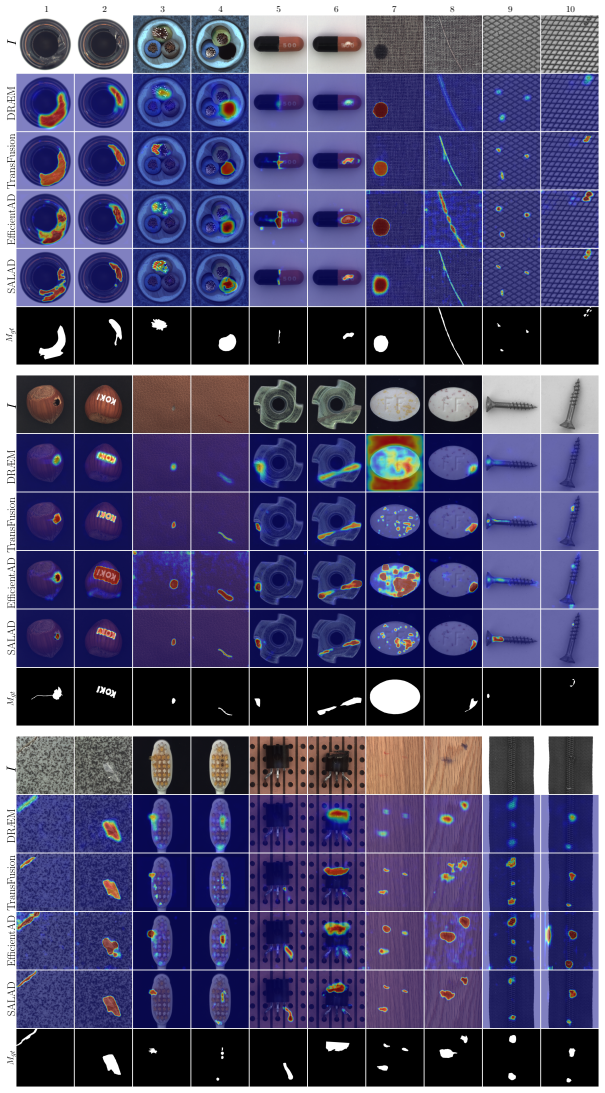
- The same three-branch model also reaches 98.9% on MVTec AD and 97.9% on VisA, so modeling composition does not hurt and may help purely structural anomaly detection.
Reading between the lines
- The 96.1% result depends on per-image K-means cluster indices lining up semantically across images; a direct check would be to measure cluster-index consistency against supervised part masks (e.g., PSAD's) on MVTec LOCO. If cluster identities are unstable, the gain likely comes from the UNet smoothing pseudo-label noise rather than from discovered semantics.
- If explicit composition-map modeling is the right inductive bias, then richer part hierarchies (more clusters, hierarchical components) or part-level language labels should push logical anomaly detection further; the paper's robustness to K=4..8 is only a partial test.
- The composition branch may also be detecting structural anomalies as side effects—defects often alter local part boundaries—so separating 'composition change' from 'appearance change' in the fused score could improve interpretability.
- On categories with highly variable object layouts, per-image clustering may not produce stable components; testing on a non-fixed-layout benchmark would delineate where the method's advantage holds.
Editorial analysis
A structured set of objections, weighed in public.
Referee Report
Summary. The paper proposes SALAD, a semantic-aware logical anomaly detection method. SALAD combines a local appearance branch (EfficientAD), a newly introduced composition branch that is discriminatively trained directly on object composition maps, and a global appearance branch that fits per-class Gaussians to features of the input image. The authors also propose an automatic, label-free composition map generation pipeline that uses DINO feature clustering and SAM-HQ mask proposals, followed by a UNet segmentation model. Synthetic logical anomalies are generated by inpainting or erasing components in the composition map space. Experiments on MVTec LOCO report a new state-of-the-art image-level AUROC of 96.1%, with additional results on MVTec AD and VisA. Ablations isolate the contribution of each branch and of each synthetic anomaly type.
Significance. If the method is valid, it makes a useful contribution: it moves logical anomaly detection beyond aggregated features and handcrafted descriptors by explicitly training a model on composition maps, and it removes the manual annotation or per-category tuning required by prior composition-based methods. The paper includes a code release, uses standard benchmarks, and provides ablations that support the relevance of the composition branch. However, a load-bearing step in the pipeline, the automatic generation of pseudo-labels by K-means clustering, is underspecified. The claim that the composition branch learns semantic relationships depends on the pseudo-labels being semantically consistent across training images; the paper does not establish that this consistency holds.
major comments (2)
- [§3.3] The pseudo-label generation is underspecified on a load-bearing point. The text says DINO features 'are then subsampled and clustered into K clusters' after processing each training image, but it does not state whether K-means is fit jointly on all training images or separately per image. If clustering is per image, K-means cluster indices are arbitrary permutations across images. Then (i) the UNet trained with cross-entropy on Cpseudo cannot learn a stable component-to-class mapping; (ii) the global branch's per-class statistics in Eq. (3) are computed over features from different semantic components in different images; and (iii) the synthetic 'inpainted from another image' anomaly in Section 3.4 pastes a component whose class label may denote a different object part. The paper must specify the clustering regime and, if per-image, describe the alignment procedure and quantify cross-ima
- [Tables 1-4] The main empirical claim is a 3.0 pp improvement over PUAD on MVTec LOCO, and the central ablation claims a 3.5 pp drop when removing the composition branch. All AUROC numbers are reported for a single run with no standard deviations, confidence intervals, or seed sensitivity. The datasets have only five LOCO categories, and the pipeline involves DINO clustering, UNet training, and synthetic anomaly generation, all of which are seed-sensitive. Please report multiple runs (at least 3-5) or a statistical significance test for the key comparisons. Without this, the margin over the previous SOTA cannot be distinguished from run-to-run variability.
minor comments (5)
- [§3.3] Please specify what 'subsampled' means (which pixels, what fraction) and the exact K-means settings. Currently the clustering procedure is not reproducible from the description.
- [Table 3] The table header is confusing: the first column label 'Category Logical' and the Average column are inconsistent. For SALAD, the average of the two reported dataset AUROCs is 98.4, not 98.3 as printed, if the column is the mean of the two dataset averages.
- [§5] The text uses 'Stat branch' in the ablation while Section 3.6 calls it the global branch. Please unify the terminology.
- [Figure 2] Typo: 'Apperance network' should be 'Appearance network'.
- [Supplementary Material A] The limitations paragraph mentions dependence on SAM-HQ and DINO, but not the cross-image cluster-alignment condition discussed above. Please add a statement about this requirement or an explicit justification for why it is not needed.
Circularity Check
No significant circularity: SALAD's composition branch and automatic composition-map extraction are evaluated against external benchmarks and do not reduce to fitted inputs or self-citation.
full rationale
Walking the paper's derivation chain: the claimed 96.1% AUROC on MVTec LOCO is produced by fusing three branch scores (Eq. 5). The composition branch is trained with the DRÆM-style discriminative objectives (Eqs. 1–2) on composition maps C, but those maps are obtained from DINO feature clustering and SAM-HQ mask proposals (Sec. 3.3), and the synthetic anomaly masks used for training are generated from C itself (Sec. 3.4). At inference, real test images and their predicted composition maps are scored by the trained networks; no test labels or test anomaly scores are used to fit any parameter. The global branch (Eq. 3) fits a Gaussian to training-set descriptors and evaluates Mahalanobis distance on test images, which is a standard train/test protocol rather than a fitted parameter renamed as a prediction. The paper contains no equation in which the final AUROC reduces by construction to its inputs, and no external benchmark result is re-derived from the method's own fitted values. The authors cite their own prior work (DRÆM, DSR, TransFusion), but only as baseline components or architectural precedents; the central contribution—the discriminatively trained composition branch and the label-free composition-map extraction—is ablated and evaluated against independently annotated test sets with standard splits. Even the paper's weakest assumption (that per-image DINO K-means cluster indices are semantically consistent across images) is a robustness/correctness concern, not a circularity: an underspecified or invalid pseudo-labeling step would weaken the method, but it does not mean the claimed result is definitionally equivalent to its inputs. Therefore, no significant circularity is present.
Assumptions & free parameters
free parameters (3)
- K (number of DINO clusters) =
6
- alpha (composition discriminative loss weight) =
5
- synthetic anomaly probability =
0.5
assumptions (6)
- domain assumption DINO features are semantically consistent across images, so per-image K-means clusters with the same index correspond to the same object component.
- domain assumption SAM-HQ mask proposals accurately cover object components and can be classified by majority DINO cluster.
- domain assumption Synthetic anomalies on composition maps (Perlin-noise class pasting, component removal, component inpainting) are representative of real logical anomalies.
- domain assumption The composition map alone encodes sufficient information to detect logical anomalies (missing/extra components).
- domain assumption The per-class Gaussian distribution of mean feature vectors is a valid normality model for global appearance.
- domain assumption Z-score normalization and unweighted summation of branch scores is an appropriate fusion.
Cite this review
Pith. "Pith review of SALAD -- Semantics-Aware Logical Anomaly Detection." pith.science (2026). https://pith.science/paper/6WNDIKVY
@misc{pith2026250902101,
  author       = {Pith},
  title        = {Pith review of: SALAD -- Semantics-Aware Logical Anomaly Detection},
  year         = {2026},
  howpublished = {\url{https://pith.science/paper/6WNDIKVY}},
  note         = {Machine review of arXiv:2509.02101}
}
read the original abstract
Recent surface anomaly detection methods excel at identifying structural anomalies, such as dents and scratches, but struggle with logical anomalies, such as irregular or missing object components. The best-performing logical anomaly detection approaches rely on aggregated pretrained features or handcrafted descriptors (most often derived from composition maps), which discard spatial and semantic information, leading to suboptimal performance. We propose SALAD, a semantics-aware discriminative logical anomaly detection method that incorporates a newly proposed composition branch to explicitly model the distribution of object composition maps, consequently learning important semantic relationships. Additionally, we introduce a novel procedure for extracting composition maps that requires no hand-made labels or category-specific information, in contrast to previous methods. By effectively modelling the composition map distribution, SALAD significantly improves upon state-of-the-art methods on the standard benchmark for logical anomaly detection, MVTec LOCO, achieving an impressive image-level AUROC of 96.1%. Code: https://github.com/MaticFuc/SALAD
Figures


Figures from the paper (12 more)


Reference graph
Works this paper leans on
-
[1]
Efficien- tAD: Accurate Visual Anomaly Detection at Millisecond- Level Latencies
Kilian Batzner, Lars Heckler, and Rebecca König. Efficien- tAD: Accurate Visual Anomaly Detection at Millisecond- Level Latencies. In Proceedings of the IEEE/CVF Winter Conference on Applications of Computer Vision, pages 128– 138, 2024. 2, 3, 6, 7, 8
work page 2024
-
[2]
Paul Bergmann, Kilian Batzner, Michael Fauser, David Satt- legger, and Carsten Steger. The MVTec Anomaly Detection Dataset: A Comprehensive Real-World Dataset for Unsuper- vised Anomaly Detection. International Journal of Computer Vision, 129(4):1038–1059, 2021. 1, 2, 5, 6, 7
work page 2021
-
[3]
Beyond Dents and Scratches: Logical Constraints in Unsupervised Anomaly Detection and Localization
Paul Bergmann, Kilian Batzner, Michael Fauser, David Sat- tlegger, and Carsten Steger. Beyond Dents and Scratches: Logical Constraints in Unsupervised Anomaly Detection and Localization. International Journal of Computer Vision, 130 (4):947–969, 2022. 2, 5, 6, 8, 1, 4
work page 2022
-
[4]
Mixed supervision for surface-defect detection: From weakly to fully supervised learning
Jakob Božiˇc, Domen Tabernik, and Danijel Skoˇcaj. Mixed supervision for surface-defect detection: From weakly to fully supervised learning. Computers in Industry , 129:103459, 2021
work page 2021
-
[5]
Robustness of unsupervised methods for image surface-anomaly detection
Jakob Boži ˇc, Matic Fu ˇcka, Vitjan Zavrtanik, and Danijel Skoˇcaj. Robustness of unsupervised methods for image surface-anomaly detection. Pattern Analysis and Applica- tions, 28(2):99, 2025. 1
work page 2025
-
[6]
Emerg- ing properties in self-supervised vision transformers
Mathilde Caron, Hugo Touvron, Ishan Misra, Hervé Jégou, Julien Mairal, Piotr Bojanowski, and Armand Joulin. Emerg- ing properties in self-supervised vision transformers. In Pro- ceedings of the IEEE/CVF international conference on com- puter vision, pages 9650–9660, 2021. 4, 5, 8, 1, 2, 3
work page 2021
-
[7]
Set Features for Anomaly Detection
Niv Cohen, Issar Tzachor, and Yedid Hoshen. Set Features for Anomaly Detection. arXiv preprint arXiv:2311.14773,
-
[8]
Generating and reweighting dense contrastive patterns for unsupervised anomaly detection
Songmin Dai, Yifan Wu, Xiaoqiang Li, and Xiangyang Xue. Generating and reweighting dense contrastive patterns for unsupervised anomaly detection. In Proceedings of the AAAI Conference on Artificial Intelligence, pages 1454–1462, 2024. 2
work page 2024
Show all 47 references
-
[9]
Anomaly Detection via Reverse Distillation From One-Class Embedding
Hanqiu Deng and Xingyu Li. Anomaly Detection via Reverse Distillation From One-Class Embedding. In Proceedings of the IEEE/CVF Conference on Computer Vision and Pattern Recognition (CVPR), pages 9737–9746, 2022. 1, 2, 6
2022
-
[10]
ImageNet: A large-scale hierarchical image database
Jia Deng, Wei Dong, Richard Socher, Li-Jia Li, Kai Li, and Li Fei-Fei. ImageNet: A large-scale hierarchical image database. In 2009 IEEE conference on computer vision and pattern recognition, pages 248–255. Ieee, 2009. 3
2009
-
[11]
An image is worth 16x16 words: Transformers for image recognition at scale
Alexey Dosovitskiy, Lucas Beyer, Alexander Kolesnikov, Dirk Weissenborn, Xiaohua Zhai, Thomas Unterthiner, Mostafa Dehghani, Matthias Minderer, Georg Heigold, Syl- vain Gelly, Jakob Uszkoreit, and Neil Houlsby. An image is worth 16x16 words: Transformers for image recognition ...
2021
-
[12]
TransFu- sion – A Transparency-Based Diffusion Model for Anomaly Detection
Matic Fuˇcka, Vitjan Zavrtanik, and Danijel Skoˇcaj. TransFu- sion – A Transparency-Based Diffusion Model for Anomaly Detection. In European conference on computer vision, pages 91–108. Springer, 2025. 1, 2, 6, 7, 8
2025
-
[13]
CFLOW-AD: Real-Time Unsupervised Anomaly Detection with Localization via Conditional Normalizing Flows
Denis Gudovskiy, Shun Ishizaka, and Kazuki Kozuka. CFLOW-AD: Real-Time Unsupervised Anomaly Detection with Localization via Conditional Normalizing Flows. In Pro- ceedings of the IEEE/CVF Winter Conference on Applications of Computer Vision, pages 98–107, 2022. 1, 2
2022
-
[14]
Template-guided hierarchical feature restoration for anomaly detection
Hewei Guo, Liping Ren, Jingjing Fu, Yuwang Wang, Zhizheng Zhang, Cuiling Lan, Haoqian Wang, and Xinwen Hou. Template-guided hierarchical feature restoration for anomaly detection. In Proceedings of the IEEE/CVF Inter- national Conference on Computer Vision, pages 6447–6458,
-
[15]
Deep Residual Learning for Image Recognition
Kaiming He, Xiangyu Zhang, Shaoqing Ren, and Jian Sun. Deep Residual Learning for Image Recognition. In 2016 IEEE Conference on Computer Vision and Pattern Recogni- tion (CVPR), pages 770–778, 2016. 8, 1, 2, 3
2016
-
[16]
CSAD: Unsupervised component segmentation for logical anomaly detection
Yu-Hsuan Hsieh and Shang-Hong Lai. CSAD: Unsupervised component segmentation for logical anomaly detection. In In Proceedings of the British Machine Vision Conference (BMVC), 2024. 1, 2, 3, 6
2024
-
[17]
Logi- cAD: Explainable Anomaly Detection via VLM-based Text Feature Extraction
Er Jin, Qihui Feng, Yongli Mou, Stefan Decker, Gerhard Lakemeyer, Oliver Simons, and Johannes Stegmaier. Logi- cAD: Explainable Anomaly Detection via VLM-based Text Feature Extraction. 2025. 2, 6
2025
-
[18]
Segment anything in high quality
Lei Ke, Mingqiao Ye, Martin Danelljan, Yu-Wing Tai, Chi- Keung Tang, Fisher Yu, et al. Segment anything in high quality. Advances in Neural Information Processing Systems, 36, 2024. 4, 5, 1, 2, 3
2024
-
[19]
Few shot part segmentation reveals compositional logic for industrial anomaly detection
Soopil Kim, Sion An, Philip Chikontwe, Myeongkyun Kang, Ehsan Adeli, Kilian M Pohl, and Sang Hyun Park. Few shot part segmentation reveals compositional logic for industrial anomaly detection. In Proceedings of the AAAI Conference on Artificial Intelligence, pages 8591–8599, 2...
2024
-
[20]
Kingma and Jimmy Ba
Diederik P. Kingma and Jimmy Ba. Adam: A method for stochastic optimization. In 3rd International Conference on Learning Representations, ICLR 2015, San Diego, CA, USA, May 7-9, 2015, Conference Track Proceedings, 2015. 5
2015
-
[21]
Omni-Frequency Channel-Selection Representations for Unsupervised Anomaly Detection
Yufei Liang, Jiangning Zhang, Shiwei Zhao, Runze Wu, Yong Liu, and Shuwen Pan. Omni-Frequency Channel-Selection Representations for Unsupervised Anomaly Detection. IEEE Transactions on Image Processing, 32:4327–4340, 2023. 2
2023
-
[22]
Focal loss for dense object detection
Tsung-Yi Lin, Priya Goyal, Ross Girshick, Kaiming He, and Piotr Dollar. Focal loss for dense object detection. In Pro- ceedings of the IEEE International Conference on Computer Vision (ICCV), 2017. 4
2017
-
[23]
FAIR: Frequency-Aware Image Restoration for Industrial Visual Anomaly Detection
Tongkun Liu, Bing Li, Xiao Du, Bingke Jiang, Leqi Geng, Feiyang Wang, and Zhuo Zhao. FAIR: Frequency-Aware Image Restoration for Industrial Visual Anomaly Detection. arXiv preprint arXiv:2309.07068, 2023. 1, 2
2023 arXiv
-
[24]
Component-aware anomaly detection framework for adjustable and logical industrial visual inspec- tion
Tongkun Liu, Bing Li, Xiao Du, Bingke Jiang, Xiao Jin, Liuyi Jin, and Zhuo Zhao. Component-aware anomaly detection framework for adjustable and logical industrial visual inspec- tion. Advanced Engineering Informatics, 58:102161, 2023. 1, 3, 6, 2
2023
-
[25]
SimpleNet: A Simple Network for Image Anomaly Detection and Localization
Zhikang Liu, Yiming Zhou, Yuansheng Xu, and Zilei Wang. SimpleNet: A Simple Network for Image Anomaly Detection and Localization. In Proceedings of the IEEE/CVF Confer- ence on Computer Vision and Pattern Recognition , pages 20402–20411, 2023. 1, 2, 6, 7
2023
-
[26]
Decoupled Weight Decay Regularization
Ilya Loshchilov and Frank Hutter. Decoupled Weight Decay Regularization. In 7th International Conference on Learning Representations, ICLR 2019, New Orleans, LA, USA, May 6-9, 2019, 2019. 5
2019
-
[27]
Maxime Oquab, Timothée Darcet, Théo Moutakanni, Huy V . V o, Marc Szafraniec, Vasil Khalidov, Pierre Fernandez, Daniel HAZIZA, Francisco Massa, Alaaeldin El-Nouby, Mido Assran, Nicolas Ballas, Wojciech Galuba, Russell Howes, Po-Yao Huang, Shang-Wen Li, Ishan Misra, Michael Rab...
-
[28]
SAM-LAD: Segment Anything Model meets zero-shot logic anomaly detection
Yun Peng, Xiao Lin, Nachuan Ma, Jiayuan Du, Chuangwei Liu, Chengju Liu, and Qijun Chen. SAM-LAD: Segment Anything Model meets zero-shot logic anomaly detection. Knowledge-Based Systems, page 113176, 2025. 2, 6
2025
-
[29]
An image synthesizer
Ken Perlin. An image synthesizer. ACM Siggraph Computer Graphics, 19(3):287–296, 1985. 5
1985
-
[30]
Inpainting transformer for anomaly detection
Jonathan Pirnay and Keng Chai. Inpainting transformer for anomaly detection. In Image Analysis and Processing – ICIAP 2022, pages 394–406, Cham, 2022. Springer International Publishing. 2
2022
-
[31]
Modeling the distribution of normal data in pre-trained deep features for anomaly detection
Oliver Rippel, Patrick Mertens, and Dorit Merhof. Modeling the distribution of normal data in pre-trained deep features for anomaly detection. In 2020 25th International Conference on Pattern Recognition (ICPR), pages 6726–6733. IEEE, 2021. 5
2020
-
[32]
SuperSim- pleNet: Unifying Unsupervised and Supervised Learning for Fast and Reliable Surface Defect Detection
Blaž Rolih, Matic Fu ˇcka, and Danijel Sko ˇcaj. SuperSim- pleNet: Unifying Unsupervised and Supervised Learning for Fast and Reliable Surface Defect Detection. In International Conference on Pattern Recognition, 2024. 2
2024
-
[33]
Towards To- tal Recall in Industrial Anomaly Detection
Karsten Roth, Latha Pemula, Joaquin Zepeda, Bernhard Schölkopf, Thomas Brox, and Peter Gehler. Towards To- tal Recall in Industrial Anomaly Detection. In Proceedings of the IEEE/CVF Conference on Computer Vision and Pattern Recognition, pages 14318–14328, 2022. 1, 2, 6, 8
2022
-
[34]
Asymmetric student-teacher networks for indus- trial anomaly detection
Marco Rudolph, Tom Wehrbein, Bodo Rosenhahn, and Bas- tian Wandt. Asymmetric student-teacher networks for indus- trial anomaly detection. In Proceedings of the IEEE/CVF Winter Conference on Applications of Computer Vision, pages 2592–2602, 2023. 2
2023
-
[35]
Generalised dice overlap as a deep learning loss function for highly unbalanced segmen- tations
Carole H Sudre, Wenqi Li, Tom Vercauteren, Sebastien Ourselin, and M Jorge Cardoso. Generalised dice overlap as a deep learning loss function for highly unbalanced segmen- tations. In Deep Learning in Medical Image Analysis and Multimodal Learning for Clinical Decision Support...
2017
-
[36]
PUAD: Frustratingly simple method for robust anomaly detection
Shota Sugawara and Ryuji Imamura. PUAD: Frustratingly simple method for robust anomaly detection. In 2024 IEEE international conference on image processing (ICIP), 2024. 1, 2, 6, 8
2024
-
[37]
Schmon, and Chris G
Julian Wyatt, Adam Leach, Sebastian M. Schmon, and Chris G. Willcocks. AnoDDPM: Anomaly Detection With Denoising Diffusion Probabilistic Models Using Simplex Noise. In Proceedings of the IEEE/CVF Conference on Com- puter Vision and Pattern Recognition (CVPR) Workshops , pages ...
2022
-
[38]
MemSeg: A semi- supervised method for image surface defect detection using differences and commonalities
Minghui Yang, Peng Wu, and Hui Feng. MemSeg: A semi- supervised method for image surface defect detection using differences and commonalities. Engineering Applications of Artificial Intelligence, 119:105835, 2023. 2, 4
2023
-
[39]
SLSG: Industrial Image Anomaly Detection by Learning Bet- ter Feature Embeddings and One-Class Classification.Pattern Recognition, 156:110862, 2024
Minghui Yang, Jing Liu, Zhiwei Yang, and Zhaoyang Wu. SLSG: Industrial Image Anomaly Detection by Learning Bet- ter Feature Embeddings and One-Class Classification.Pattern Recognition, 156:110862, 2024. 2, 6
2024
-
[40]
Focus the discrepancy: Intra-and inter- correlation learning for image anomaly detection
Xincheng Yao, Ruoqi Li, Zefeng Qian, Yan Luo, and Chongyang Zhang. Focus the discrepancy: Intra-and inter- correlation learning for image anomaly detection. In Proceed- ings of the IEEE/CVF International Conference on Computer Vision, pages 6803–6813, 2023. 2
2023
-
[41]
FastFlow: Unsupervised Anomaly Detection and Localization via 2D Normalizing Flows
Jiawei Yu, Ye Zheng, Xiang Wang, Wei Li, Yushuang Wu, Rui Zhao, and Liwei Wu. FastFlow: Unsupervised Anomaly Detection and Localization via 2D Normalizing Flows. arXiv preprint arXiv:2111.07677, 2021. 2
2021 arXiv
-
[42]
DRAEM-A discriminatively trained reconstruction embed- ding for surface anomaly detection
Vitjan Zavrtanik, Matej Kristan, and Danijel Sko ˇcaj. DRAEM-A discriminatively trained reconstruction embed- ding for surface anomaly detection. In Proceedings of the IEEE/CVF International Conference on Computer Vision , pages 8330–8339, 2021. 1, 2, 3, 4, 5, 6, 7, 8
2021
-
[43]
Recon- struction by inpainting for visual anomaly detection
Vitjan Zavrtanik, Matej Kristan, and Danijel Skoˇcaj. Recon- struction by inpainting for visual anomaly detection. Pattern Recognition, 112:107706, 2021. 2
2021
-
[44]
DSR–A dual subspace re-projection network for surface anomaly de- tection
Vitjan Zavrtanik, Matej Kristan, and Danijel Skoˇcaj. DSR–A dual subspace re-projection network for surface anomaly de- tection. In European Conference on Computer Vision, pages 539–554. Springer, 2022. 1, 2, 6, 7, 8
2022
-
[45]
Con- textual affinity distillation for image anomaly detection
Jie Zhang, Masanori Suganuma, and Takayuki Okatani. Con- textual affinity distillation for image anomaly detection. In Proceedings of the IEEE/CVF Winter Conference on Applica- tions of Computer Vision, pages 149–158, 2024. 2
2024
-
[46]
SPot-the-Difference Self-supervised Pre- training for Anomaly Detection and Segmentation
Yang Zou, Jongheon Jeong, Latha Pemula, Dongqing Zhang, and Onkar Dabeer. SPot-the-Difference Self-supervised Pre- training for Anomaly Detection and Segmentation. In Com- puter Vision–ECCV 2022: 17th European Conference, Tel Aviv, Israel, October 23–27, 2022, Proceedings, Par...
2022
-
[47]
Architectural improvements to the compositional and appearance branch might improve this
and logical anomalies (Columns 7-10). Architectural improvements to the compositional and appearance branch might improve this. B. Differences from other methods utilising composition maps Currently, there are three different methods using compo- sition maps – ComAD [ 24], CSA...
Reviewed August 5, 2026 · model on record in the stance chip above.
Discussion (0). Continue with ORCID to comment.