REVIEW 1 major objections 1 minor 96 references
Exploring giant barium stars: $^{12}\rm{C}/^{13}\rm{C}$ ratio and elemental abundances of carbon, nitrogen, and oxygen
T0 review · 1 major / 1 minor · reviewed 2026-08-05 · deepseek-v4-flash
Pith's one-line read Barium giant stars are systematically carbon-rich, and their carbon excess tracks the s-process material accreted from a former AGB companion.
desk verdict Useful homogeneous C/N/isotope catalog for 180 Ba giants, but oxygen is assumed and the advertised C–s correlation isn't controlled for metallicity. read the letter →
The pith
A machine-rendered reading of the paper's core claim, the machinery that carries it, and where it could break.
The reading
What carries the argument
The machinery is LTE synthetic-spectrum fitting of molecular bands: the C2 band near 5635 Å for carbon, the 12CN features near 8000 Å for nitrogen, and the 13CN features at 8004-8020 Å for the 12C/13C ratio. A standard spectral synthesis code and 1D model atmospheres are used to fit observed spectra. Oxygen abundances are not measured but assigned from the published [O/Fe]-versus-[Fe/H] relation for normal field stars, with the assumption that barium giants follow the same trend.
What would settle it
Measure oxygen directly from the [O I] 6300 Å line, or from an NLTE-corrected O I triplet, for a metallicity-stratified subsample that includes HD 107541, HD 107270, and HD 204075. If their true [O/Fe] deviates from the assumed normal-field-giant relation by more than about 0.1 dex, the reported C/O values and HD 107541's CH classification cross the C/O=1 boundary; agreement would confirm the weakest link in the analysis.
Extended reading notes
Core claim
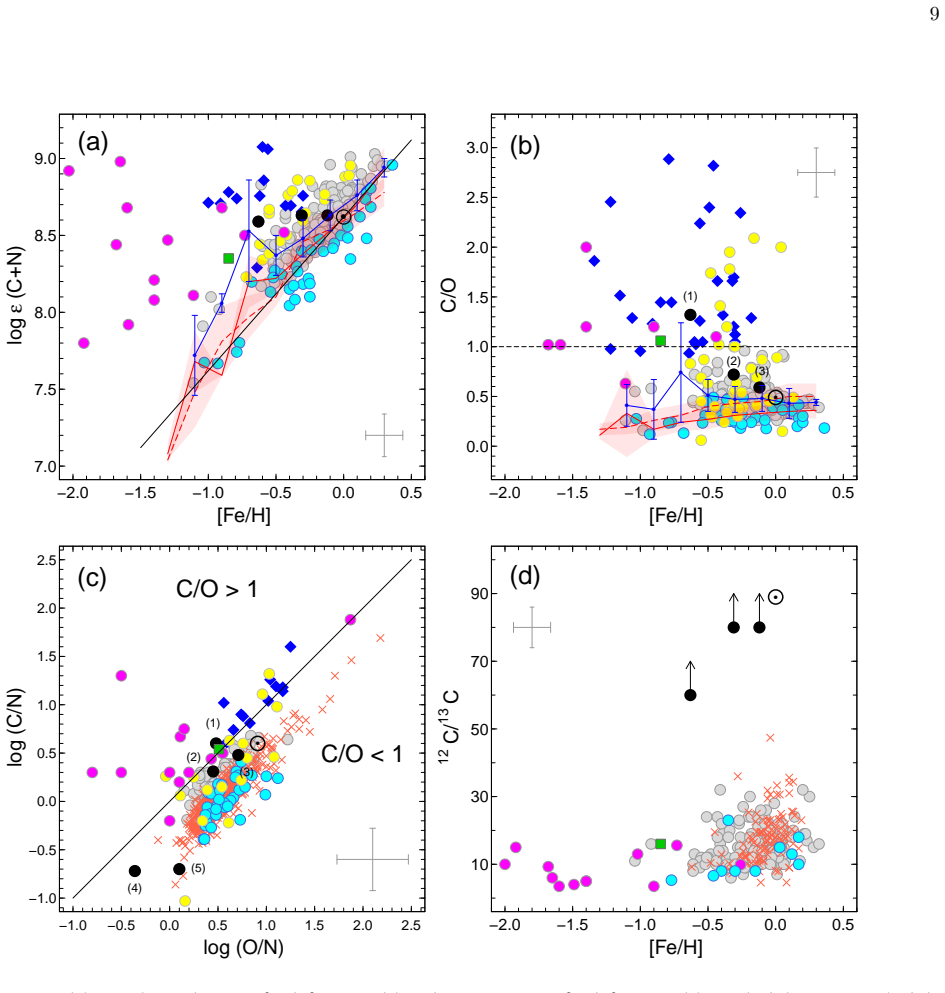
The paper establishes that carbon abundance in barium giants is a direct, quantitative tracer of the s-process pollution they received: the mean carbon excess over normal giants is +0.18±0.05 dex, and [C/Fe] correlates with the average s-process index [s/Fe] with Pearson correlation rho=+0.78, fitted as [C/Fe]=(0.39±0.02)[s/Fe]-(0.28±0.02). The authors also find that 83% of the 145 program stars with measured ratios have 12C/13C<20, showing that CN cycling within the current star dominates the isotope ratio, while the carbon excess itself is accreted. The only star with C/O>1, HD 107541, is classified as a CH star. The paper concludes that the transferred AGB material is co-produced with the
Load-bearing premise
The load-bearing premise is that barium giants have the same oxygen-to-iron ratios as normal field stars: oxygen was never measured for the program stars, it was assigned from a published [O/Fe]-versus-[Fe/H] relation, and a roughly 0.1 dex systematic error would push near-unity C/O stars across the C/O=1 boundary and shift the derived carbon abundances through CO equilibrium.
Editorial extensions
If this is right
- Carbon abundance can serve as an independent tracer of s-process contamination in barium giants, since the measured [C/Fe] tracks [s/Fe] with a strong correlation.
- The persistent +0.18 dex carbon offset means first dredge-up does not erase the accreted signature, so barium giants retain a record of their mass-transfer history.
- HD 107541, with C/O=1.32, sits on the CH-star side of the C/O=1 boundary, suggesting a continuum between barium giants and CH stars rather than a sharp dichotomy.
- The nitrogen rise seen at low metallicity, if real, would indicate extra-mixing in the AGB donor and motivates larger samples of low-metallicity barium giants.
- New red-giant models with surface layers pre-enriched in carbon and nitrogen from accreted AGB matter are needed to quantify how dredge-up reshapes the polluted envelope.
Reading between the lines
- I infer that if the carbon-s correlation survives direct oxygen measurements, carbon could become a cheap proxy for s-process strength in large spectroscopic surveys where heavy-element lines are weak.
- I infer that the oxygen assumption is the fragile link behind the C/O<1 claim: a systematic offset of about 0.1 dex in the assumed [O/Fe] would move near-unity C/O stars like HD 107270 and HD 204075 across the boundary.
- I infer that the three stars with 12C/13C>60 may be cases where accreted material was diluted less, or where an intermediate neutron-capture process contributed, although the paper only flags this as a possibility through its Nb-Mo discussion.
- I infer that the paper's simple dilution calculation implies specific accreted-mass predictions that future models of polluted giants could test against known orbital parameters of these binary systems.
Editorial analysis
A structured set of objections, weighed in public.
Referee Report
Summary. The paper presents a classical LTE abundance analysis of carbon, nitrogen, and oxygen plus the 12C/13C ratio for 180 barium giant stars, using synthetic-spectrum fits to C2 and CN features. Oxygen is not measured; it is assigned from the Melendez & Barbuy (2002) [O/Fe] versus [Fe/H] relation for normal field stars. The main results are that [C/Fe] is systematically higher in Ba giants than in normal giants (mean offset +0.18 +/- 0.05 dex), that [C/Fe] correlates with the average s-process index [s/Fe] (Pearson rho = +0.78; fit [C/Fe] = 0.39[s/Fe] - 0.28), that C/O < 1 for the whole sample except HD 107541 (C/O = 1.32, classified as a CH star), and that 83% of the 145 stars with measured isotopic ratios have 12C/13C < 20. These results are interpreted as evidence for AGB mass transfer with co-production of carbon and s-process elements.
Significance. If the central claims hold, this is a valuable homogeneous dataset: 180 Ba giants with C, N, and 12C/13C from a consistent LTE methodology, with template-star error propagation, machine-readable tables, and internal checks against FDU tracks and a dilution toy model. The paper also explicitly connects the C enhancement to the s-process enrichment expected from low-mass AGB donors. The main load-bearing claims, however, depend on two assumptions that need quantitative support: (1) the [C/Fe]-[s/Fe] correlation is presented without controlling for the strong [Fe/H] dependence of both quantities, and (2) the C/O results and the CH classification of HD 107541 rely on oxygen abundances that are assumed, not measured, for the program stars. The isotopic-ratio statistics also need a clearer denominator. These issues are addressable and do not undermine the basic measurement strategy, but they are central enough to require revision.
major comments (1)
- [§5] The statement that 'the models generally predict [C/Fe] ratios higher than the observed value, allowing for the decrease due to the FDU' is qualitative. A quantitative comparison (e.g., listed model values for the five highlighted stars) would strengthen the discussion, though this is not essential for the main conclusions.
minor comments (1)
- [§2] The stated metallicity range of the sample (−1.0 ≲ [Fe/H] ≲ +0.3) is consistent with HD 26, but the text should note that HD 26 is a new addition and clarify whether it is included in the 180-star sample.
Circularity Check
Core C/N/isotopic measurements and the [C/Fe]-[s/Fe] correlation are independent; the abstract-level C/O<1 finding and HD 107541 CH classification reduce partially to the assumed, unmeasured MB02 oxygen input.
-
fitted input called prediction
[Section 3 (oxygen assigned from MB02); Sections 4.3 and 6 (C/O<1 and HD 107541 CH classification)]
"Relying on this analysis, we constrained the oxygen abundances for the program stars, assuming here that Ba stars follow the same trend as the normal field stars. ... The entire sample present C/O < 1, as commonly found in Ba stars, except for one star (HD 107541), with C/O = 1.32, which may be placed to the family of the CH stars."
Oxygen is not measured: log ε(O) is set from the MB02 [O/Fe]-[Fe/H] relation for normal field stars, 'assuming that Ba stars follow the same trend.' The abstract's 'Except for HD 107541, the entire sample shows C/O < 1' and the CH reclassification of HD 107541 (C/O = 1.32) are therefore measured C divided by assumed O. Table 2 shows the derived C itself moves +0.05 to +0.15 dex for +0.20 dex in O, so the C entering C/O is partly co-determined by the same input. The Fig. 1 check (one star per 0.2-dex bin) still deviates locally by up to ~0.1 dex, enough to move stars with C/O just below 1 (HD 107270, HD 204075) across the boundary. Not wholly forced (C is measured), but the C/O headline and HD 107541's CH classification reduce partially by construction to the assumed O.
full rationale
The paper's main measurement chain is self-contained: C (C2 band at 5635 Å), N (12CN at 7995–8005 Å), and 12C/13C (13CN at 8004–8005 Å) are derived by fitting synthetic LTE spectra to observed FEROS spectra, and none of these outputs is defined in terms of the paper's conclusions. The flagship [C/Fe]–[s/Fe] correlation (ρ = +0.78) compares an independent molecular-carbon tracer with atomic s-process lines from Papers I–III; it is not circular. The absence of a partial correlation controlling for [Fe/H] is a possible confounding or robustness limitation, but a confound is not a reduction-by-construction, so it does not raise the circularity score by itself. The genuine partial circularity is the oxygen channel. Section 3 assigns O from the MB02 normal-giant relation rather than measuring it, and every O-dependent conclusion — the abstract's 'entire sample shows C/O < 1,' the Ba/CH segregation via C/O, the five C/O-selected objects compared with AGB models in Section 5, and the CH classification of HD 107541 — is computed against this assumed O. Because Table 2 documents that the fitted C abundance itself responds to the assumed O, the C/O results are partly manufactured by the input rather than purely measured. The paper is transparent about the assumption, justifies it with external evidence, and validates it on roughly one star per 0.2-dex bin (mean deviation 0.09 ± 0.04 dex), so this is partial, not full, circularity; the paper itself states that 'uncertainties in log ε(O) were not estimated.' Internal inconsistencies further weaken the C/O headline: HD 26 is reported with C/O = 1.06 (Section 4.3, Table 3), contradicting 'except for HD 107541'; and 'another three stars ... close to unity' is followed by a list of four stars. Also non-circular but notable: the abstract's '~80% of the sampled stars' for 12C/13C < 20 does not match the paper's own Section 4.3 statistic (83% of 145 stars with determined ratios; ≈67% of the full 180-star sample if lower limits are included). Self-citations (Papers I–IV, Drake & Pereira 2008) carry data and methodology with independent content and are not load-bearing circular premises. Net: the central claims stand on independent measurements; only the oxygen-dependent conclusions partially reduce to the assumed input.
Assumptions & free parameters
free parameters (3)
- Per-star oxygen abundance from MB02 [O/Fe] vs [Fe/H] curve =
log epsilon(O) per star, read off the Melendez & Barbuy (2002) normal-star relation
- Dilution toy model mixing masses =
0.5 Msun solar-composition + 0.3 Msun C-depleted + 0.1 Msun accreted AGB material
- [s/Fe] index composition =
Mean of [Sr, Y, Zr, La, Ce, Nd]/Fe
assumptions (6)
- domain assumption LTE and 1D plane-parallel atmosphere approximation for all 180 stars
- domain assumption Ba stars follow the normal field star [O/Fe] vs [Fe/H] relation of Melendez & Barbuy (2002)
- standard math Solar abundance scale of Grevesse & Sauval (1998) as normalization
- standard math First dredge-up conserves log epsilon(C+N)
- domain assumption Atmospheric parameters (Teff, log g, xi, [Fe/H]) from Papers I-IV are adequate and propagated via three template stars
- domain assumption 12C/13C lower limits (e.g., >= 32) are genuine lower bounds and can be excluded from ratio statistics
Cite this review
Pith. "Pith review of Exploring giant barium stars: $^{12}\rm{C}/^{13}\rm{C}$ ratio and elemental abundances of carbon, nitrogen, and oxygen." pith.science (2026). https://pith.science/paper/BD4HAKKR
@misc{pith2026250902441,
  author       = {Pith},
  title        = {Pith review of: Exploring giant barium stars: $^12\rmC/^13\rmC$ ratio and elemental abundances of carbon, nitrogen, and oxygen},
  year         = {2026},
  howpublished = {\url{https://pith.science/paper/BD4HAKKR}},
  note         = {Machine review of arXiv:2509.02441}
}
abstract
Barium (Ba) stars belong to binary systems that underwent mass transfer events. As a consequence, their envelopes were enriched with material synthesized in the interiors of their evolved companions via \textit{slow} neutron-capture nucleosynthesis, the $s$-process. As post-interacting binaries, Ba stars figure as powerful tracers of the $s$-process. In this study, we conduct a classical local thermodynamic equilibrium analysis for a sample of 180 Ba giant stars to find complementary insights for the $s$-process, in form of elemental abundances of carbon, nitrogen, and oxygen, as well as the $^{12}\rm{C}/^{13}\rm{C}$ ratio. We found carbon abundances systematically larger than those observed in normal giants, with [C/Fe] ratios ranging within from $-0.30$ to $+0.60$~dex. As expected, the [C/Fe] ratios increase for lower metallicity regimes and are strongly correlated with the average $s$-process abundances. Nitrogen abundances have a flat behavior around $\rm{[N/Fe]}\sim+0.50$~dex and are moderately correlated with sodium abundances. Except for HD~107541, the entire sample shows $\rm{C/O}<1$. We found $^{12}\rm{C}/^{13}\rm{C}<20$ for $\sim80\%$ of the sampled stars and $^{12}\rm{C}/^{13}\rm{C}>60$ for three objects.
Figures


Figures from the paper (4 more)



Reference graph
Works this paper leans on
-
[1]
, " * write output.state after.block = add.period write newline
ENTRY address archivePrefix author booktitle chapter doi edition editor eprint howpublished institution journal key month number organization pages publisher school series title misctitle type volume year version url label extra.label sort.label short.list INTEGERS output.state before.all mid.sentence after.sentence after.block FUNCTION init.state.consts ...
-
[2]
write newline
" write newline "" before.all 'output.state := FUNCTION format.url url empty "" new.block "" url * "" * if FUNCTION format.eprint eprint empty "" archivePrefix empty "" archivePrefix "arXiv" = new.block " " eprint * " " * new.block " " eprint * " " * if if if FUNCTION format.doi doi empty "" " " doi * " " * if FUNCTION format.pid doi empty eprint empty ur...
-
[3]
W 6 )Z b
thebibliography [1] 20pt to REFERENCES 6pt =0pt -12pt 10pt plus 3pt =0pt =0pt =1pt plus 1pt =0pt =0pt -12pt =13pt plus 1pt =20pt =13pt plus 1pt \@M =10000 =-1.0em =0pt =0pt 0pt =0pt =1.0em @enumiv\@empty 10000 10000 `\.\@m \@noitemerr \@latex@warning Empty `thebibliography' environment \@ifnextchar \@reference \@latexerr Missing key on reference command E...
2021
-
[4]
Allen , D. M., & Barbuy , B. 2006 a , , 454, 895, 10.1051/0004-6361:20064912
-
[5]
2006 b , , 454, 917, 10.1051/0004-6361:20064968
---. 2006 b , , 454, 917, 10.1051/0004-6361:20064968
-
[6]
1988, , 191, 121
Barbuy , B. 1988, , 191, 121
1988
-
[7]
Barbuy , B., Jorissen , A., Rossi , S. C. F., & Arnould , M. 1992, , 262, 216
1992
-
[8]
2019, , 489, 1082, 10.1093/mnras/stz2158
Battino , U., Tattersall , A., Lederer-Woods , C., et al. 2019, , 489, 1082, 10.1093/mnras/stz2158
Show all 96 references
- [9]
-
[10]
A., Antipova , L
Boyarchuk , A. A., Antipova , L. I., Boyarchuk , M. E., & Savanov , I. S. 2001, Astronomy Reports, 45, 301, 10.1134/1.1361322
2001 doi
-
[11]
M., Burbidge , G
Burbidge , E. M., Burbidge , G. R., Fowler , W. A., & Hoyle , F. 1957, Reviews of Modern Physics, 29, 547, 10.1103/RevModPhys.29.547
1957 doi
-
[12]
Busso , M., Gallino , R., & Wasserburg , G. J. 1999, , 37, 239, 10.1146/annurev.astro.37.1.239
1999 doi
- [13]
-
[14]
2009, , 696, 797, 10.1088/0004-637X/696/1/797
Cristallo , S., Straniero , O., Gallino , R., et al. 2009, , 696, 797, 10.1088/0004-637X/696/1/797
2009 doi
-
[15]
2011, , 197, 17, 10.1088/0067-0049/197/2/17
Cristallo , S., Piersanti , L., Straniero , O., et al. 2011, , 197, 17, 10.1088/0067-0049/197/2/17
2011 doi
-
[16]
2018, , 620, A146, 10.1051/0004-6361/201834079
Cseh , B., Lugaro , M., D'Orazi , V., et al. 2018, , 620, A146, 10.1051/0004-6361/201834079
2018 doi
-
[17]
P., et al
Cseh , B., Vil \'a gos , B., Roriz , M. P., et al. 2022, , 660, A128, 10.1051/0004-6361/202142468
2022 doi
-
[18]
B., Pereira , C
de Castro , D. B., Pereira , C. B., Roig , F., et al. 2016, , 459, 4299, 10.1093/mnras/stw815
2016 doi
-
[19]
2016, , 587, A6, 10.1051/0004-6361/201527430
De Smedt , K., Van Winckel , H., Kamath , D., et al. 2016, , 587, A6, 10.1051/0004-6361/201527430
2016 doi
-
[20]
De Smedt , K., Van Winckel , H., Kamath , D., & Wood , P. R. 2015, , 583, A56, 10.1051/0004-6361/201526743
2015 doi
-
[21]
I., et al
De Smedt , K., Van Winckel , H., Karakas , A. I., et al. 2012, , 541, A67, 10.1051/0004-6361/201219150
2012 doi
-
[22]
W., Yag \"u e L \'o pez , A., Cseh , B., et al
den Hartogh , J. W., Yag \"u e L \'o pez , A., Cseh , B., et al. 2023, , 672, A143, 10.1051/0004-6361/202244189
2023 doi
-
[23]
A., & Pereira , C
Drake , N. A., & Pereira , C. B. 2008, , 135, 1070, 10.1088/0004-6256/135/3/1070
2008 doi
-
[24]
2023, in Highlights on Spanish Astrophysics XI, ed
Escorza , A. 2023, in Highlights on Spanish Astrophysics XI, ed. M. Manteiga , L. Bellot , P. Benavidez , A. de Lorenzo-C \'a ceres , M. A. Fuente , M. J. Mart \' nez , M. V \'a zquez Acosta , & C. Dafonte , 1
2023
-
[25]
Escorza , A., & De Rosa , R. J. 2023, , 671, A97, 10.1051/0004-6361/202244782
2023 doi
-
[26]
2020, , 639, A24, 10.1051/0004-6361/202037487
Escorza , A., Siess , L., Van Winckel , H., & Jorissen , A. 2020, , 639, A24, 10.1051/0004-6361/202037487
2020 doi
-
[27]
H., & Joyce , R
Ga an , C., Miko ajewska , J., Hinkle , K. H., & Joyce , R. R. 2016, , 455, 1282, 10.1093/mnras/stv2365
2016 doi
- [28]
-
[29]
1998, , 497, 388, 10.1086/305437
Gallino , R., Arlandini , C., Busso , M., et al. 1998, , 497, 388, 10.1086/305437
1998 doi
-
[30]
2000, , 362, 599
Goriely , S., & Mowlavi , N. 2000, , 362, 599
2000
-
[31]
2016, , 455, 402, 10.1093/mnras/stv2011
Goswami , A., Aoki , W., & Karinkuzhi , D. 2016, , 455, 402, 10.1093/mnras/stv2011
2016 doi
-
[32]
G., Sneden , C., Carretta , E., & Bragaglia , A
Gratton , R. G., Sneden , C., Carretta , E., & Bragaglia , A. 2000, , 354, 169
2000
-
[33]
Grevesse , N., & Sauval , A. J. 1998, , 85, 161, 10.1023/A:1005161325181
1998 doi
- [34]
-
[35]
2003, in Astronomical Society of the Pacific Conference Series, Vol
Jorissen , A. 2003, in Astronomical Society of the Pacific Conference Series, Vol. 303, Symbiotic Stars Probing Stellar Evolution, ed. R. L. M. Corradi , J. Mikolajewska , & T. J. Mahoney , 25
2003
-
[36]
Jorissen , A., Boffin , H. M. J., Karinkuzhi , D., et al. 2019, , 626, A127, 10.1051/0004-6361/201834630
2019 doi
- [37]
-
[38]
Jorissen , A., Za c s , L., Udry , S., Lindgren , H., & Musaev , F. A. 2005, , 441, 1135, 10.1051/0004-6361:20053298
2005 doi
-
[39]
2011, Reviews of Modern Physics, 83, 157, 10.1103/RevModPhys.83.157
K \"a ppeler , F., Gallino , R., Bisterzo , S., & Aoki , W. 2011, Reviews of Modern Physics, 83, 157, 10.1103/RevModPhys.83.157
2011 doi
-
[40]
I., & Lattanzio , J
Karakas , A. I., & Lattanzio , J. C. 2014, , 31, e030, 10.1017/pasa.2014.21
2014 doi
-
[41]
I., & Lugaro , M
Karakas , A. I., & Lugaro , M. 2016, , 825, 26, 10.3847/0004-637X/825/1/26
2016 doi
-
[42]
I., Lugaro , M., Carlos , M., et al
Karakas , A. I., Lugaro , M., Carlos , M., et al. 2018, , 477, 421, 10.1093/mnras/sty625
2018 doi
-
[43]
2021, , 645, A61, 10.1051/0004-6361/202038891
Karinkuzhi , D., Van Eck , S., Goriely , S., et al. 2021, , 645, A61, 10.1051/0004-6361/202038891
2021 doi
-
[44]
2018, , 618, A32, 10.1051/0004-6361/201833084
Karinkuzhi , D., Van Eck , S., Jorissen , A., et al. 2018, , 618, A32, 10.1051/0004-6361/201833084
2018 doi
-
[45]
1999, The Messenger, 95, 8
Kaufer , A., Stahl , O., Tubbesing , S., et al. 1999, The Messenger, 95, 8
1999
-
[46]
I., & Lugaro , M
Kobayashi , C., Karakas , A. I., & Lugaro , M. 2020, , 900, 179, 10.3847/1538-4357/abae65
2020 doi
-
[47]
1993, ATLAS9 Stellar Atmosphere Programs and 2 km/s grid
Kurucz , R. 1993, ATLAS9 Stellar Atmosphere Programs and 2 km/s grid. Kurucz CD-ROM No. 13. Cambridge, 13
1993
- [48]
- [49]
- [50]
-
[51]
2023, Annual Review of Nuclear and Particle Science, 73, 315, 10.1146/annurev-nucl-102422-080857
Lugaro , M., Pignatari , M., Reifarth , R., & Wiescher , M. 2023, Annual Review of Nuclear and Particle Science, 73, 315, 10.1146/annurev-nucl-102422-080857
2023 doi
-
[52]
A., Plez , B., et al
Masseron , T., Johnson , J. A., Plez , B., et al. 2010, , 509, A93, 10.1051/0004-6361/200911744
2010 doi
-
[53]
D., Fletcher , J
McClure , R. D., Fletcher , J. M., & Nemec , J. M. 1980, , 238, L35, 10.1086/183252
1980 doi
-
[54]
2002, , 575, 474, 10.1086/341142
Mel \'e ndez , J., & Barbuy , B. 2002, , 575, 474, 10.1086/341142
2002 doi
-
[55]
V., Bienaym \'e , O., Gorbaneva , T
Mishenina , T. V., Bienaym \'e , O., Gorbaneva , T. I., et al. 2006, , 456, 1109, 10.1051/0004-6361:20065141
2006 doi
-
[56]
M., Busso , M., & Wasserburg , G
Nollett , K. M., Busso , M., & Wasserburg , G. J. 2003, , 582, 1036, 10.1086/344817
2003 doi
-
[57]
1994, , 281, 775
North , P., Berthet , S., & Lanz , T. 1994, , 281, 775
1994
-
[58]
B., Baella , N
Pereira , C. B., Baella , N. O., Drake , N. A., Miranda , L. F., & Roig , F. 2017, , 841, 50, 10.3847/1538-4357/aa6d78
2017 doi
-
[59]
B., & Drake , N
Pereira , C. B., & Drake , N. A. 2009, , 496, 791, 10.1051/0004-6361/200810851
2009 doi
-
[60]
B., Gallino , R., & Bisterzo , S
Pereira , C. B., Gallino , R., & Bisterzo , S. 2012 a , , 538, A48, 10.1051/0004-6361/201117398
2012 doi
-
[61]
B., Jilinski , E., Drake , N
Pereira , C. B., Jilinski , E., Drake , N. A., et al. 2012 b , , 543, A58, 10.1051/0004-6361/201219122
2012 doi
-
[62]
B., Sales Silva , J
Pereira , C. B., Sales Silva , J. V., Chavero , C., Roig , F., & Jilinski , E. 2011, , 533, A51, 10.1051/0004-6361/201117070
2011 doi
-
[63]
P., Shejeelammal , J., & Masseron , T
Purandardas , M., Goswami , A., Goswami , P. P., Shejeelammal , J., & Masseron , T. 2019, , 486, 3266, 10.1093/mnras/stz759
2019 doi
-
[64]
2021, R: A Language and Environment for Statistical Computing, R Foundation for Statistical Computing, Vienna, Austria
R Core Team . 2021, R: A Language and Environment for Statistical Computing, R Foundation for Statistical Computing, Vienna, Austria. https://www.R-project.org/
2021
-
[65]
Ram \' rez , I., Allende Prieto , C., & Lambert , D. L. 2013, , 764, 78, 10.1088/0004-637X/764/1/78
2013 doi
-
[66]
E., Lambert , D
Reddy , B. E., Lambert , D. L., & Allende Prieto , C. 2006, , 367, 1329, 10.1111/j.1365-2966.2006.10148.x
2006
-
[67]
E., Tomkin , J., Lambert , D
Reddy , B. E., Tomkin , J., Lambert , D. L., & Allende Prieto , C. 2003, , 340, 304, 10.1046/j.1365-8711.2003.06305.x
2003
-
[68]
2004, , 417, 269, 10.1051/0004-6361:20034397
Reyniers , M., Van Winckel , H., Gallino , R., & Straniero , O. 2004, , 417, 269, 10.1051/0004-6361:20034397
2004 doi
-
[69]
2022, , 30, 7, 10.1007/s00159-022-00144-z
Romano , D. 2022, , 30, 7, 10.1007/s00159-022-00144-z
2022 doi
-
[70]
P., Holanda , N., da Concei c \ a o , L
Roriz , M. P., Holanda , N., da Concei c \ a o , L. V., et al. 2024 a , , 167, 184, 10.3847/1538-3881/ad29f2
2024 doi
-
[71]
P., Lugaro , M., Junqueira , S., et al
Roriz , M. P., Lugaro , M., Junqueira , S., et al. 2024 b , , 528, 4354, 10.1093/mnras/stae221
2024 doi
-
[72]
P., Lugaro , M., Pereira , C
Roriz , M. P., Lugaro , M., Pereira , C. B., et al. 2021 a , , 501, 5834, 10.1093/mnras/staa3888
2021 doi
-
[73]
2021 b , , 507, 1956, 10.1093/mnras/stab2014
---. 2021 b , , 507, 1956, 10.1093/mnras/stab2014
2021 doi
-
[74]
P., Pereira , C
Roriz , M. P., Pereira , C. B., Junqueira , S., et al. 2023, , 518, 5414, 10.1093/mnras/stac3378
2023 doi
- [75]
-
[76]
P., Rathour , R
Shejeelammal , J., Goswami , A., Goswami , P. P., Rathour , R. S., & Masseron , T. 2020, , 492, 3708, 10.1093/mnras/stz3518
2020 doi
-
[77]
J., et al
Simmerer , J., Sneden , C., Cowan , J. J., et al. 2004, , 617, 1091, 10.1086/424504
2004 doi
-
[78]
V., Hinkle , K
Smith , V. V., Hinkle , K. H., Cunha , K., et al. 2002, , 124, 3241, 10.1086/344482
2002 doi
-
[79]
V., Cunha , K., Shetrone , M
Smith , V. V., Cunha , K., Shetrone , M. D., et al. 2013, , 765, 16, 10.1088/0004-637X/765/1/16
2013 doi
-
[80]
2012, MOOG: LTE line analysis and spectrum synthesis , Astrophysics Source Code Library, record ascl:1202.009
Sneden , C., Bean , J., Ivans , I., Lucatello , S., & Sobeck , J. 2012, MOOG: LTE line analysis and spectrum synthesis , Astrophysics Source Code Library, record ascl:1202.009. 1202.009
2012
-
[81]
P., Prosser , C
Sneden , C., Kraft , R. P., Prosser , C. F., & Langer , G. E. 1991, , 102, 2001, 10.1086/116023
1991 doi
-
[82]
Sneden , C. A. 1973, PhD thesis, University of Texas, Austin
1973
-
[83]
2005, , 430, 655, 10.1051/0004-6361:20041274
Spite , M., Cayrel , R., Plez , B., et al. 2005, , 430, 655, 10.1051/0004-6361:20041274
2005 doi
-
[84]
2003, , 402, 343, 10.1051/0004-6361:20030217
Takeda , Y. 2003, , 402, 343, 10.1051/0004-6361:20030217
2003 doi
-
[85]
2023, Research in Astronomy and Astrophysics, 23, 025008, 10.1088/1674-4527/acab46
---. 2023, Research in Astronomy and Astrophysics, 23, 025008, 10.1088/1674-4527/acab46
2023 doi
-
[86]
2019, , 71, 119, 10.1093/pasj/psz104
Takeda , Y., Omiya , M., Harakawa , H., & Sato , B. 2019, , 71, 119, 10.1093/pasj/psz104
2019 doi
-
[87]
2008, , 60, 781, 10.1093/pasj/60.4.781
Takeda , Y., Sato , B., & Murata , D. 2008, , 60, 781, 10.1093/pasj/60.4.781
2008 doi
-
[88]
X., Woosley , S
Timmes , F. X., Woosley , S. E., & Weaver , T. A. 1995, , 98, 617, 10.1086/192172
1995 doi
-
[89]
1986, in Society of Photo-Optical Instrumentation Engineers (SPIE) Conference Series, Vol
Tody , D. 1986, in Society of Photo-Optical Instrumentation Engineers (SPIE) Conference Series, Vol. 627, Instrumentation in astronomy VI, ed. D. L. Crawford , 733, 10.1117/12.968154
1986 doi
-
[90]
L., Edvardsson , B., Gustafsson , B., & Nissen , P
Tomkin , J., Lambert , D. L., Edvardsson , B., Gustafsson , B., & Nissen , P. E. 1989, , 219, L15
1989
-
[91]
van Aarle , E., Van Winckel , H., De Smedt , K., Kamath , D., & Wood , P. R. 2013, , 554, A106, 10.1051/0004-6361/201219988
2013 doi
-
[92]
A., Lugaro , M., Karakas , A
van Raai , M. A., Lugaro , M., Karakas , A. I., Garc \' a-Hern \'a ndez , D. A., & Yong , D. 2012, , 540, A44, 10.1051/0004-6361/201117896
2012 doi
- [93]
-
[94]
Vanture , A. D. 1992, , 104, 1986, 10.1086/116374
1992 doi
-
[95]
2024, , 688, A164, 10.1051/0004-6361/202450084
Vil \'a gos , B., Cseh , B., Yag \"u e L \'o pez , A., et al. 2024, , 688, A164, 10.1051/0004-6361/202450084
2024 doi
- [96]
Reviewed August 5, 2026 · model on record in the stance chip above.
Discussion (0). Continue with ORCID to comment.