REVIEW 3 major objections 5 minor 67 references
Controlled Buildup of Half-Quantized Thermal Conductance in an Engineered Chiral Spin Liquid Platform
T0 review · 3 major / 5 minor · reviewed 2026-08-15 · deepseek-v4-flash
Pith's one-line read A small, finite Kitaev channel coupled to two Ising chains reaches the half-quantized thermal conductance $\pi/12$ in a quasi-steady time window.
desk verdict Serious proposal, but the half-quantized claim is made inside a vortex-free sector that the tunnel coupling itself can leave; referee time is warranted. read the letter →
The pith
A machine-rendered reading of the paper's core claim, the machinery that carries it, and where it could break.
The reading
What carries the argument
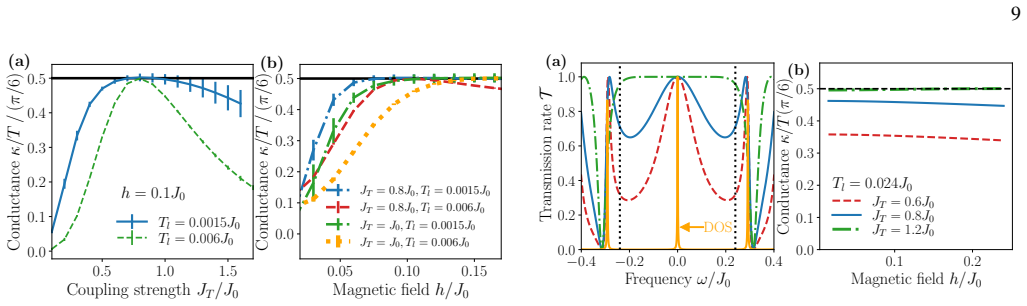
The load-bearing object is the excitation-only conductance extraction $\kappa/T = |(J_l^E-J_r^E)/(T_l^2-T_r^2)|$ [Eq. (12)], which uses the equality of the two reservoirs' ground-state currents to cancel their spurious contribution and leaves only quasiparticle heat transport. The underlying representation is a global Majorana-fermion rewriting of the channel, reservoirs, and tunnel couplings, in which the thermal current is a reservoir-channel spin correlation and the zero-energy Majorana mode enforces $T(\omega)\to 1$ as $\omega\to 0$. A simplified four-state model of the two lowest channel levels explains the transmission plateau: its width is set by the level spacing $\epsilon$, and the optimal coupling corresponds to $\epsilon = 2\sqrt{A_0A_1}$, which is why tuning $J_T$ to $0.8J_0$ or $0.6J_0$ according to the magnetic field produces the flattest plateau and the cleanest half-quantization.
What would settle it
Recompute the thermal conductance of the $8\times 4$ channel at $T_l=0.024J_0$ without restricting to the vortex-free sector, for example by sampling vortex configurations or including the vison sector; if the extracted $\kappa/T$ moves away from $\pi/12$ by more than the fitting uncertainty of Fig. 6, the high-temperature plateau claim fails. Alternatively, a cold-atom or Rydberg realization that measures the reservoir-channel correlator in Eq. (6) could directly confirm or rule out the plateau in the predicted time window.
Extended reading notes
Core claim
The central claim is that a finite chiral spin liquid, modeled as an $8\times 16$ cylindrical Kitaev lattice, can mediate two-terminal heat transport with conductance saturating at $\kappa/T=\pi/12$ once the reservoir-channel coupling is tuned to an optimal strength $J_T^*\approx 0.8J_0$ at low temperature. The half-quantization is traced to the topologically protected zero-energy Majorana mode: particle-hole symmetry forces the transmission rate $T(\omega)$ to unity as $\omega\to 0$, and the low-temperature Fermi window samples only that region. In a finite system, discrete level spacing and coupling-induced broadening compete; the optimal coupling merges the lowest levels into a near-unit transmission plateau, while lowering the temperature or reducing the channel's circumference widens the parameter window over which the plateau value survives. The paper also argues that taking half the difference of the two reservoir currents yields a stable conductance in the quasi-steady window, and that the Landauer-Büttiker formula agrees with direct time evolution when the reservoirs are sufficiently long.
Load-bearing premise
The entire calculation assumes the Kitaev channel stays in its vortex-free sector (all flux variables $\eta_b=1$), which is justified only at very low temperature; the higher-temperature plateau at $T_l=0.024J_0$ could be altered by vortex excitations that the paper explicitly leaves out of scope.
Editorial extensions
If this is right
- A two-terminal heat measurement on a finite engineered Kitaev channel can read out the half-quantized conductance in a quasi-steady time window, without requiring infinite reservoirs or a true long-time steady state.
- Tuning the tunnel coupling $J_T$ to the value that maximizes the near-unit transmission plateau is a practical control knob; the same Landauer-Büttiker calculation that predicts the plateau also predicts the optimal $J_T$ for a given magnetic field.
- Reducing the periodic circumference to four unit cells enlarges the level spacing and shifts the half-quantized plateau up to $T_l=0.024J_0$, more than an order of magnitude above the ultralow-temperature regime needed for larger circumferences.
- As the system grows along the periodic direction, the discrete transmission valleys fill in, so the finite-size plateau continuously connects to the conventional chiral-edge picture of half-quantized thermal Hall transport.
Reading between the lines
- I would expect the half-difference current subtraction to transfer directly to other Majorana transport platforms with symmetric identical leads: it removes contact ground-state heating without needing a Kubo or steady-state assumption.
- The few-state condition $\epsilon = 2\sqrt{A_0A_1}$ suggests a possible finite-size engineering rule: choose the channel circumference so that the first excited level spacing matches the coupling-induced broadening, which would let one tune the plateau width without changing the magnetic field.
- The high-temperature plateau of Fig. 6 is the part most exposed to the vortex-free assumption; including vison excitations at $T_l=0.024J_0$ in the same geometry would show whether the plateau survives or where it breaks.
- One could also test the plateau experimentally by replacing the thermal reservoirs with synthetic heat baths and measuring the reservoir-channel spin correlation $\langle S^y_l S^x_{C_l}\rangle$ directly, since Eq. (6) identifies this correlator as the current.
Signed reviews
Editorial analysis
A structured set of objections, weighed in public.
Referee Report
Summary. The paper proposes a two-terminal thermal transport setup in which a finite chiral spin liquid (Kitaev honeycomb model with a magnetic field, on a cylinder) is coupled at two edge points to transverse-field Ising chain reservoirs. A protocol adiabatically ramps the tunnel couplings, and the thermal current is extracted from spin correlations at the contacts. The central claim is that, after subtracting the ground-state contribution, the quasi-steady thermal conductance approaches the half-quantized value π/12 over a finite time window, for optimal coupling and ultralow temperatures. The authors support this with direct time-evolution simulations restricted to the vortex-free Majorana sector and with a Landauer-Büttiker formula derived from the same projected Hamiltonian; they show agreement between the two methods for sufficiently long reservoirs. They also analyze the dependence of the conductance on coupling strength, magnetic field, temperature, and finite-size effects, and provide a toy model for the transmission plateau.
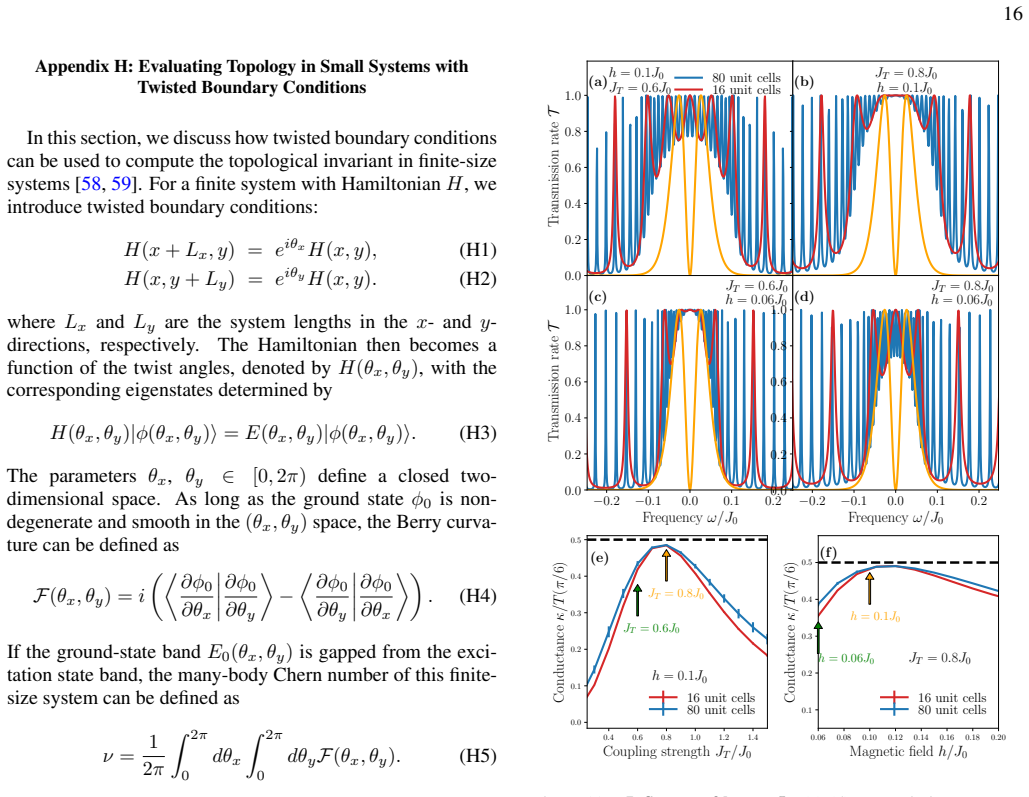
Significance. If the central claim holds, the paper provides a concrete and experimentally plausible route to observing half-quantized thermal conductance in engineered cold-atom or Rydberg-atom simulators, with estimated measurement times on the order of 100–150 μs. The strengths of the manuscript are substantial: the time-evolution calculations are exact within the vortex-free sector; the Landauer-Büttiker derivation in Appendix C explicitly accounts for the number-non-conserving Majorana couplings and yields a parameter-free prediction of the half-quantized value; the finite-size Chern number check in Appendix H supports the topological interpretation; and the analytic toy model in Appendices F and G explains the transmission plateau and its stability. The agreement between direct evolution and the Landauer-Büttiker formula in Fig. 3(d) is a genuine cross-check, albeit within the same projected model. The main risk is the uncontrolled vortex-free truncation under strong reservoir coupling, which affects the physical validity of the central claim.
major comments (3)
- [Sec. II.C and App. A (after Eq. A8; Eq. A9)] The entire calculation restricts the Kitaev channel to the vortex-free sector (all η_b = 1), justified by the temperature being below 0.01 J_0 with a citation to Nasu et al. That argument addresses the initial equilibrium state, not the subsequent dynamics. The tunnel coupling H_T in Eq. (3), written in Majorana form in Eq. (A9) as iJ_T/4 (c-bar_l c_{Cl} + c-bar_r c_{Cr}) with all η_b set to 1, drops the flux-changing matrix elements of the original spin exchange term S^x_l S^x_{Cl}. In the exact Kitaev model, this spin operator can flip the conserved fluxes η_b, and the relevant small parameter is not T/(0.01J_0) but the ratio of the vison-creation matrix element to the vison gap, roughly J_T/Δ_vis. Since the optimal couplings used in Figs. 4–6 are J_T = 0.6–1.2 J_0, and vison gaps in the Kitaev model are typically of order 0.02–0.06 J_0, this ratio is not small. Vison creation at the contacts could substantially modify the heat current even at the ultralow temperatures of Figs. 3 and 5. Because both the time-evolution simulation and the Landauer-Büttiker formula use the same projected Hamiltonian, they cannot detect this error. The paper needs to quantify the flux-changing matrix elements of H_T, or provide an independent check (e.g., exact diagonalization of a small full Kitaev model with reservoirs) establishing that vison creation is negligible in the parameter regime of the central claim.
- [Sec. IV.B, Fig. 6 and Sec. II.C] The higher-temperature plateau in Fig. 6(b) uses T_l = 0.024 J_0, which exceeds the paper's own quoted vortex-free validity threshold (T < 0.01 J_0, Sec. II.C). The manuscript explicitly states that vortex-related effects are beyond the scope of the work. This is a load-bearing limitation: Fig. 6 is presented as a practical route to observe half-quantized conductance under less extreme cooling, but if vison proliferation contributes substantially to heat transport at 0.024 J_0, the plateau in Fig. 6(b) could be materially altered. The authors should either restrict the claim to temperatures below the quoted threshold, or provide an estimate of the vison contribution at the parameters of Fig. 6.
- [Sec. III.A.1, Eq. (12) and Fig. 3(b)] The extraction of the excitation thermal conductance in Eq. (12) as half the difference of the two reservoir currents assumes that the ground-state contributions to J_l^E and J_r^E are exactly equal and therefore cancel. The paper demonstrates this cancellation for one parameter set through the overlapping black curves in Fig. 3(b), but it does not verify the cancellation across the parameter ranges used in Figs. 5 and 6, where the magnetic field and the coupling strength are varied. In a finite chiral system, the two contacts are not necessarily equivalent under reflection if the chiral edge current breaks the relevant symmetry, and unequal ground-state leakage would bias the extracted κ/T. The paper should provide a quantitative check, for example comparing Eq. (12) with the excitation-only result (the orange curve in Fig. 3(b)) for the parameters used in the main figures, or reporting the residual T=0 difference |J_l^0 - J_r^0| over the h–J_T parameter plane.
minor comments (5)
- [Fig. 3 caption and Sec. III.A.2] In Fig. 3(d), the text refers to the Landauer-Büttiker curve as red and the direct-evolution curve for 200 reservoir sites as blue, but the caption only mentions the blue curve as showing strong agreement. Adding a color key directly in the caption would improve readability.
- [Eq. (7) and App. B, Eq. (B8)] The density matrix formula in Eq. (7) contains a factor 2 and a ground-state term (last term) whose physical interpretation is explained only later in the text. A short sentence immediately after Eq. (7) identifying the last term as the zero-temperature contribution would help readers follow the subtraction procedure.
- [App. B, Eq. (B1) and Eq. (A10)] The notation Q(t) = e^{-tA} is confusing, since the Hamiltonian in Eq. (A10) is defined as H = i/4 Σ A_{jj'} c_j c_{j'}; the time-evolution operator in the Majorana adjoint representation is not simply e^{-tA} as written. The authors should clarify the relationship between the matrix A and the orthogonal time-evolution matrix used in the computation.
- [App. F, Eqs. (F2)–(F3)] The toy model introduces phenomenological parameters A_0, A_1, A_2 and later imposes A_2^2 ∼ A_0 A_1 and 4A_0^2 = ε^2 to obtain the flat transmission plateau. The connection of these conditions to the actual microscopic parameters (J_T, h, system size) is not derived; stating explicitly that these are fitting parameters used only for qualitative insight would avoid over-interpretation.
- [App. D, Fig. 7] The caption of Fig. 7 says 'T_l is always set to be 0.006 J_0', which is incompatible with the ratio T_l = 1.2 T_r shown in the legend; if T_l is fixed, then T_r varies between the two cases. The wording should be corrected to specify which temperature is held fixed.
Circularity Check
No significant circularity: the half-quantized conductance is a computed outcome, and the Landauer-Büttiker agreement is a consistency check rather than a fitted or self-referential input.
full rationale
The derivation chain is self-contained. The central observable κ/T in Eq. (12) is extracted from time-evolved reservoir currents as half the difference of the two currents; this is a measurement prescription designed to cancel equal ground-state contributions, not a fit to the half-quantized target. The Landauer-Büttiker expression Eq. (9) is re-derived in App. C from the same projected Majorana Hamiltonian, so the agreement in Fig. 3(d) is a consistency check between the LB approximation and the time evolution, not an independent empirical confirmation; the paper presents it as such. The half-quantized value π/12 is obtained analytically by setting T(ω)=1 in Eq. (9), but the actual T(ω) is computed from the model, and Figs. 4–6 show conductance deviating from half-quantization away from optimal parameters, so the result is not forced by construction. The vortex-free sector restriction (all η_b=1) is an approximation justified by citing Nasu et al. for low-temperature vison suppression; whether HT can create visons dynamically is an accuracy or truncation concern, not a circularity. Self-citations ([10], [57], [59]) provide derivations or standard techniques rather than a load-bearing uniqueness claim. No circular step can be quoted from the manuscript.
Assumptions & free parameters
free parameters (3)
- reservoir field B = JR/2 =
B = JR/2
- optimal coupling J*_T =
0.8 J0 for h = 0.1 J0; 0.6 J0 for h = 0.05 J0; 1.2 J0 for 8x4y at h = 0.1 J0
- A0, A1, A2 amplitudes in the toy model =
Not given numerical values; constrained only by symmetry and scaling with J_T^2
assumptions (4)
- domain assumption The Kitaev channel stays in the vortex-free sector, eta_b = 1 for all bonds.
- domain assumption The reservoirs are large enough that their Green functions remain unchanged, so the Landauer-Büttiker steady-state derivation applies.
- domain assumption The reservoir spectrum is gapless because B = JR/2 (Eq. A7).
- domain assumption In App. F, the number-non-conserving terms in the coupling are the reason for the off-diagonal Gamma entries; without them transmission near zero deviates from unity.
Cite this review
Pith. "Pith review of Controlled Buildup of Half-Quantized Thermal Conductance in an Engineered Chiral Spin Liquid Platform." pith.science (2026). https://pith.science/paper/ZAPDUQZ2
@misc{pith2026250903355,
  author       = {Pith},
  title        = {Pith review of: Controlled Buildup of Half-Quantized Thermal Conductance in an Engineered Chiral Spin Liquid Platform},
  year         = {2026},
  howpublished = {\url{https://pith.science/paper/ZAPDUQZ2}},
  note         = {Machine review of arXiv:2509.03355}
}
read the original abstract
We study thermal transport along the edge of a small chiral-spin-liquid device coupled to two Ising-chain reservoirs, a platform suitable for quantum-engineered systems. Adiabatically switching on the tunnel couplings to the reservoirs generates a thermal current that dynamically builds up and reaches a quasi-steady-state regime. In this time window, the two-terminal thermal conductance can approach half-quantized values -- a hallmark of Majorana-mediated transport -- under finely tuned conditions. The results agree with a steady-state Landauer-B\"uttiker description for sufficiently large reservoirs, where energy-resolved transmission rates help identify the optimal parameters to achieve the half-quantized conductance. This work provides a controllable platform to investigate topological thermal transport in engineered spin systems, such as realized in cold-atom and Rydberg-atom settings.
Figures


Figures from the paper (6 more)


Reference graph
Works this paper leans on
-
[1]
Direct time-evolution simulation As described in Sec. II B, the reservoirs are initially decou- pled from the central channel, and each is prepared in thermal equilibrium at a known temperature. Under this condition, the excitations in both the reservoirs and the channel follow the Fermi distribution. This allows us to construct the initial density matrix...
-
[2]
Landauer-Büttiker formula approach In our system, both the Kitaev model and the transverse- field Ising model can be reformulated in terms of Majorana fermions [see Eqs. (A8) and (A6)]. However, when expressed in their respective eigenstate representations, the tunneling Hamiltonian involves processes that do not conserve the num- ber of quasiparticles. T...
-
[3]
Thermal conductance from direct time evolution simulation As introduced in the previous section, the time evolution of the quasi-thermal conductanceκl/r/T [see Eq. (8)] can be obtained numerically and the result after the ramping, i.e., for t >10ts = 200J0, is shown in Fig. 3(a). The curves in dif- ferent colors correspond to different reservoir lengths, ...
-
[4]
(12), the system can also be analyzed using the Landauer- Büttiker formula; see Refs
Comparison with the Landauer-Büttiker formalism Beyond the direct time-evolution calculations based on Eq. (12), the system can also be analyzed using the Landauer- Büttiker formula; see Refs. [51–53] for previous applications to Majorana-related transport problems. Using Eq. (11), we evaluate the thermal conductance from the Landauer-Büttiker formula and...
-
[5]
Influence of coupling strength To systematically explore different transport regimes, we analyze the transmission spectrumT (ω) by varying the cou- pling strength JT . The interplay between the broadening Γl/r∝J2 T and the discrete energy level structure of the finite- sized channel leads to qualitatively distinct behaviors, depend- ing on whether Γl/r is...
-
[6]
Influence of temperature According to the Landauer-Büttiker formalism [Eq. (9)], the thermal conductance is obtained by integrating T (ω) against the difference in occupation functions. In particu- lar, by setting T (ω) = 1 in Eq. (9), one obtains the result κ/T = π/12 (in natural units with kB = ℏ = 1), which cor- responds to the half-quantized value [24...
-
[7]
Dependence on coupling strength, magnetic field, and temperature Building on the understanding established via the Landauer-Büttiker analysis, we now examine the thermal con- ductance calculated from the direct time-evolution calculation (see Sec. II C 1). As shown in Fig. 5(a) with h = 0.1J0, which is the same field used in Fig. 4(c), the conductance dep...
-
[8]
Enhancing quantized conductance at higher temperatures via finite-size effects While our earlier analysis emphasized the necessity of ul- tralow temperatures for observing half-quantized thermal con- ductance, primarily due to finite-size-induced suppression of transmission away from ω = 0, a notable exception emerges under special conditions. Specificall...
Show all 67 references
-
[9]
Kitaev, Anyons in an exactly solved model and beyond, An- nals of Physics 321, 2 (2006)
A. Kitaev, Anyons in an exactly solved model and beyond, An- nals of Physics 321, 2 (2006)
2006
-
[10]
Semeghini, H
G. Semeghini, H. Levine, A. Keesling, S. Ebadi, T. T. Wang, D. Bluvstein, R. Verresen, H. Pichler, M. Kalinowski, R. Sama- jdar, et al., Probing topological spin liquids on a programmable quantum simulator, Science 374, 1242 (2021)
2021
-
[11]
Satzinger, Y .-J
K. Satzinger, Y .-J. Liu, A. Smith, C. Knapp, M. Newman, C. Jones, Z. Chen, C. Quintana, X. Mi, A. Dunsworth, et al., Realizing topologically ordered states on a quantum processor, Science 374, 1237 (2021)
2021
-
[12]
Xu, Z.-Z
S. Xu, Z.-Z. Sun, K. Wang, L. Xiang, Z. Bao, Z. Zhu, F. Shen, Z. Song, P. Zhang, W. Ren, X. Zhang, H. Dong, J. Deng, J. Chen, Y . Wu, Z. Tan, Y . Gao, F. Jin, X. Zhu, C. Zhang, N. Wang, Y . Zou, J. Zhong, A. Zhang, W. Li, W. Jiang, L.- W. Yu, Y . Yao, Z. Wang, H. Li, Q. Guo, C...
2022 arXiv
-
[13]
S. Zhou, M. Zelenayova, O. Hart, C. Chamon, and C. Castel- novo, Probing fractional statistics in quantum simulators of spin liquid hamiltonians, arXiv preprint arXiv:2211.09784 (2022)
2022 arXiv
-
[14]
Trebst and C
S. Trebst and C. Hickey, Kitaev materials, Physics Reports950, 1 (2022)
2022
-
[15]
Hermanns, I
M. Hermanns, I. Kimchi, and J. Knolle, Physics of the kitaev model: fractionalization, dynamic correlations, and material connections, Annual Review of Condensed Matter Physics 9, 17 (2018)
2018
-
[16]
Knolle and R
J. Knolle and R. Moessner, A field guide to spin liquids, Annual Review of Condensed Matter Physics 10, 451 (2019)
2019
-
[17]
Takagi, T
H. Takagi, T. Takayama, G. Jackeli, G. Khaliullin, and S. E. Nagler, Concept and realization of kitaev quantum spin liquids, Nature Reviews Physics 1, 264 (2019)
2019
-
[18]
B.-Y . Sun, N. Goldman, M. Aidelsburger, and M. Bukov, Engi- neering and probing non-abelian chiral spin liquids using pe- riodically driven ultracold atoms, PRX Quantum 4, 020329 (2023)
2023
-
[19]
A. Y . Kitaev, Fault-tolerant quantum computation by anyons, Annals of Physics 303, 2 (2003)
2003
-
[20]
Stern and N
A. Stern and N. H. Lindner, Topological quantum computation – from basic concepts to first experiments, Science 339, 1179 (2013)
2013
-
[21]
T. I. Andersen, Y . D. Lensky, K. Kechedzhi, I. Drozdov, A. Bengtsson, S. Hong, A. Morvan, X. Mi, A. Oprem- cak, R. Acharya, et al., Observation of non-abelian ex- change statistics on a superconducting processor, arXiv preprint arXiv:2210.10255 (2022)
2022 arXiv
-
[22]
Y . D. Lensky, K. Kechedzhi, I. Aleiner, and E.-A. Kim, Graph gauge theory of mobile non-abelian anyons in a qubit stabilizer code, Annals of Physics 452, 169286 (2023)
2023
-
[23]
Harle, O
N. Harle, O. Shtanko, and R. Movassagh, Observing and braid- ing topological majorana modes on programmable quantum simulators, Nat. Commun. 14, 2286 (2023)
2023
-
[24]
Knolle, D
J. Knolle, D. L. Kovrizhin, J. T. Chalker, and R. Moessner, Dy- namics of a two-dimensional quantum spin liquid: Signatures of emergent majorana fermions and fluxes, Phys. Rev. Lett.112, 207203 (2014)
2014
-
[25]
Knolle, D
J. Knolle, D. L. Kovrizhin, J. T. Chalker, and R. Moessner, Dy- namics of fractionalization in quantum spin liquids, Phys. Rev. B 92, 115127 (2015)
2015
-
[26]
Schmitt and S
M. Schmitt and S. Kehrein, Dynamical quantum phase transi- tions in the kitaev honeycomb model, Phys. Rev. B 92, 075114 (2015)
2015
-
[27]
Banerjee, J
A. Banerjee, J. Yan, J. Knolle, C. A. Bridges, M. B. Stone, M. D. Lumsden, D. G. Mandrus, D. A. Tennant, R. Moessner, and S. E. Nagler, Neutron scattering in the proximate quantum spin liquidα-RuCl3, Science 356, 1055 (2017)
2017
-
[28]
Smith, J
A. Smith, J. Knolle, D. L. Kovrizhin, J. T. Chalker, and R. Moessner, Majorana spectroscopy of three-dimensional ki- taev spin liquids, Phys. Rev. B 93, 235146 (2016)
2016
-
[29]
J.-Y . Chen, L. Vanderstraeten, S. Capponi, and D. Poilblanc, Non-abelian chiral spin liquid in a quantum antiferromagnet re- vealed by an ipeps study, Phys. Rev. B98, 184409 (2018)
2018
-
[30]
Feldmeier, W
J. Feldmeier, W. Natori, M. Knap, and J. Knolle, Local probes for charge-neutral edge states in two-dimensional quantum magnets, Phys. Rev. B 102, 134423 (2020)
2020
-
[31]
Mizoguchi, T
T. Mizoguchi, T. Koma, and Y . Yoshida, Oriented propagation of magnetization due to chiral edge modes in kitaev-type mod- els, Phys. Rev. B 101, 014442 (2020)
2020
-
[32]
J. Nasu, J. Yoshitake, and Y . Motome, Thermal transport in the kitaev model, Phys. Rev. Lett. 119, 127204 (2017)
2017
-
[33]
A. P. Joy and A. Rosch, Dynamics of visons and thermal hall effect in perturbed kitaev models, Phys. Rev. X 12, 041004 (2022)
2022
-
[34]
Kasahara, T
Y . Kasahara, T. Ohnishi, Y . Mizukami, O. Tanaka, S. Ma, K. Sugii, N. Kurita, H. Tanaka, J. Nasu, Y . Motome,et al., Ma- jorana quantization and half-integer thermal quantum hall effect in a kitaev spin liquid, Nature 559, 227 (2018)
2018
-
[35]
Bruin, R
J. Bruin, R. Claus, Y . Matsumoto, N. Kurita, H. Tanaka, and H. Takagi, Robustness of the thermal hall effect close to half- quantization inα-RuCl3, Nature Physics 18, 401 (2022)
2022
-
[36]
Yamashita, J
M. Yamashita, J. Gouchi, Y . Uwatoko, N. Kurita, and H. Tanaka, Sample dependence of half-integer quantized ther- mal hall effect in the kitaev spin-liquid candidate α-RuCl3, Phys. Rev. B 102, 220404 (2020)
2020
-
[37]
Goldman, J
N. Goldman, J. C. Budich, and P. Zoller, Topological quantum matter with ultracold gases in optical lattices, Nature Physics 12, 639 (2016)
2016
-
[38]
Cooper, J
N. Cooper, J. Dalibard, and I. Spielman, Topological bands for ultracold atoms, Reviews of modern physics91, 015005 (2019)
2019
-
[39]
Léonard, S
J. Léonard, S. Kim, J. Kwan, P. Segura, F. Grusdt, C. Repellin, N. Goldman, and M. Greiner, Realization of a fractional quan- tum hall state with ultracold atoms, Nature 619, 495 (2023)
2023
-
[40]
de Léséleuc, V
S. de Léséleuc, V . Lienhard, P. Scholl, D. Barredo, S. Weber, N. Lang, H. P. Büchler, T. Lahaye, and A. Browaeys, Observa- tion of a symmetry-protected topological phase of interacting bosons with rydberg atoms, Science 365, 775 (2019)
2019
-
[41]
Verresen, M
R. Verresen, M. D. Lukin, and A. Vishwanath, Prediction of toric code topological order from rydberg blockade, Phys. Rev. X 11, 031005 (2021)
2021
-
[42]
Chen, B.-Z
Y .-H. Chen, B.-Z. Wang, T.-F. J. Poon, X.-C. Zhou, Z.-X. Liu, and X.-J. Liu, Proposal for realization and detection of kitaev quantum spin liquid with rydberg atoms, Phys. Rev. Res. 6, 18 L042054 (2024)
2024
-
[43]
Kalinowski, N
M. Kalinowski, N. Maskara, and M. D. Lukin, Non-abelian flo- quet spin liquids in a digital rydberg simulator, Phys. Rev. X13, 031008 (2023)
2023
-
[44]
S. J. Evered, M. Kalinowski, A. A. Geim, T. Manovitz, D. Blu- vstein, S. H. Li, N. Maskara, H. Zhou, S. Ebadi, M. Xu, J. Campo, M. Cain, S. Ostermann, S. F. Yelin, S. Sachdev, M. Greiner, V . Vuleti´c, and M. D. Lukin, Probing topological matter and fermion dynamics on a neutr...
2025
-
[45]
M. Will, T. A. Cochran, E. Rosenberg, B. Jobst, N. M. Eassa, P. Roushan, M. Knap, A. Gammon-Smith, and F. Pollmann, Probing non-equilibrium topological order on a quantum pro- cessor (2025), arXiv:2501.18461 [quant-ph]
2025
-
[46]
J. Wu, L. Zhu, and Q. Si, Crossovers and critical scaling in the one-dimensional transverse-field ising model, Phys. Rev. B 97, 245127 (2018)
2018
-
[47]
Borish, O
V . Borish, O. Markovi ´c, J. A. Hines, S. V . Rajagopal, and M. Schleier-Smith, Transverse-field ising dynamics in a rydberg-dressed atomic gas, Phys. Rev. Lett. 124, 063601 (2020)
2020
-
[48]
Pfeuty, The one-dimensional ising model with a transverse field, Annals of Physics 57, 79 (1970)
P. Pfeuty, The one-dimensional ising model with a transverse field, Annals of Physics 57, 79 (1970)
1970
-
[49]
Haug and A.-P
H. Haug and A.-P. Jauho, Quantum Kinetics in Transport and Optics of Semiconductors (Springer Berlin, Heidelberg, 2008)
2008
-
[50]
Datta, Electronic Transport in Mesoscopic Systems, Cam- bridge Studies in Semiconductor Physics and Microelectronic Engineering (Cambridge University Press, 1995)
S. Datta, Electronic Transport in Mesoscopic Systems, Cam- bridge Studies in Semiconductor Physics and Microelectronic Engineering (Cambridge University Press, 1995)
1995
-
[51]
Kundu and B
A. Kundu and B. Seradjeh, Transport signatures of floquet ma- jorana fermions in driven topological superconductors, Phys. Rev. Lett. 111, 136402 (2013)
2013
-
[52]
Farrell and T
A. Farrell and T. Pereg-Barnea, Photon-inhibited topological transport in quantum well heterostructures, Phys. Rev. Lett. 115, 106403 (2015)
2015
-
[53]
H. H. Yap, L. Zhou, J.-S. Wang, and J. Gong, Computational study of the two-terminal transport of floquet quantum hall in- sulators, Phys. Rev. B 96, 165443 (2017)
2017
-
[54]
Salerno, H
G. Salerno, H. M. Price, M. Lebrat, S. Häusler, T. Esslinger, L. Corman, J.-P. Brantut, and N. Goldman, Quantized hall con- ductance of a single atomic wire: A proposal based on synthetic dimensions, Phys. Rev. X 9, 041001 (2019)
2019
-
[55]
Feng, G.-M
X.-Y . Feng, G.-M. Zhang, and T. Xiang, Topological character- ization of quantum phase transitions in a spin-1/2 model, Phys. Rev. Lett. 98, 087204 (2007)
2007
-
[56]
Chen and J
H.-D. Chen and J. Hu, Exact mapping between classical and topological orders in two-dimensional spin systems, Phys. Rev. B 76, 193101 (2007)
2007
-
[57]
Chen and Z
H.-D. Chen and Z. Nussinov, Exact results of the kitaev model on a hexagonal lattice: spin states, string and brane correlators, and anyonic excitations, Journal of Physics A: Mathematical and Theoretical 41, 075001 (2008)
2008
-
[58]
Sumiyoshi and S
H. Sumiyoshi and S. Fujimoto, Quantum thermal hall effect in a time-reversal-symmetry-broken topological superconductor in two dimensions: Approach from bulk calculations, Journal of the Physical Society of Japan 82, 023602 (2013)
2013
-
[59]
Wan and Q.-F
Y .-H. Wan and Q.-F. Sun, Quarter-quantized thermal hall effect with parity anomaly, Phys. Rev. B109, 195408 (2024)
2024
-
[60]
Q. Yan, H. Li, J. Zeng, Q.-F. Sun, and X. C. Xie, A majorana perspective on understanding and identifying axion insulators, Commun. Phys. 4, 239 (2021)
2021
-
[61]
Huang, F
Y . Huang, F. Setiawan, and J. D. Sau, Disorder-induced half- integer quantized conductance plateau in quantum anoma- lous hall insulator-superconductor structures, Phys. Rev. B 97, 100501 (2018)
2018
-
[62]
Arrachea, G
L. Arrachea, G. S. Lozano, and A. A. Aligia, Thermal trans- port in one-dimensional spin heterostructures, Phys. Rev. B 80, 014425 (2009)
2009
-
[63]
Ł ˛ acki, H
M. Ł ˛ acki, H. Pichler, A. Sterdyniak, A. Lyras, V . E. Lem- bessis, O. Al-Dossary, J. C. Budich, and P. Zoller, Quantum hall physics with cold atoms in cylindrical optical lattices, Phys. Rev. A 93, 013604 (2016)
2016
-
[64]
The fluctuations of the orange signal lack perfect symmetry, which is expected, as it takes time for variations in one reservoir to propagate to the other
-
[65]
Peralta Gavensky, G
L. Peralta Gavensky, G. Usaj, and C. A. Balseiro, Nonequilib- rium edge transport in quantum hall based josephson junctions, Phys. Rev. B 103, 024527 (2021)
2021
-
[66]
Q. Niu, D. J. Thouless, and Y .-S. Wu, Quantized hall conduc- tance as a topological invariant, Phys. Rev. B31, 3372 (1985)
1985
-
[67]
Goldman and T
N. Goldman and T. Ozawa, Relating the hall conductivity to the many-body chern number using fermi’s golden rule and kramers-kronig relations, Comptes Rendus. Physique 25, 289 (2024)
2024
Reviewed August 15, 2026 · model on record in the stance chip above.
Discussion (0). Continue with ORCID to comment.