REVIEW 4 major objections 6 minor 42 references
Markov Missing Graph: A Graphical Approach for Missing Data Imputation
T0 review · 4 major / 6 minor · reviewed 2026-08-15 · deepseek-v4-flash
Pith's one-line read An undirected graph and a local information principle identify the full data distribution without assuming missing at random.
desk verdict MMG is a genuinely new undirected-graph framework for MNAR imputation, but the identification rests entirely on PAI, an untestable assumption the paper itself admits. read the letter →
The pith
A machine-rendered reading of the paper's core claim, the machinery that carries it, and where it could break.
The reading
What carries the argument
The load-bearing object is the Markov missing graph (MMG), an undirected graph $G=(V,E)$ whose neighborhoods specify which variables may be used to impute a missing variable. The argument runs on two equations: equation (1) decomposes the imputation model $p(x_{\bar r}|x_r,R=r)$ into a product over connected components $s_k$ of the missing set, and equation (2), the principle of available information, identifies each factor with the same conditional distribution computed from rows where the component and its neighbors are all observed. Around these, the paper builds an imputation risk minimization (IRM) framework: for each connected pattern $s$, the parameter $\theta_s$ minimizes an empirical loss restricted to observations with $R_{\bar N_G(s)}=1$, so Gaussian, Ising, and mixture-of-product likelihoods become plug-in choices. For estimating a mean functional, the efficient influence function combines an inverse probability weight $O_s$ with a regression adjustment $m_s$, giving a multiply robust estimator.
What would settle it
Take a fully observed dataset, mask values with a mechanism in which the probability of each response pattern still depends on the missing block's values after conditioning on the observed neighborhood, and compare the nonparametric MMG imputed distribution of the masked block with its true distribution; a systematic discrepancy at growing sample size would show that equation (2) is doing the identification work and cannot be inferred from the observed data. Alternatively, with a validation subset, estimate $p(x_s|x_{N_G(s)},R=r)$ and $p(x_s|x_{N_G(s)},R_{\bar N_G(s)}=1)$ separately and test their equality for patterns sharing the same neighborhood.
Extended reading notes
Core claim
The paper's central discovery is a nonparametric identification theorem. Starting from the pattern-mixture decomposition $p(x,r)=p(x_{\bar r}|x_r,R=r)p(x_r,R=r)$, it defines a Markov missing graph (MMG): an undirected graph $G$ whose connected components of the missing set $s_1,\ldots,s_K$ factor the extrapolation density as $p(x_{\bar r}|x_r,R=r)=\prod_{k=1}^K p(x_{s_k}|x_{N_G(s_k)},R=r)$. The principle of available information (PAI) identifies each factor with $p(x_{s_k}|x_{N_G(s_k)},R_{\bar N_G(s_k)}=1)$, the same conditional law computed from rows whose component and neighbors are all observed. Theorem 1 states that under equations (1) and (2) the full-data distribution $p(x,r)$ is nonparametrically identified: every extrapolation density is a product of identifiable conditional distributions. The paper further shows that a fully connected graph reduces PAI exactly to the complete-case missing value assumption, that under monotone missingness a chain-faithful complete-case law makes the two equivalent, and that under MCAR with a faithful graph NP-MMG recovers the true model while the Gaussian variant is asymptotically more efficient than complete-case analysis.
Load-bearing premise
The load-bearing premise is the principle of available information: for each missing block, the conditional distribution given its observed graph neighborhood is assumed to be the same whether the row belongs to the target missingness pattern or to any pattern where that neighborhood is fully observed; this is an untestable missing-not-at-random assumption, and if it fails, the identification proof collapses.
Editorial extensions
If this is right
- Imputation under missing-not-at-random becomes a local modeling problem: each missing block is drawn from a conditional distribution learned from rows whose graph neighborhood is fully observed, so no parametric model for the full data or the missingness mechanism is required.
- When the graph is fully connected, PAI coincides exactly with the classical complete-case missing value assumption, so MMG nests a standard complete-case restriction as a boundary case.
- Under monotone missingness with a chain-faithful complete-case law, PAI and the complete-case missing value assumption give the same imputation model.
- Under MCAR with a faithful graph, using the same graph in MMG recovers the true imputation model, and the Gaussian variant is asymptotically more efficient than complete-case analysis.
- The IRM framework produces regression-adjustment, inverse-probability-weighted, and multiply robust estimators for means, and the NACC application replaces 351 raw missingness patterns with 84 representative model patterns while yielding narrower confidence intervals than complete-case analysis.
Reading between the lines
- A testable consequence the paper leaves implicit: if PAI holds, then any two missingness patterns that agree on a missing component and its observed neighborhood must share the same conditional law for that missing block; this equality can be checked directly in a validation study with fully observed holdout rows.
- Because PAI trains each local submodel only on rows where the relevant neighborhood is complete, the effective sample size is the size of that local stratum; users with highly fragmented missingness patterns may need to verify that these strata are large enough before relying on nonparametric versions.
- The graph itself is an assumption carrier: estimating the graph from complete cases is justified primarily under MCAR and faithfulness, so outside that setting a misspecified graph can bias imputations; the paper's sensitivity analysis suggests stability until the graph becomes very sparse, which could be tested routinely in applications.
- The paper's locality propositions imply that edits to a graph far from a missing component do not change that component's imputation model, so large or noisy graphs can be simplified locally; this is a direct corollary, though the paper stops short of proposing an automatic local simplification procedure.
Signed reviews
Editorial analysis
A structured set of objections, weighed in public.
Referee Report
Summary. The paper introduces the Markov missing graph (MMG), an undirected-graph framework for imputation. The full-data law is decomposed pattern-mixture style, and the extrapolation density is factorized over connected components of the missingness pattern (eq. 1). The Principle of Available Information (PAI, eq. 2) identifies each factor with the corresponding conditional density among rows in which the relevant neighborhood is fully observed, yielding Theorem 1. The paper then frames estimation as empirical risk minimization (Section 3), with Gaussian, Ising, and mixture-of-product instantiations. Theoretical results connect MMG to CCMV (Theorems 3-4), prove recovery under MCAR and an efficiency gain for G-MMG (Theorem 5), and give an augmented IPW-type estimator with a claimed efficient influence function (Theorems 6-7) and graphical properties (Propositions 8-10). Simulations and a NACC application compare MMG with CC, MICE, and missForest, with a sensitivity analysis over the graphical lasso threshold.
Significance. The identification result, though assumption-relative, is clean and correct under the stated PAI condition, and it provides a new and simple way to build MNAR imputation models with local structure. The MCAR recovery theorem and the efficiency comparison to complete-case analysis are valuable, as is the demonstrated practicality on a large Alzheimer's data set with an R package. If the efficiency claims are appropriately revised or completed, the framework could be a useful addition to the missing-data toolbox. The main weakness is that the efficiency theory is not yet fully established.
major comments (4)
- [§2.1, Theorem 1 and equation (2)] The theorem needs an explicit positivity condition. For every connected pattern s that can occur, PAI conditions on the event R_{\bar N_G(s)}=1; if this event has zero probability, the right-hand side of (2) is undefined and the imputation submodel is not identifiable. The statement that MMG and PAI nonparametrically identify the full-data distribution is therefore too strong without adding the support assumption.
- [§4.3.3, Theorem 6] The pathwise-derivative calculation is performed in the unrestricted model for p0(x1,xNG(sj),r), without characterizing the tangent space of the MMG-PAI model. Since equations (1)-(2) impose equality constraints across response patterns, the model's tangent space is smaller than the one used in the derivation; consequently, the paper has not shown that the displayed expression is the efficient influence function in the MMG model. The estimator may still be a reasonable augmented IPW estimator, but the efficiency claim in the abstract and Section 4.3 is not supported.
- [§4.3.3, Theorem 7] The multiple-robustness proof only treats the case where the odds model is correct and the regression model is misspecified; the symmetric case is asserted without proof. More importantly, the proof uses the expansion from Theorem 6, which per the previous comment is not established in the MMG model, so the consistency argument for the oracle estimator does not go through as written.
- [§4.3.1-4.3.2, equations (11)-(13)] The identification formulas rely on the MMG factorization (1) applied to the extrapolation density for the given pattern r. Under MNAR, conditioning on R=r can create dependencies among missing components even if the complete-data law is faithful to G, so equation (1) is a substantive assumption about the missingness mechanism, not a consequence of choosing G. The paper should state this caveat explicitly in the statements of the identification results, not only in the informal discussion of Section 2.2.
minor comments (6)
- [§1.1] The text 'X001 = (X1, X2)^T' appears to be a typo; it should likely read 'X110 = (X1, X2)^T'.
- [§2.1] The shorthand 'R≥ pattern' (for example, R≥11110) is used without a formal definition; define it once near the notation section.
- [§4.2, Theorem 5] The statement that G-MMG is asymptotically more efficient than complete-case analysis presumes the graph G used by MMG is the true graph; if G is estimated from data, the result requires an additional consistency assumption on graph estimation, which should be stated explicitly.
- [§6.1] The phrase 'codes 96' or 996'' appears to be a typo; clarify whether the intended test codes are 96 and 996.
- [§4.3.3, assumption (A2)] The assumption that X1, Osj, and msj are uniformly bounded is restrictive for continuous X1; consider replacing it with a bounded-influence-function condition or suitable moment assumptions, since the NACC application includes continuous test scores.
- [§5.1] The simulation uses the true graph for G-MMG, which gives the method an advantage over competitors; the practical setting where the graph is estimated is only addressed in the real-data sensitivity analysis, so this limitation should be acknowledged in the simulation section.
Circularity Check
No circularity: Theorem 1 is an identification result conditional on explicitly stated assumptions (MMG and PAI), and its proof is algebraic rather than a restatement of its inputs.
full rationale
The central identification claim (Theorem 1, Section 2.1) is not circular. The paper explicitly introduces equations (1) and (2) as assumptions: equation (1) defines the MMG factorization of the extrapolation density, and equation (2) states PAI as an identifying restriction, p(x_s | x_NG(s), R=r) = p(x_s | x_NG(s), R_{\bar NG(s)}=1). The proof then only combines these two assumptions with the pattern-mixture decomposition p(x,r)=p(x_{\bar r}|x_r,R=r)p(x_r,R=r) and observes that each factor in the resulting product is identifiable from rows with R_{\bar NG(s)}=1. This is a logical consequence of the assumptions, not an equality between output and input. PAI is not derived from the graphical model or from observed data; the paper states it as a principle ('PAI states that, without further information, one should use all available information'), so its untestability is a substantive MNAR modeling assumption rather than a circular step. The recovery result (Theorem 5) uses external conditions (MCAR and faithfulness), and the graph is either assumed correct or estimated from complete cases; the paper explicitly cautions that an estimated graph should only be regarded as a 'reasonable working graph' and that 'it is impossible to know the true model for missing data without additional information.' Self-citations (Chen 2022; Suen and Chen 2023) are used for related work or as the Mixture-of-Product model in the application, not as the justification for the identification theorem. No fitted parameter is renamed as a prediction, and no uniqueness theorem from the authors' prior work is invoked to force a choice. Therefore the paper is self-contained in its derivations; any caveats, such as the implicit positivity requirement for the conditioning events in equation (2), are technical or assumption-relative concerns, not circularity.
Assumptions & free parameters
free parameters (2)
- Graph G (edge structure and graphical lasso threshold) =
Figure 4 graph for NACC; simulation graphs in Figure 2; thresholds 0.05-0.3 in sensitivity analysis
- Number of mixture components K =
not stated for simulations or NACC application
assumptions (5)
- domain assumption MMG decomposition (equation 1): p(x_bar_r|x_r,R=r) = product_k p(x_s_k|x_N(s_k),R=r)
- domain assumption PAI equality (equation 2): p(x_s|x_N(s),R=r) = p(x_s|x_N(s),R_{N_bar(s)}=1)
- domain assumption Faithfulness of X to G for recovery under MCAR (Theorem 5)
- domain assumption Monotone missingness and chain graph for Theorem 4
- domain assumption Assumptions A1-A4 for Theorem 7
Cite this review
Pith. "Pith review of Markov Missing Graph: A Graphical Approach for Missing Data Imputation." pith.science (2026). https://pith.science/paper/7Y2OQKCU
@misc{pith2026250903410,
  author       = {Pith},
  title        = {Pith review of: Markov Missing Graph: A Graphical Approach for Missing Data Imputation},
  year         = {2026},
  howpublished = {\url{https://pith.science/paper/7Y2OQKCU}},
  note         = {Machine review of arXiv:2509.03410}
}
read the original abstract
We introduce the Markov missing graph (MMG), a novel framework that imputes missing data based on undirected graphs. MMG leverages conditional independence relationships to locally decompose the imputation model. To establish the identification, we introduce the Principle of Available Information (PAI), which guides the use of all relevant observed data. We then propose a flexible statistical learning paradigm, MMG Imputation Risk Minimization under PAI, that frames the imputation task as an empirical risk minimization problem. This framework is adaptable to various modeling choices. We develop theories of MMG, including the connection between MMG and Little's complete-case missing value assumption, recovery under missing completely at random, efficiency theory, and graph-related properties. We show the validity of our method with simulation studies and illustrate its application with a real-world Alzheimer's data set.
Figures

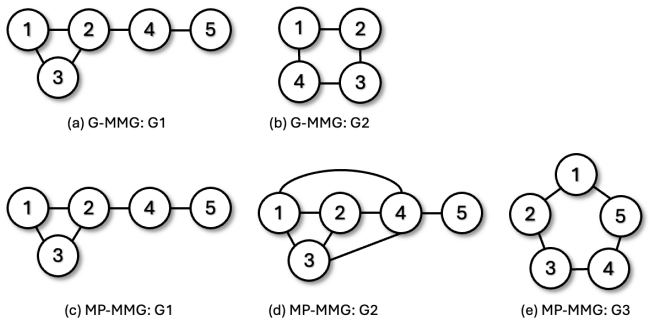

Figures from the paper (4 more)


Reference graph
Works this paper leans on
-
[1]
Angelopoulos, Stephen Bates, Clara Fannjiang, Michael I
Anastasios N. Angelopoulos, Stephen Bates, Clara Fannjiang, Michael I. Jordan, and Tijana Zrnic. Prediction-powered inference. Science, 382 0 (6671): 0 669--674, 2023
work page 2023
-
[2]
Melanie L Bell, Mallorie Fiero, Nicholas J. Horton, and Chiu-Hsieh Hsu. Handling missing data in RCT s; a review of the top medical journals. BMC Medical Research Methodology, 14 0 (1): 0 118, 2014
work page 2014
-
[3]
Rohit Bhattacharya, Razieh Nabi, Ilya Shpitser, and James M. Robins. Identification in missing data models represented by directed acyclic graphs. In Uncertainty in Artificial Intelligence, pages 1149--1158. PMLR, 2020
work page 2020
-
[4]
Lane F. Burgette and Jerome P. Reiter. Multiple imputation for missing data via sequential regression trees. American Journal of Epidemiology, 172 0 (9): 0 1070--1076, 2010
work page 2010
-
[5]
Pattern graphs: a graphical approach to nonmonotone missing data
Yen-Chi Chen. Pattern graphs: a graphical approach to nonmonotone missing data. The Annals of Statistics, 50 0 (1): 0 129--146, 2022
work page 2022
-
[6]
Nonparametric pattern-mixture models for inference with missing data, 2019
Yen-Chi Chen and Mauricio Sadinle. Nonparametric pattern-mixture models for inference with missing data, 2019. URL https://arxiv.org/abs/1904.11085
arXiv 2019
-
[7]
A survey on missing data in machine learning
Tlamelo Emmanuel, Thabiso Maupong, Dimane Mpoeleng, Thabo Semong, Banyatsang Mphago, and Oteng Tabona. A survey on missing data in machine learning. Journal of Big data, 8 0 (1): 0 140, 2021
work page 2021
-
[8]
Extended bayesian information criteria for gaussian graphical models
Rina Foygel and Mathias Drton. Extended bayesian information criteria for gaussian graphical models. Advances in Neural Information Processing Systems, 23, 2010
work page 2010
Show all 42 references
-
[9]
Sparse inverse covariance estimation with the graphical lasso
Jerome Friedman, Trevor Hastie, and Robert Tibshirani. Sparse inverse covariance estimation with the graphical lasso. Biostatistics, 9 0 (3): 0 432--441, 2008
2008
-
[10]
MIDA : Multiple imputation using denoising autoencoders
Lovedeep Gondara and Ke Wang. MIDA : Multiple imputation using denoising autoencoders. In Pacific-Asia Conference on Knowledge Discovery and Data Mining, pages 260--272. Springer, 2018
2018
-
[11]
Johnson, David K
Matthew J. Johnson, David K. Duvenaud, Alex Wiltschko, Ryan P. Adams, and Sandeep R. Datta. Composing graphical models with neural networks for structured representations and fast inference. Advances in Neural Information Processing Systems, 29, 2016
2016
-
[12]
Tchetgen Tchetgen
Yilin Li, Wang Miao, Ilya Shpitser, and Eric J. Tchetgen Tchetgen. A self-censoring model for multivariate nonignorable nonmonotone missing data. Biometrics, 79 0 (4): 0 3203--3214, 2023
2023
-
[13]
Roderick J.A. Little. Pattern-mixture models for multivariate incomplete data. Journal of the American Statistical Association, 88 0 (421): 0 125--134, 1993
1993
-
[14]
Tchetgen Tchetgen
Daniel Malinsky, Ilya Shpitser, and Eric J. Tchetgen Tchetgen. Semiparametric inference for nonmonotone missing-not-at-random data: the no self-censoring model. Journal of the American Statistical Association, 117 0 (539): 0 1415--1423, 2022
2022
-
[15]
MIWAE : Deep generative modelling and imputation of incomplete data sets
Pierre-Alexandre Mattei and Jes Frellsen. MIWAE : Deep generative modelling and imputation of incomplete data sets. In International Conference on Machine Learning, volume 97, pages 4413--4423. PMLR, 2019
2019
-
[16]
High-dimensional graphs and variable selection with the lasso
Nicolai Meinshausen and Peter B \"u hlmann. High-dimensional graphs and variable selection with the lasso. The Annals of Statistics, 34 0 (3): 0 1436--1462, 2006
2006
-
[17]
On the testability of models with missing data
Karthika Mohan and Judea Pearl. On the testability of models with missing data. In Artificial Intelligence and Statistics, pages 643--650. PMLR, 2014
2014
-
[18]
Graphical models for processing missing data
Karthika Mohan and Judea Pearl. Graphical models for processing missing data. Journal of the American Statistical Association, 116 0 (534): 0 1023--1037, 2021
2021
-
[19]
Graphical models for inference with missing data
Karthika Mohan, Judea Pearl, and Jin Tian. Graphical models for inference with missing data. Advances in Neural Information Processing Systems, 26, 2013
2013
-
[20]
Kenward, and Peter J
Geert Molenberghs, Bart Michiels, Michael G. Kenward, and Peter J. Diggle. Monotone missing data and pattern-mixture models. Statistica Neerlandica, 52 0 (2): 0 153--161, 1998
1998
-
[21]
Handbook of Missing Data Methodology
Geert Molenberghs, Garrett Fitzmaurice, Michael G Kenward, Anastasios Tsiatis, and Geert Verbeke. Handbook of Missing Data Methodology. CRC Press, 2014
2014
-
[22]
Murray and Jerome P
Jared S. Murray and Jerome P. Reiter. Multiple imputation of missing categorical and continuous values via bayesian mixture models with local dependence. Journal of the American Statistical Association, 111 0 (516): 0 1466--1479, 2016
2016
-
[23]
Full law identification in graphical models of missing data: Completeness results
Razieh Nabi, Rohit Bhattacharya, and Ilya Shpitser. Full law identification in graphical models of missing data: Completeness results. In International Conference on Machine Learning, pages 7153--7163. PMLR, 2020
2020
-
[24]
Recursive equations for imputation of missing not at random data with sparse pattern support, 2025
Trung Phung, Kyle Reese, Ilya Shpitser, and Rohit Bhattacharya. Recursive equations for imputation of missing not at random data with sparse pattern support, 2025. URL https://arxiv.org/abs/2507.16107
2025 arXiv
-
[25]
Raghunathan, James M
Trivellore E. Raghunathan, James M. Lepkowski, John Van Hoewyk, Peter Solenberger, et al. A multivariate technique for multiply imputing missing values using a sequence of regression models. Survey Methodology, 27: 0 85--96, 2001
2001
-
[26]
James M. Robins. Non-response models for the analysis of non-monotone non-ignorable missing data. Statistics in Medicine, 16 0 (1): 0 21--37, 1997
1997
-
[27]
Mauricio Sadinle and Jerome P. Reiter. Itemwise conditionally independent nonresponse modelling for incomplete multivariate data. Biometrika, 104 0 (1): 0 207--220, 2017
2017
-
[28]
Consistent estimation of functions of data missing non-monotonically and not at random
Ilya Shpitser. Consistent estimation of functions of data missing non-monotonically and not at random. Advances in Neural Information Processing Systems, 29, 2016
2016
-
[29]
Missing data as a causal and probabilistic problem
Ilya Shpitser, Karthika Mohan, and Judea Pearl. Missing data as a causal and probabilistic problem. In Uncertainty in Artificial Intelligence, pages 802--811, 2015
2015
-
[30]
Neural graphical models, 2023
Harsh Shrivastava and Urszula Chajewska. Neural graphical models, 2023. URL https://arxiv.org/abs/2210.00453
2023 arXiv
-
[31]
Stekhoven and Peter B \"u hlmann
Daniel J. Stekhoven and Peter B \"u hlmann. Miss F orest—non-parametric missing value imputation for mixed-type data. Bioinformatics, 28 0 (1): 0 112--118, 2012
2012
-
[32]
Modeling missing at random neuropsychological test scores using a mixture of binomial product experts
Daniel Suen and Yen-Chi Chen. Modeling missing at random neuropsychological test scores using a mixture of binomial product experts. 2023. URL https://arxiv.org/abs/2310.09384
2023
-
[33]
Tchetgen Tchetgen, Linbo Wang, and BaoLuo Sun
Eric J. Tchetgen Tchetgen, Linbo Wang, and BaoLuo Sun. Discrete choice models for nonmonotone nonignorable missing data: Identification and inference. Statistica Sinica, 28 0 (4): 0 2069, 2018
2018
-
[34]
Missing at random in graphical models
Jin Tian. Missing at random in graphical models. In Artificial Intelligence and Statistics, pages 977--985. PMLR, 2015
2015
-
[35]
Flexible Imputation of Missing Data
Stef Van Buuren . Flexible Imputation of Missing Data. CRC Press, 2018
2018
-
[36]
mice: Multivariate imputation by chained equations in R
Stef van Buuren and Karin Groothuis-Oudshoorn. mice: Multivariate imputation by chained equations in R . Journal of Statistical Software, 45 0 (3): 0 1–67, 2011
2011
-
[37]
Asymptotic statistics, volume 3
Aad W Van der Vaart. Asymptotic statistics, volume 3. Cambridge university press, 2000
2000
-
[38]
Kenward, and Geert Molenberghs
Stijn Vansteelandt, Els Goetghebeur, Michael G. Kenward, and Geert Molenberghs. Ignorance and uncertainty regions as inferential tools in a sensitivity analysis. Statistica Sinica, pages 953--979, 2006
2006
-
[39]
Dodge, Merilee Teylan, Steven Ferris, Felicia C
Sandra Weintraub, Lilah Besser, Hiroko H. Dodge, Merilee Teylan, Steven Ferris, Felicia C. Goldstein, Bruno Giordani, Joel Kramer, David Loewenstein, Dan Marson, et al. Version 3 of the alzheimer disease centers’ neuropsychological test battery in the uniform data set ( UDS )....
2018
-
[40]
Gain: Missing data imputation using generative adversarial nets
Jinsung Yoon, James Jordon, and Mihaela Schaar. Gain: Missing data imputation using generative adversarial nets. In International Conference on Machine Learning, pages 5689--5698. PMLR, 2018
2018
-
[41]
Handling missing data with graph representation learning
Jian You, Sheng Hu, Yu Wang, Jiliang Li, Jun Liang, and Zhen Ding. Handling missing data with graph representation learning. In Proceedings of the 2020 International Conference on Learning Representations, 2020
2020
-
[42]
Little, and John D
Yan Zhou, Roderick J.A. Little, and John D. Kalbfleisch. Block-conditional missing at random models for missing data. Statistical Science, 25 0 (4): 0 517--532, 2010
2010
Reviewed August 15, 2026 · model on record in the stance chip above.
Discussion (0). Continue with ORCID to comment.