Quantum Critical Collapse Abhors a Naked Singularity
Pith reviewed 2026-05-21 22:16 UTC · model grok-4.3
The pith
Quantum vacuum polarization creates a horizon and mass gap in critical gravitational collapse.
A machine-rendered reading of the paper's core claim, the machinery that carries it, and where it could break.
Core claim
In analytically tractable Einstein-scalar critical spacetimes, regularity uniquely selects an asymptotically Minkowskian vacuum-polarization state. Its renormalized stress tensor carries a universal quantum growing mode that competes with the classical unstable mode, shifts the critical point, and generates a trapped surface along with a finite mass gap at the new threshold, thereby enforcing horizon formation even under arbitrary fine-tuning.
What carries the argument
The universal quantum growing mode carried by the one-loop renormalized stress tensor, linearized around self-similar backgrounds.
Load-bearing premise
The one-loop s-wave treatment linearized around self-similar backgrounds remains valid inside a controlled semiclassical regime near the threshold.
What would settle it
A higher-order or non-linearized calculation that shows the quantum growing mode fails to produce a trapped surface or finite mass gap at the shifted threshold would falsify the central claim.
Figures

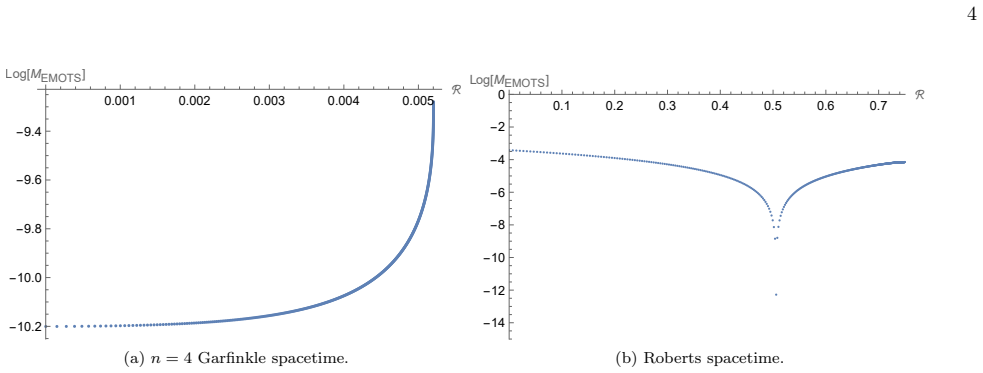
read the original abstract
Classical critical collapse yields naked singularities from smooth initial data, challenging cosmic censorship, and shaping the spectrum of primordial black holes. We show that one-loop vacuum polarization near the threshold qualitatively changes this outcome by dressing the singularity with a horizon within a controlled semiclassical regime. In analytically tractable Einstein-scalar critical spacetimes, a one-loop $s$-wave treatment linearized around self-similar backgrounds shows that regularity uniquely selects an asymptotically Minkowskian, vacuum-polarization state. Its renormalized stress tensor carries a universal quantum growing mode that competes with the classical unstable mode, shifts the critical point, and generates a trapped surface along with a finite mass gap at the new threshold, thereby enforcing horizon formation even under arbitrary fine-tuning. In primordial collapse, the threshold shift enters exponentially into the formation fraction, while the mass gap truncates the low-mass tail, suggesting potentially important consequences for the predicted mass spectrum. These results provide a self-consistent semiclassical treatment of critical collapse and yield sharp predictions within the one-loop, near-critical, linearized regime.
Editorial analysis
A structured set of objections, weighed in public.
Referee Report
Summary. The manuscript claims that one-loop vacuum polarization in Einstein-scalar critical collapse, treated via an s-wave approximation and linearized around self-similar backgrounds, produces a universal quantum growing mode in the renormalized stress tensor. This mode competes with the classical unstable mode, shifts the critical threshold, generates a trapped surface together with a finite mass gap at the new threshold, and thereby enforces horizon formation even under arbitrary fine-tuning of initial data. The analysis is asserted to remain within a controlled semiclassical regime, with implications for the primordial black hole mass spectrum via exponential sensitivity of the formation fraction and truncation of the low-mass tail.
Significance. If the central result holds, the work supplies a self-consistent semiclassical mechanism that upholds cosmic censorship in critical collapse by dressing would-be naked singularities with horizons. The exponential dependence of the PBH formation fraction on the shifted threshold and the mass-gap truncation of the low-mass tail could materially alter predicted abundances. The approach is notable for attempting an analytically tractable, parameter-free derivation within the one-loop, near-critical, linearized regime.
major comments (2)
- Abstract (paragraph describing the method): The central claim that the renormalized stress tensor carries a universal quantum growing mode generating a trapped surface requires that the sourced metric perturbation remain ≪1 until the null expansion crosses zero. No explicit bound or estimate on the perturbation amplitude at that moment is supplied, leaving open the possibility that the linearization exits its perturbative regime before the mass gap appears.
- Abstract: The selection of the asymptotically Minkowskian vacuum-polarization state by regularity and the subsequent extraction of the quantum growing mode are presented without derivation steps, error estimates, or checks that the one-loop s-wave treatment remains valid inside the claimed controlled semiclassical regime near threshold.
minor comments (1)
- Abstract: The dense technical phrasing makes the logical flow from regularity condition to universal mode to horizon formation difficult to follow on first reading; a short schematic outline of the steps would improve accessibility.
Simulated Author's Rebuttal
We thank the referee for the careful and constructive review of our manuscript. We address each major comment point by point below, providing the strongest honest defense of our results while acknowledging where additional clarification is warranted. Revisions will be incorporated in the next version to strengthen the presentation of the perturbative control and derivation details.
read point-by-point responses
-
Referee: Abstract (paragraph describing the method): The central claim that the renormalized stress tensor carries a universal quantum growing mode generating a trapped surface requires that the sourced metric perturbation remain ≪1 until the null expansion crosses zero. No explicit bound or estimate on the perturbation amplitude at that moment is supplied, leaving open the possibility that the linearization exits its perturbative regime before the mass gap appears.
Authors: We thank the referee for this important observation on the validity of our linearization. The manuscript uses scaling arguments near threshold (following Eq. (5.12) and in Section 6) to show that the quantum perturbation amplitude remains parametrically small compared to the classical background until the trapped surface forms, consistent with the controlled semiclassical regime. However, we acknowledge that an explicit, dedicated bound or order-of-magnitude estimate evaluated precisely at the null-expansion crossing is not supplied. We will add a short paragraph in the revised manuscript (likely in Section 6 or a new appendix) providing such an estimate based on the relative growth rates of the quantum and classical modes and the distance to the shifted threshold. This addition will confirm the perturbation remains ≪1 without changing any results or conclusions. revision: yes
-
Referee: Abstract: The selection of the asymptotically Minkowskian vacuum-polarization state by regularity and the subsequent extraction of the quantum growing mode are presented without derivation steps, error estimates, or checks that the one-loop s-wave treatment remains valid inside the claimed controlled semiclassical regime near threshold.
Authors: The abstract is necessarily concise and therefore omits full steps. The complete derivation—imposing regularity at the origin together with asymptotic flatness to select the unique vacuum-polarization state, followed by extraction of the universal growing mode from the renormalized stress tensor—is given in Sections 3.2 and 4.1. Validity checks for the one-loop s-wave approximation and error estimates confirming the semiclassical regime near threshold appear in Section 6. To address the referee’s concern directly, we will revise the abstract to include a brief outline of these steps with cross-references to the relevant sections, and we will expand the introduction with a concise summary of the error estimates. These changes clarify the controlled nature of the approximation while leaving the underlying analysis unchanged. revision: partial
Circularity Check
No significant circularity; derivation proceeds from regularity condition to computed stress-tensor mode
full rationale
The abstract describes a one-loop s-wave treatment linearized around self-similar backgrounds in which regularity selects an asymptotically Minkowskian vacuum-polarization state whose renormalized stress tensor then yields a universal quantum growing mode. This sequence is a direct calculation rather than a self-definition, fitted input renamed as prediction, or load-bearing self-citation. No equation or step is shown to reduce the final horizon/mass-gap result to an input parameter by construction, and the approach remains within the stated semiclassical assumptions. The derivation chain is therefore self-contained against external benchmarks.
Axiom & Free-Parameter Ledger
axioms (1)
- domain assumption One-loop s-wave vacuum polarization remains a controlled approximation near the critical threshold in self-similar Einstein-scalar spacetimes
Lean theorems connected to this paper
-
IndisputableMonolith/Foundation/RealityFromDistinction.leanreality_from_one_distinction unclear?
unclearRelation between the paper passage and the cited Recognition theorem.
Its renormalized stress tensor carries a universal quantum growing mode that competes with the classical unstable mode, shifts the critical point, and generates a trapped surface along with a finite mass gap
-
IndisputableMonolith/Foundation/AbsoluteFloorClosure.leanabsolute_floor_iff_bare_distinguishability unclear?
unclearRelation between the paper passage and the cited Recognition theorem.
regularity uniquely selects an asymptotically Minkowskian, vacuum-polarization state
-
IndisputableMonolith/Cost/FunctionalEquation.leanwashburn_uniqueness_aczel unclear?
unclearRelation between the paper passage and the cited Recognition theorem.
one-loop s-wave treatment linearized around self-similar backgrounds
What do these tags mean?
- matches
- The paper's claim is directly supported by a theorem in the formal canon.
- supports
- The theorem supports part of the paper's argument, but the paper may add assumptions or extra steps.
- extends
- The paper goes beyond the formal theorem; the theorem is a base layer rather than the whole result.
- uses
- The paper appears to rely on the theorem as machinery.
- contradicts
- The paper's claim conflicts with a theorem or certificate in the canon.
- unclear
- Pith found a possible connection, but the passage is too broad, indirect, or ambiguous to say the theorem truly supports the claim.
Forward citations
Cited by 5 Pith papers
-
Critical spacetime crystals in continuous dimensions
Numerical construction of a one-parameter family of discretely self-similar critical spacetimes for massless scalar collapse in continuous D>3, giving echoing period Delta(D) and Choptuik exponent gamma(D) with a maxi...
-
Unveiling horizons in quantum critical collapse
Semiclassical quantum corrections in critical collapse yield a finite mass gap and transition from classical Type II to quantum Type I behavior, providing a quantum enforcement of weak cosmic censorship.
-
The Fate of Nucleated Black Holes in de Sitter Quantum Gravity
Nucleated maximal-mass black holes in de Sitter space undergo thermal Hawking evaporation in smooth quantum states and return fully to the empty de Sitter vacuum.
-
Unveiling horizons in quantum critical collapse
Semiclassical one-loop analysis of solvable near-critical collapse solutions shows quantum corrections selecting a Boulware-like state and producing a growing mode that yields a finite mass gap and a transition to Typ...
-
The Fate of Nucleated Black Holes in de Sitter Quantum Gravity
Nucleated black holes in de Sitter space evaporate via standard Hawking radiation back to the empty vacuum, rendering nucleation a temporary fluctuation.
Reference graph
Works this paper leans on
-
[1]
Penrose, Gravitational collapse: The role of general relativity, Riv
R. Penrose, Gravitational collapse: The role of general relativity, Riv. Nuovo Cim.1, 252 (1969)
work page 1969
-
[2]
S. W. Hawking, Nature of space and time (1994), arXiv:hep-th/9409195
work page internal anchor Pith review Pith/arXiv arXiv 1994
-
[3]
Hawking, Particle Creation by Black Holes, Com- mun.Math.Phys.43, 199 (1975)
S. Hawking, Particle Creation by Black Holes, Com- mun.Math.Phys.43, 199 (1975)
work page 1975
-
[4]
S. W. Hawking, Breakdown of Predictability in Gravita- tional Collapse, Phys. Rev. D14, 2460 (1976)
work page 1976
-
[5]
R. Gregory and R. Laflamme, Black strings and p-branes are unstable, Phys. Rev. Lett.70, 2837 (1993), arXiv:hep- th/9301052
-
[6]
M. W. Choptuik, Universality and scaling in gravitational collapse of a massless scalar field, Phys. Rev. Lett.70, 9 (1993)
work page 1993
-
[7]
C. Gundlach, D. Hilditch, and J. M. Mart´ ın-Garc´ ıa, Critical Phenomena in Gravitational Collapse (2025), arXiv:2507.07636 [gr-qc]
- [8]
-
[9]
Christodoulou, The Problem of a Self-gravitating Scalar Field, Commun
D. Christodoulou, The Problem of a Self-gravitating Scalar Field, Commun. Math. Phys.105, 337 (1986). 6
work page 1986
-
[10]
D. Christodoulou, The formation of black holes and sin- gularities in spherically symmetric gravitational collapse, Commun. Pure Appl. Math.44, 339 (1991)
work page 1991
-
[11]
D. Christodoulou, Bounded variation solutions of the spherically symmetric einstein-scalar field equations, Com- mun. Pure Appl. Math.46, 1131 (1993)
work page 1993
-
[12]
D. Christodoulou, Examples of naked singularity forma- tion in the gravitational collapse of a scalar field, Annals Math.140, 607 (1994)
work page 1994
-
[13]
D. Christodoulou, On the global initial value problem and the issue of singularities, Classical and Quantum Gravity 16, A23 (1999)
work page 1999
-
[14]
Gundlach, The Choptuik space-time as an eigenvalue problem, Phys
C. Gundlach, The Choptuik space-time as an eigenvalue problem, Phys. Rev. Lett.75, 3214 (1995), arXiv:gr- qc/9507054
-
[15]
Understanding critical collapse of a scalar field
C. Gundlach, Understanding critical collapse of a scalar field, Phys. Rev. D55, 695 (1997), arXiv:gr-qc/9604019
work page internal anchor Pith review Pith/arXiv arXiv 1997
-
[16]
Kinematics of discretely self-similar spherically symmetric spacetimes
C. Gundlach and J. M. Mart´ ın-Garc´ ıa, Kinematics of discretely self-similar spherically symmetric space- times, Physical Review D68, 10.1103/physrevd.68.064019 (2003), arXiv:gr-qc/0306001
work page internal anchor Pith review Pith/arXiv arXiv doi:10.1103/physrevd.68.064019 2003
-
[17]
J. M. Martin-Garcia and C. Gundlach, Global structure of Choptuik’s critical solution in scalar field collapse, Phys. Rev. D68, 024011 (2003), arXiv:gr-qc/0304070
work page internal anchor Pith review Pith/arXiv arXiv 2003
-
[18]
A. V. Frolov and U.-L. Pen, The Naked singularity in the global structure of critical collapse space-times, Phys. Rev. D68, 124024 (2003), arXiv:gr-qc/0307081
work page internal anchor Pith review Pith/arXiv arXiv 2003
-
[19]
J. M. Martin-Garcia and C. Gundlach, All nonspherical perturbations of the Choptuik space-time decay, Phys. Rev. D59, 064031 (1999), arXiv:gr-qc/9809059
work page internal anchor Pith review Pith/arXiv arXiv 1999
-
[20]
S. Cicortas and C. Kehle, Discretely self-similar exterior- naked singularities for the Einstein-scalar field system (2024), arXiv:2412.09540 [gr-qc]
-
[21]
Universality and Scaling at the Onset of Quantum Black Hole Formation
A. Strominger and L. Thorlacius, Universality and scaling at the onset of quantum black hole formation, Phys. Rev. Lett.72, 1584 (1994), arXiv:hep-th/9312017
work page internal anchor Pith review Pith/arXiv arXiv 1994
-
[22]
Choptuik Scaling and Quantum Effects in 2D Dilaton Gravity
Y. Peleg, S. Bose, and L. Parker, Choptuik scaling and quantum effects in 2-d dilaton gravity, Phys. Rev. D55, 4525 (1997), arXiv:gr-qc/9608040
work page internal anchor Pith review Pith/arXiv arXiv 1997
-
[23]
S. Bose, L. Parker, and Y. Peleg, Predictability and semi- classical approximation at the onset of black hole forma- tion, Phys. Rev. D54, 7490 (1996), arXiv:hep-th/9606152
work page internal anchor Pith review Pith/arXiv arXiv 1996
-
[24]
Spherical Collapse of a Mass-Less Scalar Field With Semi-Classical Corrections
S. Ayal and T. Piran, Spherical collapse of a massless scalar field with semiclassical corrections, Phys. Rev. D 56, 4768 (1997), arXiv:gr-qc/9704027
work page internal anchor Pith review Pith/arXiv arXiv 1997
-
[25]
T. Chiba and M. Siino, Disappearance of black hole criti- cality in semiclassical general relativity, Modern Physics Letters A12, 709 (1997)
work page 1997
-
[26]
P. R. Brady and A. C. Ottewill, Quantum corrections to critical phenomena in gravitational collapse, Phys. Rev. D58, 024006 (1998), arXiv:gr-qc/9804058
work page internal anchor Pith review Pith/arXiv arXiv 1998
- [27]
-
[28]
U. Moitra, Self-similar gravitational dynamics, singulari- ties and criticality in 2D, JHEP06, 194, arXiv:2211.01394 [hep-th]
-
[29]
Unveiling horizons in quantum critical collapse
M. Tomaˇ sevi´ c and C.-H. Wu, Unveiling horizons in quan- tum critical collapse (2025), arXiv:2509.03584 [gr-qc]
work page internal anchor Pith review Pith/arXiv arXiv 2025
-
[30]
Dilaton Gravity in Two Dimensions
D. Grumiller, W. Kummer, and D. V. Vassilevich, Dilaton gravity in two-dimensions, Phys. Rept.369, 327 (2002), arXiv:hep-th/0204253
work page internal anchor Pith review Pith/arXiv arXiv 2002
-
[31]
V. Mukhanov, A. Wipf, and A. Zelnikov, On 4d hawking radiation from the effective action, Physics Letters B332, 283–291 (1994)
work page 1994
-
[32]
Trace Anomaly of Dilaton Coupled Scalars in Two Dimensions
R. Bousso and S. W. Hawking, Trace anomaly of dilaton coupled scalars in two-dimensions, Phys. Rev. D56, 7788 (1997), arXiv:hep-th/9705236
work page internal anchor Pith review Pith/arXiv arXiv 1997
-
[33]
W. Kummer and D. V. Vassilevich, Effective action and hawking radiation for dilaton coupled scalars in two dimen- sions, Physical Review D60, 10.1103/physrevd.60.084021 (1999)
-
[34]
W. Kummer and D. Vassilevich, Hawking radiation from dilaton gravity in 1 + 1 dimensions: a pedagogical review, Annalen der Physik8, 801–827 (1999)
work page 1999
-
[35]
R. Balbinot, A. Fabbri, P. Nicolini, V. Frolov, P. Sutton, and A. Zelnikov, Vacuum polarization in the schwarzschild spacetime and dimensional reduction, Physical Review D 63, 10.1103/physrevd.63.084029 (2001)
-
[36]
Generalized Virasoro anomaly and stress tensor for dilaton coupled theories
A. Fabbri, S. Farese, and J. Navarro-Salas, Generalized Vi- rasoro anomaly and stress tensor for dilaton coupled theo- ries, Phys. Lett. B574, 309 (2003), arXiv:hep-th/0309160
work page internal anchor Pith review Pith/arXiv arXiv 2003
-
[37]
Effective Action and Hawking Flux from Covariant Perturbation Theory
D. Hofmann and W. Kummer, Effective action and Hawk- ing flux from covariant perturbation theory, Eur. Phys. J. C40, 275 (2005), arXiv:gr-qc/0408088
work page internal anchor Pith review Pith/arXiv arXiv 2005
-
[38]
D. R. Karakhanian, R. P. Manvelyan, and R. L. Mkrtchian, Area preserving structure of 2-d gravity, Phys. Lett. B329, 185 (1994), arXiv:hep-th/9401031
work page internal anchor Pith review Pith/arXiv arXiv 1994
-
[39]
Another View on Massless Matter-Gravity Fields in Two Dimensions
R. Jackiw, Another view on massless matter - gravity fields in two-dimensions (1995), arXiv:hep-th/9501016
work page internal anchor Pith review Pith/arXiv arXiv 1995
-
[40]
Weyl Invariance and Black Hole Evaporation
J. Navarro-Salas, M. Navarro, and C. F. Talavera, Weyl invariance and black hole evaporation, Phys. Lett. B356, 217 (1995), arXiv:hep-th/9505139
work page internal anchor Pith review Pith/arXiv arXiv 1995
-
[41]
M. Buri´ c, V. Radovanovi´ c, and A. Mikovi´ c, One-loop cor- rections for a schwarzschild black hole via 2d dilaton grav- ity, Physical Review D59, 10.1103/physrevd.59.084002 (1999)
-
[42]
R. Balbinot and A. Fabbri, Hawking radiation by ef- fective two-dimensional theories, Physical Review D59, 10.1103/physrevd.59.044031 (1999)
-
[43]
R. Balbinot and A. Fabbri, 4d quantum black hole physics from 2d models?, Physics Letters B459, 112 (1999)
work page 1999
-
[44]
Quantum corrections for (anti)-evaporating black hole
M. Buric and V. Radovanovic, Quantum corrections for anti-evaporating black hole, Phys. Rev. D63, 044020 (2001), arXiv:hep-th/0007172
work page internal anchor Pith review Pith/arXiv arXiv 2001
-
[45]
Vacuum polarization in two-dimensional static spacetimes and dimensional reduction
R. Balbinot, A. Fabbri, P. Nicolini, and P. J. Sutton, Vac- uum polarization in two-dimensional static space-times and dimensional reduction, Phys. Rev. D66, 024014 (2002), arXiv:hep-th/0202036
work page internal anchor Pith review Pith/arXiv arXiv 2002
-
[46]
IR Renormalisation of General Effective Actions and Hawking Flux in 2D Gravity Theories
D. Hofmann and W. Kummer, IR renormalisation of gen- eral effective actions and Hawking flux in 2-D gravity theo- ries, Eur. Phys. J. C48, 291 (2006), arXiv:gr-qc/0512163
work page internal anchor Pith review Pith/arXiv arXiv 2006
- [47]
-
[48]
R. M. Wald, The Back Reaction Effect in Particle Cre- ation in Curved Space-Time, Commun. Math. Phys.54, 1 (1977)
work page 1977
-
[49]
R. M. Wald, Trace anomaly of a conformally invariant quantum field in curved spacetime, Phys. Rev. D17, 1477 (1978)
work page 1978
-
[50]
R. M. Wald, Axiomatic Renormalization of the Stress Tensor of a Conformally Invariant Field in Conformally Flat Space-Times, Annals Phys.110, 472 (1978)
work page 1978
-
[51]
Garfinkle, An Exact solution for 2+1 dimensional critical collapse, Phys
D. Garfinkle, An Exact solution for 2+1 dimensional critical collapse, Phys. Rev. D63, 044007 (2001), arXiv:gr- qc/0008023. 7
-
[52]
M. D. Roberts, Scalar Field Counterexamples to the Cosmic Censorship Hypothesis, Gen. Rel. Grav.21, 907 (1989)
work page 1989
-
[53]
P. R. Brady, Analytic example of critical behaviour in scalar field collapse, Class. Quant. Grav.11, 1255 (1994)
work page 1994
-
[54]
Critical Behavior of Black Hole Formation in a Scalar Wave Collapse
Y. Oshiro, K. Nakamura, and A. Tomimatsu, Critical behavior of black hole formation in a scalar wave collapse, Prog. Theor. Phys.91, 1265 (1994), arXiv:gr-qc/9402017
work page internal anchor Pith review Pith/arXiv arXiv 1994
-
[55]
Perturbations of an exact solution for 2+1 dimensional critical collapse
D. Garfinkle and C. Gundlach, Perturbations of an exact solution for (2+1)-dimensional critical collapse, Phys. Rev. D66, 044015 (2002), arXiv:gr-qc/0205107
work page internal anchor Pith review Pith/arXiv arXiv 2002
-
[56]
Scalar field critical collapse in 2+1 dimensions
J. Ja lmu˙ zna, C. Gundlach, and T. Chmaj, Scalar field critical collapse in 2+1 dimensions, Phys. Rev. D92, 124044 (2015), arXiv:1510.02592 [gr-qc]
work page internal anchor Pith review Pith/arXiv arXiv 2015
-
[57]
P. R. Brady, Self-similar scalar field collapse: Naked sin- gularities and critical behavior, Phys. Rev. D51, 4168 (1995), arXiv:gr-qc/9409035
work page internal anchor Pith review Pith/arXiv arXiv 1995
-
[58]
A. V. Frolov, Perturbations and critical behavior in the self-similar gravitational collapse of a massless scalar field, Phys. Rev. D56, 6433 (1997), arXiv:gr-qc/9704040
work page internal anchor Pith review Pith/arXiv arXiv 1997
-
[59]
A. V. Frolov, Critical collapse beyond spherical symmetry: General perturbations of the Roberts solution, Phys. Rev. D59, 104011 (1999), arXiv:gr-qc/9811001
work page internal anchor Pith review Pith/arXiv arXiv 1999
- [60]
-
[61]
Hawking, Gravitational radiation in an expanding uni- verse, J
S. Hawking, Gravitational radiation in an expanding uni- verse, J. Math. Phys.9, 598 (1968)
work page 1968
-
[62]
S. A. Hayward, Quasilocal gravitational energy, Phys. Rev. D49, 831 (1994), arXiv:gr-qc/9303030
work page internal anchor Pith review Pith/arXiv arXiv 1994
-
[63]
C. W. Misner and D. H. Sharp, Relativistic equations for adiabatic, spherically symmetric gravitational collapse, Phys. Rev.136, B571 (1964)
work page 1964
-
[64]
W. C. Hernandez and C. W. Misner, Observer Time as a Coordinate in Relativistic Spherical Hydrodynamics, Astrophys. J.143, 452 (1966)
work page 1966
-
[65]
P. R. Brady, C. M. Chambers, and S. M. C. V. Goncalves, Phases of massive scalar field collapse, Phys. Rev. D56, R6057 (1997), arXiv:gr-qc/9709014
work page internal anchor Pith review Pith/arXiv arXiv 1997
-
[66]
M. W. Choptuik, T. Chmaj, and P. Bizon, Critical behav- ior in gravitational collapse of a Yang-Mills field, Phys. Rev. Lett.77, 424 (1996), arXiv:gr-qc/9603051
work page internal anchor Pith review Pith/arXiv arXiv 1996
-
[67]
S. H. Hawley and M. W. Choptuik, Boson stars driven to the brink of black hole formation, Phys. Rev. D62, 104024 (2000), arXiv:gr-qc/0007039
work page internal anchor Pith review Pith/arXiv arXiv 2000
-
[68]
R. Bartnik and J. Mckinnon, Particle - Like Solutions of the Einstein Yang-Mills Equations, Phys. Rev. Lett.61, 141 (1988)
work page 1988
-
[69]
Semiclassical zero-temperature corrections to Schwarzschild spacetime and holography
A. Fabbri, S. Farese, J. Navarro-Salas, G. J. Olmo, and H. Sanchis-Alepuz, Semiclassical zero-temperature correc- tions to Schwarzschild spacetime and holography, Phys. Rev. D73, 104023 (2006), arXiv:hep-th/0512167
work page internal anchor Pith review Pith/arXiv arXiv 2006
-
[70]
Static quantum corrections to the Schwarzschild spacetime
A. Fabbri, S. Farese, J. Navarro-Salas, G. J. Olmo, and H. Sanchis-Alepuz, Static quantum corrections to the Schwarzschild spacetime, J. Phys. Conf. Ser.33, 457 (2006), arXiv:hep-th/0512179
work page internal anchor Pith review Pith/arXiv arXiv 2006
-
[71]
Static Black Holes With Back Reaction From Vacuum Energy
P.-M. Ho and Y. Matsuo, Static Black Holes With Back Reaction From Vacuum Energy, Class. Quant. Grav.35, 065012 (2018), arXiv:1703.08662 [hep-th]
work page internal anchor Pith review Pith/arXiv arXiv 2018
-
[72]
Static Black Hole and Vacuum Energy: Thin Shell and Incompressible Fluid
P.-M. Ho and Y. Matsuo, Static Black Hole and Vacuum Energy: Thin Shell and Incompressible Fluid, JHEP03, 096, arXiv:1710.10390 [hep-th]
work page internal anchor Pith review Pith/arXiv arXiv
-
[73]
P.-M. Ho, H. Kawai, Y. Matsuo, and Y. Yokokura, Back Reaction of 4D Conformal Fields on Static Geometry, JHEP11, 056, arXiv:1807.11352 [hep-th]
work page internal anchor Pith review Pith/arXiv arXiv
- [74]
-
[75]
C. Barcel´ o, V. Boyanov, R. Carballo-Rubio, and L. J. Garay, Semiclassical gravity effects near hori- zon formation, Class. Quant. Grav.36, 165004 (2019), arXiv:1904.06558 [gr-qc]
-
[76]
J. Arrechea, C. Barcel´ o, R. Carballo-Rubio, and L. J. Garay, Schwarzschild geometry counterpart in semi- classical gravity, Phys. Rev. D101, 064059 (2020), arXiv:1911.03213 [gr-qc]
-
[77]
P. Beltr´ an-Palau, A. del R´ ıo, and J. Navarro-Salas, Quan- tum corrections to the Schwarzschild metric from vac- uum polarization, Phys. Rev. D107, 085023 (2023), arXiv:2212.08089 [gr-qc]
-
[78]
J. Arrechea, C. Breen, A. Ottewill, L. Pisani, and P. Tay- lor, Renormalized stress-energy tensor for scalar fields in the Boulware state with applications to extremal black holes, Phys. Rev. D111, 085009 (2025), arXiv:2409.04528 [gr-qc]
-
[79]
K. Numajiri, K. Okabayashi, and S. Mukohyama, Boul- ware vacuum vs regularity: Thoughts on anomaly- induced effective action, Phys. Rev. D111, 085024 (2025), arXiv:2411.12617 [gr-qc]
-
[80]
C. R. Evans and J. S. Coleman, Observation of critical phenomena and self-similarity in the gravitational col- lapse of radiation fluid, Phys. Rev. Lett.72, 1782 (1994), arXiv:gr-qc/9402041
work page internal anchor Pith review Pith/arXiv arXiv 1994
discussion (0)
Sign in with ORCID, Apple, or X to comment. Anyone can read and Pith papers without signing in.