Critical spacetime crystals in continuous dimensions
Pith reviewed 2026-05-21 13:07 UTC · model grok-4.3
The pith
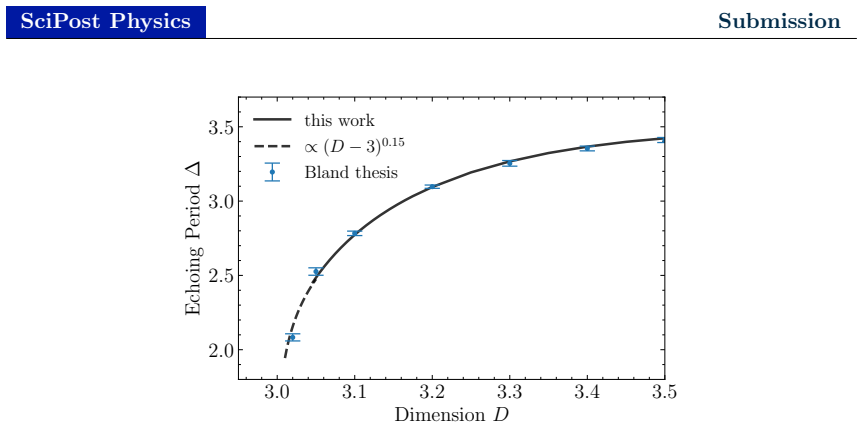
Critical solutions for scalar collapse exist in continuous dimensions above three with echoing period peaking near 3.76.
A machine-rendered reading of the paper's core claim, the machinery that carries it, and where it could break.
Core claim
A one-parameter family of discretely self-similar critical spacetimes is constructed numerically for arbitrary continuous dimensions D greater than three. The echoing period and Choptuik exponent are obtained as functions of D, with the period attaining a maximum near D equals 3.76. Expansions in 1/D and D minus 3 support the numerics and suggest both quantities vanish as D approaches three from above, while the four- and five-dimensional cases are recovered and the method is applied to two-dimensional dilaton gravity.
What carries the argument
The discretely self-similar critical spacetime imposed as an ansatz with a single echoing period in logarithmic time coordinate, verified by numerical convergence to a periodic solution.
If this is right
- The echoing period reaches a maximum near dimension 3.76.
- Both the echoing period and Choptuik exponent approach zero as dimension approaches three from above.
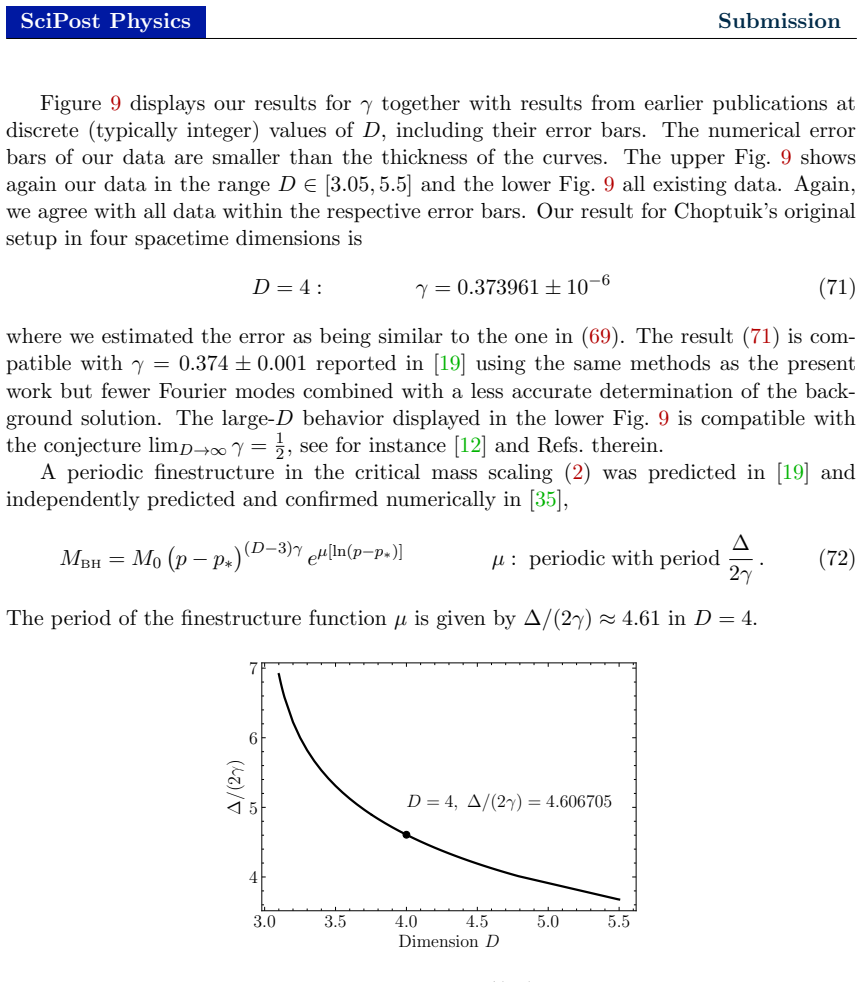
- The four-dimensional values Delta approximately 3.445 and gamma approximately 0.374 are recovered, as are the five-dimensional values.
- The construction extends directly to two-dimensional dilaton gravity.
- Large-D and small-(D-3) analytic expansions are consistent with the numerical data.
Where Pith is reading between the lines
- A systematic small-(D-3) expansion around the three-dimensional limit becomes feasible, mirroring existing large-D expansions.
- Continuous tracking with dimension may allow interpolation between known critical phenomena in different dimensions.
- Further checks in dimensions outside the reported interval could test how robust the single-period assumption remains.
- The maximum in echoing period points to a distinguished scale near D equals 3.76 where critical behavior changes most rapidly.
Load-bearing premise
The critical solution remains discretely self-similar with exactly one echoing period for every dimension greater than three.
What would settle it
A high-resolution numerical evolution at D equals 3.5 that fails to converge to a periodic attractor in logarithmic time or produces an echoing period outside the reported continuous curve.
Figures








read the original abstract
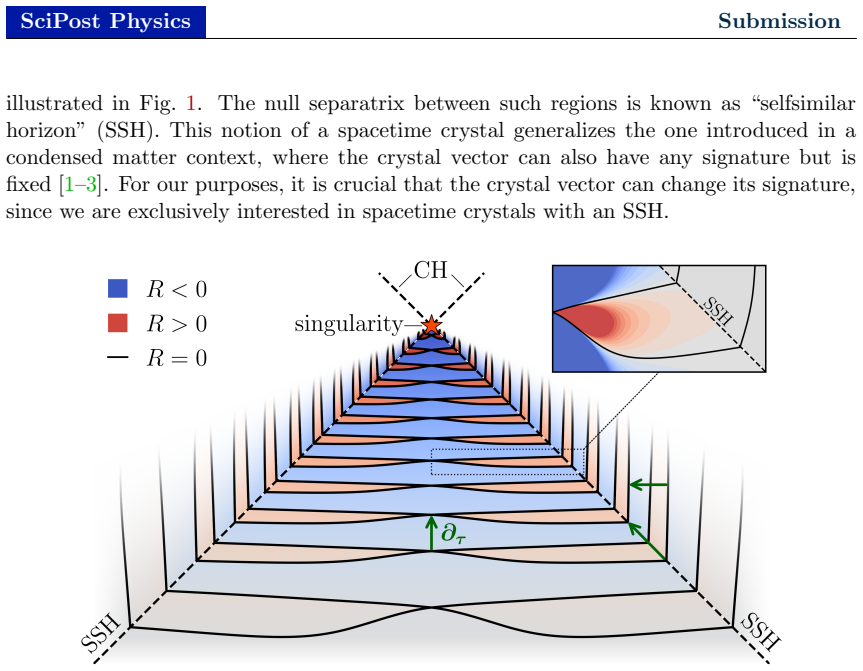
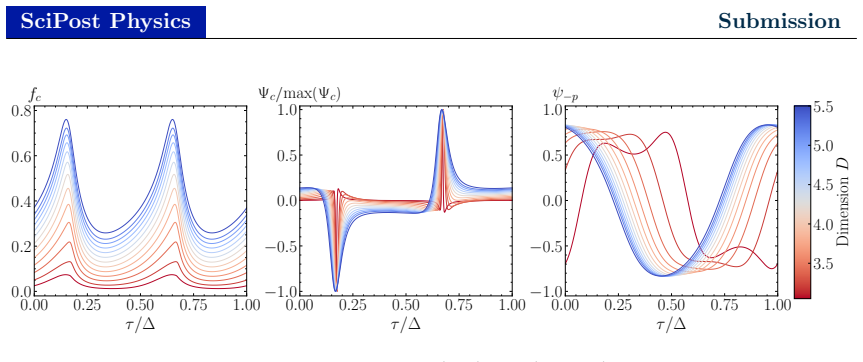
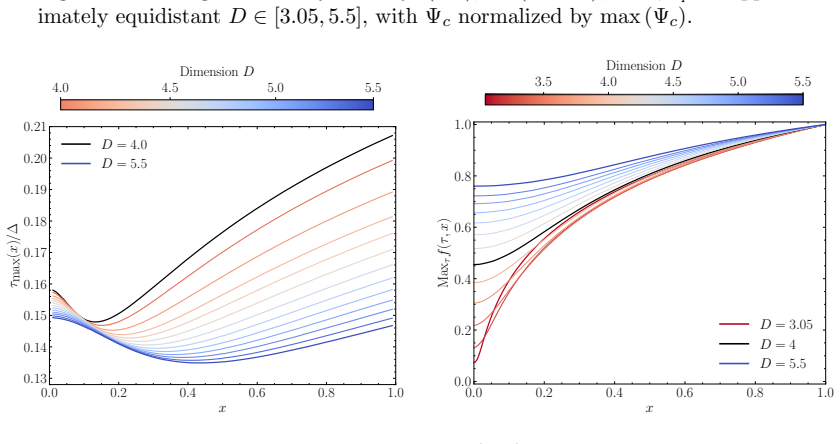
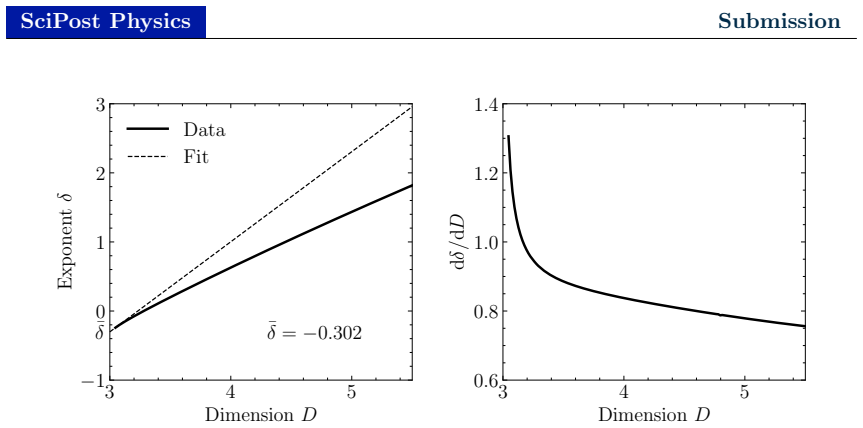
We numerically construct a one-parameter family of critical spacetimes in arbitrary continuous dimensions D>3. This generalizes Choptuik's D=4 solution to spherically symmetric massless scalar-field collapse at the threshold of D-dimensional Schwarzschild-Tangherlini black hole formation. We refer to these solutions, which share the discrete self-similarity of their four-dimensional counterpart, as critical spacetime crystals. Our main results are the echoing period and Choptuik exponent of the crystals as continuous functions of D, with detailed data for the interval 3.05<D<5.5. Notably, the echoing period has a maximum near D=3.76. As a by-product, we recover the echoing periods and Choptuik exponents in D=4 (5): Delta=3.445453 (3.22176) and gamma=0.373961 (0.41322). We support these numerical results with analytical expansions in 1/D and D-3. They suggest that both the echoing period and Choptuik exponent vanish as D approaches 3 from above. This paves the way for a small-(D-3) expansion, paralleling the large-$D$ expansion of general relativity. We also extend our results to two-dimensional dilaton gravity.
Editorial analysis