REVIEW 5 major objections 5 minor 42 references
A Synthetic-to-Real Dehazing Method based on Domain Unification
T0 review · 5 major / 5 minor · reviewed 2026-08-05 · deepseek-v4-flash
Pith's one-line read The paper claims that residual haze in supposedly clean training images breaks the standard atmospheric scattering model, and that a loss committee built on the derived composite model closes the synthetic-to-real gap in single-image dehazi
desk verdict A plausible but unproven causal story bolted onto a modestly effective training recipe; worth a serious referee, but the mechanism needs testing. read the letter →
The pith
A machine-rendered reading of the paper's core claim, the machinery that carries it, and where it could break.
The reading
What carries the argument
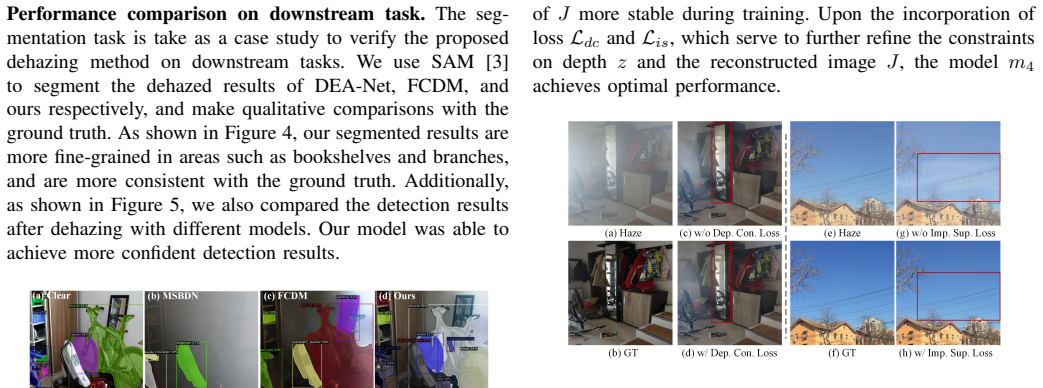
The key object is the composite atmospheric scattering relation of Equation (4): Ih = e^{-(β_h+β_c)z}J + e^{-β_h z}(1-e^{-β_c z})Ac + (1-e^{-β_h z})Ah, obtained by treating the clean image as a hazy observation of an ideal image. This relation reframes synthetic-to-real dehazing as a two-layer scattering problem and is enforced through a loss committee: Lsc constrains the synthetic pair via the standard model on Ic, Lcc constrains Ih through the composite model, Ldc distills depth from a pretrained estimator to tie zc and zh together, and Lis aligns the implicit J with the visible clean-image distribution by KL divergence.
What would settle it
Estimate residual haze parameters (atmospheric light and transmission) directly on RESIDE clean images with a standard dehazing prior, then re-haze them under Equation (4) and measure reconstruction error against the actual synthetic hazy images; if the error is large, the two-layer model is mis-specified. A cleaner controlled test: retrain on clean images that are genuinely haze-free (digitally cleared or rendered with no atmosphere); under the paper's explanation, the real-world gain over plain training should substantially disappear.
Extended reading notes
Core claim
The central claim is that every collected 'clean' image Ic is itself a hazy observation of an ideal image J, so the training synthesis Ih = e^{-β_h z}Ic + (1-e^{-β_h z})Ah should be composed with Ic = e^{-β_c z}J + (1-e^{-β_c z})Ac. Substituting gives Equation (4), in which Ih and J do not satisfy the simple atmospheric scattering model. The paper builds a dehazing method on this composite relation: it runs the same dehazing network twice, once on Ih and once on Ic, and applies a loss committee—synthesis-domain consistency Lsc, cross-domain consistency Lcc, depth consistency Ldc using a pretrained depth estimator, and implicit KL supervision Lis—to constrain the latent ideal image J. At infe
Load-bearing premise
The method assumes every 'clean' training image is itself a hazy observation of an ideal image, with the residual haze following the same atmospheric scattering model; if that residual comes from sensor noise, color shifts, or non-scattering degradation, the derived composite relation and its losses are mis-specified.
Editorial extensions
If this is right
- Real-world dehazing can be improved without real paired hazy/haze-free data, by correcting the clean side of synthetic training pairs.
- The same loss-committee training recipe improves several regression-based backbones beyond DEA-Net, including FFANet, MSBDN, and DehazeFormer, so the correction is architecture-agnostic.
- Depth becomes an explicit training signal: adding depth distillation stabilizes inferred transmission and improves dehazing in deep scene regions.
- Downstream segmentation and detection benefit from the dehazed output, supporting the practical value of the method as a preprocessing step.
Reading between the lines
- A direct mechanism test: retrain the same loss committee on truly haze-free clean images (digitally cleared or rendered without atmosphere). If Equation (4) is the real cause of the gap, the gain over plain training should shrink toward zero.
- The KL divergence between predicted J and Ic aligns distributions but not physical plausibility; a stronger generator prior, such as an adversarial or diffusion model, could both reduce the reported training collapse and improve NIQE, where FCDM remains ahead.
- Because the derivation assumes the same scene depth z for Ic and Ih, the method inherits a hidden dependence on the pretrained depth estimator's accuracy; depth errors would propagate directly into Lcc and Ldc.
- The same two-layer scattering argument could extend to other degradations with imperfectly collected training data, such as rain, fog with non-uniform scattering, or low-light enhancement.
Editorial analysis
A structured set of objections, weighed in public.
Referee Report
Summary. The paper claims that the synthetic-to-real domain gap in image dehazing is caused by non-ideal collection of 'clean' training images, which themselves retain residual haze. It derives a composed atmospheric scattering model (Eq. 4) and proposes a loss committee comprising synthesis-domain consistency (Lsc), cross-domain consistency (Lcc), depth consistency (Ldc), and implicit supervision (Lis, a KL divergence between the estimated ideal image J and the observed clean image Ic). The model is trained on RESIDE (ITS/OTS) and evaluated on real-world I-Haze, O-Haze, and RTTS. The reported PSNR/SSIM values on I-Haze and O-Haze are the best among the compared methods (e.g., PSNR 17.971 on I-Haze vs. 17.346 for FCDM), but NIQE is consistently worse than FCDM on all three datasets.
Significance. If validated, the paper offers a useful and principled perspective: that apparent 'clean' training images are themselves hazy observations of an ideal image, and that dehazing should account for this composition. Eq. (4) is a correct algebraic consequence of the assumed model, and the idea of treating the real clean image as an implicit variable is interesting. The authors also evaluate generalization across several backbones and include downstream segmentation/detection examples. However, the current evidence does not support the causal claim: the key premise is never measured, the ablation attributes most of the performance gain to a generic depth-distillation loss, and the comparison protocol has potential confounds. With additional validation and controlled experiments, the contribution could be solid.
major comments (5)
- [Section III-A, Eq. (2) and Eq. (4)] The entire method rests on the assumption that every collected clean image Ic is itself an ASM observation of an ideal image J: Ic = e^{-βc z}J + (1 - e^{-βc z})Ac. This premise is asserted but never tested on the RESIDE training data. Figure 2 shows a few qualitative examples with depth-dependent haziness; it does not establish that a single (Ac, βc) per image fits the residuals, nor that those residuals follow the scattering model as opposed to sensor noise, color shifts, or other degradation. If the premise fails, Eq. (4) and Lcc (Eq. 8) are mis-specified, and the reported gains cannot be attributed to the proposed mechanism. Please provide a quantitative validation, e.g., estimate Ac and βc per RESIDE clean image and measure the residual against Eq. (2), or compare training with an alternative 'clean' prior.
- [Section IV-C, Table III] The ablation does not support the claim that the cross-domain loss is the source of improvement. Adding Lcc alone (m2) decreases PSNR from 16.293 to 15.736 and SSIM from 0.828 to 0.817, and the result is marked 'unstable'. Adding Lis (m3) raises PSNR to 16.814, but the large jump to 17.971 occurs only after Ldc is added in m4. Ldc is a generic depth-consistency regularizer using DepthAnything and is not specific to domain unification. Thus the experiments do not isolate the effect of Lcc. Please report multiple-seed results with variance, and provide a controlled ablation, e.g., m1+Ldc+Lis versus m1+Lcc+Ldc+Lis, to show the marginal contribution of Lcc.
- [Section IV-A, Implementation details] The loss weights αsc, αcc, αdc, and αis are obtained via AutoML (Bayesian optimization), but no validation set is described. If the AutoML procedure used I-Haze or O-Haze test metrics, the comparison with fixed-weight baselines is not fair, and the reported gains of about 0.6–0.8 dB over FCDM could be partly due to selection bias. Please specify the validation split used for weight tuning and state whether the same tuning procedure was applied to the m1 baseline and to the retrained competitors. If the weights were tuned on the test datasets, the headline results are not blind.
- [Section IV-A, Table I and Table II] The comparison protocol is inconsistent across methods. The paper retrains FFANet, GCANet, DEA-Net, and PSD variants on the same training dataset, but uses provided pre-trained models for MSBDN, DehazeFormer, and FCDM. If those pre-trained models were trained on different data or at different resolutions, the comparisons are confounded. This matters especially because FCDM outperforms the proposed method on NIQE on all three datasets. Please retrain all competitors on the same ITS/OTS split (or document the exact pre-training data and resolution), and report statistical significance or error bars for the PSNR/SSIM differences.
- [Section III-B, Eq. (8)] The definition of z in Lcc is ambiguous. The text says 'we treat both zc and zh as z', but Eq. (7) uses zc and Eq. (9) uses zh and zc separately. It is not clear whether z in Eq. (8) is zh, zc, or some combination, and whether gradients flow through both Dehaze calls. Since the two-stage architecture (Eqs. (5)–(6)) feeds the output Ic of the first Dehaze call into a second Dehaze call, the use of stop-gradient is an important implementation detail. Please clarify with exact equations or pseudocode.
minor comments (5)
- [Table IV] The SSIM values (17.261, 17.294, 16.806) are impossible because SSIM is bounded above by 1 and they are identical to the PSNR values in the row above. This appears to be a copy-paste error; please correct the table.
- [Section III-B, Eqs. (10)–(11)] The implicit supervision loss is defined as Ldiv in Eq. (10) but appears as Lis in Eq. (11). Please align the notation.
- [Abstract and Section IV-B] The claim of 'significantly outperforming' is too strong given that NIQE is consistently worse than FCDM (I-Haze: 3.857 vs. 3.817; O-Haze: 2.473 vs. 2.268; RTTS: 3.117 vs. 2.968). Please qualify the claim and discuss this trade-off explicitly.
- [References] Reference [19] (Tang et al., 'Investigating the optimal size of anticancer nanomedicine') appears to be a citation error; it is not related to dehazing. Please verify the citation.
- [Section IV-B, Figures 4–5] The downstream-task evaluation is only qualitative. Adding quantitative segmentation/detection metrics (e.g., mIoU or mAP) would strengthen the claim.
Circularity Check
No circular reasoning found: Eq. (4) is an algebraic consequence of the stated ASM assumptions, the evaluation is against external real-world ground truth, and the self-citations are not load-bearing.
full rationale
The paper's central derivation (Eq. 4) is obtained by substituting the assumed ASM relation for the non-ideal clean image (Eq. 2) into the synthetic hazing equation (Eq. 3). This is a direct algebraic step, not a circular definition: the target variable J is not used to define the input I_h, and the model's output J is evaluated against independent real clean images in I-Haze/O-Haze/RTTS. The training losses L_sc, L_cc, L_dc, L_is are consistency and regularization objectives; none of them is the evaluation metric, and there is no evidence that test-set labels are used during training. The central empirical premise (RESIDE clean images contain residual haze) is asserted and illustrated in Fig. 2 but not measured; if false, the method is mis-specified, but that is a correctness/validity risk, not circularity. Likewise, Table III shows adding L_cc alone degrades PSNR (m2: 15.736 vs m1: 16.293) and the final gain requires L_dc and L_is; this weakens the causal claim that the ASM-based cross-domain loss is responsible for the improvement, but it is an attribution problem rather than a circular derivation. Self-citations are present ([13] FCDM is by a co-author and is used only for dataset-choice precedent; [4]-[6], [16] are incidental related-work citations), but none supplies the load-bearing theorem, ansatz, or uniqueness argument, so they do not constitute circularity. The paper is self-contained in the sense that the reported real-world performance could in principle falsify the model.
Assumptions & free parameters
free parameters (4)
- alpha_sc (synthesis-domain consistency loss weight) =
0.5
- alpha_cc (cross-domain consistency loss weight) =
0.3
- alpha_dc (depth consistency loss weight) =
0.05
- alpha_is (implicit supervision loss weight) =
0.1
assumptions (4)
- domain assumption The atmospheric scattering model in Eq. (1) accurately describes hazy image formation.
- ad hoc to paper Collected clean images Ic satisfy Ic = e^{-beta_c z} J + (1 - e^{-beta_c z}) A_c.
- domain assumption The same depth map z applies to both the real haze (Ic from J) and synthetic haze (Ih from Ic).
- domain assumption Pre-trained DepthAnything and ResNet-18 provide reliable features for depth and distribution matching.
Cite this review
Pith. "Pith review of A Synthetic-to-Real Dehazing Method based on Domain Unification." pith.science (2026). https://pith.science/paper/5GPJE243
@misc{pith2026250905374,
  author       = {Pith},
  title        = {Pith review of: A Synthetic-to-Real Dehazing Method based on Domain Unification},
  year         = {2026},
  howpublished = {\url{https://pith.science/paper/5GPJE243}},
  note         = {Machine review of arXiv:2509.05374}
}
read the original abstract
Due to distribution shift, the performance of deep learning-based method for image dehazing is adversely affected when applied to real-world hazy images. In this paper, we find that such deviation in dehazing task between real and synthetic domains may come from the imperfect collection of clean data. Owing to the complexity of the scene and the effect of depth, the collected clean data cannot strictly meet the ideal conditions, which makes the atmospheric physics model in the real domain inconsistent with that in the synthetic domain. For this reason, we come up with a synthetic-to-real dehazing method based on domain unification, which attempts to unify the relationship between the real and synthetic domain, thus to let the dehazing model more in line with the actual situation. Extensive experiments qualitatively and quantitatively demonstrate that the proposed dehazing method significantly outperforms state-of-the-art methods on real-world images.
Figures


Figures from the paper (2 more)

Reference graph
Works this paper leans on
-
[1]
Hu, Y ., Li, Z., Chen, Y ., Cheng, Y ., Cao, Z., & Liu, J. (2023). Content- aware adaptive device–cloud collaborative inference for object detection. IEEE Internet of Things Journal, 10(21), 19087-19101
work page 2023
-
[2]
Hu, Y ., Cheng, Y ., Lu, A., Cao, Z., Wei, D., Liu, J., & Li, Z. (2024, March). LF-ViT: Reducing spatial redundancy in vision transformer for efficient image recognition. In Proceedings of the AAAI Conference on Artificial Intelligence (V ol. 38, No. 3, pp. 2274-2284)
work page 2024
-
[3]
Kirillov, A., Mintun, E., Ravi, N., Mao, H., Rolland, C., Gustafson, L., ... & Girshick, R. (2023). Segment anything. In Proceedings of the IEEE/CVF International Conference on Computer Vision (pp. 4015- 4026)
work page 2023
-
[4]
Zhou, R., Yuan, Z., Rong, X., Ma, W., Sun, X., Fu, K., & Zhang, W. (2023). Weakly supervised semantic segmentation in aerial imagery via cross-image semantic mining. Remote Sensing, 15(4), 986
work page 2023
-
[5]
WalkVLM:Aid Visually Impaired People Walking by Vision Language Model
Yuan, Z., Zhang, T., Deng, Y ., Zhang, J., Zhu, Y ., Jia, Z., ... & Zhang, J. (2024). WalkVLM: Aid Visually Impaired People Walking by Vision Language Model. arXiv preprint arXiv:2412.20903
work page Pith review arXiv 2024
-
[6]
Yuan, Z., Zhang, W., Fu, K., Li, X., Deng, C., Wang, H., & Sun, X. (2022). Exploring a fine-grained multiscale method for cross-modal remote sensing image retrieval. arXiv preprint arXiv:2204.09868
arXiv 2022
-
[7]
Nayar, S. K., & Narasimhan, S. G. (1999, September). Vision in bad weather. In Proceedings of the seventh IEEE international conference on computer vision (V ol. 2, pp. 820-827). IEEE
work page 1999
-
[8]
Shao, Y ., Li, L., Ren, W., Gao, C., & Sang, N. (2020). Domain adaptation for image dehazing. In Proceedings of the IEEE/CVF conference on computer vision and pattern recognition (pp. 2808-2817)
work page 2020
Show all 42 references
-
[9]
Z. Chen, Y . Wang, Y . Yang and D. Liu, PSD: Principled Synthetic-to- Real Dehazing Guided by Physical Priors, 2021 IEEE/CVF Conference on Computer Vision and Pattern Recognition (CVPR), 2021, pp. 7176- 7185, doi: 10.1109/CVPR46437.2021.00710
2021
-
[10]
Dong, H., Pan, J., Xiang, L., Hu, Z., Zhang, X., Wang, F., & Yang, M. H. (2020). Multi-scale boosted dehazing network with dense feature fusion. In Proceedings of the IEEE/CVF conference on computer vision and pattern recognition (pp. 2157-2167)
2020
-
[11]
(2020, April)
Qin, X., Wang, Z., Bai, Y ., Xie, X., & Jia, H. (2020, April). FFA- Net: Feature fusion attention network for single image dehazing. In Proceedings of the AAAI conference on artificial intelligence (V ol. 34, No. 07, pp. 11908-11915)
2020
-
[12]
& Feng, W
Liu, Y ., Zhu, L., Pei, S., Fu, H., Qin, J., Zhang, Q., ... & Feng, W. (2021, October). From synthetic to real: Image dehazing collaborating with unlabeled real data. In Proceedings of the 29th ACM international conference on multimedia (pp. 50-58)
2021
-
[13]
Wang, J., Wu, S., Yuan, Z., Tong, Q., & Xu, K. (2024). Frequency compensated diffusion model for real-scene dehazing. Neural Networks, 175, 106281
2024
-
[14]
Cai, B., Xu, X., Jia, K., Qing, C., & Tao, D. (2016). Dehazenet: An end-to-end system for single image haze removal. IEEE transactions on image processing, 25(11), 5187-5198
2016
-
[15]
Singh, D., & Kumar, V . (2019). A comprehensive review of compu- tational dehazing techniques. Archives of Computational Methods in Engineering, 26(5), 1395-1413
2019
-
[16]
Liu, J., Yuan, H., Yuan, Z., Liu, L., Lu, B.,& Yu, M. (2023). Visual transformer with stable prior and patch-level attention for single image dehazing. Neurocomputing, 551, 126535
2023
-
[17]
H., & McCann, J
Land, E. H., & McCann, J. J. (1971). Lightness and retinex theory. Josa, 61(1), 1-11
1971
-
[18]
Fattal, R. (2008). Single image dehazing. ACM transactions on graphics (TOG), 27(3), 1-9
2008
-
[19]
& Cheng, J
Tang, L., Yang, X., Yin, Q., Cai, K., Wang, H., Chaudhury, I., ... & Cheng, J. (2014). Investigating the optimal size of anticancer nanomedicine. Proceedings of the National Academy of Sciences, 111(43), 15344-15349
2014
-
[20]
Fattal, R. (2014). Dehazing using color-lines. ACM transactions on graphics (TOG), 34(1), 1-14
2014
-
[21]
S., & Amin, M
Das, S., Islam, M. S., & Amin, M. R. (2022). Gca-net: utilizing gated context attention for improving image forgery localization and detection. In Proceedings of the IEEE/CVF Conference on Computer Vision and Pattern Recognition (pp. 81-90)
2022
-
[22]
Engin, D., Genc ¸, A., & Kemal Ekenel, H. (2018). Cycle-dehaze: Enhanced cyclegan for single image dehazing. In Proceedings of the IEEE conference on computer vision and pattern recognition workshops (pp. 825-833)
2018
-
[23]
Zhang, H., & Patel, V . M. (2018). Densely connected pyramid dehazing network. In Proceedings of the IEEE conference on computer vision and pattern recognition (pp. 3194-3203)
2018
-
[24]
(2017, December)
Zhao, X., Wang, K., Li, Y ., & Li, J. (2017, December). Deep fully convolutional regression networks for single image haze removal. In 2017 IEEE Visual Communications and Image Processing (VCIP) (pp. 1-4). IEEE
2017
-
[25]
, Chen, Y
Qu, Y . , Chen, Y . , Huang, J. , & Xie, Y . . (2019). Enhanced Pix2pix Dehazing Network. 2019 IEEE/CVF Conference on Computer Vision and Pattern Recognition (CVPR). IEEE
2019
-
[26]
(2020, April)
Dong, Y ., Liu, Y ., Zhang, H., Chen, S., & Qiao, Y . (2020, April). FD-GAN: Generative adversarial networks with fusion-discriminator for single image dehazing. In Proceedings of the AAAI conference on artificial intelligence (V ol. 34, No. 07, pp. 10729-10736)
2020
-
[27]
He, C., Shen, Y ., Fang, C., Xiao, F., Tang, L., Zhang, Y ., ... & Li, X. (2024). Diffusion Models in Low-Level Vision: A Survey. arXiv preprint arXiv:2406.11138
2024 arXiv
-
[28]
(2024, August)
Guo, Y ., Wu, Y ., & Wan, C. (2024, August). A Multi-scale Patch Approach with Diffusion Model for Image Dehazing. In International Conference on Intelligent Computing (pp. 392-402). Singapore: Springer Nature Singapore
2024
-
[29]
Benchmarking single image dehazing and beyond
Boyi Li, Wenqi Ren, Dengpan Fu, Dacheng Tao, Dan Feng, Wenjun Zeng, and Zhangyang Wang. Benchmarking single image dehazing and beyond. IEEE Transactions on Image Processing, 28(1):492–505, 2019
2019
-
[30]
& Wang, F
Zhang, X., Dong, H., Pan, J., Zhu, C., Tai, Y ., Wang, C., ... & Wang, F. (2021). Learning to restore hazy video: A new real-world dataset and a new method. In Proceedings of the IEEE/CVF Conference on Computer Vision and Pattern Recognition (pp. 9239-9248)
2021
-
[31]
Y . Shao, L. Li, W. Ren, C. Gao and N. Sang, Domain Adapta- tion for Image Dehazing, 2020 IEEE/CVF Conference on Computer Vision and Pattern Recognition (CVPR), 2020, pp. 2805-2814, doi: 10.1109/CVPR42600.2020.00288
2020
-
[32]
Yang, L., Kang, B., Huang, Z., Xu, X., Feng, J., & Zhao, H. (2024). Depth anything: Unleashing the power of large-scale unlabeled data. In Proceedings of the IEEE/CVF Conference on Computer Vision and Pattern Recognition (pp. 10371-10381)
2024
-
[33]
He, K., Sun, J., & Tang, X. (2010). Single image haze removal using dark channel prior. IEEE transactions on pattern analysis and machine intelligence, 33(12), 2341-2353
2010
-
[34]
Chen, Z., He, Z., & Lu, Z. M. (2024). DEA-Net: Single image dehazing based on detail-enhanced convolution and content-guided attention. IEEE Transactions on Image Processing
2024
-
[35]
Song, Y ., He, Z., Qian, H., & Du, X. (2023). Vision transformers for single image dehazing. IEEE Transactions on Image Processing, 32, 1927-1941
2023
-
[36]
Yang, Y ., Wang, C., Liu, R., Zhang, L., Guo, X., & Tao, D. (2022). Self- augmented unpaired image dehazing via density and depth decomposi- tion. In Proceedings of the IEEE/CVF conference on computer vision and pattern recognition (pp. 2037-2046)
2022
-
[37]
(2010, August)
Hore, A., & Ziou, D. (2010, August). Image quality metrics: PSNR vs. SSIM. In 2010 20th international conference on pattern recognition (pp. 2366-2369). IEEE
2010
-
[38]
Westland, S., Ripamonti, C., & Cheung, V . (2012). Computational colour science using MATLAB. John Wiley & Sons
2012
-
[39]
R., Bovik, A
Sheikh, H. R., Bovik, A. C., & Cormack, L. (2005). No-reference quality assessment using natural scene statistics: JPEG2000. IEEE Transactions on image processing, 14(11), 1918-1927
2005
-
[40]
Ke, J., Wang, Q., Wang, Y ., Milanfar, P., & Yang, F. (2021). Musiq: Multi-scale image quality transformer. In Proceedings of the IEEE/CVF international conference on computer vision (pp. 5148-5157)
2021
-
[41]
He, K., Zhang, X., Ren, S., & Sun, J. (2016). Deep residual learning for image recognition. In Proceedings of the IEEE conference on computer vision and pattern recognition (pp. 770-778)
2016
-
[42]
Hu, Y ., Cheng, Y ., Lu, A., Wei, D., & Li, Z. (2025). SAC-ViT: Semantic- Aware Clustering Vision Transformer with Early Exit. arXiv preprint arXiv:2503.00060
2025 arXiv
Reviewed August 5, 2026 · model on record in the stance chip above.
Discussion (0). Sign in to comment.