REVIEW 4 major objections 5 minor 2 cited by
O$^3$Afford: One-Shot 3D Object-to-Object Affordance Grounding for Generalizable Robotic Manipulation
T0 review · 4 major / 5 minor · reviewed 2026-08-04 · deepseek-v4-flash
Pith's one-line read This paper argues that a robot can learn where and how two objects should interact—per-point on both 3D point clouds—from a single annotated example of each interaction type, and that these affordance maps improve LLM-generated manipulation
desk verdict A solid one-shot object-to-object affordance system with real robot demos, but the quantitative grounding results rest on self-annotated labels that need independent validation. read the letter →
The pith
A machine-rendered reading of the paper's core claim, the machinery that carries it, and where it could break.
The reading
What carries the argument
The load-bearing object is the 3D semantic point cloud: DINOv2 features extracted from multiple RGB-D views are projected and fused onto each object's point cloud, giving every point a rich semantic descriptor alongside its coordinates. On top of this, a joint-attention transformer decoder tokenizes each point cloud into local patches with a PointNet encoder, then applies cross-attention in both directions—source attending to target and target attending to source—so that the predicted affordance on each object depends on the other object's geometry and semantics. One-hot source/target embeddings keep the roles distinct. The final per-point maps are trained with binary cross-entropy against d
What would settle it
Retrain the model on the same object pairs using independently annotated contact points from a second annotator, or contact labels recovered from physical interaction, instead of distance-propagated seed labels, then compare held-out IOU and real-robot success; a large drop would show the model learned label propagation artifacts rather than object-interaction semantics.
Extended reading notes
Core claim
The paper's central claim is that object-to-object affordance can be learned in 3D from one annotated example per interaction verb. The system takes two point clouds—a source object and a target object—with per-point semantic features distilled from a self-supervised visual foundation model, and a joint-attention transformer decoder predicts a per-point interaction-probability map on both objects simultaneously. The affordance category is defined by the verb (pour, cut, press, hang, insert), not by the object pair, so at test time the same decoder is applied zero-shot to entirely unseen object pairs and even unseen categories with similar functional parts. The paper further claims that feedi
Load-bearing premise
The results assume that a few user-picked contact points, spread to nearby points by distance, correctly mark the functional interaction region on each object, and that image-derived semantic features projected onto the point cloud carry enough signal for one example per interaction verb to generalize to unseen objects and categories.
Editorial extensions
If this is right
- A robot can be taught a new interaction verb from a single example pair and generalize it to unseen object instances and categories.
- Object-to-object affordance in 3D is more robust to viewpoint and occlusion changes than 2D affordance grounding, because semantic and geometric cues are fused in point-cloud space.
- Affordance maps can act as effective intermediate constraints for LLM-based optimization planners, raising manipulation success in two-object tasks.
- The one-shot formulation avoids large annotation efforts for pairwise affordance data, making the approach scalable to many everyday tasks.
- The model degrades gracefully under partial observations, such as two camera views instead of four, supporting deployment with limited sensing.
Reading between the lines
- A direct implication the paper leaves implicit: because the affordance category is a verb rather than a fixed object pair, the same decoder could be trained on one example per verb from human demonstrations, replacing seed-point annotations with contact traces recovered from manipulation videos.
- The failure analysis suggests that once affordance grounding is adequate, sensor depth quality and inverse-kinematics feasibility become the dominant bottlenecks; combining this method with sparse-view 3D reconstruction could raise success more than further affordance-model tuning.
- The one-shot formulation could be tested as an open-vocabulary system: substitute a language embedding for the one-hot affordance channel and ask the model to ground any verb, letting a user specify novel interactions without retraining.
- Cross-category generalization to objects that share no part geometry (e.g., pouring from a bag versus a teapot) would stress whether the method relies on semantic features or on local geometry clusters; the paper does not test that limit.
Editorial analysis
A structured set of objections, weighed in public.
Referee Report
Summary. The paper proposes O3Afford, a one-shot 3D object-to-object affordance grounding method. It constructs semantic point clouds by projecting DINOv2 features from multi-view RGB-D frames, encodes source and target point clouds with a PointNet patch encoder, and uses a joint-attention transformer decoder to predict per-point affordance maps for both objects. The affordance maps are then integrated with LLM-generated geometric constraint functions for optimization-based robotic manipulation. Training uses a single annotated object pair per affordance category. Experiments report affordance grounding metrics (Table 1), ablations (Table 4), and success rates on five simulated and real-robot manipulation tasks (Tables 2-3), with qualitative generalization to unseen categories and occlusion conditions.
Significance. If the results hold, the paper makes a useful contribution: it formulates object-to-object affordance grounding as a one-shot 3D problem, combines DINOv2 feature distillation with a joint-attention interaction module, and demonstrates a plausible integration of affordance maps with LLM-generated constraints for manipulation. The simulation and real-robot evaluation scope is broader than in many affordance papers, and the method is relatively simple to reproduce from the description. The strongest parts are the clean problem formulation, the use of pretrained semantic features to reduce supervision, and the concrete downstream manipulation formulation. However, the central claims rest on a self-annotated label-generation procedure and on success counts without statistical support; these need independent validation before the reported margins can be taken as evidence of genuine object-to-object affordance understanding.
major comments (4)
- [Sec. 5.1, Table 1, Sec. 4.3] The ground-truth affordance labels are created by the authors via user-assigned contact points followed by distance-based propagation (Sec. 5.1, following [26]). The same annotation procedure is used for both training (BCE loss in Sec. 4.3) and evaluation (Table 1). There is no independent human annotation, no inter-annotator agreement, and no sensitivity analysis of the propagation radius/kernel. Consequently, the large margins in Table 1 (aIOU 26.19 vs 16.89 for the best baseline) may reflect learning the distance-propagation label bias rather than functional object-to-object semantics. The concern is reinforced by Table 4: removing DINOv2 features drops aIOU from 26.19 to 6.59, suggesting that the pretrained semantic features dominate the result. I recommend adding an independent human-annotated evaluation set (or a leave-one-out cross-check against human labels), reporting per-catego
- [Tables 2 and 3, Sec. 5.3] Success rates are reported as success counts over 10 trials per task with no confidence intervals, no significance tests, and no description of trial randomization or initial-state variation. The text repeatedly states that the method 'significantly outperforms' baselines (e.g., Sec. 5.3). With 10 trials, a 3/10 vs 8/10 difference is suggestive but not statistically secured, and smaller differences (e.g., Hang 3/10 vs 1/10 under 2-view) are within binomial noise. Please provide binomial confidence intervals, per-trial variability, and, where feasible, repeated seeds or independent trials. Also specify how ReKep is configured (keypoint proposal, optimizer, and whether the same LLM is used) so the comparison is reproducible.
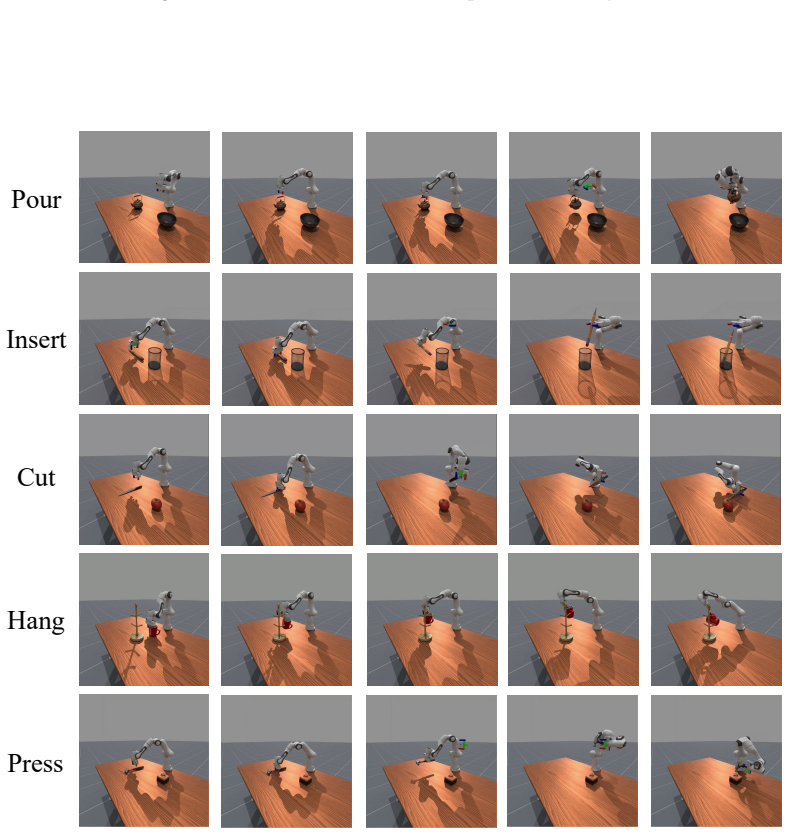
- [Sec. 5.2.2 and Fig. 4] Category-level generalization is shown only qualitatively on unseen categories (scissor, coat rack, spray bottle). Since the title and abstract claim 'generalizable' and 'strong semantic and geometric generalization,' a quantitative evaluation on held-out categories is needed. As written, the claim rests on three qualitative examples. An extension would be to add a held-out category split to Tables 1/4 or report per-category aIOU/AUC for unseen categories. This is load-bearing for the generalization claim.
- [Table 1 and Appendix B.1] Baseline comparability is questionable: O2O-Afford is designed for annotation-free contact-based affordances (place/fit), and IAGNet is adapted from a single-image 2D setting by providing both source and target bounding boxes. The paper should justify that these are meaningful comparators for the one-shot 3D O2O setting, or add a baseline that uses the same input representation and supervision level. Otherwise the 'outperforms baselines' claim is difficult to interpret.
minor comments (5)
- [Abstract and Sec. 5.1] Typo: 'contraints' in the abstract. In Sec. 5.1, the phrase 'several user-assigned contact points' is vague; please specify how many contact points are used per object and the exact distance-propagation rule.
- [Table 1] The header arrows are inconsistent: IOU and SIM are marked with up arrows while MAE is marked with a down arrow, but the text later refers to '↑ IOU ↑ SIM ↓ MAE ↑ AUC' without explaining the direction. Clarify which direction is better for each metric.
- [Sec. 4.4] Equation (1) is referenced as 'Eq. 4.4' in the text, which is a formatting artifact. Also, the objective defines a weighted sum of score terms but does not explicitly list the constraints mentioned in the introductory sentence.
- [References] References [11] and [13] are duplicates (CLIP), and [12] and [34] are duplicates (latent diffusion). Please consolidate.
- [Sec. 3 and Sec. 4.3] The symbol K is used both for the number of affordance categories in the problem formulation and for the output-channel dimension in A ∈ [0,1]^{2B×K×N} in Sec. 4.3. Use distinct symbols to avoid confusion.
Circularity Check
No significant circularity: the core training/evaluation loop is supervised against human-assigned labels and external benchmarks, with no fitted input renamed as a prediction.
full rationale
No load-bearing circular step is present in the paper. The affordance model is trained with a standard binary cross-entropy loss (Sec. 4.3) against ground-truth affordance maps produced by user-assigned contact points propagated by distance (Sec. 5.1). This label-generation procedure is borrowed from prior work (3D AffordanceNet [26]) and is external to the authors' own method; the test-time affordance metrics (aIOU, SIM, MAE, AUC) are computed against held-out labels of the same type. The model does not fit a parameter to the test set and then rename it a prediction; it is trained on one example per category and evaluated on unseen object pairs, which is a standard supervised generalization setup. The manipulation experiments (Tables 2-3) measure physical task success in simulation and on a real Franka robot, which is an external, task-level outcome rather than a quantity derived from the model's own outputs. The only pretrained component, DINOv2, is used as a frozen external feature extractor, and the multi-view feature projection method is adapted from D3Field [14], which is not authored by the present authors. There are no self-citations in the reference list that carry the argument, and the paper does not invoke any uniqueness theorem or ansatz that is smuggled in via the authors' prior work. Concerns about distance-propagated label quality, the small number of trials, or the choice of LLM constraint weights in Table 7 are validity and robustness issues, not circularity: they do not make any stated prediction equivalent to its own input by construction.
Assumptions & free parameters
free parameters (2)
- LLM constraint weights lambda_i per task =
e.g., Pour: position 0.3, orientation 0.2, clearance 0.3, affordance alignment 0.1 (Table 7)
- Number of training examples per category =
1 (one-shot)
assumptions (4)
- domain assumption DINOv2 features projected onto 3D point clouds preserve semantic part correspondence useful for affordance grounding.
- domain assumption PointNet patch encoder captures local geometric primitives that transfer across object categories.
- domain assumption LLM-generated constraint functions are physically meaningful and correctly weighted for the specified tasks.
- domain assumption The affordance labels produced by user-assigned contact points and distance propagation are a valid ground truth for object-to-object interaction.
Cite this review
Pith. "Pith review of O$^3$Afford: One-Shot 3D Object-to-Object Affordance Grounding for Generalizable Robotic Manipulation." pith.science (2026). https://pith.science/paper/TY2N3TY5
@misc{pith2026250906233,
  author       = {Pith},
  title        = {Pith review of: O$^3$Afford: One-Shot 3D Object-to-Object Affordance Grounding for Generalizable Robotic Manipulation},
  year         = {2026},
  howpublished = {\url{https://pith.science/paper/TY2N3TY5}},
  note         = {Machine review of arXiv:2509.06233}
}
abstract
Grounding object affordance is fundamental to robotic manipulation as it establishes the critical link between perception and action among interacting objects. However, prior works predominantly focus on predicting single-object affordance, overlooking the fact that most real-world interactions involve relationships between pairs of objects. In this work, we address the challenge of object-to-object affordance grounding under limited data contraints. Inspired by recent advances in few-shot learning with 2D vision foundation models, we propose a novel one-shot 3D object-to-object affordance learning approach for robotic manipulation. Semantic features from vision foundation models combined with point cloud representation for geometric understanding enable our one-shot learning pipeline to generalize effectively to novel objects and categories. We further integrate our 3D affordance representation with large language models (LLMs) for robotics manipulation, significantly enhancing LLMs' capability to comprehend and reason about object interactions when generating task-specific constraint functions. Our experiments on 3D object-to-object affordance grounding and robotic manipulation demonstrate that our O$^3$Afford significantly outperforms existing baselines in terms of both accuracy and generalization capability.
Figures


Figures from the paper (11 more)




Forward citations
Cited by 2 Pith papers
-
SemAnCorr: Semantic Anchored Correspondence for Zero-Shot Manipulation Skill Transfer
Training-free semantic anchors plus functional maps yield dense correspondences that are both part-accurate and geometrically coherent, improving zero-shot robot skill transfer over nearest-neighbor 3D feature matching.
-
Beyond Point-Attached Semantics: Object-Centric Semantic Fields for Generalizable Manipulation
An object-conditioned continuous semantic field queried at explicit 3D locations yields more stable part cues and higher manipulation success than point-attached 2D/3D features.
Reference graph
Works this paper leans on
-
[26]
S. Deng, X. Xu, C. Wu, K. Chen, and K. Jia. 3d affordancenet: A benchmark for visual object affordance understanding. In Proceedings of the IEEE/CVF Conference on Computer Vision and Pattern Recognition (CVPR), pages 1778–1787, June 2021
work page 2021
-
[1]
V . Kaptelinin and B. Nardi. Affordances in hci: toward a mediated action perspective. In Proceedings of the SIGCHI conference on human factors in computing systems , pages 967– 976, 2012
work page 2012
-
[2]
A. Delitzas, A. Takmaz, F. Tombari, R. Sumner, M. Pollefeys, and F. Engelmann. Scene- fun3d: fine-grained functionality and affordance understanding in 3d scenes. InProceedings of the IEEE/CVF Conference on Computer Vision and Pattern Recognition, pages 14531–14542, 2024
work page 2024
- [3]
-
[4]
G. Li, D. Sun, L. Sevilla-Lara, and V . Jampani. One-shot open affordance learning with foun- dation models. In Proceedings of the IEEE/CVF Conference on Computer Vision and Pattern Recognition, pages 3086–3096, 2024
work page 2024
-
[5]
H. Luo, W. Zhai, J. Zhang, Y . Cao, and D. Tao. Learning affordance grounding from exo- centric images. In Proceedings of the IEEE/CVF conference on computer vision and pattern recognition, pages 2252–2261, 2022
work page 2022
-
[6]
H. Luo, W. Zhai, J. Zhang, Y . Cao, and D. Tao. Leverage interactive affinity for affordance learning. In Proceedings of the IEEE/CVF Conference on Computer Vision and Pattern Recog- nition, pages 6809–6819, 2023
work page 2023
-
[7]
W. Zhai, H. Luo, J. Zhang, Y . Cao, and D. Tao. One-shot object affordance detection in the wild. International Journal of Computer Vision, 130(10):2472–2500, 2022
work page 2022
Show all 61 references
-
[8]
X. Zhao, Y . Cao, and Y . Kang. Object affordance detection with relationship-aware network. Neural Computing and Applications, 32(18):14321–14333, 2020. 9
2020
-
[9]
K. Mo, Y . Qin, F. Xiang, H. Su, and L. Guibas. O2o-afford: Annotation-free large-scale object-object affordance learning. In Conference on robot learning, pages 1666–1677. PMLR, 2022
2022
-
[10]
Oquab, T
M. Oquab, T. Darcet, T. Moutakanni, H. V o, M. Szafraniec, V . Khalidov, P. Fernandez, D. Haz- iza, F. Massa, A. El-Nouby, et al. Dinov2: Learning robust visual features without supervision. arXiv preprint arXiv:2304.07193, 2023
2023 arXiv
-
[11]
Radford, J
A. Radford, J. W. Kim, C. Hallacy, A. Ramesh, G. Goh, S. Agarwal, G. Sastry, A. Askell, P. Mishkin, J. Clark, G. Krueger, and I. Sutskever. Learning transferable visual models from natural language supervision. In M. Meila and T. Zhang, editors, Proceedings of the 38th In- ter...
2021
-
[12]
Rombach, A
R. Rombach, A. Blattmann, D. Lorenz, P. Esser, and B. Ommer. High-resolution image syn- thesis with latent diffusion models. In Proceedings of the IEEE/CVF conference on computer vision and pattern recognition, pages 10684–10695, 2022
2022
-
[13]
Radford, J
A. Radford, J. W. Kim, C. Hallacy, A. Ramesh, G. Goh, S. Agarwal, G. Sastry, A. Askell, P. Mishkin, J. Clark, et al. Learning transferable visual models from natural language supervi- sion. In International conference on machine learning, pages 8748–8763. PmLR, 2021
2021
-
[14]
Y . Wang, M. Zhang, Z. Li, T. Kelestemur, K. Driggs-Campbell, J. Wu, L. Fei-Fei, and Y . Li. D3fields: Dynamic 3d descriptor fields for zero-shot generalizable rearrangement. In 8th An- nual Conference on Robot Learning, 2024
2024
-
[15]
Z. Zhou, Y . Lei, B. Zhang, L. Liu, and Y . Liu. Zegclip: Towards adapting clip for zero-shot semantic segmentation. Proceedings of the IEEE/CVF Conference on Computer Vision and Pattern Recognition (CVPR), 2023
2023
-
[16]
Han and S.-N
G. Han and S.-N. Lim. Few-shot object detection with foundation models. In Proceedings of the IEEE/CVF Conference on Computer Vision and Pattern Recognition (CVPR) , pages 28608–28618, June 2024
2024
-
[17]
Zhang, C
J. Zhang, C. Herrmann, J. Hur, L. Polania Cabrera, V . Jampani, D. Sun, and M.-H. Yang. A tale of two features: Stable diffusion complements dino for zero-shot semantic correspondence. Advances in Neural Information Processing Systems, 36:45533–45547, 2023
2023
-
[18]
Myers, C
A. Myers, C. L. Teo, C. Fermüller, and Y . Aloimonos. Affordance detection of tool parts from geometric features. In 2015 IEEE international conference on robotics and automation (ICRA), pages 1374–1381. IEEE, 2015
2015
-
[19]
Sawatzky, A
J. Sawatzky, A. Srikantha, and J. Gall. Weakly supervised affordance detection. InProceedings of the IEEE Conference on Computer Vision and Pattern Recognition, pages 2795–2804, 2017
2017
-
[20]
J. H. Jang, H. Seo, and S. Y . Chun. Intra: Interaction relationship-aware weakly supervised affordance grounding. In European Conference on Computer Vision, pages 18–34. Springer, 2024
2024
-
[21]
G. Li, V . Jampani, D. Sun, and L. Sevilla-Lara. Locate: Localize and transfer object parts for weakly supervised affordance grounding. In Proceedings of the IEEE/CVF Conference on Computer Vision and Pattern Recognition, pages 10922–10931, 2023
2023
-
[22]
S. Qian, W. Chen, M. Bai, X. Zhou, Z. Tu, and L. E. Li. Affordancellm: Grounding affordance from vision language models. In Proceedings of the IEEE/CVF Conference on Computer Vision and Pattern Recognition, pages 7587–7597, 2024. 10
2024
-
[23]
C. Chen, Y . Cong, and Z. Kan. Worldafford: Affordance grounding based on natural language instructions. In 2024 IEEE 36th International Conference on Tools with Artificial Intelligence (ICTAI), pages 822–828. IEEE, 2024
2024
-
[24]
Y . Ju, K. Hu, G. Zhang, G. Zhang, M. Jiang, and H. Xu. Robo-abc: Affordance general- ization beyond categories via semantic correspondence for robot manipulation. In European Conference on Computer Vision, pages 222–239. Springer, 2024
2024
-
[25]
E. Tong, A. Opipari, S. Lewis, Z. Zeng, and O. C. Jenkins. Oval-prompt: Open-vocabulary af- fordance localization for robot manipulation through llm affordance-grounding.arXiv preprint arXiv:2404.11000, 2024
2024 arXiv
-
[27]
Y . Yang, W. Zhai, H. Luo, Y . Cao, J. Luo, and Z.-J. Zha. Grounding 3d object affordance from 2d interactions in images. In Proceedings of the IEEE/CVF International Conference on Computer Vision (ICCV), pages 10905–10915, October 2023
2023
-
[28]
Y . Yang, W. Zhai, H. Luo, Y . Cao, and Z.-J. Zha. Lemon: Learning 3d human-object interaction relation from 2d images. In Proceedings of the IEEE/CVF Conference on Computer Vision and Pattern Recognition, pages 16284–16295, 2024
2024
-
[29]
H. Chu, X. Deng, Q. Lv, X. Chen, Y . Li, J. Hao, and L. Nie. 3d-affordancellm: Harnessing large language models for open-vocabulary affordance detection in 3d worlds. arXiv preprint arXiv:2502.20041, 2025
2025 arXiv
-
[30]
Y . Li, N. Zhao, J. Xiao, C. Feng, X. Wang, and T.-s. Chua. Laso: Language-guided affordance segmentation on 3d object. In Proceedings of the IEEE/CVF Conference on Computer Vision and Pattern Recognition (CVPR), pages 14251–14260, June 2024
2024
-
[31]
Brown, B
T. Brown, B. Mann, N. Ryder, M. Subbiah, J. D. Kaplan, P. Dhariwal, A. Nee- lakantan, P. Shyam, G. Sastry, A. Askell, S. Agarwal, A. Herbert-V oss, G. Krueger, T. Henighan, R. Child, A. Ramesh, D. Ziegler, J. Wu, C. Winter, C. Hesse, M. Chen, E. Sigler, M. Litwin, S. Gray, B. ...
1901
-
[32]
H. Song, L. Dong, W.-N. Zhang, T. Liu, and F. Wei. Clip models are few-shot learners: Empirical studies on vqa and visual entailment. arXiv preprint arXiv:2203.07190, 2022
2022 arXiv
-
[33]
Touvron, L
H. Touvron, L. Martin, K. Stone, P. Albert, A. Almahairi, Y . Babaei, N. Bashlykov, S. Batra, P. Bhargava, S. Bhosale, et al. Llama 2: Open foundation and fine-tuned chat models. arXiv preprint arXiv:2307.09288, 2023
2023 arXiv
-
[34]
Rombach, A
R. Rombach, A. Blattmann, D. Lorenz, P. Esser, and B. Ommer. High-resolution image syn- thesis with latent diffusion models, 2021
2021
-
[35]
Qiu, Y .-X
R.-Z. Qiu, Y .-X. Wang, and K. Hauser. Aligndiff: aligning diffusion models for general few- shot segmentation. In European Conference on Computer Vision , pages 384–400. Springer, 2024
2024
-
[36]
M. Zhu, Y . Liu, Z. Luo, C. Jing, H. Chen, G. Xu, X. Wang, and C. Shen. Unleash- ing the potential of the diffusion model in few-shot semantic segmentation. arXiv preprint arXiv:2410.02369, 2024. 11
2024 arXiv
-
[37]
W. Tan, S. Chen, and B. Yan. Diffss: Diffusion model for few-shot semantic segmentation. arXiv preprint arXiv:2307.00773, 2023
2023 arXiv
-
[38]
J. Zhou, J. Wang, B. Ma, Y .-S. Liu, T. Huang, and X. Wang. Uni3d: Exploring unified 3d rep- resentation at scale. In International Conference on Learning Representations (ICLR), 2024
2024
-
[39]
Zhang, Z
R. Zhang, Z. Guo, W. Zhang, K. Li, X. Miao, B. Cui, Y . Qiao, P. Gao, and H. Li. Pointclip: Point cloud understanding by clip. arXiv preprint arXiv:2112.02413, 2021
2021 arXiv
-
[40]
Borja-Diaz, O
J. Borja-Diaz, O. Mees, G. Kalweit, L. Hermann, J. Boedecker, and W. Burgard. Affordance learning from play for sample-efficient policy learning. In 2022 International Conference on Robotics and Automation (ICRA), pages 6372–6378. IEEE, 2022
2022
-
[41]
O. Y . Lee, A. Xie, K. Fang, K. Pertsch, and C. Finn. Affordance-guided reinforcement learning via visual prompting. arXiv preprint arXiv:2407.10341, 2024
2024 arXiv
-
[42]
S. Bahl, R. Mendonca, L. Chen, U. Jain, and D. Pathak. Affordances from human videos as a versatile representation for robotics. InProceedings of the IEEE/CVF Conference on Computer Vision and Pattern Recognition, pages 13778–13790, 2023
2023
-
[43]
Y . Geng, B. An, H. Geng, Y . Chen, Y . Yang, and H. Dong. Rlafford: End-to-end affordance learning for robotic manipulation. In 2023 IEEE International Conference on Robotics and Automation (ICRA), pages 5880–5886. IEEE, 2023
2023
-
[44]
K. Fang, P. Yin, A. Nair, H. R. Walke, G. Yan, and S. Levine. Generalization with lossy affordances: Leveraging broad offline data for learning visuomotor tasks. In Conference on Robot Learning, pages 106–117. PMLR, 2023
2023
-
[45]
Nasiriany, S
S. Nasiriany, S. Kirmani, T. Ding, L. Smith, Y . Zhu, D. Driess, D. Sadigh, and T. Xiao. Rt-affordance: Affordances are versatile intermediate representations for robot manipulation. arXiv preprint arXiv:2411.02704, 2024
2024 arXiv
-
[46]
S. Wu, Y . Zhu, Y . Huang, K. Zhu, J. Gu, J. Yu, Y . Shi, and J. Wang. Afforddp: Generalizable diffusion policy with transferable affordance. arXiv preprint arXiv:2412.03142, 2024
2024 arXiv
-
[47]
Y . Zha, S. Bhambri, and L. Guan. Contrastively learning visual attention as affordance cues from demonstrations for robotic grasping. In 2021 IEEE/RSJ International Conference on Intelligent Robots and Systems (IROS), pages 7835–7842. IEEE, 2021
2021
-
[48]
O. Mees, J. Borja-Diaz, and W. Burgard. Grounding language with visual affordances over unstructured data. In Proceedings of the IEEE International Conference on Robotics and Au- tomation (ICRA), London, UK, 2023
2023
-
[49]
Huang, C
W. Huang, C. Wang, R. Zhang, Y . Li, J. Wu, and L. Fei-Fei. V oxposer: Composable 3d value maps for robotic manipulation with language models. In J. Tan, M. Toussaint, and K. Darvish, editors, Proceedings of The 7th Conference on Robot Learning , volume 229 of Proceedings of M...
2023
-
[50]
Huang, C
W. Huang, C. Wang, Y . Li, R. Zhang, and L. Fei-Fei. Rekep: Spatio-temporal reasoning of relational keypoint constraints for robotic manipulation. arXiv preprint arXiv:2409.01652 , 2024
2024 arXiv
-
[51]
W. Yuan, J. Duan, V . Blukis, W. Pumacay, R. Krishna, A. Murali, A. Mousavian, and D. Fox. Robopoint: A vision-language model for spatial affordance prediction for robotics. arXiv preprint arXiv:2406.10721, 2024
2024 arXiv
-
[52]
Xiang, Y
F. Xiang, Y . Qin, K. Mo, Y . Xia, H. Zhu, F. Liu, M. Liu, H. Jiang, Y . Yuan, H. Wang, L. Yi, A. X. Chang, L. J. Guibas, and H. Su. SAPIEN: A simulated part-based interactive environ- ment. In The IEEE Conference on Computer Vision and Pattern Recognition (CVPR) , June 2020. 12
2020
-
[53]
I. Liu, E. Yang, J. Tao, R. Chen, X. Zhang, Q. Ran, Z. Liu, and H. Su. Activezero: Mixed domain learning for active stereovision with zero annotation. In Proceedings of the IEEE/CVF Conference on Computer Vision and Pattern Recognition, pages 13033–13042, 2022
2022
-
[54]
Achiam, S
J. Achiam, S. Adler, S. Agarwal, L. Ahmad, I. Akkaya, F. L. Aleman, D. Almeida, J. Altenschmidt, S. Altman, S. Anadkat, et al. Gpt-4 technical report. arXiv preprint arXiv:2303.08774, 2023
2023 arXiv
-
[55]
M. A. Rahman and Y . Wang. Optimizing intersection-over-union in deep neural networks for image segmentation. In International symposium on visual computing , pages 234–244. Springer, 2016
2016
-
[56]
M. J. Swain and D. H. Ballard. Color indexing. International journal of computer vision, 7(1): 11–32, 1991
1991
-
[57]
C. J. Willmott and K. Matsuura. Advantages of the mean absolute error (mae) over the root mean square error (rmse) in assessing average model performance. Climate research, 30(1): 79–82, 2005
2005
-
[58]
J. M. Lobo, A. Jiménez-Valverde, and R. Real. Auc: a misleading measure of the performance of predictive distribution models. Global ecology and Biogeography, 17(2):145–151, 2008
2008
-
[59]
Y . Tang, W. Huang, Y . Wang, C. Li, R. Yuan, R. Zhang, J. Wu, and L. Fei-Fei. Uad: Un- supervised affordance distillation for generalization in robotic manipulation. arXiv preprint arXiv:2506.09284, 2025
2025 arXiv
-
[60]
Xiang, Z
J. Xiang, Z. Lv, S. Xu, Y . Deng, R. Wang, B. Zhang, D. Chen, X. Tong, and J. Yang. Structured 3d latents for scalable and versatile 3d generation. arXiv preprint arXiv:2412.01506, 2024. 13 Appendices A Additional Results A.1 Ablation We present ablation results on the model a...
2024 arXiv
-
[2020]
URL https://proceedings.neurips.cc/paper_files/paper/2020/ file/1457c0d6bfcb4967418bfb8ac142f64a-Paper.pdf
2020
Reviewed August 4, 2026 · model on record in the stance chip above.
Discussion (0). Sign in to comment.