REVIEW 3 major objections 4 minor 124 references
ALMA-IMF XX: Core fragmentation in the W51 high-mass star-forming region
T0 review · 3 major / 4 minor · reviewed 2026-08-04 · deepseek-v4-flash
Pith's one-line read Massive cores in W51 fragment into more and brighter protostars than thermal Jeans masses can explain.
desk verdict A solid, data-rich ALMA-IMF catalog paper whose broad trends (massive cores host more and brighter fragments; thermal Jeans mass alone cannot explain fragment masses) probably hold, but the PPO selection is subjective and environment-biased, and the protostellar-heating suppression claim outruns the paper's own statistics. read the letter →
The pith
A machine-rendered reading of the paper's core claim, the machinery that carries it, and where it could break.
The reading
What carries the argument
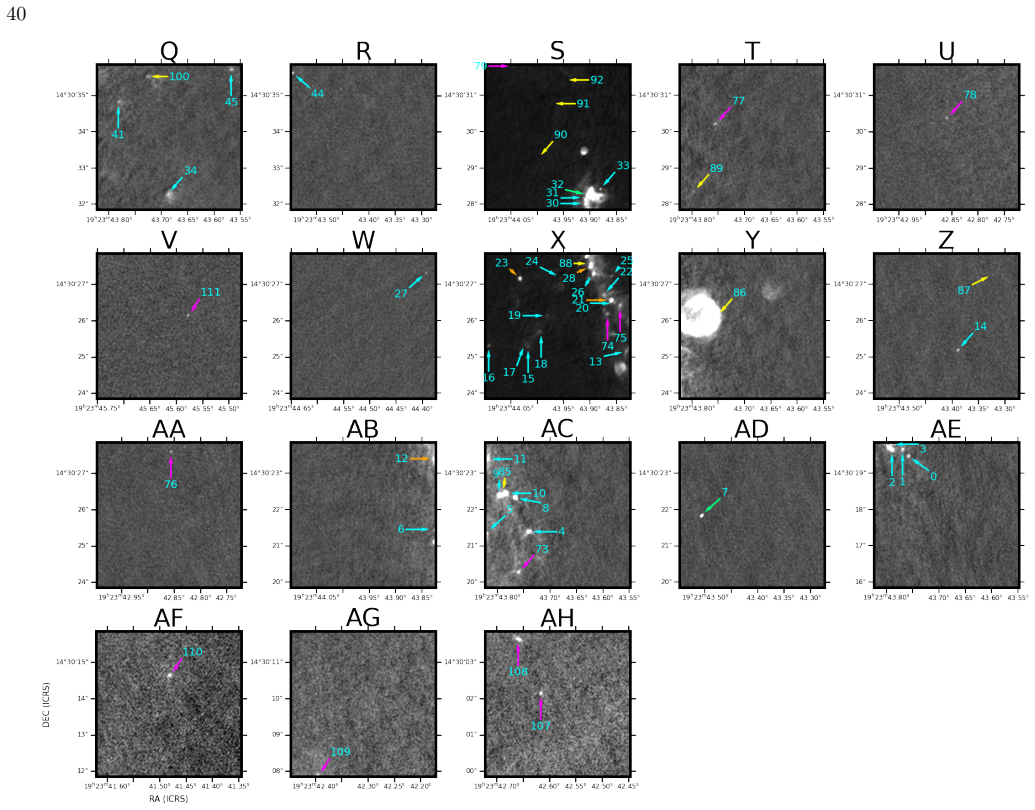
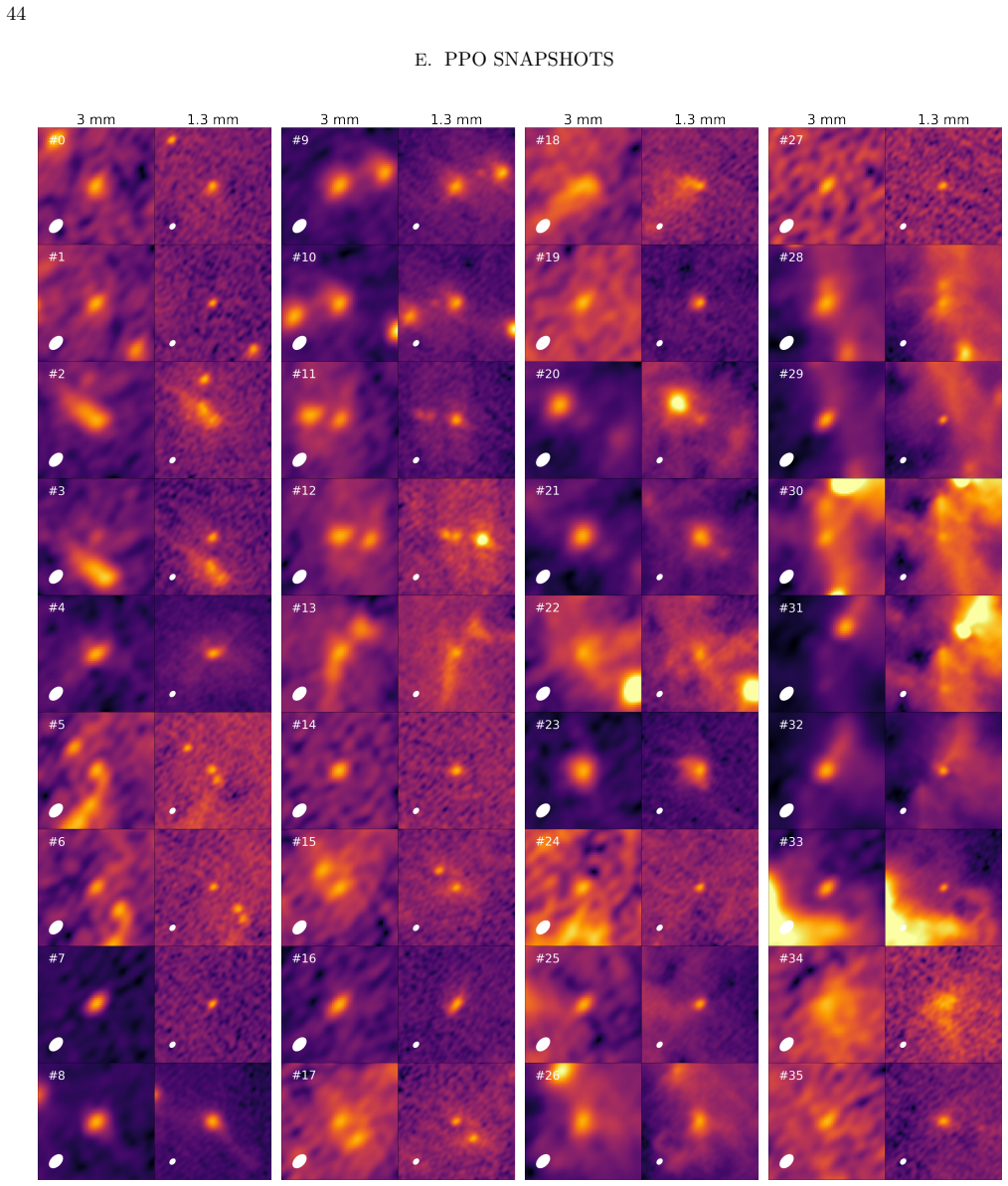
The analysis rests on a two-scale spatial association: ALMA-IMF short-baseline images (resolution about 2000 AU) define cores, while long-baseline images (resolution about 100–300 AU) reveal compact pre/protostellar objects (PPOs). The Jeans efficiency, epsilon_J = N_frag/N_J with N_J = M_core/M_J from the thermal Jeans mass, is the metric that exposes the mismatch between observed fragment counts and thermal predictions.
What would settle it
Repeat the core-to-PPO association on the W51 images with several dendrogram min_delta thresholds (for example 0.5 sigma, 1.5 sigma, and 3 sigma) and recompute the N_frag-M_core Spearman rank and the Jeans efficiencies; if the positive correlation and the low Jeans efficiency vanish at a threshold that still passes completeness tests, the physical trend is an artifact of source finding.
Extended reading notes
Core claim
In the W51-E and W51-IRS2 protoclusters, matching approximately 2000-AU-resolution ALMA-IMF cores to approximately 100–300-AU-resolution compact sources shows that the number of fragments rises with core mass, the flux of the brightest fragment tracks core flux even after the fragment fluxes are subtracted, and fragment fluxes within a core span a wide range rather than being equal. The thermal Jeans number N_J = M_core/M_J is below the observed fragment count in most cores, with average Jeans efficiencies of 5% (W51-E) and 20% (W51-IRS2), and many fragments have mass lower limits that exceed the Jeans mass of their parent core. The paper interprets this as thermal pressure being insufficien
Load-bearing premise
The compact sources counted as fragments are true individual pre/protostellar objects, not transient brightness peaks in a continuous dusty medium; the catalog depends on a threshold-sensitive visual plus dendrogram selection.
Editorial extensions
If this is right
- The number of fragments in a core scales with core mass, so a top-heavy CMF can be steepened toward the IMF without assuming a universal fragmentation efficiency.
- Thermal Jeans mass alone predicts fewer and less massive fragments than observed, so additional support or post-fragmentation accretion is required in high-mass cores.
- Massive protostars appear to suppress further fragmentation nearby: cores with the brightest PPOs show low fragmentation efficiency and wide flux gaps to the next-brightest fragment.
- Fragmented cores are smaller, denser, and more massive than unfragmented ones, implying faster collapse of dense cores or mass growth through accretion.
- Jeans efficiency falls with core mass across W51-E, W51-IRS2, and Perseus, suggesting a common mass-dependent fragmentation behavior.
Reading between the lines
- If fragment counts are set by core mass rather than by thermal Jeans mass, then the CMF-to-IMF mapping must depend on the core mass distribution; this is a testable prediction for other ALMA-IMF protoclusters.
- The low Jeans efficiency at scales of about 100 AU, if real, points to non-thermal support such as magnetic fields or turbulence; this can be tested with ALMA polarization or high-resolution line observations of the same PPOs.
- The difference between this study's and Tang et al.'s fragment counts around W51north implies that published fragmentation properties in high-mass regions are threshold-dependent, so a standardized, completeness-calibrated source finder is needed before claiming physical universality.
Editorial analysis
A structured set of objections, weighed in public.
Referee Report
Summary. This paper studies core fragmentation in the W51-E and W51-IRS2 protoclusters by matching ALMA-IMF cores (≈2700 AU resolution) with compact sources ('PPOs') detected at ≈100–300 AU in archival long-baseline ALMA images. The authors characterize PPOs via spectral indices, sizes, modified-blackbody temperatures, and mass lower limits, and then link them to cores. The main empirical claims are: (i) the number of fragments per core correlates with core mass/flux, even after subtracting summed fragment flux; (ii) brighter PPOs reside in brighter/massive cores; (iii) fragment flux distributions within a core are non-uniform; and (iv) thermal Jeans masses of parent cores cannot account for the observed fragment masses, with Jeans efficiency decreasing toward higher core masses. The paper also compares fragmented and unfragmented cores and discusses core-independent PPOs.
Significance. If these trends hold, the paper provides valuable constraints on the CMF–IMF mapping and on the role of thermal pressure in high-mass star formation. The study connects a large ALMA-IMF sample to ~100 au compact sources in an extreme high-mass region, and the comparison with Perseus and Sgr B2 suggests a possibly general mass-dependence of fragmentation. The paper is transparent and reproducible: machine-readable catalogs are on Zenodo, the TGIF fitting package is public, the authors explicitly discuss caveats (density evolution, temperature resolution, lower-limit masses), and they test for the self-correlation between core flux and fragment count by using residual fluxes. However, the central quantitative claims are built on a PPO catalog whose detection thresholds are environment-dependent, and the Jeans-efficiency analysis is partly coupled to the detected fragment counts by construction. These issues are load-bearing and must be addressed before the empirical trends can be considered robust.
major comments (3)
- [Sec. 3.1, Sec. 5.1.1, Appendix B] The PPO catalog combines visual selection with dendrogram parameters min_delta=1.5σ and an explicit 'independence from background' criterion. The paper's own comparison with Tang et al. (2022) shows that this choice changes fragment counts by a factor of 3–10 in the densest structures (W51north: 6 vs 20 fragments; central continuous structure: 1 vs 10). Appendix B's completeness test injects isolated synthetic sources on a regular grid and therefore does not calibrate the recovery of peaks embedded in bright, structured backgrounds—precisely the environments of the massive cores where the 'independence' cut is most restrictive. Because the censoring is mass-dependent, the N_frag–M_core relation (Fig. 12) and the Jeans efficiencies (Fig. 17) may be biased. In particular, missing low-contrast fragments in massive cores artificially lowers the inferred Jeans efficiency at high M_core, a hea
- [Sec. 4.2.1 / Eq. (6), Sec. 5.1] The core masses used to rank 'massive cores' are computed from the 1.3 mm integrated flux, which includes the flux of the fragments themselves. The residual-flux test (Fig. 12, lower panels) only partially breaks this interdependence because PPO fluxes are lower limits and the subtracted point-source model does not remove all embedded flux. More importantly, the Jeans analysis uses M_core in both the numerator of N_J and, through the density ρ ∝ M_core, in M_J ∝ ρ^{-1/2}; a core with more detected fragments therefore has a larger M_core and a smaller M_J, mechanically lowering ϵ_J = N_frag/N_J. The paper does not estimate the magnitude of this built-in anti-correlation. Please recompute ϵ_J using a core mass from which all detected PPO flux has been removed (or an independent mass tracer) and show that the decreasing Jeans-efficiency trend in Fig. 17 persists.
- [Sec. 5.1 / Fig. 18] The conclusion that 'thermal Jeans masses are insufficient to explain fragment masses' relies on comparing lower-limit PPO masses with parent-core Jeans masses computed from present-day density and temperature. The lower-limit direction is conservative for the individual mass ratios, but the abstract's additional claim that 'this trend is more prominent at high-mass cores' is not directly supported by Fig. 18, which shows no explicit mass-dependence test; the mass-dependence is instead inferred from the ϵ_J trend in Fig. 17, which is affected by the N_J self-correlation described above. Either add a direct mass-dependence test that is insensitive to the N_J definition, or soften the claim.
minor comments (4)
- [Sec. 3.2, Eq. (2)] The sentence after Eq. (2) says the central frequencies are 92.98 GHz and 226.69 GHz 'at 1.3 mm and 3 mm, respectively.' This appears reversed: 92.98 GHz is the Band 3 (3 mm) value and 226.69 GHz is Band 6 (1.3 mm). Please correct the ordering.
- [Sec. 5.3.2, final paragraph] The text states that 'ciPPOs are distinctly fainter than other populations' in W51-E, but a few paragraphs later says 'Higher fluxes of ciPPOs than caPPOs at both 1.3 mm and 3 mm fluxes.' These statements are contradictory; clarify which population is brighter and which comparison is meant.
- [Sec. 4.2.1, paragraph containing Fig. 12] The sentence 'The shaded regions in the right panel of Fig. 8 display 1σ range...' appears to be a cross-reference error: the MCMC fit results are shown in Fig. 12 (right panel), not Fig. 8. Please update the citation.
- [Appendix A] The description of the 2D Gaussian fitting method is useful, but the notation for the penalty factor λ is introduced after the weighted σ formula; define λ before first use for clarity.
Circularity Check
No significant circularity: the central correlations are observational and the only plausible self-contamination (core flux includes fragments) is explicitly controlled in the paper.
full rationale
The paper's claims are observational correlations, not derivations from fitted parameters. The PPO catalog is constructed from long-baseline ALMA images via visual inspection plus dendrogram thresholds, and the core catalog comes from the independent ALMA-IMF getsf products (Louvet et al. 2024). The main potential circularity is that core flux/mass includes the flux of embedded fragments, so the N_frag–M_core correlation could be partly self-induced. The paper identifies this explicitly in Sec. 4.2.1 ('Since the flux of a core implicitly includes the contributions from its fragments, we also present the core flux with the summed fluxes of its fragments subtracted') and shows the correlation persists with p<0.05 after subtraction. The Jeans analysis uses standard definitions (Eqs. 6, 7) and compares measured quantities; no fitted parameter is renamed as a prediction. Self-citations to ALMA-IMF and Budaiev et al. (2024) supply data products and a standard modified-blackbody model, but they do not smuggle in an unverified ansatz or uniqueness theorem that forces the conclusions. The acknowledged threshold sensitivity relative to Tang et al. (2022) is a completeness/selection caveat, not a circular reduction; the paper argues the low fragmentation efficiency conclusion is robust to it. Overall, no load-bearing step reduces by construction to its own inputs.
Assumptions & free parameters
free parameters (4)
- Dust temperature for PPO mass lower limits =
40 K
- Hot core dust temperatures =
100 K, 300 K
- Dendrogram detection thresholds =
min_value=3 sigma, min_delta=1.5 sigma, min_npix=15
- Core-PPO association radius =
core FWHM + ALMA-IMF beam
assumptions (6)
- domain assumption The distance to W51 is 5.4 kpc
- domain assumption Dust opacity from Ossenkopf and Henning (1994) applies at mm wavelengths
- domain assumption PPO masses are lower limits under the optically thin assumption
- domain assumption Core temperatures from PPMAP at 2.5 arcsec resolution are representative of fragmentation-time temperatures
- domain assumption Compact high-res sources are individual pre/protostellar objects
- standard math Jeans mass formula (Binney and Tremaine 1987) with thermal pressure only
Cite this review
Pith. "Pith review of ALMA-IMF XX: Core fragmentation in the W51 high-mass star-forming region." pith.science (2026). https://pith.science/paper/ZWW2O7EP
@misc{pith2026250906749,
  author       = {Pith},
  title        = {Pith review of: ALMA-IMF XX: Core fragmentation in the W51 high-mass star-forming region},
  year         = {2026},
  howpublished = {\url{https://pith.science/paper/ZWW2O7EP}},
  note         = {Machine review of arXiv:2509.06749}
}
read the original abstract
We present a study of core fragmentation in the W51-E and W51-IRS2 protoclusters in the W51 high-mass star-forming region. The identification of core fragmentation is achieved by the spatial correspondence of cores and compact sources which are detected in the short (low resolution) and the long baseline (high resolution) continuum images with the Atacama Large Millimeter/submillimeter Array (ALMA) in Bands 3 (3 mm) and 6 (1.3 mm), respectively. We characterize the compact sources found in the long baseline image, and conclude that the compact sources are pre/protostellar objects (PPOs) that are either prestellar dust cores or dust disks or envelopes around protostars. The observed trend of core fragmentation in W51 is that (i) massive cores host more PPOs, (ii) bright PPOs are preferentially formed in massive cores, (iii) equipartition of flux between PPOs is uncommon. Thermal Jeans masses of parent cores are insufficient to explain the masses of their fragments, and this trend is more prominent at high-mass cores. We also find that unfragmented cores are large, less massive, and less dense than fragmented cores.
Figures


Figures from the paper (34 more)






Reference graph
Works this paper leans on
-
[1]
, " * write output.state after.block = add.period write newline
ENTRY address archivePrefix author booktitle chapter doi edition editor eprint howpublished institution journal key month number organization pages publisher school series title misctitle type volume year version url label extra.label sort.label short.list INTEGERS output.state before.all mid.sentence after.sentence after.block FUNCTION init.state.consts ...
-
[2]
write newline
" write newline "" before.all 'output.state := FUNCTION format.url url empty "" new.block "" url * "" * if FUNCTION format.eprint eprint empty "" archivePrefix empty "" archivePrefix "arXiv" = new.block " " eprint * " " * new.block " " eprint * " " * if if if FUNCTION format.doi doi empty "" " " doi * " " * if FUNCTION format.pid doi empty eprint empty ur...
-
[3]
Zk z 3ĸURR;wA Zhz?^͚5Ӓ 4yduU۷o 34l0=) A9ݻWuM7iȑ1=>7x ] 3FcƌQ XƍgHƎ F iUֱa q &h̘1]xᅺ
thebibliography [1] 20pt to REFERENCES 6pt =0pt -12pt 10pt plus 3pt =0pt =0pt =1pt plus 1pt =0pt =0pt -12pt =13pt plus 1pt =20pt =13pt plus 1pt \@M =10000 =-1.0em =0pt =0pt 0pt =0pt =1.0em @enumiv\@empty 10000 10000 `\.\@m \@noitemerr \@latex@warning Empty `thebibliography' environment \@ifnextchar \@reference \@latexerr Missing key on reference command E...
2021
-
[4]
\'A lvarez-Guti \'e rrez , R. H., Stutz , A. M., Sandoval-Garrido , N., et al. 2024, , 689, A74, 10.1051/0004-6361/202450321
-
[5]
Alves , J., Lombardi , M., & Lada , C. J. 2007, , 462, L17, 10.1051/0004-6361:20066389
-
[6]
2010, , 518, L102, 10.1051/0004-6361/201014666
Andr \'e , P., Men'shchikov , A., Bontemps , S., et al. 2010, , 518, L102, 10.1051/0004-6361/201014666
-
[7]
Ansdell , M., Williams , J. P., Trapman , L., et al. 2018, , 859, 21, 10.3847/1538-4357/aab890
-
[8]
2024, , 686, A122, 10.1051/0004-6361/202347595
Armante , M., Gusdorf , A., Louvet , F., et al. 2024, , 686, A122, 10.1051/0004-6361/202347595
Show all 124 references
-
[9]
P., Tollerud , E
Astropy Collaboration , Robitaille , T. P., Tollerud , E. J., et al. 2013, , 558, A33, 10.1051/0004-6361/201322068
2013 doi
-
[10]
M., Sip o cz , B
Astropy Collaboration , Price-Whelan , A. M., Sip o cz , B. M., et al. 2018, , 156, 123, 10.3847/1538-3881/aabc4f
2018 doi
-
[11]
R., & Meyer , M
Bastian , N., Covey , K. R., & Meyer , M. R. 2010, , 48, 339, 10.1146/annurev-astro-082708-101642
2010 doi
-
[12]
1987, Galactic dynamics
Binney , J., & Tremaine , S. 1987, Galactic dynamics
1987
-
[13]
2024, , 687, A163, 10.1051/0004-6361/202347856
Bonfand , M., Csengeri , T., Bontemps , S., et al. 2024, , 687, A163, 10.1051/0004-6361/202347856
2024 doi
-
[14]
A., & Bate , M
Bonnell , I. A., & Bate , M. R. 2002, , 336, 659, 10.1046/j.1365-8711.2002.05794.x
2002
-
[15]
A., Bate , M
Bonnell , I. A., Bate , M. R., Clarke , C. J., & Pringle , J. E. 2001, , 323, 785, 10.1046/j.1365-8711.2001.04270.x
2001
-
[16]
2010, , 524, A18, 10.1051/0004-6361/200913286
Bontemps , S., Motte , F., Csengeri , T., & Schneider , N. 2010, , 524, A18, 10.1051/0004-6361/200913286
2010 doi
- [17]
-
[18]
2024, , 961, 4, 10.3847/1538-4357/ad0383
Budaiev , N., Ginsburg , A., Jeff , D., et al. 2024, , 961, 4, 10.3847/1538-4357/ad0383
2024 doi
-
[19]
2021, CARTA: Cube Analysis and Rendering Tool for Astronomy , Astrophysics Source Code Library, record ascl:2103.031
Comrie , A., Wang , K.-S., Hsu , S.-C., et al. 2021, CARTA: Cube Analysis and Rendering Tool for Astronomy , Astrophysics Source Code Library, record ascl:2103.031. 2103.031
2021
-
[20]
2024, CARTA: The Cube Analysis and Rendering Tool for Astronomy, 4.1.0, Zenodo, 10.5281/zenodo.15172686
Comrie, A., Wang, K.-S., Hwang, Y.-H., et al. 2024, CARTA: The Cube Analysis and Rendering Tool for Astronomy, 4.1.0, Zenodo, 10.5281/zenodo.15172686
2024 doi
-
[21]
F., Hogerheijde , M
Crapsi , A., van Dishoeck , E. F., Hogerheijde , M. R., Pontoppidan , K. M., & Dullemond , C. P. 2008, , 486, 245, 10.1051/0004-6361:20078589
2008 doi
-
[22]
2017, , 600, L10, 10.1051/0004-6361/201629754
Csengeri , T., Bontemps , S., Wyrowski , F., et al. 2017, , 600, L10, 10.1051/0004-6361/201629754
2017 doi
-
[23]
2019, Journal of Open Source Software, 4, 1317, 10.21105/joss.01317
Davidson-Pilon, C. 2019, Journal of Open Source Software, 4, 1317, 10.21105/joss.01317
2019 doi
-
[24]
2024, , 687, A217, 10.1051/0004-6361/202348984
Dell'Ova , P., Motte , F., Gusdorf , A., et al. 2024, , 687, A217, 10.1051/0004-6361/202348984
2024 doi
- [25]
-
[26]
J., Galv \'a n-Madrid , R., Ginsburg , A., et al
D \' az-Gonz \'a lez , D. J., Galv \'a n-Madrid , R., Ginsburg , A., et al. 2023, , 269, 55, 10.3847/1538-4365/ad029c
2023 doi
-
[27]
A., Greenhill , L
Eisner , J. A., Greenhill , L. J., Herrnstein , J. R., Moran , J. M., & Menten , K. M. 2002, , 569, 334, 10.1086/338968
2002 doi
-
[28]
D., & Fuller , G
Etoka , S., Gray , M. D., & Fuller , G. A. 2012, , 423, 647, 10.1111/j.1365-2966.2012.20900.x
2012
-
[29]
M., et al
Fern \'a ndez-L \'o pez , M., Curiel , S., Girart , J. M., et al. 2011, , 141, 72, 10.1088/0004-6256/141/3/72
2011 doi
-
[30]
B., Izquierdo , A
Galv \'a n-Madrid , R., Liu , H. B., Izquierdo , A. F., et al. 2018, , 868, 39, 10.3847/1538-4357/aae779
2018 doi
-
[31]
A., Johnston , K
Gaume , R. A., Johnston , K. J., & Wilson , T. L. 1993, , 417, 645, 10.1086/173342
1993 doi
-
[32]
H., et al
Genzel , R., Downes , D., Schneps , M. H., et al. 1981, , 247, 1039, 10.1086/159113
1981 doi
-
[33]
1998, , 501, 687, 10.1086/305864
Ghavamian , P., & Hartigan , P. 1998, , 501, 687, 10.1086/305864
1998 doi
- [34]
-
[35]
2015, , 573, A106, 10.1051/0004-6361/201424979
Ginsburg , A., Bally , J., Battersby , C., et al. 2015, , 573, A106, 10.1051/0004-6361/201424979
2015 doi
-
[36]
2019, , 158, 208, 10.3847/1538-3881/ab4790
Ginsburg , A., & Goddi , C. 2019, , 158, 208, 10.3847/1538-3881/ab4790
2019 doi
-
[37]
M., Goddi , C., et al
Ginsburg , A., Goss , W. M., Goddi , C., et al. 2016, , 595, A27, 10.1051/0004-6361/201628318
2016 doi
-
[38]
Ginsburg , A., Goddi , C., Kruijssen , J. M. D., et al. 2017, , 842, 92, 10.3847/1538-4357/aa6bfa
2017 doi
-
[39]
2022, , 662, A9, 10.1051/0004-6361/202141681
Ginsburg , A., Csengeri , T., Galv \'a n-Madrid , R., et al. 2022, , 662, A9, 10.1051/0004-6361/202141681
2022 doi
-
[40]
Girichidis , P., Federrath , C., Banerjee , R., & Klessen , R. S. 2012, , 420, 613, 10.1111/j.1365-2966.2011.20073.x
2012
-
[41]
T., Zhang , Q., & Zapata , L
Goddi , C., Ginsburg , A., Maud , L. T., Zhang , Q., & Zapata , L. A. 2020, , 905, 25, 10.3847/1538-4357/abc88e
2020 doi
-
[42]
2016, , 589, A44, 10.1051/0004-6361/201527855
Goddi , C., Ginsburg , A., & Zhang , Q. 2016, , 589, A44, 10.1051/0004-6361/201527855
2016 doi
-
[43]
Guszejnov , D., & Hopkins , P. F. 2015, , 450, 4137, 10.1093/mnras/stv872
2015 doi
- [44]
-
[45]
R., Millman, K
Harris, C. R., Millman, K. J., van der Walt, S. J., et al. 2020, Nature, 585, 357, 10.1038/s41586-020-2649-2
2020 doi
-
[46]
L., Asiri , H., & Mauersberger , R
Henkel , C., Wilson , T. L., Asiri , H., & Mauersberger , R. 2013, , 549, A90, 10.1051/0004-6361/201220098
2013 doi
-
[47]
Hennebelle , P., & Grudi \'c , M. Y. 2024, , 62, 63, 10.1146/annurev-astro-052622-031748
2024 doi
-
[48]
Hildebrand , R. H. 1983, , 24, 267
1983
-
[49]
R., Anderson , J., et al
Hosek , Matthew W., J., Lu , J. R., Anderson , J., et al. 2019, , 870, 44, 10.3847/1538-4357/aaef90
2019 doi
- [50]
-
[51]
Hunter, J. D. 2007, Computing in Science & Engineering, 9, 90, 10.1109/MCSE.2007.55
2007 doi
-
[52]
2002, , 54, 741, 10.1093/pasj/54.5.741
Imai , H., Watanabe , T., Omodaka , T., et al. 2002, , 54, 741, 10.1093/pasj/54.5.741
2002 doi
-
[53]
Kelly , B. C. 2007, , 665, 1489, 10.1086/519947
2007 doi
-
[54]
2008, , 672, 423, 10.1086/522570
Keto , E., Zhang , Q., & Kurtz , S. 2008, , 672, 423, 10.1086/522570
2008 doi
-
[55]
M., Tang , Y.-W., Ho , P
Koch , P. M., Tang , Y.-W., Ho , P. T. P., et al. 2022, , 940, 89, 10.3847/1538-4357/ac96e3
2022 doi
-
[56]
2019, , 873, 31, 10.3847/1538-4357/aaffd5
Kong , S. 2019, , 873, 31, 10.3847/1538-4357/aaffd5
2019 doi
- [57]
-
[58]
R., Klein , R
Krumholz , M. R., Klein , R. I., & McKee , C. F. 2007, , 656, 959, 10.1086/510664
2007 doi
-
[59]
Kumar , M. S. N., Kamath , U. S., & Davis , C. J. 2004, , 353, 1025, 10.1111/j.1365-2966.2004.08143.x
2004
-
[60]
I.-H., Liu , H
Li , J. I.-H., Liu , H. B., Hasegawa , Y., & Hirano , N. 2017, , 840, 72, 10.3847/1538-4357/aa6f04
2017 doi
- [61]
-
[62]
2019, , 631, A72, 10.1051/0004-6361/201935410
Lin , Y., Csengeri , T., Wyrowski , F., et al. 2019, , 631, A72, 10.1051/0004-6361/201935410
2019 doi
-
[63]
2014, , 570, A15, 10.1051/0004-6361/201423603
Louvet , F., Motte , F., Hennebelle , P., et al. 2014, , 570, A15, 10.1051/0004-6361/201423603
2014 doi
- [64]
-
[65]
R., Do , T., Ghez , A
Lu , J. R., Do , T., Ghez , A. M., et al. 2013, , 764, 155, 10.1088/0004-637X/764/2/155
2013 doi
-
[66]
2020, , 894, L14, 10.3847/2041-8213/ab8b65
Lu , X., Cheng , Y., Ginsburg , A., et al. 2020, , 894, L14, 10.3847/2041-8213/ab8b65
2020 doi
-
[67]
Maia , F. F. S., Moraux , E., & Joncour , I. 2016, , 458, 3027, 10.1093/mnras/stw450
2016 doi
-
[68]
A., Whitworth , A
Marsh , K. A., Whitworth , A. P., & Lomax , O. 2015, , 454, 4282, 10.1093/mnras/stv2248
2015 doi
- [69]
- [70]
-
[71]
P., Waters , B., Schiebel , D., Young , W., & Golap , K
McMullin , J. P., Waters , B., Schiebel , D., Young , W., & Golap , K. 2007, in Astronomical Society of the Pacific Conference Series, Vol. 376, Astronomical Data Analysis Software and Systems XVI, ed. R. A. Shaw , F. Hill , & D. J. Bell , 127
2007
-
[72]
2021, , 649, A89, 10.1051/0004-6361/202039913
Men'shchikov , A. 2021, , 649, A89, 10.1051/0004-6361/202039913
2021 doi
-
[73]
2023, , 950, 148, 10.3847/1538-4357/acccea
Morii , K., Sanhueza , P., Nakamura , F., et al. 2023, , 950, 148, 10.3847/1538-4357/acccea
2023 doi
-
[74]
2024, , 966, 171, 10.3847/1538-4357/ad32d0
Morii , K., Sanhueza , P., Zhang , Q., et al. 2024, , 966, 171, 10.3847/1538-4357/ad32d0
2024 doi
-
[75]
K., & Ishiguro , M
Morita , K.-I., Hasegawa , T., Ukita , N., Okumura , S. K., & Ishiguro , M. 1992, , 44, 373
1992
-
[76]
1998, , 336, 150
Motte , F., Andre , P., & Neri , R. 1998, , 336, 150
1998
-
[77]
2018, , 56, 41, 10.1146/annurev-astro-091916-055235
Motte , F., Bontemps , S., & Louvet , F. 2018, , 56, 41, 10.1146/annurev-astro-091916-055235
2018 doi
-
[78]
2022, , 662, A8, 10.1051/0004-6361/202141677
Motte , F., Bontemps , S., Csengeri , T., et al. 2022, , 662, A8, 10.1051/0004-6361/202141677
2022 doi
-
[79]
2025, , 694, A24, 10.1051/0004-6361/202451931
Motte , F., Pouteau , Y., Nony , T., et al. 2025, , 694, A24, 10.1051/0004-6361/202451931
2025 doi
-
[80]
B., & Ingargiola, A
Newville, M., Stensitzki, T., Allen, D. B., & Ingargiola, A. 2015, LMFIT: Non-Linear Least-Square Minimization and Curve-Fitting for Python , 0.8.0, Zenodo, 10.5281/zenodo.11813
2015 doi
-
[81]
2023, , 674, A75, 10.1051/0004-6361/202244762
Nony , T., Galv \'a n-Madrid , R., Motte , F., et al. 2023, , 674, A75, 10.1051/0004-6361/202244762
2023 doi
-
[82]
Offner , S. S. R., Clark , P. C., Hennebelle , P., et al. 2014, in PPVII, 53--75, 10.2458/azu_uapress_9780816531240-ch003
2014 doi
- [83]
-
[84]
2016, , 590, A107, 10.1051/0004-6361/201628233
Oh , S., & Kroupa , P. 2016, , 590, A107, 10.1051/0004-6361/201628233
2016 doi
-
[85]
2015, , 805, 92, 10.1088/0004-637X/805/2/92
Oh , S., Kroupa , P., & Pflamm-Altenburg , J. 2015, , 805, 92, 10.1088/0004-637X/805/2/92
2015 doi
-
[86]
2000, , 543, 799, 10.1086/317116
Okumura , S.-i., Mori , A., Nishihara , E., Watanabe , E., & Yamashita , T. 2000, , 543, 799, 10.1086/317116
2000 doi
-
[87]
1994, , 291, 943
Ossenkopf , V., & Henning , T. 1994, , 291, 943
1994
-
[88]
2002, , 576, 870, 10.1086/341790
Padoan , P., & Nordlund , A . 2002, , 576, 870, 10.1086/341790
2002 doi
-
[89]
2020, , 900, 82, 10.3847/1538-4357/abaa47
Padoan , P., Pan , L., Juvela , M., Haugb lle , T., & Nordlund , A . 2020, , 900, 82, 10.3847/1538-4357/abaa47
2020 doi
-
[90]
M., Juvela , M., Haugb lle , T., & Nordlund , A
Padoan , P., Pelkonen , V. M., Juvela , M., Haugb lle , T., & Nordlund , A . 2023, , 522, 3548, 10.1093/mnras/stad1213
2023 doi
-
[91]
2015, , 453, 3785, 10.1093/mnras/stv1834
Palau , A., Ballesteros-Paredes , J., V \'a zquez-Semadeni , E., et al. 2015, , 453, 3785, 10.1093/mnras/stv1834
2015 doi
-
[92]
M., et al
Palau , A., Zhang , Q., Girart , J. M., et al. 2021, , 912, 159, 10.3847/1538-4357/abee1e
2021 doi
-
[93]
2024, , 960, 76, 10.3847/1538-4357/ad10ac
Pan , S., Liu , H.-L., & Qin , S.-L. 2024, , 960, 76, 10.3847/1538-4357/ad10ac
2024 doi
-
[94]
Phillips , C., & van Langevelde , H. J. 2005, in Astronomical Society of the Pacific Conference Series, Vol. 340, Future Directions in High Resolution Astronomy, ed. J. Romney & M. Reid , 342
2005
-
[95]
C., Dunham , M
Pokhrel , R., Myers , P. C., Dunham , M. M., et al. 2018, , 853, 5, 10.3847/1538-4357/aaa240
2018 doi
-
[96]
2022, , 664, A26, 10.1051/0004-6361/202142951
Pouteau , Y., Motte , F., Nony , T., et al. 2022, , 664, A26, 10.1051/0004-6361/202142951
2022 doi
-
[97]
2001, , 122, 432, 10.1086/321121
Reipurth , B., & Clarke , C. 2001, , 122, 432, 10.1086/321121
2001 doi
-
[98]
Richardson , T., Ginsburg , A., Indebetouw , R., & Robitaille , T. P. 2024, , 961, 188, 10.3847/1538-4357/ad072d
2024 doi
-
[99]
A., et al
Rong , J., Qin , S.-L., Zapata , L. A., et al. 2016, , 455, 1428, 10.1093/mnras/stv2406
2016 doi
-
[100]
W., Pineda , J
Rosolowsky , E. W., Pineda , J. E., Kauffmann , J., & Goodman , A. A. 2008, , 679, 1338, 10.1086/587685
2008 doi
-
[101]
Salpeter , E. E. 1955, , 121, 161, 10.1086/145971
1955 doi
-
[102]
A., Stutz , A
Sandoval-Garrido , N. A., Stutz , A. M., \'A lvarez-Guti \'e rrez , R. H., et al. 2024, arXiv e-prints, arXiv:2410.09843. 2410.09843
2024 arXiv
-
[103]
2019, , 886, 102, 10.3847/1538-4357/ab45e9
Sanhueza , P., Contreras , Y., Wu , B., et al. 2019, , 886, 102, 10.3847/1538-4357/ab45e9
2019 doi
-
[104]
M., Padovani , M., et al
Sanhueza , P., Girart , J. M., Padovani , M., et al. 2021, , 915, L10, 10.3847/2041-8213/ac081c
2021 doi
-
[105]
J., Brunthaler , A., & Menten , K
Sato , M., Reid , M. J., Brunthaler , A., & Menten , K. M. 2010, , 720, 1055, 10.1088/0004-637X/720/2/1055
2010 doi
-
[106]
J., Nutter , D., & Ward-Thompson , D
Simpson , R. J., Nutter , D., & Ward-Thompson , D. 2008, , 391, 205, 10.1111/j.1365-2966.2008.13750.x
2008
-
[107]
A., & Qin , S.-L
Tang , M., Palau , A., Zapata , L. A., & Qin , S.-L. 2022, , 657, A30, 10.1051/0004-6361/202038741
2022 doi
-
[108]
J., Sheehan , P
Tobin , J. J., Sheehan , P. D., Megeath , S. T., et al. 2020, , 890, 130, 10.3847/1538-4357/ab6f64
2020 doi
-
[109]
K., Broos , P
Townsley , L. K., Broos , P. S., Garmire , G. P., et al. 2014, , 213, 1, 10.1088/0067-0049/213/1/1
2014 doi
-
[110]
C., & Zamora-Avil \'e s , M
V \'a zquez-Semadeni , E., Palau , A., Ballesteros-Paredes , J., G \'o mez , G. C., & Zamora-Avil \'e s , M. 2019, , 490, 3061, 10.1093/mnras/stz2736
2019 doi
-
[111]
E., et al
Virtanen, P., Gommers, R., Oliphant, T. E., et al. 2020, Nature Methods, 17, 261, 10.1038/s41592-019-0686-2
2020 doi
-
[112]
2024, in American Astronomical Society Meeting Abstracts, Vol
Wainer , T., Williams , B., Weisz , D., et al. 2024, in American Astronomical Society Meeting Abstracts, Vol. 243, American Astronomical Society Meeting Abstracts, 428.02
2024
-
[113]
Waskom, M. L. 2021, Journal of Open Source Software, 6, 3021, 10.21105/joss.03021
2021 doi
-
[114]
R., Johnson , L
Weisz , D. R., Johnson , L. C., Foreman-Mackey , D., et al. 2015, , 806, 198, 10.1088/0004-637X/806/2/198
2015 doi
-
[115]
L., Rohlfs , K., & H \"u ttemeister , S
Wilson , T. L., Rohlfs , K., & H \"u ttemeister , S. 2013, Tools of Radio Astronomy , 10.1007/978-3-642-39950-3
2013 doi
-
[116]
2024, , 270, 9, 10.3847/1538-4365/acfee5
Xu , F., Wang , K., Liu , T., et al. 2024, , 270, 9, 10.3847/1538-4365/acfee5
2024 doi
-
[117]
J., Menten , K
Xu , Y., Reid , M. J., Menten , K. M., et al. 2009, , 693, 413, 10.1088/0004-637X/693/1/413
2009 doi
-
[118]
2023, , 953, 40, 10.3847/1538-4357/acdf42
Yang , D., Liu , H.-L., Tej , A., et al. 2023, , 953, 40, 10.3847/1538-4357/acdf42
2023 doi
-
[119]
2024, TGIF: Two d Gaussian In Fitting, Zenodo, 10.5281/zenodo.13973837
Yoo, T., & Ginsburg, A. 2024, TGIF: Two d Gaussian In Fitting, Zenodo, 10.5281/zenodo.13973837
2024 doi
-
[120]
A., Ho , P
Zapata , L. A., Ho , P. T. P., Schilke , P., et al. 2009, , 698, 1422, 10.1088/0004-637X/698/2/1422
2009 doi
-
[121]
A., Tang , Y.-W., & Leurini , S
Zapata , L. A., Tang , Y.-W., & Leurini , S. 2010, , 725, 1091, 10.1088/0004-637X/725/1/1091
2010 doi
-
[122]
Zhang , Q., & Ho , P. T. P. 1997, , 488, 241, 10.1086/304667
1997 doi
-
[123]
2015, , 804, 141, 10.1088/0004-637X/804/2/141
Zhang , Q., Wang , K., Lu , X., & Jim \'e nez-Serra , I. 2015, , 804, 141, 10.1088/0004-637X/804/2/141
2015 doi
-
[124]
2009, , 696, 268, 10.1088/0004-637X/696/1/268
Zhang , Q., Wang , Y., Pillai , T., & Rathborne , J. 2009, , 696, 268, 10.1088/0004-637X/696/1/268
2009 doi
Reviewed August 4, 2026 · model on record in the stance chip above.
Discussion (0). Continue with ORCID to comment.