Jet cone size dependence of single inclusive jet suppression due to jet quenching in Pb+Pb collisions at sqrt{s_{rm NN}}=5.02 TeV
Pith reviewed 2026-05-18 17:38 UTC · model grok-4.3
The pith
The nuclear modification factor R_AA for jets in Pb+Pb collisions increases with jet cone size R as in-cone energy loss decreases.
A machine-rendered reading of the paper's core claim, the machinery that carries it, and where it could break.
Core claim
Within the perturbative QCD parton model that incorporates both elastic and inelastic energy loss, the jet nuclear modification factor R_AA increases with cone size R because the net in-cone energy loss decreases at larger radii. As R grows, the probability that elastically scattered partons escape the cone and the chance that radiated gluons fall outside the cone both drop, yielding less apparent suppression. The double ratios R_AA(R=0.4)/R_AA(R=0.2) and similar ratios up to R=1.0 remain approximately unity for small radii and for p_T above 200 GeV/c, consistent with the measured data within uncertainties.
What carries the argument
The cone radius R applied to in-cone energy loss, where elastic contributions are reduced by recoiling thermal partons and inelastic contributions are shaped by the angular distribution of radiated gluons plus their thermalization.
If this is right
- R_AA increases with jet cone size R because in-cone energy loss falls at larger radii.
- Double ratios of R_AA for different cone sizes stay close to one at small R and high p_T.
- The calculated R dependence agrees with ALICE, ATLAS, and CMS data in 0-10% and 30-50% centrality classes.
- The R dependence supplies direct information on the angular character of jet energy loss in the QGP.
Where Pith is reading between the lines
- The same framework could be used to predict how cone-size choice affects other jet observables such as jet mass or substructure in the same collisions.
- If the R dependence persists in future data at different beam energies, it would constrain the transport coefficients that govern gluon radiation angles.
- Measurements with very large cones might reveal whether additional medium-induced effects outside the model become important.
Load-bearing premise
The specific angular distributions chosen for radiated gluons and the modeling of soft gluon thermalization correctly determine how much energy remains inside the jet cone.
What would settle it
Precision measurements showing R_AA decreasing with increasing R at high p_T, or double ratios far from unity beyond experimental uncertainties, would indicate that the reduction in in-cone energy loss with larger cones does not hold.
Figures



read the original abstract
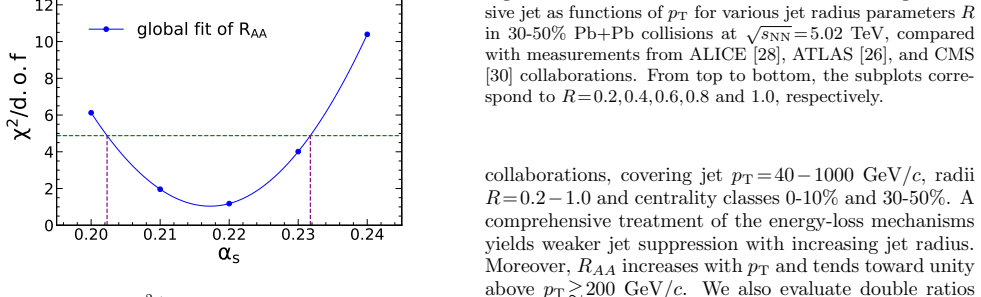
Jet suppression in high-energy heavy-ion collisions results from jet energy loss and transverse-momentum broadening during jet propagation through the quark-gluon plasma (QGP). The jet cone size ($R$) dependence of this suppression offers crucial insights into the energy loss mechanisms and QGP transport properties. In our study, we implement a comprehensive approach within the perturbative QCD parton model that incorporates both elastic and inelastic energy loss mechanisms. For elastic processes the contribution from recoiling thermal partons reduces the net in-cone energy loss for a given jet radius. For inelastic processes, we account for the angular distribution of radiated gluons, the thermalization of soft gluons, and transverse-momentum broadening. Using this framework, we calculate the jet nuclear modification factors ($R_{AA}$) and their double ratios $R_{AA}(R=0.2-1.0)/R_{AA}(R=0.2)$, and systematically compare with ALICE, ATLAS and CMS data in 0-10\% and 30-50\% Pb+Pb collisions at $\sqrt{s_{\rm NN}}$ = 5.02~TeV. Numerical results show that $R_{AA}$ increases with the cone size $R$ because the in-cone energy loss decreases at larger radii. Specifically, as the radius $R$ grows, the probability for elastically scattered partons to escape the jet cone and the likelihood for radiated gluons to fall outside the cone both decrease, resulting in a net reduction of energy loss. The $R_{AA}$ double ratios are approximately unity for small radii ($R=0.4$ relative to $R=0.2$) and at high $p_{\rm T}\gtrsim200$ GeV$/c$, in agreement with the data within uncertainties.
Editorial analysis
A structured set of objections, weighed in public.
Referee Report
Summary. The manuscript presents a perturbative QCD parton model calculation of single-inclusive jet nuclear modification factors R_AA in Pb+Pb collisions at 5.02 TeV, incorporating both elastic (with recoiling thermal partons) and inelastic (with angular gluon distributions, soft-gluon thermalization, and p_T broadening) energy-loss mechanisms. It computes R_AA(R) for cone sizes R = 0.2–1.0 and the double ratios R_AA(R)/R_AA(R=0.2), reporting that R_AA increases with R because the net in-cone energy loss decreases, and compares the results to ALICE, ATLAS, and CMS data in 0–10% and 30–50% centrality classes.
Significance. If the modeling assumptions are robust, the work provides a concrete link between observed R dependence and the relative importance of elastic recoil versus medium-induced radiation, offering a potential handle on QGP transport coefficients. The multi-experiment, multi-centrality comparison is a positive feature.
major comments (1)
- [inelastic energy loss modeling] The central claim that R_AA increases with R rests on the assumed angular distribution of radiated gluons and the thermalization cutoff for soft gluons (inelastic energy-loss implementation). No quantitative variation of these distributions or cutoffs is shown; altering them would directly modify the escape probability for scattered partons and the out-of-cone gluon fraction, thereby changing the predicted R dependence and double ratios at high p_T.
minor comments (1)
- [Abstract] The abstract states that double ratios are 'approximately unity' for R=0.4/0.2 at high p_T but does not quantify the deviation or propagate model uncertainties.
Simulated Author's Rebuttal
We thank the referee for the careful review, the positive assessment of the work's significance, and the constructive major comment. We address the concern on inelastic energy-loss modeling below and will strengthen the manuscript accordingly.
read point-by-point responses
-
Referee: [inelastic energy loss modeling] The central claim that R_AA increases with R rests on the assumed angular distribution of radiated gluons and the thermalization cutoff for soft gluons (inelastic energy-loss implementation). No quantitative variation of these distributions or cutoffs is shown; altering them would directly modify the escape probability for scattered partons and the out-of-cone gluon fraction, thereby changing the predicted R dependence and double ratios at high p_T.
Authors: We agree that an explicit quantitative sensitivity study to the gluon angular distribution and soft-gluon thermalization cutoff would improve the robustness assessment. Our current implementation follows standard pQCD-based assumptions for medium-induced radiation (including angular spectra and thermalization), but the original manuscript does not display variations of these choices. In the revised version we will add such a study, varying the parameters over physically motivated ranges, and show that the qualitative rise of R_AA with R persists, although the precise magnitude of the double ratios can shift. We will also clarify that the net reduction in in-cone energy loss arises from the combined elastic-recoil and inelastic-radiation contributions, with the latter's out-of-cone fraction decreasing at larger R. revision: yes
Circularity Check
No significant circularity in derivation of R_AA(R) dependence
full rationale
The paper implements a pQCD parton model with explicit elastic and inelastic energy loss, incorporating recoiling thermal partons for elastic processes and angular distributions plus thermalization for inelastic processes. The claimed increase of R_AA with jet cone size R follows directly from reduced in-cone energy loss at larger R, arising from lower escape probability for elastically scattered partons and lower fraction of radiated gluons outside the cone. These mechanisms are model inputs leading to numerical calculations of R_AA and double ratios, which are then compared to ALICE, ATLAS, and CMS data. No equations or steps in the provided text reduce the central result to a self-definition, a fitted parameter renamed as prediction, or a load-bearing self-citation chain. The derivation remains self-contained with independent physical content.
Axiom & Free-Parameter Ledger
axioms (2)
- domain assumption Perturbative QCD parton model remains valid for jet propagation through the QGP
- domain assumption Angular distribution of radiated gluons and thermalization of soft gluons follow the forms used in prior jet-quenching calculations
Lean theorems connected to this paper
-
IndisputableMonolith/Cost/FunctionalEquation.leanwashburn_uniqueness_aczel unclear?
unclearRelation between the paper passage and the cited Recognition theorem.
For elastic processes the contribution from recoiling thermal partons reduces the net in-cone energy loss... For inelastic processes, we account for the angular distribution of radiated gluons, the thermalization of soft gluons, and transverse-momentum broadening... (1−θ(zE−μD)θ(zE sin R − |lT + ΔlT|))
-
IndisputableMonolith/Foundation/AlphaCoordinateFixation.leanJ_uniquely_calibrated_via_higher_derivative unclear?
unclearRelation between the paper passage and the cited Recognition theorem.
Numerical results show that RAA increases with the cone size R because the in-cone energy loss decreases at larger radii
What do these tags mean?
- matches
- The paper's claim is directly supported by a theorem in the formal canon.
- supports
- The theorem supports part of the paper's argument, but the paper may add assumptions or extra steps.
- extends
- The paper goes beyond the formal theorem; the theorem is a base layer rather than the whole result.
- uses
- The paper appears to rely on the theorem as machinery.
- contradicts
- The paper's claim conflicts with a theorem or certificate in the canon.
- unclear
- Pith found a possible connection, but the passage is too broad, indirect, or ambiguous to say the theorem truly supports the claim.
Reference graph
Works this paper leans on
-
[1]
and ALICE [27, 50] Collaborations also measured the suppression of inclusive jet production in 2.76 TeV Pb+Pb collisions and pointed out that the jet suppres- sion does not depend onR. For lower-p T jets, differences arXiv:2509.07842v1 [hep-ph] 9 Sep 2025 2 in background-subtraction methods and jet-selection cri- teria may affect the jet yield measurement...
work page internal anchor Pith review Pith/arXiv arXiv 2025
-
[2]
From top to bottom, the subplots corre- spond toR=0.2,0.4,0.6,0.8 and 1.0, respectively
collaborations. From top to bottom, the subplots corre- spond toR=0.2,0.4,0.6,0.8 and 1.0, respectively. escape the jet cone decreases, and (ii) the likelihood that recoiling medium partons fall inside the cone increases. The data, however, exhibit a weakerRdependence than predicted, indicating that the in-cone energy-loss dynam- ics may require further r...
-
[3]
groups, coveringp T =40−800 GeV/c. Similar to, and in some cases even better than, the results in 0-10% centrality class, the theoretical results are consistent with the experimental data for all jet radii within the uncer- tainties, especially at highp T range. This phenomenon further points that in non-central collisions and at large pT, the sensitivity...
-
[4]
From top to bottom, the subplots corre- spond toR=0.2,0.4,0.6,0.8 and 1.0, respectively
collaborations. From top to bottom, the subplots corre- spond toR=0.2,0.4,0.6,0.8 and 1.0, respectively. collaborations, covering jetp T =40−1000 GeV/c, radii R=0.2−1.0 and centrality classes 0-10% and 30-50%. A comprehensive treatment of the energy-loss mechanisms yields weaker jet suppression with increasing jet radius. Moreover,R AA increases withp T a...
-
[5]
K. Adcox et al. (PHENIX), Phys. Rev. Lett.88, 022301 (2002), arXiv:nucl-ex/0109003
work page internal anchor Pith review Pith/arXiv arXiv 2002
-
[6]
K. Adcox et al. (PHENIX), Phys. Lett. B561, 82 (2003), arXiv:nucl-ex/0207009
work page internal anchor Pith review Pith/arXiv arXiv 2003
-
[7]
S. S. Adler et al. (PHENIX), Phys. Rev. Lett.91, 072301 (2003), arXiv:nucl-ex/0304022
work page internal anchor Pith review Pith/arXiv arXiv 2003
-
[8]
A. Adare et al. (PHENIX), Phys. Rev. C87, 034911 (2013), arXiv:1208.2254 [nucl-ex]
work page internal anchor Pith review Pith/arXiv arXiv 2013
-
[9]
J. Adams et al. (STAR), Phys. Rev. Lett.91, 172302 (2003), arXiv:nucl-ex/0305015
work page internal anchor Pith review Pith/arXiv arXiv 2003
-
[10]
Direct observation of dijets in central Au+Au collisions at sqrt(s_NN) = 200 GeV
J. Adams et al. (STAR), Phys. Rev. Lett.97, 162301 (2006), arXiv:nucl-ex/0604018
work page internal anchor Pith review Pith/arXiv arXiv 2006
-
[11]
L. Adamczyk et al. (STAR), Phys. Rev. C96, 024905 (2017), arXiv:1702.01108 [nucl-ex]
work page internal anchor Pith review Pith/arXiv arXiv 2017
-
[12]
K. Aamodt et al. (ALICE), Phys. Rev. Lett.105, 252301 (2010), arXiv:1011.3916 [nucl-ex]
work page internal anchor Pith review Pith/arXiv arXiv 2010
-
[13]
K. Aamodt et al. (ALICE), Phys. Rev. Lett.106, 032301 (2011), arXiv:1012.1657 [nucl-ex]
work page internal anchor Pith review Pith/arXiv arXiv 2011
-
[14]
S. Chatrchyan et al. (CMS), JHEP08, 141 (2011), arXiv:1107.4800 [nucl-ex]
work page internal anchor Pith review Pith/arXiv arXiv 2011
-
[15]
S. Chatrchyan et al. (CMS), Eur. Phys. J. C72, 2012 (2012), arXiv:1201.3158 [nucl-ex]
work page internal anchor Pith review Pith/arXiv arXiv 2012
-
[16]
G. Aad et al. (ATLAS), Phys. Lett. B707, 330 (2012), arXiv:1108.6018 [hep-ex]. 11
work page internal anchor Pith review Pith/arXiv arXiv 2012
-
[17]
G. Aad et al. (ATLAS), JHEP11, 183 (2013), arXiv:1305.2942 [hep-ex]
work page internal anchor Pith review Pith/arXiv arXiv 2013
-
[18]
Multiple Collisions and Induced Gluon Bremsstrahlung in QCD
M. Gyulassy and X.-n. Wang, Nucl. Phys. B420, 583 (1994), arXiv:nucl-th/9306003
work page internal anchor Pith review Pith/arXiv arXiv 1994
- [19]
-
[20]
Non-Abelian Energy Loss at Finite Opacity
M. Gyulassy, P. Levai, and I. Vitev, Phys. Rev. Lett. 85, 5535 (2000), arXiv:nucl-th/0005032
work page internal anchor Pith review Pith/arXiv arXiv 2000
-
[21]
X.-f. Guo and X.-N. Wang, Phys. Rev. Lett.85, 3591 (2000), arXiv:hep-ph/0005044
work page internal anchor Pith review Pith/arXiv arXiv 2000
-
[22]
Multiple Parton Scattering in Nuclei: Modified DGLAP Evolution for Fragmentation Functions
W.-t. Deng and X.-N. Wang, Phys. Rev. C81, 024902 (2010), arXiv:0910.3403 [hep-ph]
work page internal anchor Pith review Pith/arXiv arXiv 2010
-
[23]
Jet quenching in high-energy heavy-ion collisions
G.-Y. Qin and X.-N. Wang, Int. J. Mod. Phys. E24, 1530014 (2015), arXiv:1511.00790 [hep-ph]
work page internal anchor Pith review Pith/arXiv arXiv 2015
-
[24]
A. Adare et al. (PHENIX), Phys. Rev. Lett.101, 232301 (2008), arXiv:0801.4020 [nucl-ex]
work page internal anchor Pith review Pith/arXiv arXiv 2008
-
[25]
G. Aad et al. (ATLAS), JHEP09, 050 (2015), arXiv:1504.04337 [hep-ex]
work page internal anchor Pith review Pith/arXiv arXiv 2015
-
[26]
Charged-particle nuclear modification factors in PbPb and pPb collisions at sqrt(s[NN]) = 5.02 TeV
V. Khachatryan et al. (CMS), JHEP04, 039 (2017), arXiv:1611.01664 [nucl-ex]
work page internal anchor Pith review Pith/arXiv arXiv 2017
-
[27]
S. Acharya et al. (ALICE), JHEP11, 013 (2018), arXiv:1802.09145 [nucl-ex]
work page internal anchor Pith review Pith/arXiv arXiv 2018
-
[28]
J. Adam et al. (STAR), Phys. Rev. C102, 054913 (2020), arXiv:2006.00582 [nucl-ex]
-
[29]
G. Aad et al. (ATLAS), Phys. Rev. Lett.114, 072302 (2015), arXiv:1411.2357 [hep-ex]
work page internal anchor Pith review Pith/arXiv arXiv 2015
- [30]
-
[31]
Measurement of jet suppression in central Pb-Pb collisions at $\sqrt{s_{\rm NN}}$ = 2.76 TeV
J. Adam et al. (ALICE), Phys. Lett. B746, 1 (2015), arXiv:1502.01689 [nucl-ex]
work page internal anchor Pith review Pith/arXiv arXiv 2015
-
[32]
S. Acharya et al. (ALICE), Phys. Lett. B849, 138412 (2024), arXiv:2303.00592 [nucl-ex]
-
[33]
Measurement of inclusive jet cross sections in pp and PbPb collisions at sqrt(s[NN]) = 2.76 TeV
V. Khachatryan et al. (CMS), Phys. Rev. C96, 015202 (2017), arXiv:1609.05383 [nucl-ex]
work page internal anchor Pith review Pith/arXiv arXiv 2017
- [34]
- [35]
- [36]
-
[37]
Tomography of high-energy nuclear collisions with photon-hadron correlations
H. Zhang, J. F. Owens, E. Wang, and X.-N. Wang, Phys. Rev. Lett.103, 032302 (2009), arXiv:0902.4000 [nucl-th]
work page internal anchor Pith review Pith/arXiv arXiv 2009
-
[38]
Dihadron Tomography of High-Energy Nuclear Collisions in NLO pQCD
H. Zhang, J. F. Owens, E. Wang, and X.-N. Wang, Phys. Rev. Lett.98, 212301 (2007), arXiv:nucl-th/0701045
work page internal anchor Pith review Pith/arXiv arXiv 2007
-
[39]
X.-F. Chen, T. Hirano, E. Wang, X.-N. Wang, and H. Zhang, Phys. Rev. C84, 034902 (2011), arXiv:1102.5614 [nucl-th]
work page internal anchor Pith review Pith/arXiv arXiv 2011
- [40]
- [41]
-
[42]
MARTINI: An event generator for relativistic heavy-ion collisions
B. Schenke, C. Gale, and S. Jeon, Phys. Rev. C80, 054913 (2009), arXiv:0909.2037 [hep-ph]
work page internal anchor Pith review Pith/arXiv arXiv 2009
-
[43]
G.-Y. Qin, J. Ruppert, C. Gale, S. Jeon, G. D. Moore, and M. G. Mustafa, Phys. Rev. Lett.100, 072301 (2008), arXiv:0710.0605 [hep-ph]
work page internal anchor Pith review Pith/arXiv arXiv 2008
-
[44]
J. Xu, J. Liao, and M. Gyulassy, Chin. Phys. Lett.32, 092501 (2015), arXiv:1411.3673 [hep-ph]
work page internal anchor Pith review Pith/arXiv arXiv 2015
-
[45]
K. M. Burke et al. (JET), Phys. Rev. C90, 014909 (2014), arXiv:1312.5003 [nucl-th]
work page internal anchor Pith review Pith/arXiv arXiv 2014
-
[47]
A. Kumar et al. (JETSCAPE), Phys. Rev. C107, 034911 (2023), arXiv:2204.01163 [hep-ph]
- [48]
- [49]
-
[50]
Y. He, S. Cao, W. Chen, T. Luo, L.-G. Pang, and X.-N. Wang, Phys. Rev. C99, 054911 (2019), arXiv:1809.02525 [nucl-th]
work page internal anchor Pith review Pith/arXiv arXiv 2019
- [51]
- [52]
-
[53]
G. Aad et al. (ATLAS), Phys. Lett. B719, 220 (2013), arXiv:1208.1967 [hep-ex]
work page internal anchor Pith review Pith/arXiv arXiv 2013
-
[54]
Measurement of charged jet suppression in Pb-Pb collisions at $\sqrt{s_{\rm NN}}=2.76$ TeV
B. Abelev et al. (ALICE), JHEP03, 013 (2014), arXiv:1311.0633 [nucl-ex]
work page internal anchor Pith review Pith/arXiv arXiv 2014
-
[55]
S. Acharya et al. (ALICE), Phys. Rev. C101, 034911 (2020), arXiv:1909.09718 [nucl-ex]
-
[56]
M. Aaboud et al. (ATLAS), Phys. Lett. B790, 108 (2019), arXiv:1805.05635 [nucl-ex]
work page internal anchor Pith review Pith/arXiv arXiv 2019
-
[57]
Y.-T. Chien and I. Vitev, JHEP05, 023 (2016), arXiv:1509.07257 [hep-ph]
work page internal anchor Pith review Pith/arXiv arXiv 2016
-
[58]
Z.-B. Kang, F. Ringer, and I. Vitev, Phys. Lett. B769, 242 (2017), arXiv:1701.05839 [hep-ph]
work page internal anchor Pith review Pith/arXiv arXiv 2017
-
[59]
K. C. Zapp, F. Krauss, and U. A. Wiedemann, JHEP 03, 080 (2013), arXiv:1212.1599 [hep-ph]
work page internal anchor Pith review Pith/arXiv arXiv 2013
-
[60]
Medium response in JEWEL and its impact on jet shape observables in heavy ion collisions
R. Kunnawalkam Elayavalli and K. C. Zapp, JHEP07, 141 (2017), arXiv:1707.01539 [hep-ph]
work page internal anchor Pith review Pith/arXiv arXiv 2017
-
[61]
Y. He, T. Luo, X.-N. Wang, and Y. Zhu, Phys. Rev. C91, 054908 (2015), [Erratum: Phys.Rev.C 97, 019902 (2018)], arXiv:1503.03313 [nucl-th]
work page internal anchor Pith review Pith/arXiv arXiv 2015
-
[62]
D. Pablos, Phys. Rev. Lett.124, 052301 (2020), arXiv:1907.12301 [hep-ph]
-
[63]
U. Sa˘ glam, M. Paternostro, and ¨O. E. M¨ ustecaplıo˘ glu, Physica A612, 128480 (2023), arXiv:2101.01472 [quant- ph]
-
[64]
X.-N. Wang, S.-Y. Wei, and H.-Z. Zhang, Phys. Rev. C 96, 034903 (2017), arXiv:1611.07211 [hep-ph]
work page internal anchor Pith review Pith/arXiv arXiv 2017
-
[65]
Multiple Parton Scattering in Nuclei: Parton Energy Loss
X.-N. Wang and X.-f. Guo, Nucl. Phys. A696, 788 (2001), arXiv:hep-ph/0102230
work page internal anchor Pith review Pith/arXiv arXiv 2001
-
[66]
J. F. Owens, Rev. Mod. Phys.59, 465 (1987)
work page 1987
-
[67]
T.-J. Hou et al., Phys. Rev. D103, 014013 (2021), arXiv:1912.10053 [hep-ph]
-
[68]
Effects of Higher-Order Threshold Corrections in High-E_T Jet Production
N. Kidonakis and J. F. Owens, Phys. Rev. D63, 054019 (2001), arXiv:hep-ph/0007268
work page internal anchor Pith review Pith/arXiv arXiv 2001
-
[69]
B. W. Harris and J. F. Owens, Phys. Rev. D65, 094032 (2002), arXiv:hep-ph/0102128
work page internal anchor Pith review Pith/arXiv arXiv 2002
- [70]
- [71]
-
[72]
Gluon Shadowing and Hadron Production at RHIC
S.-y. Li and X.-N. Wang, Phys. Lett. B527, 85 (2002), arXiv:nucl-th/0110075
work page internal anchor Pith review Pith/arXiv arXiv 2002
-
[73]
V. Emel’yanov, A. Khodinov, S. R. Klein, and R. Vogt, Phys. Rev. C61, 044904 (2000), arXiv:hep-ph/9909427
work page internal anchor Pith review Pith/arXiv arXiv 2000
-
[74]
T. Hirano and Y. Nara, Phys. Rev. C69, 034908 (2004), arXiv:nucl-th/0307015
work page internal anchor Pith review Pith/arXiv arXiv 2004
- [75]
-
[76]
E. Eichten, I. Hinchliffe, K. D. Lane, and C. Quigg, Rev. Mod. Phys.56, 579 (1984), [Addendum: Rev.Mod.Phys. 58, 1065–1073 (1986)]
work page 1984
-
[77]
Z.-Q. Liu, H. Zhang, B.-W. Zhang, and E. Wang, Eur. Phys. J. C76, 20 (2016), arXiv:1506.02840 [nucl-th]
work page internal anchor Pith review Pith/arXiv arXiv 2016
-
[78]
Multiple Parton Scattering in Nuclei: Beyond Helicity Amplitude Approximation
B.-W. Zhang and X.-N. Wang, Nucl. Phys. A720, 429 (2003), arXiv:hep-ph/0301195
work page internal anchor Pith review Pith/arXiv arXiv 2003
-
[79]
Multiple Parton Scattering in Nuclei: Heavy Quark Energy Loss and Modified Fragmentation Functions
B.-W. Zhang, E.-k. Wang, and X.-N. Wang, Nucl. Phys. A757, 493 (2005), arXiv:hep-ph/0412060
work page internal anchor Pith review Pith/arXiv arXiv 2005
-
[80]
S. K. Das, F. Scardina, S. Plumari, and V. Greco, Phys. Lett. B747, 260 (2015), arXiv:1502.03757 [nucl-th]
work page internal anchor Pith review Pith/arXiv arXiv 2015
- [81]
discussion (0)
Sign in with ORCID, Apple, or X to comment. Anyone can read and Pith papers without signing in.