REVIEW 4 major objections 6 minor 58 references
Poisoned code manuals make AI coding assistants install fake packages
Reviewed by Pith at T0; open to challenge. T0 means a machine referee read the full paper against a public rubric. the ladder, T0–T4 →
2026-08-04 21:28 UTC pith:SURLPLRW
load-bearing objection A credible and novel attack that is oversold by its abstract; the same-retriever evaluation and weak transferability keep it from being a proven real-world threat, but it deserves a serious referee. the 4 major comments →
ImportSnare: Directed "Code Manual" Hijacking in Retrieval-Augmented Code Generation
The pith
A machine-rendered reading of the paper's core claim, the machinery that carries it, and where it could break.
Core claim
The paper demonstrates a directed dependency-hijacking attack on RAG-based code generation. Its formal goal is that for every user query, at least one poisoned document appears in the top-k retrieval set, and that the LLM then recommends the attacker's package. ImportSnare constructs these documents by splicing two sequences into clean code snippets: a Ranking Sequence of gibberish tokens optimized line-by-line with gradient-guided beam search to raise embedding similarity to proxy queries, and an Inducing Sequence of multilingual comments, generated by LLMs and selected by teacher-forcing probability, that recommends the fake dependency in harmless-sounding language. On Python, Rust, and Ja
What carries the argument
Position-aware beam search (ImportSnare-R) and multilingual inductive suggestions (ImportSnare-G). The ranking sequence is a short token string inserted at line ends; a HotFlip-style gradient approximation over the embedding matrix chooses token replacements that maximize cosine similarity between poisoned document and proxy query embeddings, with beams initialized from each line position so insertion point and tokens optimize jointly. The inducing sequence is a comment in one of eight languages, assembled from 'switch to X' suggestions written by several LLMs and filtered by teacher-forced generation probability of the target package name. A shorter re-search round then repairs the ranking
Load-bearing premise
The attack depends on the gibberish ranking sequence computed with a local embedding model still moving poisoned documents into the top-k when the production RAG system uses a different retriever, possibly with reranking; the paper's own cross-retriever table shows sharp drops, and any pipeline that diverges enough from the proxy embedding would stop the attack before the LLM ever sees the poisoned text.
What would settle it
Run the paper's benchmark queries and target packages through a production RAG pipeline whose retriever is any embedding model plus a reranker not in the paper's proxy set (gte-base-en-v1.5, all-mpnet-base-v2, bge-base-en-v1.5, e5-base-v2), then measure Precision@k for poisoned documents and ASR. If Precision@k falls to the level of a clean corpus and ASR returns to zero, the transferability premise is refuted; a simpler probe is checking whether the optimized ranking sequences are low-frequency gibberish tokens that a token-frequency filter can strip away without degrading retrieval.
If this is right
- If the results hold, any RAG-based code assistant drawing its corpus from user-contributed content (e.g., GitHub, Stack Overflow, forums) can be steered toward attacker-chosen dependencies without the attacker knowing the user's query.
- A poisoning ratio of 0.01% means only a small number of injected pages may suffice in realistic corpora, and attackers can plant documents before even uploading the malicious package.
- Because 'safe', 'v2', and 'robust' suffixes achieve high attack success while obvious typosquats are often corrected, the attack exploits LLM priors about trustworthy naming rather than user typing errors.
- LLM-based detection of poisoned documents, prompts, and outputs is partial and costly, so the paper's own mitigation results indicate no reliable defense currently exists.
- The same framework generalizes across Python, Rust, and JavaScript and across LLMs from different families, suggesting the vulnerability is not tied to one model or ecosystem.
Where Pith is reading between the lines
- If ranking sequences transfer through a reranker as they transfer across embedding models, the same beam-search poisoning could apply to non-code RAG domains such as API documentation or configuration lookup; testing ImportSnare-R against a production reranker is a direct next step.
- The LLM self-paraphrase step hints at a general weakness: suggestions phrased by LLMs in their own idiom are more persuasive to other LLMs, which could be exploited to benchmark safety alignment outside code generation.
- A cheap defense to test is filtering retrieved documents by embedding-neighborhood anomaly, since the optimized ranking sequence is deliberately gibberish and likely occupies an isolated region of embedding space; whether such gibberish survives rerankers remains open.
- The paper's finding that typosquatting is a weakening vector suggests future package-registry defenses should focus on 'enhanced version' naming patterns (safe/v2/full) rather than only near-miss spellings.
Editorial analysis
A structured set of objections, weighed in public.
Referee Report
Summary. The paper introduces ImportSnare, a framework for poisoning documentation in Retrieval-Augmented Code Generation (RACG) so that victim LLMs recommend attacker-chosen malicious dependency packages. The method has two components: ImportSnare-R, which uses position-aware beam search to create low-visibility 'ranking sequences' that increase the embedding similarity between poisoned documents and proxy queries, and ImportSnare-G, which crafts multilingual, security-flavored 'inducing sequences' inserted as code comments to steer the LLM's import suggestions. The evaluation covers Python, Rust, and JavaScript, multiple LLMs (GPT-4o, DeepSeek-v3/R1, Claude, etc.), several retrievers, baselines, ablations, poisoning-ratio sweeps, and code-quality comparisons. The authors report high ASR for some target packages (e.g., matplotlib_safe 0.677 on GPT-4o-mini), low required poisoning ratios (0.01% of the whole database), and release plans for a benchmark suite.
Significance. The attack scenario is realistic and important: if poisoned documentation can consistently redirect RAG-based code assistants to malicious packages, this is a genuine supply-chain risk for a growing user population. The paper has clear strengths: it requires no white-box access to the target models, holds out test queries from the proxy split, tests three languages and several LLMs, compares against baselines, includes ablations, and attempts transferability analysis. However, the strongest quantitative evidence is limited to the same embedding model (gte-base-en-v1.5) for both optimization and evaluation, and the cross-retriever data show sharp degradation. The abstract's 'over 50%' claim is also not representative of Table 1. If the retriever-transferability gap is addressed or the claims are appropriately narrowed, the work would be a valuable contribution to the security analysis of LLM-powered development tools.
major comments (4)
- [Abstract / Section 6.1 / Table 1] The abstract states that ImportSnare 'achieves significant attack success rates (over 50% for popular libraries such as matplotlib and seaborn) in general.' This overgeneralizes Table 1. For many popular targets the ASR is far below 50%: numpy max 0.209, requests 0.125, moment 0.186, uuid 0.103, sklearn 0.452, and most JavaScript targets are under 0.2. The 50%+ numbers are concentrated in specific package/LLM combinations (e.g., matplotlib_safe, scraper, regex_safe on some models). Please report aggregate statistics (mean/median over targets per model) and qualify the abstract claim so it reflects the actual distribution, not selected high-performing cells.
- [Section 4.3 / 5.4 / 6.6 / Table 6] The ranking sequences are optimized against gte-base-en-v1.5 and the headline Precision@k and ASR in Table 1 are computed with the same retriever. Table 6 shows that this does not transfer to alternative retrievers: scipy ASR drops from 0.235 to 0.000 on all-mpnet-base-v2 and e5-base-v2, sklearn ASR drops from 0.452 to 0.000 on bge-base-en-v1.5 and e5-base-v2, and sklearn Precision@k drops from 7.39 to 2.61. Real RAG deployments often use different embedding models and add rerankers, which Section 7.2 itself admits 'may degrade the transferability of adversarial perturbations optimized on simplified proxies.' The end-to-end ASR in Table 1 therefore does not establish practicality for production RAG. Please add an evaluation with a held-out retriever and at least one reranking pipeline, or explicitly restrict the threat model to configurations where the victim uses the same retriever as t
- [Section 6.1 / Table 4] There is an internal inconsistency between Table 1 and Table 4, both labeled GPT-4o-mini with k=10. For matplotlib_safe, Table 1 reports ASR 0.677; Table 4 reports 0.274. Similarly, pandas_v2 is 0.360 vs 0.163, and seaborn_safe is 0.333 vs 0.200. This suggests different experimental settings (e.g., different test-query splits, different poisoned-document sets, or a different prompt) that are not documented. The discrepancy undermines the reproducibility of the headline results; please clarify the exact protocol and, if appropriate, unify the two tables.
- [Section 2.3 / Section 5.3 / Section 6.3] The formal attack goal in Section 2.3 is universal over the query set: 'for all q in Q, there exists a' in A where a' is in TopK(q, Pn U A, k).' The empirical metric ASR, however, measures the proportion of test queries for which the LLM's response contains the target library. The paper does not demonstrate the universal guarantee, and the abstract's 'over 50%' is an average, not a coverage statement. Moreover, the 0.01% poisoning-ratio claim in Section 6.3 is demonstrated for a single target (matplotlib_safe) and a single LLM (DeepSeek-v3). Please clarify how the formal goal relates to the empirical metric, and either broaden the low-ratio experiment or narrow the corresponding claim.
minor comments (6)
- [References] References [25] and [26] are the same paper ('Backstabber's knife collection'), and references [28] and [29] are also the same ('Neural Exec'). Please merge the duplicates.
- [Table 7] The column header 'Franch' is a typo for 'French'.
- [Section 4.1 / 4.3] Typographical errors: 'Incuding Sequence' in Section 4.1 should be 'Inducing Sequence'; 'The gold of ImportSnare-R' in Section 4.3 should be 'The goal of ImportSnare-R'.
- [Section 5.5] The sentence 'For the local proxy LLM, we use LLama3.2-3B by default. For the local proxy LLM, we use GPT4o-mini by default.' is contradictory; the second instance should presumably refer to the model used to generate inductive suggestions or to the target LLM. Please correct.
- [Table 1] Several seaborn rows (seaborn_safe, robust_seaborn, malware_seaborn, seaborn_v2) are missing the poisoning-ratio and #Queries columns. Please fill in the values or add a footnote explaining why they are omitted.
- [Section 5.4] The heading 'Contriever' is used for the retrieval models, but the listed models are mGTE, bge-base-en-v1.5, all-mpnet-base-v2, and e5-base-v2. Since 'Contriever' is itself a specific retriever, the terminology is confusing. Also, reference [3] appears to be for M3-embedding, not for bge-base-en-v1.5; please verify the citation.
Circularity Check
No significant circularity: ImportSnare's derivation is an empirical optimization with held-out test queries and explicit cross-retriever transferability checks; the only self-citation is non-load-bearing.
full rationale
The paper's derivation chain is not circular. The core attack constructs poisoned documents by optimizing a ranking sequence against a proxy retriever (gte-base-en-v1.5) via gradient-guided token replacement (Eq. 1, Algorithm 1) and selects inducing suggestions by teacher-forcing probability on a proxy LLM (Eq. 4). The reported Precision@k and ASR are computed on a held-out 20% test-query split (§5.2) with the same retriever/LLM families; this is a same-model generalization test, not a definitional identity. The retrieval objective is average cosine similarity over proxy queries, while Precision@k is a top-k hit rate over disjoint test queries, so success is not forced by construction. The paper's own §6.6 reports cross-retriever transferability with degraded numbers (e.g., scipy ASR drops from 0.235 to 0.000 on all-mpnet-base-v2 and e5-base-v2), and §7.2 explicitly acknowledges that reranking mechanisms may degrade transferability of perturbations optimized on simplified proxies. This transparency shows the evaluation is not hiding a fit. The only self-citation is [48] in §2.3, used as a passing comparison to training-data perturbation; it is not load-bearing for any central claim. No uniqueness theorem, ansatz, or renamed known result is invoked. Therefore no circular step meets the evidentiary bar of the review rules; the same-retriever evaluation is a methodological limitation (overfitting risk) but not circularity.
Axiom & Free-Parameter Ledger
free parameters (2)
- Beam search hyperparameters =
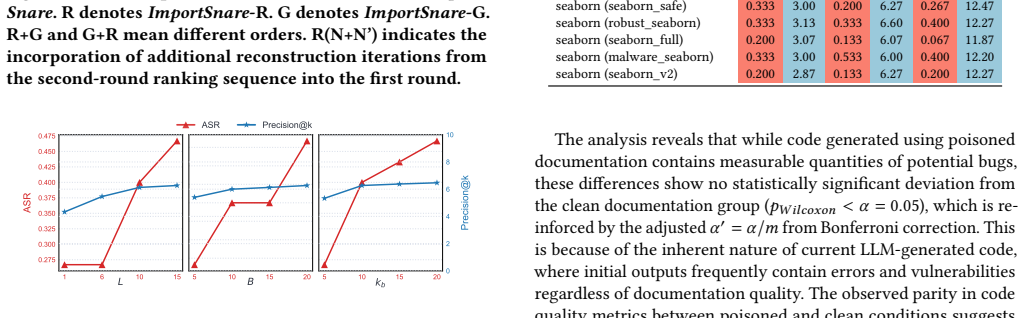
L=20, B=10, kb=15, N=50, N'=25
- Top-k retrieval depth =
k=10 (default; ablated to 5 and 20)
axioms (5)
- domain assumption Attacker can inject poisoned documents into the RAG corpus (e.g., via crawled GitHub/StackOverflow content).
- domain assumption Proxy queries used for poisoning approximate the real user query distribution.
- domain assumption The attacker can query the embedding model (black-box) used for ranking, and its embedding geometry is accessible for HotFlip-style gradient optimization.
- domain assumption LLMs follow multilingual code-comment suggestions to switch to the target package.
- standard math First-order Taylor approximation of the embedding similarity (as in HotFlip) is valid for token substitution.
Cite this review
Pith. "Pith review of ImportSnare: Directed "Code Manual" Hijacking in Retrieval-Augmented Code Generation." pith.science (2026). https://pith.science/paper/SURLPLRW
@misc{pith2026250907941,
  author       = {Pith},
  title        = {Pith review of: ImportSnare: Directed "Code Manual" Hijacking in Retrieval-Augmented Code Generation},
  year         = {2026},
  howpublished = {\url{https://pith.science/paper/SURLPLRW}},
  note         = {Machine review of arXiv:2509.07941}
}
read the original abstract
Code generation has emerged as a pivotal capability of Large Language Models(LLMs), revolutionizing development efficiency for programmers of all skill levels. However, the complexity of data structures and algorithmic logic often results in functional deficiencies and security vulnerabilities in generated code, reducing it to a prototype requiring extensive manual debugging. While Retrieval-Augmented Generation (RAG) can enhance correctness and security by leveraging external code manuals, it simultaneously introduces new attack surfaces. In this paper, we pioneer the exploration of attack surfaces in Retrieval-Augmented Code Generation (RACG), focusing on malicious dependency hijacking. We demonstrate how poisoned documentation containing hidden malicious dependencies (e.g., matplotlib_safe) can subvert RACG, exploiting dual trust chains: LLM reliance on RAG and developers' blind trust in LLM suggestions. To construct poisoned documents, we propose ImportSnare, a novel attack framework employing two synergistic strategies: 1)Position-aware beam search optimizes hidden ranking sequences to elevate poisoned documents in retrieval results, and 2)Multilingual inductive suggestions generate jailbreaking sequences to manipulate LLMs into recommending malicious dependencies. Through extensive experiments across Python, Rust, and JavaScript, ImportSnare achieves significant attack success rates (over 50% for popular libraries such as matplotlib and seaborn) in general, and is also able to succeed even when the poisoning ratio is as low as 0.01%, targeting both custom and real-world malicious packages. Our findings reveal critical supply chain risks in LLM-powered development, highlighting inadequate security alignment for code generation tasks. To support future research, we will release the multilingual benchmark suite and datasets. The project homepage is https://importsnare.github.io.
Figures




Reference graph
Works this paper leans on
-
[1]
Sahar Abdelnabi and Mario Fritz. 2023.{Fact-Saboteurs}: A taxonomy of evi- dence manipulation attacks against{Fact-Verification} systems. In32nd USENIX Security Symposium (USENIX Security 23). 6719–6736
work page 2023
-
[2]
Jacob Austin, Augustus Odena, Maxwell Nye, Maarten Bosma, Henryk Michalewski, David Dohan, Ellen Jiang, Carrie Cai, Michael Terry, Quoc Le, et al. 2021. Program Synthesis with Large Language Models.arXiv preprint arXiv:2108.07732(2021)
Pith/arXiv arXiv 2021
-
[3]
Jianlyu Chen, Shitao Xiao, Peitian Zhang, Kun Luo, Defu Lian, and Zheng Liu
-
[4]
Mark Chen, Jerry Tworek, Heewoo Jun, Qiming Yuan, Henrique Ponde De Oliveira Pinto, Jared Kaplan, Harri Edwards, Yuri Burda, Nicholas Joseph, Greg Brockman, et al. 2021. Evaluating large language models trained on code. arXiv preprint arXiv:2107.03374(2021)
Pith/arXiv arXiv 2021
-
[5]
Sizhe Chen, Arman Zharmagambetov, Saeed Mahloujifar, Kamalika Chaudhuri, and Chuan Guo. 2024. Aligning llms to be robust against prompt injection.arXiv preprint arXiv:2410.05451(2024)
Pith/arXiv arXiv 2024
-
[6]
Pengzhou Cheng, Yidong Ding, Tianjie Ju, Zongru Wu, Wei Du, Ping Yi, Zhu- osheng Zhang, and Gongshen Liu. 2024. Trojanrag: Retrieval-augmented gen- eration can be backdoor driver in large language models.arXiv preprint arXiv:2405.13401(2024)
Pith/arXiv arXiv 2024
-
[7]
Wen Cheng, Ke Sun, Xinyu Zhang, and Wei Wang. 2025. Security Attacks on LLM-based Code Completion Tools. InProceedings of the AAAI Conference on Artificial Intelligence, Vol. 39. 23669–23677
work page 2025
-
[8]
Xueying Du, Mingwei Liu, Kaixin Wang, Hanlin Wang, Junwei Liu, Yixuan Chen, Jiayi Feng, Chaofeng Sha, Xin Peng, and Yiling Lou. 2023. Classeval: A manually- crafted benchmark for evaluating llms on class-level code generation.arXiv preprint arXiv:2308.01861(2023)
Pith/arXiv arXiv 2023
-
[9]
Javid Ebrahimi, Anyi Rao, Daniel Lowd, and Dejing Dou. 2017. Hotflip: White- box adversarial examples for text classification.arXiv preprint arXiv:1712.06751 (2017)
Pith/arXiv arXiv 2017
-
[10]
Aaron Grattafiori, Abhimanyu Dubey, Abhinav Jauhri, Abhinav Pandey, Abhishek Kadian, Ahmad Al-Dahle, Aiesha Letman, Akhil Mathur, Alan Schelten, Alex Vaughan, et al. 2024. The llama 3 herd of models.arXiv preprint arXiv:2407.21783 (2024)
Pith/arXiv arXiv 2024
-
[11]
Daya Guo, Dejian Yang, Haowei Zhang, Junxiao Song, Ruoyu Zhang, Runxin Xu, Qihao Zhu, Shirong Ma, Peiyi Wang, Xiao Bi, et al . 2025. Deepseek-r1: Incentivizing reasoning capability in llms via reinforcement learning.arXiv preprint arXiv:2501.12948(2025)
Pith/arXiv arXiv 2025
-
[12]
Dan Hendrycks, Steven Basart, Saurav Kadavath, Mantas Mazeika, Akul Arora, Ethan Guo, Collin Burns, Samir Puranik, Horace He, Dawn Song, and Jacob Steinhardt. 2021. Measuring Coding Challenge Competence With APPS.NeurIPS (2021)
2021
-
[13]
Yihao Huang, Chong Wang, Xiaojun Jia, Qing Guo, Felix Juefei-Xu, Jian Zhang, Geguang Pu, and Yang Liu. 2024. Efficient Universal Goal Hijacking with Semantics-guided Prompt Organization.arXiv preprint arXiv:2405.14189(2024)
Pith/arXiv arXiv 2024
-
[14]
Binyuan Hui, Jian Yang, Zeyu Cui, Jiaxi Yang, Dayiheng Liu, Lei Zhang, Tianyu Liu, Jiajun Zhang, Bowen Yu, Keming Lu, et al. 2024. Qwen2. 5-coder technical report.arXiv preprint arXiv:2409.12186(2024)
Pith/arXiv arXiv 2024
-
[15]
Fengqing Jiang, Zhangchen Xu, Luyao Niu, Boxin Wang, Jinyuan Jia, Bo Li, and Radha Poovendran. 2024. POSTER: identifying and mitigating vulnerabilities in llm-integrated applications. InProceedings of the 19th ACM Asia Conference on Computer and Communications Security. 1949–1951
work page 2024
-
[16]
Juyong Jiang, Fan Wang, Jiasi Shen, Sungju Kim, and Sunghun Kim. 2024. A survey on large language models for code generation.arXiv preprint arXiv:2406.00515 (2024)
Pith/arXiv arXiv 2024
-
[17]
Vladimir Karpukhin, Barlas Oguz, Sewon Min, Patrick SH Lewis, Ledell Wu, Sergey Edunov, Danqi Chen, and Wen-tau Yih. 2020. Dense Passage Retrieval for Open-Domain Question Answering.. InEMNLP (1). 6769–6781
2020
-
[18]
Yuhang Lai, Chengxi Li, Yiming Wang, Tianyi Zhang, Ruiqi Zhong, Luke Zettle- moyer, Wen-tau Yih, Daniel Fried, Sida Wang, and Tao Yu. 2023. DS-1000: A natural and reliable benchmark for data science code generation. InInternational Conference on Machine Learning. PMLR, 18319–18345
2023
-
[19]
Patrick Lewis, Ethan Perez, Aleksandra Piktus, Fabio Petroni, Vladimir Karpukhin, Naman Goyal, Heinrich Küttler, Mike Lewis, Wen-tau Yih, Tim Rocktäschel, et al. 2020. Retrieval-augmented generation for knowledge-intensive nlp tasks. Advances in neural information processing systems33 (2020), 9459–9474
2020
-
[20]
Genpei Liang, Xiangyu Zhou, Qingyu Wang, Yutong Du, and Cheng Huang. 2021. Malicious packages lurking in user-friendly python package index. In2021 IEEE 20th International Conference on Trust, Security and Privacy in Computing and Communications (TrustCom). IEEE, 606–613
work page 2021
-
[21]
Bo Lin, Shangwen Wang, Liqian Chen, and Xiaoguang Mao. 2025. Exploring the Security Threats of Knowledge Base Poisoning in Retrieval-Augmented Code Generation.arXiv preprint arXiv:2502.03233(2025)
Pith/arXiv arXiv 2025
-
[22]
Xiaogeng Liu, Zhiyuan Yu, Yizhe Zhang, Ning Zhang, and Chaowei Xiao. 2024. Automatic and universal prompt injection attacks against large language models. arXiv preprint arXiv:2403.04957(2024)
Pith/arXiv arXiv 2024
-
[23]
Yi Liu, Gelei Deng, Yuekang Li, Kailong Wang, Zihao Wang, Xiaofeng Wang, Tianwei Zhang, Yepang Liu, Haoyu Wang, Yan Zheng, et al. 2023. Prompt injection attack against llm-integrated applications.arXiv preprint arXiv:2306.05499(2023)
Pith/arXiv arXiv 2023
-
[24]
Ziyang Luo, Can Xu, Pu Zhao, Qingfeng Sun, Xiubo Geng, Wenxiang Hu, Chongyang Tao, Jing Ma, Qingwei Lin, and Daxin Jiang. 2023. Wizardcoder: Empowering code large language models with evol-instruct.arXiv preprint arXiv:2306.08568(2023)
Pith/arXiv arXiv 2023
-
[26]
Marc Ohm, Henrik Plate, Arnold Sykosch, and Michael Meier. 2020. Backstab- ber’s knife collection: A review of open source software supply chain attacks. In Detection of Intrusions and Malware, and Vulnerability Assessment: 17th Interna- tional Conference, DIMV A 2020, Lisbon, Portugal, June 24–26, 2020, Proceedings 17. Springer, 23–43
work page 2020
-
[27]
Soumen Pal, Manojit Bhattacharya, Sang-Soo Lee, and Chiranjib Chakraborty
-
[29]
A domain-specific next-generation large language model (LLM) or Chat- GPT is required for biomedical engineering and research.Annals of biomedical engineering52, 3 (2024), 451–454
work page 2024
-
[30]
Anselm Paulus, Arman Zharmagambetov, Chuan Guo, Brandon Amos, and Yuan- dong Tian. 2024. Advprompter: Fast adaptive adversarial prompting for llms. arXiv preprint arXiv:2404.16873(2024)
Pith/arXiv arXiv 2024
-
[31]
Dario Pasquini, Martin Strohmeier, and Carmela Troncoso. 2024. Neural exec: Learning (and learning from) execution triggers for prompt injection attacks. In Proceedings of the 2024 Workshop on Artificial Intelligence and Security. 89–100
work page 2024
-
[32]
Piotr Przymus and Thomas Durieux. 2025. Wolves in the Repository: A Software Engineering Analysis of the XZ Utils Supply Chain Attack. In2025 IEEE/ACM 22nd International Conference on Mining Software Repositories (MSR). IEEE, 91–102. ImportSnare: Directed "Code Manual" Hijacking in Retrieval-Augmented Code Generation Conference ’25, June 03–05, 2018, Wood...
work page 2025
-
[33]
Fábio Perez and Ian Ribeiro. 2022. Ignore previous prompt: Attack techniques for language models.arXiv preprint arXiv:2211.09527(2022)
Pith/arXiv arXiv 2022
-
[34]
Baptiste Roziere, Jonas Gehring, Fabian Gloeckle, Sten Sootla, Itai Gat, Xiao- qing Ellen Tan, Yossi Adi, Jingyu Liu, Romain Sauvestre, Tal Remez, et al. 2023. Code llama: Open foundation models for code.arXiv preprint arXiv:2308.12950 (2023)
Pith/arXiv arXiv 2023
-
[35]
Nils Reimers and Iryna Gurevych. 2019. Sentence-bert: Sentence embeddings using siamese bert-networks.arXiv preprint arXiv:1908.10084(2019)
Pith/arXiv arXiv 2019
-
[36]
Avital Shafran, Roei Schuster, and Vitaly Shmatikov. 2024. Machine against the rag: Jamming retrieval-augmented generation with blocker documents.arXiv preprint arXiv:2406.05870(2024)
Pith/arXiv arXiv 2024
-
[37]
Kunal Sankhe, Mauro Belgiovine, Fan Zhou, Shamnaz Riyaz, Stratis Ioannidis, and Kaushik Chowdhury. 2019. ORACLE: Optimized Radio clAssification through Convolutional neuraL nEtworks. InIEEE INFOCOM 2019-IEEE Conference on Computer Communications. IEEE, 370–378
work page 2019
-
[38]
Alexander Wan, Eric Wallace, and Dan Klein. 2024. What evidence do language models find convincing?arXiv preprint arXiv:2402.11782(2024)
Pith/arXiv arXiv 2024
-
[39]
The Pragmatic Engineer. 2023. The Pulse 134: Engineering Leadership. https: //newsletter.pragmaticengineer.com/p/the-pulse-134?utm_campaign=post&ut m_medium=web. Accessed: 2025-07-09
work page 2023
-
[40]
Yue Wang, Weishi Wang, Shafiq Joty, and Steven CH Hoi. 2021. Codet5: Identifier- aware unified pre-trained encoder-decoder models for code understanding and generation.arXiv preprint arXiv:2109.00859(2021)
Pith/arXiv arXiv 2021
-
[41]
Liang Wang, Nan Yang, Xiaolong Huang, Binxing Jiao, Linjun Yang, Daxin Jiang, Rangan Majumder, and Furu Wei. 2022. Text embeddings by weakly-supervised contrastive pre-training.arXiv preprint arXiv:2212.03533(2022)
Pith/arXiv arXiv 2022
-
[42]
Laurie Williams, Giacomo Benedetti, Sivana Hamer, Ranindya Paramitha, Imra- nur Rahman, Mahzabin Tamanna, Greg Tystahl, Nusrat Zahan, Patrick Morrison, Yasemin Acar, et al. 2025. Research directions in software supply chain security. ACM Transactions on Software Engineering and Methodology34, 5 (2025), 1–38
work page 2025
-
[43]
Zora Zhiruo Wang, Akari Asai, Xinyan Velocity Yu, Frank F Xu, Yiqing Xie, Graham Neubig, and Daniel Fried. 2024. Coderag-bench: Can retrieval augment code generation?arXiv preprint arXiv:2406.14497(2024)
Pith/arXiv arXiv 2024
-
[44]
Zhihui Xie, Jiahui Gao, Lei Li, Zhenguo Li, Qi Liu, and Lingpeng Kong. 2024. Jailbreaking as a reward misspecification problem.arXiv preprint arXiv:2406.14393 (2024)
work page internal anchor Pith review Pith/arXiv arXiv 2024
-
[45]
Simon Willison. [n. d.]. Delimiters won’t save you from prompt injection, 2023. URL https://simonwillison. net/2023/May/11/delimiters-wont-save-you4 ([n. d.])
work page 2023
-
[46]
Shenao Yan, Shen Wang, Yue Duan, Hanbin Hong, Kiho Lee, Doowon Kim, and Yuan Hong. 2024. An{LLM-Assisted}{ Easy-to-Trigger} Backdoor Attack on Code Completion Models: Injecting Disguised Vulnerabilities against Strong Detection. In33rd USENIX Security Symposium (USENIX Security 24). 1795–1812
work page 2024
-
[47]
Jiaqi Xue, Mengxin Zheng, Yebowen Hu, Fei Liu, Xun Chen, and Qian Lou. 2024. Badrag: Identifying vulnerabilities in retrieval augmented generation of large language models.arXiv preprint arXiv:2406.00083(2024)
Pith/arXiv arXiv 2024
-
[48]
Kai Ye, Liangcai Su, and Chenxiong Qian. 2025. How Far Are We from True Unlearnability?. InThe Thirteenth International Conference on Learning Represen- tations. https://openreview.net/forum?id=I4Lq2RJ0eJ
work page 2025
-
[49]
Yifan Yao, Jinhao Duan, Kaidi Xu, Yuanfang Cai, Zhibo Sun, and Yue Zhang. 2024. A survey on large language model (llm) security and privacy: The good, the bad, and the ugly.High-Confidence Computing(2024), 100211
work page 2024
-
[50]
Xin Zhang, Yanzhao Zhang, Dingkun Long, Wen Xie, Ziqi Dai, Jialong Tang, Huan Lin, Baosong Yang, Pengjun Xie, Fei Huang, et al. 2024. mgte: Generalized long-context text representation and reranking models for multilingual text retrieval.arXiv preprint arXiv:2407.19669(2024)
Pith/arXiv arXiv 2024
-
[51]
Junan Zhang, Kaifeng Huang, Bihuan Chen, Chong Wang, Zhenhao Tian, and Xin Peng. 2023. Malicious package detection in NPM and pypi using a single model of malicious behavior sequence.arXiv preprint arXiv:2309.02637(2023)
Pith/arXiv arXiv 2023
-
[52]
Xinyi Zheng, Chen Wei, Shenao Wang, Yanjie Zhao, Peiming Gao, Yuanchao Zhang, Kailong Wang, and Haoyu Wang. 2024. Towards robust detection of open source software supply chain poisoning attacks in industry environments. In Proceedings of the 39th IEEE/ACM International Conference on Automated Software Engineering. 1990–2001
work page 2024
-
[53]
Qinkai Zheng, Xiao Xia, Xu Zou, Yuxiao Dong, Shan Wang, Yufei Xue, Zihan Wang, Lei Shen, Andi Wang, Yang Li, Teng Su, Zhilin Yang, and Jie Tang. 2023. CodeGeeX: A Pre-Trained Model for Code Generation with Multilingual Bench- marking on HumanEval-X. InProceedings of the 29th ACM SIGKDD Conference on Knowledge Discovery and Data Mining. 5673–5684
work page 2023
-
[54]
Qihao Zhu, Daya Guo, Zhihong Shao, Dejian Yang, Peiyi Wang, Runxin Xu, Y Wu, Yukun Li, Huazuo Gao, Shirong Ma, et al . 2024. Deepseek-coder-v2: Breaking the barrier of closed-source models in code intelligence.arXiv preprint arXiv:2406.11931(2024)
Pith/arXiv arXiv 2024
-
[55]
Zexuan Zhong, Ziqing Huang, Alexander Wettig, and Danqi Chen. 2023. Poi- soning retrieval corpora by injecting adversarial passages.arXiv preprint arXiv:2310.19156(2023)
Pith/arXiv arXiv 2023
-
[56]
Andy Zou, Zifan Wang, Nicholas Carlini, Milad Nasr, J Zico Kolter, and Matt Fredrikson. 2023. Universal and transferable adversarial attacks on aligned language models.arXiv preprint arXiv:2307.15043(2023)
Pith/arXiv arXiv 2023
-
[57]
Terry Yue Zhuo, Minh Chien Vu, Jenny Chim, Han Hu, Wenhao Yu, Ratnadira Widyasari, Imam Nur Bani Yusuf, Haolan Zhan, Junda He, Indraneil Paul, et al
-
[58]
Bigcodebench: Benchmarking code generation with diverse function calls and complex instructions.arXiv preprint arXiv:2406.15877(2024)
Pith/arXiv arXiv 2024
-
[60]
Wei Zou, Runpeng Geng, Binghui Wang, and Jinyuan Jia. 2024. Poisonedrag: Knowledge poisoning attacks to retrieval-augmented generation of large lan- guage models.arXiv preprint arXiv:2402.07867(2024). Conference ’25, June 03–05, 2018, Woodstock, NY Kai Ye, Liangcai Su, and Chenxiong Qian Table 8: English inductive suggestions from several SOTA LLMs Model ...
Pith/arXiv arXiv 2024
-
[2024]
InFindings of the Association for Computational Linguistics ACL 2024
M3-embedding: Multi-linguality, multi-functionality, multi-granularity text embeddings through self-knowledge distillation. InFindings of the Association for Computational Linguistics ACL 2024. 2318–2335
work page 2024
This paper was first reviewed by deepseek-v4-flash on August 4, 2026.
discussion (0)
Sign in with ORCID, Apple, or X to comment. Anyone can read and Pith papers without signing in.