Towards an application of fourth-order shear statistics I. The information content of langle M_ap⁴ rangle
Pith reviewed 2026-05-18 17:27 UTC · model grok-4.3
The pith
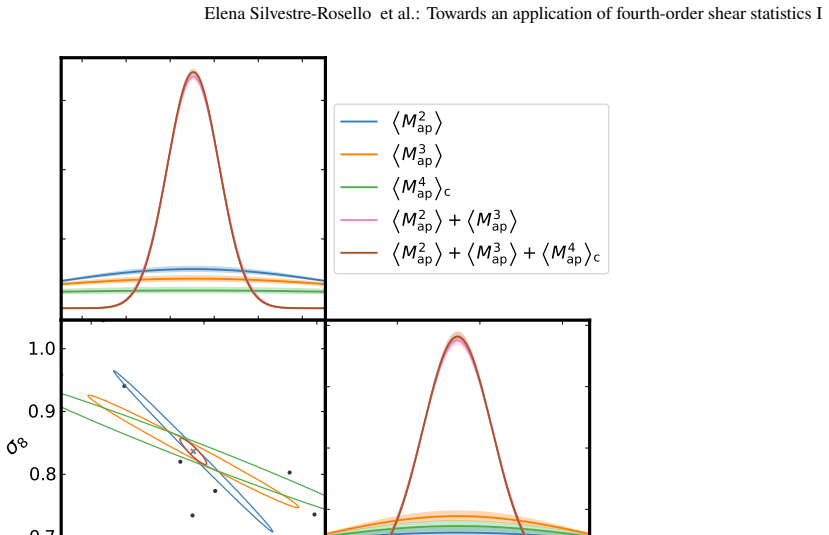
Fourth-order aperture statistics add only minimal extra constraining power on cosmology beyond second- and third-order statistics in non-tomographic analyses.
A machine-rendered reading of the paper's core claim, the machinery that carries it, and where it could break.
Core claim
The central claim is that fourth-order aperture statistics contain some non-Gaussian information from the projected matter field but deliver only a minimal gain in cosmological constraining power when combined with lower-order aperture statistics for current-generation survey setups.
What carries the argument
The fourth-order aperture statistics ⟨M_ap^4⟩, obtained by integrating the shear four-point correlation function against derived filter functions that connect directly to the convergence polyspectra.
If this is right
- Including fourth-order statistics does not substantially tighten cosmological parameter constraints beyond those from second- and third-order aperture statistics in equal-scale non-tomographic setups.
- The integration pipeline reaches the precision level required for Stage IV surveys because two-percent accuracy lies well below the expected noise budget.
- Non-Gaussian information accessible through higher-order shear statistics remains present yet contributes limited additional leverage under the analysis choices examined.
Where Pith is reading between the lines
- Tomographic binning or unequal-scale combinations of apertures could extract more information from the fourth-order statistic than the equal-scale non-tomographic case tested here.
- Surveys with lower shape noise might see larger relative gains from fourth-order statistics even if the absolute improvement stays modest.
- The same numerical framework could be applied to cross-correlations with other tracers to test whether the minimal-gain result is specific to auto-correlations of galaxy shear.
Load-bearing premise
The novel method for estimating derivatives from a simulation suite with arbitrarily distributed cosmological sets produces accurate Fisher-matrix elements.
What would settle it
Recomputing the Fisher matrix with a conventional finite-difference derivative estimator on a regularly spaced cosmological grid and checking whether the resulting error ellipses differ significantly from those obtained with the new estimator.
Figures


read the original abstract
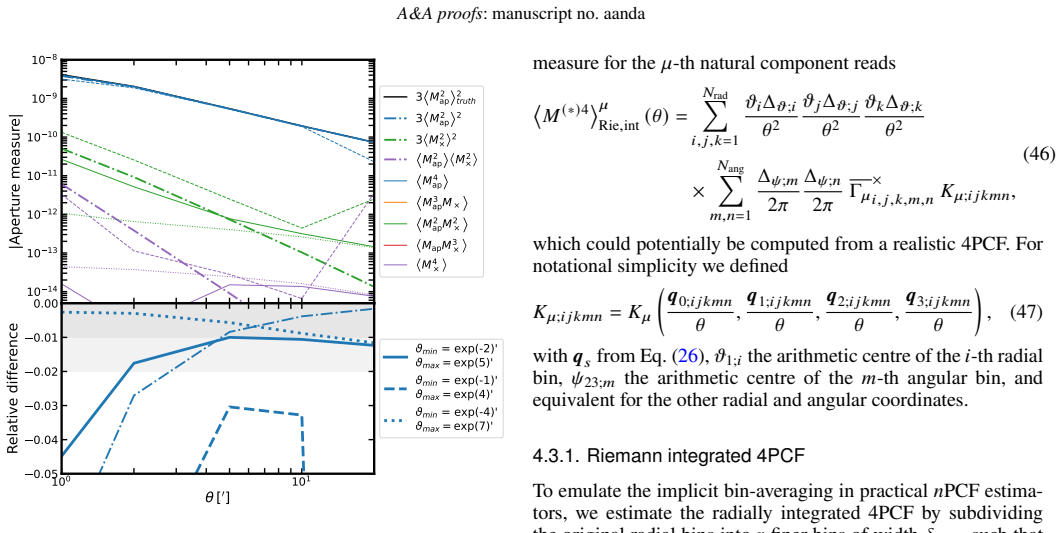
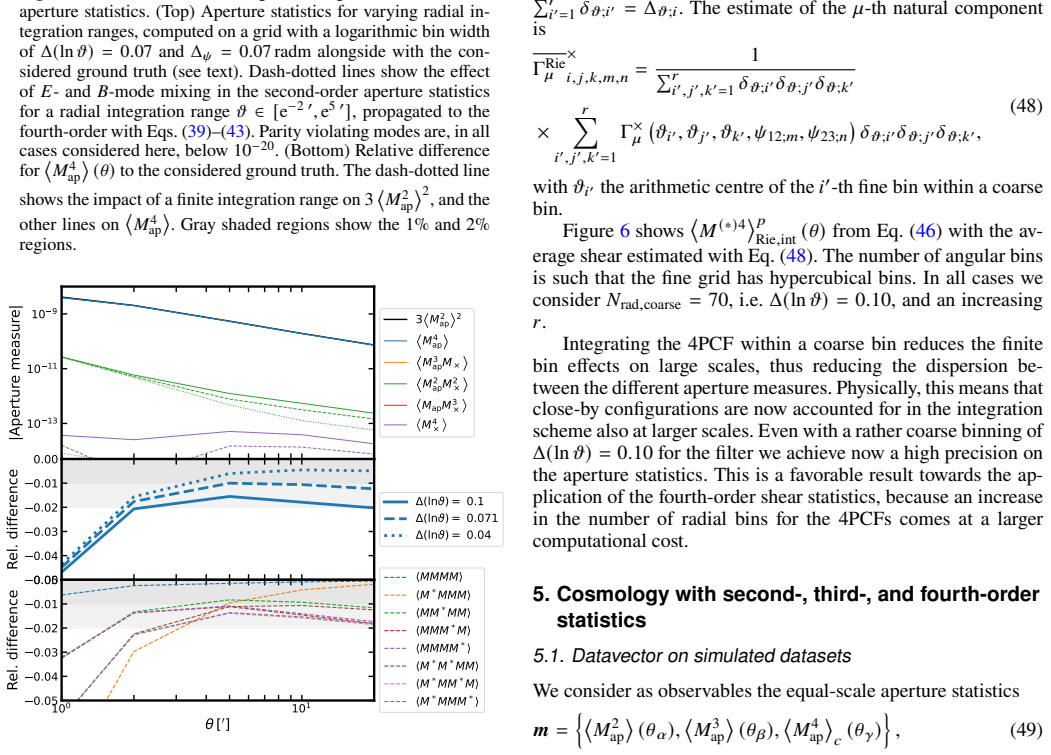
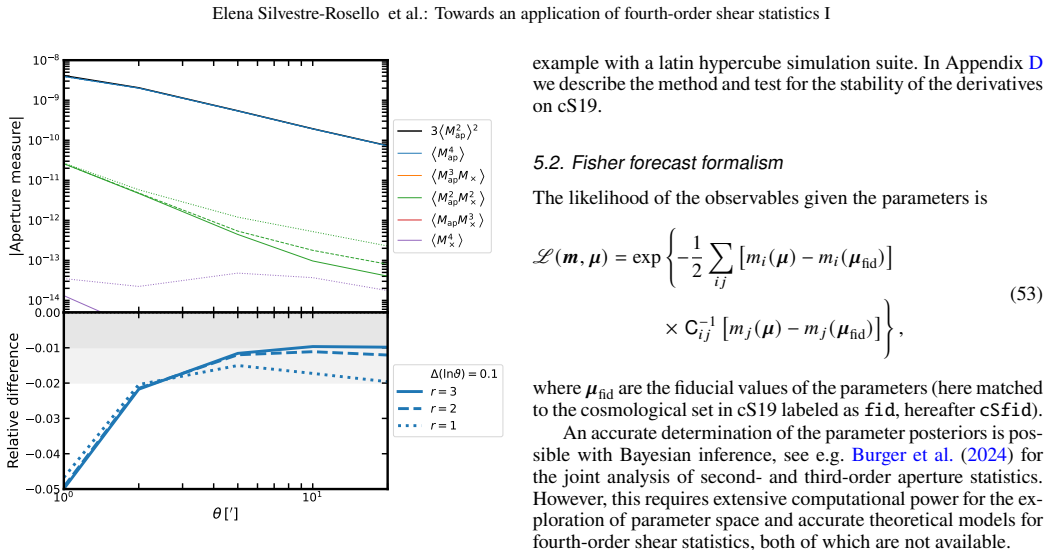
Higher-order shear statistics contain part of the non-Gaussian information of the projected matter field and therefore can provide additional constraints on the cosmological parameters when combined with second-order statistics. We aim to provide the theoretical framework for studying shear four-point correlation functions (4PCF) using fourth-order aperture statistics and develop a numerical integration pipeline to compute them. Finally, we forecast the information content of fourth-order aperture statistics. We begin by giving the relation of the $n$-th order aperture statistics, $\langle M_\mathrm{ap}^n\rangle$, to the shear $n$PCF and to the convergence polyspectra. We then focus on the fourth-order case, where we derive the functional form of their filters and test the behavior of these filters by numerically integrating over the 4PCF of a Gaussian random shear field (GRF). Finally, we perform a Fisher forecast on the constraining power of $\langle M_\mathrm{ap}^4\rangle_\rm{c}$, where we develop a novel method to estimate derivatives from a simulation suite with arbitrarily distributed cosmological sets. By analyzing and mitigating numerical effects within the integration pipeline, we achieve a two-percent-level precision on the fourth-order aperture statistics for a GRF, which remains well below the noise budget of Stage IV surveys. We report a minimal improvement in the constraining power of the aperture statistics when including fourth-order statistics to a $\langle M_\mathrm{ap}^2\rangle + \langle M_\mathrm{ap}^3\rangle$ joint analysis for a DES-Y3-like setup, using non-tomographic equal-scale aperture statistics.
Editorial analysis
A structured set of objections, weighed in public.
Referee Report
Summary. The manuscript develops the theoretical framework relating n-th order aperture statistics ⟨M_ap^n⟩ to shear n-point correlation functions and convergence polyspectra, with a focus on the fourth-order case. It derives the corresponding filter functions, implements and validates a numerical integration pipeline achieving ~2% precision on Gaussian random field (GRF) integrals, introduces a novel derivative estimator for simulation suites with arbitrarily distributed cosmological parameters, and performs a Fisher-matrix forecast for a DES-Y3-like non-tomographic equal-scale setup. The central result is that adding the connected fourth-order aperture statistic ⟨M_ap^4⟩_c yields only minimal improvement in cosmological constraining power relative to a joint ⟨M_ap^2⟩ + ⟨M_ap^3⟩ analysis.
Significance. If the forecast result holds, the work supplies a practical pipeline and theoretical relations that could enable extraction of additional non-Gaussian information from weak-lensing surveys. The 2% GRF precision demonstrates control over the integration step, and the derivative estimator addresses a practical need for irregular simulation grids; however, the reported minimal improvement implies that, for the specific non-tomographic equal-scale configuration, fourth-order statistics add limited new information beyond lower-order aperture statistics.
major comments (2)
- [Fisher forecast section] § on Fisher forecast / derivative estimator: the headline conclusion of minimal improvement rests on Fisher-matrix elements computed with a new derivative estimator for arbitrarily distributed cosmological parameter sets. This estimator is introduced after the GRF validation and is not cross-checked against analytic derivatives or standard finite-difference methods on a regular grid; any systematic bias or excess variance in the estimated derivatives would propagate directly into the reported information gain and the 'minimal improvement' statement.
- [Abstract and forecast results] Abstract and results section: the minimal-improvement claim is obtained exclusively for non-tomographic, equal-scale aperture statistics. The manuscript does not quantify how the conclusion changes under tomographic binning or multi-scale combinations, which are the configurations most relevant for Stage-IV analyses and could alter the relative information content of ⟨M_ap^4⟩_c.
minor comments (2)
- [Notation and figures] Notation for the connected fourth-order statistic should be used consistently (⟨M_ap^4⟩_c versus ⟨M_ap^4⟩) in all equations, tables, and figure captions.
- [Methods] A brief comparison of the new derivative estimator's computational cost or stability relative to existing interpolation-based methods would help readers assess its practical utility.
Simulated Author's Rebuttal
We thank the referee for their careful reading of the manuscript and for the constructive comments. We appreciate the positive assessment of the theoretical framework, numerical pipeline, and the practical relevance of the derivative estimator. Below we respond to each major comment. We have revised the manuscript to address the concerns where possible.
read point-by-point responses
-
Referee: [Fisher forecast section] § on Fisher forecast / derivative estimator: the headline conclusion of minimal improvement rests on Fisher-matrix elements computed with a new derivative estimator for arbitrarily distributed cosmological parameter sets. This estimator is introduced after the GRF validation and is not cross-checked against analytic derivatives or standard finite-difference methods on a regular grid; any systematic bias or excess variance in the estimated derivatives would propagate directly into the reported information gain and the 'minimal improvement' statement.
Authors: We agree that additional validation of the derivative estimator would strengthen the robustness of the Fisher forecast results. The estimator was developed specifically to handle simulation suites with irregularly distributed cosmological parameters, which is a common practical constraint. While the integration pipeline itself was validated to 2% precision on Gaussian random fields, we acknowledge that a direct comparison of the derivative estimator to standard finite-difference methods on a regular grid was not performed. In the revised manuscript we will add a new subsection that performs such a cross-check on a regular-grid subset of the available simulations, quantifying any differences in the resulting Fisher-matrix elements and confirming that the reported minimal improvement is not affected by estimator bias. revision: yes
-
Referee: [Abstract and forecast results] Abstract and results section: the minimal-improvement claim is obtained exclusively for non-tomographic, equal-scale aperture statistics. The manuscript does not quantify how the conclusion changes under tomographic binning or multi-scale combinations, which are the configurations most relevant for Stage-IV analyses and could alter the relative information content of ⟨M_ap^4⟩_c.
Authors: We acknowledge that the forecast demonstrating minimal additional constraining power is restricted to the non-tomographic, equal-scale configuration, as stated in the abstract and Section on Fisher forecast. This choice isolates the information content in a controlled DES-Y3-like setting while focusing on the new theoretical relations and numerical methods. Tomographic binning and multi-scale combinations are indeed more relevant for Stage-IV surveys and could change the relative contribution of the connected fourth-order term. Performing the full tomographic forecast lies beyond the scope of the present work, which is intended as a methodological first step. In the revised version we will expand the discussion and conclusions to explicitly note this limitation, discuss how the framework can be extended to tomographic analyses, and outline the expected computational requirements for such an extension. revision: partial
Circularity Check
No significant circularity in the derivation chain
full rationale
The paper derives the relation of nth-order aperture statistics to shear nPCF and convergence polyspectra analytically, then specializes to fourth-order filters whose behavior is tested by direct numerical integration over a GRF 4PCF, reaching 2% precision after mitigating pipeline effects. A separate novel derivative estimator is introduced for simulation suites with arbitrary cosmological sampling and is used to populate the Fisher matrix for the forecast. The headline result (minimal improvement when adding fourth-order statistics) is the numerical output of that forecast rather than a quantity defined to equal its inputs by construction. No self-definitional steps, fitted parameters renamed as predictions, or load-bearing self-citations appear in the chain; the analytic content and numerical pipeline remain independent of the final forecast numbers.
Axiom & Free-Parameter Ledger
axioms (1)
- domain assumption The numerical integration over the 4PCF of a Gaussian random shear field validates the pipeline for the subsequent non-Gaussian forecast
Reference graph
Works this paper leans on
-
[1]
, " * write output.state after.block = add.period write newline
ENTRY address archiveprefix author booktitle chapter edition editor howpublished institution eprint journal key month note number organization pages publisher school series title type volume year label extra.label sort.label short.list INTEGERS output.state before.all mid.sentence after.sentence after.block FUNCTION init.state.consts #0 'before.all := #1 ...
-
[2]
" write newline "" before.all 'output.state := FUNCTION n.dashify 't := "" t empty not t #1 #1 substring "-" = t #1 #2 substring "--" = not "--" * t #2 global.max substring 't := t #1 #1 substring "-" = "-" * t #2 global.max substring 't := while if t #1 #1 substring * t #2 global.max substring 't := if while FUNCTION word.in bbl.in " " * FUNCTION format....
-
[3]
Abbott , T. M. C., Aguena , M., Alarcon , A., et al. 2022, , 105, 023520
work page 2022
- [4]
-
[5]
E., Zennaro , M., Contreras , S., et al
Angulo , R. E., Zennaro , M., Contreras , S., et al. 2021, , 507, 5869
work page 2021
- [6]
-
[7]
Bernardeau , F., Colombi , S., Gazta \ n aga , E., & Scoccimarro , R. 2002, , 367, 1
work page 2002
-
[8]
A., Porth , L., Heydenreich , S., et al
Burger , P. A., Porth , L., Heydenreich , S., et al. 2024, , 683, A103
work page 2024
-
[9]
E., Alonso, D., Krause, E., et al
Chisari, N. E., Alonso, D., Krause, E., et al. 2019, The Astrophysical Journal Supplement Series, 242, 2
work page 2019
-
[10]
1946, Mathematical Methods of Statistics (Princeton: Princeton University Press)
Cramér , H. 1946, Mathematical Methods of Statistics (Princeton: Princeton University Press)
work page 1946
-
[11]
G., Natarajan , P., Pen , U.-L., & Theuns , T
Crittenden , R. G., Natarajan , P., Pen , U.-L., & Theuns , T. 2002, , 568, 20
work page 2002
- [12]
-
[13]
Euclid Collaboration: Ajani , V., Baldi , M., Barthelemy , A., et al. 2023, , 675, A120
work page 2023
- [14]
-
[15]
1922, Zeitschrift fur Physik, 10, 377
Friedmann , A. 1922, Zeitschrift fur Physik, 10, 377
work page 1922
- [16]
-
[17]
Heydenreich , S., Linke , L., Burger , P., & Schneider , P. 2023, , 672, A44
work page 2023
-
[18]
Hunter, J. D. 2007, Computing in Science & Engineering, 9, 90
work page 2007
- [19]
- [20]
- [21]
-
[22]
2015, Reports on Progress in Physics, 78, 086901
Kilbinger , M. 2015, Reports on Progress in Physics, 78, 086901
work page 2015
- [23]
-
[24]
Kuijken , K., Heymans , C., Hildebrandt , H., et al. 2015, , 454, 3500
work page 2015
- [25]
-
[26]
Limber , D. N. 1953, , 117, 134
work page 1953
- [27]
- [28]
-
[29]
Porth , L., Heydenreich , S., Burger , P., Linke , L., & Schneider , P. 2024, , 689, A227
work page 2024
-
[30]
2025, submitted to , and published on arXiv
Porth , L., Silvestre-Rosello , E., Schneider , P., & Larma , M. 2025, submitted to , and published on arXiv
work page 2025
- [31]
-
[32]
E., Simon , P., Marian , L., & Hilbert , S
Porth , L., Smith , R. E., Simon , P., Marian , L., & Hilbert , S. 2020, , 499, 2474
work page 2020
- [33]
- [34]
- [35]
- [36]
- [37]
- [38]
-
[39]
Schneider , P., van Waerbeke , L., Jain , B., & Kruse , G. 1998, , 296, 873
work page 1998
- [40]
-
[41]
F., Samuroff , S., Krause , E., et al
Secco , L. F., Samuroff , S., Krause , E., et al. 2022, , 105, 023515
work page 2022
-
[42]
St \"o lzner , B., Wright , A. H., Asgari , M., et al. 2025, arXiv e-prints, arXiv:2503.19442
- [43]
-
[44]
Takahashi , R., Nishimichi , T., Namikawa , T., et al. 2021, BiHalofit: Fitting formula of non-linear matter bispectrum , Astrophysics Source Code Library, record ascl:2106.031
work page 2021
-
[45]
KiDS-Legacy: Cosmological constraints from cosmic shear with the complete Kilo-Degree Survey
Wright , A. H., St \"o lzner , B., Asgari , M., et al. 2025, arXiv e-prints, arXiv:2503.19441
work page internal anchor Pith review Pith/arXiv arXiv 2025
discussion (0)
Sign in with ORCID, Apple, or X to comment. Anyone can read and Pith papers without signing in.