REVIEW 4 major objections 5 minor 64 references
Two-Stage Swarm Intelligence Ensemble Deep Transfer Learning (SI-EDTL) for Vehicle Detection Using Unmanned Aerial Vehicles
T0 review · 4 major / 5 minor · reviewed 2026-08-15 · deepseek-v4-flash
Pith's one-line read The paper claims that a two-stage ensemble of 15 transfer-learned detectors—three Faster R-CNN feature extractors and five classifiers—with whale-optimized weights achieves 91.3% accuracy on vehicle detection in UAV images.
desk verdict A transparent self-archive of a 2022 journal article, with a useful method description but an under-specified comparison table that cannot support the claimed superiority. read the letter →
The pith
A machine-rendered reading of the paper's core claim, the machinery that carries it, and where it could break.
The reading
What carries the argument
The load-bearing object is the two-level ensemble of $N_{FE}\times N_{CL}=15$ base learners with weighted-average fusion. Each base learner is one classifier from {KNN, SVM, MLP, C4.5, Naive Bayes} applied to features from one of three Faster R-CNN feature extractors (InceptionV3, ResNet50, GoogLeNet). The fused score decides the region's class only if it exceeds a decision threshold $D_{Th}$; both the 15 ensemble weights and $D_{Th}$ are the hyperparameters optimized by the whale optimization algorithm (a swarm search that mimics humpback-whale hunting) against a fitness of 0.5 accuracy plus 0.3 average precision plus 0.2 average recall. This mechanism lets the system combine complementary strengths of different architectures and classifiers without training a new deep network, and it makes the accuracy-precision-recall trade-off tunable after training.
What would settle it
Re-run YOLOv3-Tiny and MobileNetv2-SSDLite on the same AU-AIR training and test split with their own hyperparameters tuned on a validation fold, using the same metric definitions as SI-EDTL; if either reaches or exceeds 91.3 percent accuracy, the claimed superiority is not supported.
Extended reading notes
Core claim
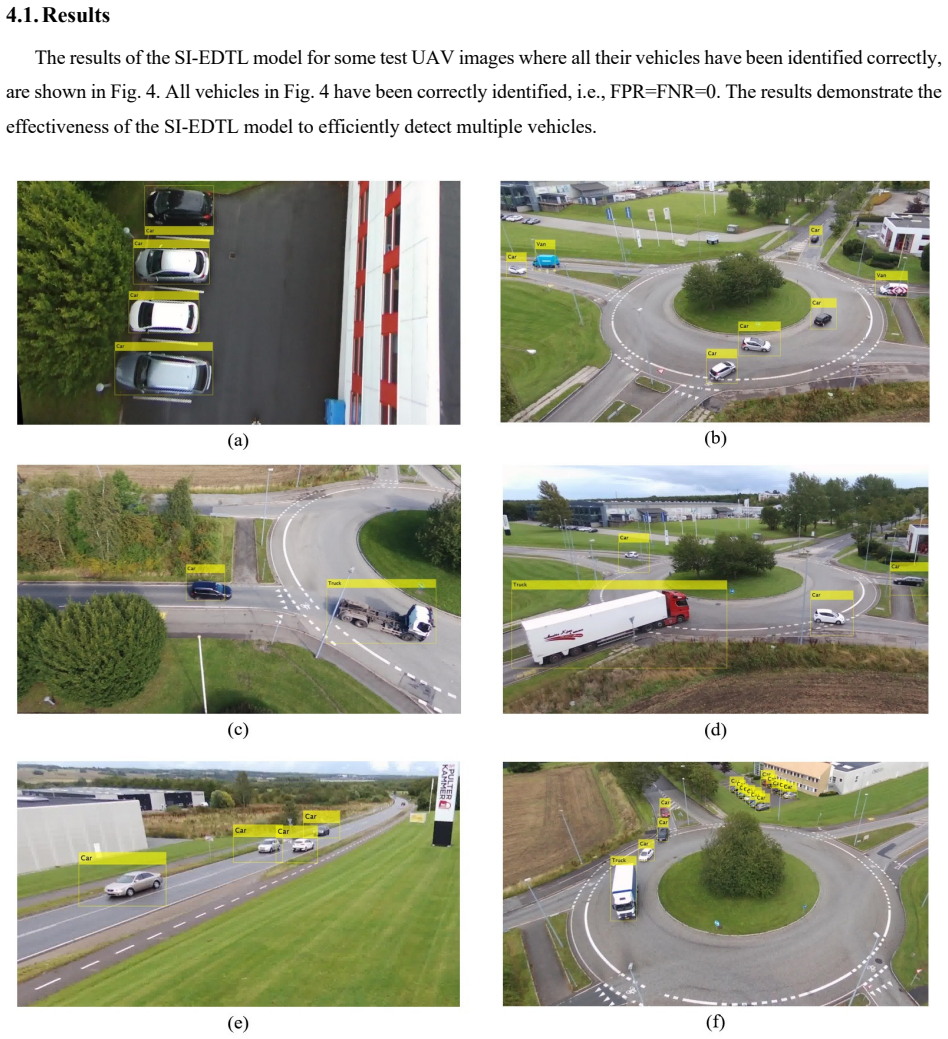
The central claim is that a two-stage ensemble of deep transfer learners, called SI-EDTL, detects Cars, Vans, Trucks, and Buses in UAV images more accurately than single detectors. In the first stage, three ImageNet-pretrained CNNs are converted into Faster R-CNN feature extractors by attaching a region proposal network, RoI pooling, and a bounding-box regression layer to chosen intermediate features ('mixed7', 'activation40_relu', 'inception_4d-output'). In the second stage, each extractor feeds five classifiers, giving 15 base learners. For each region proposal, the final class score is the weighted average of the learners' binary votes, and the proposal is assigned to the class with the highest score if that score exceeds a tuned threshold. The whale optimization algorithm sets the 15 weights and the threshold using a fitness that balances accuracy, precision, and recall under 10-fold cross-validation, and the resulting system reports 91.3 percent accuracy, 89.3 percent precision, and 89.1 percent recall on the AU-AIR test split.
Load-bearing premise
The load-bearing assumption is that the baselines in Table 2 were run under a fair, comparable protocol; the paper does not describe how YOLOv3-Tiny and MobileNetv2-SSDLite were configured, so part of the performance gap could come from tuning or evaluation differences rather than from the ensemble itself.
Editorial extensions
If this is right
- If the reported results hold, SI-EDTL beats all six listed baselines on AU-AIR, including the strongest prior deep method (SW-CNN at 83.5 percent accuracy) and both mobile detectors, on the same dataset split.
- The ensemble adds little online cost: because the three Faster R-CNN extractors run on parallel GPUs, per-image test time is 1.57 seconds, close to the slowest single extractor (InceptionV3 at 1.43 seconds).
- Offline training time is dominated by the three Faster R-CNN extractors (about 19.9 hours total), while the whale-optimization tuning stage is comparatively short, so the method is a viable offline-train and online-deploy pipeline.
- The tunable fitness weights mean an operator can rebalance precision versus recall by rerunning whale optimization, without retraining the 15 base learners.
Reading between the lines
- The paper reports only whole-dataset accuracy, precision, and recall; a per-class breakdown, especially for Bus with only 23 test samples, would show whether the ensemble's gain is consistent across rare classes or driven by Car and Truck.
- Because the method is modular, an ablation dropping one feature extractor or one classifier would isolate which components carry the gain; the paper does not include such an ablation.
- The same weighted-voting recipe could be applied to other region-proposal detectors and other aerial datasets, but because only AU-AIR is tested, the method's generality is an untested inference rather than a paper claim.
Signed reviews
Editorial analysis
A structured set of objections, weighed in public.
Referee Report
Summary. The manuscript proposes SI-EDTL, a two-stage ensemble deep transfer learning model for multi-vehicle detection in UAV imagery. The first stage uses three pre-trained Faster R-CNN feature extractors (InceptionV3, ResNet50, GoogLeNet), and the second stage uses five classifiers (KNN, SVM, MLP, C4.5, Naive Bayes), yielding 15 base learners whose weighted outputs are aggregated and thresholded. The ensemble weights and decision threshold are tuned on the training set with the Whale Optimization Algorithm using a fitness that combines accuracy, precision, and recall. The paper reports experiments on the AU-AIR dataset, claiming 91.3% accuracy, 89.3% precision, and 89.1% recall, and states that this outperforms existing detectors including YOLOv3-Tiny and MobileNetv2-SSDLite.
Significance. If the empirical claims were rigorously supported, the two-stage ensemble idea and the use of WOA to tune ensemble weights and threshold would be a plausible engineering contribution to UAV-based vehicle detection. The architecture is described in enough detail to be reproduced in principle, and the explicit fitness formulation in Eqs. (4)-(7) is a useful starting point. However, the paper's central claim of superiority rests entirely on a single comparison table with under-specified baselines, no error bars, no statistical tests, and no reported detection metric such as mAP, despite the conclusion asserting an mAP advantage. In its current form the manuscript provides no machine-checked proofs, no released code, and no reproducible evaluation protocol, so the claimed performance gain is not evidenced.
major comments (4)
- [Section 4.2, Table 2] The central claim that SI-EDTL outperforms existing methods is not supported because the baseline comparisons are not established under the same protocol. The manuscript gives no implementation details for YOLOv3-Tiny or MobileNetv2-SSDLite: no framework, input resolution, anchors, epochs, augmentation, optimizer, or training/evaluation split. It also does not state whether these detectors operated on full images, cropped regions, or the same region proposals as SI-EDTL. The text itself attributes their low scores to "not optimizing the default parameters for aerial images," which concedes that the gap may be a tuning artifact rather than a method advantage.
- [Sections 3.2 and 4.2] The evaluation protocol is ambiguous and appears to mix different tasks. Training is described as using cropped target objects and background regions, and Eqs. (5)-(7) define region-level classification metrics, not detection metrics. Yet Table 2 compares against full-image detectors such as YOLOv3-Tiny. It must be stated explicitly whether all methods are evaluated on the same set of region proposals with the same overlap/decision criterion; otherwise the accuracy, precision, and recall values in Table 2 are not comparable quantities.
- [Section 4.2, Table 2] No variance, confidence intervals, or statistical significance tests are reported anywhere. Table 1 shows that the test set contains only 23 Bus samples, and the class distribution is heavily imbalanced, so a single-run aggregate accuracy is unstable. The authors should report per-class results, repeated runs or cross-validation splits, and appropriate significance tests before claiming superiority.
- [Section 5] The conclusion states that SI-EDTL outperforms other methods "in accuracy, precision, recall, and mean average precision," but no mAP value is reported in Section 4 or in Table 2. Either provide the mAP evaluation with the same protocol as the other methods, or remove the mAP claim from the conclusion.
minor comments (5)
- [Table 1] The header 'TRAN DATASET' should be corrected to 'TRAIN DATASET'.
- [Section 4.2 heading] The heading 'Comparision with existing methods' contains a typo; it should read 'Comparison with existing methods'.
- [Section 5] The first sentence contains a typo: 'de ep' should be 'deep'.
- [Section 3.2] The symbols N1Train and N0Train are introduced but never quantified; please state the actual number of cropped object and background training samples used.
- [Figures and tables] All figure and table captions cite the authors' earlier publication [48] as the source. Because this manuscript is explicitly a shortened version of that paper, the authors should clarify what new content is added here and ensure that any reused material is properly credited or reproduced with permission.
Circularity Check
No significant circularity: WOA tuning is confined to training folds and the reported test metrics are held out.
full rationale
The claimed derivation chain is not circular. Three pre-trained CNNs are converted into Faster R-CNN detectors, fifteen base learners are formed, and WOA tunes only the ensemble weights w_ij and the decision threshold DTh (Eqs. 1-3) using a fitness function (Eq. 4) evaluated on 10-fold cross-validated training regions. The reported accuracy, precision, and recall in Table 2 are computed on the held-out 25% test split described in Section 4, so the test metrics are not equivalent by construction to the fitted parameters. The only substantive concern is the comparison with YOLOv3-Tiny and MobileNetv2-SSDLite, which the paper itself states were run with default parameters; that is a question of experimental fairness and reproducibility, not a circular reduction. The reuse of figures and Table 2 from the authors' prior article [48] is transparently disclosed as a shortened version, so it is provenance rather than a load-bearing circular argument.
Assumptions & free parameters
free parameters (4)
- Ensemble weights w_ij =
Optimized by WOA, values not reported
- Decision threshold DTh =
Optimized by WOA, value not reported
- WOA parameters (MaxIter, PopSize, b) =
MaxIter=500, PopSize=50, b=1
- Fitness weights (wA, wP, wR) =
0.5, 0.3, 0.2
assumptions (3)
- domain assumption Pre-trained ImageNet features transfer to UAV aerial imagery
- domain assumption Cropped regions from Faster R-CNN are representative and correctly labeled
- domain assumption The AU-AIR dataset split is unbiased
Cite this review
Pith. "Pith review of Two-Stage Swarm Intelligence Ensemble Deep Transfer Learning (SI-EDTL) for Vehicle Detection Using Unmanned Aerial Vehicles." pith.science (2026). https://pith.science/paper/WAJABN7H
@misc{pith2026250908026,
  author       = {Pith},
  title        = {Pith review of: Two-Stage Swarm Intelligence Ensemble Deep Transfer Learning (SI-EDTL) for Vehicle Detection Using Unmanned Aerial Vehicles},
  year         = {2026},
  howpublished = {\url{https://pith.science/paper/WAJABN7H}},
  note         = {Machine review of arXiv:2509.08026}
}
read the original abstract
This paper introduces SI-EDTL, a two-stage swarm intelligence ensemble deep transfer learning model for detecting multiple vehicles in UAV images. It combines three pre-trained Faster R-CNN feature extractor models (InceptionV3, ResNet50, GoogLeNet) with five transfer classifiers (KNN, SVM, MLP, C4.5, Na\"ive Bayes), resulting in 15 different base learners. These are aggregated via weighted averaging to classify regions as Car, Van, Truck, Bus, or background. Hyperparameters are optimized with the whale optimization algorithm to balance accuracy, precision, and recall. Implemented in MATLAB R2020b with parallel processing, SI-EDTL outperforms existing methods on the AU-AIR UAV dataset.
Figures


Figures from the paper (2 more)

Reference graph
Works this paper leans on
-
[48]
Ghasemi Darehnaei, Z., Shokouhifar, M., Yazdanjouei, H., & Rastegar Fatemi, S. M. J. (2022). SI‐EDTL: swarm intelligence ensemble deep transfer learning for multiple vehicle detection in UAV images. Concurrency and Computation: Practice and Experience, 34(5), e6726
work page 2022
-
[1]
Angel, A., Hickman, M., Mirchandani, P., & Chandnani, D. (2003). Methods of analyzing traffic imagery collected from aerial platforms. IEEE Transactions on Intelligent Transportation Systems, 4(2), 99-107
work page 2003
-
[2]
Hickman, M., & Mirchandani, P. (2008, July). Airborne traffic f low data and traffic management. In Proceedings of the 75 Years of the Fundamental Diagram for Traffic Flow Theory: Greenshields Symposium (pp. 121-132)
work page 2008
-
[3]
Leitloff, J., Rosenbaum, D., Kurz, F., Meynberg, O., & Reinartz, P. (2014). An operational system for estimating road traffic information from aerial images. Remote Sensing, 6(11), 11315-11341
work page 2014
-
[4]
Xu, Y., Yu, G., Wang, Y., Wu, X ., & Ma, Y. (2017). Car Detectio n from Low‐Altitude UAV Imagery with the Faster R‐ CNN. Journal of Advanced Transportation, 2017(1), 2823617
work page 2017
-
[5]
Unmanned aerial systems for photogrammetry and remote sensing: A review
Colomina, I.; Molina, P. Unmanned aerial systems for photogrammetry and remote sensing: A review. ISPRS J. Photogramm. Remote Sens. 2014, 92, 79–97
work page 2014
-
[6]
Characterization of Rice Paddies by a UAV-Mounted Miniature Hyperspectral Sensor System
Uto, K.; Seki, H.; Saito, G.; Kosugi, Y. Characterization of Rice Paddies by a UAV-Mounted Miniature Hyperspectral Sensor System. IEEE J. Sel. Top. Appl. Earth Obs. Remote Sens. 2013, 6, 851–860. 11
work page 2013
-
[7]
LBP-based multiclass classification method for UAV imagery
Moranduzzo, T.; Mekhalfi, M.L.; Melgani, F. LBP-based multiclass classification method for UAV imagery. In Proceedings of the 2015 IEEE International Geoscience and Remote Sensing Sy mposium (IGARSS), Milan, Italy, 26–31 July 2015; pp. 2362–2365
work page 2015
Show all 64 references
-
[8]
Combining GeoEye-1 Satellite Remote Sensing, UAV Aerial Imaging, and Geophysical Surveys in Anomaly Detection Applied to Archaeology
Lin, A.Y.-M.; Novo, A.; Har-Noy, S .; Ricklin, N.D.; Stamatiou, K. Combining GeoEye-1 Satellite Remote Sensing, UAV Aerial Imaging, and Geophysical Surveys in Anomaly Detection Applied to Archaeology. IEEE J. Sel. Top. Appl. Earth Obs. Remote Sens. 2011, 4, 870–876
2011
-
[9]
A fast object detector based on high-order gradients and Gaussian process regression for UAV images
Moranduzzo, T.; Melgani, F.; Bazi, Y.; Alajlan, N. A fast object detector based on high-order gradients and Gaussian process regression for UAV images. Int. J. Remote Sens. 2015, 36, 37–41
2015
-
[10]
A SI FT-SVM method for detecting car s in UAV images
Moranduzzo, T.; Melgani, F. A SI FT-SVM method for detecting car s in UAV images. In Proceedings of the 2012 IEEE International Geoscience and Remote Sensing Symposium, Munich, Germany, 2227 July 2012; pp. 6868–6871
2012
-
[11]
Auto matic Car Counting Method for U nmanned Aerial Vehicle Ima ges
Moranduzzo, T.; Melgani, F. Auto matic Car Counting Method for U nmanned Aerial Vehicle Ima ges. IEEE Trans. Geosci. Remote Sens. 2014, 52, 1635–1647
2014
-
[12]
Detecting Cars in UAV Images With a Catalog-Based Approach
Moranduzzo, T.; Melgani, F. Detecting Cars in UAV Images With a Catalog-Based Approach. IEEE Trans. Geosci. Remote Sens. 2014, 52, 6356–6367
2014
-
[13]
Car detection in low resolution aerial image
Zhao, T.; Nevatia, R. Car detection in low resolution aerial image. In Proceedings of the Eighth IEEE International Conference on Computer Vision (ICCV 2001), Washington, WA, USA, 7–14 July 2001
2001
-
[14]
Performance analysis of a simple vehicle detection algorithm
Moon, H.; Chellappa, R.; Rosenfel d, A. Performance analysis of a simple vehicle detection algorithm. Image Vis. Comput. 2002, 20, 1-13
2002
-
[15]
A 3D Teacher for Car Detection in Aerial Images
Kluckner, S.; Pacher, G.; Grabner, H.; Bischof, H.; Bauer, J. A 3D Teacher for Car Detection in Aerial Images. In Proceedings of the 2007 IEEE 11th International Conference on Computer Vision, Rio de Janeiro, Brazil, 14–21 October 2007; pp. 1–8
2007
-
[16]
Object-based Det ection and Classification of Vehicles from High resolution Aerial Photography
Holt, A.C.; Seto, E.Y .W.; Rivard, T.; Gong, P. Object-based Det ection and Classification of Vehicles from High resolution Aerial Photography. Photogrammetric Engineering and Remote. Photogramm. Eng. Remote Sens. 2009, 75, 871–880
2009
-
[17]
Car detection from high-resolution aerial imagery using multiple features
Shao, W.; Yang, W.; Liu, G.; Liu, J. Car detection from high-resolution aerial imagery using multiple features. In Proceedings of the 2012 IEEE International Geoscience and Remote Sensing Symposium, Munich, Germany, 22–27 July 2012; pp. 4379– 4382
2012
-
[18]
L., & Pan, C
Chen, X., Xiang, S., Liu, C. L., & Pan, C. H. (2014). Vehicle detection in satellite images by hybrid deep convolutional neural networks. IEEE Geoscience and remote sensing letters, 11(10), 1797-1801
2014
-
[19]
Salvo, G., Caruso, L., & Scordo, A. (2014). Urban traffic analy sis through an UAV. Procedia-Social and Behavioral Sciences, 111, 1083-1091
2014
-
[20]
Shokouhifar, A., Shokouhifar, M., Sabbaghian, M., & Soltanian-Zadeh, H. (2023). Swarm intelligence empowered three-stage ensemble deep learning for arm volume measurement in patients w ith lymphedema. Biomedical Signal Processing and Control, 85, 105027
2023
-
[21]
El Mostafa Hambi, F. B. (2020). A new online plagiarism detection system based on deep learning. International Journal of Advanced Computer Sciences and Applications, 11(9), 470-478
2020
-
[22]
A., Awais, M., & Mousavi, Z
Yang, J., Shokouhifar, M., Yee, L., Khan, A. A., Awais, M., & Mousavi, Z. (2024). DT2F-TLNet: A novel text-independent writer identification and verification model using a combinatio n of deep type-2 fuzzy architecture and Transfer Learning networks based on handwriting data. ...
2024
-
[23]
S., Niemela, M
Yazdanjue, N., Rakhshaninejad, M., Yazdanjouei, H., Khorshidi, M. S., Niemela, M. S., Chen, F., & Gandomi, A. H. (2025). A Language Model-Driven Semi-Supervised Ensemble Framework for Illicit Market Detection Across Deep/Dark Web and Social Platforms. arXiv preprint arXiv:2507.22912
2025 arXiv
-
[24]
He, K., Zhang, X., Ren, S., & S un, J. (2015). Spatial pyramid p ooling in deep convolutional networks for visual recognition. IEEE transactions on pattern analysis and machine intelligence, 37(9), 1904-1916
2015
-
[25]
Girshick, R., Donahue, J., Darrell, T., & Malik, J. (2014). Rich feature hierarchies for accurate object detection and semantic segmentation. In Proceedings of the IEEE conference on computer vision and pattern recognition (pp. 580-587)
2014
-
[26]
Girshick, R. (2015). Fast r-cnn. In Proceedings of the IEEE international conference on computer vision (pp. 1440-1448)
2015
-
[27]
Ren, S., He, K., Girshick, R., & Sun, J. (2016). Faster R-CNN: Towards real-time object dete ction with region proposal networks. IEEE transactions on pattern analysis and machine intelligence, 39(6), 1137-1149
2016
-
[28]
Barnich, O., & Van Droogenbroeck, M. (2010). ViBe: A universal background subtraction algorithm for video sequences. IEEE Transactions on Image processing, 20(6), 1709-1724. 12
2010
-
[29]
C., & Schowengerdt, R
Shastry, A. C., & Schowengerdt, R. A. (2005). Airborne video re gistration and traffic-flow parameter estimation. IEEE Transactions on Intelligent Transportation Systems, 6(4), 391-405
2005
-
[30]
Yalcin, H., Hebert, M., Collins, R., & Black, M. J. (2005, June). A flow-based approach to vehicle detection and background mosaicking in airborne video. In 2005 IEEE Computer Society Conference on Computer Vision and Pattern Recognition (CVPR'05) (Vol. 2, pp. 1202-vol). IEEE
2005
-
[31]
(2001, December)
Viola, P., & Jones, M. (2001, December). Rapid object detection using a boosted cascade of simple features. In Proceedings of the 2001 IEEE computer society conference on computer vision and pattern recognition. CVPR 2001 (Vol. 1, pp. I-I). IEEE
2001
-
[32]
F., Girshick, R
Felzenszwalb, P. F., Girshick, R. B., McAllester, D., & Ramanan , D. (2009). Object detection wi th discriminatively trained part-based models. IEEE transactions on pattern analysis and machine intelligence, 32(9), 1627-1645
2009
-
[33]
Xu, Y., Yu, G., Wang, Y., Wu, X., & Ma, Y. (2016). A hybrid veh icle detection method based on viola-jones and HOG+ SVM from UAV images. Sensors, 16(8), 1325
2016
-
[34]
Pérez, A., Chamoso, P., Parra, V., & Sánchez, A. J. (2014, July ). Ground vehicle detection through aerial images taken by a UAV. In 17th International Conference on Information Fusion (FUSION) (pp. 1-6). IEEE
2014
-
[35]
Ammour, N., Alhichri, H., Bazi, Y., Benjdira, B., Alajlan, N., & Zuair, M. (2017). Deep learning approach for car detection in UAV imagery. Remote Sensing, 9(4), 312
2017
-
[36]
Comaniciu, D., & Meer, P. (2002). Mean shift: A robust approach toward feature space analysis. IEEE Transactions on pattern analysis and machine intelligence, 24(5), 603-619
2002
-
[37]
Simonyan, K., & Zisserman, A. ( 2014). Very deep convolutional networks for large-scale image recognition. arXiv preprint arXiv:1409.1556
2014 arXiv
-
[38]
Bazi, Y., & Melgani, F. (2018). Convolutional SVM networks for object detection in UAV imagery. Ieee transactions on geoscience and remote sensing, 56(6), 3107-3118
2018
-
[39]
(2019, July)
Li, Y., Melgani, F., & He, B. (2019, July). Fully Convolutional SVM for Car Detection In Uav Imagery. In IGARSS 2019- 2019 IEEE International Geoscience and Remote Sensing Symposium (pp. 2451-2454). IEEE
2019
-
[40]
(2019, February)
Wang, L., Liao, J., & Xu, C. (2019, February). Vehicle detectio n based on drone images with the improved Faster R-CNN. In Proceedings of the 2019 11th International Conference on Machine Learning and Computing (pp. 466-471)
2019
-
[41]
E., Velastin, S
Espinosa, J. E., Velastin, S. A., & Branch, J. W. (2017, November). Vehicle detection using alex net and faster R-CNN deep learning models: a comparative study. In International Visual Informatics Conference (pp. 3-15). Springer, Cham
2017
-
[42]
(2020, June)
Mittal, U., Potnuru, R., & Chawla, P. (2020, June). Vehicle Detection and Classification using Improved Faster Region Based Convolution Neural Network. In 2020 8th International Conference on Reliabi lity, Infocom Technologies and Optimization (Trends and Future Directions)(IC...
2020
-
[43]
(2018, March)
Sommer, L., Schumann, A., Schuchert, T., & Beyerer, J. (2018, March). Multi feature deconvolutional faster r-cnn for precise vehicle detection in aerial imagery. In 2018 IEEE Winter Conference on Applications of Computer Vision (WACV) (pp. 635- 642). IEEE
2018
-
[44]
Ji, H., Gao, Z., Mei, T., & Li, Y. (2019). Improved faster R-CNN with multiscale feature fusion and homography augmentation for vehicle detection in remote sensing images. IEEE Geoscience and Remote Sensing Letters, 16(11), 1761-1765
2019
-
[45]
Ammar, A., Koubaa, A., Ahmed, M., & Saad, A. (2019). Aerial images processing for car detection using convolutional neural networks: Comparison between faster r-cnn and yolov3. arXiv preprint arXiv:1910.07234
2019 arXiv
-
[46]
& Zhang, H
Bai, T., Pang, Y., Wang, J., Han, K., Luo, J., Wang, H., ... & Zhang, H. (2020). An Optimized Faster R-CNN Method Based on DRNet and RoI Align for Building Detection in Remote Sensing Images. Remote Sensing, 12(5), 762
2020
-
[47]
Ghasemi Darehnaei, Z., Rastegar Fatemi, S. M. J., Mirhassani, S. M., & Fouladian, M. (2021). Ensemble Deep Learning Using Faster R-CNN and Genetic Algorithm for Vehicle Detection in UAV Images. IETE Journal of Research, 1-10
2021
-
[49]
( 2010, December)
Shokouhifar, M., & Farokhi, F. ( 2010, December). An artificial bee colony optimization for fe ature subset selection using supervised fuzzy C_means algorithm. In 3rd International conference on informa tion security and artificial intelligent (ISAI) (pp. 427-432)
2010
-
[50]
(2014, May)
Shokouhifar, M., & Jalali, A. (2014, May). Automatic symbolic simplification of analog circuits in MATLAB using ant colony optimization. In 2014 22nd Iranian Conference on Electrical Engineering (ICEE) (pp. 407-412). IEEE. 13
2014
-
[51]
Sabet, S., Shokouhifar, M., & Farokhi, F. (2016). A comparison between swarm intelligence algorithms for routing problems. Electrical & Computer Engineering: An International Journal (ECIJ), 5(1), 17-33
2016
-
[52]
Nahavandi, B., Homayounfar, M., Daneshvar, A., & Shokouhifar, M . (2022). Hierarchical structure modelling in uncertain emergency location-routing problem using combined genetic algor ithm and simulated annealing. International Journal of Computer Applications in Technology, 6...
2022
-
[53]
Yazdanjue, N., Yazdanjouei, H., Karimianghadim, R., & Gandomi, A. H. (2024). An enhanced d iscrete particle swarm optimization for structural k-Anonymity in social networks. Information Sciences, 670, 120631
2024
-
[54]
Shokouhifar, M., Hasanvand, M., Moharamkhani, E., & Werner, F. (2024). Ensemble heuristic–metaheuristic feature fusion learning for heart disease diagnosis using tabular data. Algorithms, 17(1), 34
2024
-
[55]
S., Chen, F., & Gandomi, A
Yazdanjue, N., Rakhshaninejad, M., Yazdanjouei, H., Niemelä, M. S., Chen, F., & Gandomi, A. H. (2025). Cyber threat management using semi-supervised ensemble learning and enhanced interior search algorithm: applications for illicit marketplace classification in deep/dark web a...
2025
-
[56]
Zhou, Y., & Hao, Z. (2025). Multi-strategy improved whale optim ization algorithm and its engineering applications. Biomimetics, 10(1), 47
2025
-
[57]
Mirjalili, S., & Lewis, A. (2016). The whale optimization algorithm. Advances in engineering software, 95, 51-67
2016
-
[58]
J., Hosseinzadeh, M., Hashemzadeh, O., & Shokouhifar, M
Aryai, P., Khademzadeh, A., Jassbi, S. J., Hosseinzadeh, M., Hashemzadeh, O., & Shokouhifar, M. (2023). Real-time health monitoring in WBANs using hybrid metaheuristic-driven machine learning routing protocol (MDML-RP). AEU-International Journal of Electronics and Communicatio...
2023
-
[59]
Bozcan, I., & Kayacan, E. (2020). AU-AIR: A Multi-modal Unmanne d Aerial Vehicle Dataset for Low Altitude Traffic Surveillance. arXiv preprint arXiv:2001.11737
2020 arXiv
-
[60]
(2012, July)
Shokouhifar, M., & Sabet, S. (2012, July). PMACO: A pheromone-m utation based ant colony optimization for traveling salesman problem. In 2012 International Symposium on Innovations in Intelligent Systems and Applications (pp. 1-5). IEEE
2012
-
[61]
Shokouhifar, M., & Jalali, A. (2016) . Evolutionary based simpli fied symbolic PSRR analysis of analog integrated circuits. Analog Integrated Circuits and Signal Processing, 86(2), 189-205
2016
-
[62]
Shokouhifar, M., & Pilevari, N. (2022). Combined adaptive neuro‐fuzzy inference system and genetic algorithm for E‐learning resilience assessment during COVID‐19 Pandemic. Concurrency and Computation: Practice and Experience, 34(10), e6791
2022
-
[63]
Redmon, J., & Farhadi, A. (2018). Yolov3: An incremental improvement. arXiv preprint arXiv:1804.02767
2018 arXiv
-
[64]
Sandler, M., Howard, A., Zhu, M., Zhmoginov, A., & Chen, L. C. (2018). Mobilenetv2: Inverted residuals and linear bottlenecks. In Proceedings of the IEEE conference on computer vision and pattern recognition (pp. 4510-4520)
2018
Reviewed August 15, 2026 · model on record in the stance chip above.
Discussion (0). Continue with ORCID to comment.