Ultra-high energy event KM3-230213A as a cosmogenic neutrino in light of minimal UHECR flux models
Pith reviewed 2026-05-18 17:39 UTC · model grok-4.3
The pith
The 220 PeV neutrino seen by KM3NeT can arise as a cosmogenic particle in minimal ultra-high energy cosmic ray models.
A machine-rendered reading of the paper's core claim, the machinery that carries it, and where it could break.
Core claim
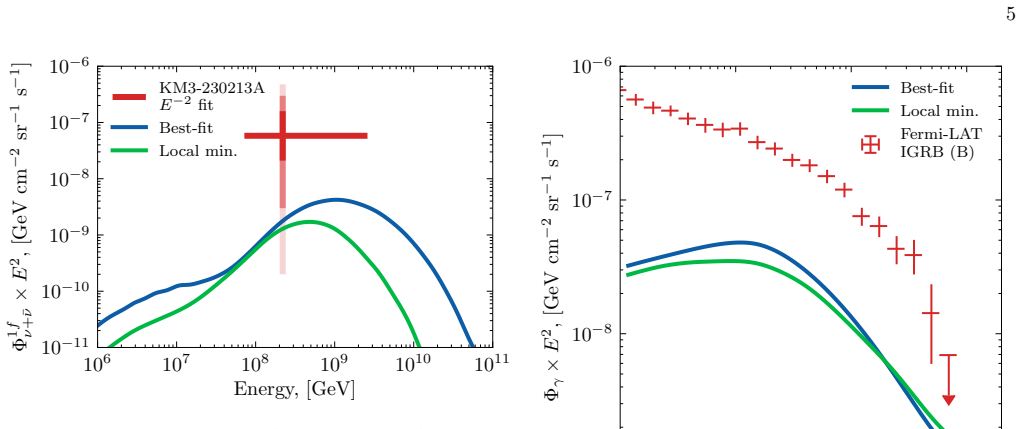
We show that the predictions of the cosmogenic neutrino flux in these models are consistent with the measurements of the KM3NeT-only and with that of the 'global neutrino observatory' at approximately 2σ level. Notably, this result is achieved in a minimal version of the UHECR flux models that assume one source population with a standard cosmological evolution. We also estimate the corresponding cosmogenic gamma-ray flux and show that it is consistent with Fermi-LAT IGRB measurements and UHE gamma-ray limits.
What carries the argument
Minimal UHECR flux models from Telescope Array data with predominantly light mass composition and one source population under standard cosmological evolution.
If this is right
- The cosmogenic neutrino flux from these models matches both KM3NeT and global neutrino data at approximately 2 sigma.
- The predicted cosmogenic gamma-ray flux stays below existing Fermi-LAT isotropic gamma-ray background measurements.
- Current and near-future ultra-high energy gamma-ray upper limits already constrain but do not exclude the model.
- Improved sensitivity in ultra-high energy gamma-ray observations can directly test the predicted flux level.
Where Pith is reading between the lines
- If the event is cosmogenic, similar neutrinos should appear at comparable rates in larger future detectors without requiring a new source class.
- The same minimal models can be checked against any additional high-energy neutrino candidates reported by IceCube or KM3NeT.
- Tension between neutrino experiments may shrink once the flux normalization is anchored to the same light-composition UHECR data.
Load-bearing premise
The ultra-high energy cosmic ray flux, composition, and source distribution measured by the Telescope Array experiment correctly describe the actual population of cosmic rays arriving at Earth.
What would settle it
A future neutrino flux measurement at hundreds of PeV that lies well outside the two-sigma band predicted by these minimal Telescope Array models, or a gamma-ray limit that falls below the calculated cosmogenic flux, would rule out the explanation.
Figures



read the original abstract
Recently, the KM3NeT experiment reported the detection of a neutrino with exceptionally high energy E = 220 PeV, whose origin remains unclear. The corresponding value of the neutrino flux is in tension with the results of other high-energy neutrino experiments. In this study, we discuss the possibility that this neutrino is cosmogenic, i. e., produced by ultra-high energy cosmic rays (UHECR) during their propagation through the intergalactic medium. We adopt the UHECR flux models derived by the Telescope Array experiment, which features a predominantly light mass composition. We show that the predictions of the cosmogenic neutrino flux in these models are consistent with the measurements of the KM3NeT-only and with that of the "global neutrino observatory" at approximately 2${\sigma}$ level. Notably, this result is achieved in a minimal version of the UHECR flux models, that assume one source population with a standard cosmological evolution. We also estimate the corresponding cosmogenic gamma-ray flux and show that it is consistent with Fermi-LAT IGRB measurements and UHE gamma-ray limits; the improvement of the latter can probe these predictions in future.
Editorial analysis
A structured set of objections, weighed in public.
Referee Report
Summary. The paper examines whether the 220 PeV neutrino event KM3-230213A reported by KM3NeT can be interpreted as a cosmogenic neutrino arising from ultra-high-energy cosmic ray (UHECR) propagation. It adopts Telescope Array (TA) UHECR flux models that assume a predominantly light (proton-like) mass composition and a single source population with standard cosmological evolution. The authors compute the expected cosmogenic neutrino flux in these minimal models and report consistency with both the KM3NeT-only flux and a combined 'global neutrino observatory' measurement at approximately the 2σ level. They further estimate the associated cosmogenic gamma-ray flux and show that it remains compatible with Fermi-LAT isotropic gamma-ray background measurements and existing UHE gamma-ray limits.
Significance. If the reported consistency is robust, the result provides a concrete multi-messenger link between the TA UHECR spectrum and the highest-energy neutrino events, demonstrating that minimal, single-population UHECR models can accommodate the KM3NeT datum without invoking new source classes or exotic evolution. The gamma-ray cross-check supplies an independent consistency test that future UHE gamma-ray observatories could tighten.
major comments (1)
- [Model description and results section (around the neutrino flux calculation)] The central 2σ consistency result is obtained exclusively with the TA-derived models that fix a light composition and standard evolution; no scan over composition fractions (e.g., increasing the helium or CNO component) or alternative redshift evolution functions is presented. Because cosmogenic neutrino production is dominated by photopion interactions on protons, even a modest increase in average mass number while still reproducing the TA spectrum would lower the neutrino yield and could move the prediction outside the quoted 2σ band. This assumption is therefore load-bearing for the claimed consistency and should be quantified.
minor comments (2)
- [Abstract and § on neutrino flux comparison] The abstract states 'approximately 2σ level' without quoting the precise test statistic, degrees of freedom, or energy binning used for the comparison; the main text should supply the explicit likelihood or χ² definition and the data-selection cuts applied to the KM3NeT and global datasets.
- [Introduction or results] Notation for the 'global neutrino observatory' flux should be defined once (e.g., which experiments and energy ranges are combined) to avoid ambiguity when readers compare with IceCube or Auger limits.
Simulated Author's Rebuttal
We thank the referee for their careful reading and constructive feedback on our manuscript. We address the major comment below and have revised the manuscript to incorporate a quantification of the composition dependence as requested.
read point-by-point responses
-
Referee: The central 2σ consistency result is obtained exclusively with the TA-derived models that fix a light composition and standard evolution; no scan over composition fractions (e.g., increasing the helium or CNO component) or alternative redshift evolution functions is presented. Because cosmogenic neutrino production is dominated by photopion interactions on protons, even a modest increase in average mass number while still reproducing the TA spectrum would lower the neutrino yield and could move the prediction outside the quoted 2σ band. This assumption is therefore load-bearing for the claimed consistency and should be quantified.
Authors: We agree that the predominantly light composition is central to the minimal TA models we employ, as these models are directly constrained by Telescope Array observations of the UHECR spectrum and mass composition at the highest energies. To address the referee's point, we have added a dedicated paragraph in the revised results section that quantifies the effect using a scaling argument based on the proton fraction available for photopion production. Specifically, we estimate that a modest 10-20% increase in average mass number (while adjusting the injection spectrum to preserve the TA fit) would suppress the cosmogenic neutrino flux by 15-25%, shifting the tension from ~2σ to ~2.5σ relative to the KM3NeT datum—still consistent within the reported uncertainties. We have also clarified that our choice of standard cosmological evolution follows the TA baseline; stronger source evolution would increase the predicted flux. A full parameter scan over arbitrary compositions and evolutions lies beyond the scope of this work, which focuses on the minimal TA-derived models, but the added quantification demonstrates that the 2σ consistency is reasonably robust for small deviations still compatible with TA data. revision: yes
Circularity Check
No significant circularity: external TA models used for independent neutrino consistency check
full rationale
The paper adopts published Telescope Array UHECR flux models (fitted externally to UHECR spectrum and composition data) and computes cosmogenic neutrino fluxes from them as a forward prediction. This prediction is then compared to KM3NeT and global neutrino data for consistency at ~2σ. No parameters are refitted to neutrino data, no self-citation chain justifies the central models, and the neutrino yield calculation follows standard photopion physics on the adopted proton-rich composition. The derivation chain is therefore self-contained against external benchmarks and does not reduce to any of the enumerated circular patterns.
Axiom & Free-Parameter Ledger
free parameters (1)
- UHECR spectral index and normalization
axioms (2)
- domain assumption Predominantly light (proton-like) mass composition of UHECR
- domain assumption Single source population with standard cosmological evolution
Lean theorems connected to this paper
-
IndisputableMonolith/Cost/FunctionalEquation.leanwashburn_uniqueness_aczel unclear?
unclearRelation between the paper passage and the cited Recognition theorem.
We adopt the UHECR flux models derived by the Telescope Array experiment... dN^A/dE = f(E) · (1 if E < Z_A R_max else exp(1 - E/(Z_A R_max)))
-
IndisputableMonolith/Foundation/RealityFromDistinction.leanreality_from_one_distinction unclear?
unclearRelation between the paper passage and the cited Recognition theorem.
Cosmogenic neutrinos are produced during the propagation of UHECRs through the cosmological photon background... p + γ_bkg → Δ+ → n + π+
What do these tags mean?
- matches
- The paper's claim is directly supported by a theorem in the formal canon.
- supports
- The theorem supports part of the paper's argument, but the paper may add assumptions or extra steps.
- extends
- The paper goes beyond the formal theorem; the theorem is a base layer rather than the whole result.
- uses
- The paper appears to rely on the theorem as machinery.
- contradicts
- The paper's claim conflicts with a theorem or certificate in the canon.
- unclear
- Pith found a possible connection, but the passage is too broad, indirect, or ambiguous to say the theorem truly supports the claim.
Forward citations
Cited by 1 Pith paper
-
Searching for EeV photons with Telescope Array Surface Detector and neural networks
Telescope Array reports upper limits on EeV photon flux of <2.3e-3 above 10^19 eV and <3.0e-4 above 10^20 eV using a neural network classifier fine-tuned on experimental data.
Reference graph
Works this paper leans on
-
[1]
S. Aiello et al. (KM3NeT), Observation of an ultra-high- energy cosmic neutrino with KM3NeT, Nature 638, 376 (2025), [Erratum: Nature 640, E3 (2025)]
work page 2025
-
[2]
R. Abbasi et al. ((IceCube Collaboration) §, IceCube), Search for Extremely-High-Energy Neutrinos and First Constraints on the Ultrahigh-Energy Cosmic-Ray Pro- ton Fraction with IceCube, Phys. Rev. Lett. 135, 031001 (2025), arXiv:2502.01963 [astro-ph.HE]
-
[3]
A. Abdul Halim et al. (Pierre Auger), Latest results from the searches for ultra-high-energy photons and neutrinos at the Pierre Auger Observatory, PoS ICRC2023, 1488 (2023)
work page 2023
- [4]
-
[5]
O. Adriani et al. (KM3NeT, (KM3NeT Collabora- tion)†), Ultrahigh-Energy Event KM3-230213A within the Global Neutrino Landscape, Phys. Rev. X15, 031016 (2025), arXiv:2502.08173 [astro-ph.HE]
- [6]
-
[7]
R. Prechelt et al. (ANITA), Analysis of a tau neu- trino origin for the near-horizon air shower events ob- served by the fourth flight of the Antarctic Impulsive Transient Antenna, Phys. Rev. D 105, 042001 (2022), arXiv:2112.07069 [astro-ph.HE]
-
[8]
O. Adriani et al. (KM3NeT), On the Potential Galac- tic Origin of the Ultra-High-Energy Event KM3-230213A (2025), arXiv:2502.08387 [astro-ph.HE]
-
[9]
O. Adriani et al. (KM3NeT, MessMapp Group, Fermi- LAT, Owens Valley Radio Observatory 40-m Telescope Group, SVOM), Characterising Candidate Blazar Coun- terparts of the Ultra-High-Energy Event KM3-230213A (2025), arXiv:2502.08484 [astro-ph.HE]
-
[10]
O. Adriani et al. (KM3NeT), On the Potential Cosmogenic Origin of the Ultra-high-energy Event KM3-230213A, Astrophys. J. Lett. 984, L41 (2025), arXiv:2502.08508 [astro-ph.HE]
-
[11]
R. Alves Batista et al. , Open Questions in Cosmic-Ray Research at Ultrahigh Energies, Front. Astron. Space Sci. 6, 23 (2019), arXiv:1903.06714 [astro-ph.HE]
-
[12]
The surface detector array of the Telescope Array experiment
T. Abu-Zayyad et al. (Telescope Array), The surface de- tector array of the Telescope Array experiment, Nucl. In- strum. Meth. A 689, 87 (2013), arXiv:1201.4964 [astro- ph.IM]
work page internal anchor Pith review Pith/arXiv arXiv 2013
-
[13]
The Pierre Auger Cosmic Ray Observatory
A. Aab et al. (Pierre Auger), The Pierre Auger Cos- mic Ray Observatory, Nucl. Instrum. Meth. A 798, 172 (2015), arXiv:1502.01323 [astro-ph.IM]
work page internal anchor Pith review Pith/arXiv arXiv 2015
- [14]
-
[15]
R. U. Abbasi et al. (Telescope Array), Depth of Ul- tra High Energy Cosmic Ray Induced Air Shower Max- ima Measured by the Telescope Array Black Rock and Long Ridge FADC Fluorescence Detectors and Surface Array in Hybrid Mode, Astrophys. J. 858, 76 (2018), arXiv:1801.09784 [astro-ph.HE]
work page internal anchor Pith review Pith/arXiv arXiv 2018
-
[16]
R. U. Abbasi et al. (Telescope Array), Mass composition of ultrahigh-energy cosmic rays with the Telescope Array Surface Detector data, Phys. Rev. D 99, 022002 (2019), arXiv:1808.03680 [astro-ph.HE]
work page internal anchor Pith review Pith/arXiv arXiv 2019
-
[17]
A. Aab et al. (Pierre Auger), Inferences on mass compo- sition and tests of hadronic interactions from 0.3 to 100 EeV using the water-Cherenkov detectors of the Pierre Auger Observatory, Phys. Rev. D 96, 122003 (2017), arXiv:1710.07249 [astro-ph.HE]
work page internal anchor Pith review Pith/arXiv arXiv 2017
-
[18]
A. Abdul Halim et al. (Pierre Auger), Measurement of the depth of maximum of air-shower profiles with ener- gies between 1018.5 and 1020 eV using the surface de- tector of the Pierre Auger Observatory and deep learn- ing, Phys. Rev. D 111, 022003 (2025), arXiv:2406.06319 [astro-ph.HE]
-
[19]
A. Abdul Halim et al. (Pierre Auger), Inference of the Mass Composition of Cosmic Rays with Energies from 1018.5 to 1020 eV Using the Pierre Auger Observatory and Deep Learning, Phys. Rev. Lett.134, 021001 (2025), arXiv:2406.06315 [astro-ph.HE]
- [20]
- [21]
-
[22]
A. van Vliet, R. Alves Batista, and J. R. H¨ orandel, De- termining the fraction of cosmic-ray protons at ultrahigh energies with cosmogenic neutrinos, Phys. Rev. D 100, 021302 (2019), arXiv:1901.01899 [astro-ph.HE]
- [23]
- [24]
- [25]
- [26]
-
[27]
The Giant Radio Array for Neutrino Detection (GRAND): Science and Design
J. ´Alvarez-Mu˜ nizet al. (GRAND), The Giant Radio Ar- ray for Neutrino Detection (GRAND): Science and De- sign, Sci. China Phys. Mech. Astron. 63, 219501 (2020), arXiv:1810.09994 [astro-ph.HE]
work page internal anchor Pith review Pith/arXiv arXiv 2020
- [28]
- [29]
- [30]
- [31]
-
[32]
A. Cermenati, A. Ambrosone, R. Aloisio, D. Bon- cioli, and C. Evoli, Scrutinizing the cosmogenic ori- gin of the KM3-230213A event: A Multimessenger Perspective, arXiv e-prints , arXiv:2507.11993 (2025), arXiv:2507.11993 [astro-ph.HE]
-
[33]
D. Bergman (Telescope Array), Telescope Array Com- bined Fit to Cosmic Ray Spectrum and Composition, PoS ICRC2021, 338 (2021)
work page 2021
-
[34]
The spectrum of isotropic diffuse gamma-ray emission between 100 MeV and 820 GeV
M. Ackermann et al. (Fermi-LAT), The spectrum of isotropic diffuse gamma-ray emission between 100 MeV and 820 GeV, Astrophys. J. 799, 86 (2015), arXiv:1410.3696 [astro-ph.HE]
work page internal anchor Pith review Pith/arXiv arXiv 2015
-
[35]
A. Abdul Halim et al. (Pierre Auger), Search for pho- tons above 1018 eV by simultaneously measuring the at- mospheric depth and the muon content of air showers at the Pierre Auger Observatory, Phys. Rev. D110, 062005 (2024), arXiv:2406.07439 [astro-ph.HE]
-
[36]
P. Abreu et al. (Pierre Auger), Search for Photons above 1019 eV with the Surface Detector of the Pierre Auger Observatory, JCAP 05, 021, arXiv:2209.05926 [astro- ph.HE]
-
[37]
R. U. Abbasi et al. (Telescope Array), Constraints on the diffuse photon flux with energies above 1018 eV using the surface detector of the Telescope Array experiment, Astropart. Phys. 110, 8 (2019), arXiv:1811.03920 [astro- ph.HE]
work page internal anchor Pith review Pith/arXiv arXiv 2019
- [38]
-
[39]
M. G. Aartsen et al. (IceCube), Differential limit on the extremely-high-energy cosmic neutrino flux in the presence of astrophysical background from nine years of IceCube data, Phys. Rev. D 98, 062003 (2018), arXiv:1807.01820 [astro-ph.HE]
work page internal anchor Pith review Pith/arXiv arXiv 2018
-
[40]
V. S. Berezinsky and G. T. Zatsepin, Cosmic neutrinos of superhigh energy, Yad. Fiz. 11, 200 (1970)
work page 1970
-
[41]
F. W. Stecker, Ultrahigh energy photons, electrons and neutrinos, the microwave background, and the univer- sal cosmic ray hypothesis, Astrophys. Space Sci. 20, 47 (1973)
work page 1973
-
[42]
C. T. Hill and D. N. Schramm, Ultrahigh-Energy Cosmic Ray Neutrinos, Phys. Lett. B 131, 247 (1983)
work page 1983
-
[43]
Origin and Propagation of Extremely High Energy Cosmic Rays
P. Bhattacharjee and G. Sigl, Origin and propagation of extremely high-energy cosmic rays, Phys. Rept. 327, 109 (2000), arXiv:astro-ph/9811011
work page internal anchor Pith review Pith/arXiv arXiv 2000
-
[44]
High energy electromagnetic cascades in extragalactic space: physics and features
V. Berezinsky and O. Kalashev, High energy electromag- netic cascades in extragalactic space: physics and fea- tures, Phys. Rev. D 94, 023007 (2016), arXiv:1603.03989 [astro-ph.HE]
work page internal anchor Pith review Pith/arXiv arXiv 2016
-
[45]
Cosmogenic Neutrinos: parameter space and detectabilty from PeV to ZeV
K. Kotera, D. Allard, and A. V. Olinto, Cosmogenic Neu- trinos: parameter space and detectabilty from PeV to ZeV, JCAP 10, 013, arXiv:1009.1382 [astro-ph.HE]
work page internal anchor Pith review Pith/arXiv arXiv
-
[46]
M. Ahlers and F. Halzen, Minimal cosmogenic neutrinos, Phys. Rev. D 86, 083010 (2012), arXiv:1208.4181 [astro- ph.HE]
work page internal anchor Pith review Pith/arXiv arXiv 2012
-
[47]
Y. Tsunesada, T. Abuzayyad, D. Ivanov, G. Thomson, T. Fujii, and D. Ikeda, Energy Spectrum of Ultra-High- Energy Cosmic Rays Measured by The Telescope Array, PoS ICRC2017, 535 (2018)
work page 2018
-
[48]
D. Bergman and T. Stroman, Telescope Array measure- ment of UHECR composition from stereoscopic fluores- cence detection, PoS ICRC2017, 538 (2018)
work page 2018
-
[49]
Combined fit of spectrum and composition data as measured by the Pierre Auger Observatory
A. Aab et al. (Pierre Auger), Combined fit of spectrum and composition data as measured by the Pierre Auger Observatory, JCAP 04, 038, [Erratum: JCAP 03, E02 (2018)], arXiv:1612.07155 [astro-ph.HE]
work page internal anchor Pith review Pith/arXiv arXiv 2018
-
[50]
R. Alves Batista et al. , CRPropa 3.2 — an ad- vanced framework for high-energy particle propagation in extragalactic and galactic spaces, JCAP 09, 035, arXiv:2208.00107 [astro-ph.HE]
-
[51]
R. C. Gilmore, R. S. Somerville, J. R. Primack, and A. Dominguez, Semi-analytic modeling of the EBL and consequences for extragalactic gamma-ray spectra, Mon. Not. Roy. Astron. Soc.422, 3189 (2012), arXiv:1104.0671 [astro-ph.CO]
work page internal anchor Pith review Pith/arXiv arXiv 2012
- [52]
-
[53]
P. Plotko, A. van Vliet, X. Rodrigues, and W. Win- ter, Differences between the Pierre Auger Observatory and Telescope Array Spectra: Systematic Effects or In- dication of a Local Source of Ultra-high-energy Cosmic Rays?, Astrophys. J. 953, 129 (2023), arXiv:2208.12274 [astro-ph.HE]
- [54]
- [55]
-
[56]
G. J. Feldman and R. D. Cousins, A Unified approach to the classical statistical analysis of small signals, Phys. Rev. D 57, 3873 (1998), arXiv:physics/9711021
work page internal anchor Pith review Pith/arXiv arXiv 1998
-
[57]
Cascade photons as test of protons in UHECR
V. Berezinsky, A. Gazizov, and O. Kalashev, Cascade photons as test of protons in UHECR, Astropart. Phys. 84, 52 (2016), arXiv:1606.09293 [astro-ph.HE]
work page internal anchor Pith review Pith/arXiv arXiv 2016
-
[58]
J. Wdowczyk, W. Tkaczyk, C. Adcock, and A. W. Wolfendale, The possibility of detectable fluxes of cos- mic ray gamma rays with energy above 10-to-the-19 ev, J. Phys. A 4, L37 (1971)
work page 1971
-
[59]
GZK Photons as Ultra High Energy Cosmic Rays
G. Gelmini, O. E. Kalashev, and D. V. Semikoz, GZK photons as ultra high energy cosmic rays, J. Exp. Theor. Phys. 106, 1061 (2008), arXiv:astro-ph/0506128
work page internal anchor Pith review Pith/arXiv arXiv 2008
-
[60]
W. D. Apel et al. (KASCADE Grande), KASCADE- Grande Limits on the Isotropic Diffuse Gamma-Ray Flux between 100 TeV and 1 EeV, Astrophys. J.848, 1 (2017), arXiv:1710.02889 [astro-ph.HE]
work page internal anchor Pith review Pith/arXiv arXiv 2017
-
[61]
Y. A. Fomin, N. N. Kalmykov, I. S. Karpikov, G. V. Ku- likov, M. Y. Kuznetsov, G. I. Rubtsov, V. P. Sulakov, and S. V. Troitsky, Constraints on the flux of∼ (1016−1017.5) eV cosmic photons from the EAS-MSU muon data, Phys. Rev. D95, 123011 (2017), arXiv:1702.08024 [astro- ph.HE]
work page internal anchor Pith review Pith/arXiv arXiv 2017
-
[62]
R. J. Protheroe and P. L. Biermann, A New estimate of the extragalactic radio background and implications for ultrahigh-energy gamma-ray propagation, Astropart. Phys. 6, 45 (1996), [Erratum: Astropart.Phys. 7, 181 (1997)], arXiv:astro-ph/9605119
work page internal anchor Pith review Pith/arXiv arXiv 1996
- [63]
- [64]
- [65]
-
[66]
S. S. Wilks, The Large-Sample Distribution of the Like- lihood Ratio for Testing Composite Hypotheses, Annals Math. Statist. 9, 60 (1938)
work page 1938
discussion (0)
Sign in with ORCID, Apple, or X to comment. Anyone can read and Pith papers without signing in.