REVIEW 3 major objections 5 minor 73 references
Fluent but Unfeeling: The Emotional Blind Spots of Language Models
T0 review · 3 major / 5 minor · reviewed 2026-08-04 · deepseek-v4-flash
Pith's one-line read The paper builds a benchmark of 33,679 Reddit posts with self-disclosed emotion labels and shows that even the best language models, such as GPT-4o, align with those labels only about a third of the time at the lexical level and under 40% a
desk verdict EXPRESS is a genuinely useful benchmark resource, but the paper's 'emotional blind spots' framing overreaches: the authors' own expert evaluation shows self-disclosed labels are not uniquely correct. read the letter →
The pith
A machine-rendered reading of the paper's core claim, the machinery that carries it, and where it could break.
The reading
What carries the argument
The evaluation framework decomposes both predicted and self-disclosed emotion words into 10-dimensional vectors using a widely used crowdsourced word-emotion lexicon aligned with Plutchik's Wheel of Emotion: eight basic emotions (joy, sadness, anger, fear, trust, disgust, anticipation, surprise) plus positive and negative sentiment. This decomposition lets the benchmark measure whether a model captures the emotional components of a self-disclosed feeling even when the exact word differs. EXPRESS itself is built by regex-based masking of phrases such as 'I feel + emotion' or 'I am + emotion' in 33,679 Reddit posts, which are segmented into 512-token contexts; this yields 251 distinct self-dis
What would settle it
A larger, pre-registered human evaluation using all 33,679 posts and a broader panel of emotion experts would settle the central claim: if expert majorities consistently prefer LLM predictions over self-disclosed emotions substantially more than 43.7% of the time, then 'alignment with self-disclosed emotions' is not a clean measure of emotional accuracy. Conversely, if agreement and preference for self-disclosures grow with more raters, the paper's low-alignment conclusion would be reinforced.
Extended reading notes
Core claim
The paper introduces EXPRESS, a fine-grained emotion recognition benchmark built from naturally occurring self-disclosures on Reddit, where authors explicitly name their own emotions. The evaluation masks those self-disclosed emotion words and asks language models to predict them, then compares predictions against the original words at two levels: exact lexical match and a 10-dimensional decomposition into eight basic emotions plus positive and negative sentiment. The central empirical finding is that accurate alignment with human self-disclosed emotions remains challenging: GPT-4o, the best model, achieves only 0.313 lexical accuracy and 0.388 vector accuracy in zero-shot evaluation, and mo
Load-bearing premise
The paper's central claim depends on treating the regex-extracted self-disclosed emotion word as the correct answer, yet the study's own experts preferred the self-disclosed word only 40.0% of the time and showed only fair agreement with each other.
Editorial extensions
If this is right
- Zero-shot emotion recognition does not reach 40% alignment at the lexical or vector level even for the best model, so current LLMs cannot be relied on to detect fine-grained self-disclosed emotions in social media text without further adaptation.
- Adding four nearest-example few-shot demonstrations improves every tested LLM, suggesting that in-context retrieval of similar emotional experiences is a practical route to better emotion awareness without task-specific training.
- Chain-of-thought prompting reliably worsens emotion prediction across model families, indicating that step-by-step reasoning is counterproductive in this subjective, context-sensitive task.
- Masked language models with around 100 million parameters match or beat causal LLMs many times their size on masked emotion prediction, offering a cost-effective alternative for emotion-focused applications.
- Providing GPT-4o with full posts instead of 512-token segments does not change performance, so long-context models gain little from additional context on this task.
Reading between the lines
- Because expert judges preferred the LLM's prediction over the writer's own self-disclosed emotion in 43.7% of disputed cases, the benchmark's central metric may be better read as agreement between two plausible human judgments rather than a measure of objective emotional accuracy; system builders should consider modeling a distribution over plausible emotions instead of a single target.
- The few-shot-nearest improvement suggests a concrete extension: retrieval-augmented emotion prediction, where a model is shown similar past self-disclosures before answering, may substantially narrow the gap to human alignment in mental-health support tools.
- Chain-of-thought's consistent harm raises a testable hypothesis that reasoning prompts nudge models toward generic emotion priors (such as 'anxious' or 'frustrated'); an experiment requiring models to quote specific contextual cues before predicting could reveal whether forcing evidence-grounded reasoning recovers accuracy.
- Fine-tuning on EXPRESS may inflate apparent gains if models exploit lexicon overlap rather than context; a stress test that paraphrases posts and swaps the self-disclosed emotion word would measure whether models truly track contextual emotion cues.
Editorial analysis
A structured set of objections, weighed in public.
Referee Report
Summary. The paper introduces EXPRESS, a benchmark of 33k+ Reddit posts in which authors' self-disclosed emotion words are masked, along with a fine-grained evaluation framework that decomposes predicted and actual emotion terms into 10-dimensional EmoLex-based vectors. Fourteen language models are evaluated in zero-shot, few-shot (random and nearest-example), and chain-of-thought settings. The main empirical finding is low lexical and vector-level alignment with self-disclosed emotions (e.g., GPT-4o reaches AccL=0.313 and AccV=0.388 in zero-shot), with few-shot prompting helping and CoT hurting. A human expert study on 213 posts finds that experts slightly prefer the LLM's predicted emotion over the self-disclosed one (43.7% vs. 40.0%, Fleiss' kappa=0.21).
Significance. EXPRESS is a potentially valuable resource: it is large, uses naturally occurring long-form self-disclosures, covers 251 fine-grained emotion labels, and the paper provides a systematic 14-model comparison with several prompting protocols and releases code and data. The few-shot vs. CoT results are informative for practical emotion-recognition use. However, the title and abstract overstate the conclusion: the quantitative results measure divergence from self-disclosed wording, and the paper's own human evaluation shows that the self-disclosed label is not a uniquely correct ground truth. If reframed as an alignment benchmark rather than evidence of 'emotional blind spots,' the contribution is solid; as it stands, the central interpretive claim is not supported by the evidence in the manuscript.
major comments (3)
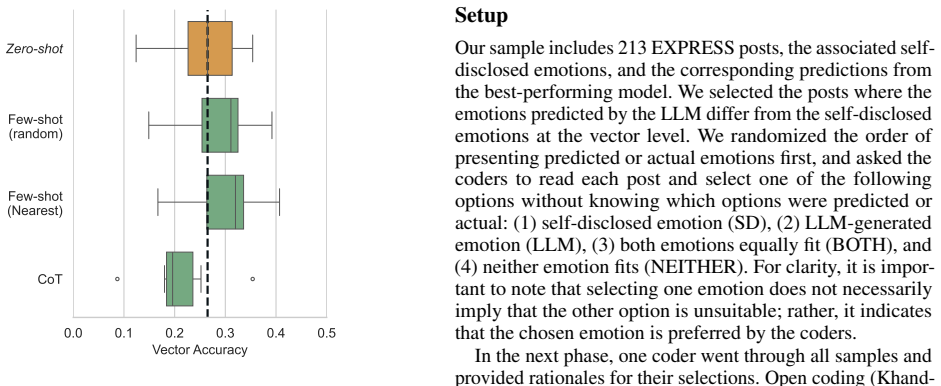
- [Human Evaluation of Predicted and Actual Emotions (Results; Limitations)] The paper's central claim—that LMs have 'emotional blind spots' because they fail to align with self-disclosed emotions—depends on treating the self-disclosed emotion word as the uniquely correct label. The paper's own expert evaluation undercuts this assumption: on the 213 posts where the LLM vector differed, experts chose the LLM emotion in 97 cases (43.7%) versus the self-disclosed emotion in 89 cases (40.0%), with Fleiss' kappa=0.21. The Limitations section further concedes that 'there may be cases where a term cannot be predicted by a human (at least without more context provided).' The 3.7-point gap is not tested for significance, and the low inter-rater agreement indicates that the text does not determine a unique emotion label. Consequently, low AccL/AccV is evidence of divergence from self-disclosed labels, not necessarily of a deficit in emotion recognition. The framing should
- [Measuring Accuracy of Emotion Recognition; Human Evaluation] No human baseline is reported for the exact mask-prediction task. The random baselines (AccL=0.001, AccV=0.322) show the task is hard relative to chance, but the abstract's claim that 'accurately predicting emotions that align with human self-disclosed emotions remains challenging' requires a human upper bound. The expert-preference study is a different task: experts choose between two given alternatives, rather than generating the masked emotion word, and the result is a near-tie. A human-participant experiment on the same masked posts is needed to determine whether the low lexical/vector accuracy reflects a distinctive limitation of LLMs or a property of the task. Alternatively, the paper should explicitly state that the benchmark measures divergence from self-disclosed wording, not human-level emotional accuracy.
- [Emotion Masking] The gold labels are produced by a regex protocol followed by a manual review, but no reliability or filtering statistics are reported ('we performed a manual review to filter out posts that did not satisfy the conditions but were not detected by the protocol'). Since all metrics compare model predictions to these extracted labels, masking errors or ambiguous cases—such as the multiple-label examples in Table A.3—directly depress AccL and AccV. The paper should report the number of posts removed or corrected by manual review, the specific exclusion criteria, and, if feasible, inter-annotator agreement on a sample of the masking decisions. Without this, the precision of EXPRESS as a gold-standard resource is unquantified.
minor comments (5)
- [Introduction vs. Dataset Statistics] The introduction states EXPRESS 'consists of 33,679 human experiences,' while the dataset construction section says 'comprises 33,697 posts' (and Table 1 lists 33,679). Please reconcile the numbers.
- [Evaluation Metrics (Appendix)] The random baseline AccV=0.322 appears without a derivation. Specifying the random vector generation process (e.g., random independent Bernoulli draws with EmoLex marginals, or random permutations) would make the baseline interpretable.
- [Model Details] The claim that GPT-4o has '1.75T parameters' is attributed without a citable source. If this is an estimate, please phrase it as such or cite a specific reference.
- [Error Analysis] The example 'grateful' vs. 'thankful' is presented as a misprediction, but these terms likely share the same EmoLex vector and therefore would not count as an error under AccV. Clarify which metric this error analysis refers to and whether the examples are lexical or vector-level errors.
- [Table 3 / Figure 2] The log-scale x-axis in Figure 2 makes it difficult to compare model families; adding labels or separate panels for architecture types would improve readability.
Circularity Check
No significant circularity: EXPRESS is an empirical benchmark with externally defined labels and metrics; the paper's own human evaluation undermines the ground-truth interpretation but does not make the derivation circular.
full rationale
This is an empirical benchmark and measurement paper, not a derivation, so the standard circularity reductions (Eq. X = Eq. Y by construction, fitted parameter renamed as prediction, or load-bearing self-citation chain) do not apply. The benchmark labels are self-disclosed emotion words extracted from Reddit by a regex protocol; the metrics (AccL, AccV, F1V) compare model outputs to those labels via EmoLex vectors and an AMT extension of EmoLex. No model parameter or evaluation parameter is fitted to the benchmark and then reported as a prediction; the only tuning is manual prompt selection on a sample (Appendix, Prompt Design), which is an overfitting/selection concern, not circularity. The paper's central claim that alignment with self-disclosed emotions is low is an empirical measurement, not a consequence of a definition. The paper's own human evaluation (213 posts; experts preferred the LLM emotion 43.7% vs the self-disclosed emotion 40.0%, Fleiss kappa 0.21) and its Limitations section ('there may be cases where a term cannot be predicted by a human (at least without more context provided)') do undermine the interpretation of self-disclosed labels as uniquely correct ground truth, but this is a construct-validity / correctness-risk issue, not a circular derivation. No load-bearing self-citations were found; Plutchik's wheel and EmoLex are external resources. Thus no circularity.
Assumptions & free parameters
free parameters (2)
- Prompt template =
best-accuracy template on sample set
- Segmentation window =
510 tokens (512 with separators)
assumptions (3)
- domain assumption Plutchik's eight basic emotions plus sentiment span the space of fine-grained emotions for evaluation
- domain assumption EmoLex binary word-emotion associations, including new AMT annotations, are valid for emotion words
- domain assumption Regex-identified self-disclosed emotion words are valid ground truth for emotion recognition
Cite this review
Pith. "Pith review of Fluent but Unfeeling: The Emotional Blind Spots of Language Models." pith.science (2026). https://pith.science/paper/OZW4RHF2
@misc{pith2026250909593,
  author       = {Pith},
  title        = {Pith review of: Fluent but Unfeeling: The Emotional Blind Spots of Language Models},
  year         = {2026},
  howpublished = {\url{https://pith.science/paper/OZW4RHF2}},
  note         = {Machine review of arXiv:2509.09593}
}
read the original abstract
The versatility of Large Language Models (LLMs) in natural language understanding has made them increasingly popular in mental health research. While many studies explore LLMs' capabilities in emotion recognition, a critical gap remains in evaluating whether LLMs align with human emotions at a fine-grained level. Existing research typically focuses on classifying emotions into predefined, limited categories, overlooking more nuanced expressions. To address this gap, we introduce EXPRESS, a benchmark dataset curated from Reddit communities featuring 251 fine-grained, self-disclosed emotion labels. Our comprehensive evaluation framework examines predicted emotion terms and decomposes them into eight basic emotions using established emotion theories, enabling a fine-grained comparison. Systematic testing of prevalent LLMs under various prompt settings reveals that accurately predicting emotions that align with human self-disclosed emotions remains challenging. Qualitative analysis further shows that while certain LLMs generate emotion terms consistent with established emotion theories and definitions, they sometimes fail to capture contextual cues as effectively as human self-disclosures. These findings highlight the limitations of LLMs in fine-grained emotion alignment and offer insights for future research aimed at enhancing their contextual understanding.
Figures


Reference graph
Works this paper leans on
-
[1]
, " * write output.state after.block = add.period write newline
ENTRY address archivePrefix author booktitle chapter edition editor eid eprint howpublished institution isbn journal key month note number organization pages publisher school series title type volume year label extra.label sort.label short.list INTEGERS output.state before.all mid.sentence after.sentence after.block FUNCTION init.state.consts #0 'before.a...
-
[2]
write newline
" write newline "" before.all 'output.state := FUNCTION n.dashify 't := "" t empty not t #1 #1 substring "-" = t #1 #2 substring "--" = not "--" * t #2 global.max substring 't := t #1 #1 substring "-" = "-" * t #2 global.max substring 't := while if t #1 #1 substring * t #2 global.max substring 't := if while FUNCTION word.in bbl.in capitalize " " * FUNCT...
-
[4]
K.; Srivastava, A.; Kumar, S.; Singh, S
Adhikary, P. K.; Srivastava, A.; Kumar, S.; Singh, S. M.; Manuja, P.; et al. 2024. Exploring the Efficacy of Large Language Models in Summarizing Mental Health Counseling Sessions: Benchmark Study. JMIR Mental Health, 11: e57306
2024
-
[5]
O.; and Sproat, R
Alm, C. O.; and Sproat, R. 2005. Perceptions of Emotions in Expressive Storytelling. In INTERSPEECH, volume 2005, 533--536
2005
-
[6]
Ball, G.; and Breese, J. 2001. Emotion and personality in a conversational agent, 189–219. Cambridge, MA, USA: MIT Press. ISBN 0262032783
2001
-
[7]
Barthel, M.; Stocking, G.; Holcomb, J.; and Mitchell, A. 2016. Reddit news users more likely to be male, young and digital in their news preferences. Pew Research Center, 25
2016
-
[8]
Beltagy, I.; Peters, M. E.; and Cohan, A. 2020. Longformer: The Long-Document Transformer. arXiv:2004.05150
arXiv 2020
-
[9]
Boe, B. 2021. PRAW : The P ython R eddit API W rapper. praw.readthedocs.io/en/latest/
2021
Show all 73 references
-
[10]
A.; Rivers, S
Brackett, M. A.; Rivers, S. E.; and Salovey, P. 2011. Emotional intelligence: Implications for personal, social, academic, and workplace success. Social and personality psychology compass, 5(1): 88--103
2011
-
[11]
Brown, T.; Mann, B.; Ryder, P., Nick Dhariwal; et al. 2020. Language models are few-shot learners. Advances in neural information processing systems, 33: 1877--1901
2020
-
[12]
Buechel, S.; and Hahn, U. 2017. E mo B ank: Studying the Impact of Annotation Perspective and Representation Format on Dimensional Emotion Analysis. In Lapata, M.; Blunsom, P.; and Koller, A., eds., Proceedings of the 15th Conference of the E uropean Chapter of the Association...
2017
-
[13]
N.; Joshi, M.; and Agrawal, P
Chatterjee, A.; Narahari, K. N.; Joshi, M.; and Agrawal, P. 2019. SemEval-2019 task 3: EmoContext contextual emotion detection in text. In Proceedings of the 13th international workshop on semantic evaluation, 39--48
2019
-
[14]
M.; Lerman, K.; and Narayanan, S
Chochlakis, G.; Pandiyan, N. M.; Lerman, K.; and Narayanan, S. 2025. Larger Language Models Don’t Care How You Think: Why Chain-of-Thought Prompting Fails in Subjective Tasks. In ICASSP 2025 - 2025 IEEE International Conference on Acoustics, Speech and Signal Processing (ICASSP), 1--5
2025
-
[15]
W.; Hou, L.; Longpre, J., Shayne Wei; et al
Chung, H. W.; Hou, L.; Longpre, J., Shayne Wei; et al. 2024. Scaling instruction-finetuned language models. J. Mach. Learn. Res., 25(1)
2024
-
[16]
Chung, M.; and Harris, C. R. 2018. Jealousy as a Specific Emotion: The Dynamic Functional Model. Emotion Review, 10(4): 272--287
2018
-
[17]
L.; and Keltner, D
Cowen, A.; Sauter, D.; Tracy, J. L.; and Keltner, D. 2019. Mapping the Passions: Toward a High-Dimensional Taxonomy of Emotional Experience and Expression. Psychological Science in the Public Interest, 20(1): 69--90. PMID: 31313637
2019
-
[18]
Davis, T. 2024. L ist of E motions: 271 E motion W ords (+ P D F ) --- berkeleywellbeing.com. https://www.berkeleywellbeing.com/list-of-emotions.html. [Accessed 06-06-2024]
2024
-
[19]
Davitz, J. 2013. The Language of Emotion. Academic Press. ISBN 9781483261713
2013
-
[20]
Demszky, D.; Movshovitz-Attias, D.; Ko, J.; Cowen, A.; Nemade, G.; and Ravi, S. 2020. G o E motions: A Dataset of Fine-Grained Emotions. In Proceedings of the 58th Annual Meeting of the Association for Computational Linguistics, 4040--4054
2020
-
[21]
Devlin, J.; Chang, M.-W.; Lee, K.; and Toutanova, K. 2019. BERT : Pre-training of Deep Bidirectional Transformers for Language Understanding. In Proceedings of the 2019 Conference of the North A merican Chapter of the Association for Computational Linguistics: Human Language T...
2019
-
[22]
R.; and Friesen, W
Ekman, P.; Sorenson, E. R.; and Friesen, W. V. 1969. Pan-cultural elements in facial displays of emotion. Science, 164(3875): 86--88
1969
-
[23]
Ekman, P.; et al. 1999. Basic emotions. Handbook of cognition and emotion, 98(45-60): 16
1999
-
[24]
Feng, S.; Lubis, N.; Geishauser, C.; Lin, H.-c.; Heck, M.; van Niekerk, C.; and Gasic, M. 2022. E mo WOZ : A Large-Scale Corpus and Labelling Scheme for Emotion Recognition in Task-Oriented Dialogue Systems. In Proceedings of the Thirteenth Language Resources and Evaluation Co...
2022
-
[25]
R.; Scherer, K
Fontaine, J. R.; Scherer, K. R.; Roesch, E. B.; and Ellsworth, P. C. 2007. The World of Emotions is not Two-Dimensional. Psychological Science, 18(12): 1050--1057. PMID: 18031411
2007
-
[26]
Frattaroli, J. 2006. Experimental Disclosure and Its Moderators: A Meta-Analysis. Psychological Bulletin, 132(6): 823
2006
-
[27]
Ghazi, D.; Inkpen, D.; and Szpakowicz, S. 2015. Detecting emotion stimuli in emotion-bearing sentences. In Computational Linguistics and Intelligent Text Processing: 16th International Conference, CICLing 2015, Cairo, Egypt, April 14-20, 2015, Proceedings, Part II 16, 152--165...
2015
-
[28]
Grattafiori, A.; Dubey, A.; Jauhri, A.; et al. 2024. The Llama 3 Herd of Models. arXiv:2407.21783
2024 arXiv
-
[29]
Grootendorst, M. 2022. BERTopic: Neural topic modeling with a class-based TF-IDF procedure. arXiv preprint arXiv:2203.05794
2022 arXiv
-
[30]
J.; and Feldman Barrett, L
Gross, J. J.; and Feldman Barrett, L. 2011. Emotion generation and emotion regulation: One or two depends on your point of view. Emotion review, 3(1): 8--16
2011
-
[31]
U.; Harper, R.; and Rollwage, M
Habicht, J.; Viswanathan, S.; Carrington, B.; Hauser, T. U.; Harper, R.; and Rollwage, M. 2024. Closing the accessibility gap to mental health treatment with a personalized self-referral Chatbot. Nature medicine, 30(2): 595--602
2024
-
[32]
F.; and Gable, P
Harmon-Jones, E.; Price, T. F.; and Gable, P. A. 2012. The Influence of Affective States on Cognitive Broadening/Narrowing: Considering the Importance of Motivational Intensity. Social and Personality Psychology Compass, 6(4): 314--327
2012
-
[33]
Hua, Y.; Na, H.; Li, Z.; Liu, F.; Fang, X.; Clifton, D.; and Torous, J. 2025. A scoping review of large language models for generative tasks in mental health care. npj Digital Medicine, 8(1): 230
2025
-
[34]
Ji, S.; Zhang, T.; Ansari, L.; Fu, J.; Tiwari, P.; and Cambria, E. 2022. MentalBERT: Publicly Available Pretrained Language Models for Mental Healthcare. In Proceedings of the Thirteenth Language Resources and Evaluation Conference, 7184--7190
2022
-
[35]
Ji, S.; Zhang, T.; Yang, K.; Ananiadou, S.; Cambria, E.; and Tiedemann, J. 2023. Domain-specific Continued Pretraining of Language Models for Capturing Long Context in Mental Health. arXiv preprint arXiv:2304.10447
2023 arXiv
-
[36]
Jurafsky, D.; and Martin, J. H. 2024. Speech and Language Processing: An Introduction to Natural Language Processing, Computational Linguistics, and Speech Recognition with Language Models. 3rd edition. Online manuscript released August 20, 2024
2024
-
[37]
Khandkar, S. H. 2009. Open coding. University of Calgary, 23(2009): 2009
2009
-
[38]
R.; Vidgen, B.; R \"o ttger, P.; and Hale, S
Kirk, H. R.; Vidgen, B.; R \"o ttger, P.; and Hale, S. A. 2024. The benefits, risks and bounds of personalizing the alignment of large language models to individuals. Nature Machine Intelligence, 1--10
2024
-
[39]
S.; Reid, M.; Matsuo, Y.; and Iwasawa, Y
Kojima, T.; Gu, S. S.; Reid, M.; Matsuo, Y.; and Iwasawa, Y. 2022. Large language models are zero-shot reasoners. In Proceedings of the 36th International Conference on Neural Information Processing Systems, NIPS '22. Red Hook, NY, USA. ISBN 9781713871088
2022
-
[40]
Li, Y.; Su, H.; Shen, X.; Li, W.; Cao, Z.; and Niu, S. 2017. D aily D ialog: A Manually Labelled Multi-turn Dialogue Dataset. In Proceedings of the Eighth International Joint Conference on Natural Language Processing (Volume 1: Long Papers), 986--995
2017
-
[41]
Liu, C.; Osama, M.; and De Andrade, A. 2019. DENS : A Dataset for Multi-class Emotion Analysis. In Proceedings of the 2019 Conference on Empirical Methods in Natural Language Processing and the 9th International Joint Conference on Natural Language Processing (EMNLP-IJCNLP), 6...
2019
-
[42]
Liu, J.; Shen, D.; Zhang, Y.; Dolan, B.; Carin, L.; and Chen, W. 2021 a . What Makes Good In-Context Examples for GPT- 3 ? arXiv preprint arXiv:2101.06804
2021 arXiv
-
[43]
Liu, S.; Zheng, C.; Demasi, O.; Sabour, S.; Li, Y.; Yu, Z.; Jiang, Y.; and Huang, M. 2021 b . Towards Emotional Support Dialog Systems. In Zong, C.; Xia, F.; Li, W.; and Navigli, R., eds., Proceedings of the 59th Annual Meeting of the Association for Computational Linguistics ...
2021
-
[44]
Liu, Y.; Ott, M.; Goyal, N.; Du, J.; Joshi, M.; Chen, D.; Levy, O.; Lewis, M.; Zettlemoyer, L.; and Stoyanov, V. 2019. RoBERTa: A Robustly Optimized BERT Pretraining Approach. arXiv:1907.11692
2019 arXiv
-
[45]
B.; and Robinson, M
Mauss, I. B.; and Robinson, M. D. 2009. Measures of Emotion: A Review. Cognition and Emotion, 23(2): 209--237
2009
-
[46]
D.; and Geher, G
Mayer, J. D.; and Geher, G. 1996. Emotional intelligence and the identification of emotion. Intelligence, 22(2): 89--113
1996
-
[47]
A.; Pelphrey, K
Mazefsky, C. A.; Pelphrey, K. A.; and Dahl, R. E. 2012. The need for a broader approach to emotion regulation research in autism. Child development perspectives, 6(1): 92--97
2012
-
[48]
Min, S.; Lyu, X.; Holtzman, A.; Artetxe, M.; Lewis, M.; Hajishirzi, H.; and Zettlemoyer, L. 2022. Rethinking the Role of Demonstrations: What Makes In-Context Learning Work? In Proceedings of the 2022 Conference on Empirical Methods in Natural Language Processing, 11048--11064
2022
-
[49]
Mohammad, S. 2018. Obtaining reliable human ratings of valence, arousal, and dominance for 20,000 English words. In Proceedings of the 56th annual meeting of the association for computational linguistics (volume 1: Long papers), 174--184
2018
-
[50]
Mohammad, S.; and Bravo-Marquez, F. 2017. Emotion Intensities in Tweets. In Ide, N.; Herbelot, A.; and M \`a rquez, L., eds., Proceedings of the 6th Joint Conference on Lexical and Computational Semantics (* SEM 2017) , 65--77
2017
-
[51]
M.; and Turney, P
Mohammad, S. M.; and Turney, P. D. 2013. Crowdsourcing a word--emotion association lexicon. Computational intelligence, 29(3): 436--465
2013
-
[52]
\"O hman, E.; Kajava, K.; Tiedemann, J.; and Honkela, T. 2018. Creating a dataset for multilingual fine-grained emotion-detection using gamification-based annotation. In Proceedings of the 9th workshop on computational approaches to subjectivity, sentiment and social media ana...
2018
-
[53]
OpenAI; Achiam, J.; Adler, S.; et al. 2024. GPT-4 Technical Report. arXiv:2303.08774
2024 arXiv
-
[54]
W.; and Beall, S
Pennebaker, J. W.; and Beall, S. K. 1986. Confronting a Traumatic Event: Toward an Understanding of Inhibition and Disease. Journal of Abnormal Psychology, 95(3): 274
1986
-
[55]
Plutchik, R. 1980. A general psychoevolutionary theory of emotion. In Theories of emotion, 3--33. Elsevier
1980
-
[56]
Russell, J. A. 1980. A circumplex model of affect. Journal of personality and social psychology, 39(6): 1161
1980
-
[57]
Sabour, S.; Liu, S.; Zhang, Z.; Liu, J.; Zhou, J.; Sunaryo, A.; Lee, T.; Mihalcea, R.; and Huang, M. 2024. E mo B ench: Evaluating the Emotional Intelligence of Large Language Models. In Proceedings of the 62nd Annual Meeting of the Association for Computational Linguistics (V...
2024
-
[58]
Salovey, P.; and Mayer, J. D. 1990. Emotional intelligence. Imagination, cognition and personality, 9(3): 185--211
1990
-
[59]
R.; and Wallbott, H
Scherer, K. R.; and Wallbott, H. G. 1994. Evidence for universality and cultural variation of differential emotion response patterning. Journal of personality and social psychology, 66(2): 310
1994
-
[60]
Schiller, D.; Alessandra, N.; Alia-Klein, N.; Dolcos, F.; et al. 2024. The human affectome. Neuroscience & Biobehavioral Reviews, 158: 105450
2024
-
[61]
Shaikh, O.; Zhang, H.; Held, W.; Bernstein, M.; and Yang, D. 2023. On Second Thought, Let`s Not Think Step by Step! Bias and Toxicity in Zero-Shot Reasoning. In Rogers, A.; Boyd-Graber, J.; and Okazaki, N., eds., Proceedings of the 61st Annual Meeting of the Association for Co...
2023
-
[62]
R.; et al
Sharma, M.; Tong, M.; Bowman, S. R.; et al. 2024. Towards Understanding Sycophancy in Language Models. In The Twelfth International Conference on Learning Representations
2024
-
[63]
Siemer, M.; Mauss, I.; and Gross, J. J. 2007. Same Situation--Different Emotions: How Appraisals Shape Our Emotions. Emotion (Washington, D.C.), 7(3): 592--600
2007
-
[64]
Singer, P.; Fl \"o ck, F.; Meinhart, C.; Zeitfogel, E.; and Strohmaier, M. 2014. Evolution of reddit: from the front page of the internet to a self-referential community? In Proceedings of the 23rd international conference on world wide web, 517--522
2014
-
[65]
Singh, S.; Caragea, C.; and Li, J. J. 2024. Language Models (Mostly) Do Not Consider Emotion Triggers When Predicting Emotion. In Proceedings of the 2024 Conference of the North American Chapter of the Association for Computational Linguistics: Human Language Technologies (Vol...
2024
-
[66]
C.; Stirman, S
Stade, E. C.; Stirman, S. W.; Ungar, L. H.; Boland, C. L.; Schwartz, H. A.; Yaden, D. B.; Sedoc, J.; DeRubeis, R. J.; Willer, R.; and Eichstaedt, J. C. 2024. Large language models could change the future of behavioral healthcare: a proposal for responsible development and eval...
2024
-
[67]
Strapparava, C.; and Mihalcea, R. 2007. Semeval-2007 task 14: Affective text. In Proceedings of the fourth international workshop on semantic evaluations (SemEval-2007), 70--74
2007
-
[68]
P.; Miller, R
Tangney, J. P.; Miller, R. S.; Flicker, L.; and Barlow, D. H. 1996. Are shame, guilt, and embarrassment distinct emotions? Journal of Personality and Social Psychology, 70: 1256--1269
1996
-
[69]
Team, G.; Riviere, M.; Pathak, S.; et al. 2024. Gemma 2: Improving Open Language Models at a Practical Size. arXiv:2408.00118
2024 arXiv
-
[70]
A.; Roberts, N.; Lin, C.; and Birmingham, E
Trevisan, D. A.; Roberts, N.; Lin, C.; and Birmingham, E. 2017. How do adults and teens with self-declared Autism Spectrum Disorder experience eye contact? A qualitative analysis of first-hand accounts. PloS one, 12(11): e0188446
2017
-
[71]
Turing, A. M. 2009. Computing machinery and intelligence. Springer
2009
-
[72]
Van Pelt, C.; and Sorokin, A. 2012. Designing a scalable crowdsourcing platform. In Proceedings of the 2012 ACM SIGMOD International Conference on Management of Data, 765--766
2012
-
[73]
Wang, X.; Li, X.; Yin, Z.; Wu, Y.; and Liu, J. 2023. Emotional intelligence of large language models. Journal of Pacific Rim Psychology, 17: 18344909231213958
2023
-
[74]
Wei, J.; Wang, X.; Schuurmans, D.; Zhou, D.; et al. 2022. Chain-of-thought prompting elicits reasoning in large language models. Advances in neural information processing systems, 35: 24824--24837
2022
Reviewed August 4, 2026 · model on record in the stance chip above.
Discussion (0). Sign in to comment.