REVIEW 5 major objections 6 minor 74 references
A dedicated traffic-surveillance multimodal dataset lifts fine-tuned vision-language models from roughly 0.5 to above 0.9 average score.
Reviewed by Pith at T0; open to challenge. T0 means a machine referee read the full paper against a public rubric. the ladder, T0–T4 →
T0 review · deepseek-v4-flash
2026-08-04 20:28 UTC pith:6NUQX72X
load-bearing objection MITS is a genuinely useful dataset resource, but the reported gains are inflated by an insufficiently split test set and in-distribution evaluation; it deserves a careful referee, not acceptance as-is. the 5 major comments →
MITS: A Large-Scale Multimodal Benchmark Dataset for Intelligent Traffic Surveillance
The pith
A machine-rendered reading of the paper's core claim, the machinery that carries it, and where it could break.
Core claim
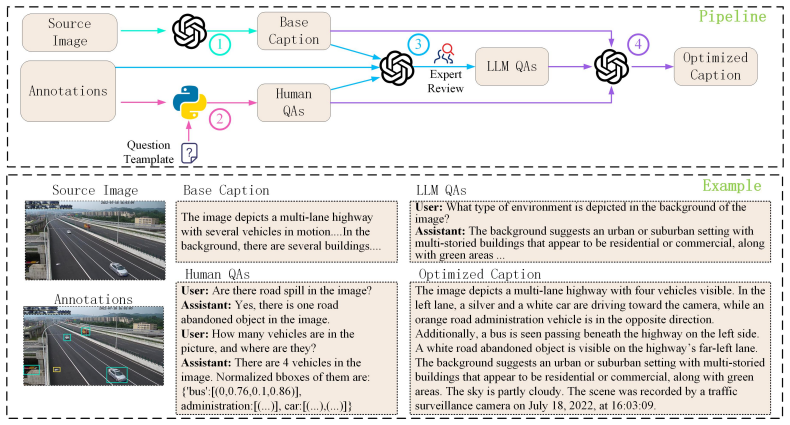
MITS is a large-scale multimodal benchmark built from four years of desensitized real-world traffic-camera footage. Around each image the authors construct a hierarchy of annotations: detection and classification labels for eight main categories and 24 subcategories of objects and events; human-generated question templates whose answers are derived automatically from those verified labels; GPT-4o-generated background-analysis and event-reasoning QA pairs that pass expert review; and an optimized caption that merges the base caption, human QAs, and verified LLM QAs. Fine-tuning four mainstream LMM families—LLaVA-1.5, LLaVA-1.6, Qwen2-VL, and Qwen2.5-VL—on this data improves average test score
What carries the argument
The carrying mechanism is a human-in-the-loop multimodal data-generation pipeline. Object and event labels are produced by an iterative YOLOv8-assisted annotation loop with human validation; question templates then generate recognition, counting, and localization QA pairs whose answers are exact functions of the verified labels, and GPT-4o generates background and reasoning QAs that experts review. An optimized-caption step fuses all verified information into one dense caption, and the models are fine-tuned with LoRA on the captions and QA pairs. Balanced positive and negative sampling per category is what makes the counting and localization answers trustworthy enough to serve as training si
Load-bearing premise
The benchmark's answers—both the object labels and the question-answer pairs—are assumed to be correct and complete because they were produced by a machine-assisted loop and expert review rather than measured for error rate; if those labels contain systematic mistakes, the reported scores overstate how well the models actually understand traffic scenes.
What would settle it
Take a random sample of MITS test images, have independent experts annotate the same counting and localization questions without seeing MITS labels, and compare their answers to the benchmark's ground truth; if agreement is materially below the fine-tuned models' scores, the ground truth is too lenient and the reported improvements are inflated. A second check: re-evaluate the fine-tuned models on a held-out set of traffic-camera images from a different region or camera system to test whether the gains generalize beyond the dataset's collection sites.
If this is right
- Fine-tuned LMMs can act as queryable traffic-surveillance assistants, answering natural-language questions about camera feeds for monitoring and incident management.
- Because counting and localization are the most improved tasks, downstream applications such as vehicle counts and incident location can plausibly rely on LMM output rather than separate small detection models.
- Optimized captions that fuse verified foreground labels with reviewed background descriptions improve downstream performance more than base captions alone, pointing to data quality as a key lever.
- The consistent gains across five model families suggest the approach transfers across architectures, so the dataset itself is the reusable asset.
- Releasing the dataset, code, and fine-tuned models lets other groups reproduce the benchmark and extend it to new cameras or regions.
Where Pith is reading between the lines
- The reported gains are measured against MITS's own ground truth; a test with independently annotated or human-expert baselines would clarify how much of the remaining gap is label noise versus model error.
- Because all images are single-frame and mostly from fixed third-person cameras, the benchmark does not test temporal reasoning; extending MITS to multi-frame sequences would likely be needed for accident prediction or intent analysis.
- The category taxonomy was chosen from the authors' ITS project experience; other deployments with different camera placements or legal regimes may need new categories, and the pipeline rather than the exact label set is the reusable part.
- The 98% human-agreement check on the scoring model suggests automatic evaluation is workable, but that agreement was measured on 5,000 QA pairs and should be re-examined per task because background and reasoning answers are open-ended.
Editorial analysis
A structured set of objections, weighed in public.
Referee Report
Summary. The paper introduces MITS, a large-scale multimodal benchmark for Intelligent Traffic Surveillance, comprising 170,400 real-world surveillance images from roughly 1,100 cameras, annotated with 8 main categories and 24 subcategories, together with image captions and more than 5 million VQA pairs spanning recognition, counting, localization, background analysis, and event reasoning. The dataset is constructed through a hybrid pipeline: YOLOv8-assisted human-validated object/event annotations, template-based human-generated QAs derived from those annotations, and GPT-4o-generated background/reasoning QAs refined by expert review. To validate MITS, the authors fine-tune several general LMMs (LLaVA-1.5/1.6, Qwen2-VL, Qwen2.5-VL) on the training set and report large test-set gains (27%–83% relative). The central claim of the paper is that MITS significantly improves LMM performance for ITS applications.
Significance. If the reported improvements are real and reflect generalization to unseen ITS scenes, MITS would be a valuable contribution: it is large-scale, sourced from real surveillance cameras, includes privacy desensitization, and is released openly with code and models. The five-task organization and the human-in-the-loop annotation process are sensible. However, the evaluation currently has load-bearing weaknesses: the train/test split is not demonstrated to be independent at the source-video/camera level, there is no control condition using non-ITS instruction data, and the test questions are generated by the same pipeline as the training questions. These issues undermine the strength of the central claim until addressed.
major comments (5)
- [§3.3.1, §3.1, Table 4]
- [§4.1.1, Table 4]
- [§3.2.3, §3.4, §4.2.1]
- [§3.2.1, Table 4]
- [§4.1.2, Table 4]
minor comments (6)
- [Table 4] The table layout is confusing: average scores are concatenated with the next cell, e.g., "0.8840.905(+83.2%)" and "0.8860.921(+35.8%)". Please add separators and clarify which column is the average.
- [Table 1, §3.2.3 prompt] There are typos: "suverillance" should be "surveillance" in Table 1 and in the GPT-4o prompt text.
- [References [67]] Reference [67] cites the ultralytics/yolov5 repository, but the text refers to YOLOv8. Please cite the correct YOLOv8 source.
- [§3.3.1] The test-set description should report the exact number of test images per category, whether balancing was done independently per category, and whether any source-camera/corridor constraints were used. Currently only "uniformly sampled 10%" is stated.
- [§4.2.3, Figures 7–8] The figure captions should state which model variant is shown (e.g., Qwen2.5-VL-7B) and clearly distinguish ground-truth boxes from model predictions.
- [§1, Abstract] The percentage gains in the abstract are relative improvements; consider reporting absolute deltas as well for clarity (e.g., 0.494→0.905 rather than only +83.2%).
Circularity Check
No significant circularity: the central fine-tuning claim is an empirical evaluation on a held-out test split; self-citations are methodological and not load-bearing.
full rationale
The paper's main claim is that fine-tuning general LMMs on MITS improves their performance on ITS tasks. This is supported by a standard supervised protocol: models are trained on a training subset and evaluated on a test subset sampled from the same dataset (Sec. 3.3.1). The QA pairs used for evaluation are generated by the same templating/GPT-4o pipeline as the training data, so the evaluation is in-distribution, but that is a normal property of benchmark construction and does not make the reported improvement equivalent to the training objective by construction. The recognition/counting/localization ground truths derive from manual plus YOLOv8-assisted annotations, while background/reasoning answers are expert-reviewed; the DeepSeek-R1 scoring is itself human-validated on 5,000 samples. The paper's self-citations ([5], [6], [61], [69]) are to related datasets, a training methodology, and an evaluation methodology; none of them supplies a premise that definitionally forces the central result. A potential issue is that the test split is image-level rather than video- or camera-level, given the images come from ~8,000 recordings at ~21 frames per recording, which could in principle leak near-duplicate frames into training and inflate gains. That is an experimental validity concern, not a circularity: no equation or definition in the paper reduces the test scores to the training fit. Overall, the derivation chain is not circular in the sense required by the review criteria.
Axiom & Free-Parameter Ledger
axioms (4)
- domain assumption The eight main categories and 24 subcategories cover the most critical ITS objects and events.
- domain assumption The YOLOv8-assisted annotation loop with human review produces accurate and complete labels for all images.
- domain assumption GPT-4o-generated captions and QA pairs, after expert review, are factually reliable.
- domain assumption DeepSeek-R1 scores for background and reasoning answers align with human judgment.
Cite this review
Pith. "Pith review of MITS: A Large-Scale Multimodal Benchmark Dataset for Intelligent Traffic Surveillance." pith.science (2026). https://pith.science/paper/6NUQX72X
@misc{pith2026250909730,
  author       = {Pith},
  title        = {Pith review of: MITS: A Large-Scale Multimodal Benchmark Dataset for Intelligent Traffic Surveillance},
  year         = {2026},
  howpublished = {\url{https://pith.science/paper/6NUQX72X}},
  note         = {Machine review of arXiv:2509.09730}
}
read the original abstract
General-domain large multimodal models (LMMs) have achieved significant advances in various image-text tasks. However, their performance in the Intelligent Traffic Surveillance (ITS) domain remains limited due to the absence of dedicated multimodal datasets. To address this gap, we introduce MITS (Multimodal Intelligent Traffic Surveillance), the first large-scale multimodal benchmark dataset specifically designed for ITS. MITS includes 170,400 independently collected real-world ITS images sourced from traffic surveillance cameras, annotated with eight main categories and 24 subcategories of ITS-specific objects and events under diverse environmental conditions. Additionally, through a systematic data generation pipeline, we generate high-quality image captions and 5 million instruction-following visual question-answer pairs, addressing five critical ITS tasks: object and event recognition, object counting, object localization, background analysis, and event reasoning. To demonstrate MITS's effectiveness, we fine-tune mainstream LMMs on this dataset, enabling the development of ITS-specific applications. Experimental results show that MITS significantly improves LMM performance in ITS applications, increasing LLaVA-1.5's performance from 0.494 to 0.905 (+83.2%), LLaVA-1.6's from 0.678 to 0.921 (+35.8%), Qwen2-VL's from 0.584 to 0.926 (+58.6%), and Qwen2.5-VL's from 0.732 to 0.930 (+27.0%). We release the dataset, code, and models as open-source, providing high-value resources to advance both ITS and LMM research.
Figures




Reference graph
Works this paper leans on
- [1]
-
[2]
S. Wan, X. Xu, T. Wang, Z. Gu, An intelligent video analysis method for abnormal event detection in intelligent transportation systems, IEEE 23 Transactions on Intelligent Transportation Systems 22 (7) (2021) 4487– 4495.doi:10.1109/TITS.2020.3017505. 2, 5
arXiv 2021
-
[3]
J. Ashraf, A. D. Bakhshi, N. Moustafa, H. Khurshid, A. Javed, A. Be- heshti, Novel deep learning-enabled lstm autoencoder architecture for discovering anomalous events from intelligent transportation systems, IEEE Transactions on Intelligent Transportation Systems 22 (7) (2021) 4507–4518.doi:10.1109/TITS.2020.3017882. 2
arXiv 2021
-
[4]
Y. Tang, C. Zhang, R. Gu, P. Li, B. Yang, Vehicle detection and recog- nition for intelligent traffic surveillance system, Multimedia tools and applications 76 (2017) 5817–5832. 2
2017
-
[5]
Y. Xu, C. Huang, Y. Nan, S. Lian, Tad: A large-scale benchmark for traffic accidents detection from video surveillance, arXiv preprint arXiv:2209.12386 (2022). 2, 4, 5, 6
Pith/arXiv arXiv 2022
-
[6]
Y. Xu, H. Hu, X. Zhu, Y. Nan, K. Wang, Z. Liu, S. Lian, Raod: A benchmark for road abandoned object detection from video surveillance, IEEE Access (2024). 2, 5, 6
2024
-
[7]
Y. Xia, N. Qian, L. Guo, Z. Cai, Cf-solt: Real-time and ac- curate traffic accident detection using correlation filter-based tracking, Image and Vision Computing 152 (2024) 105336. doi:https://doi.org/10.1016/j.imavis.2024.105336. URLhttps://www.sciencedirect.com/science/article/pii/ S02628856240044142, 4
arXiv 2024
-
[8]
H. Pan, S. Guan, X. Zhao, Lvd-yolo: An efficient lightweight vehicle detection model for intelligent transportation systems, Image and Vision Computing 151 (2024) 105276.doi:https: //doi.org/10.1016/j.imavis.2024.105276. URLhttps://www.sciencedirect.com/science/article/pii/ S02628856240038102
arXiv 2024
-
[9]
Z. Yang, L. S. Pun-Cheng, Vehicle detection in intelligent trans- portation systems and its applications under varying environ- ments: A review, Image and Vision Computing 69 (2018) 143–154. doi:https://doi.org/10.1016/j.imavis.2017.09.008. 24 URLhttps://www.sciencedirect.com/science/article/pii/ S02628856173015922
-
[10]
E. Lee, D. Kim, Accurate traffic light detection using deep neural net- work with focal regression loss, Image and Vision Computing 87 (2019) 24–36.doi:https://doi.org/10.1016/j.imavis.2019.04.003. URLhttps://www.sciencedirect.com/science/article/pii/ S02628856193005382
-
[11]
Faghri, H
F. Faghri, H. Pouransari, S. Mehta, M. Farajtabar, A. Farhadi, M. Rastegari, O. Tuzel, Reinforce data, multiply impact: Improved model accuracy and robustness with dataset reinforcement, in: Proceed- ings of the IEEE/CVF International Conference on Computer Vision, 2023, pp. 17032–17043. 2
2023
-
[12]
Y. Wang, H. Jiang, G. Chen, T. Zhang, J. Zhou, Z. Qing, C. Wang, W. Zhao, Efficient and robust multi-camera 3d object detection in bird-eye-view, Image and Vision Computing 154 (2025) 105428. doi:https://doi.org/10.1016/j.imavis.2025.105428. URLhttps://www.sciencedirect.com/science/article/pii/ S02628856250001622
arXiv 2025
-
[13]
D. Zhu, J. Chen, X. Shen, X. Li, M. Elhoseiny, Minigpt-4: Enhancing vision-language understanding with advanced large language models, arXiv preprint arXiv:2304.10592 (2023). 2, 7
Pith/arXiv arXiv 2023
-
[14]
H. Liu, C. Li, Q. Wu, Y. J. Lee, Visual instruction tuning, Advances in neural information processing systems 36 (2024). 2, 7, 16
2024
-
[15]
J. Bai, S. Bai, S. Yang, S. Wang, S. Tan, P. Wang, J. Lin, C. Zhou, J. Zhou, Qwen-vl: A versatile vision-language model for understanding, localization, text reading, and beyond, arXiv preprint arXiv:2308.12966 (2023). 2
Pith/arXiv arXiv 2023
-
[16]
P. Wang, S. Bai, S. Tan, S. Wang, Z. Fan, J. Bai, K. Chen, X. Liu, J. Wang, W. Ge, Y. Fan, K. Dang, M. Du, X. Ren, R. Men, D. Liu, C. Zhou, J. Zhou, J. Lin, Qwen2-vl: Enhancing vision-language model’s perception of the world at any resolution, arXiv preprint arXiv:2409.12191 (2024). 2, 7 25
Pith/arXiv arXiv 2024
-
[17]
C. Li, C. Wong, S. Zhang, N. Usuyama, H. Liu, J. Yang, T. Naumann, H. Poon, J. Gao, Llava-med: Training a large language-and-vision as- sistant for biomedicine in one day, Advances in Neural Information Pro- cessing Systems 36 (2024). 2, 3, 7, 17
2024
-
[18]
F. Bai, Y. Du, T. Huang, M. Q.-H. Meng, B. Zhao, M3d: Advancing 3d medical image analysis with multi-modal large language models, arXiv preprint arXiv:2404.00578 (2024). 2, 7
Pith/arXiv arXiv 2024
-
[19]
A.-M.Marcu, L.Chen, J.Hünermann, A.Karnsund, B.Hanotte, P.Chi- dananda, S.Nair, V.Badrinarayanan, A.Kendall, J.Shotton, etal., Lin- goqa: Video question answering for autonomous driving, arXiv preprint arXiv:2312.14115 (2023). 2, 5, 6
Pith/arXiv arXiv 2023
-
[20]
X. Cao, T. Zhou, Y. Ma, W. Ye, C. Cui, K. Tang, Z. Cao, K. Liang, Z. Wang, J. M. Rehg, et al., Maplm: A real-world large-scale vision- language benchmark for map and traffic scene understanding, in: Pro- ceedings of the IEEE/CVF Conference on Computer Vision and Pattern Recognition, 2024, pp. 21819–21830. 2, 3, 5
2024
-
[21]
L. Zha, C. Gong, K. Lv, Real-time localization and navigation method for autonomous vehicles based on multi-modal data fusion by integrating memory transformer and ddqn, Image and Vision Computing 156 (2025) 105484.doi:https://doi.org/10.1016/j.imavis.2025.105484. URLhttps://www.sciencedirect.com/science/article/pii/ S02628856250007212
arXiv 2025
-
[22]
14615–14624
K.Zhu, Y.Wang, Y.Sun, Q.Chen, J.Liu, G.Zhang, J.Wang, Continual sft matches multimodal rlhf with negative supervision, in: Proceedings of the Computer Vision and Pattern Recognition Conference, 2025, pp. 14615–14624. 2
2025
-
[23]
Y. Sun, J. Chen, S. Zhang, X. Zhang, Q. Chen, G. Zhang, E. Ding, J. Wang, Z. Li, Vrp-sam: Sam with visual reference prompt, in: Pro- ceedings of the IEEE/CVF Conference on Computer Vision and Pattern Recognition, 2024, pp. 23565–23574. 2
2024
-
[24]
Y. Sun, Q. Chen, X. He, J. Wang, H. Feng, J. Han, E. Ding, J. Cheng, Z. Li, J. Wang, Singular value fine-tuning: Few-shot segmentation re- quires few-parameters fine-tuning, Advances in neural information pro- cessing systems 35 (2022) 37484–37496. 2 26
2022
-
[25]
W. Tang, Y. Sun, Q. Gu, Z. Li, Visual position prompt for mllm based visual grounding, arXiv preprint arXiv:2503.15426 (2025). 2
Pith/arXiv arXiv 2025
-
[26]
W. Tang, L. Li, X. Liu, L. Jin, J. Tang, Z. Li, Context disentangling and prototype inheriting for robust visual grounding, IEEE Transactions on Pattern Analysis and Machine Intelligence 46 (5) (2023) 3213–3229. 2
2023
-
[27]
Y. Sun, Q. Chen, J. Wang, J. Wang, Z. Li, Exploring effective factors for improving visual in-context learning, IEEE Transactions on Image Processing (2025). 2
2025
-
[28]
X. Li, X. Liu, L. Qi, J. Dong, Weakly supervised camou- flaged object detection based on the sam model and mask guidance, Image and Vision Computing 159 (2025) 105571. doi:https://doi.org/10.1016/j.imavis.2025.105571. URLhttps://www.sciencedirect.com/science/article/pii/ S02628856250015932
arXiv 2025
-
[29]
S. Paulraj, S. Vairavasundaram, M2vad: Multiview multi- modality transformer-based weakly supervised video anomaly detection, Image and Vision Computing 149 (2024) 105139. doi:https://doi.org/10.1016/j.imavis.2024.105139. URLhttps://www.sciencedirect.com/science/article/pii/ S02628856240024392
arXiv 2024
-
[30]
X. Hong, T. Adam, M. Ghazali, Uhdnet: Unified multimodal fusion harmonization and hierarchical dependency learning for visible-infrared person re-identification, Image and Vision Computing 161 (2025) 105628.doi:https://doi.org/10.1016/j.imavis.2025.105628. URLhttps://www.sciencedirect.com/science/article/pii/ S02628856250021612
arXiv 2025
-
[31]
J. Zhang, Y. Yu, Y. Mao, Y. Ren, Event-level multimodal feature fusion for audio–visual event localization, Image and Vision Computing 161 (2025) 105610.doi:https://doi.org/10.1016/j.imavis.2025. 105610. URLhttps://www.sciencedirect.com/science/article/pii/ S02628856250019822 27
-
[32]
M. Li, Z. Zhu, K. Li, L. Zhou, Z. Zhao, H. Pei, Joint train- ing strategy of unimodal and multimodal for multimodal senti- ment analysis, Image and Vision Computing 149 (2024) 105172. doi:https://doi.org/10.1016/j.imavis.2024.105172. URLhttps://www.sciencedirect.com/science/article/pii/ S02628856240027742
arXiv 2024
-
[33]
Z. Wang, W. Wang, N. Li, S. Zhang, Q. Chen, Z. Jiang, Multimodal parallel attention network for medical image seg- mentation, Image and Vision Computing 147 (2024) 105069. doi:https://doi.org/10.1016/j.imavis.2024.105069. URLhttps://www.sciencedirect.com/science/article/pii/ S02628856240017322
arXiv 2024
-
[34]
V. Guarrasi, F. Aksu, C. M. Caruso, F. Di Feola, A. Ro- fena, F. Ruffini, P. Soda, A systematic review of interme- diate fusion in multimodal deep learning for biomedical ap- plications, Image and Vision Computing 158 (2025) 105509. doi:https://doi.org/10.1016/j.imavis.2025.105509. URLhttps://www.sciencedirect.com/science/article/pii/ S02628856250009762
arXiv 2025
-
[35]
B. Jiang, M. Liao, Y. Zhao, G. Li, S. Cheng, X. Wang, Q. Xia, Deep learning for brain tumor segmentation in multimodal mri images: A re- view of methods and advances, Image and Vision Computing 156 (2025) 105463.doi:https://doi.org/10.1016/j.imavis.2025.105463. URLhttps://www.sciencedirect.com/science/article/pii/ S02628856250005142
arXiv 2025
-
[36]
S. R. Pulari, M. Umadevi, S. K. Vasudevan, Optimizing multimodal personalized disease prediction accuracy using generated prompts and large language models, Image and Vision Computing 161 (2025) 105649. doi:https://doi.org/10.1016/j.imavis.2025.105649. URLhttps://www.sciencedirect.com/science/article/pii/ S02628856250023792
arXiv 2025
-
[37]
L. Xu, H. Huang, J. Liu, Sutd-trafficqa: A question answering bench- mark and an efficient network for video reasoning over traffic events, in: Proceedings of the IEEE/CVF conference on computer vision and pattern recognition, 2021, pp. 9878–9888. 5, 6, 11 28
2021
-
[38]
Q. Kong, Y. Kawana, R. Saini, A. Kumar, J. Pan, T. Gu, Y. Ozao, B. Opra, D. C. Anastasiu, Y. Sato, N. Kobori, Wts: A pedestrian- centric traffic video dataset for fine-grained spatial-temporal under- standing (2024).arXiv:2407.15350. URLhttps://arxiv.org/abs/2407.153505, 6
Pith/arXiv arXiv 2024
-
[39]
Parikh, D
C. Parikh, D. Rawat, R. R. T., T. Ghosh, R. K. Sarvadevabhatla, Road- social: A diverse videoqa dataset and benchmark for road event under- standing from social video narratives, in: Proceedings of the Computer Vision and Pattern Recognition Conference (CVPR), 2025, pp. 19002– 19011. 5, 6
2025
-
[40]
Fang, L.-l
J. Fang, L.-l. Li, J. Zhou, J. Xiao, H. Yu, C. Lv, J. Xue, T.-S. Chua, Abductive ego-view accident video understanding for safe driving per- ception, in: Proceedings of the IEEE/CVF Conference on Computer Vision and Pattern Recognition (CVPR), 2024, pp. 22030–22040. 5, 6, 11
2024
-
[41]
A. P. Shah, J.-B. Lamare, T. Nguyen-Anh, A. Hauptmann, Cadp: A novel dataset for cctv traffic camera based accident analysis, in: 2018 15th IEEE International Conference on Advanced Video and Signal Based Surveillance (AVSS), IEEE, 2018, pp. 1–9. 4
2018
-
[42]
J. Fang, D. Yan, J. Qiao, J. Xue, H. Wang, S. Li, Dada-2000: Can driv- ing accident be predicted by driver attentionƒanalyzed by a benchmark, in: 2019 IEEE Intelligent Transportation Systems Conference (ITSC), IEEE, 2019, pp. 4303–4309. 4
2000
-
[43]
2110–2118
Z.Zhu, D.Liang, S.Zhang, X.Huang, B.Li, S.Hu, Traffic-signdetection and classification in the wild, in: Proceedings of the IEEE conference on computer vision and pattern recognition, 2016, pp. 2110–2118. 5
2016
-
[44]
Møgelmose, D
A. Møgelmose, D. Liu, M. M. Trivedi, Detection of us traffic signs, IEEE Transactions on Intelligent Transportation Systems 16 (6) (2015) 3116–
2015
-
[45]
L. Wen, D. Du, Z. Cai, Z. Lei, M.-C. Chang, H. Qi, J. Lim, M.-H. Yang, S. Lyu, Ua-detrac: A new benchmark and protocol for multi-object detection and tracking, Computer Vision and Image Understanding 193 (2020) 102907. 5 29
2020
-
[46]
Naphade, Z
M. Naphade, Z. Tang, M.-C. Chang, D. C. Anastasiu, A. Sharma, R. Chellappa, S. Wang, P. Chakraborty, T. Huang, J.-N. Hwang, et al., The 2019 ai city challenge., in: CVPR workshops, Vol. 8, 2019, p. 2. 5
2019
-
[47]
Snyder, M
C. Snyder, M. Do, Data for streets: A novel camera network dataset for traffic flow, University of Illinois at Urbana-Champaign: Urbana/Cham- paign, IL, USA (2019). 5
2019
-
[48]
Krajewski, J
R. Krajewski, J. Bock, L. Kloeker, L. Eckstein, The highd dataset: A drone dataset of naturalistic vehicle trajectories on german highways for validation of highly automated driving systems, in: 2018 21st interna- tional conference on intelligent transportation systems (ITSC), IEEE, 2018, pp. 2118–2125. 5
2018
-
[49]
F. Yu, H. Chen, X. Wang, W. Xian, Y. Chen, F. Liu, V. Madhavan, T. Darrell, Bdd100k: A diverse driving dataset for heterogeneous multi- tasklearning, in: Proceedings of theIEEE/CVF conferenceon computer vision and pattern recognition, 2020, pp. 2636–2645. 5
2020
-
[50]
G. Tom, M. Mathew, S. Garcia-Bordils, D. Karatzas, C. Jawahar, Read- ing between the lanes: Text videoqa on the road, in: International Conference on Document Analysis and Recognition, Springer, 2023, pp. 137–154. 5
2023
-
[51]
S. Jain, S. Thapa, K.-T. Chen, A. L. Abbott, A. Sarkar, Semantic un- derstanding of traffic scenes with large vision language models, in: 2024 IEEE Intelligent Vehicles Symposium (IV), IEEE, 2024, pp. 1580–1587. 5
2024
-
[52]
Deruyttere, D
T. Deruyttere, D. Grujicic, M. B. Blaschko, M.-F. Moens, Talk2car: Predicting physical trajectories for natural language commands, Ieee Access 10 (2022) 123809–123834. 5
2022
-
[53]
J. Zhang, F. Ilievski, K. Ma, A. Kollaa, J. Francis, A. Oltramari, A study of situational reasoning for traffic understanding, arXiv preprint arXiv:2306.02520 (2023). 5
Pith/arXiv arXiv 2023
-
[54]
T. Qian, J. Chen, L. Zhuo, Y. Jiao, Y.-G. Jiang, Nuscenes-qa: A multi- modal visual question answering benchmark for autonomous driving sce- nario, in: Proceedings of the AAAI Conference on Artificial Intelligence, Vol. 38, 2024, pp. 4542–4550. 5 30
2024
-
[55]
Malla, C
S. Malla, C. Choi, I. Dwivedi, J. H. Choi, J. Li, Drama: Joint risk localizationandcaptioningindriving, in: ProceedingsoftheIEEE/CVF winter conference on applications of computer vision, 2023, pp. 1043–
2023
-
[56]
D. Wu, W. Han, T. Wang, Y. Liu, X. Zhang, J. Shen, Language prompt for autonomous driving, arXiv preprint arXiv:2309.04379 (2023). 5
Pith/arXiv arXiv 2023
-
[57]
C. Sima, K. Renz, K. Chitta, L. Chen, H. Zhang, C. Xie, J. Beißwenger, P. Luo, A. Geiger, H. Li, Drivelm: Driving with graph visual question answering, arXiv preprint arXiv:2312.14150 (2023). 5
Pith/arXiv arXiv 2023
-
[58]
Haotian, L
L. Haotian, L. Chunyuan, W. Qingyang, Y. jae Lee, Llava: Large lan- guage and vision assistant visual instruction tuning (2023). URLhttps://huggingface.co/llava-hf/llava-1.5-7b-hf7, 18, 19, 20
2023
-
[59]
Qwen Team, Qwen2.5-vl-7b-instruct hugging face model. (2025). URLhttps://huggingface.co/Qwen/Qwen2.5-VL-7B-Instruct7, 18, 19, 20
2025
-
[60]
Haotian, L
L. Haotian, L. Chunyuan, L. Yuheng, L. Bo, Z. Yuanhan, S. Sheng, Y. J. Lee, Llava-next: Improved reasoning, ocr, and world knowledge (2023). URLhttps://huggingface.co/llava-hf/llava-v1. 6-mistral-7b-hf7, 18, 19, 20
2023
-
[61]
X. Liu, Z. Liu, H. Hu, Z. Chen, K. Wang, K. Wang, S. Lian, A mul- timodal benchmark dataset and model for crop disease diagnosis, in: European Conference on Computer Vision, Springer, 2025, pp. 157–170. 7, 17
2025
-
[62]
T. Wei, Z. Chen, Z. Huang, X. Yu, Benchmarking in-the-wild mul- timodal disease recognition and a versatile baseline, arXiv preprint arXiv:2408.03120 (2024). 7
Pith/arXiv arXiv 2024
-
[63]
J. Yan, J. Yu, Hyperlpr3 - high performance license plate recognition framework. (2023). URLhttps://github.com/szad670401/HyperLPR8 31
2023
-
[64]
J. Deng, J. Guo, E. Ververas, I. Kotsia, S. Zafeiriou, Retinaface: Single- shot multi-level face localisation in the wild, in: CVPR, 2020. 8
2020
-
[65]
J. Deng, J. Guo, Insightface: 2d and 3d face analysis project. (2024). URLhttps://github.com/deepinsight/insightface8
2024
-
[66]
Kittinaradorn, Easyocr
R. Kittinaradorn, Easyocr. (2024). URLhttps://github.com/JaidedAI/EasyOCR8
2024
-
[67]
G.Jocher, A.Chaurasia, A.Stoken, J.Borovec, NanoCode012, Y.Kwon, K. Michael, TaoXie, J. Fang, imyhxy, Lorna, Z. Yifu, C. Wong, A. V, D. Montes, Z. Wang, C. Fati, J. Nadar, Laughing, UnglvKitDe, V. Sonck, tkianai, yxNONG, P. Skalski, A. Hogan, D. Nair, M. Strobel, M. Jain, ultralytics/yolov5: v7.0 - YOLOv5 SOTA Realtime Instance Segmentation (Nov. 2022).do...
-
[68]
URLhttps://openai.com/index/hello-gpt-4o/11
OpenAI, Hello gpt-4o (2024). URLhttps://openai.com/index/hello-gpt-4o/11
2024
-
[69]
S. Lian, K. Zhao, X. Liu, X. Lei, B. Yang, W. Zhang, K. Wang, Z. Liu, Whatisthebestmodel? application-drivenevaluationforlargelanguage models, arXiv preprint arXiv:2406.10307 (2024). 16
Pith/arXiv arXiv 2024
-
[70]
URLhttps://arxiv.org/abs/2501.1294816
DeepSeek-AI, Deepseek-r1: Incentivizing reasoning capabilityin llms via reinforcement learning (2025).arXiv:2501.12948. URLhttps://arxiv.org/abs/2501.1294816
Pith/arXiv arXiv 2025
-
[71]
Qwen Team, Qwen2-vl-7b-instruct hugging face model. (2024). URLhttps://huggingface.co/Qwen/Qwen2-VL-7B-Instruct18, 19, 20
2024
-
[72]
Qwen Team, Qwen2.5-vl-3b-instruct hugging face model. (2025). URLhttps://huggingface.co/Qwen/Qwen2.5-VL-3B-Instruct18, 19, 20
2025
-
[73]
Qwen Team, Qwen2.5-vl-32b-instruct hugging face model. (2025). URLhttps://huggingface.co/Qwen/Qwen2.5-VL-32B-Instruct18, 19, 20
2025
-
[74]
AI, Yi vision language model
01. AI, Yi vision language model. (2025). URLhttps://huggingface.co/01-ai/Yi-VL-34B18, 19, 20 32
2025
discussion (0)
Sign in with ORCID, Apple, or X to comment. Anyone can read and Pith papers without signing in.